Parliament tore the roof off the sucker to swing down and deliver the uncut extraterrestrial supergroovalistic prosifunkstication with this sweet conscience grumbling space age chariot. The ever-changing lineup of musicians in the Parliament-Funkadelic collective had released three albums as Parliament (Osmium Up for the Down Stroke Chocolate City Funkadelic Free Your Mind... and Your Ass Will Follow Maggot Brain America Eats Its Young Cosmic Slop Standing on the Verge of Getting It On Let's Take It to the Stage Sun-Ra , they developed a concept called The Mothership which was, in part, a re-appropriation of the African slave ship.
Clinton considers: "We had put black people in situations nobody ever thought they would be in, like the White House. I figured another place you wouldn't think black people would be was in outer space. I was a big fan of Star Trek
George Clinton produced the sessions at United Sound in Detroit, Michigan, and Hollywood Sound in Hollywood, California that resulted in Mothership Connection
VOCALS:
George Clinton, Calvin Simon, Fuzzy Haskins, Raymond Davis, Grady Thomas, Gary Shider, Glen Goins, Bootsi Collins
HORNS: Fred Wesley, Maceo Parker, Michael Brecker, Randy Brecker, Boom, Joe Farrell
BASS:Bootsie Collins, Cordell Mosson
GUITARS:Gary Shider, Michael Hampton, Glen Goins, Bootsie Collins
DRUMS AND PERCUSSION: Tiki Fulwood, Jerome Brailey, Bootsie Collins, Gary Cooper
KEYBOARDS AND SYNTHESIZERS: Bernie Worrell
HORN ARRANGEMENTS: Fred Wesley, Bernie Worrell
RHYTHM ARRANGEMENTS: Bootsie Collins, George Clinton
EXTRATERRESTIAL VOICES & GOOD TIME HAND CLAPPERS: Gary Cooper, Debbie Edwards, Taka Kahn, Archie Ivy, Bryna Chimenti, Rasputin Boutte, Pam Vincent, Debra Wright and Sidney Barnes
Clinton: "Whenever I hear something, if parents or older musicians say, “Man, that ain’t music. That ain’t shit,” that’s when I jump on it because that’s gonna be the next music. As soon as older musicians start dissing or parents start dissing, I try to jump on that because that’s what actually gives it the energy to become the next music. When old folks hate it, kids are gonna love it ... When we stopped doing Motown [Records-sounding music], they said, “What the fuck are y’all doing?” It was too White for Black folks and too Black for White folks. I saw all these rock and rollers from England coming over here. We were already at Motown at that time. We were already cool and slick. Then things started to change. Things started to look like the Ink Spots, which I had seen in the 1950s - The Platters and things - just started looking like things got old all of a sudden. So then we started doing the Funkadelic stuff, for the kids in college, that was like the new Rock & Roll. Then after we did that, after everyone else started doing [what we were doing], we started doing Mothership Connection Chocolate City Mothership Connection Mothership Connection "
Mothership Connection http://georgeclinton.com/ lyrics: http://genius.com/albums/Parliament/Mothership-connection "Give Up the Funk (Tear the Roof off the Sucker)" sent a whole lot of rhythm goin' 'round and became the band's biggest pop hit, turning the mother out at number fifteen on the pop chart and five on the R&B chart. VIDEO Mothership Connection full album:
VIDEO Side One
1. 00:00 "P. Funk (Wants to Get Funked Up)" George Clinton, Bootsy Collins, Bernie Worrell 7:412. 07:41 "Mothership Connection (Star Child)" Clinton, Collins, Worrell 6:133. 13:54 "Unfunky UFO" Clinton, Collins, Garry Shider 4:23 Side Two
4. 18:18 "Supergroovalisticprosifunkstication" Clinton, Collins, Shider, Worrell 5:03 5. 23:23 "Handcuffs" Clinton, Glenn Goins, John McLaughlin 4:02 6. "Give Up the Funk (Tear the Roof off the Sucker)" Jerome Brailey, Clinton, Collins 5:467. 33:15 "Night of the Thumpasorus Peoples" Clinton, Collins, Shider 5:10bonus track
8. 38:26 "Star Child (Mothership Connection)" (Promo Radio Version) Clinton, Collins, Worrell 3:08
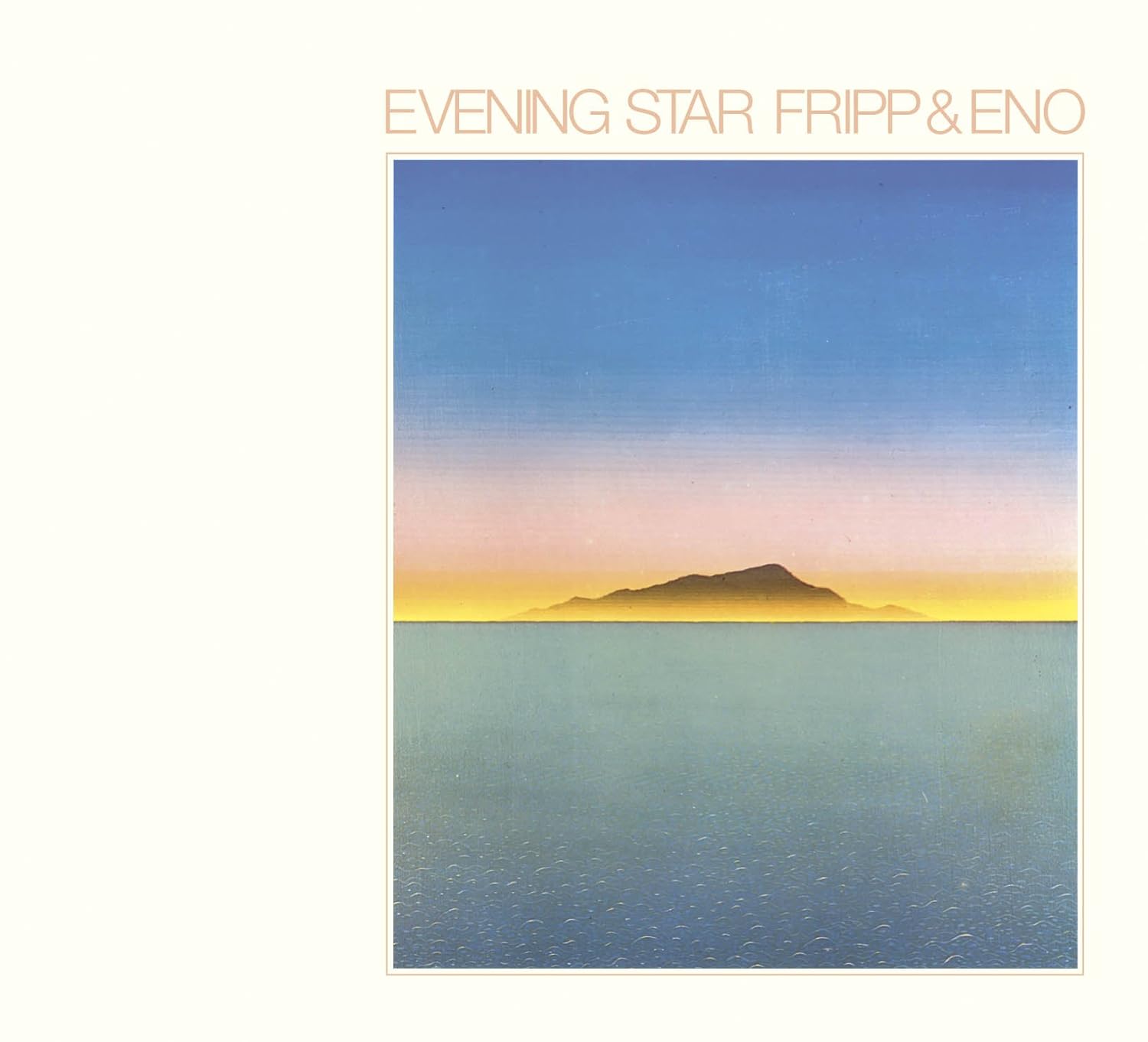
Brian Eno and Robert Fripp layered treatments and textures into the meditative metallic melodies of this cosmic collaborative quietus. While they were still in their respective bands Roxy Music and King Crimson , the pair came together to create (No Pussyfooting) in 1972 utilizing tape loops and effects to create droning atmospheric soundscapes.
Fripp reveals: "I was first introduced to the technique, the actual way of using two tape machines together by Brian Eno seven years ago this month when we recorded side one of No Pussyfooting. A purely unofficial off-the-cuff informal meeting when for the first time I visited him socially at home in London. And the story behind this is Bryan Ferry auditioned for King Crimson in December 1970, and I turned him down but I suggested he go and visit David Enthoven, the manager of King Crimson, the "E" of EG, which he did, and consequently Roxy Music went into EG, and Eno was part of that establishment. So I bumped into Eno in the office a couple of times, and he invited me round. And I went round with my guitar and pedalboard for no reason that I can recall. In fact I had no idea why then. And he said, "Well, plug in." So I did. He didn't tell me how it worked. I simply intuited what was happening, and that was side one of No Pussyfooting "
Eno elaborates: ''[When I said, 'I'm not a musician',] It was originally intended to indicate that my interest in music was in a set of ideas rather than in a set of techniques and it was intended to make a distinction between a body of opinion that saw music simply as a bundle of virtuosity and a bundle of skills which I don't think it is. Those skills are the vehicle for a set of ideas and it's the ideas that interest me. The obvious attraction of synthesizers for me was that there was no code of playing any of this new equipment and recording studio technology developed so quickly that nobody could say 'This is the right way to play a synthesizer'...There are things that you can do when you're naive that you can't do when you're not naive anymore. For example, you'll never learn to draw like a child again so you have to accept that you can't do that and you say what you'll do is just draw as you are.''
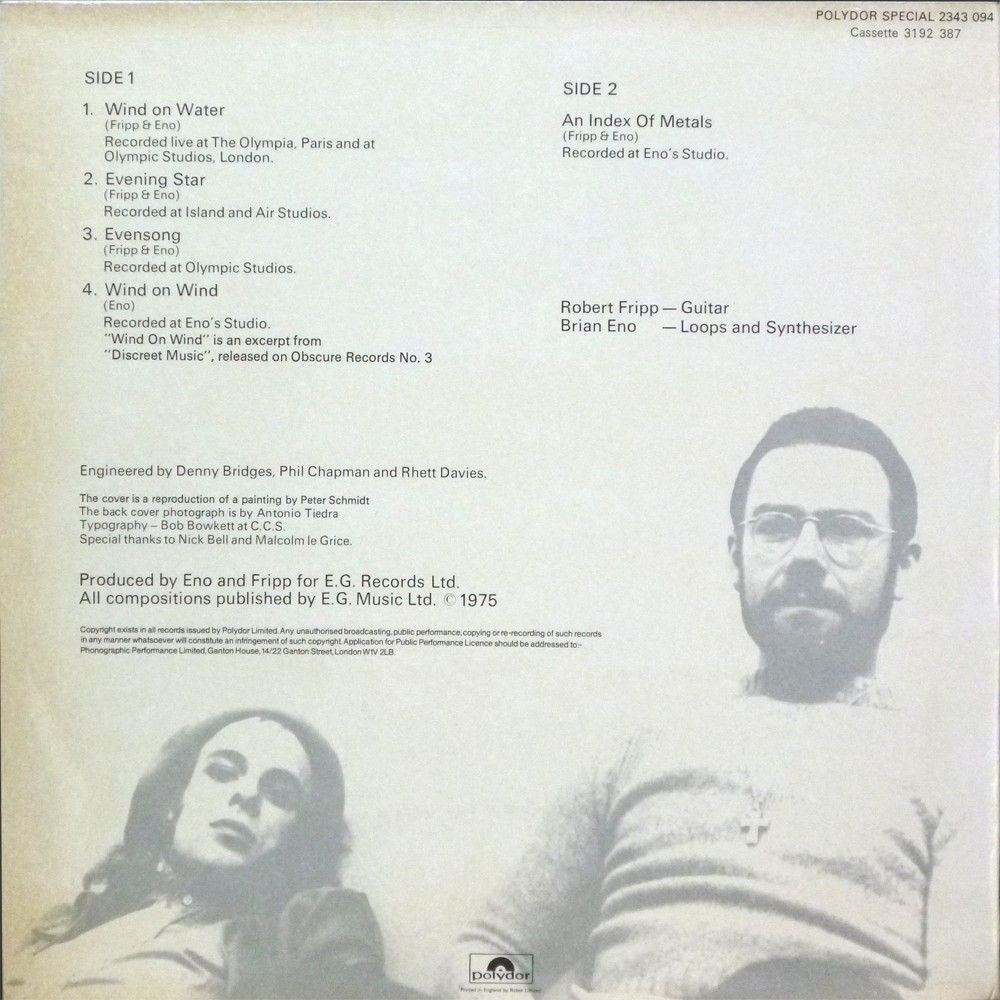
In the intervening years, Eno left Roxy Music and recorded several groundbreaking albums (Here Come the Warm Jets Taking Tiger Mountain Another Green World Discreet Music Evening Star Discreet Music . The cover painting for Evening Star was done by Peter Schmidt. Eno: ''If you had a sign above every studio door saying 'This Studio is a Musical Instrument' it would make such a different approach to recording. You see my interest for quite a while has been in using the studio not as a machine that you feed input into and have it transferred onto a piece of tape. It's a means not simply of re-creating but of actually changing a sound. Sometimes it is even a source of that sound.''
The technique of guitar effects they developed became known as 'Frippertronics'. Fripp considers: "A lot of Frippertronics is ambient within Eno's definition of the term, that it's music as ignorable as it is listenable. There are two categories of Frippertronics, pure and applied. Applied is where it's used as an alternative to traditional orchestration, instrumentation, arrangement and so on and pure Frippertronics is where Frippertronics stands up as music in it's own right. Some of this is ambient and some of it has an imperative, a demand to be heard, that one must listen to it in order to catch the sense of it. So some of it is and some of it isn't...The most exciting response is where there's no excitement. That excitement is a cheap state of the release of tension, that a qualitative experience does not involve excitement, that it involves something quite different. It involves a sense of still, a sense of calm, a sense which is tangible but quite intangible and it's very difficult to express rationally. "
Eno expounds: "The function of being an artist for me is that it's an experimental area where I can test ways of thinking and operating and hopefully apply the results to real life. The advantage of testing them in an art context is that it doesn't really matter if you fail. You can afford to take risks that you wouldn't allow yourself in normal life. Having taken those risks and seen what freedoms they allow or what restrictions they impose, you are then free to extrapolate them into normal-life situation. That's what I think is the function of culture - to teach you new way of dealing with the world... We are no longer concerned with making horizontal music, by which I mean music that starts at point A, develops through point B and ends at point C in a kind of logical or semi logical progression. What's more interesting is constructing music that is a solid block of interactions. This then leaves your brain free to make some of those interactions more important than others and to find which particular ones it wants to speak to. One thing about vertical music is that you can enter it at any point and leave it at any point. You don't have to be in at the beginning. "
http://brian-eno.net/ http://www.enoshop.co.uk/ https://www.dgmlive.com/ "Evening Star"
VIDEO Evening Star full album:
Brian Eno & Robert Fripp | Evening Star | Whole... by OssieBabb All tracks written by Brian Eno and Robert Fripp, except "Wind on Wind" by Eno.
Side one
"Wind on Water" – 5:30 "Evening Star" – 7:48 "Evensong" – 2:53 "Wind on Wind" – 2:56 Side two
"An Index of Metals" – 28:36
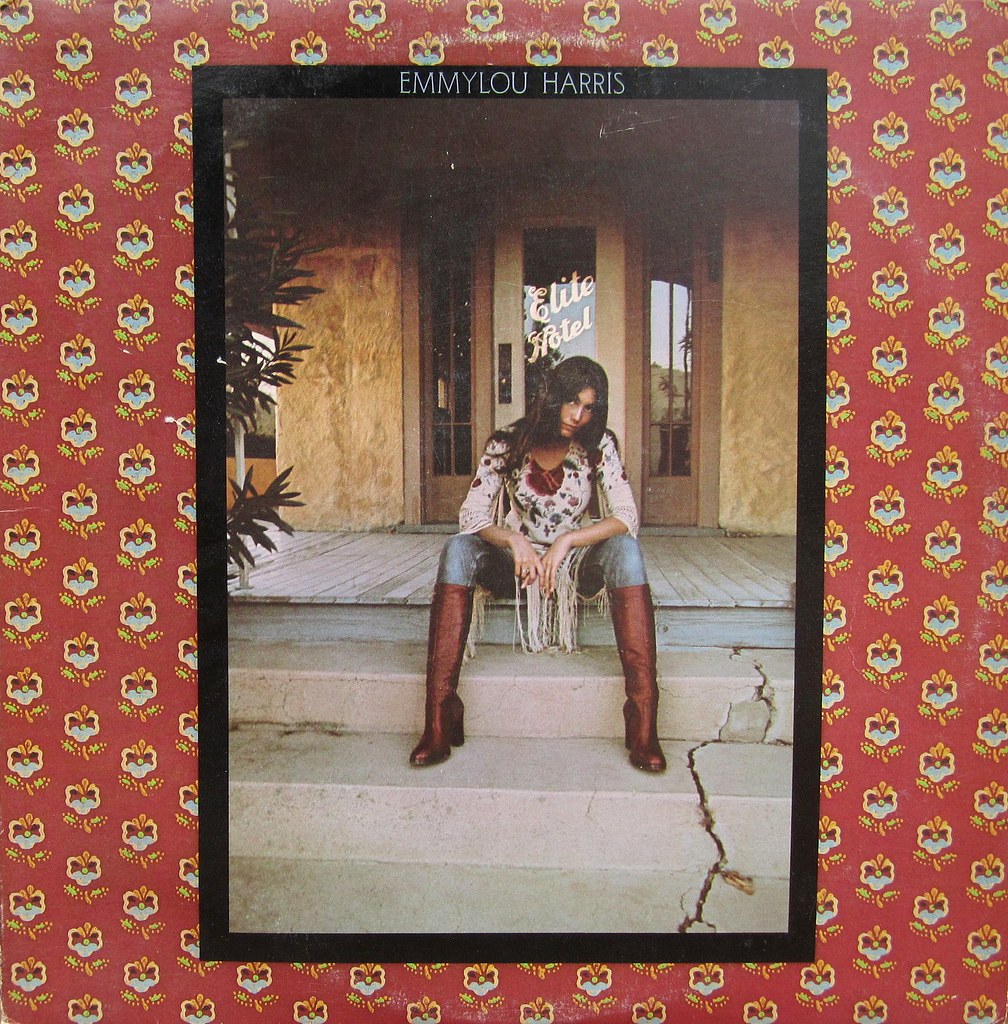
Emmylou Harris and The Hot Band were hooked in the first degree on sin and salvation and gone like the wayward wind walking the long way home just to think of an alibi. Elite Hotel came out less than a year after her acclaimed Pieces of the Sky Heart Like a Wheel and Prisoner in Disguise with Linda Ronstadt, Home Plate with Bonnie Raitt, Two Lane Highway with Pure Prairie League, All I Can Do with Dolly Parton, Desire with Bob Dylan, Mike Auldridge with Mike Auldridge, Sleepless Nights with The Flying Burrito Brothers, Starland Vocal Band with Starland Vocal Band, and Texas Cookin' with Guy Clark. Warner Brothers executives agreed to record her next album as long as she got herself "a hot band". She brought in a revolving cast of studio aces, including guitarist James Burton and pianist Glen Hardin from Elvis Presley's touring band. Elite Hotel was recorded during June with producer Brian Ahern and engineers Bradley Hartman, Rudy Hill, Stuart Taylor, and Miles Wilkinson . The Hot Band included: Brian Ahern on acoustic guitar and bass; Mike Auldridge on dobro; Byron Berline on fiddle and mandolin; Dianne Brooks on backing vocals; James Burton electric guitar; Rodney Crowell on electric guitar and backing vocals; Rick Cunha on acoustic guitar; Nick DeCaro on string arrangements; Hank DeVito on pedal steel; Jonathan Edwards on backing vocals; Amos Garrett on electric guitar; Emory Gordy, Jr. on bass and backing vocals; Glen D. Hardinon piano, electric piano, and string arrangements; Emmylou Harris vocals and acoustic guitar; Ben Keith on pedal steel; Bernie Leadon acoustic guitar and backing vocals; Bill Payne on piano; Herb Pedersen on acoustic guitar, banjo, and backing vocals; Mickey Raphael and harmonica; Linda Ronstadt on backing vocals; Fayssoux Starling on backing vocals; John Starling on acoustic guitar and backing vocals; Ron Tutt on drums; and John Ware on drums.
Harris says the album and tour with The Hot Band made her reputation; but left her $250,000 in debt: "Well, we were damn good, but [the name of the band] was slightly tongue-in-cheek. It came about because someone at the record company – and this was the early 1970s, remember – decided, 'We gotta put the chick singer together with a hot band.' ... I made it all back in record sales – so it turned out to be a smart business move. That was something else I learned from Gram, 'If you pay the best, you'll play with the best.'...R ight at the beginning, the Hot Band was just me and Rodney [Cromwell], sitting late into the night, singing harmony and strumming guitars," The eclectic mix of songs on the album set her apart from other country artists at the time: “Elite Hotel Elite Hotel became her first number one album on the country chart riding the wave of two number one country singles. Harris would admit: “I know what’s happening but it hasn’t really hit me yet...I guess it’s just been a kind of long hard road. In a way I’ve been at this for almost ten years on almost all kinds of levels – from waiting tables to playing in New York clubs and not having anybody listen to me, to making a terrible first record for a bankrupt company to working with Gram. I suppose working with Gram was the most amazing thing that ever happened to me. There was just something very magical about the experience. It was so much fun to just get up there, sing with him, and not worry about carrying a show myself. Everyone paid all this attention to me and told me how good I was and all that. It was really like being some kind of fairytale princess. Somehow that affected me more than all this that’s happening now...Maybe I’m on time delay.” http://www.emmylouharris.com/ lyrics: http://genius.com/albums/Emmylou-harris/Elite-hotel "Together Again" VIDEO
"Sweet Dreams" VIDEO
"One of These Days"
VIDEO
Elite Hotel full album:
VIDEO "Amarillo" (Emmylou Harris, Rodney Crowell) – 3:05
"Together Again" (Buck Owens) – 3:56
"Feelin' Single, Seein' Double" (Wayne Kemp) – 2:34
"Sin City" (Gram Parsons, Chris Hillman) – 3:57
"One of These Days" (Earl Montgomery) – 3:03
"Till I Gain Control Again" (Rodney Crowell) – 5:40
"Here, There and Everywhere" (John Lennon, Paul McCartney) – 3:59
"Ooh Las Vegas" (Gram Parsons, Ric Grech) – 3:47
"Sweet Dreams" (Don Gibson) – 4:03
"Jambalaya (On The Bayou)" (Hank Williams) – 3:05
"Satan's Jewel Crown" (Edgar L. Eden) – 3:13
"Wheels" [with Jonathan Edwards] (Chris Hillman, Gram Parsons) – 3:13
bonus tracks:
"You're Running Wild" [with Rodney Crowell] (Ray Edenton, Don Winters) – 1:44
"Cajun Born" [with Jo-El Sonnier] (Jo-El Sonnier, Kermit Goell) – 3:19
VIDEO VIDEO
Tangerine Dream crossed into a new paradigm with the threefold divergences of studio sophistication, improvisational expressiveness, and cinematic soundscapes. After four albums (Electronic Meditation Alpha Centauri Zeit Atem Phaedra
Edgar Froese: "When the band walked into the Manor for the second time, we were weighed down by the success of 'Phaedra' 'Rubycon' 'Phaedra' 'Phaedra' 'Phaedra' ...I had orchestral instruments recorded by the BBC for my mellotron, at the time a very luxurious thing to do. One can hear an oboe on 'Rubycon Part 2' as well as numerous string sections and horns. The biggest problem, however, was the inconstant power supply at the Manor. At the time there were electrical problems throughout the Oxford region and sometimes the power was cut off for two to three hours at a time. We had to interrupt recording sessions when this happened or conect our synths to electrical generators. Chris's Moog often played completely random sequences because of the unstable electrical current driving the oscillators. It was a crazy situation. When we finished recording there were twelve hours of music from which to mix the final master."
Rubycon full album:
VIDEO "Rubycon, Part One" – 17:18
"Rubycon, Part Two" – 17:35
4th October 1975, Coventry Cathedral VIDEO VIDEO
Their first live album 'Ricochet' "The concerts were much too long to use in one context. We had to edit about forty or fifty hours of music, kilometres of tape to find the most important parts, the most typical things of us. We were very satisfied with the results ...Ricochet Ricochet Ricochet
Ricochet full album:
VIDEO 1. "Ricochet, Part One" 17:02
2. "Ricochet, Part Two" 21:13
Much of "Ricochet, Part Two" was taken from this show:
October 23, 1975 Fairfield Halls (Croydon) VIDEO 00:00 - Part One (20.31)
20:35 - Part Two (30.15)
50:50 - Part Three (10.54)
At the end of the year, they also began working on their first movie soundtrack, marking the beginning of one of their primary creative outlets.
Froese recalls: "Sorcerer
"William Friedkin had heard our music in Los Angeles. He rang up and said he liked it, that it was innovative and new, and that he'd like to do a film with it. He was interested in having the music playing for the actors on set. We felt very independent -- it was just us in a room in Berlin, with an 8-track and the script". Sorcerer full album
VIDEO All songs written and composed by Edgar Froese, Christopher Franke, Peter Baumann.
1. "Main Title" 5:28
2. "Search" 2:54
3. "The Call" 1:57
4. "Creation" 5:00
5. "Vengeance" 5:32
6. "The Journey" 2:00
7. "Grind" 3:01
8. "Rain Forest" 2:30
9. "Abyss" 7:04
10. "The Mountain Road" 1:53
11. "Impressions Of Sorcerer" 2:55
12. "Betrayal (Sorcerer Theme)" 3:38
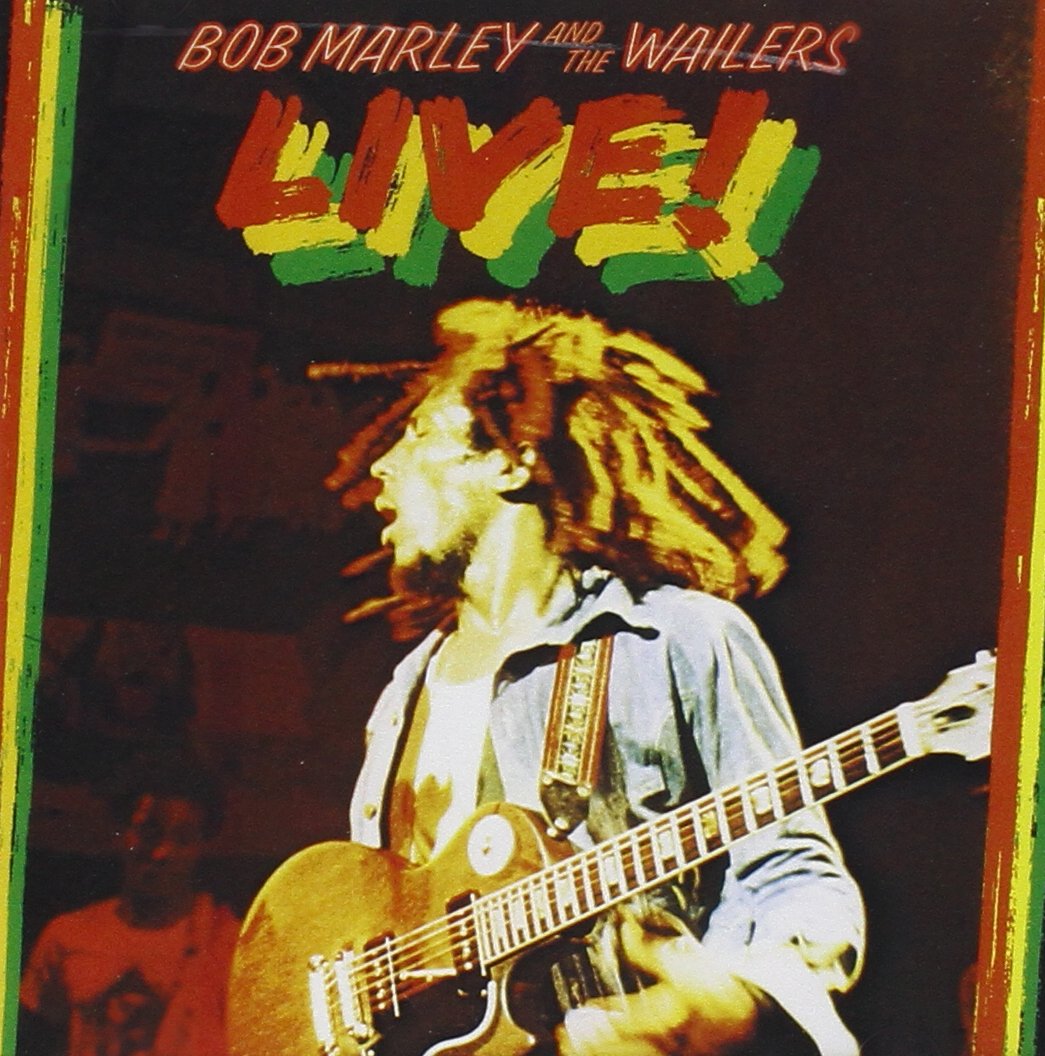
Bob Marley and The Wailers had their breakthrough success with the positive vibration of this incandescent reggae incantation. After a decade together and five albums (The Wailing Wailers Soul Rebels Soul Revolution Catch a Fire Burnin'
Bob Marley assembled a new lineup for the recording of Natty Dread "[The music is tighter now; but] I don't think it because [Tosh and Wailer] leave. I feel it mostly because the type of vibration we had in the studio. We did have a good vibration...You not supposed to feel down over whatever happen to you. I mean, you're supposed to use whatever happen to you as some type of upper, not a downer. Say if a brother say he don't wanna play no more music, then you have a little time to work out what is to be, what must be...I don't see reggae music as like the twist, I see reggae music as music. When people say reggae them expect a type of music. As far as me is concerned, I never give it a name. Just play music. Once you put it in a bag and call it reggae and then mebbe you listen with your ear and think you hear a single thing. Because music wide, music go everywhere...That's why people expect reggae to be a one type of thing but it's not that. This music, man, is not music of a day. It have to be real...Babylon is everywhere. You have wrong and you have right. Wrong is what we call Babylon, wrong things. That is what Babylon is to me. I could have born in England, I could have born in America, it make no difference where me born, because there is Babylon everywhere...What important is man should live in righteousness, in natural love for mankind...Prejudice is a chain, it can hold you. If you prejudice, you can't move, you keep prejudice for years. Never get nowhere with that...I wish things could change without hurt and righteousness reign for ever, let righteousness cover the earth like the water cover the sea."
'Live!' 'Live!' went to number ninety on the US pop album chart, forty-seven on the US R&B album chart, thirty-eight in the UK, and twenty-nine in Sweden. Marley would consider: "People who listen to the music and don't listen to the words soon start listening to the words. Let them hear the music first. But as long as you want to listen, you might hear the words, mebbe not unnerstand everything. Like if I write a song, Them Belly Full But We Hungry, can you understand that?...That's a patois. It's not straight English you can write. Sometimes we sing in patois ... I don't care what people do with the music. Every time I play I get that fresh inspiration. It fresh, and no-one can hear a song that you write until it out on a record. So people can capitalise upon reggae as much as they want. People have all sorts of music they can play. We can play different music from the kind of music that we play now...Different, just different, so if somebody try and catch up with we, we can leave and change again. Because that's what we been doing over the years. Every time that we make some music, they catch up with we, so we change, just like ska, rock steady, reggae. If them come too much and call it reggae, we go to nyahbingi music, the first music...It mean 'Death to black and white oppressors'. But that type of music it come from the heart." He beat his chest with a fluttering palm. "Just like that. Every time you hear the drums you hear it, sometime soft, sometime frightening, you get to know it. Like when I first hear rasta drumming, I think it something terrible going to do with me, because it's something that we no understand. And yet it's so near to me. And then we get to understand it and everything become natural again."
http://www.bobmarley.com/ "No Woman, No Cry" charted at number thirty in New Zealand, twenty-three in the Netherlands, and twenty in the UK. The song re-entered the British charts in 1980 after Marley's death and went to number eight. Marley gave songwriter credit to his friend Vincent Ford to help maintain the soup kitchen Ford ran in Trenchtown, the ghetto of Kingston, Jamaica where Marley grew up.VIDEO VIDEO 'Live!' full album:
VIDEO Side one
1. "Trenchtown Rock" Bob Marley 4:23 2. "Burnin' and Lootin'" Bob Marley 5:11 3. "Them Belly Full (But We Hungry)" Leon Cogill, Carlton Barrett 4:36 4. "Lively Up Yourself" Bob Marley 4:33 Side two
5. "No Woman, No Cry" Vincent Ford 7:07 6. "I Shot the Sheriff" Bob Marley 5:18 7. "Get Up, Stand Up" Bob Marley, Peter Tosh 6:28 bonus track
8. "Kinky Reggae" (originally the B-side of "No Woman, No Cry") Bob Marley 7:35 full show July 18, 1975
Setlist
Burnin' and Lootin'
No Woman, No Cry
Kinky Reggae
Stir It Up
Lively Up Yourself
I Shot the Sheriff
Get Up, Stand Up
Trenchtown Rock
Live at the Boarding House, San Francisco July 7, 1975
VIDEO Setlist:
Trenchtown Rock
Burnin' And Lootin'
Midnight Ravers
Them Belly Full (But We Hungry)
Rebel Music (3 O'Clock Roadblock)
No Woman, No Cry
Kinky Reggae
Stir It Up
Lively Up Yourself
Get Up, Stand Up
New York, NY June 15 1975
VIDEO part one
01: Trench Town Rock
02: Slave Driver
03: Burnin' And Lootin'
04: Concrete Jungle
05: Kinky Reggae
06: Midnight Raver
07: Lively Up Yourself
08: No Woman No Cry
09: Rebel Music
part two
01: Them Belly Full
02: Natty Dread
03: I Shot The Sheriff
04: Nice Time
encore:
05: Talkin' Blues
06: Bend Down Low
07: So Jah Seh
08: Get Up Stand Up