Showing posts with label art rock. Show all posts

Friday, January 8, 2016

★ (blackstar)


David Bowie chases danger and drama in the restless intensity of this dark jazz inversion.  Nearly a decade after 'Reality', the iconic chameleon of rock had surprised everyone when he released 'The Next Day' in early 2013.  He never gave any interviews, but submitted a "work flow diagram" around that time.  The slinky vagabond had gone underground after undergoing emergency heart surgery in 2004.  His only live appearances since then have been at Fashion Rocks (performing solo and with Arcade Fire) in 2005 and with Alicia Keys at the Black Ball in 2006.  That same year, he did an hilarious cameo on the show Extras with Ricky Gervais.


The Next Day was recorded with his longtime producer and collaborator Tony Visconti.  They cut some demos for a new album in early 2014 and Bowie went to his home to work on the material for several months.  When he was ready, they called in the members of an experimental jazz quartet that Bowie had seen earlier that year.  The sessions included Saxophonist Donny McCaslin on saxophone, Ben Monder on guitar, Mark Guiliana on drums, Tim Lefebvre on bass, Jason Lindner on keyboard, and James Murphy on percussion.  


Visconti says in MOJO:   “David on purpose used Donny so that [it would sound different].  If we’d used David’s former musicians they would be rock people playing jazz. Having jazz guys play rock music turns it upside down. Their approach to the music was so refreshing, I looked forward to every day in the studio. Nothing was done recalling the past.”


the band at 55 Bar in New York City where Bowie first saw them in the Spring of 2014.  


Visconti reveals in Rolling Stone:  "We were listening to a lot of Kendrick Lamar.  We wound up with nothing like that, but we loved the fact Kendrick was so open-minded and he didn't do a straight-up hip-hop record. He threw everything on there, and that's exactly what we wanted to do. The goal, in many, many ways, was to avoid rock & roll...When he put out albums like Heroes and Low, no one was doing anything like that.  And then he gave birth to the New Romantic scene. He's a genre-breaker, and I can't wait for the ★ imitation albums to start coming out."


http://www.davidbowie.com/


"Blackstar"
The terrifying video directed by Johan Renck for the ten minute title track harkens back to other epic album openers from Station to Station  and  The Man Who Sold the World  and evokes imagry of Major Tom and Aleister Crowley.  The sonic undercurrent of his work from the Berlin Trilogy (Low, "Heroes", and Lodger) flavored with the kind of heavily syncopated drum rhythm he experimented with on Earthling.  Maybe that creepy dance will catch on.  


In the villa of Ormen, in the villa of Ormen
Stands a solitary candle, ah-ah, ah-ah
In the center of it all, in the center of it all
Your eyes
​
On the day of execution, on the day of execution
Only women kneel and smile, ah-ah, ah-ah
At the center of it all, at the center of it all
Your eyes, your eyes
​
Ah-ah-ah
Ah-ah-ah
​
In the villa of Ormen, in the villa of Ormen
Stands a solitary candle, ah-ah, ah-ah
In the center of it all, in the center of it all
Your eyes
Ah-ah-ah
​
Something happened on the day he died
Spirit rose a meter and stepped aside
Somebody else took his place, and bravely cried
(I’m a blackstar, I’m a blackstar)
​
How many times does an angel fall?
How many people lie instead of talking tall?
He trod on sacred ground, he cried loud into the crowd
(I’m a blackstar, I’m a blackstar, I’m not a gangster)
​
I can’t answer why (I’m a blackstar)
Just go with me (I’m not a filmstar)
I’m-a take you home (I’m a blackstar)
Take your passport and shoes (I’m not a popstar)
And your sedatives, boo (I’m a blackstar)
You’re a flash in the pan (I’m not a marvel star)
I’m the great I am (I’m a blackstar)
​
I’m a blackstar, way up, oh honey, I’ve got game
I see right so white, so open-heart it’s pain
I want eagles in my daydreams, diamonds in my eyes
(I’m a blackstar, I’m a blackstar)
​
Something happened on the day he died
Spirit rose a meter and stepped aside
Somebody else took his place, and bravely cried
(I’m a blackstar, I’m a star star, I’m a blackstar)
​
I can’t answer why (I’m not a gangster)
But I can tell you how (I’m not a flam star)
We were born upside-down (I’m a star star)
Born the wrong way ‘round (I’m not a white star)
(I’m a blackstar, I’m not a gangster
I’m a blackstar, I’m a blackstar
I’m not a pornstar, I’m not a wandering star
I’m a blackstar, I’m a blackstar)
​
In the villa of Ormen stands a solitary candle
Ah-ah, ah-ah
At the center of it all, your eyes
On the day of execution, only women kneel and smile
Ah-ah, ah-ah
At the center of it all, your eyes, your eyes
Ah-ah-ah


"Lazarus"  is cut from the same cloth as Black Tie White Noise.


Look up here, I'm in heaven I've got scars that can't be seen
I've got drama, can't be stolen
Everybody knows me now

Look up here, man, I'm in danger
I've got nothing left to lose
I'm so high it makes my brain whirl
Dropped my cell phone down below
Ain't that just like me?

By the time I got to New York
I was living like a king
Then I used up all my money
I was looking for your ass
This way or no way
You know, I'll be free
Just like that bluebird
Now ain't that just like me?
Oh I'll be free
Just like that bluebird
Oh I'll be free
Ain't that just like me?


★ (Blackstar)
full album


1."Blackstar"
2."'Tis a Pity She Was a Whore"
3."Lazarus"
4."Sue (Or in a Season of Crime)"
5."Girl Loves Me"
6."Dollar Days"
7."I Can't Give Everything Away"


Wednesday, December 16, 2015

rubycon / ricochet / sorcerer


Tangerine Dream crossed into a new paradigm with the threefold divergences of studio sophistication, improvisational expressiveness, and cinematic soundscapes.   After four albums (Electronic Meditation  in 1970,  Alpha Centauri in 1971,  Zeit  in 1972,  and Atem in 1973) on the German Ohr label, the trio found a larger audience  in 1974 with Phaedra their first album on the British Virgin Records.  They returned to The Manor Studio in the village of Shipton-on-Cherwell in Oxfordshire, England, north of the city of Oxford  with  Edgar Froese on guitar, bass, organ, Mellotron, piano, percussive objects, gong, Moog, synthesizer, string ensemble, sequencer, electronics, computer, drum programming, drums, harmonica, vocals, and accordion;  Peter Baumann on synthesizer, organ, electric piano, and vibraphone;  and  Jerome Froese on guitar, keyboards, drums, and percussion.  


Edgar Froese:   "When the band walked into the Manor for the second time, we were weighed down by the success of 'Phaedra'. There was a pressure to 'do it again' but one has to point out that Simon Draper and Richard Branson at Virgin did not pressure us to be commercial. The attitude was that Tangerine Dream could do whatever they wanted on record, which was a very unusual practice for a record company. The recording of 'Rubycon' was a very floating process. Unlike the 'Phaedra' production there was never a break in the creative flow. The band had been on tour for most of the previous year and was now hot to spend a month working on new music. Because of the commercial success of 'Phaedra' the sequencers could now be technically better equipped. At that time this branch of technology was fairly unknown and any technical alterations had to be custom-built. This was a very extensive undertaking and most of our 'Phaedra' earnings went into new equipment...I had orchestral instruments recorded by the BBC for my mellotron, at the time a very luxurious thing to do. One can hear an oboe on 'Rubycon Part 2' as well as numerous string sections and horns. The biggest problem, however, was the inconstant power supply at the Manor. At the time there were electrical problems throughout the Oxford region and sometimes the power was cut off for two to three hours at a time. We had to interrupt recording sessions when this happened or conect our synths to electrical generators. Chris's Moog often played completely random sequences because of the unstable electrical current driving the oscillators. It was a crazy situation. When we finished recording there were twelve hours of music from which to mix the final master."


Rubycon
full album:


"Rubycon, Part One" – 17:18
"Rubycon, Part Two" – 17:35


4th October 1975, Coventry Cathedral


Their first live album 'Ricochet' was culled together from a series of concerts in France and the UK with additional recording done in the studio.  Chris Franke:   "The concerts were much too long to use in one context. We had to edit about forty or fifty hours of music, kilometres of tape to find the most important parts, the most typical things of us. We were very satisfied with the results...Ricochet is probably my favourite, because it proved that when we create live music, it is always different. When we create in the studio we pursue particular directions and we experiment, and it becomes more polished, but somehow the live work remains more classic. Ricochet still says something to me...Ricochet was the first album we really had a concept on. We had sixteen tracks, so it was the first album where we really got in touch with overdub technology -- it was much more formed".


Ricochet

full album:


1. "Ricochet, Part One"   17:02
2. "Ricochet, Part Two"   21:13


Much of "Ricochet, Part Two" was taken from this show:  

October 23, 1975
Fairfield Halls (Croydon)


00:00 - Part One (20.31)
20:35 - Part Two (30.15)
50:50 - Part Three (10.54)


At the end of the year, they also began working on their first movie soundtrack, marking the beginning of one of their primary creative outlets.  

Froese recalls: "Sorcerer was recorded on an old 8-track Ampex in Berlin. It was one of the four machines that were in Abbey Road Studios in London, and which were sold after the Beatles era. We had rented an old movie theatre in Berlin, and made a small studio out of it. The Moog was very useful, and by this stage we were quite versed in its use. We also used a Fender Rhodes piano, guitars, and even Revox tape machines as delay units".

Franke: "William Friedkin had heard our music in Los Angeles. He rang up and said he liked it, that it was innovative and new, and that he'd like to do a film with it. He was interested in having the music playing for the actors on set. We felt very independent -- it was just us in a room in Berlin, with an 8-track and the script".


Sorcerer
full album


All songs written and composed by Edgar Froese, Christopher Franke, Peter Baumann.

1. "Main Title"   5:28
2. "Search"   2:54
3. "The Call"   1:57
4. "Creation"   5:00
5. "Vengeance"   5:32
6. "The Journey"   2:00
7. "Grind"   3:01
8. "Rain Forest"   2:30
9. "Abyss"   7:04
10. "The Mountain Road"   1:53
11. "Impressions Of Sorcerer"   2:55
12. "Betrayal (Sorcerer Theme)"   3:38


Friday, December 11, 2015

lizard


King Crimson punctured all the ballyhoo and scarred the sacred tablet of wax with the upholstered visions of megaphonium pandemonium.   With the widespread acclaim afforded their groundbreaking debut 'In the Court of the Crimson King', the band embarked on a tour that ended in December of 1969.  It was at this point that Ian McDonald and Michael Giles decided to leave the group (releasing the 'McDonald and Giles' album together in 1970).  Robert Fripp reveals:   “The band died in December of that year, while we were staying in Los Angeles. With all the pressure finally off, the group ran around the room in glee. I couldn’t do the same. I had realized that King Crimson was too important to let die. That particular band was especially good, perhaps because we shared an intense frustration and animosity towards the world in general and ourselves in particular. We were very creative, most definitely because pain and frustration lends itself to such a fruitful artistic state.”

The sessions for their second album, 'In the Wake of Poseidon', brought back Michael Giles (returning only as a session drummer) with his brother Peter on bass.  Keith Tippett joined the proceedings on keyboards; while Greg Lake (who went on to form Emerson, Lake & Palmer) stuck around to do most of the vocals on the sessions; while Fripp invited former bandmate from The League of Gentlemen Gordon Haskell to sing on one song.  Mel Collins sat in on two tracks (one with sax and one with flute) as well.

Haskell and Collins became full fleged band members for the third album 'Lizard'.   As a parting gesture, Lake had introduced drummer Andy McCulloch (a tenant of Keith Emerson's) to the group. Tippett was offered membership in the band; but preferred to remain a session contributor, bringing in Nick Evans and Marc Charig.


Haskell remembers:   "[When Fripp asked me to join the band] I straight away, without any hesitation, said 'absolutely not'. I was totally r&b oriented and it wasn't my sort of music. I didn't like King Crimson. Anyway, after a while I said I'd think about it, and my wife got to work on me because she wanted a regular income so in the end I joined. I did some vocals on 'In The Wake of Poseidon', and then we got down to rehearsing 'Lizards' and.... the drummer, Andy McCulloch, was in tears - Fripp used to bully him unmercifully. He bullied us all. I don't go for that though, so where Andy would cry I would just laugh. At the end of one song, 'Indoor Games', I just burst out laughing. You can hear it on the album. They thought it was really freaky, that I'd understood the lyrics and my part - but the truth of the matter is, it was a lousy song, the lyrics were ludicrous and my singing was atrocious so I just burst out laughing. And they thought it was wonderful!"


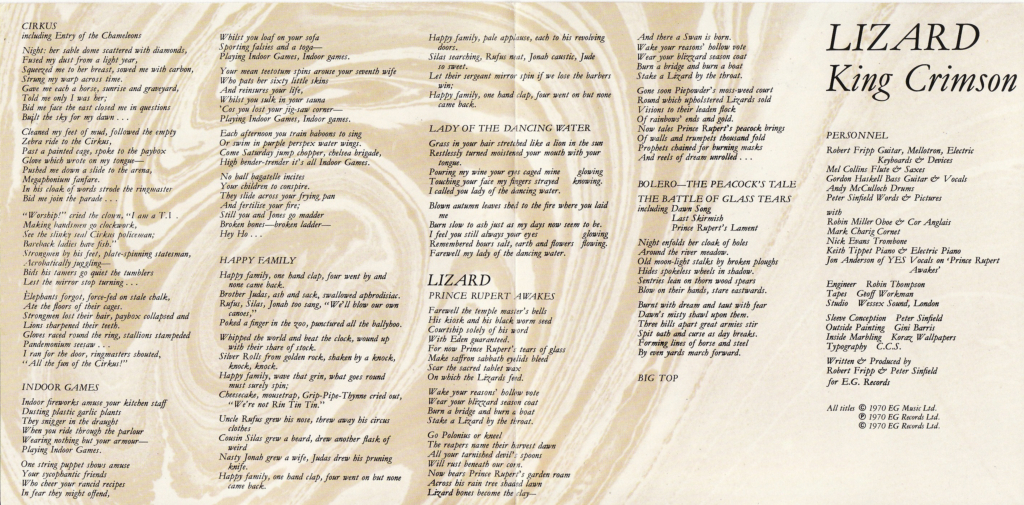
'Lizard' featured  Robert Fripp on guitar, Mellotron, synthesizer, organ, devices, and remixing;    Peter Sinfield on lyrics, VCS3, pictures, and sleeve conception;   Mel Collins on saxophone and flute;    Gordon Haskell on bass guitar and vocals;   and  Andy McCulloch on drums;    with    Keith Tippett on acoustic and electric pianos;   Robin Miller on oboe and cor anglais;   Mark Charig on cornet;   and Nick Evans on trombone.    Jon Anderson did a guest appearance on vocals for "Prince Rupert Awakes".   The lineup dissolved before there could be a tour.  Haskell and McCulloch made their exit, leaving behind the official trio of Fripp, Sinfield, and Collins.    'Lizard' charted at number one hundred and eighteen in the US, sixty in Canada, and twenty-nine in the UK.  


Mel Collins looks back:   "We would go and see King Crimson on a Sunday and they would come and see us on a Wednesday and that's how I first got to meet Robert Fripp. He obviously liked what I was doing in Circus - after Philip left I was pretty much the leader of the band, anyway - and Crimson had been having a troubled time on tour in America, Mike Giles and Ian MacDonald had left the band, girlfriend problems, or whatever, and when they came back from the States they were minus a drummer and a sax player. Fripp came down to see us one night and asked me if I would be interested in joining. So that was the beginning of my leaving Circus to join King Crimson.   Originally it was just on a session basis, during the recording of the 'Wake Of Poseidon' LP, but when I joined the band permanently it was with the specific purpose of getting the band out on the road. Greg Lake was still involved at the time that I joined, but he quit to form Emerson, Lake & Palmer while Crimson were still looking for their new drummer. So for a while, Crimson was just Robert, myself and Pete Sinfield, trying to get the band together. It took a year in fact, before we got the personnel together who recorded the album 'Lizard', which was the addition of Gordon Haskall on bass and Andy McCulloch on drums. Once the album was finished, this was going to be the band that went out on the road, but on the first day of rehearsals Gordon Haskall decided that he couldn't work with Robert anymore. Gordon and Robert had actually been at school together, but they'd had such a hard time in the studio - Fripp isn't always the easiest of people to work with - but the first day of rehearsing the tour and Gordon turns round and tells us he's leaving!" 

Fripp confesses:   I’m a very difficult person to work with, because in King Crimson there was a founding statement to be honoured, going back to ’69. And if what is available fails to meet what I see as a responsibility to the larger Crimson, then that gap has to be met by someone. And it would fall to me. So it’s not a comfortable place...The reason King Crimson had had so many members over the past few years is simple instability. You might take that to infer that I’m unstable, but most people would disagree with you… myself included...I am very fascinated in a way musicians work together as a unit. You see, I view King Crimson as the microcosm of the macrocosm. If one can’t operate successfully with three other musicians, it stands to reason that one would find it difficult to work well in a larger unit...I form bands, but I’m not a leader. There are far more subtle ways of influencing people and getting things done than being a band leader, it’s not a function I cherish. Who needs it?...Within the corpus of Crimson albums, Lizard is, historically, one of the least popular...Nevertheless, some strange characters in the listening community liked, even developed a passion for Lizard...Perhaps the leading very- strange-Lizard-lover is [reissue producer] Steven Wilson...And, from time to time, in different places, I have met others who admit to the same strange passion. Now I can hear why. The music of Lizard is redeemed."


 Sinfield says:   "I've been criticized; but a lot of it's quite valid, anyway.  I do play games, endlessly, just for my own amusement.  But I get annoyed about being called pretentious, because as far as can be worked out, and I checked in the dictionary, it means pretending to be something you're not.  Now, if you're in the rock and roll business, and you're making money, I see absolutely no reason why you shouldn't make a comment on the world."


https://www.dgmlive.com/


http://www.songsouponsea.com/


"Prince Rupert Awakes" /  "Bolero – The Peacock's Tale"


"Cirkus" (including "Entry of the Chameleons")


'Lizard'
full album:


All songs written by Robert Fripp and Peter Sinfield.

side one
1. Cirkus (including Entry Of The Chameleons) (6:28)
2. Indoor Games (5:41)
3. Happy Family (4:16)
4. Lady Of The Dancing Water (2:44)
side two
5. Lizard:
- a. Prince Rupert Awakes (4:36)
- b. Bolero - The Peacock's Tale (6:39)
- c. The Battle Of The Glass Tears (10:58)
- i) Dawn Song
- ii) Last Skirmish
- iii) Prince Rupert's Lament
- d. Big Top (1:13)

Total Time: 42:35


Sunday, December 6, 2015

emerson, lake & palmer


Emerson, Lake & Palmer found a lucky break in the shared vision of these expansive experimental extemporizations of classical themes and psychedelic rock.   The progressive power trio was started by Keith Emerson and Greg Lake, who were both unsatisfied with their work with King Crimson and The Nice, respectively.  

Lake:   "The Nice had been playing on the same bill as King Crimson, and I met Keith in the bar after the show. We just started chatting, and he said, 'How is it going with King Crimson?' and I said, 'To honest Keith, it’s not, it’s over really.' And he said, 'That’s incredible because I’m just finishing with the Nice. I can’t see taking it any further. That’s as much as I can do with it, so I’m really looking to move on. Maybe we should think about starting a band together.' And that’s how it started ... We drew more off our European roots and that’s really what made us sound different. I think Keith and I had that clear, right from the word go...We knew from the very beginning we would be better off being a three-piece."


Emerson:   "We tried Mitch Mitchell and a bunch of other guys, sort of like an open audition. And we had almost given up, but then an old friend of mine, Tony Stratten-Smith, who was the Nice’s manager, suggested Carl Palmer. He was our last hope, really, before we looked to America for a drummer. So Carl arrived and set up his drums, and we played a blues shuffle. And it was great. But then he said, 'Well, I don’t know if I can really join you, because I’ve got commitments with Atomic Rooster.'  So there was all this talk going on by telephone, with Greg and myself trying to encourage Carl to join."


Palmer:    "At the particular time, I had a very strong group (Atomic Rooster), which musically was where exactly I wanted to be. My only apprehension in leaving Atomic Rooster is that, you have to understand, it was kind of my band, I started the group. We had Robert Stigwood as the manager. The whole deal with ELP was slightly up in the air. I didn’t want to be in any other format except a trio. And it if it was going to be a trio, then I was very, very happy. There was talk of guitar at the beginning of ELP, and I wasn’t that keen on it. I’ve only been in one successful band that wasn’t a trio and that was Asia. So that was the apprehension on my part at the very beginning. But then I played with both of them. I enjoyed the music and I still do. So I thought maybe I’d give it a try. I had an agreement with the Atomic Rooster that I would disappear for a while and give this a shot and if it worked, it worked; and if it didn’t, it didn’t."


Their eponymous debut album was recorded at Advision Studios in London with Greg Lake producing with engineer Eddie Offord.  The sessions were directed and arranged by Emerson, Lake & Palmer with  Keith Emerson on Hammond organ, piano, clavinet, pipe organ, and Moog modular synthesizer;  Greg Lake on vocals, bass guitar, as well as acoustic and electric guitars;   and  Carl Palmer on drums and percussion.   'Emerson, Lake & Palmer'  went to number eighteen in the US and number four in the UK.  

Emerson:   "There were no quarters given. ELP was out on a limb. I'd wanted to create a three-piece band with the biggest sound possible, a kind of three-man electric orchestra. We had an ambitious repertoire of rocked-up classics based on Bach, Bartok, Janacek, Mussorgsky and Ginastera intercut with blues, boogie, rock'n'roll, and we'd experiment, extemporise anywhere in between. We'd play this multi-layered stuff - complex time-changes and a lot of stage theatrics, like me spinning into space while playing the piano - without anyone working tapes or pulling strings behind the scenes. We were a live band. We could play anything we recorded. I've never liked being stuck in studios."

Lake:   "It was strange! But I think it was one of things that people liked about ELP, really, the dynamic of it: one moment, the band would be very intense and screaming, and loud and powerful, and the next minute it would be beautiful and gentle, and soulful and emotional...A singer has a different way of emotionally connecting… When you play an instrument, you are passing your feelings through it; when you sing, it is really a direct connection. I mean your voice is an instrument but in reality, your feeling is being expressed directly. And I think that in that way it’s easier to be more emotional to express feelings better, but Keith used to play some very beautiful things on piano, and sometimes I would do a very intense things."

Palmer:   "The shows we did then were overblown, but when you consider what’s being done today, all we did at the time was set an industry standard and hope people would improve on it. Unfortunately for the naïve people who are in the music business, they thought it was overblown and it was too big. But compared to what’s happening today, we did absolutely nothing but set a standard...Yes, we were pompous — we’re English! You have to be pompous. We came from Great Britain. We weren’t a blues band. We weren’t a rock band. We played classical adaptations similar to what I do now. We played folk tunes, we were quite eclectic. We dealt with technology, we didn’t have a guitar player, and we never played 12-bar. Sure, we were pomp because that’s where we come from. We’re not from the South, we’re not from the Mississippi — we’re English! (laughs)"


http://emersonlakepalmer.com/


"Lucky Man" became a hit for the band in the US.  It had been written by Lake when he was twelve years old.     

Lake:    "To be honest with you, Keith couldn’t really find a part to play on the song – so, he went down to the pub. I made the record, basically. When he got back, it was pretty much finished and he said: ‘Wow.’ What he’d heard when he left was just me singing this plaintive little folk song. When he came back, what he was hearing was five-part harmony, triple-tracked acoustic guitars and all the rest of it – and he was quite shocked. He said: ‘I better play on it.’ It just so happened that on that very day, we had the Moog synthesizer delivered. So I said: ‘Why don’t you try out the new Moog on it?’ Of course, Keith said: ‘I haven’t had the chance to experiment with it yet; I’m going to need some time.’ I said: ‘Give it a go anyway.’ He went out there and started experimenting with the pormento – you know, how long it takes to go from one note and then to slide up to the other note. What the recording is, is him experimenting with the pormento. He experimented with it, and it just so happened – just like in the case with Gary Moore – I had the good sense to push the red button to record him. In those days, we used to run out of tracks, and we had no more tracks to record on to. Keith wanted to do another take. But I said: ‘No, we have to keep the take.’ We almost fell out over it. In the end, I said: ‘Please, Keith come in and listen to what we’ve recorded before we erase it – because if we erase it, it’s gone forever.’ And he came in, and he heard it. Well what would you say? You’d have to be deaf not to hear how good it is, right? So, it was a kind of perfect – because he hadn’t preconceived it. It had just come out of the end of his fingers, literally. I think that was the key to why it’s so popular. There was total fluidity. There’s not a moment where he stops to think. It’s free playing. If he hit a wrong note, he couldn’t give a shit. And right until the end, fantastic. There you are: That’s what art is all about. Sometimes, actually, you do get lucky. (Laughs.)"


He had white horses
And ladies by the score
All dressed in satin
And waiting by the door

Oooh, what a lucky man he was

White lace and feathers
They made up his bed
A gold covered mattress
On which he was laid

Oooh, what a lucky man he was

He went to fight wars
For his country and his king
Of his honor and his glory
The people would sing

Oooh, what a lucky man he was

A bullet had found him
His blood ran as he cried
No money could save him
So he laid down and he died

Oooh, what a lucky man he was


"Take A Pebble" 
live in Switzerland, 1970


"Knife-Edge"
live in Switzerland, 1970


'Emerson, Lake & Palmer' 
full album:


Side one
00:00 "The Barbarian"   (instrumental) Béla Bartók, arr. Emerson, Lake & Palmer 4:27
04:28 "Take a Pebble"   Greg Lake Emerson, Lake & Palmer 12:32
14:56 "Knife-Edge"   Lake and Richard Fraser  / Leoš Janáček and J. S. Bach, arr. Keith Emerson 5:04

Side two
20:00 "The Three Fates
Clotho – 1:48
Lachesis – 2:43
Atropos – 3:15"  
(instrumental) Emerson 7:46
27:44 "Tank"   (instrumental) Emerson and Palmer 6:49
34:35 "Lucky Man"   Lake  / Lake  4:36


1. "The Barbarian" (Béla Bartók, arr. Emerson, Lake & Palmer) 4:32
2. "Take a Pebble" (Greg Lake; arr. Emerson, Lake & Palmer, but not always credited) 12:36
3. "Knife-Edge (With Extended Outro)" (Leoš Janáček & J. S. Bach, arr. Keith Emerson, lyrics by Lake and Richard Fraser) 5:38
4. "Promenade" (Modest Mussorgsky, arr. Greg Lake and Keith Emerson, lyrics by Lake) 1:29
5. "The Three Fates: Atropos" (Emerson) 3:11
6. "Rave Up" (Emerson, Lake & Palmer) 5:02
7. "Drum Solo" (Palmer) 3:02
8. "Lucky Man" (Lake) 4:39