Showing posts with label symphonic. Show all posts

Sunday, October 11, 2015

atom heart mother


Pink Floyd bent the rules to understand the spaces between with a plutonium prototype pacemaker,  transmogrifying an amazing pudding into this psychedelic symphonic bovine breakfast.   Syd Barrett's involvement with the band had diminished after The Piper at the Gates of Dawn with minimal involvement on  A Saucerful of Secrets.   Roger Waters and David Gilmour had helped him to produce his solo album The Madcap Laughs; while the band carried on in 1969 with the half live, half studio double album Ummagumma and the soundtrack to More directed by Barbet Schroeder.   In 1970, they worked on the soundtrack to the film Zabriskie Point 
directed by Michelangelo Antonioni before heading back to England to begin work on their next album.   


Pink Floyd produced 'Atom Heart Mother' with  Norman Smith at Abbey Road Studios in London with  Roger Waters on bass guitar, tape effects, tape collages, plus acoustic guitar and vocals on "If";     David Gilmour on guitars, vocals,  plus bass and drums on "Fat Old Sun";    Rick Wright on keyboards, plus vocals on "Summer '68";    and   Nick Mason on drums, percussion, tape editing, tape collage, plus additional engineering on "Alan's Psychedelic Breakfast".    The sessions included the EMI Pops Orchestra providing brass and orchestral sections,  Haflidi Hallgrimsson contributing cello,  John Alldis Choir doing vocals,  Alan Styles with voice and sound effects on "Alan's Psychedelic Breakfast".    Peter Bown and Alan Parsons engineered the sessions,  and Ron Geesin did the orchestration.   

The sprawling title track takes up the entire first side of the album in six sections.  It had been performed as "The Amazing Pudding" before they brought in Ron Geesin to assist with the orchestration.  Geesin says:   "The opening section is clearly a critical statement about the nature of so-called 'progressive rock'.  I've got very mixed feeling about rock music, I find my part embodies a dilemma for and against.  The group's drone is on the tonic note of E, my brass drones pull and twist that in tension, up and down, never settling on it...It could have been called 'Argument In E Minor For Band And Orchestra'."


Mason calls the title track:  "a composition that we remain fond of, proud of, and in my case slightly bemused by...There are various sections on Atom Heart Mother that I'm very happy with. I love the choir section, both the singing and the spoken choir section...All we did after Atom Heart Mother was realizing we would never record with a big orchestra again, that's it. We wanted to go back to being a band."

Waters would wax:   " I’m not bored with doing “Atom Heart Mother” when we get the brass and choir together, because it’s so weird doing it. It always comes out as so odd because of the problems of rehearsing musicians, it’s like everybody throwing their lump of clay at the wall, and seeing what it looks like when it’s happened. It depends on so many other things as well. It depends on how it mixes, you know, and we’re working with this ludicrous situation where we don’t have anybody out mixing the sound in the audience, which we obviously ought to. I’m beginning to come to a position now where I don’t think we ought to play any more on a kind of Heath Robinson level – go and do it, play the numbers, do the stuff, get the money and go home. We should not go along and play a whole load of numbers, most of them old and some of then new, with things patently wrong, like with some people balancing from the side of the stage. I think we, and a hell of a lot of other groups, are in a position now to start raising standards a bit, but we don’t – well, we haven’t, but we’re always intending to. The reason that they haven’t is that the money’s there, and people are prepared to spend it on them doing what they’re doing now, so they go on schlapping around the country, doing it all, and maybe they get a new and wonderful buzz out of it, communicating with the audience every night, but I don’t believe it. It’s a job, a fucking well-paid job, with all the ego-boosting and stuff and everything, and I think it becomes very mechanical. I’m going on a ten-day tour tomorrow night – Frankfurt, Vienna, Montreux – but why am I going? To spread the gospel, to make people happy by playing them wonderful music? No, it’s not true. I’m going to make bread. I’m going because I’m caught up in the whole pop machinery business and so are the majority."


 The album sleeve was designed by the Hipgnosis art collective with the band wanting to get away from the psychedelic imagery of their previous releases.   Storm Thorgerson drove out into the countryside and took a picture of a cow named Lulubelle III in  Potters Bar.  The original pressings did not have the name of the band on the sleeve.  

It was their first album to be mixed in quadrophonic sound and their first album to go to the top of the British album chart.   It also went to number eighty-one in Switzerland, fifty-five in the US, thirty-nine in Canada, thirty in Australia, eleven in France, eight in Germany, and number five in the Netherlands.  


http://www.pinkfloyd.com/


"Atom Heart Mother"

Pink Floyd Atom Heart Mother - Video from achamp1121 on Vimeo.


Bath Festival 27 June 1970 


Gilmour's first solo composition for the band, "Fat Old Sun" has some similarities to the Kinks' Lazy Old Sun.  Dave considers: "Maybe I ripped it off subconsciously. Who knows? They've never sued me. One sometimes gets the feeling about something that maybe one pinched it from someone; you can't figure out where on earth it's from. The added coincidence is that there were only one or two tape libraries around: the EMI Abbey Road library and one or two others, which mostly had the same sound effects. It can make a magical difference in a track if you put some bit of real atmosphere in the background, like church bells. Usually, you'd go find the bells, and it's the only set on tape that anyone can use. You'd often recognize exactly the same bit of birdsong on different records from that period."


"Summer '68"

Wright: "My lyrics are really bad and they're not saying anything that's important. A couple of songs I haven't minded being put out in terms of lyrics, like Summer '68. Although I don't think that the lyrics were good, they did at least say something that — I felt — was a real genuine feeling and therefore that's cool."


Improvisation-French TV 1970


'Atom Heart Mother'
full album:


Side one
1. "Atom Heart Mother"
I. "Father's Shout" (00:00)
II. "Breast Milky" (02:50)
III. "Mother Fore" (05:23)
IV. "Funky Dung" (10:13)
V. "Mind Your Throats Please" (15:28)
VI. "Remergence" (17:56)"  
Nick Mason, David Gilmour, Roger Waters, Rick Wright, Ron Geesin Instrumental, wordless vocals by the John Alldis Choir 23:44

Side two
2. "If"   Waters 4:31
3. "Summer '68"   Wright 5:29
4. "Fat Old Sun"   Gilmour   5:22
5. "Alan's Psychedelic Breakfast"
I. "Rise and Shine"
II. "Sunny Side Up"
III. "Morning Glory"  
Waters, Mason, Gilmour, Wright Instrumental, vocalisations by Alan Styles 13:00


endless groove


'Dark Side of the Moo'  bootleg


Thursday, December 18, 2014

mirage


Camel unfolded a daydream fantasy freefall from the progressive procession of this smoldering sophomore supertwister.  The group originally began as The Brew with Andrew Latimer, Andy Ward, and Doug Ferguson in Surrey, England. The trio recorded the album 'I Think I'll Write a Song' as the backup band for singer/songwriter Phillip Goodhand-Tait.  They brought Peter Bardens onboard and changed their name to Camel, securing a record deal with MCA for their eponymous debut at the end of 1973.  The next year they switched to the Deram Records subsidiary of Decca Records to record their second album, 'Mirage' at Island Studios and Decca Studios No. 2 in London with producer David Hitchcock.  The sessions featured Andrew Latimer on guitars, flute, vocals on "Nimrodel/The Procession/The White Rider" and "Lady Fantasy";  Peter Bardens on organ, piano, Minimoog, Mellotron, vocals on "Freefall", Fender piano, and Clavinet;  Doug Ferguson on bass;  and Andy Ward on drums and percussion.   Howard Kilgour and Bill Price were the engineers. 


Latimer says:  "We were only signed to MCA and then we got dropped from MCA after that first album, well they dropped a lot of artists at that time but it was a great experience and it was a great time for the band. When we just started out. It was a very exciting time. We were all young and very enthusiastic bags of energy and worked well together as a four piece. It was a very magical time for us, but things like Lady Fantasy, we still play it. It's a sort of golden oldie. In certain periods of each album, there is a certain naivet‚ about pieces that I like, that are fun. They bring a smile to me when Andy was, you know, blowing in a bucket of water, bits of lunacy....Just nice periods, because Andy was always into that sort of thing; I mean, on one track or two he decided he'd use hair spray or deodorant spray, and to use it's sound. By the end of the session, the actual studio stunk to high heaven. (laughter). But you listen to a track and you conjure up these images and it brings a smile to your face."


The artwork on the album was inspired by the package of a pack of Camel cigarettes and had to be re-issued with a different cover featuring a camel dragon after the cigarette company threatened suit.  'Mirage' was a minor hit in the US, going to number one hundred and forty-nine on the national album chart.  It was enough to land the group a spot supporting Wishbone Ash.  Latimer remembers:  "Well, we went all over America. I mean, it was unbelievable tour for us. We started out thinking it was going to be a month's tour, but the manager came to us in New York and said, 'How do you fancy spending Christmas here?' We said 'Where?' and they said, 'Florida' and we said, 'well, all right.' and we did and it went on for three months, this tour. We supported Wishbone Ash and we supported Kiss and Steppenwolf. It was funny because when we came over to America thinking, 'We'll show the Americans some English-type material' and we started playing all this stuff and the second gig in, somebody shouted out, 'ROCK AND ROLL!!', you know, started jeering at us, so we thought, 'We better play all our fast stuff'. We only did a half hour or 45 minutes and we were doing all these fast numbers. It was kind of funny! (laughs)"


http://www.camelproductions.com/


'Mirage' 
full album:   


Side one
"Freefall" (Peter Bardens) – 5:53
"Supertwister" (Bardens) – 3:22
"Nimrodel/The Procession/The White Rider" (Andrew Latimer) – 9:17
Side two
"Earthrise" (Bardens, Latimer) – 6:40
"Lady Fantasy" (Bardens, Latimer, Andy Ward, Doug Ferguson) – 12:45
("Encounter" / "Smiles for You" / "Lady Fantasy")


Listen very carefully, my words are about to unfold
Concerning a lady I've seen but I never could hold
I can see by your smile,
Take a long while,
The words that come through,
I see that they're true,
For she reminds me of you.
Don't misunderstand me, it's not always easy to say
The words in your head and your heart that you just can't explain
I can see clearly,
A face in the sky,
Moon's in your eye,
You're passing me by.
Tell me the reason why.
I can see clearly,
A face in the sky,
Moon's in your eye,
You're passing me by.
Saw you riding on a moon cloud,
Saw you walking on a whirlpool,
From the corner of my eye,
I saw you.
Saw you sitting on a sunbeam,
In the middle of my daydream,
Oh my Lady Fantasy,
I love you.

Thursday, November 13, 2014

relayer


Yes made an adventurous advance and breached the gates of delirium with the progressive jazz fusion of this symphonic sound chaser.  Although their double album 'Tales from Topographic Oceans' had been criticized as overindulgent, it still was a hit with the fans. After the tour, keyboardist Rick Wakeman left the group over creative differences.  The band auditioned several people to replace him, including Jean Roussel, Eddie Jobson, and Vangelis Papathanassiou before settling on Swiss keyboardist Patrick Moraz of Refugee.  

Moraz remembers:  "I had never met Rick before joining YES. However I had met some of the other YESmen, like Tony Kaye, Peter Banks, Jon Anderson, Chris Squire and Bill Bruford...Personal contact with Jon Anderson which had been arranged by my very good friend Ray Gomez, guitarist extraordinaire, also by Chris Welch, the main journalist for the music paper “Melody Maker” and also through a request by Brian Lane, YES’s manager at that time. Then through the request by the whole group. Apparently, it was a unanimous decision and the invitation came quite instantly. The day after I played with them for the very first time, I got a call telling me I was in the band as an equal-member, and my presence was being requested immediately!  Personally, I wasn’t sure I wanted to get into YES at the time because I was doing film scores, (I was working on two movies at the same time, one with my friend Gerard Depardieu) and I was still under professional commitment with REFUGEE. Although we were on the verge of splitting-up REFUGEE, we still had some concerts to do, promoting our first and only eponymous album “Refugee”, which had entered at #28 in the “Melody Maker” British Music Charts a few weeks earlier and was still climbing...When we started to record 'Relayer', some of the music had already been written and rehearsed by Chris, Jon, Steve and Alan. I contributed as much as I could to the overall picture of the pieces. However, it is a fact that Steve used quite a lot of tracks for his many overdubs everywhere on the album, except when there is no guitar at all, which is a rare occasion...We all participated in the compositions and the final arrangements, even if most of the “songs” were originally composed somewhat more by Jon, and Steve in some instances. I liked to work with Jon and Chris, especially. Alan was always contributing some very good rhythmic ideas. I also worked quite a lot with Steve during the whole time I was in YES."


'Relayer' was recorded at a converted garage in Squire's home in Virginia Water, Surrey with Eddy Offord engineering and co-producing with the band.  The sessions featured Jon Anderson on lead vocals;  Steve Howe on acoustic and electric guitars, and vocals;   Patrick Moraz on keyboards;   Chris Squire on bass guitar and vocals;   and Alan White on drums and percussion.   The album was mixed at Advision Studios in London.   As with their previous four albums ('Fragile', 'Close to the Edge', 'Yessongs', and 'Tales from Topographic Oceans' ), Roger Dean did the sleeve design and illustration.  


Squire says:  "Jon Anderson wrote most of our lyrics in the '70s. A lot of his lyrics were fairly abstract, anyway. They were based more on the phonetics and the way things sounded. They weren't rooted to one particular idea in one particular decade, so they're kind of fluid lyrics, and they seem to stand the test of time. People just like the sentiments and the way that it sounds...Our music has always run the gamut, borrowing from basic rock & roll and also from classical music and injections of various styles from different members, including country and blues, jazz. They've all been absorbed into the Yes history at one time or another. So, it's kept it interesting as a player, and it's kept life interesting for me. It's great to still go out on the road and perform this music, and people seem to be really fond of it."


'Relayer' went to number eighteen in Norway, fifteen in Australia, ten in the Netherlands, five in the US, and four in the UK.  


Anderson considers:  "A lot of fans would come along and really lock into Yes and realize that this is more to do with an experimental band, a very musical band, a very outgoing band, an adventurous band. We weren't really that concerned about having a hit record. We were thankful, but it wasn't something that we were going to be tied to. I didn't feel as part of the band we should ever try to make another "Roundabout" or make another Fragile record. That's why within a space of time, three years, the record companies got very upset with us, because we were doing diverse music and Topographic Oceans..."Gates of Delirium," the record company didn't know what to do with it, but we did, because we were performing it on stage and that was our legacy, to be able to go on stage and perform this music that would never be heard on radio ... “Gates of Delirium is a war song, a battle scene, but it's not to explain war or denounce it, really. It's an emotional description with the slight feeling at the end of 'do we have to go through this forever?' There's a prelude, a change, a victory tune, and peace at the end, with hope for the future…"


http://www.yesworld.com/


'Relayer' 
full album:
http://www.youtube.com/watch?v=A4v1WkzY3gA


All tracks written and arranged by Jon Anderson, Chris Squire, Steve Howe, Alan White and Patrick Moraz.

side one
1 The Gates Of Delirium 0:00
side two
2 Sound Chaser 21:56
3 To Be Over 31:23


Saturday, October 19, 2013

quadrophenia


The Who nearly crumbled under the weight of the dynamic examination of their conflicted relationship with each other and their past that rendered this mad and majestic rock opera. They had taken some time off after touring for 'Who's Next'; but when the band began sessions for a new album things dissolved with creative tensions and overindulgence in drugs and alcohol. During this time, the band also decided to find new management from Kit Lambert and Chris Stamp (who had taken money from their royalties to fund their own drug habit), eventually settling on Bill Curbishley.

'Quadrophenia' was produced by the Who with Lambert, Stamp, and Glyn Johns at Olympic Studios in London and at Ramport Studios in Battersea, London with Ronnie Lane's Mobile Studio. The sessions included Roger Daltrey on lead vocals and percussion; Pete Townshend on 6 and 12-string acoustic and electric lead and rhythm guitars, backing vocals, synthesisers, piano, violin, banjo, percussion, sound effects, pre-production, special effects, co-lead vocals on "Cut My Hair", "The Punk and the Godfather", "I've Had Enough", "5:15", and "Sea and Sand", lead vocals on "I'm One"; John Entwistle on bass guitar, horns, backing vocals, and partial vocals on "Is It in My Head?"; and Keith Moon on drums, percussion, and co-lead vocals on "Bell Boy"; with Jon Curle as newsreader voice; Chris Stainton on piano on "The Dirty Jobs", "5:15", and "Drowned"; Rod Houison on special effects; and Ron Nevison on engineering and special effects. Townshend also made field recordings with a portable reel-to-reel recorder that were included on the album.


'Quadrophenia' focuses on Jimmy, a teenager growing up in Brighton during the clashes between Mods and Rockers in the 60's. His 'double schizophrenia' was also a reflection of the four different personalities in the Who. Townshend would reveal: "I identify very strongly with Jimmy in several ways, but...he's a workshop figure. An invention. And while he may seem a lot more real than Tommy, he isn't. Tommy was set in fantasy, but there was something very real about its structure. Jimmy, on the surface, looks like a simple kid with straightforward hang-ups, but he's far more surrealistic. I don't fully identify with Jimmy's early experiences. . . his romanticism, his neurosis, his craziness. I never went through a tormented childhood. When I was a kid, it was just me and the guitar and the belief that if I ever learned the secret of rock'n'roll I would own the world. I feel closest to Jimmy when he's reached the stage, late in the album, of being stuck on the Rock. He's surrendered himself to the inevitable, whatever that is, and has put all his problems behind him. Jimmy's not become any kind of saint or sage, he hasn't even found anything, much less himself. Basically, he isn't gonna be any different. He's just reached the point in his life where he's seriously contemplated suicide -- as we all have -- and the fact that he chose not to kill himself has left him with a fantastic emptiness. A need to be filled. A lot of kids today try to fill that void by waving the rock 'n' roll flag, but they just don't understand it or feel it or live it. In a way, they should be totally immersed in rock 'n' roll the way I do which is practically in a religious sense ... The four-personality concept grew out of a naive understanding of schizophrenia -- a misunderstanding of schizophrenia. Jimmy is a kid who suffers from schizophrenia, and when he takes pills, his schizophrenia divides up and he suffers from quadrophrenia. It was a silly gag but it was something I felt. I tend towards manic depresssion -- I don't think I am a classic manic-depressive, but I tend towards it; I have, or have had, high highs and low lows in my life. In the times when I abused drugs, when I was very young -- and particularly when I used to use the amphetamines of the mods -- I used to feel that my manic depression became very complicated. That aspect is still there, it's just we don't hang it so obviously on the characters in the band ... Trying to project into the future, what I think will hurt me about 'Quadrophenia' when I'm old is its deliberate self-consciousnes. But I felt it was time for the Who to be self-conscious. It's incredible how well it works on record and how badly it works on stage. I found it so embarrassing to have to explain the album in between numbers. It's a bloody admission of growing old, to stand up an talk about "When I was nineteen..." Nineteen isn't too fucking young and that was years ago. When I walk onstage I feel time less. I feel abundantly athletic, free, and liberated and unfettered and complete unselfconscious. I don't feel like I'm Pete Townshend, I feel like one of the Who -- a group with tremendous collective impact on that audience. I get lost in the rush and then all of a sudden, there you are trying to explain yourself. Well, it won't happen again because another conscious aspect of 'Quadrophenia' is that it's a rejection of that sort work ever again. Or at least the adolescent obsession, the teenage frustration thing. I've got some lyrical growing up to do ... What happened with 'Quadrophenia' is it's a very elegant piece of work that to an extent is confused by its grandiosity. But it's a very very simple story. A young man has a bad day, basically, and that's really all there is. It's a series of events...He just realizes that all he has in his life is himself and some spiritual future ... The music is as good as it gets from me – as a collection it covers a lot of my broadest skills as a song-writer. And it was a very important time for The Who and for me personally. The band were really hot in the studio, all of us, and it was an excellent joint production. Ron Nevison’s role must not be underestimated: it was his first major engineering project and he was faultless. (That’s why we worked together again straight away on the 'Tommy' movie soundtrack album. I’m surprised we didn’t go on to do more together to be honest.) The story endures because it is turnkey: it allows the listener to easily enter the action and believe they might be the central character, the hero...I believe this empty glass system to be at the heart of the best modern music: a place – or even an actual performer – the listener can occupy, supported by a movement of music and themes, and of course a setting of appropriate fashion and ideology, that he or she can fully identify with and make their own."


'Quadrophenia' went to number thirty-five in Australia, seventeen in the Netherlands, eight in Austria and Norway, seven in Germany, and number two in Canada, the UK, and the US (the highest chart performance for any of their albums). Daltry says: “['Quadrophenia' ] is easy to understand. It’s that period of your life when you’re going through adolescence and you’re trying to find out who you are. Hopefully you get to that point quite soon after your teens. Obviously some people would get into their 30s before they get there. Maybe even their 70s. That kind of story doesn’t change. The songs are so superb, but they come from a very deep space within the psyche.”

Townshend considers: “I think if you’re one of those people that gets left out of the loop somehow, if you can’t do twitter, God you must feel pretty lonely. This is about a young man who doesn’t fit in, that’s all. Everybody are now starting to communicate through texting, through emails, through Facebook, through all kinds of social media. And one of the difficulties with that is if it’s not a place where you can be absolutely authentic to yourself, you will have great difficulty when you try to, in a sense, mature, grow...And that’s what 'Quadrophenia' is about. It’s this young man who realizes that he hasn’t quite managed to solve the problems of growing up and what he has to do is he has to sit and offer up to the universe and that’s all he can do. And I can well imagine that there are young people all over the planet at the moment coming to that point in their life, where they put their computer aside and they just try to sit with themselves and find out what does it feel like to sit in the rain and pray? I don’t know. I can imagine it’s happening everywhere.”


"Love, Reign o'er Me"


"5:15"


'Quadrophenia' 
full album:

1. "I Am the Sea"   2:08
2. "The Real Me"   3:20
3. "Quadrophenia"   6:13
4. "Cut My Hair"   3:44
5. "The Punk and the Godfather"   5:10
6. "I'm One"   2:37
7. "The Dirty Jobs"   4:28
8. "Helpless Dancer" (Roger's theme) 2:33
9. "Is It in My Head?"   3:43
10. "I've Had Enough"   6:14
11. "5:15"   5:00
12. "Sea and Sand"   5:01
13. "Drowned"   5:26
14. "Bell Boy" (Keith's theme) 4:55
15. "Doctor Jimmy (containing "Is It Me?")" (John's theme) 8:36
16. "The Rock"   6:37
17. "Love, Reign o'er Me" (Pete's theme) 5:48


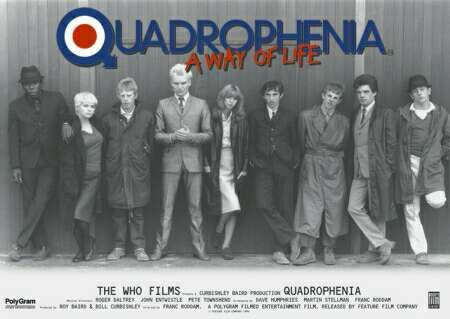
Six years later 'Quadrophenia'  was made into a motion picture directed by Franc Roddam.