Showing posts with label field recordings. Show all posts

Sunday, October 11, 2015

atom heart mother


Pink Floyd bent the rules to understand the spaces between with a plutonium prototype pacemaker,  transmogrifying an amazing pudding into this psychedelic symphonic bovine breakfast.   Syd Barrett's involvement with the band had diminished after The Piper at the Gates of Dawn with minimal involvement on  A Saucerful of Secrets.   Roger Waters and David Gilmour had helped him to produce his solo album The Madcap Laughs; while the band carried on in 1969 with the half live, half studio double album Ummagumma and the soundtrack to More directed by Barbet Schroeder.   In 1970, they worked on the soundtrack to the film Zabriskie Point 
directed by Michelangelo Antonioni before heading back to England to begin work on their next album.   


Pink Floyd produced 'Atom Heart Mother' with  Norman Smith at Abbey Road Studios in London with  Roger Waters on bass guitar, tape effects, tape collages, plus acoustic guitar and vocals on "If";     David Gilmour on guitars, vocals,  plus bass and drums on "Fat Old Sun";    Rick Wright on keyboards, plus vocals on "Summer '68";    and   Nick Mason on drums, percussion, tape editing, tape collage, plus additional engineering on "Alan's Psychedelic Breakfast".    The sessions included the EMI Pops Orchestra providing brass and orchestral sections,  Haflidi Hallgrimsson contributing cello,  John Alldis Choir doing vocals,  Alan Styles with voice and sound effects on "Alan's Psychedelic Breakfast".    Peter Bown and Alan Parsons engineered the sessions,  and Ron Geesin did the orchestration.   

The sprawling title track takes up the entire first side of the album in six sections.  It had been performed as "The Amazing Pudding" before they brought in Ron Geesin to assist with the orchestration.  Geesin says:   "The opening section is clearly a critical statement about the nature of so-called 'progressive rock'.  I've got very mixed feeling about rock music, I find my part embodies a dilemma for and against.  The group's drone is on the tonic note of E, my brass drones pull and twist that in tension, up and down, never settling on it...It could have been called 'Argument In E Minor For Band And Orchestra'."


Mason calls the title track:  "a composition that we remain fond of, proud of, and in my case slightly bemused by...There are various sections on Atom Heart Mother that I'm very happy with. I love the choir section, both the singing and the spoken choir section...All we did after Atom Heart Mother was realizing we would never record with a big orchestra again, that's it. We wanted to go back to being a band."

Waters would wax:   " I’m not bored with doing “Atom Heart Mother” when we get the brass and choir together, because it’s so weird doing it. It always comes out as so odd because of the problems of rehearsing musicians, it’s like everybody throwing their lump of clay at the wall, and seeing what it looks like when it’s happened. It depends on so many other things as well. It depends on how it mixes, you know, and we’re working with this ludicrous situation where we don’t have anybody out mixing the sound in the audience, which we obviously ought to. I’m beginning to come to a position now where I don’t think we ought to play any more on a kind of Heath Robinson level – go and do it, play the numbers, do the stuff, get the money and go home. We should not go along and play a whole load of numbers, most of them old and some of then new, with things patently wrong, like with some people balancing from the side of the stage. I think we, and a hell of a lot of other groups, are in a position now to start raising standards a bit, but we don’t – well, we haven’t, but we’re always intending to. The reason that they haven’t is that the money’s there, and people are prepared to spend it on them doing what they’re doing now, so they go on schlapping around the country, doing it all, and maybe they get a new and wonderful buzz out of it, communicating with the audience every night, but I don’t believe it. It’s a job, a fucking well-paid job, with all the ego-boosting and stuff and everything, and I think it becomes very mechanical. I’m going on a ten-day tour tomorrow night – Frankfurt, Vienna, Montreux – but why am I going? To spread the gospel, to make people happy by playing them wonderful music? No, it’s not true. I’m going to make bread. I’m going because I’m caught up in the whole pop machinery business and so are the majority."


 The album sleeve was designed by the Hipgnosis art collective with the band wanting to get away from the psychedelic imagery of their previous releases.   Storm Thorgerson drove out into the countryside and took a picture of a cow named Lulubelle III in  Potters Bar.  The original pressings did not have the name of the band on the sleeve.  

It was their first album to be mixed in quadrophonic sound and their first album to go to the top of the British album chart.   It also went to number eighty-one in Switzerland, fifty-five in the US, thirty-nine in Canada, thirty in Australia, eleven in France, eight in Germany, and number five in the Netherlands.  


http://www.pinkfloyd.com/


"Atom Heart Mother"

Pink Floyd Atom Heart Mother - Video from achamp1121 on Vimeo.


Bath Festival 27 June 1970 


Gilmour's first solo composition for the band, "Fat Old Sun" has some similarities to the Kinks' Lazy Old Sun.  Dave considers: "Maybe I ripped it off subconsciously. Who knows? They've never sued me. One sometimes gets the feeling about something that maybe one pinched it from someone; you can't figure out where on earth it's from. The added coincidence is that there were only one or two tape libraries around: the EMI Abbey Road library and one or two others, which mostly had the same sound effects. It can make a magical difference in a track if you put some bit of real atmosphere in the background, like church bells. Usually, you'd go find the bells, and it's the only set on tape that anyone can use. You'd often recognize exactly the same bit of birdsong on different records from that period."


"Summer '68"

Wright: "My lyrics are really bad and they're not saying anything that's important. A couple of songs I haven't minded being put out in terms of lyrics, like Summer '68. Although I don't think that the lyrics were good, they did at least say something that — I felt — was a real genuine feeling and therefore that's cool."


Improvisation-French TV 1970


'Atom Heart Mother'
full album:


Side one
1. "Atom Heart Mother"
I. "Father's Shout" (00:00)
II. "Breast Milky" (02:50)
III. "Mother Fore" (05:23)
IV. "Funky Dung" (10:13)
V. "Mind Your Throats Please" (15:28)
VI. "Remergence" (17:56)"  
Nick Mason, David Gilmour, Roger Waters, Rick Wright, Ron Geesin Instrumental, wordless vocals by the John Alldis Choir 23:44

Side two
2. "If"   Waters 4:31
3. "Summer '68"   Wright 5:29
4. "Fat Old Sun"   Gilmour   5:22
5. "Alan's Psychedelic Breakfast"
I. "Rise and Shine"
II. "Sunny Side Up"
III. "Morning Glory"  
Waters, Mason, Gilmour, Wright Instrumental, vocalisations by Alan Styles 13:00


endless groove


'Dark Side of the Moo'  bootleg


Friday, October 9, 2015

lift your skinny fists like antennas to heaven!


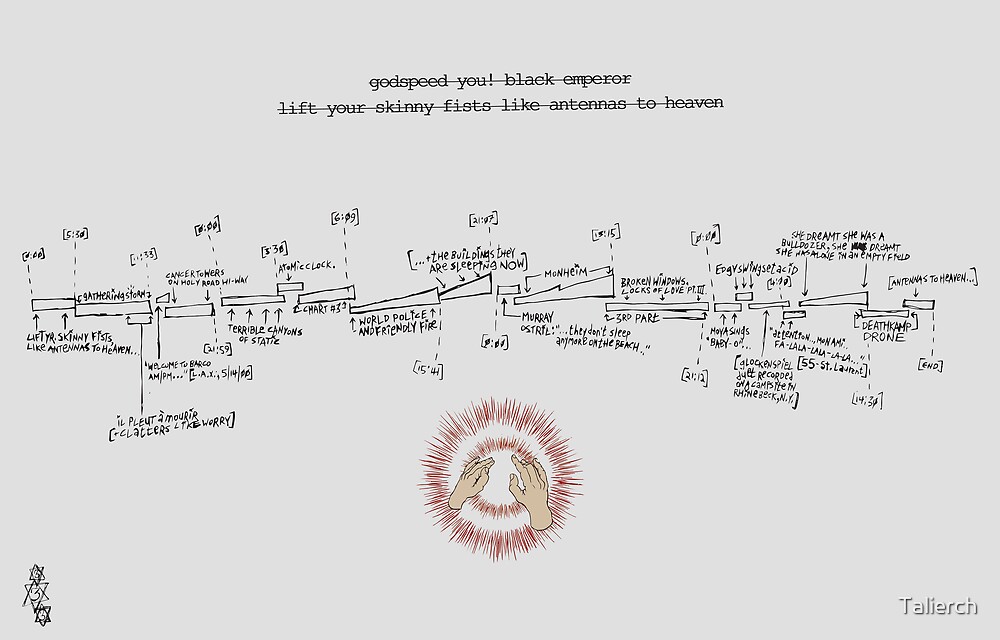
Godspeed You! Black Emperor awakened into the gathering storm of canyons of static to allow lights and perfections to penetrate secret windows with unspoken words.     The group was formed in 1994 in Montreal, Quebec when another local band (Steak 72) needed an opening act.  Efrim Menuck, Mike Moya, and Mauro Pezzente took up the challenge and, after a few gigs, recorded a limited edition cassette.  It was at this point that they began to let various local musicians take part in the project and their ranks swelled as new members came and went.  They released their first album F♯ A♯ ∞  in 1997 on local independent Constellation Records.  The band coalesced into a nontet at this point as founding member Moya left to form HṚṢṬA.  He would be replaced by Roger Tellier-Craig.   


Their second album Lift Your Skinny Fists Like Antennas to Heaven!  continued to develop their medium of narrative sonic collage through field recordings, ensemble pieces, and tape manipulations to produce stirring emotional aural landscapes.   The album   features  Mauro Pezzente and Thierry Amar on bass guitar;   David Bryant on electric guitar;  Bruce Cawdron and Aidan Girt on drums;  Norsola Johnson on cello;  Efrim Menuck and Roger Tellier-Craig on guitar;   and  Sophie Trudeau on violin;   with   Alfons and Brian adding horns.   Production was done by Daryl Smith and mastering by John Golden at Chemical Sound Studios in Toronto, Ontario.  


Bryant


Menuck 
 "I think that in the last three years there's been three or four different groups of people making spaces for people to play what they want to play,  I think that plays some part in it you end up with a real supportive, small... uh, that's a cliche,..What l'm trying to say is that there's a lot of stuff going on that got people listening to what everyone else was doing... it's about as difficult to get gigs in Montreal as it is in a lot of medium to large size cities in North America and Europe . There's a few shitty rock clubs - not as many as other large cities, but at the same time rent is cheap - it's cheap to live there. There's a drifting population of people who only stick around for two or three years and a lot of people who are there to try to involve themselves in building something, so you end up with a lot of people willing to put energy into putting on smaller shows in smaller spaces that aren't rock clubs." 

Girt

"As more people got involved in Godspeed, it became a bit more interesting.  We're at a hard point in trying to figure out what we're doing next because we don't want to be one-trick ponies, and I think that the moment you start questioning what you're going to do next, things get confusing. We're certainly at a confusing place right now. At the beginning it was more conscious... in terms of it being a collective, of being kind of loose, of writing long pieces. In terms of having this sort of instrumentation, in terms of not having a singer, in terms of using tape loops, in terms of backing films - in terms of utilising a certain visual aesthetic there was consciousness there, but I think what's good about Godspeed doesn't have very much to do with any of those elements... everyone in this band has done a good job of working within it. Before Godspeed a lot of us had been interested in hardcore... well, that weird period between hardcore and what's now called indie rock... that period of five years where those two things met. I don't know what you would call that, but there was tons of shit going on all the time." 


Girt


Menuck

Girt


http://www.brainwashed.com/godspeed/


Lift Your Skinny Fists Like Antennas to Heaven!

full album:


Disc one
1.1 / Side 1: Storm

3. "'Welcome to Barco AM/PM...' [ L.A.X.; 5/14/00]"   1:15
Total length:   22:32

1.2 / Side 2: Static

2. "Atomic Clock"   1:09
3. "Chart #3"   2:39
5. "[...+The Buildings They Are Sleeping Now]"   5:25
Total length:   22:35

Disc two
2.1 / Side 3: Sleep

1. "Murray Ostril: '...They Don't Sleep Anymore on the Beach...'"   1:10
Total length:   23:17

2.2 / Side 4: Antennas to Heaven

1. "Moya Sings 'Baby-O'..."   1:00
2. "Edgyswingsetacid"   0:58
3. "[Glockenspiel Duet Recorded on a Campsite In Rhinebeck, N.Y.]"   0:47
4. "'Attention...Mon Ami...Fa-Lala-Lala-La-La...' [55-St. Laurent]"   1:18
7. "[Antennas to Heaven...]"   2:02
Total length:   18:57


"Gathering Storm"


live 2000


The band took its name from a 1976 Japanese black-and-white documentary called God Speed You! Black Emperor by Mitsuo Yanagimachi, about a Japanese biker gang, the Black Emperors.


Tuesday, August 21, 2012

kala


M.I.A. doubled down on her adventurous world music with the explosive percussion and innovative samples of this primal and political pièce de résistance.  After the critical success of her debut 'Arular', British born  Sri Lankan Maya Arulpragasam planned to record her follow-up 'Kala' with American producer Timbaland; however, due to the incendiary lyrics of her first album, she was not allowed to enter the US.  She considers:  "When I was denied the visa, I ended up just couch-surfing, sleeping at other people’s houses. I couldn’t access any of my equipment or my demos – it was already over in America, with the rest of my life – so I had to start from scratch with what was around me. The thing is, I get bored easily, and I don’t see the point of doing something twice. I made 'Arular' in London; I’d already made a real London album. I just thought, fuck it. If I’m gonna couch-surf in London, I might as well go and couch surf in India or Liberia...And at the same time, I wanted to get out of people’s view: to go and spend time learning about myself and trying to be better. Not really technically better, but I just wanted to be better as a human being. And it’s really hard to do that when you make club music. There’s no such thing as a better human being in club music! It’s like, you either dance . . . or you get the fuck out! And I don’t want to be talking about ‘big titties’ and ‘fucking hos’. Dance music needs to be expanded, in terms of subject matter and substance, and that’s what I was trying to do...So when I started this album, I really thought, 'I don’t know why I’m doing this, I don’t know who I’m doing it for. I don’t know anything. I’m out of this relationship, Timbaland, that dream and hope, is not gonna happen, and I probably don’t even wanna make music.' I was exhausted, and then this album just came out from that weird place. I just didn’t care what anyone was going to think. And it just ended up being what it is because it came out from a time of just trying to survive, in music, as a woman...When I started making 'Arular', back in 2002-2004, there was just politics. Most people of our age, living in the West, were in the middle of the biggest saturated political moment of their lives. But now, well, we’ve seen where it goes. Everyone is out there talking about it. We’ve all watched Saddam Hussein being hanged on YouTube. What the hell have I got to add to that? Just trying to survive:  that’s what it’s about. I wanted to speak for everyday people, living their everyday lives."

While her first album was named after her father; this new album was named for her mother.  'Kala' was recorded in India, Jamaica, Australia, Liberia, and Trinidad with vocals by M.I.A.; featured vocals by Afrikan Boy, the Wilcannia Mob, Timbaland, and Rye Rye; and production by M.I.A., Switch, Diplo, Timbaland, Morganics, and Blaqstarr.  

'Kala' went to number one hundred and seventeen in France, ninety-three in Germany, forty-six in Australia, forty-four in the Netherlands, thirty-nine in the UK, twenty-three in Japan, twenty-two in Norway, eighteen in Sweden and the US, and number one on the US dance album chart.  The album was a huge critical success, making the top of end of the year reviews in several publications. She also saw a huge increase in her fan base.  She says:  "I was kind of surprised, actually. We keep doing these shows and people keep screaming and going mad. I don’t get it. I really don’t get it. I thought this album was much more raw than the first one, but the audiences are going crazy; dancing to it."


http://miauk.com/


@MIAuniverse


"Paper Planes" samples the Clash's "Straight to Hell". It became an international smash hit after appearing in the film 'Pineapple Express', going to seventy-six in Germany, sixty-six in Australia, fifty-seven in the Netherlands, thirty-six on the US R&B chart, nineteen in the UK, eighteen in Belgium and Denmark, seven in Canada, four in the US, and number one on the US dance chart.  
http://www.youtube.com/watch?v=7sei-eEjy4g


"Bamboo Banga" samples "Roadrunner" by Jonathan Richman and "Kaattukkuyilu" by Ilaiyaraaja from the 1991 Tamil film 'Thalapathi'.
http://www.youtube.com/watch?v=9jU5riJNrQQ


"Bird Flu"  samples "Thirvizha Na Vantha" by R. P. Patnaik from the Tamil film 'Jayam'.
http://www.dailymotion.com/video/x2po1t_m-i-a-bird-flu_music

M.I.A. - Bird flu by eatbiscuits


"Boyz" went to number three on the US dance chart. 
http://www.youtube.com/watch?v=ZBX3lo3Boxs


"Jimmy" samples "Jimmy Jimmy Aaja" composed by Bappi Lahiri from the Bollywood film 'Disco Dancer'.  The single reached number sixty-six in the UK and number twenty-eight on the US dance chart.  
http://www.youtube.com/watch?v=HBECisSkAu4&feature=fvwrel


'Kala' 

full album:


1. "Bamboo Banga"  
(M.I.A. Switch Jonathan Richman Ilaiyaraaja)
M.I.A. Switch  4:58
2. "Bird Flu"  
(M.I.A. Switch R. P. Patnaik)
M.I.A. Switch  3:24
3. "Boyz"  
(M.I.A. Switch)
M.I.A. Switch  3:27
4. "Jimmy"  
(M.I.A. Switch Bappi Lahiri)
M.I.A. Switch  3:29
5. "Hussel" (featuring Afrikan Boy)
(M.I.A. Switch Diplo)
M.I.A. Switch Diplo  4:25
6. "Mango Pickle Down River" (with The Wilcannia Mob)
(M.I.A. Keith Dutton Lendal King Colin Roy Johnson Walter Ebsworth Buddy Blair Morgan Lewis Brendan Adams Daniel Wright Will Jarrett)
M.I.A. Morganics 3:53
7. "20 Dollar"  
(M.I.A. Switch Charles Thompson)
Switch 4:34
8. "World Town"  
(M.I.A. Switch Blaqstarr)
M.I.A. Switch 3:52
9. "The Turn"  
(M.I.A. Blaqstarr)
M.I.A. Blaqstarr  3:52
10. "XR2"  
(M.I.A. Diplo Switch)
Diplo Switch 4:20
11. "Paper Planes"  
(M.I.A. Diplo Joe Strummer Mick Jones Paul Simonon Topper Headon)
Diplo Switch 3:24
12. "Come Around" (featuring Timbaland)
(Timothy Mosley Timothy Clayton M.I.A.)
Timbaland 3:53

Sunday, February 27, 2011

my life in the bush of ghosts


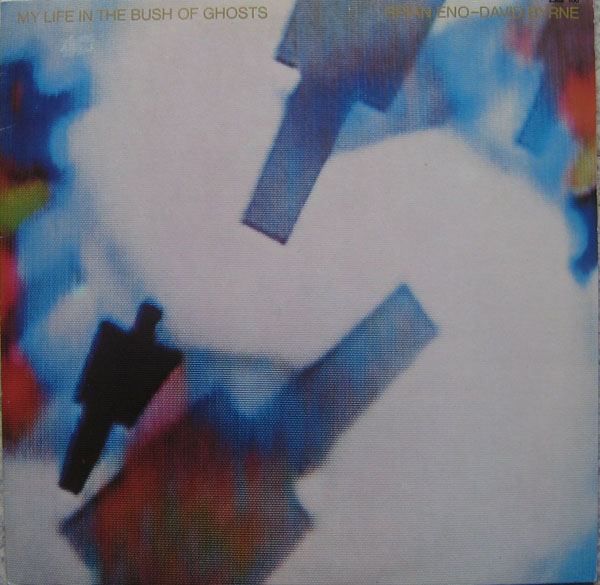
This dense and funky collaboration exorcised the demons and tapped into something primal with its extensive use of “found vocals and objects”. 'My Life in the Bush of Ghosts' influenced several movements in music by drawing together the ambient experimentation of Eno with Byrne's predilection for polyrhythmic world music. It sat on the shelves for months as record companies sought legal permission for the extensive audio samples.


Byrne says:  "I still feel like if I can get a song to work with, say, a basic beat, a rhythm, some chord changes, and a melody, a vocal melody-- if it works with that, then I feel it's written and there's something there. So I intentionally don't get involved with arranging stuff or fussing over the sounds and the edits and the beats too much, at least not in the beginning, because I feel like then you can fool yourself that you've got something there, when you might not. In a certain way, you get some new tools to work with, but I don't know if it ultimately makes the creative process any easier...The idea of making music from an imaginary culture was to give ourselves a set of restrictions and parameters within which to work. Otherwise, we might have just gone on all kinds of creative detours, some of which might have been interesting. But better we confine ourselves to something. Which kind of worked. At least it kept us within bounds for a while, [and] by the time we abandoned that whole idea, which was pretty early on, we already had a direction."


Eno elaborates:   "We are both fairly disenchanted with ordinary song structures - the voice you record is invested with your own personality. What we wanted was to create something more mysterious, and by taking voices out of context, but featuring them dominantly as the main vocal performance, you can go on to create meaning by surrounding the voice with a musical mood.  In a way it was an experiment to see if you can create fairly sophisticated moods with voices outside their linguistic meaning. Basically I'm so fed up with reading reviews of records that concentrate on the lyrics, quoting them as if they had some great relevance, but ignoring the music."


http://davidbyrne.com/


http://brian-eno.net/


'America Is Waiting' samples an "Unidentified indignant radio host"


'Mea Culpa'
"Inflamed caller and smooth politician replying"


'Regiment' includes Lebanese mountain singer Dunya Yusin and Michael "Busta Cherry" Jones on bass.


'Help Me Somebody'
Reverend Paul Morton


'The Jezebel Spirit'
Unidentified exorcist


'Qu'ran'
Algerian Muslims chanting the Qur'an.  

The song was removed from later editions of the album.  Byrne explains:    "Way back when the record first came out, in 1981, it might have been ’82, we got a request from an Islamic organization in London, and they said, 'We consider this blasphemy that you put grooves to the chanting of the Holy Book.' And we thought, 'Okay, in deference to somebody’s religion, we’ll take it off.' You could probably argue for and against monkeying with something like that. But I think we were certainly feeling very cautious about this whole thing. We made a big effort to try and clear all the voices, and make sure everybody was okay with everything. Because we thought, 'We’re going to get accused of all kinds of things, and so we want to cover our asses as best we can'.” So I think in that sense we reacted maybe with more caution than we had to. But that’s the way it was.”


'Moonlight In Glory'
The Moving Star Hall Singers, Sea Islands, Georgia


'The Carrier'
Dunya Yusin


'A Secret Life'
Samira Tewfik, Egyptian popular singer


'Come With Us'
Unidentified radio evangelist


'My Life in the Bush of Ghosts'
full album: