Showing posts with label yes. Show all posts

Thursday, November 13, 2014

relayer


Yes made an adventurous advance and breached the gates of delirium with the progressive jazz fusion of this symphonic sound chaser.  Although their double album 'Tales from Topographic Oceans' had been criticized as overindulgent, it still was a hit with the fans. After the tour, keyboardist Rick Wakeman left the group over creative differences.  The band auditioned several people to replace him, including Jean Roussel, Eddie Jobson, and Vangelis Papathanassiou before settling on Swiss keyboardist Patrick Moraz of Refugee.  

Moraz remembers:  "I had never met Rick before joining YES. However I had met some of the other YESmen, like Tony Kaye, Peter Banks, Jon Anderson, Chris Squire and Bill Bruford...Personal contact with Jon Anderson which had been arranged by my very good friend Ray Gomez, guitarist extraordinaire, also by Chris Welch, the main journalist for the music paper “Melody Maker” and also through a request by Brian Lane, YES’s manager at that time. Then through the request by the whole group. Apparently, it was a unanimous decision and the invitation came quite instantly. The day after I played with them for the very first time, I got a call telling me I was in the band as an equal-member, and my presence was being requested immediately!  Personally, I wasn’t sure I wanted to get into YES at the time because I was doing film scores, (I was working on two movies at the same time, one with my friend Gerard Depardieu) and I was still under professional commitment with REFUGEE. Although we were on the verge of splitting-up REFUGEE, we still had some concerts to do, promoting our first and only eponymous album “Refugee”, which had entered at #28 in the “Melody Maker” British Music Charts a few weeks earlier and was still climbing...When we started to record 'Relayer', some of the music had already been written and rehearsed by Chris, Jon, Steve and Alan. I contributed as much as I could to the overall picture of the pieces. However, it is a fact that Steve used quite a lot of tracks for his many overdubs everywhere on the album, except when there is no guitar at all, which is a rare occasion...We all participated in the compositions and the final arrangements, even if most of the “songs” were originally composed somewhat more by Jon, and Steve in some instances. I liked to work with Jon and Chris, especially. Alan was always contributing some very good rhythmic ideas. I also worked quite a lot with Steve during the whole time I was in YES."


'Relayer' was recorded at a converted garage in Squire's home in Virginia Water, Surrey with Eddy Offord engineering and co-producing with the band.  The sessions featured Jon Anderson on lead vocals;  Steve Howe on acoustic and electric guitars, and vocals;   Patrick Moraz on keyboards;   Chris Squire on bass guitar and vocals;   and Alan White on drums and percussion.   The album was mixed at Advision Studios in London.   As with their previous four albums ('Fragile', 'Close to the Edge', 'Yessongs', and 'Tales from Topographic Oceans' ), Roger Dean did the sleeve design and illustration.  


Squire says:  "Jon Anderson wrote most of our lyrics in the '70s. A lot of his lyrics were fairly abstract, anyway. They were based more on the phonetics and the way things sounded. They weren't rooted to one particular idea in one particular decade, so they're kind of fluid lyrics, and they seem to stand the test of time. People just like the sentiments and the way that it sounds...Our music has always run the gamut, borrowing from basic rock & roll and also from classical music and injections of various styles from different members, including country and blues, jazz. They've all been absorbed into the Yes history at one time or another. So, it's kept it interesting as a player, and it's kept life interesting for me. It's great to still go out on the road and perform this music, and people seem to be really fond of it."


'Relayer' went to number eighteen in Norway, fifteen in Australia, ten in the Netherlands, five in the US, and four in the UK.  


Anderson considers:  "A lot of fans would come along and really lock into Yes and realize that this is more to do with an experimental band, a very musical band, a very outgoing band, an adventurous band. We weren't really that concerned about having a hit record. We were thankful, but it wasn't something that we were going to be tied to. I didn't feel as part of the band we should ever try to make another "Roundabout" or make another Fragile record. That's why within a space of time, three years, the record companies got very upset with us, because we were doing diverse music and Topographic Oceans..."Gates of Delirium," the record company didn't know what to do with it, but we did, because we were performing it on stage and that was our legacy, to be able to go on stage and perform this music that would never be heard on radio ... “Gates of Delirium is a war song, a battle scene, but it's not to explain war or denounce it, really. It's an emotional description with the slight feeling at the end of 'do we have to go through this forever?' There's a prelude, a change, a victory tune, and peace at the end, with hope for the future…"


http://www.yesworld.com/


'Relayer' 
full album:
http://www.youtube.com/watch?v=A4v1WkzY3gA


All tracks written and arranged by Jon Anderson, Chris Squire, Steve Howe, Alan White and Patrick Moraz.

side one
1 The Gates Of Delirium 0:00
side two
2 Sound Chaser 21:56
3 To Be Over 31:23


Thursday, November 14, 2013

90125


Yes was reincarnated when several members came back together for this side project that became the biggest success of their entire career.   Jon Anderson and Rick Wakeman had left after the poorly received 'Tormato'; and the most recent incarnation of the band had called it quits after the subsequent album 'Drama' in 1980; with Trevor Horn focusing on producing, Steve Howe and Geoff Downes formed Asia, and Chris Squire and Alan White started a new group called Cinema.  

White reveals:  "We played with Jimmy Page for about eight weeks and we wrote about eight songs and Jimmy wrote some parts with us; but mostly the writing was being done by Chris and myself...The music was great.  They were just demos that we were doing; but in the end management got into in and the whole thing dissipated and fell to pieces; which is when...someone from Atlantic Records called up and said we have this guy Trevor Rabin that you might be interested in; and they flew him in to England and we just had one jam in Chris' basement studio; and it was starting to sound really good; and that was the real birth of what was going to be called cinema...We were going to play new music, a new direction but you still had the rhythm section of Yes; so you're going to have overtones of the band anyway.  The idea was to create this new band and kind of switch gear as it were.  Only after we'd laid down three quarters of the tracks that you hear on '90125' - the backing tracks - and Trevor was actually thinking about starting to get into putting the vocals on and harmonies were being worked out...Chris met Jon - in a pub I believe somewhere - and Jon said 'I heard you're doing some really good work; maybe I could sing on a track.'  Jon came down and tried singing on a track...It sounded so much like Yes you couldn't call it anything else; so you really had to think about reverting back the other way and say well it sounds like a new Yes."

Rabin says:   "There was parts of it which I felt were a little peculiar.  'Cause I was just so unaccustomed to hearing Jon singing my songs, obviously.  And then he sang 'Hearts'...and I really liked it.  And we spoke; and he joined the band.  Only at that point - which out of nine months was the last month of the album - and was at which point we called the band Yes...The sound of Yes' harmonies is not Jon...it's Jon and Chris...and the others get involved...it's really Jon and Chris' voices that make the difference."

Anderson acknowledges:  "What I've always said is that Yes is something that hovers above the collective unit and keeps us in tow, keeps us working hard, and keeps our spirits in the right direction in order to make good music with a defined idea and not to just jump and try make a hit single.  The single market is very difficult to understand difficult to ascertain:  one minute you're made you're famous and the next minute you're nothing. I'd rather make ten good albums than one hit single.  It's one of those things that when the Yes idea first came we would talk only about making album music."

Kaye considers:    "I think in many ways we kind of stumble along...looking for an opening.  I don't think anyone really thinks about it.  It's not like the phone calls are made.  It would never happen like that.  It has to happen by stumbling along and...even if it's separately, to go through a period of writing music.  And then somehow at the end of that period just like it did in '90125' and probably before in certain ways - different ways - it stumbles along to the necessary, right conclusion."

Squire says:    "It’s ironic in a way, because Yes has had quite a few changes over the years. Every time someone new has come in they’ve obviously injected more energy or new energy into the band and changed the sound a bit, and the approach, etc., depending on how much input the new member has had.  Of course, there’ve been some notable people; Trevor Rabin was a big influence in the ‘80s. And I think because of the changing in itself has just allowed the band to be free to grow in different directions and then come back and change again and then come back and learn from every phase that we’ve been through, really. I’ve benefitted a lot personally from having been able to evaluate what the band has done with various different musicians, and I’ve been very lucky to have gained all the information from the many members there have been."


'90125' was recorded at Sarm Studios in London with Jon Anderson on vocals; Tony Kaye on keyboards; Trevor Rabin on guitars, vocals, and additional keyboards; Chris Squire on bass and vocals; and Alan White on drums, percussion, and backing vocals;  with Trevor Horn on production and backing vocals; J.J. Jeczalik and Dave Lawson on keyboard programming; Deepak Khazanchi on sitar and tambura on "It Can Happen"; and Graham Preskett on violin on "Leave It".   The album went to twenty-seven in Australia, sixteen in the UK, nine in Austria, eight in Norway, seven in Sweden, five in the US, three in Switzerland, and number two in the Netherlands.  '90125' became the band's biggest album, selling over eight million copies and going triple platinum in the US, double platinum in Canada, and gold in the UK.  The title comes from its Atco Records catalogue number.   


http://yesworld.com/


"Owner of a Lonely Heart" became the biggest hit of Yes' career, going to twenty-eight in the UK, twenty-five in Australia, eleven in Switzerland, nine in Austria, seven in the Netherlands, six in Norway, four in Sweden, and number one in the US.
http://www.youtube.com/watch?v=ELpmmeT69cE


"It Can Happen"  
http://www.youtube.com/watch?v=koh0Ku9JUag

http://www.youtube.com/watch?v=l5W2IpVMw0E


"Changes" 
http://www.youtube.com/watch?v=P6jAMwK-4QU


"Leave It"  


'90125'  full album


Side one
1. "Owner of a Lonely Heart"   Trevor Rabin, Jon Anderson, Chris Squire, Trevor Horn 4:27
2. "Hold On"   Rabin, Anderson, Squire 5:15
3. "It Can Happen"   Squire, Anderson, Rabin 5:39
4. "Changes"   Rabin, Anderson, Alan White 6:16
Side two
1. "Cinema"   Squire, Rabin, White, Tony Kaye 2:09
2. "Leave It"   Squire, Rabin, Horn 4:10
3. "Our Song"   Anderson, Squire, Rabin, White 4:16
4. "City of Love"   Rabin, Anderson 4:48
5. "Hearts"   Anderson, Squire, Rabin, White, Kaye 7:34


Saturday, September 8, 2012

close to the edge


Yes took their classic lineup in a constant vogue of triumphs to the progressive precipice with this mystical musical landmark.   'Close to the Edge' was recorded with the same lineup as 'Fragile' with Jon Anderson on vocals, Steve Howe on guitars and vocals, Chris Squire on bass and vocals, Rick Wakeman on keyboards, and Bill Bruford on drums and percussion.  The band produced the sessions with Eddie Offord at Advision Studios in London. 

Hermann Hesse's book 'Siddhartha' inspired the epic title track, which took up the entire first side of the album.  Anderson muses:  "What I haven’t seen, I can’t tell.  It’s not very whole until I’ve seen it. So it’s all metaphors.  That’s when I went through that very strong period of just sketching and writing whatever I sang as being a state of consciousness. I would smoke a joint and just have fun and write:  'A seasoned witch can call you from the depths of your disgrace and rearrange your liver to the solid mental grace.'  And I know exactly what it means.  'A seasoned witch can call you from the depths of your disgrace' – your higher self can call you from the depths of your disgraceful feelings, your doubts.  “And rearrange your liver” – your body – you can rearrange your body to a 'solid mental grace'.  The liver is a very powerful part of the body, so it can rearrange your physical self to a higher state of mind. 'Close to the edge, round by the corner' – 'Siddhartha'.  I was reading 'Siddhartha'.  So, everything means something to me.  And people can say what they want – I don’t care – because I know what I was saying was what I was thinking, what I was dreaming."


Bruford considers his compositional contributions:  "There were snippets in there...Jon Anderson pushed me into doing bits and pieces. So I would come up with odd movements of the bass or... Riffs mostly. I heard the music from the bottom up: a bass line that could be doubled with the guitar, which would turn into some kind of riff or lead part." 

Howe compares the band's different recording stratagies:  "I shouldn’t be saying it myself, but some of this old material we’re playing still blows me away. To think that we did 'Fragile' and 'Close to the Edge' in the same year is astonishing to me now. I don’t know how the hell we did that. We were very young, very keen and prepared to work hard. And we still are – the 'work hard' bit, anyhow...There are two schools of thought. In one, you start making an album, and then you never stop until you completely finish it. The opposite of that is you do tracks, and then you come back to them. You do some more tracks, and then you come back even later to the mixing. So, you’re always thinking fresh. You’re not thinking, 'God, I’ve been on this record for three months. I just want to stop hearing it!'...This is how we made our earlier records, and it may prove to be a much better way. In the early days, we could never have one period of total immersion, until we did 'Topographic Oceans'. That was the first time we said, 'Okay, life stops until we finish this record.'...But the records made before that were made around, and involved, life. 'Close to the Edge', 'Fragile' and 'The Yes Album' were made as we lived and toured, and stopped and started. I think, most probably, they were better because of it. They benefitted from renewing that fresh approach."


Wakeman remembers the difficulties of touring:  "It was bloody nightmare on stage, because there was quite a lot of Mellotron, and Mellotrons, they were so difficult to behave themselves on stage. I mean they were worse than naughty boys; they were just escaped convicts. They just had minds of their own and never did what you asked them to do, and because that involved the Mellotrons a lot, you used to just tear your hair out--you really did tear your hair out...I mean, now it's fine; it's great, because with the keyboard setup and things you've got now, you don't have those worries about when I hit this note, is it going to be anywhere remotely in tune, in another key, on another planet; or is it not going to do anything at all or is it going to catch fire? Are the bits going to come out the back? Those days are long since gone."

Squire says that he didn't want to rest on the success of 'Fragile':  "You’re only as big as your last hit...I know I always worked hard on making sure we came out with the best possible product and of course we were working with four other people, you have to balance that as well."

Bruford left the band after the album was completed to join King Crimson.  The members of the band lived in a house together and personality conflicts between Bruford, Anderson, and Squire began to wear on the drummer.  He and Squire would argue over chords and even got into a fistfight after a show.  Bruford admits: "Chris is, I'm sure, a wonderful guy. But in those days he also very, very late. For all appointments and departures and arrivals and sound checks and anything...That, in a way, is the most grievous form of offense that one musician can visit upon another. Because it's simply keeping everybody waiting. Like the last guy who enters the room is the biggest guy. So there was a lot of that about him and eventually... you know, I was a hot-blooded guy back then and I'd had enough of waiting for him, really."


'Close to the Edge' went to number four in the UK, three in the US, and number one in the Netherlands.  It has been certified platinum in Canada, the UK, and the US.  


http://yesworld.com/


'Close to the Edge'

full album:


http://www.youtube.com/watch?v=GNkWac-Nm0A


1. "Close to the Edge"  (Anderson, Howe) (0:00-18:43)

I. "The Solid Time of Change" 00:00
II. "Total Mass Retain" 06:05
III. "I Get Up, I Get Down" 08:01
IV. "Seasons of Man"  14:12

2. "And You and I" (Anderson, Howe, Bruford, Squire) (18:45-28:56)

I. "Cord of Life" 18:45
II. "Eclipse"   19:59  22:33
III. "The Preacher the Teacher" 24:32
IV. "Apocalypse"  28:11


3. "Siberian Khatru"   (Anderson, Howe, Wakeman) (28:57-37:49)


Saturday, November 26, 2011

fragile


Yes coalesced into their classic lineup and produced their big commercial breakthrough with this expansive progressive rock masterwork. Original keyboardist Tony Kaye refused to play the synthesizer that the rest of the band wanted and quit early in the sessions, paving the way for multi-instrumentalist session man Rick Wakeman to fill in on Hammond organ, piano, RMI 368 Electra-Piano and Harpsichord, Mellotron, as well as the disputed Moog synthesizer. Wakeman remembers: "I had heard Yes live, as Strawbs had supported them at a gig in Hull. I thought they were amazing – incredibly different. When they asked me to join, I said 'no' initially, as I had decided to go back to just doing sessions. But after going along to one rehearsal, I was sold instantly. I wanted to add orchestral sounds in the keyboard department, and that’s exactly what Yes wanted. A match made in Heaven!"

Chris Squire says, "Yes has had quite a few changes over the years. Every time someone new has come in they’ve obviously injected more energy or new energy into the band and changed the sound a bit, and the approach, etc., depending on how much input the new member has had." Wakeman's contributions went uncredited, due to contractual obligations. Jon Anderson recalls: “Those songs still stand the test of time for sure. Steve and Rick added amazing amounts of different styles, music, new chords, new ideas. It was that perfect storm of energy that created 'Fragile'.”

Wakeman says, "Yes were always prepared before we went into the studio. The studio is not the place to write. You need to be seventy-five percent ready when you go into the studio, and then the music can develop to the next stage. The studio is the end of the assembly line. David Bowie taught me this. It’s a lesson I never forgot and will be eternally grateful for."

Steve Howe explains the band's differing methods of recording: "There are two schools of thought. In one, you start making an album, and then you never stop until you completely finish it. The opposite of that is you do tracks, and then you come back to them. You do some more tracks, and then you come back even later to the mixing. So, you’re always thinking fresh. You’re not thinking, 'God, I’ve been on this record for three months. I just want to stop hearing it!' This is how we made our earlier records, and it may prove to be a much better way. In the early days, we could never have one period of total immersion, until we did 'Topographic Oceans'. That was the first time we said, 'Okay, life stops until we finish this record.' But the records made before that were made around, and involved, life. 'Close to the Edge', 'Fragile', and 'The Yes Album' were made as we lived and toured, and stopped and started. I think, most probably, they were better because of it. They benefitted from renewing that fresh approach."


Squire ponders the band's influences and contemporaries: "Strange enough, around that time that you start realizing that you’ve got a band that could work and could become popular—and of course you see that in growing audiences, etc.—you don’t really listen to necessarily people who say you’re from the same country or whatever. In fact, I probably listened to Crosby, Stills and Nash more than I listened to Led Zeppelin in those formative years. Because that was more what Yes was about; a band that had great vocal harmonies. So, of course, I was influenced by Simon and Garfunkel and bands with great vocals. And of course we wanted to be band who were good instrumentalists as well, and Bill Bruford, our original drummer, was of course very influenced by jazz. So that was another element that was sewn into the makeup of Yes. We were kind of eclectic really. We kind of stood slightly aside from other acts."

Bill Bruford reminisces: “If you say to people that rock music is made up of three chords, there will always be guys, especially in the UK, who say, ‘What if we added a fourth chord and put it into 5/4?’ Those people fell into something called progressive rock. The British working class guys who assumed that rock ’n’ roll was their property got very pissed off at these art school guys who brought in all the nuts and bolts of progressive rock and added classical music, vocal harmony, poetry, and art. The Black Sabbaths of the world were very pissed off, and then the punks came and trashed it. I was fortunate enough to grow up in an era where everything went on. It was great. People even cared what the drummer thought!”

Anderson elaborates: "Each person in the band was great at what he did. Bill had that jazz-rock style, Chris Squire was of course a great bass player, Rick Wakeman was classically trained, and of course Steve Howe was terrific. There was so much talent, at a variety of levels. I was sort of the musical director, the person who decided which direction we should go with an idea. I might bring in a song and say, 'I don’t want you to simply play the chords. Why don’t you play some unusual figures, and jump around within the song?' Oftentimes the song might be very simple, so I wanted everyone to come up with music that would be entertaining for them to play. That’s how 'Long Distance Runaround' and 'Roundabout' were written. They were variations on the idea of, 'You find what you like playing, and let’s make it all work together.' Pulling those elements together is what created that unique sound. Everyone is playing his unique part, but we somehow made it all fit."

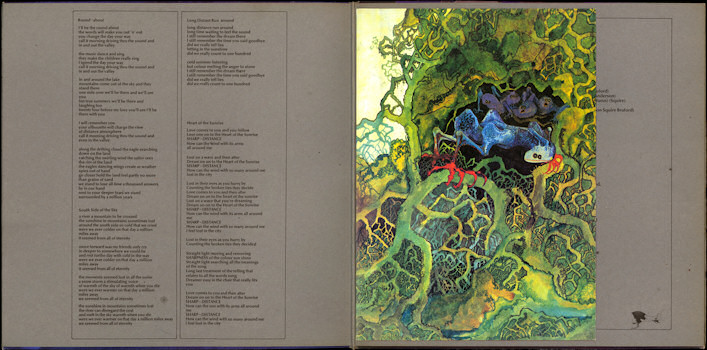
'Fragile' consists of four long group pieces and five individual showcase tracks. Anderson says: “Steve wanted to do a piece … Rick had ideas for his solo … so I suggested we all try one.” As laid out in the liner notes: "Five tracks on this album are the individual ideas, personally arranged and organised, by the five members of the band. 'Cans and Brahms' is an adaptation by Rick Wakeman on which he plays electric piano taking the part of the strings, grand piano taking the part of the woodwind, organ taking the brass, electric harpsichord taking reeds, and synthesizer taking contra bassoon. 'We Have Heaven' is a personal idea by Jon Anderson in which he sings all the vocal parts. 'Five Per Cent For Nothing' is a sixteen bar tune by Bill Bruford, played twice by the group, and taken directly from the percussion line. In Chris Squire’s 'The Fish,' each riff, rhythm, and melody is produced by using the different sounds of the bass guitar. Steve Howe concludes with a solo guitar piece 'Mood For A Day.' The remaining tracks on the album are group arranged and performed." 'Fragile' was recorded with Eddy Offord at Advision Studios in London. It went to number seven in the UK and number four in the US, selling double-platinum. Roger Dean did the iconic artwork.


"Tell the Moon Dog, Tell the March Hare".


An edited version of 'Roundabout' made it to number twenty seven in the Netherlands and number thirteen in the US. “It was written on the way from Aberdeen to Glasgow in Scotland, and we went through so many roundabouts (traffic circles on Scottish roadways), maybe 40 or so. It has a Scottish feel about it. Just listen to the solo, just like a ‘reel’. It changed everything. 'Roundabout' was a hit! And that’s what the band needed.”

"In and around the lake
Mountains come out of the sky
And they stand there
One mile over we'll be there
And we'll see you
Ten true summers we'll be back
And laughing too
Twenty four before my love
You'll see, I'll be there with you"


'Long Distance Runaround'

"Long distance runaround
Long time waiting to feel the sound
I still remember the dream there
I still remember the time you said goodbye
Did we really tell lies
Letting in the sunshine
Did we really count to one hundred"


'Heart of the Sunrise'

"Lost on a wave and then after
Dream on on to the Heart of the Sunrise
SHARP-DISTANCE
How can the wind with so many around me
Lost in the city "


'Fragile'
full album:
https://www.youtube.com/watch?v=87xx5pzHDlY


"Roundabout" (Jon Anderson/Steve Howe) -- 8:33
"Cans And Brahms" (Johannes Brahms, Arr. Rick Wakeman) -- 1:38
"We Have Heaven" (Jon Anderson) -- 1:40
"South Side Of The Sky" (Jon Anderson/Chris Squire) -- 7:58
"Five Per Cent For Nothing" (Bill Bruford) -- 0:35
"Long Distance Runaround" (Jon Anderson) -- 3:30
"The Fish (Schindleria praematurus)" (Chris Squire) -- 2:39
"Mood For A Day" (Steve Howe) -- 3:00
"Heart Of The Sunrise" (Jon Anderson/Chris Squire/Bill Bruford) -- 11:27