Showing posts with label samba. Show all posts

Wednesday, August 19, 2015

ogum xangô


Jorge Ben and Gilberto Gil played with order and disorder in the extended improvisations and subtle hypnotic grooves of this fluid acoustic jam session.   Jorge Ben had established himself over a decade with seven albums (Samba Esquema Novo in 1963,  Sacundin Ben Samba and  Ben É Samba Bom  in 1964,   O Bidú  in 1967,   Jorge Ben   in 1969,   Força Bruta  in 1970,   and   A Tábua de Esmeralda  in 1974)  that bridged bossa nova, samba, funk, and rock;   while Gilberto Gil expressed a more political perspective (with  Louvação in 1967,   Gilberto Gil [Frevo Rasgado] [with Os Mutantes]  and the Tropicália: ou Panis et Circencis  compilation [alongside Caetano Veloso, Os Mutantes, Gal Costa, Nara Leão, and Tom Zé] in 1968,   Gilberto Gil (Cérebro Eletrônico) in 1969,   Copacabana Mon Amour  in 1970,   Gilberto Gil (Nêga)  in 1971,   Expresso 2222  and   Barra 69: Caetano e Gil Ao Vivo Na Bahia in 1972,   Gilberto Gil Ao Vivo  in 1974,   and  Refazenda in 1975), such that he was considered a threat by the Brazilian military regime and imprisoned for several months in 1969 before being exiled for several years.   


Gil e Jorge aka Ogum Xangô  was recorded at CIA Brasiliera De Discos Phonogram in Rio De Janeiro.  The twelve hour marathon session was produced by Paulinho Tapajós and Perinho Albuquerque with technicians  Ary, João Moreira, Luigi, and Luis Claudio.   The album features  Jorge Ben and Gilberto Gil on vocals and violão (acoustic guitar),  with  Djalma Corrêa adding percussion and Wagner Dias providing bass.    


According to Afro Brazilian mythology, Ogum is the Yoruba deity or orixá of iron and war and the patron deity for warriors; while Xangô  is the Yoruba orixá or deity of thunder, lightening, and fire.


http://www.jorgebenjor.com.br/


http://www.gilbertogil.com.br/


"Taj Mahal" inspired Rod Stewart's number one smash hit "Da Ya Thing I'm Sexy?".  A court agreed and awarded damages to Jorge Ben.  
https://www.youtube.com/watch?v=LL-MWkMb07A


Gil e Jorge aka Ogum Xangô 
full album:
https://www.youtube.com/watch?v=SRMIgrvXsNk


side one
1-Meu Glorioso São Cristóvão (Jorge Ben)-00:00 
2-Nêga (Gilberto Gil)-08:12
side two
3-Jurubeba (Gilberto Gil)-18:42 
4-Quem Mandou (Pé na Estrada) (Jorge Ben)-30:22 
side three
5-Taj Mahal (Jorge Ben)-37:13 
6-Morre O Burro Fica O Homem (Jorge Ben)-49:19 
side four
7-Essa É Pra Tocar No Rádio (Gilberto Gil)-55:21 
8-Filhos De Gandhi (Gilberto Gil)-1:01:26
9-Sarro (Jorge Ben/Gilberto Gil)-1:13:29


Tuesday, June 16, 2015

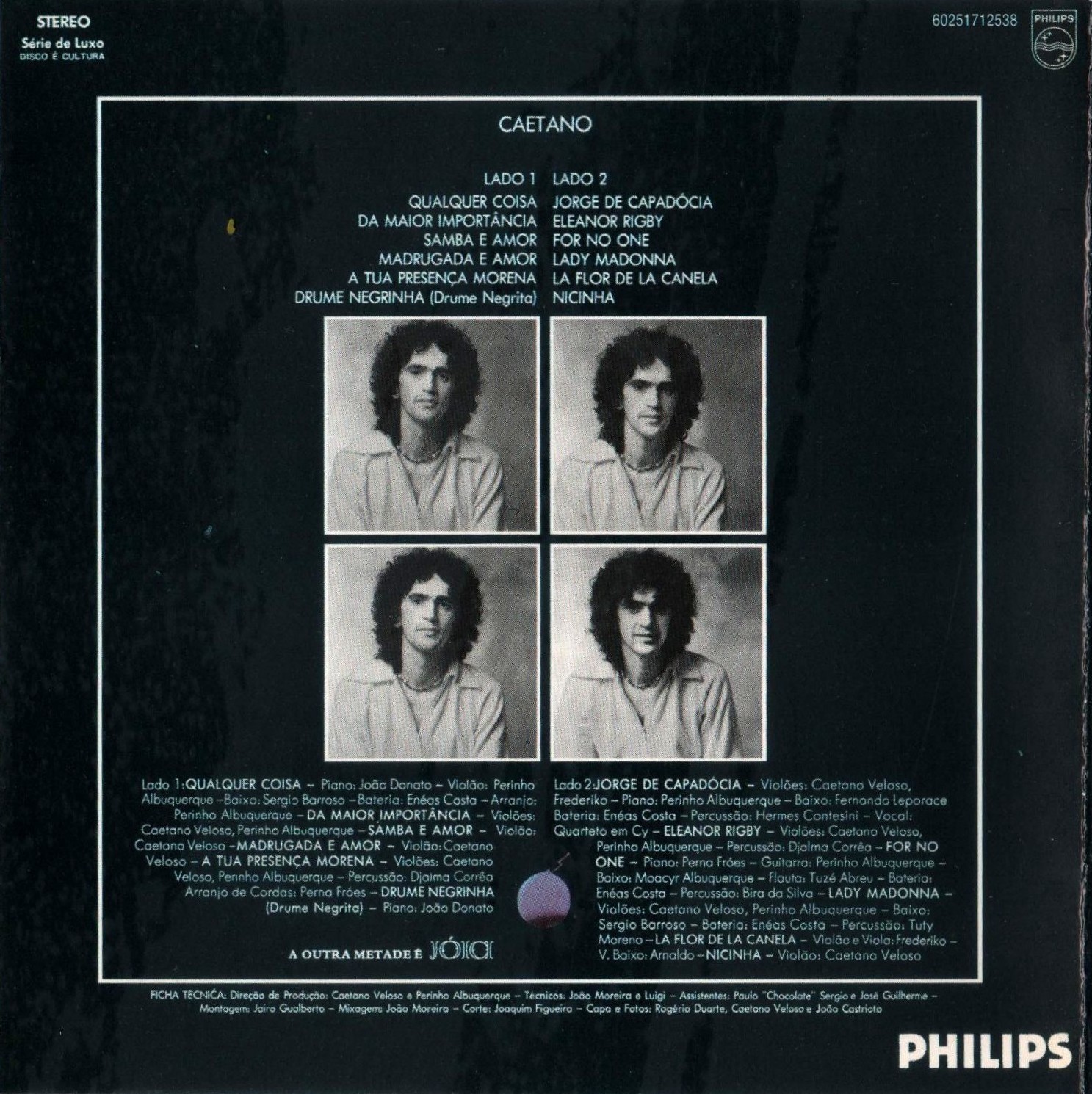
jóia / qualquer coisa


Caetano Veloso simultaneously created two pseudo-movements with these two jewels of unique expression and quiet contemplation.   He had been the catalyst for a new hybrid of traditional music with modern influences over the course of almost a decade on albums like Domingo with Gal Costa in 1967, Caetano Veloso (Tropicália), the 1968 collaboration Tropicália: ou Panis et CircensesCaetano Veloso in 1969 and  Caetano Veloso in 1971, and  Transa and Araçá Azul in 1972.   

After spending some time touring and producing albums for other, he returned to the studio to record one album of (mostly) originals and a second of (mostly) covers.  The proceedings were produced by Caetano Veloso and Perinho Albuquerque and included  Moacyr Albuquerque and Sergio Barroso on bass;  Perinho Albuquerque on arrangements, guitar, violin, and percussion;  Tuzé Abreu, Altamiro Carrilho, Jorge Ferreira da Silva, and Celso on flute;   Djalma Corrêa and Bira Da Silva on percussion;  Perna Froes on arrangements and piano;  As Gatas on background vocals;  Tutty Moreno on bateria;  Quarteto em Cy on vocals;  with  Jairo Gualberto and Aldo Luiz;  and  director Caetano Veloso on guitar, percussion, viola, and vocals.     Both albums were released on the same day in June of 1975.  The racy album cover for 'Jóia' was banned by the Brazilian goverment.  


http://caetanoveloso.com.br/


"Jóia"
https://www.youtube.com/watch?v=bca8KmPXro8


"Lua, Lua, Lua"
https://www.youtube.com/watch?v=egb-EcydMKo


Escapulário
https://www.youtube.com/watch?v=wWMam99r4J4


"Jóia"
full album:

https://www.youtube.com/playlist?list=PLh3wyaXXqme76hLLmNd_CsB-xx4jVrF_R


All songs composed by Caetano Veloso, unless otherwise indicated.
Minha mulher  – 4:46
Guá (Perinho Albuquerque, Caetano Veloso) – 3:13
Pelos olhos  – 2:35
Asa, Asa  – 1:36
Lua, lua, lua, lua  – 3:59
Canto do povo de um lugar  – 4:11
Pipoca moderna (Sebastião Biano, Caetano Veloso) – 3:11
Jóia  – 1:27
Help (Lennon, McCartney) – 2:30
Gravidade  – 2:55
Tudo tudo tudo  – 2:00
Na asa do vento (Luiz Vieira, João do Vale) – 4:08
Escapulário (Oswald de Andrade, Caetano Veloso) – 2:17


"Qualquer Coisa"
https://www.youtube.com/watch?v=1FtVHzligxI


 "For No One"
https://www.youtube.com/watch?v=Nns1CYCyTMg


"Qualquer Coisa"
full album:

https://www.youtube.com/playlist?list=PLH-7xOQpXBxsnmEhgmidCvBZRO_AfCB1k


All songs composed by Caetano Veloso, unless otherwise indicated.
Qualquer coisa  - 3:15
Da maior importância  - 4:34
Samba e amor (Chico Buarque) - 2:54
Madrugada e amor (José Messias) - 3:39
A tua presença morena  - 2:04
Drume negrinha (Drume negrita) (Eliseo Grenet, Caetano Veloso) - 3:53
Jorge de Capadócia (Jorge Ben) - 3:21
Eleanor Rigby (Lennon, McCartney) - 5:33
For No One (Lennon, McCartney) - 5:02
Lady Madonna (Lennon, McCartney) - 2:49
La flor de la canela (Chabuca Granda) - 3:12
Nicinha  - 0:46


Friday, March 21, 2014

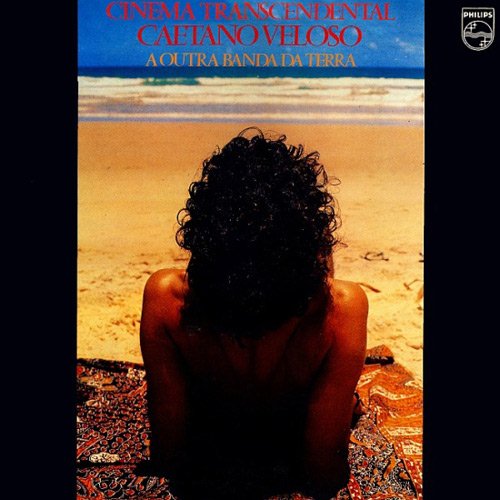
cinema transcendental


Caetano Veloso found his bliss in the organic acoustic grooves of this soothing and sensual mystical meditation.  'Cinema Transcendental' shows Velose and A Outra Banda da Terra cooling the afro-jazz rhythms of 'Bicho' and the sultry samba of 'Muito (dentro da estrela azulada)' into a more subtle sound while still experimenting with different genres and forms.  

The sessions were produced and engineered by Paulo Chocolate and Luis Claudio Coutinho with Caetano Veloso on production, acoustic guitar, whistle, palmas, percussion, and vocals;  Tony Costa and Perinho Santana on guitar;  Tomás Improta on keyboards, arrangements, claves, bamboo flute, palmas, percussion, and vocals;  Arnaldo Brandão on bass, palmas, percussion, and vocals;  Vinícius Cantuária on drums and steel guitar;  Bolão on percussion, palmas, and vocals;  and Dominguinhos on accordion;  with Lúcia Turnbull and Marizinha on choir.   


Veloso would expound at the time:   "The sung word is, in sum, another type of raw material that is related to the written word and the spoken word, but that cannot be reduced to either. The sung word works, perhaps, as a synthesis of the other two; it has performed at least that function. Enjoying the word in a state of poetry has always been more intense in the arena of popular music that in the others.   Perhaps this phenomenon has to do a bit with fatigue, fatigue of the visual, of visual communication, of reading. At the end of the 1960s, McLuhan’s talk about that stuff was perhaps an indication of such a fatigue. The visual failed. The ear is something much more absorbing, more participatory. Sound comes from everywhere; it penetrates every pore.  Perhaps such a fatigue is temporary. Things come and go. I don’t believe that things go forward, as if there could be a kind of progress. I don’t share the Western idea of linear progress...Brazilian popular music is, in all senses of the word, very abundant. It is the only artistic expression in Brazil that is not poor. In reality, it is an aberration in Brazilian society: it’s different. Nowhere in the world does popular music matter as much as it matters here.   Popular music always manages to support itself, always manages to get enough resources to stay strong, something that doesn’t happen with written poetry, with film, with theater. It generates push, national pride. It has the mission of expressing the country.   A generation like mine, with Jorge Ben, Gilberto Gil, Chico Buarque, Paulinho da Viola, only managed to succeed because other good people were there before.   Not even in the United States is popular music as strong as it is here, because Americans also have other things. 'There they have money, cars, lawns, food / all of that is cool,' to quote a verse from Paulo Leminski. Brazilians are very poor; they don’t manage to get together to get anything done. But in the midst of such chaos, popular music somehow works. Popular music is the philosophical expression of the country. It is much more important than all the college-educated people of all ages who already wrote about all the complicated things in the world. Popular music is a more totalizing expression of Brazil, a more direct one. It doesn’t mess with noble materials because Brazil is not a noble country.   I believe that the 'paper' poets are in a more general way linked to a European tradition, and popular music is something more linked to the Americas. When it appeared, the Americas were already around. In that way, it is somewhat like cinema, and, at the same time, it is music because it is a very old thing."


http://www.caetanoveloso.com.br/


 'Cinema Transcendental' 
full album:


00:00 Lua de São Jorge
03:57 Oração ao Tempo
07:24 Beleza Pura
10:54 Menino do Rio
13:22 Vampiro
17:26 Elegia [adaptado de poema de John Donne]
19:45 Trilhos Urbanos
22:31 Louco Por Você
30:10 Cajuína
32:30 Aracaju
34:54 Badauê,
36:27 Os Meninos Dançam


1. "Moon of St. George" 3:57
2. "Prayer at the Time" 3:25
3. "Pure Beauty" 3:30
4. "River Boy" 2:28
5. "Vampire" Jorge Mautner 4:03
6. "Elegy" Pericles Cavalcanti and Augusto de Campos 2:19
7. "Urban Trails" 2:46
8. "Crazy for You" 7:40
9. "Cajuína" 2:20
10. "Aracaju" Thomas Improta, Canterbury Vinicius Caetano Veloso and 2:23
11. "Badauê" Môa the Catende 1:32
12. "The Dancing Boys" 3:14


Friday, March 7, 2014

getz/gilberto


This classic collaboration set the standard for samba in the world of jazz.  Stan Getz had been experimenting with Brazilian music by collaborating with different guitarists.   It began with Charlie Byrd (who had just toured Brazil) on 'Jazz Samba' (winning the Grammy for Best Jazz Performance of 1963 for "Desafinado") and continued with Brazilian guitarist Luiz Bonfá on 'Jazz Samba Encore!'In between he recorded 'Big Band Bossa Nova' with arrangements by Gary McFarland and Jim Hall on guitar. 

For his next project, he brought in João Gilberto and Antonio Carlos Jobim who had both been instrumental in creating the style of bossa nova.  The sessions took place at A&R Recording Studios in New York City with producer Creed Taylor and featured Stan Getz on tenor saxophone; João Gilberto on guitar and vocals; Antonio Carlos Jobim on piano; Sebastião Neto on bass; and Milton Banana on drums;  with Astrud Gilberto on vocals (in "The Girl from Ipanema" & "Corcovado"). 

The results were magical.  'Getz/Gilberto' became one of the biggest selling jazz albums of all time and the biggest Brazilian album ever.  It won tons of Grammy's including Album of the Year.  Decide for yourself if it isn't the grooviest thing you've ever heard.  


http://www.stangetz.net/


http://joaogilberto.org/


http://www.jobim.com.br/


"The Girl from Ipanema" was a worldwide smash hit in the that won a Grammy for Record of the Year in 1965.  It is one of the most covered songs of all time. 

http://www.youtube.com/watch?v=UJkxFhFRFDA


1. "The Girl from Ipanema" 
Antônio Carlos Jobim, Vinicius de Moraes, Norman Gimbel 5:24
http://www.youtube.com/watch?v=c5QfXjsoNe4


2. "Doralice" 
Dorival Caymmi, Antonio Almeida 2:46
http://www.youtube.com/watch?v=JMe52bNozYg


3. "P'ra Machucar Meu Coração" 
Ary Barroso 5:05
http://www.youtube.com/watch?v=Lt6rsHa88t0


4. "Desafinado" 
Jobim, Newton Mendonça 4:15
http://www.youtube.com/watch?v=EScHcS-o2oE


5. "Corcovado" 
Jobim, Gene Lees 4:16
http://www.youtube.com/watch?v=lyWX5HH16vc


6. "Só Danço Samba" 
Jobim, de Moraes 3:45
http://www.youtube.com/watch?v=uiWEJotU__0


7. "O Grande Amor"
Jobim, de Moraes 5:27
http://www.youtube.com/watch?v=4YfEMhlcX54


8. "Vivo Sonhando" 
Jobim 3:04


9. "The Girl from Ipanema" [45 rpm issue] 
Jobim, de Moraes, Gimbel 2:54
http://www.youtube.com/watch?v=YPHFu2ETIqc


10. "Corcovado" [45 rpm issue] 
Jobim, Lees 2:20


'Getz/Gilberto' 
full album:


1. The Girl From Ipanema - 00:00:00
2. Doralice - 00:05:24
3. Para Machuchar Meu Coracao - 00:008:09
4. Desafinado (Off Key) - 00:13:15
5. Corcovado (Quiet Nights Of Quiet Stars) - 00:17:27
6. So Danco Samba - 00:21:44
7. O Grande - 00:25:30
8. Vivo Sonhando (Dreamer) - 00:30:57
9. The Girl From Ipanema (45 rpm Issue) - 00:33:50
10. Quiet Nights Of Quiet Stars (45 rpm Issue) - 00:36:38 


Saturday, February 8, 2014

nara


Nara Leão sought the ugly truth in the socially conscious samba of this warm and winsome consolation.  She had begun playing the guitar at the age of twelve and was a part of the birth of bossa nova with many informal jam sessions taking place at her parent's home.  She learned from Solon Ayala, Patrício Teixeira, Roberto Menescal, and Carlos Lyra and played with such luminaries as João Gilberto, Luiz Eça, Ronaldo Bôscoli, Vinicius de Moraes, Antônio Carlos Jobim, and Sérgio Mendes.  Her involvement with the musical movement led to her affectionate nickname of 'the Muse of Bossa Nova'.  After making her stage debut in the musical comedy Pobre Menina Rica, by Vinícius de Moraes and Carlos Lyra, she began her recording career.  While on tour, she was exposed to the more radical elements of the Brazilian popular music movement (Caetano Veloso, Gilberto Gil, Gal Costa, and Maria Bethânia) who influenced her turn away from the cool and sophisticated lounge sound toward the more ideological sambas de morro of the slum favelas.  Her debut album  'Nara' was recorded with producer Aloysio de Oliveira with arrangements by Lindolfo Gaya and Moacir Santos. 


Leão expressed at the time:   "Enough bossa nova. Enough of singing little apartment compositions for two or three intellectuals. I want pure samba, which has much more to say for itself, which is the people’s way of expressing themselves, and not something written by some small group for another small group. The story that bossa nova originated in my house is a big lie. Even if the gang did often get together here, they also did so in a thousand other places. I want nothing, and I mean nothing, to do with a musical genre that I don’t feel a part of, and that isn’t even genuine ... Bossa nova is boring, it doesn’t excite me. Perhaps I was an idiot in the past, blindly accepting that square form of music that, even now, people are still trying to pin on me. I’m not the person they’re trying to make me out to be: a little rich girl, who lives on Avenida Atlantica, overlooking the sea ... Bossa nova always has the same basic theme: love-flower-sea-love-flower-sea, and it goes on ad infinitum. It’s very complex. You need to hear it sixty times in order to understand what’s being said. I don’t want to spend the rest of my life singing ‘The Girl from Ipanema,’ much less in English. I want to be understood, I want to be a singer of the people.”


http://www.naraleao.com.br/


http://www.batanga.com/en/cds/nara-leao-nara


O Morro
Gianfrancesco Guarnieri / Carlos Lyra
3:05
http://www.youtube.com/watch?v=364l0kZi1Mw


O Sol Nascera
Agenor D'Oliveira / Elton Medeiros
2:59
http://www.youtube.com/watch?v=2t8hr2D-pb4&feature=kp


Luz Negra
Irani Barros / Nelson Cavaquinho
2:33
http://www.youtube.com/watch?v=xqtGGdXyum0&feature=kp


Berimbau
Vinícius de Moraes / Baden Powell
2:34
http://www.youtube.com/watch?v=ocjEz4Zzcn0


Maria Moita
Carlos Lyra / Vinícius de Moraes
2:42
http://www.youtube.com/watch?v=Wk3sVLkHXVo


Nana
Moacyr Santos / Mario Telles
2:08
http://www.youtube.com/watch?v=plieI6BKE2k


'Nara'
full album


Tuesday, July 16, 2013

samba esquema novo


Jorge Ben made his free spirited debut with the new style swing of this seductive samba.  He was born Jorge Duilio Lima Menezes in Rio de Janeiro and began playing guitar to emulate the bossa nova style of João Gilberto.   He took the stage name Ben from his mother's maiden name.  He sang in a church choir and played parties and nightclubs, where he was discovered at the age of twenty-three and signed to the Phillips label.  A week later, his first single 'Mas Que Nada' was released and became such a huge sensation that other artists were tripping over each other to cover the song.  

'Samba Esquema Novo' ("New Style Samba") was recorded with producer Armando Pittigliani and features Jorge Ben on vocals and violão; Manuel Gusmão on bass; Luís Carlos Vinhas on piano; J.T. Meirelles on flute and saxophone; Pedro Paulo on trumpet; and Dom Um Romão on drums.  


http://www.jorgebenjor.com.br/


'Mas Que Nada'
http://www.youtube.com/watch?v=dDlVZNfxVtE


Mas que nada
Don't mind that

Sai da minha frente
Get out of my way

Eu quero passar
I want to come through

Pois o samba está animado
Because the samba is cheerful 

O que eu quero é sambar
And what I want is to samba

Este samba
This samba

Que é misto de maracatu
is a mixture of Maracatu

É samba de preto velho
It is the old black man's samba

Samba de preto tu
Black man's samba

Mas que nada
Don't mind that

Um samba como esse tão legal
A samba like this is so cool

Você não vai querer
You won't want it 

Que eu chegue no final

to come to an end.


In 1966, Sergio Mendez and Brasil 66 took the song to number forty-seven on the US pop chart and number four on the US easy listening chart.
http://www.youtube.com/watch?v=BrZBiqK0p9E


'Samba Esquema Novo'
full album:
http://www.youtube.com/watch?v=IPENGb-FG5E


1 Mas, Que Nada 0:00
2 Tim, Dom, Dom 3:02
3 Balança Pema 05:23
4 Vem, Morena, Vem 6:53
5 Chove, Chuva 8:52
6 É Só Sambar 11:59
7 Rosa, Menina Rosa 14:05
8 Quero Esquecer Você 16:21
9 Uala, Ualala 18:43
10 A Tamba 20:52
11 Menina Bonita Não Chora 23:57
12 Por Causa de Você, Menina 26:05