Showing posts with label brian eno. Show all posts

Tuesday, December 22, 2015

evening star


Brian Eno and Robert Fripp layered treatments and textures into the meditative metallic melodies of this cosmic collaborative quietus.  While they were still in their respective bands Roxy Music and King Crimson, the pair came together to create (No Pussyfooting) in 1972 utilizing tape loops and effects to create droning atmospheric soundscapes.   

Fripp reveals:   "I was first introduced to the technique, the actual way of using two tape machines together by Brian Eno seven years ago this month when we recorded side one of No Pussyfooting. A purely unofficial off-the-cuff informal meeting when for the first time I visited him socially at home in London. And the story behind this is Bryan Ferry auditioned for King Crimson in December 1970, and I turned him down but I suggested he go and visit David Enthoven, the manager of King Crimson, the "E" of EG, which he did, and consequently Roxy Music went into EG, and Eno was part of that establishment. So I bumped into Eno in the office a couple of times, and he invited me round. And I went round with my guitar and pedalboard for no reason that I can recall. In fact I had no idea why then. And he said, "Well, plug in." So I did. He didn't tell me how it worked. I simply intuited what was happening, and that was side one of No Pussyfooting"

Eno elaborates:   ''[When I said, 'I'm not a musician',] It was originally intended to indicate that my interest in music was in a set of ideas rather than in a set of techniques and it was intended to make a distinction between a body of opinion that saw music simply as a bundle of virtuosity and a bundle of skills which I don't think it is. Those skills are the vehicle for a set of ideas and it's the ideas that interest me. The obvious attraction of synthesizers for me was that there was no code of playing any of this new equipment and recording studio technology developed so quickly that nobody could say 'This is the right way to play a synthesizer'...There are things that you can do when you're naive that you can't do when you're not naive anymore. For example, you'll never learn to draw like a child again so you have to accept that you can't do that and you say what you'll do is just draw as you are.''


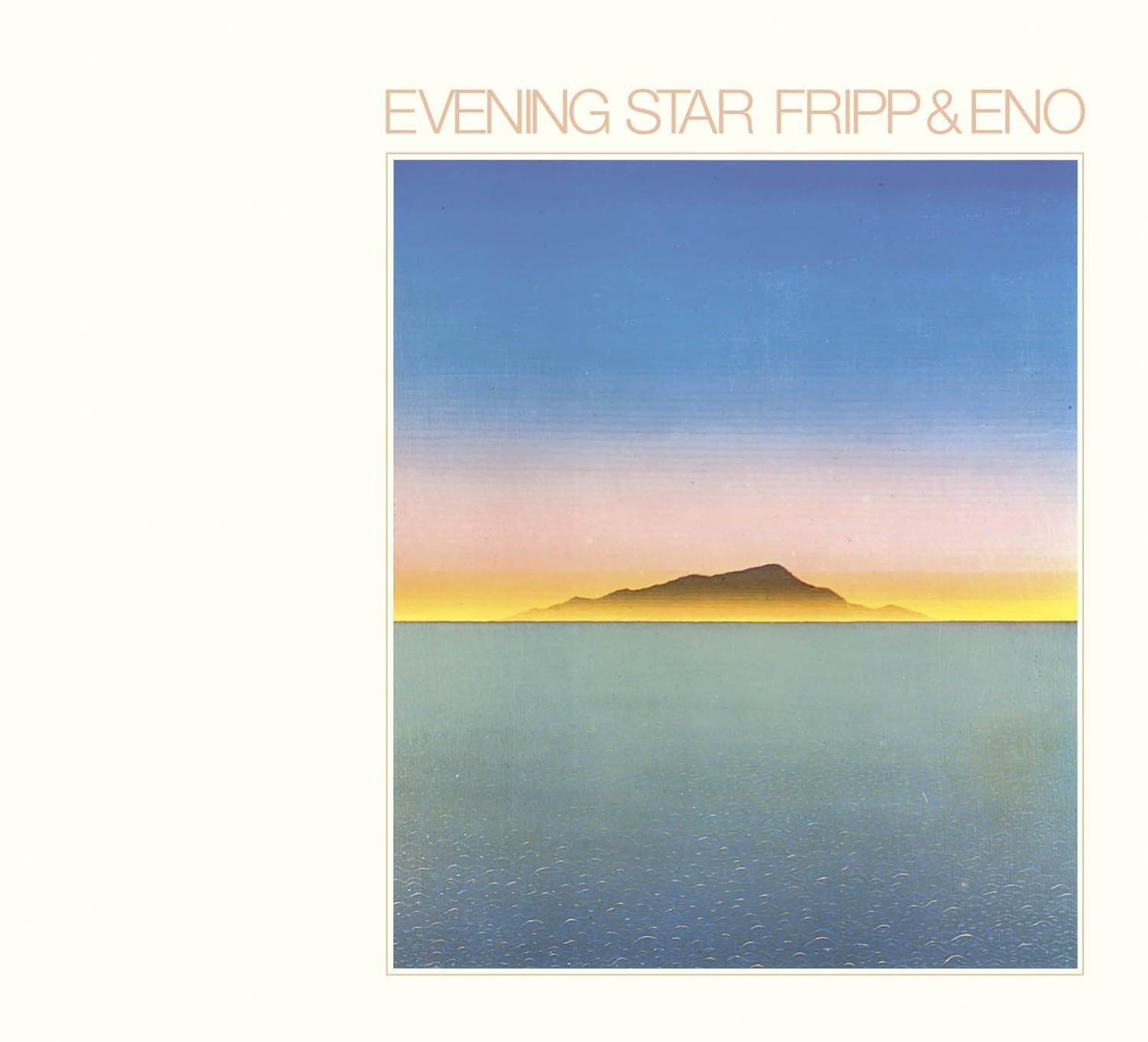
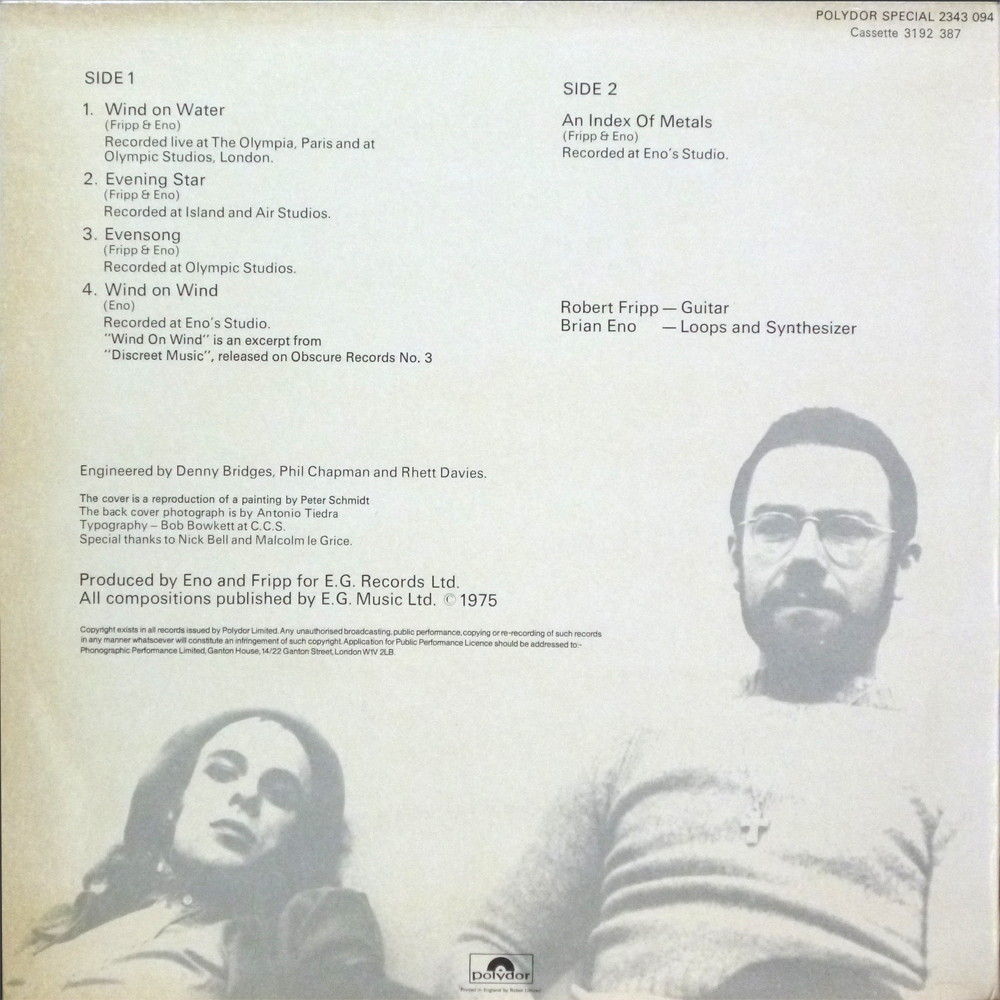
In the intervening years, Eno left Roxy Music and recorded several groundbreaking albums (Here Come the Warm Jets  and  Taking Tiger Mountain  in 1974,    and    Another Green World   and   Discreet Music  earlier in 1975);  while Fripp disbanded King Crimson after a series of turbulent lineup changes.   The duo came together again to produce Evening Star with Robert Fripp playing guitar and  Brian Eno handling tape loops, synthesizer, and piano.  "Wind on Wind" was an excerpt from Eno's Discreet Music.   The cover painting for Evening Star was done by Peter Schmidt.    


Eno:   ''If you had a sign above every studio door saying 'This Studio is a Musical Instrument' it would make such a different approach to recording.  You see my interest for quite a while has been in using the studio not as a machine that you feed input into and have it transferred onto a piece of tape. It's a means not simply of re-creating but of actually changing a sound. Sometimes it is even a source of that sound.''

The technique of guitar effects they developed became known as 'Frippertronics'.   Fripp considers:  "A lot of Frippertronics is ambient within Eno's definition of the term, that it's music as ignorable as it is listenable. There are two categories of Frippertronics, pure and applied. Applied is where it's used as an alternative to traditional orchestration, instrumentation, arrangement and so on and pure Frippertronics is where Frippertronics stands up as music in it's own right. Some of this is ambient and some of it has an imperative, a demand to be heard, that one must listen to it in order to catch the sense of it. So some of it is and some of it isn't...The most exciting response is where there's no excitement. That excitement is a cheap state of the release of tension, that a qualitative experience does not involve excitement, that it involves something quite different. It involves a sense of still, a sense of calm, a sense which is tangible but quite intangible and it's very difficult to express rationally. "

Eno expounds:   "The function of being an artist for me is that it's an experimental area where I can test ways of thinking and operating and hopefully apply the results to real life. The advantage of testing them in an art context is that it doesn't really matter if you fail. You can afford to take risks that you wouldn't allow yourself in normal life. Having taken those risks and seen what freedoms they allow or what restrictions they impose, you are then free to extrapolate them into normal-life situation. That's what I think is the function of culture - to teach you new way of dealing with the world...We are no longer concerned with making horizontal music, by which I mean music that starts at point A, develops through point B and ends at point C in a kind of logical or semi logical progression. What's more interesting is constructing music that is a solid block of interactions. This then leaves your brain free to make some of those interactions more important than others and to find which particular ones it wants to speak to.  One thing about vertical music is that you can enter it at any point and leave it at any point. You don't have to be in at the beginning."


http://brian-eno.net/

http://www.enoshop.co.uk/


https://www.dgmlive.com/


"Evening Star"


 Evening Star
full album:


Brian Eno & Robert Fripp | Evening Star | Whole... by OssieBabb


All tracks written by Brian Eno and Robert Fripp, except "Wind on Wind" by Eno.

Side one
"Wind on Water" – 5:30
"Evening Star" – 7:48
"Evensong" – 2:53
"Wind on Wind" – 2:56
Side two
"An Index of Metals" – 28:36


Thursday, September 10, 2015

another green world


Brian Eno went surging down the wires watching words float in sequence like softened silhouettes of delphic doldrums in an eternity of uncertainty.   After putting out two acclaimed albums in 1974 (Here Come the Warm Jets   and  Taking Tiger Mountain (By Strategy)), he decided that he would take a purely experimental approach on his next project, working with his Oblique Strategies cards to stimulate new ideas.  Eno  co-produced the sessions with engineer Rhett Davies during July and August of 1975 at Island Studios in London.  Eno reveals:   "I fed in enough information to get something to happen and the chemical equation of the interaction between the various styles of the musicians involved - who were intelligent enough not to retreat from a situation which was musically strange - took us somewhere that we would have been unable to design...Twenty-four track technology encourages you to keep adding things.  But there comes a point where adding simply obscures what's already there, and toward the end of that album I listened to the tracks to see what I could take away.  The more you supply, the less you demand of a listener...The idea of of making music that in some way related to a sense of place - landscape or environment -  had occurred to me many times over the last twelve years. My conscious exploration of this way of thinking about music probably began with 'Another Green World' in 1975.  Since then I have become interested in exaggerating and inventing rather than replicating spaces, and experimenting with various techniques of time distortion."  


The sessions for 'Another Green World' included Phil Collins on drums and percussion;   Percy Jones on fretless bass;   Paul Rudolph on anchor bass, bass, snare drums, bass guitar, assistant castanet guitars, and guitar;   Rod Melvin on rhodes piano and lead piano;   John Cale on viola;   Robert Fripp on wimshurst guitar, restrained lead guitar;   Brian Turrington on bass guitar and pianos;   and  Brian Eno on snake guitar, digital guitar, vocals, synthesizer, guitars, tapes, organ, piano, yamaha bass pedals, synthetic percussion, desert guitars, electric percussion, treated rhythm generator, chord piano, farfisa organ, Hammond organ, Peruvian percussion, electric elements and unnatural sounds, prepared piano, choppy organs, spasmodic percussion, club guitars, uncertain piano, Leslie piano, grand piano,  tape, and bass guitar.   'Another Green World'  only charted in New Zealand at number twenty-four; but it became a major influence on ambient music.  


http://brian-eno.net/


"Sky Saw"
https://www.youtube.com/watch?v=syiceT77Cn4


All the clouds turn to words 
All the words float in sequence 
No one knows what they mean
Everyone just ignores them

Mau Mau starter ching ching da da 
Daughter daughter dumpling data 
Pack and pick the ping-pong starter 
Carter Carter go get Carter 
Perigeeeeeee 
Open stick and delphic doldrums 

Open click and quantum data.


"Another Green World"
https://www.youtube.com/watch?v=KJdydQ12ICw


"Golden Hours"
https://www.youtube.com/watch?v=K86xVtI_c6U


The passage of time is flicking dimly upon the screen; 
I can't see the lines I used to think I could read between. 
Perhaps my brains have turned to sand. 

Oh me oh my, I think it's been an eternity. 
You'd be surprised at my degree of uncertainty. 
How can moments go so slow?

Several times I've seen the evening slide away. 
Watching the signs taking over from the fading day. 
Perhaps my brains are old and scrambled ...

Several times I've seen the evening slide away. 
Watching the signs taking over from the fading day. 
Changing water into wine...

Several times I've seen the evening slide away. 
Watching the signs taking over from the fading day. 
Putting grapes back on the vine...

Who could believe what a poor set of eyes can show you? 
Who would believe what an innocent voice could do? 
Never a silence, always a face at the door

Who would believe what a poor set of ears can tell you? 
Who would believe what a weak pair of hands can do? 
Never a silence, always a foot in the door.


"Becalmed"
https://www.youtube.com/watch?v=DyLn_uFXBFw


 'Another Green World' 
full album:
https://myspace.com/ambientlegend/music/album/another-green-world-9640294


All songs written by Brian Eno.

side A
00:00  "Sky Saw"  – 3:25
03:27  "Over Fire Island"  – 1:49
05:18  "St. Elmo's Fire"  – 3:02
08:22  "In Dark Trees"  – 2:29
10:52  "The Big Ship"  – 3:01
13:55  "I'll Come Running"  – 3:48
17:46  "Another Green World"  – 1:38
side B
19:23  "Sombre Reptiles"  – 2:26
21:49  "Little Fishes"  – 1:30
23:20  "Golden Hours"  – 4:01
27:21  "Becalmed"  – 3:56
31:17  "Zawinul/Lava"  – 3:00
34:18  "Everything Merges with the Night"  – 3:59
38:18  "Spirits Drifting"  – 2:36


Saturday, November 29, 2014

taking tiger mountain (by strategy)


Brian Eno sought a certain ratio swinging about through the creepers to make us weep more cheaply with subtleties a spectrograph would miss in the impressionistic espionage of these strategically scaled scenes of surrender.  

Eno had started 1974 off with the artistic triumph of his solo debut 'Here Come the Warm Jets' and continued to work in the studio producing John Cale's 'Fear', Robert Calvert's 'Lucky Leif and the Longships', and two albums for the Portsmouth Sinfonia.  Eno also collaborated with Kevin Ayers on the experimental spoken word album 'Lady June's Linguistic Leprosy';  and the two of them performed an all-star concert with John Cale and Nico at the Rainbow Theatre in London that was released as a live album entitled 'June 1, 1974'.  


All the while, Eno was struggling with the lyrical component of composition:   "I...began to wonder about what lyrics were...They aren't a problem in the sense of inhibition - but they were a problem in that I didn't have anything to say. I didn't have a message and I didn't have experiences that I felt strongly enough to want to write about. In fact, I felt far more strongly about the intellectual side of me that was going into essays and lectures and things...All my favourite songs had lyrics which I didn't quite understand...My own favourite songs had lines like that. 'Dead Finks', for example: 'Oh please sir, will you let it go by / Cos I failed both tests with my legs both tied / In my case the stuff is all there / I've never been so sad for a very long time.'  Which gave me a picture of this tongue-twisted boy who had just failed an interview and was sort of blushing and embarrassed.  And I decided I wanted these picture-lyrics. Because love-songs don't do that. Love-songs make a number of statements - which I'm wary of doing - so I've avoided love-songs, and it's only on this album I've just done that anything like a love-song starts to appear."


A major epiphany came when he found a set of postcard stills from a Red Chinese ballet-film called Taking Tiger Mountain By Strategy:   "It was so exciting! I thought 'That's the sort of lyric I want!' There was 'Tiger Mountain' which gave it a medieval, almost folksy, flavour - and 'By Strategy', which was very up-tempo and modern.  So I bought the set and started carrying it around with me and thinking about it. And when I got to New York I went to stay with this girl called Randi and fell asleep after taking some mescaline and had this dream where this group of girls were singing to this group of sailors who had just come into port. And they were singing 'We are The 801 / We are the Central Shaft' - and I woke up absolutely jubilant because this was the first bit of lyric I'd written in this new style."

Back in London, Eno began going through years of old tapes to find fragments with which to work:   "I called up Phil (Manzanera) and asked him over to help. What actually happened was that I'd have loads of little bits and pieces lying around which I'd give to him to work out what key they were in, etc., and then he'd come back to me and say 'Well, this bit might fit onto the end of that bit', you know?  He helped a lot by plastering it together - and also by co-writing 'The True Wheel' which contains the fragment about The 801.   As soon as I'd made up the shape of the song, I made a plan of it on paper, sketching out all the spaces where I wanted words, and began running through it, just singing whatever came into my head. And every time I hit on a phrase I liked, I'd write it down in its particular place in the framework.   And gradually I'd arrive at a kind of 'found' document made up of half-obscured fragments -and all I then had to do was fill in the blanks by reconstructing what I thought each lyric was about. Automatic writing, in fact.  I liked the idea of making myself into a channel for whatever it is to transmit ideas and images through. So my lyrics are receivers, rather than transmitters, of meaning - very vague and ambiguous, but just about evocative enough to stimulate some sort of interpretation process to take place.  The mysterious thing is: where do the words come from?"


The sessions for 'Taking Tiger Mountain (By Strategy)' took place at Island Studios in London with Brian Eno on arrangements, production, vocals, electronics, snake guitar, and keyboards;   Phil Manzanera on arrangements, production, and guitars;   Brian Turrington on bass guitar;  Freddie Smith on drums;  and Robert Wyatt on percussion and backing vocals.  "Special Guests" included Portsmouth Sinfonia on strings for "Put a Straw Under Baby";  Randi and the Pyramids on the chorus of "The True Wheel";  The Simplistics on the chorus of "Back in Judy's Jungle" and "Taking Tiger Mountain";   Andy Mackay providing brass on "The Fat Lady of Limbourg";  Phil Collins adding extra drums on "Mother Whale Eyeless";  and Polly Eltes doing vocals on "Mother Whale Eyeless".  Rhett Davies engineered the album with assistant Robert Ash.   During the process he also worked with Peter Schmidt to develop the 'Oblique Strategies (Over One Hundred Worthwhile Dilemmas)' cards to help break through creative blocks by trying a random approach.  Schmidt also designed the album cover from lithographs and polaroids of Eno.  

Manzanera looks back:     "Oh, it was great fun. On "Taking Tiger Mountain (By Strategy)", we were just doing anything we felt like doing at the time. The funny thing is that the engineer who we used, Rhett Davies, he's involved on this Roxy tour. He also did "Diamond Head" and "801 Live" and Quiet Sun, so it's like a family. There was a lot of experimenting and a lot of hours spent with Brian Eno, me and Rhett in the control room doing all the things that eventually evolved into those cards, the "Oblique Strategies", and it was a lot of fun. But then, after "801 Live", Eno went off to work with Bowie, and we virtually never saw him again. He was just too busy working with all those other people."

Eno considers:  "I nearly always work from ideas rather than sounds. Titles. It's that title that just fascinates me. It's fabulous. I mean, I am interested in strategy, and the idea of it. I'm not Maoist or any of that; if anything, I'm anti-Maoist. Strategy interests me because it deals with the interaction of systems, which is what my interest in music is really, and not so much the interaction of sounds ... The dichotomy between the archaic and the progressive. Half Taking Tiger Mountain – that Middle Ages physical feel of storming a military position – and half (By Strategy) – that very, very 20th-century mental concept of a tactical interaction of systems ... One of the recurrent themes of rock music is a preoccupation with new dances. And it's taken by intellectuals as the lowest form of rock music, the most basic and crude. So I was interested in combining that very naive and crude form of expression with an extremely complex concept like Taking Tiger Mountain, which would be a sort of double joke. First of all the joke of me doing a dance number and secondly the fact that it also has a complex symbology that discusses another question. The idea is paraphrasing the dance as a dance between two technologies. One of McLuhan's contentions is that conflict, international conflict, is always conflict between two technologies, not two moralities. Moralities are dictated by those technologies. I've taken the conflict between the regular-type soldiers and guerilla-type technologies. I've called the regular soldier-type ones, since they're mechanically oriented, clockwork ones. The guerilla tactic ones are electronic... I'm not subscribing to any political point of view. It's to do with this technological rift. Technological rifts have always produced hybrid art forms... For the soldiers, it's a set of emergencies. For the guerillas, it's a set of opportunities." 


http://brian-eno.net/


"Taking Tiger Mountain" 
https://www.youtube.com/watch?v=rBeQuVJYuKw


"China My China"
https://www.youtube.com/watch?v=7oNEsJHUFcs


"The True Wheel"
https://www.youtube.com/watch?v=-bPbToMJmCI


"Third Uncle"
https://www.youtube.com/watch?v=MbEZWm0JrRo


 'Taking Tiger Mountain (By Strategy)'
full album:
https://www.youtube.com/playlist?list=PLCF93A3601AC09CE0


All songs written and composed by Brian Eno, except where noted. 


Side one
https://www.youtube.com/watch?v=mNAvsMdGeOU


1. "Burning Airlines Give You So Much More"   3:18
2. "Back in Judy's Jungle"   5:16
3. "The Fat Lady of Limbourg"   5:03
4. "Mother Whale Eyeless"   5:45
5. "The Great Pretender"   5:11


Side two
1. "Third Uncle" (Eno, arr. Brian Turrington) 4:48
2. "Put a Straw Under Baby"   3:25
3. "The True Wheel" (composed by Eno, Phil Manzanera) 5:11
4. "China My China"   4:44
5. "Taking Tiger Mountain"   5:32


Wednesday, January 8, 2014

here come the warm jets


Brian Eno lent assistance to the object with the oblique strategies and avante-glam pop experiments of his solo debut.  Eno had left Roxy Music over creative differences with Bryan Ferry after their second album 'For Your Pleasure' and collaborated with Robert Fripp on an album of ambient music '(No Pussyfooting)' before starting work on 'Here Come the Warm Jets'.  


The album was produced by Eno over twelve days at Majestic Studios in London with engineer Derek Chandler; and mixed at Air and Olympic Studios by Eno and engineer Chris Thomas.   The sessions featured Brian Eno on vocals, synthesizer, guitar, keyboards, treatments, and instrumentation; Chris Spedding, Phil Manzanera, and Robert Fripp on guitar;  Simon King, Marty Simon, and Paul Thompson on percussion; Bill MacCormick, John Wetton, Chris Thomas, and Busta Jones on bass guitar; Paul Rudolph on guitar and bass guitar; Nick Judd and Nick Kool & the Koolaids on keyboards; Andy Mackay on keyboards and saxophone septet; Sweetfeed on backing vocals; and Lloyd Watson on slide guitar.  


Eno would expound:    "Vocal techniques. That's something I've never even thought about. Why, I propose the question to myself do people sing certain ways at certain times in history? Why should I want to sing through my nose?...What I like is when you get a combination of something that's very turned-down and dark and sinister, but not dramatic – very underhand and almost inaudible, as opposed to the kind of aggression that people like The Floyd use, which is very obvious assault. Iggy Pop does it as well.  I like taking something that's played down – low-key – contrasting with a voice that's very anguished, making the whole sound grotesque and aggressive in a pathetic and laughable way. 'Baby's On Fire' starts out as though it's going to be very sinister, but has very ordinary words, sung with an incredible amount of passion...I'm always prone to do things very quickly, which has distinct advantages – you leave all the mistakes in, and the mistakes always become interesting. The Velvet Underground, for example, are the epitome of mistake-filled music, and it makes the music very subtle and beautiful.   Any feature can be the most important one – as long as there is one important feature. There are so many bands who present you with a large number of well-done features- none of which are important.   I think that bands like Yes and E.L.P., even The Floyd who everyone's saying are the beginning of something new and exciting – the new rock tradition – are just tying up a lot of loose ends.   They're finishing something off which is a useful function, but not one which should be confused with breaking new territory...I think that until the turn of the century, art was always the object – the thing on the wall – whereas now, the orientation is more to think that art is the process, or what happens to you when you view it. I think this is an important part of Gary Glitter's records in that they make you move in a funny sort of way. Or reggae. It's not possible to assess them without taking into account the part of their existence which causes a certain kind of behaviour.  I've always been interested in the idea of what I call systems art/systems music', which is where you think first of all of your activity as a system which must be intact and interesting – and you think of the artwork which also must be interesting – and you think of the listener as a system which must be interesting too. So you must work on all these levels. That's why I don't like the idea of spending months and years recording, because essentially, that isn't an interesting process to me."

'Here Come the Warm Jets' charted at number one hundred and fifty-one in the US and twenty-six in the UK.  It remains his highest charting solo album in either country.  


'Here Come the Warm Jets'
full album:


All tracks written by Brian Eno, except where noted.

0:00 Needles in the Camel's Eye  (Eno, Phil Manzanera)
3:11 The Paw Paw Negro Blowtorch
6:15 Baby's on Fire
11:35 Cindy Tells Me (Eno, Manzanera)
15:01 Driving Me Backwards
20:13 On Some Faraway Beach
24:49 Blank Frank (Eno, Robert Fripp)
28:26 Dead Finks Don't Talk  (arr. Paul Thompson, Busta Jones, Nick Judd, Eno)
32:47 Some of Them Are Old


37:25 Here Come the Warm Jets


Sunday, August 18, 2013

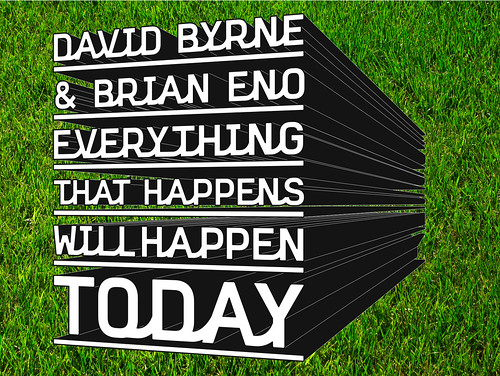
everything that happens will happen today


David Byrne and Brian Eno reunited for this experiment with electronic gospel to find a sense of hope and joy in the dark fluidity.  Twenty-five years after their first collaboration 'My Life in the Bush of Ghosts', Byrne and Eno found themselves sharing musical ideas again.  

Eno reveals:    “We didn’t really talk to each other.  We used e-mail, the modern way of recording. I could spend as long as I wanted on the music. And he wasn’t under any pressure to do something with me sitting there drumming my fingers...I didn’t think about it.  This was just something new.”


Byrne expressed at the time:    "In a nutshell, Brian wrote most of the music, and I composed most of the vocal melodies and lyrics, and then sang them. Other musicians play on the album too. It’s not 'Bush of Ghosts II': this is a record of sung songs, and the result really surprises me. Despite a sinister inflection to both the lyrics and the music, many songs feel fairly uplifting and the overall tone is hopeful. From where does this quality derive?   Eno and I hadn’t worked together for many years, but since the Nonesuch reissue of 'Bush Of Ghosts' in 2006, we’d kept in contact fairly regularly. In spite of a slow start, we began to collaborate, still with no plans to make a whole record (or whatever a collection of songs might be called now). After a while though, it became obvious that we were indeed making a record. As it neared completion, we decided to try releasing it ourselves — so far there is no record label involved — though various independent distributors will handle the physical CDs. Those who follow the music industry will know this idea is not entirely new; but every experiment in this area turns out a little different, as no model is right for everyone."


'Everything That Happens Will Happen Today' features Leo Abrahams on acoustic and electric guitar, piano, percussion,  coin guitar, upright piano, hurdy gurdy, baritone guitar, Dubreq Stylophone, programming, thunder guitar, ebow, high bass, and reverse guitars; David Byrne on vocals, guitars, ebow guitars, clavinet, piano, surdu, and percussion; Brian Eno on bass guitar, backing vocals, electric drums, Kaoss Pad, keyboards, guitars, organ, Steinberg virtual guitar, "inhuman piano" vocalizations, brass, traps, water guitars, stellar voice, strings, programming, Omnichord piano, guitar treatments, keys, and shakers; and Seb Rochford on live drums;   with Steve Jones on delay guitar, fast pulls guitar, and rhythm guitar; Tim Harries on melody bass; Phil Manzanera on drone guitar; Robert Wyatt on frame drum solo; Melanie Hall QC on female backing vocals; Robert Wyatt on Handsonic drum; Darla Eno and Irial Eno on vocals; Dan Levine on brass and arrangement; Dave Mann and Paul Shapiro on brass and treated brass; Barry Danielian on treated brass; and Mauro Refosco on murky pandeiro, cricket shaker, reco reco, peddler's rattle, bongo, conga, tambourine, zabumba, cahon, tamborim, and timbal.  

Byrne discusses the spirituality that informs the lyrics:   “I’m always thinking about it but not overtly. That might frighten me. Probably like a lot of people, I feel alienated from the traditional models that were presented when I was a child, and eventually I left those and said, ‘That doesn’t seem relevant to me.’ But I, like a lot of people, felt that as human beings we have some longing for transcending things in some way, shape or form...I thought, if I can write lyrics that emphasize that kind of uplift but then express the other stuff that’s going on as well, then it will seem like the music and the words and all the other stuff all belong together and came out of one mind, as opposed to being artificially stuck together.”


Byrne created his own label Todo Mundo to release the album; which was originally released through their own website and streamed for free.  Although it sold more than twenty thousand downloads on the website, 'Everything That Happens Will Happen Today' didn't chart until it was released as a CD in November of 2008.  It made it to number one hundred and seventy-four on the US billboard 200 album chart, one hundred and twenty-seven in France, fifty-eight in Belgium, thirty-one in New Zealand, three on the CMJ radio 200, and number one on the College Music Journal AAA charts.  'Everything That Happens Will Happen Today' was featured in numerous lists of the best albums of the year and was nominated for three Grammy Awards (Best Alternative Music Album, Best Recording Package, and Best Boxed or Special Limited Edition Package) winning for Best Recording Package.  


http://www.davidbyrne.com/


http://brian-eno.net/


"Strange Overtones"


'Everything That Happens Will Happen Today' 

full album:


All lyrics written by David Byrne; all music by Byrne (vocals) and Brian Eno (instrumentation), except "Strange Overtones" co-written by Leo Abrahams.

1. "Home" – 5:06
2. "My Big Nurse" – 3:21
3. "I Feel My Stuff" – 6:25
4. "Everything That Happens" – 3:46
5. "Life Is Long" – 3:45
6. "The River" – 2:30
7. "Strange Overtones" – 4:17
8. "Wanted for Life" – 5:06
9. "One Fine Day" – 4:55
10. "Poor Boy" – 4:19
11. "The Lighthouse" – 3:46