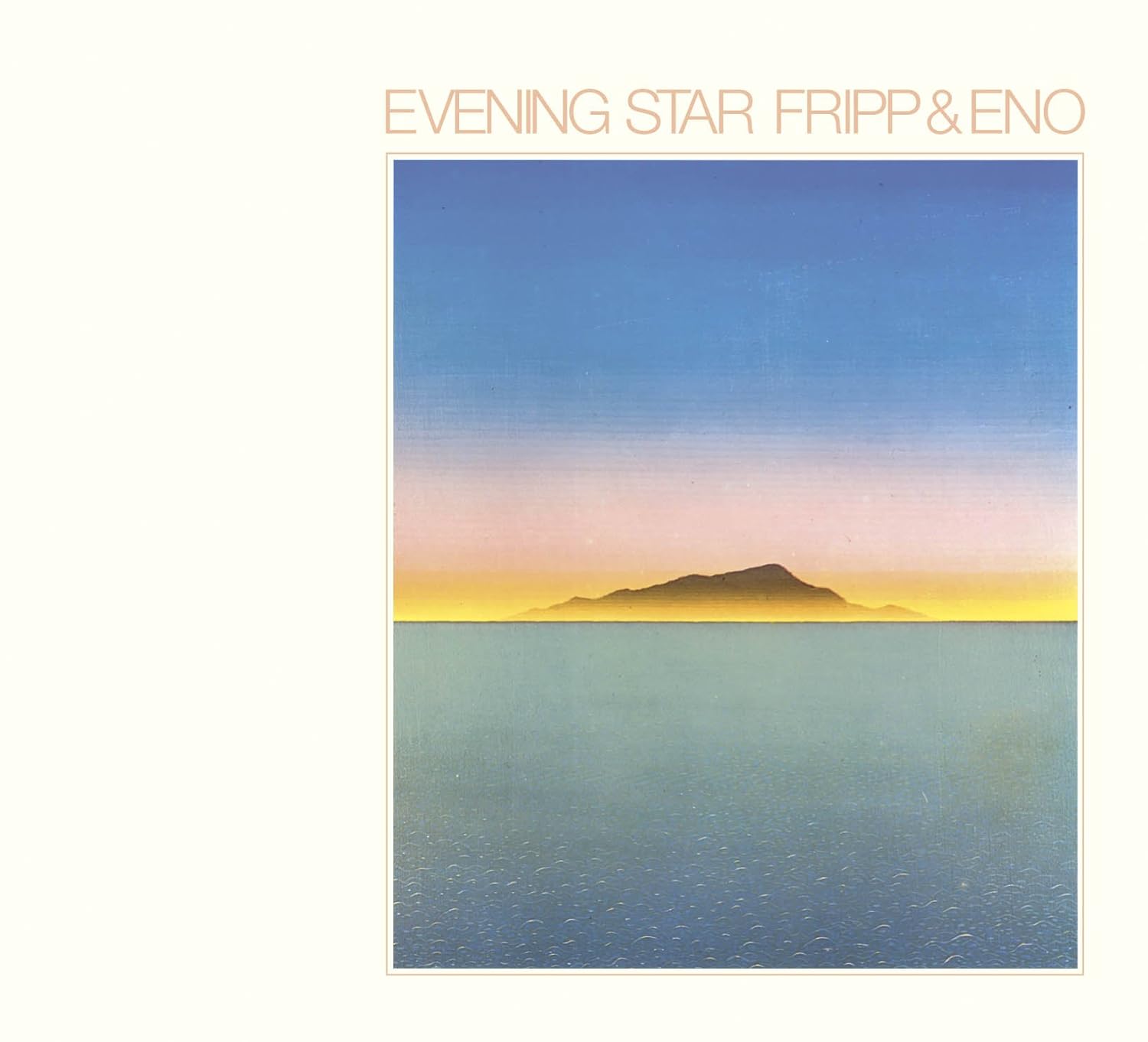
Brian Eno and Robert Fripp layered treatments and textures into the meditative metallic melodies of this cosmic collaborative quietus. While they were still in their respective bands Roxy Music and King Crimson, the pair came together to create (No Pussyfooting) in 1972 utilizing tape loops and effects to create droning atmospheric soundscapes.
Fripp reveals: "I was first introduced to the technique, the actual way of using two tape machines together by Brian Eno seven years ago this month when we recorded side one of No Pussyfooting. A purely unofficial off-the-cuff informal meeting when for the first time I visited him socially at home in London. And the story behind this is Bryan Ferry auditioned for King Crimson in December 1970, and I turned him down but I suggested he go and visit David Enthoven, the manager of King Crimson, the "E" of EG, which he did, and consequently Roxy Music went into EG, and Eno was part of that establishment. So I bumped into Eno in the office a couple of times, and he invited me round. And I went round with my guitar and pedalboard for no reason that I can recall. In fact I had no idea why then. And he said, "Well, plug in." So I did. He didn't tell me how it worked. I simply intuited what was happening, and that was side one of No Pussyfooting. "
Eno elaborates: ''[When I said, 'I'm not a musician',] It was originally intended to indicate that my interest in music was in a set of ideas rather than in a set of techniques and it was intended to make a distinction between a body of opinion that saw music simply as a bundle of virtuosity and a bundle of skills which I don't think it is. Those skills are the vehicle for a set of ideas and it's the ideas that interest me. The obvious attraction of synthesizers for me was that there was no code of playing any of this new equipment and recording studio technology developed so quickly that nobody could say 'This is the right way to play a synthesizer'...There are things that you can do when you're naive that you can't do when you're not naive anymore. For example, you'll never learn to draw like a child again so you have to accept that you can't do that and you say what you'll do is just draw as you are.''

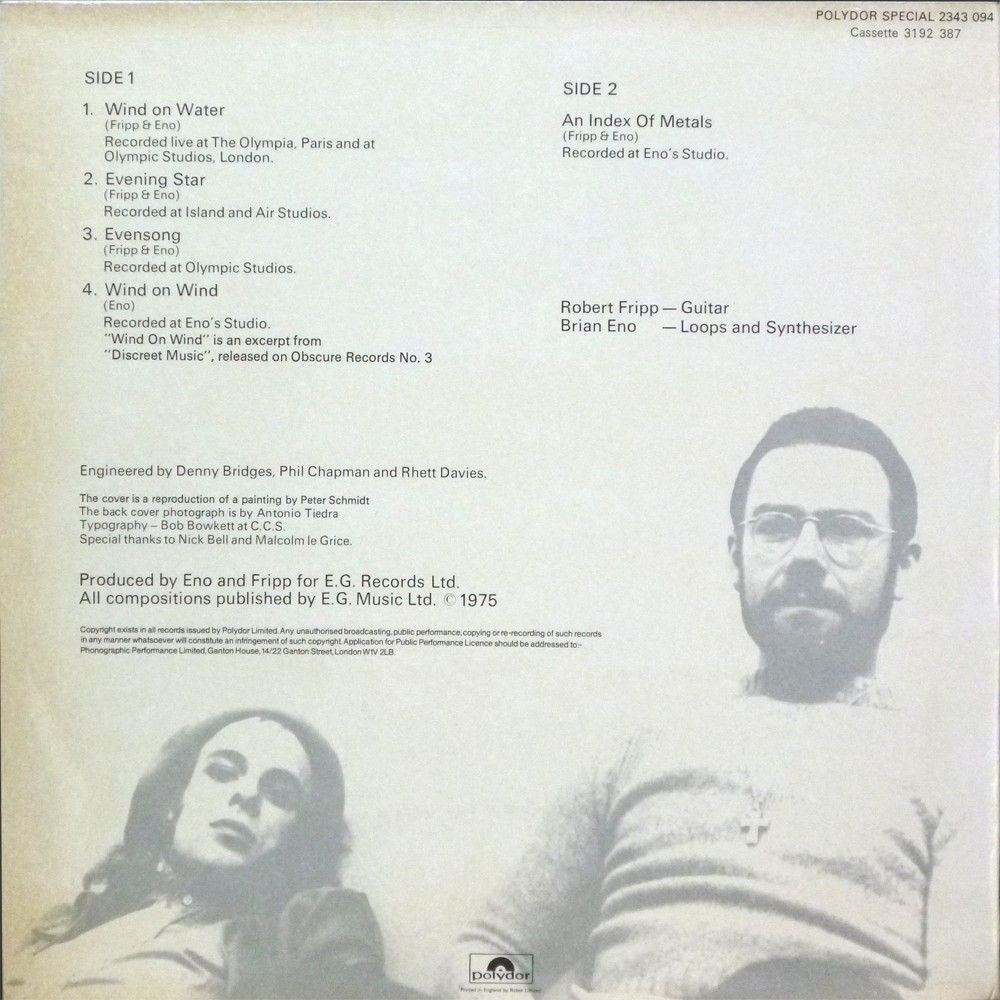
In the intervening years, Eno left Roxy Music and recorded several groundbreaking albums (Here Come the Warm Jets and Taking Tiger Mountain in 1974, and Another Green World and Discreet Music earlier in 1975); while Fripp disbanded King Crimson after a series of turbulent lineup changes. The duo came together again to produce Evening Star with Robert Fripp playing guitar and Brian Eno handling tape loops, synthesizer, and piano. "Wind on Wind" was an excerpt from Eno's Discreet Music. The cover painting for Evening Star was done by Peter Schmidt.
Eno: ''If you had a sign above every studio door saying 'This Studio is a Musical Instrument' it would make such a different approach to recording. You see my interest for quite a while has been in using the studio not as a machine that you feed input into and have it transferred onto a piece of tape. It's a means not simply of re-creating but of actually changing a sound. Sometimes it is even a source of that sound.''
The technique of guitar effects they developed became known as 'Frippertronics'. Fripp considers: "A lot of Frippertronics is ambient within Eno's definition of the term, that it's music as ignorable as it is listenable. There are two categories of Frippertronics, pure and applied. Applied is where it's used as an alternative to traditional orchestration, instrumentation, arrangement and so on and pure Frippertronics is where Frippertronics stands up as music in it's own right. Some of this is ambient and some of it has an imperative, a demand to be heard, that one must listen to it in order to catch the sense of it. So some of it is and some of it isn't...The most exciting response is where there's no excitement. That excitement is a cheap state of the release of tension, that a qualitative experience does not involve excitement, that it involves something quite different. It involves a sense of still, a sense of calm, a sense which is tangible but quite intangible and it's very difficult to express rationally. "
Eno expounds: "The function of being an artist for me is that it's an experimental area where I can test ways of thinking and operating and hopefully apply the results to real life. The advantage of testing them in an art context is that it doesn't really matter if you fail. You can afford to take risks that you wouldn't allow yourself in normal life. Having taken those risks and seen what freedoms they allow or what restrictions they impose, you are then free to extrapolate them into normal-life situation. That's what I think is the function of culture - to teach you new way of dealing with the world...We are no longer concerned with making horizontal music, by which I mean music that starts at point A, develops through point B and ends at point C in a kind of logical or semi logical progression. What's more interesting is constructing music that is a solid block of interactions. This then leaves your brain free to make some of those interactions more important than others and to find which particular ones it wants to speak to. One thing about vertical music is that you can enter it at any point and leave it at any point. You don't have to be in at the beginning."
http://brian-eno.net/
http://www.enoshop.co.uk/
https://www.dgmlive.com/
"Evening Star"
Evening Star
full album:
Brian Eno & Robert Fripp | Evening Star | Whole... by OssieBabb
All tracks written by Brian Eno and Robert Fripp, except "Wind on Wind" by Eno.
Side one
"Wind on Water" – 5:30
"Evening Star" – 7:48
"Evensong" – 2:53
"Wind on Wind" – 2:56
Side two
"An Index of Metals" – 28:36

Robert Fripp originally conceived of his solo debut as part of a trilogy of albums released simultaneously with Daryl Hall and Peter Gabriel. Fripp had collaborated with Brian Eno on two albums ('(No Pussyfooting)' and 'Evening Star') before the breakup of King Crimson in 1974 and played a secondary role on Eno's first two albums ('Here Come the Warm Jets' and 'Another Green World') before taking a hiatus from the music business. He would return to play guitar on Peter Gabriel's solo debut 'Peter Gabriel (car)' in 1977 under the pseudonym 'Dusty Rhodes': "When I withdrew from the music business to official retirement in 1974, I had no intention of returning at all. I thought it unlikely. But when I went to America in February 1977, to join Peter Gabriel, I was in a sense putting my elbow in the water and finding out whether this was a world in which I could receive an appropriate education ... It was a very demoralizing and a depressing experience. I found it difficult to work with the producer [Bob Ezrin]. I liked him as a man, but I couldn't express myself fully in the circumstances. Neither could Peter. It wasn't Robert Fripp on that album. It wasn't until the end of July 1977 - when I went off to do '"Heroes"' with Bowie in Berlin - that Fripp was able to be Fripp. There were no limitation on Fripp in that experience ... As I became more busy, producing Darryl Hall and Peter Gabriel, it occurred to me - probably around the Spring of 1978 - that I was in no way officially retired."
After '"Heroes"' in 1977, Fripp was invited to play guitar on Daryl Hall's solo debut 'Sacred Songs'
and was promoted to producer right away. The final album was not well received by RCA, who didn't want the art rock experimentalism to interfere with the pop appeal of Hall and Oates. Fripp fumes: "It terrified the record company. Terrified them. Their official description of the record was 'strange.' They simply refused to release it. The record scared off the company and his manager. It was a beautiful working experience, though. It contains some excellent music, some of the best work Hall's ever done. Certainly some of the most honest and personally revealing. I think the people around him were disturbed by what he'd done. One of the things that has become evident is that Darryl doesn't have the freedom he thought he had."
When it came time to record his own solo debut, Fripp ran into more complications with record companies. Although Hall was excited to contribute vocals to 'Exposure', RCA would not cooperate with the project and most of the tracks had to be redone. Also, Chrysalis refused to let Debbie Harry take part in the sessions. Peter Hamill was brought in to work on the new recordings. Fripp says: "[Hamill] came into the studio dressed in a rather svelte and smooth fashion, took off his nice cloths and got into a smelly dressing-gown, poured himself liberal dose from the bottle of cognac he'd brought with him, and went in there and started delivering the goods. Great man. Very nice an. He said that when he began singing he wanted to be the vocal equivalent of Hendrix. Conceptually, he was right on the beam. And he delivers, I think...The kind of decision that prevented Blondie from appearing on my album represents a value system I'm not prepared to work with. It's a value judgement which belongs to an old world. It's not a world 'm any longer involved in."
At the same time, Fripp was producing Gabriel's second album 'Peter Gabriel (scratch)', which he had come to conceive as cut from the same cloth as 'Sacred Songs' and 'Exposure'. Fripp attempted to explain: "'Exposure' deals with tweaking the vocabulary of, for want of a better word, 'rock' music. It investigates the vocabulary and, hopefully, expands the possibilities of expression and introduces a more sophisticated emotional dynamic than one would normally find within 'rock.'... What I was trying to do in the original trilogy was to investigate the 'pop song' as a means of expression. I think it's an incredibly good way of putting forward ideas. I think it's a supreme discipline to know that you have three- to four minutes to get together all your lost emotions and find words of one syllable or less to put forward all you ideas. It's a discipline of form that I don't think is cheap or shoddy...It's all interlocking. As Eno would say, in a complex system one can never accurately forecast al the possible outcomes. So one takes a decision and rides on the dynamics generated by that. I would express that in the phrase, 'riding the dynamic of disaster.'... One very concise way of expressing that would be to say - since everything fucks up, you might as well learn to bodge it...And this bodging, which is the universal hazard, is a creative ongoing process. It's the active hand that does the bodging and the mind which tries to find an order within it. They're not separate elements. Hey go on simultaneously. And having made a simple decision to make a record, everything proceeds from there. What I do is make the record and ten discover what I'm doing. The assumption being that there's a part of me that knows what I'm doing and my mind has to discover it. There's an innate order, you know. People aren't turkeys. If you listen to yourself, you might find out what you're saying...It continues to surprise me, in the sense that it's so good I'm familiar now with the more superficial nuances. But more than that, it continues to surprise me that it works so completely. As a whole it's so good. So good...I think probably, in terms of the genre, it's conceivably the best record in the past five years, perhaps longer. I don't think of it as a 'progressive' rock album. I think in a sense it rises above ALL categories. In a sense it's a compendium, none of the components are in themselves innovatory, but nothing is dated."
'Exposure' would chart at number seventy-nine in the US, 'Sacred Songs' would go to number fifty-eight when it was begrudgingly released in 1980 after fans and critics wrote to RCA. 'Peter Gabriel (scratch)', hit number forty-five in the US and number ten in the UK.
https://www.dgmlive.com/
http://crimson.wz.cz/data/t-exposure.php
Exposure
You Burn Me Up I'm a Cigarette
https://www.youtube.com/watch?v=089SH63fiSw
New York, New York
North Star
https://www.youtube.com/watch?v=eeRJQ8T4r98
https://www.youtube.com/watch?v=GHX-vCr2KbI
Water Music I / Here Comes the Flood
Here Comes The Flood - Peter Gabriel & Robert... by ShanonLeger
Water Music II
'Exposure'
full album:
http://www.last.fm/music/Robert+Fripp/Exposure
https://myspace.com/robertfripp/music/album/exposure-bonus-cd-20058773
Exposure [Bonus CD] from Robert Fripp on Myspace.
1. "Preface" Robert Fripp 1:16
2. "You Burn Me Up I'm a Cigarette" Daryl Hall, Robert Fripp 2:24
3. "Breathless" Robert Fripp 4:43
4. "Disengage II" Daryl Hall, Joanna Walton, Robert Fripp 2:44
5. "North Star" Daryl Hall, Joanna Walton, Robert Fripp 3:12
6. "Chicago" Daryl Hall, Joanna Walton, Robert Fripp 2:18
7. "New York City, New York" Daryl Hall, Joanna Walton, Robert Fripp 2:18
8. "Mary" Daryl Hall, Joanna Walton, Robert Fripp 2:09
9. "Exposure" Peter Gabriel, Robert Fripp 4:26
10. "Hååden Two" Robert Fripp 1:57
11. "Urban Landscape" Robert Fripp 2:35
12. "I May Not Have Had Enough of Me but I've Had Enough of You" Joanna Walton, Robert Fripp 3:38
13. "First Inaugural Address to the I.A.C.E. Sherborne House" J. G. Bennett 0:07
14. "Water Music I" Robert Fripp, J. G. Bennett 1:19
15. "Here Comes the Flood" Peter Gabriel 3:54
16. "Water Music II" Robert Fripp 3:55
17. "Postscript" Robert Fripp 0:40