Showing posts with label u2. Show all posts

Wednesday, October 28, 2015

all that you can't leave behind


U2 got themselves together and walked on through heartbreak and hopelessness to find grace in this soulful pop elevation.  Despite charting at number one and selling over seven million copies each, their previous two albums ('Zooropa'  and  'Pop') had alienated many fans with their experimental sounds and ironic presentation.  Bono reveals:   "We spent most of the '90s experimenting and I think we finally realized on the PopMart tour that it was time for us to start stripping back again...We got into Washington, D.C., before all our equipment arrived and rehearsed with just guitar, bass and drums--none of the loops or samples that we had been attaching to the songs. Howie B. came in during the middle of the rehearsal and he said, 'Wow, what a sound. What is this?' We told him it was us, it was what U2 sounds like. I think that's when we realized that it was time for us to get back to the essence of what we do."


Edge says that they were revitalized by a return to their 'classic' sound:  "It sounded fresh again.  We had been exploring the fringe of what we could be and what rock 'n' roll was all about, and that was essential. I think the group would have died creatively if we hadn't moved into uncharted territory. But eventually we needed to return to the center. I don't know if we've made a great record or not, but it is our record. It's us standing there naked, if you will...Why are you still around?...You know, you made some great records. But why are you still making records?' Part of what we decided is that we had a sense or belief that we can still make the album of the year." 


Bono:  "There was a moment that had to do with one's mortality...It was a time when I saw how you could suddenly lose everything, and it woke me up in a way...Suddenly the person in the bar who was very interesting before becomes boring. You want to spend more time with your family, with your kids. You also realize you don't have the time anymore for things like the irony and the masks. There was never any irony in the songs, just the way we presented them..."


'All That You Can't Leave Behind' saw the band reunited with the production team of Daniel Lanois and Brian Eno for the first time since their blockbuster 'Achtung Baby' album nearly a decade before.  They began working in late 1998 on new material in the studio at Hanover Quay Studios in Dublin; but sessions were delayed with Bono's political work on debt relief.   During the summer of 1999, the members of the band relocated to the south of France to continue the creative process; which continued in Dublin at  Windmill Lane Studios,  Westland Studios,  and  Totally Wired.   Some additional production work was done by Mike Hedges, Richard Stannard, Julian Gallagher, and  Steve Lillywhite.  The sessions were engineered by  Richard Rainey with  Bono on vocals, guitar, and synthesisers;   The Edge on guitar, piano, vocals, synthesisers, and strings;    Adam Clayton on bass guitar;   and  Larry Mullen, Jr. on drums and percussion;   with   Brian Eno on synthesisers, programming, backing vocals, and string arrangement;   Daniel Lanois on backing vocals, and additional guitar;  and  Paul Barrett on brass.   


Mullen mused:    "Bono did something recently that he probably shouldn't have done.  He did a book as a favor for a friend of his in Ireland that 'explained' all the lyrics. I think that was a mistake because one of the most valuable things about his lyrics is that you can adapt them to any particular situation." 


Released in October of 2000 on Interscope Records, 'All That You Can't Leave Behind' made its debut at number one in over thirty countries.  In the US, it debuted (and peaked) at number three.  In 2001, the album received three Grammy Awards for the song "Beautiful Day":  Song of the Year, Best Rock Performance by a Duo or Group with Vocal, and Record of the Year.  In the wake of the tragedy of September 11, 2001; the album struck a responsive chord with the American public and began to sell again (rising to number twenty-five on the album chart) as the band incorporated a tribute to the fallen police, firefighters, and victims to their live performances.   Mullen says:   "There was anger, rage, patriotism, sadness.  Everything became frighteningly extreme." 


Clayton confesses:    "I have to say I wasn't sure about it at first.  It seemed like we were really pushing a button. But Bono is a pretty unique individual, and he's got great judgment. He's able to perform open-heart surgery and zap people with a bit of brain surgery at the same time." 


In 2002, 'All That You Can't Leave Behind' won four more Grammys:   Record of the Year for  "Walk On",  Best Rock Performance by a Duo or Group with Vocal for "Elevation", and  Best Pop Performance by a Duo or Group with Vocal for "Stuck in a Moment You Can't Get Out Of", as well as Best Rock Album.  It is the only album ever to have two singles win Record of the Year in two consecutive years.  It has sold over twelve million copies worldwide.  


Bono:    "It's funny.  When people kept making fun of us as this band that wanted to change the world, we'd say, 'No, no, we just want to be musicians.' The truth is we really did want to change the world...Megalomania, if you will, set in at a very young age with us. But it wasn't just megalomania. We came out of punk rock, but not the [outrageous] Sex Pistols. We bought into the [politically minded] Clash. We have always been ideologues. We were in the back of the bus reading Bibles instead of Playboy when we were 19 or 20...I'm tired of dreaming. I'm into doing at the moment. It's, like, let's only have goals that we can go after. U2 is about the impossible. Politics is the art of the possible. They're very different, and I'm resigned to that now. Music's the thing that stopped me from falling asleep in the comfort of my freedom. I learned about South America from listening to the Clash. I learned about Situationism from the Sex Pistols. But that's a long way from budget caps and dealing with a Congress that is suspicious of aid because it has been so misused...When you sing, you make people vulnerable to change in their lives. You make yourself vulnerable to change in your life. But in the end, you've got to become the change you want to see in the world. I'm actually not a very good example of that -- I'm too selfish, and the right to be ridiculous is something I hold too dear -- but still, I know it's true...[We're] reapplying for the job. What job? The best band in the world job...Initially, I felt that it would be difficult for U2 to be relevant.  The only way to puncture the indifference out there toward rock bands was to make each song a single,,,This was no time to waffle, no time for art. That was the only way we could deal with the competition. At times we feel these are the best songs we've ever written...I hope it's a soulful record, but it's also a rock record. I always like to say, 'It kicks ass.'"


http://www.u2.com/


lyrics:
http://www.u2.com/music/Albums/4013/All+That+You+Can't+Leave+Behind


"Beautiful Day"  was a number one smash around the world; but in the US, where it won three Grammy Awards, it peaked at number twenty-one.  


"Stuck in a Moment You Can't Get Out Of"  was another international hit (number one in Canada and Ireland) that didn't even make the top forty in the US; yet, it still won a Grammy for Best Pop Performance by a Duo or Group with Vocal.  


"Elevation" didn't chart in the US; but won a Grammy for Best Rock Performance by a Duo or Group with Vocal.  Around the world it was another big hit, going to number one in Canada, Ireland, and the Netherlands.  


"Walk On"  won their second consecutive Grammy for Record of the Year.  It was a number one hit in Canada; but didn't even chart in the US.    This song got the album banned in Burma for its dedication to imprisoned activist Aung San Suu Kyi.  

Peace On Earth/Walk On (from "America: A Tribute to Heroes")


'All That You Can't Leave Behind' 
full album:


All lyrics written by Bono except where noted, all music composed by U2.


1. "Beautiful Day"     4:06
2. "Stuck in a Moment You Can't Get Out Of"  (Bono, The Edge) 4:32
3. "Elevation"     3:45
4. "Walk On"     4:55
5. "Kite"    (Bono, The Edge) 4:23
6. "In a Little While"     3:39
7. "Wild Honey"     3:47
8. "Peace on Earth"     4:46
9. "When I Look at the World"    (Bono, The Edge) 4:15
10. "New York"     5:28
11. "Grace"     5:31


bonus tracks

"The Ground Beneath Her Feet"   Salman Rushdie Lanois, Eno 3:44


"Always" 


"Summer Rain" 


"Big Girls are Best"


live in Boston 2001 Elevation tour


1 - Elevation 0:00
2 - Beautiful Day 05:10
3 - Until the End of the World 09:50
4 - Stuck in a Moment 15:07
5 - Kite 20:50
6 - Gone 26:12
7 - New York 31:09
8 - I Will Follow 37:00
9 - Sunday Bloody Sunday 42:08 
10 - In a Little While 50:35
11 - Desire 56:40
12 - Stay 59:45
13 - Bad 1:04:35 
14 - Where the Streets Have No Name 1:11:15
15 - Bullet the Blue Sky 1:17:45
16 - With or Without You 1:25:40
17 - The Fly 1:31:09
18 - Wake Up Dead Man 1:38:45
19 - Walk On 1:40:30 


Wednesday, October 1, 2014

the unforgettable fire


U2 brought an incandescent new vision to their sound with the expansive sonic experiments of this impressionist dream landscape.  After three albums with producer Steve Lillywhite ('Boy', 'October', and 'War'), the band was ready to explore a new direction.  

Bono:
"We felt we had more dimension than just the next big anything, we had something unique to offer. The innovation was what would suffer if we went down the standard rock route. We were looking for another feeling."

Larry:
"I thought it was a great idea to get someone to come in and help us develop in a different way.  It seemed we had done very well on three chords and the truth but we needed someone who could take our songs in a different direction, add new textures and explore new ways of using the studio."

Adam:
"We were looking for something that was a little bit more serious, more arty.  Roxy Music was a name that kept coming up, with a sense that this was the sonic territory of European pop music as opposed to American rock.  Brett Davies had produced Roxy and we had a meeting with him that didn't really go anywhere.  Then we started thinking about Brian Eno, who had been the keyboard player in Roxy Music and had gone on to produce Bowie and Talking Heads."

They sought out Brian Eno to produce their new album; but he was resistant.  Bono convinced him to come to Dublin to meet the band and Eno brought his engineer Daniel Lanois as well.  

Edge:  
"We were talking about different recording approaches, about ambient recording, in the sense of trying to capture not just the performance but the sonic interaction of the people in the room.  I thing Brian became very interested in this.  We also discussed trying to find a really great-sounding space and use the acoustics of the room as a natural characteristic of the recordings."

It was agreed that Eno and Lanois would work in tandem and the band began recording at Slane Castle where the band and crew set up residence for over a month.   


Bono:
"The sound in magnificent.  If Phil Spector was oing to lie in state, it would be here.  And we have this thing in our head:  we're going to make the big music.  That's who we are.  We're not indie; we're not miserable; we're full of joy and we are going to take over where Phil Spector left off.  Big ideas, big themes, big sound.  We're going to take risks and prove just how elastic a rock band can be.  And we had Brian Eno as our producer...This great artist and superb strategist went to woek for these rather uncouth Irish musicians.  He had his friend at his side, Daniel Lanois, who had more music in his little finger than Brian had in every appendage.  A truly funk soul brother, the skinny white guy in every funky band, a guy who reeks of music.   The combination was deadly.  Larry and Adam, as insecure as they were on the studio, suddenly started to warm to this Canadian, this Danny Boy, who just brought the best out of them.  Myself and Edge, who were more cerebral, were attracted by Brian's big ideas.  Every great rock band in the British invasion went to art school.  We never did, we went to Brian.  And his was a great act of generousity.  Those arpeggiating sequences you hear in 'Band' and later on 'The Joshua Tree', they're him.  He analysed our songwriting , allowed us to get away from the primary colours of rock into another world were we could really describe ourselves in what was gong on around us.  It was  monumental." 

The sessions were produced and engineered by Eno and Lanois and featured Bono on lead vocals;  The Edge on guitar, keyboards, and vocals;  Adam Clayton on bass guitar; and Larry Mullen, Jr. on drums;   with Brian Eno and Daniel Lanois on additional vocals, instruments, and treatments; Paul Barret on Fairlight;  Chrissie Hynde on backing vocals on "Pride (In The Name of Love)" (thanked as "Mrs. Christine Kerr" on the record sleeve); and Peter Gabriel on vocals on "A Sort Homecoming" (Daniel Lanois Remix).   Mixing and postproduction were done at Windmill Lane Studios.  Eno left before the album was completed, impatient with the slow progress.  Lanois stayed on to finish the mixing.  Many of the songs were locked in with improvised lyrics.  


'The Unforgettable Fire' burned up the charts, going to number twenty-seven in Portugal; twelve in the US; six in Norway and Sweden; five in Canada; and number one in Australia, New Zealand, and the UK.  The album cover features the band in front of the ruins of Moydrum Castle, not Slane Castle.   The band would release the EP 'Wide Awake in America' the next year with live versions of two songs from the tour and two b-sides that honestly should have been on the album.  

Bono:  "The theme of the album was a flirtation with death, nuclear fission, the raw material for a power plant or for weapons of total destruction."


http://www.u2.com/


'Pride (In the Name of Love)' rang out around the world, going to number thirty-three on the US pop chart, twenty-seven in Canada, five in the Netherlands, three in the UK, two in Ireland and on the US mainstream rock track chart, and number one in New Zealand.  
https://www.youtube.com/watch?v=897WjTBePik

 Donald Cammell version
https://www.youtube.com/watch?v=LHcP4MWABGY

 Anton Corbijn version
https://www.youtube.com/watch?v=u1kY0-CmL04


'The Unforgettable Fire'  hit number six in the UK, four in the Netherlands, three in New Zealand, and one in Ireland. 


Ice
Your only rivers run cold
These city lights
They shine as silver and gold
Dug from the night
Your eyes as black as coal

Walk on by
Walk on through
Walk 'til you run
And don't look back
For here I am

Carnival
The wheels fly and the colors spin
Through alcohol
Red wine that punctures the skin
Face to face
In a dry and waterless place

Walk on by
Walk on through
So sad to besiege your love so head on
Stay this time
Stay tonight in a lie
I'm only asking but I
I think you know
Come on take me away
Come on take me home
Home again

And if the mountain should crumble
Or disappear into the sea
Not a tear, no not I

Stay in this time
Stay tonight in
Ever after, this love in time
And if you save your love
Save it all

Don't push me too far
Tonight
Tonight
Tonight


A Sort Of Homecoming
https://www.youtube.com/watch?v=D1qKECV_IY8


And you know it's time to go
Through the sleet and driving snow
Across the fields of mourning
Light in the distance

And you hunger for the time
Time to heal, desire, time
And your earth moves beneath
Your own dream landscape

Oh, oh, oh 
On borderland we run 

I'll be there
I'll be there 
Tonight
A high road
A high road out from here

The city walls are all come down
The dust, a smoke screen all around
See faces ploughed like fields that once
Gave no resistance

And we live by the side of the road
On the side of a hill 
As the valley explode
Dislocated, suffocated
The land grows weary of its own

Oh, oh, oh on borderland we run 
And still we run
We run and don't look back
I'll be there
I'll be there
Tonight
Tonight

I'll be there tonight I believe
I'll be there somehow
I'll be there tonight
Tonight

The wind will crack in winter time
This bomb-blast lightning waltz
No spoken words, just a scream 

Tonight we'll build a bridge 
Across the sea and land
See the sky, the burning rain
She will die and live again
Tonight

And your heart beats so slow
Through the rain and fallen snow
Across the fields of mourning
Light's in the distance

Oh don't sorrow, no don't weep
For tonight, at last
I am coming home

I am coming home


https://www.youtube.com/watch?v=x2Fa4EYh5QM


Bad
https://www.youtube.com/watch?v=q94FGYCmQss


'The Unforgettable Fire' 
full album


All lyrics written by Bono, all music composed by U2.


1. "A Sort of Homecoming"   5:28
2. "Pride (In the Name of Love)"   3:48
3. "Wire"   4:19
4. "The Unforgettable Fire"   4:55
5. "Promenade"   2:35
6. "4th of July"   2:12
7. "Bad"   6:09
8. "Indian Summer Sky"   4:17
9. "Elvis Presley and America"   6:23
10. "MLK"   2:31


b sides 


Three Sunrises
https://www.youtube.com/watch?v=wcXjy9LYewo


 Love Comes Tumbling
https://www.youtube.com/watch?v=IMMcF_Ngv88


Wednesday, July 3, 2013

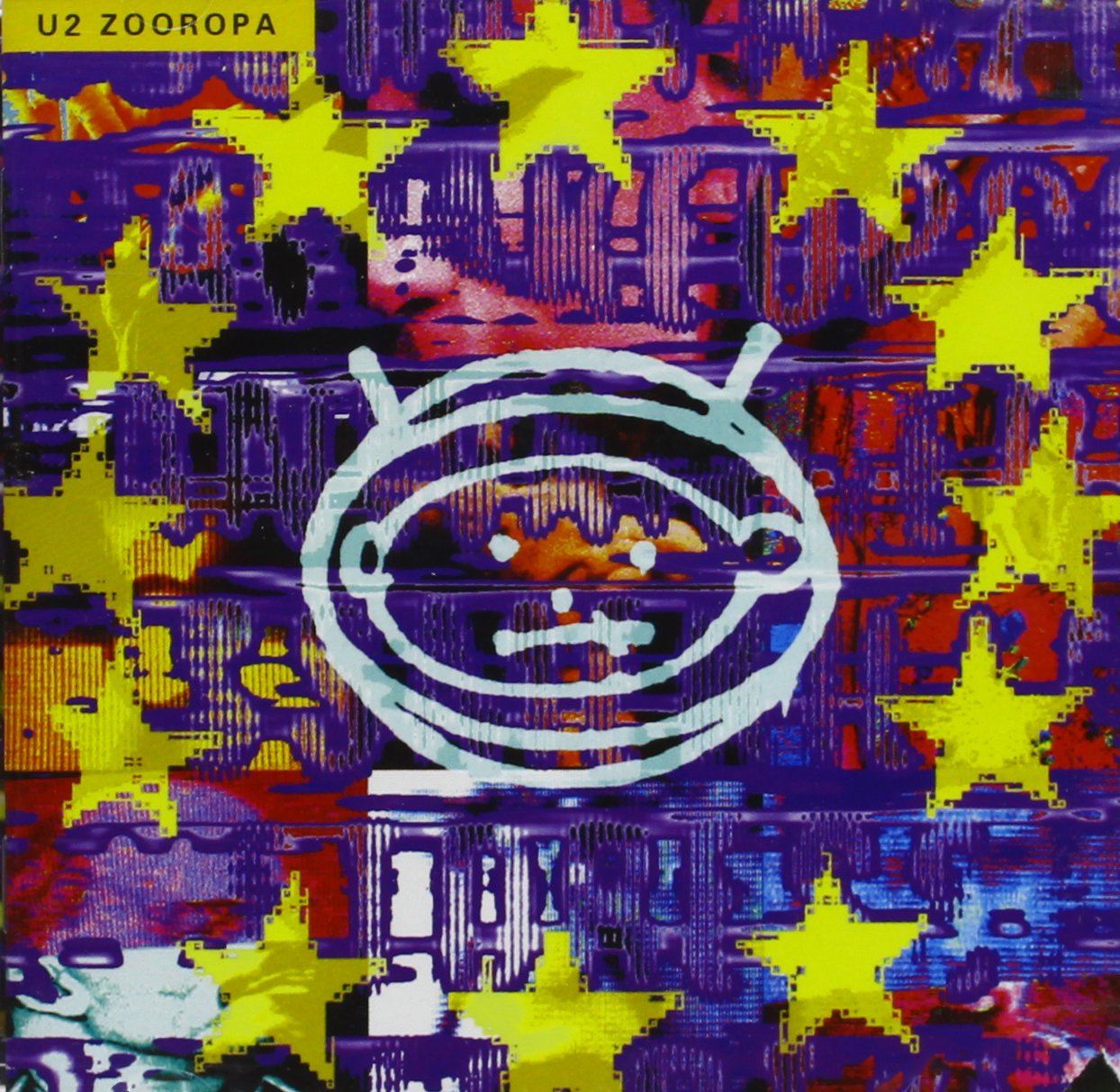
zooropa


U2 quickly recorded the experimental dance grooves and ambient art rock textures of this technocratic concept album during a break on their ZooTV world tour.  With the massive critical and commercial success of 'Achtung Baby', the band launched an ambitious world tour that featured multi-media satire that sought to illustrate the sensory overload of our consumerist culture.  When the first leg of the tour ended in late November of 1992, the band decided to record an EP. 

Bono describes the spirit with which the band started the sessions:   "We thought we could live a normal life and then go back on the road. But it turns out that your whole way of thinking, your whole body has been geared toward the madness of Zoo TV... So we decided to put the madness on a record. Everybody's head was spinning, so we thought, why not keep that momentum going...?"

Edge elaborates:  "We've got a bit of time off. We've got some ideas hanging around from the last record, let's do an EP, maybe four new songs to spice the next phase of the tour up a bit. It'll be a fan thing. It'll be cool...Some of the ideas we started out with on 'Achtung Baby' started to come into focus on the tour as we played around with the new stage set, the TV screens, the whole concept of a TV station on the road. We found out what it could do and then we started playing around with the imagery and the ideas that were in the airstream, gleaned from the world of advertising, CNN, MTV and so on. It struck a chord in us and the music that came out on 'Zooropa' was very influenced by the tour. Normally it's the other way around; you put an album together and then you go off on the road and you're drawing from the album for your inspiration."

Mullen recalls the whirlwind of activity:  "The show would finish at eleven.  As soon as we left the stage it was straight down into the cars, straigh to the airport, take off. Because the shows were in Europe, normally they were an hour or two ahead, so we'd arrive back in Ireland about midnight, go straight into the studio, do a couple of hours work, go home, go to bed. There were often a couple of days between shows, so we'd go into the studio in the afternoon, work into the night, get up the next day, head to the airport and fly to the next city. There was a month of that. It was mad, but it was mad good as opposed to mad bad."

Clayton considers:    "After being on the road for a year we wanted something a bit quieter...It occured to me...look at the history of the band and then the 'Zooropa' album... and looking at the history of The Beatles, and everything they'd done and learned, and then suddenly...'Sergeant Pepper', which redefined the whole ballgame, and produced a different language, a different sound. And I think 'Zooropa' achieves a new language for Bono to use - a language that's more his own, that he feels more comfortable with...And musically, I think, we've defined, or found, a sound that we're entitled to use...It's a record deep with mystery for me."  


Edge says:   "We were very inspired by what was happening in dance music and hip-hop. Technology has always been a very important dynamic in pushing music forward. You can point to almost every important developments in music and see a technology that went with it. The fuzzbox launched rock and roll into the '60s.   So for us, it seemed perfectly natural to be up to speed with the state-of-the-art technology happening in the dance culture. In that blend, we hoped we could hold on to the essence of what U2 is about. That's been, at times, a fine line you draw ... We don't worry about borrowing things from other groups. On the other hand, as soon as we notice that we are back to the U2 sound, we stop everything...It's also at the point that when people say to us that we can't do this or that because we're U2, that makes us want to do it even more. Because we think that the spirit of the group is so strong that it can use any style and still be U2. From the past and what's being done today we are trying to build a future. William Burroughs said I think, 'You cut up the past to find the future'. We're at exactly that point at the moment: if we keep our interest awake our music will be alive. Whereas if you're too sure of what you're doing, you come to a dead end...We had pieces which might give birth to songs, but which have lost their interest through familiarity: too structured. Musically, we tend not to give in to logic any more. Mystery gives the tempo, the emotion and the setting."

Bono muses:    "People have lost all confidence in images. Same thing in music. The polish of over-produced work ends up as smooth and glossy surface. That's why a large part of this album is improvised. It's just the four members of the group shut in a room playing together taking risks for six weeks...It's easy to be complacent with oneself about this idea but I think that when you know what you're doing, everything else must be swept away. It's difficult to experience, but we struggle on. You always want to keep your hands on the wheel, you don't want God to drive. Yet all the best U2 songs have been written by accident. And all the worst have been written by us...We are coming to a really interesting time in music where it seems as though classic guitar-based rock is short of ideas. For five years we've heard that rock is dead. We've never really thought of ourselves as a rock group but one feels that there are so many uncertainties that in fact anything is possible. One of the main interests in music is combining everything which has become part of the everyday background like TV programmes or cinema. Anything could happen in music today and that's what we're trying to do. We're living in a kind of transformation where video games sell more than records, and where audiovisual formats are taking precedence over music. Most showbiz people are shit scared. We find it stimulating. With the Zoo TV Tour we are getting near this point of transformation, and this overload of images you refer to is precisely the language of Zoo TV. Richard Kearney, an Irish philosopher, deals with the death of images in his book ('The Awakening of the Imagination'). A theme which you got close to in Until The End of The World. The idea that images are manipulated to the point where our perception of reality has taken a knock."


Twenty songs were recorded during the six weeks, from which they chose ten for 'Zooropa' which features Bono on vocals and guitar; Adam Clayton on bass guitar; The Edge on guitar, piano, synthesisers, and vocals; and Larry Mullen, Jr. on drums, percussion, and backing vocals;  with Brian Eno on synthesisers, piano, arcade sounds, backing vocals, loops, strings, and harmonium; Des Broadbery and Flood on loops; and Johnny Cash as a featured lead vocalist.     The sessions took place at three Dublin studios (The Factory, Windmill Lane Studios, and Westland Studios) and were produced by Flood, Brian Eno, and The Edge; with mixing and engineering by Flood and Robbie Adams. 

'Zooropa' was a worldwide success, going to number three in Norway; two in Finland; and number one in Australia, Austria, Canada, Denmark, France, Germany, Ireland, the Netherlands, New Zealand, Sweden, Switzerland, the UK, and the US.  The album sold over seven million copies worldwide and went on to win the Grammy Award for Best Alternative Music Album.  


http://www.u2.com/


"Lemon"
http://www.youtube.com/watch?v=GvEfUf1Ux20


"Stay (Faraway, So Close!)"  


'Zooropa'
full album:


All music composed by U2.

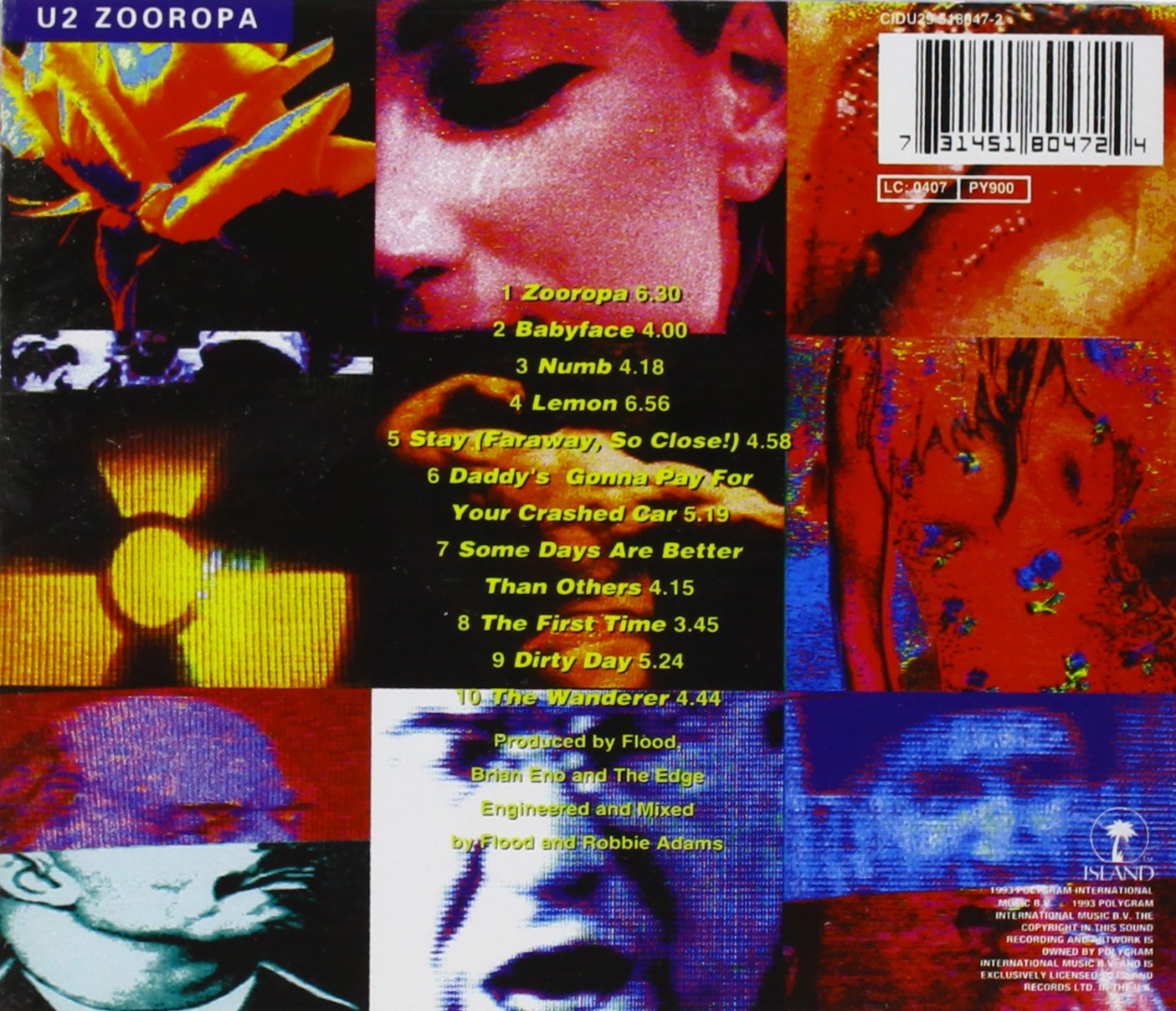
1. "Zooropa"   Bono Flood 6:31
2. "Babyface"   Bono Flood 4:01
3. "Numb"   The Edge Robbie Adams 4:20
4. "Lemon"   Bono Flood 6:58
5. "Stay (Faraway, So Close!)"   Bono Flood 4:58
6. "Daddy's Gonna Pay for Your Crashed Car"   Bono Flood 5:20
7. "Some Days Are Better Than Others"   Bono Robbie Adams 4:17
8. "The First Time"   Bono Flood 3:45
9. "Dirty Day"   Bono and The Edge Robbie Adams 5:24
10. "The Wanderer" (featuring Johnny Cash) Bono Flood, Robbie Adams 5:41

Total length:   51:15


Thursday, February 28, 2013

war


U2 marched forth and found the perfect expression of their power and passion with the stark martial rhythms, stirring emotional anthems, and fiery political protest of this magnificent tour de force. After the mixed reviews of their sophomore album 'October' the band was determined to create something special. The band went into the studio with producer Steve Lillywhite who had produced 'October' and their debut 'Boy'.


Adam:   "We wanted something that was more abrasive, a bit more in-your-face, more street rather than stadium. I think because of the way we were performing, people were already beginning to get a whiff of stadium off the band, of those big gestures. I guess it was an attempt to underplay it."


Bono got married shortly after the sessions began, and continued to work on lyrics during his honeymoon in Jamaica. When he returned to Dublin the sessions resumed in earnest at Windmill Lane Studios with Bono on lead vocals, and additional guitar; The Edge on guitar, piano, lap steel, backing vocals, lead vocals on "Seconds," and bass and rhythm guitar on "40"; Adam Clayton on bass and lead guitar on "40"; Larry Mullen Jr. on drums. The sessions also included Kenny Fradley on trumpet on "Red Light"; Steve Wickham on electric violin on "Sunday Bloody Sunday" and "Drowning Man"; and The Coconuts: Cheryl Poirier, Adriana Kaegi, Taryn Hagey, Jessica Felton on backing vocals on "Like A Song...", "Red Light", and "Surrender".


Edge:    "One morning, on my way to rehersal, I was standing at a bus stop with my guitar. A guy came over carrying a violin case. He was probably about nineteen. He said, 'You're from U2. Have you ever thought about having violin on your album?' Three days later Steve Wickham was in Windmill Lane with his violin. I think it was his first recording session but he was absolutely fantastic to have around because his energy was so positive. He was only in the studio for half a day, but we did 'Sunday, Bloody Sunday' and 'Drowning Man'."


Adam:    "Kid Creole and the Coconuts were seasoned New York musicians who were in town. We invited the trumpet player down to work on a song called 'Red Light'. We thought it might freshen up the sound of the band."


Bono:    "The singers came too. Three Coconuts. They were so hot. Everyone started to perspire, the temperature in the studio was at an all time high. We had the studio lit red for effect, and one Coconut took her top off and sang in what looked like a ballerina's bra. The boys from Ireland had difficulty breathing."


Edge:     "On the last day of our session, we worked all through the night; it's six in the morning, but we still felt we were a song short. And then, to our horror, the next session arrives. It's a band called Minor Detail and they are booked into the studio at eight o'clock. They arrived early just to hover about and get ready for their eight o'clock start. And we were saying, 'But we haven't finished our album. You know, we've been in here for the last eight weeks. This is our last morning. You're starting at eight? You're kidding! Can you give us some more time?' They weren't hearing it. We had two hours and that was it. So we said, 'OK, we've got one more song to do. What's it going to be?' There was another number we had worked up and eventually abandoned. It had a great bass hook but a slightly unwieldy arrangement with lots of strange sections and time changes; but we had failed to pull it together as a coherent song. Someone said, 'Let's dig out that tune and see what we can do with it.' We decided to chop out the bits that weren't working - literally; so Steve did some very quick multi-track edits and took out any section that just didn't seem to be part of the main idea. So then we had this slightly unusual piece of music and we said, 'OK, what are we going to do with it?' Bono said, 'Let's do a psalm.' Opened up the Bible and found Psalm 40. 'This is it. Let's do it.' And within forty minutes we had worked out the last few elements for the tune, Bono had sung it, and we mixed it. And literally, after finishing the mix, we walked out through the door and the next band walked in."


Larry:   "The songs, rather than meandering, seemed to be a little more concise. Edge had taken on the role of musical director, and Steve Lillywhite knew the form and seemed more assured as a producer; which is not to say it was easy...We knew there was something special there. We felt we had finished the songs and done as much on the album as we could possibly do. There was a sense that we'd achieved what we'd set out to achieve."


Bono:   "War seemed to be the motif for 1982. Everywhere you looked, from the Falklands to the Middle East and South Africa, there was war. By calling the album War we're giving people a slap in the face and at the same time getting away from the cosy image a lot of people have of U2."

Edge:   "It's a heavy title. It's blunt. It's not something that's safe, so it could backfire. It's the sort of subject matter that people can really take a dislike to. But we wanted to take a more dangerous course, fly a bit closer to the wind, so I think the title is appropriate. 'October' and 'Boy' both had a key to the songs in the title and this one is no different. Not all the songs are about war, but it's a good general heading."


Bono:   "A lot of the songs on our last album were quite abstract, but 'War' is intentionally more direct, more specific. But you can still take the title on a lot of different levels. We're not only interested in the physical aspects of war. The emotional effects are just as important, 'the trenches dug within our hearts.'   People have become numb to violence. Watching the television, it's hard to tell the difference between fact and fiction. One minute you see something being shot on The Professionals, and the next you see someone falling through a window after being shot on the news. One is fiction and one is real life, but we're becoming so used to the fiction that we become numb to the real thing. 'War' could be the story of a broken home, a family at war. Instead of putting tanks and guns on the cover, we've put a child's face. 'War' can also be a mental thing, an emotional thing between loves. It doesn't have to be a physical thing...You have to have hope. Rock music can be a very powerful medium and if you use that to offer something positive then it can be very uplifting. If you use your songs to convey bitterness and hate, a blackness seems to descend over everything.   I don't like music unless it has a healing effect. I don't like it when people leave concerts still feeling edgy. I want people to leave our concerts feeling positive, a bit more free. Things might look very gloomy, but there is always hope. I think there is a need to develop a new political language to get over what is happening...I'm frightened, yes, but I'm not cynical or pessimistic about the future and a lot of that must come down to my beliefs. It is my belief in God that enables me to get up in the morning and face the world. I believe that there is a reason and a logic to everything. If I didn't believe that and thought that everything was simply down to chance, then I'd be really afraid. I wouldn't cross the road for fear of being run over...'War' is not a negative LP. I mean, I'm in love and there is a lot of love on the album. A song like 'New Year's Day' might be about war and struggle, but it is also about love. It is about having the faith to break through and survive against all odds. Love is a very powerful thing. There's nothing more radical than two people loving each other. When I talk about love I'm thinking of an unselfish love. Emotions can be bought and sold just like anything else, but I think real love is about giving and not expecting anything in return...I think that love stands out when set against struggle. That's probably the power of the record in a nutshell. The album is about the struggle for love, not about war in the negative sense. I would be failing in this interview if I made War sound like a gloomy album, because it's not. I hope it's an uplifting record. Some love songs devalue the meaning of the word. Disco bands turn it into a cliché by tearing it down until it means nothing. The power of love is always more striking when set against realism than when set against escapism."


'War' stormed its way to number fifty-nine in Germany, twenty-six in Finland, sixteen in Ireland, fifteen in Norway, twelve in the US, nine in Australia, five in New Zealand, four in Canada and France, three in the Netherlands, two in Sweden, and became their first number one album in the UK, making its debut in the top spot and upsetting Michael Jackson's 'Thriller'. It was their first gold album in the US, and broke the band on college and mainstream rock radio.


http://www.u2.com/


"Sunday Bloody Sunday" 4:38

hit number fourteen in Belgium, seven on the US hot mainstream rock tracks chart, and number three in the Netherlands.
http://www.youtube.com/watch?v=EM4vblG6BVQ


"New Year's Day" 5:38

went to number fifty-three on the US hot 100, thirty-six in Australia, thirty-two in New Zealand, seventeen in Sweden, eleven in the Netherlands, ten in the UK, nine in Norway, and number two in Ireland and on the US hot mainstream rock tracks chart.
http://www.dailymotion.com/video/x1y50r_u2-new-years-day_music

U2 New Years Day by Celtiemama


http://www.youtube.com/watch?v=f8BtB4C3Vi8


"Two Hearts Beat as One" 4:00

went to number one hundred and one on the US hot 100, fifty-three in Australia, eighteen in the UK, sixteen in New Zealand, and number twelve on the US hot mainstream rock tracks chart.
http://www.youtube.com/watch?v=uIuAFBRyjj4


"Surrender" did not chart.

http://www.youtube.com/watch?v=XWJ2-XyXaMo


'War'

full album:


All tracks written by U2.

Side one
1. "Sunday Bloody Sunday" 4:38
2. "Seconds" 3:09
3. "New Year's Day" 5:38
4. "Like a Song…" 4:48
5. "Drowning Man" 4:12
Side two
6. "The Refugee" (produced by Bill Whelan) 3:40
7. "Two Hearts Beat as One" 4:00
8. "Red Light" 3:46
9. "Surrender" 5:34

10. "40" 2:36


bonus tracks


Treasure (Whatever Happened To Pete The Chop)*


Angels Too Tied To The Ground 


'War' tour in Boston:

http://www.youtube.com/watch?v=vAxWr5qtWJg


00:00 Out Of Control

04:40 Twilight
09:30 An Cat Dubh
13:50 Into The Heart
16:40 Surrender
21:37 Two Hearts Beat As One / Let's Twist Again (snippet)
27:08 Seconds
30:09 Sunday Bloody Sunday
35:37 The Cry
36:12 The Electric Co. / Send In The Clowns (snippet)
41:43 I Fall Down
45:05 October
47:11 New Year's Day
52:09 Gloria
56:47 I Threw A Brick Through A Window
01:00:39 A Day Without Me
01:03:57 Party Girl
encore(s):
01:07:10 11 O'Clock Tick Tock / Drowning Man (snippet)
01:11:56 I Will Follow
01:16:35 40