Showing posts with label king crimson. Show all posts

Friday, December 11, 2015

lizard


King Crimson punctured all the ballyhoo and scarred the sacred tablet of wax with the upholstered visions of megaphonium pandemonium.   With the widespread acclaim afforded their groundbreaking debut 'In the Court of the Crimson King', the band embarked on a tour that ended in December of 1969.  It was at this point that Ian McDonald and Michael Giles decided to leave the group (releasing the 'McDonald and Giles' album together in 1970).  Robert Fripp reveals:   “The band died in December of that year, while we were staying in Los Angeles. With all the pressure finally off, the group ran around the room in glee. I couldn’t do the same. I had realized that King Crimson was too important to let die. That particular band was especially good, perhaps because we shared an intense frustration and animosity towards the world in general and ourselves in particular. We were very creative, most definitely because pain and frustration lends itself to such a fruitful artistic state.”

The sessions for their second album, 'In the Wake of Poseidon', brought back Michael Giles (returning only as a session drummer) with his brother Peter on bass.  Keith Tippett joined the proceedings on keyboards; while Greg Lake (who went on to form Emerson, Lake & Palmer) stuck around to do most of the vocals on the sessions; while Fripp invited former bandmate from The League of Gentlemen Gordon Haskell to sing on one song.  Mel Collins sat in on two tracks (one with sax and one with flute) as well.

Haskell and Collins became full fleged band members for the third album 'Lizard'.   As a parting gesture, Lake had introduced drummer Andy McCulloch (a tenant of Keith Emerson's) to the group. Tippett was offered membership in the band; but preferred to remain a session contributor, bringing in Nick Evans and Marc Charig.


Haskell remembers:   "[When Fripp asked me to join the band] I straight away, without any hesitation, said 'absolutely not'. I was totally r&b oriented and it wasn't my sort of music. I didn't like King Crimson. Anyway, after a while I said I'd think about it, and my wife got to work on me because she wanted a regular income so in the end I joined. I did some vocals on 'In The Wake of Poseidon', and then we got down to rehearsing 'Lizards' and.... the drummer, Andy McCulloch, was in tears - Fripp used to bully him unmercifully. He bullied us all. I don't go for that though, so where Andy would cry I would just laugh. At the end of one song, 'Indoor Games', I just burst out laughing. You can hear it on the album. They thought it was really freaky, that I'd understood the lyrics and my part - but the truth of the matter is, it was a lousy song, the lyrics were ludicrous and my singing was atrocious so I just burst out laughing. And they thought it was wonderful!"


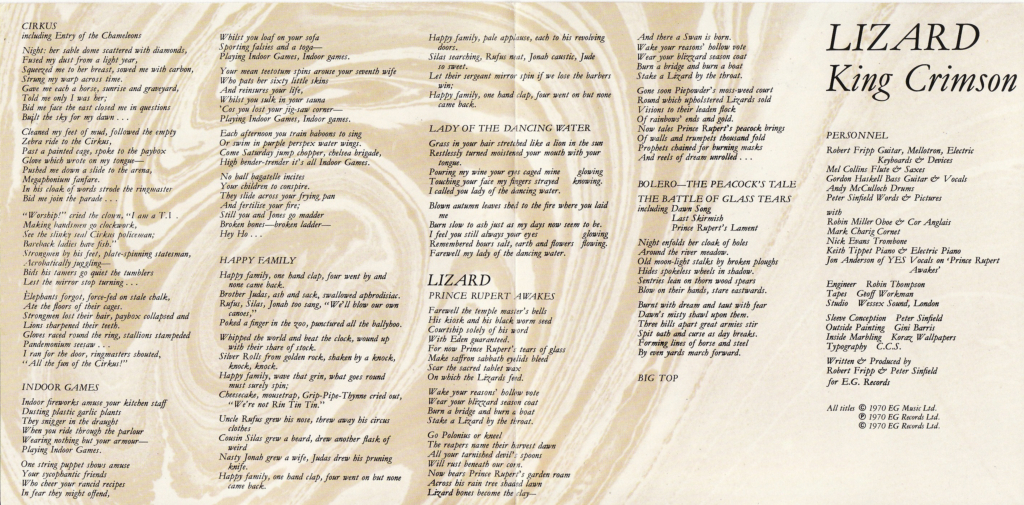
'Lizard' featured  Robert Fripp on guitar, Mellotron, synthesizer, organ, devices, and remixing;    Peter Sinfield on lyrics, VCS3, pictures, and sleeve conception;   Mel Collins on saxophone and flute;    Gordon Haskell on bass guitar and vocals;   and  Andy McCulloch on drums;    with    Keith Tippett on acoustic and electric pianos;   Robin Miller on oboe and cor anglais;   Mark Charig on cornet;   and Nick Evans on trombone.    Jon Anderson did a guest appearance on vocals for "Prince Rupert Awakes".   The lineup dissolved before there could be a tour.  Haskell and McCulloch made their exit, leaving behind the official trio of Fripp, Sinfield, and Collins.    'Lizard' charted at number one hundred and eighteen in the US, sixty in Canada, and twenty-nine in the UK.  


Mel Collins looks back:   "We would go and see King Crimson on a Sunday and they would come and see us on a Wednesday and that's how I first got to meet Robert Fripp. He obviously liked what I was doing in Circus - after Philip left I was pretty much the leader of the band, anyway - and Crimson had been having a troubled time on tour in America, Mike Giles and Ian MacDonald had left the band, girlfriend problems, or whatever, and when they came back from the States they were minus a drummer and a sax player. Fripp came down to see us one night and asked me if I would be interested in joining. So that was the beginning of my leaving Circus to join King Crimson.   Originally it was just on a session basis, during the recording of the 'Wake Of Poseidon' LP, but when I joined the band permanently it was with the specific purpose of getting the band out on the road. Greg Lake was still involved at the time that I joined, but he quit to form Emerson, Lake & Palmer while Crimson were still looking for their new drummer. So for a while, Crimson was just Robert, myself and Pete Sinfield, trying to get the band together. It took a year in fact, before we got the personnel together who recorded the album 'Lizard', which was the addition of Gordon Haskall on bass and Andy McCulloch on drums. Once the album was finished, this was going to be the band that went out on the road, but on the first day of rehearsals Gordon Haskall decided that he couldn't work with Robert anymore. Gordon and Robert had actually been at school together, but they'd had such a hard time in the studio - Fripp isn't always the easiest of people to work with - but the first day of rehearsing the tour and Gordon turns round and tells us he's leaving!" 
Fripp confesses:   I’m a very difficult person to work with, because in King Crimson there was a founding statement to be honoured, going back to ’69. And if what is available fails to meet what I see as a responsibility to the larger Crimson, then that gap has to be met by someone. And it would fall to me. So it’s not a comfortable place...The reason King Crimson had had so many members over the past few years is simple instability. You might take that to infer that I’m unstable, but most people would disagree with you… myself included...I am very fascinated in a way musicians work together as a unit. You see, I view King Crimson as the microcosm of the macrocosm. If one can’t operate successfully with three other musicians, it stands to reason that one would find it difficult to work well in a larger unit...I form bands, but I’m not a leader. There are far more subtle ways of influencing people and getting things done than being a band leader, it’s not a function I cherish. Who needs it?...Within the corpus of Crimson albums, Lizard is, historically, one of the least popular...Nevertheless, some strange characters in the listening community liked, even developed a passion for Lizard...Perhaps the leading very- strange-Lizard-lover is [reissue producer] Steven Wilson...And, from time to time, in different places, I have met others who admit to the same strange passion. Now I can hear why. The music of Lizard is redeemed."


 Sinfield says:   "I've been criticized; but a lot of it's quite valid, anyway.  I do play games, endlessly, just for my own amusement.  But I get annoyed about being called pretentious, because as far as can be worked out, and I checked in the dictionary, it means pretending to be something you're not.  Now, if you're in the rock and roll business, and you're making money, I see absolutely no reason why you shouldn't make a comment on the world."


https://www.dgmlive.com/


http://www.songsouponsea.com/


"Prince Rupert Awakes" /  "Bolero – The Peacock's Tale"


"Cirkus" (including "Entry of the Chameleons")


'Lizard'
full album:


All songs written by Robert Fripp and Peter Sinfield.

side one
1. Cirkus (including Entry Of The Chameleons) (6:28)
2. Indoor Games (5:41)
3. Happy Family (4:16)
4. Lady Of The Dancing Water (2:44)
side two
5. Lizard:
- a. Prince Rupert Awakes (4:36)
- b. Bolero - The Peacock's Tale (6:39)
- c. The Battle Of The Glass Tears (10:58)
- i) Dawn Song
- ii) Last Skirmish
- iii) Prince Rupert's Lament
- d. Big Top (1:13)

Total Time: 42:35


Tuesday, December 23, 2014

red


King Crimson imploded with the wicked and wild turbulence of this starless providence.  In the wake of two groundbreaking albums ('Starless and Bible Black' and 'Larks' Tongues in Aspic') with the same lineup, David Cross left the band after their summer tour in 1974.  Their next project 'Red' was recorded  at Olympic Studios in London with the remaining trio of Robert Fripp on guitar and mellotron;  John Wetton on bass guitar, and vocals;  and Bill Bruford on drums and percussion.  David Cross played violin on the live improvisation "Providence";  and former band members Mel Collins and Ian McDonald provided saxophone.  Mark Charig played cornet and Robin Miller added oboe, while a mystery musician added cello.  'Red' was arranged and produced by King Crimson with engineers George Chkiantz and Rod Thear.  

King Crimson had disbanded before 'Red' was even released.  The album charted at sixty-six in the US and forty-five in the UK.  Founding member Fripp would reveal:   "It was time for King Crimson to come to an end...and for three reasons. The first is that it represents a change in the world. Second, where I once considered being part of a band like Crimson to be the best liberal education a young man could receive, I now know that isn't so. And third, the energies involved in the particular lifestyle of the band and in the music are no longer of value to the way I live...The interesting point is that a number of groups are still going when the musicians involved are no longer in charge of the situation. With King Crimson, although that situation hadn't yet been reached, it could have developed that way within the next six months...King Crimson was a democratic band, we each had the power of veto, and would accommodate each other. But we'd got to the point where we discovered we were working together simply because we wouldn't be able to find musicians of that calibre outside of the band...I felt that by the end we were working together because there aren't any musicians of the same quality and proficiency outside.   And musically, perhaps, it was too much of a compromise. John's a rocker but Bill, on the other hand, has a very detailed and meticulous approach...When David left at the beginning of July, however, we considered working as a trio. Then Ian McDonald was joining the band for an American tour, but this would have involved three weeks rehearsals, for four weeks work - which is rather unbalanced...And then a European tour was suggested but I'd already decided the band was coming to an end. The tour would have meant that the band was on the road for another six months but I'm not prepared to keep secrets from men I'm working with and life is too valuable for me to commit six months to a situation in which I'm not whole-heartedly involved.   Hence the decision to end the band rapidly. the whole thing wasn't discussed, as such, although I think both Bill and John were aware of my feelings.   The energies involved weren't right. Getting on stage and having to fight the aggression of five thousand people, to beat them down to the point that they're listening... the band became very adept at going on stage and smacking straight through, but at the expense of creating something of a higher nature, if you like.   To give you an idea of the work we've done this year: from January to February we made an album, then went to Europe for a tour, then immediately off to America, back to Britain for rehearsals and straight back to America for another tour.   After that, I had one full day off in the country before we started recording 'Red'. With that kind of life there's a lot of things I'd like to do, but can't.    There are my responsibilities to the land, for instance, which can only be discharged by going out there and working (Fripp owns a cottage in Dorset). Consequently you can now see me halfway up a very large tree clasping two large saws and a pair of secateurs.   I am also spending more time learning, both in a very broad sense - for example, I am practically inept at anything more exciting than changing a three-pin plug - and in the field of musical electronics.   I would like to become self-sufficient so that, not only am I mobile, but I'm also independent as well. In other words, I want to develop practical skills and, in addition to this, there is a mental approach involved in all these things...I was tone deaf and had no sense of time when I became a guitarist. And, looking back over the years, I've wondered what on earth an unmusical, tone deaf, timeless dummy was doing becoming a professional musician.  And I've found the answer: I needed music, and music needed me. If you accept that I needed music, then this also involves responsibilities. Because of what I received, I have responsibilities, and I can discharge these as a player...My tuition involves the creation of a technique which enables the player to have the facility to move his hands to perform an idea which has come from a feeling inside him.  In other words, it's a technique which works on the level of the head, the hands and the heart...What my guitar technique will do is enable is enable musicians to move more freely from one form of music to another since, in learning the technique, his personality will be put under sufficient stress that he will not only develop emotionally and mentally, but the feelings involved will change his personality.   In other words, it's not so much a guitar technique as a way of life."


http://www.dgmlive.com/

http://www.dgmlive.com/kc/

http://www.elephant-talk.com/wiki/ETWiki_Home


Side one
1. "Red" (instrumental) Robert Fripp 6:16


2. "Fallen Angel"   Fripp, Richard Palmer-James, John Wetton 6:02


3. "One More Red Nightmare"   Fripp, Wetton 7:07
http://www.zapkolik.com/video/king-crimson-one-more-red-nightmare-534914
http://www.frequency.com/video/king-crimson-one-more-red-nightmare/200672058?cid=5-64850


Side two
4. "Providence" (instrumental improv)  (Recorded at Palace Theatre, Providence, USA, 30 June 1974) Bill Bruford, David Cross, Fripp, Wetton 8:09
http://www.dailymotion.com/video/x19m8sc_king-crimson-red-providence_music

KING CRIMSON - RED - Providence by bozorale


5. "Starless"   Bruford, Cross, Fripp, Palmer-James, Wetton 12:16
https://www.youtube.com/watch?v=aRHvD6h3-C0


Sundown dazzling day
Gold through my eyes
But my eyes turned within
Only see
Starless and bible black

Ice blue silver sky
Fades into grey
To a grey hope that oh years to be
Starless and bible black

Old friend charity
Cruel twisted smile
And the smile signals emptiness
For me
Starless and bible black


'Red' 
full album:


Saturday, October 25, 2014

in the court of the crimson king


King Crimson developed a majestic progressive rock from psychedelic avant-garde heavy metal orchestral jazz into this seminal scarlet schizoid surge.  

Robert Fripp reveals the scene in which the band formed:  "I was a young man without work signed to Decca. I arrived in London in 67 with Sgt. Pepper's bubbling inside of me. Hendrix, Bartok string quartets, an experience of passionate music...That was the power of rock in those days, without money, without the support of record companies. We were punky, like each new generation. It was the time of the student demonstrations in Paris, of Vietnam...Rock music spoke directly to youth. There was a sense of community, not yet of distance between the public and the artist...It didn't survive 1970." 

Brothers Michael Giles and Peter Giles joined with Robert Fripp to record 'The Cheerful Insanity of Giles, Giles and Fripp'.  The group transformed when  multi-instrumentalist Ian McDonald joined with Peter Sinfield; and Fripp suggested that Greg Lake come in to replace the whimsical Peter Giles.  Lake looks back:  "Robert and I went to the same guitar teacher when we were very young boys. We used to practice our lessons together. When I joined a band, Robert wasn’t in a band at all, and he used to come around and follow me as a guitar player. He’d travel in the van, along with my band. He just used to hang around the stage while we played. Sometimes, he’d do a duet with me. So, Robert and I knew each other’s playing intimately. We had the same guitar teacher; we learned the same guitar lessons – and we were dragged up the same way, basically. So I knew what he could play; he knew what I could play. That’s one of the things that was underpinning King Crimson – that Robert and I are almost one person, in a sense. I really know exactly what he’s going to play. Not so much nowadays, because we’ve grown up all those years apart, but certainly then, when the early King Crimson was formed."

Sinfield says:  "The name King Crimson was mine - I wanted something like Led Zeppelin, something with a bit of power to it. Anything better than Giles, Giles, and Fripp.  King Crimson had arrogance to it." 

According to Fripp:  "The name King Crimson is a synonym for Beelzebub, which is an anglicized form of the Arabic phrase B'il Sabab. This means literally the man with an aim and is the recognizable quality of King Crimson." 

McDonald muses:  "I started on guitar, that's my first instrument. Then I picked up piano, and then later clarinet, flute and saxophone. So I don't see myself mainly as a saxophone player. That's just one of the instruments I play. I was always a so-called multi-instrumentalist, that's always what I've done...I spent my teenage years, unfortunately, in the army, as a bandsman, yes. A junior bandsman, and then a bandsman. So I learned to read music. I learned harmony orchestration things like that. I was taught clarinet, and from there I taught myself flute and saxophone. During that time I did have experience in lots of different musical styles, whether it be doing show tunes or classical wind quintets, little jazz groups, dance band things... as well as of course the marches and all that sort of things. I guess the good thing about that was that I was exposed to a number of different musical styles there, which I guess was a purpose to that as well...I've always produced. It was just an extension of what I'd always done. In anything that I've been involved in, I've always produced. 'In The Court...', I had a large hand in the production of that album, it was a self-produced album and I had a lot to do with that." 

'In the Court of the Crimson King' was produced by King Crimson at Wessex Sound Studios in London and featured Robert Fripp on guitars;  Michael Giles on drums, percussion, and backing vocals;  Greg Lake on lead vocals and bass guitar;  Ian McDonald on woodwinds (saxophone, flute, clarinet, bass clarinet), keyboards (mellotron, harpsichord, piano, organ), vibraphone, and backing vocals;  and Peter Sinfield on lyrics and illumination.


The iconic album illustrations were done by Barry Godber.  Fripp reveals:  "Barry Godber was not a painter but a computer programmer. That painting was the only one he ever did. He was a friend of Peter Sinfield, and died in 1970 of a heart attack at age 24. Peter brought this painting in and the band loved it. I recently recovered the original from EG's offices because they kept it exposed to bright light, at the risk of ruining it, so I ended up removing it. The face on the outside is the Schizoid Man, and on the inside it's the Crimson King. If you cover the smiling face, the eyes reveal an incredible sadness. What can one add? It reflects the music. I was never impressed by heavy metal. Nobody at the time sounded like us in concert. For me "Schizoid" was the first heavy metal track, that sound of an electric saxophone going through a Marshall amp...As for Michael Giles, he was a phenomenal drummer. No rock drummer could touch him in 69." 

Lake: "What most people identify what is Prog rock is essentially rock music with European roots. As opposed to rock music with American blues, and country, and gospel blues. And that’s the difference essentially I think. And the best of progressive music, I would say for example is Sgt. Pepper. I would call that a progressive album. It involves the imagination and there is a kind of a universal truth about a lot of things that are said in there, and almost anyone can identify with. And there just not literal they can also be impressionistic, it is an art form I think. It’s not just an attempt to sell a commercial record. There is sort of an artistic contingent in there which I rather personally like."


Sinfield:  "We had an Ethos in Crimson...we just refused to play anything that sounded anything like a Tin Pan Alley record. If it sounded at all popular, it was out. So it had to be complicated, it had to be more expansive chords, it had to have strange influences. If it sounded, like, too simple, we'd make it more complicated, we'd play it in 7/8 or 5/8, just to show off"


Giles remembers:  "I did quite a lot of the arranging, fitting different sections together, tempo changes, all sorts of things like that. I actually acted as a bridge between Robert and Ian... Not so much composing, rather presenting musical ideas at each rehearsal...We weren't involved in the hippie movement, or the flower power, or drugs, or 'Swinging London'... We were somehow outside that, just concentrating on the music. But of course, we played, and we had access to all sorts of situations that 'Swinging London' was doing. But we didn't come from this environment...there was a sort of... underground cult following, which came from nowhere, and grew, and grew... It was quite surprising to us all, because all of us had spent probably the previous five to ten years without it. So it was quite overwhelming... Overwhelming and humbling." 

'In the Court of the Crimson King' made it to number twenty-eight in the US and five in the UK, becoming a major sensation in the music world and spearheading the progressive rock movement.  


http://www.dgmlive.com/


"21st Century Schizoid Man" 
https://www.youtube.com/watch?v=m-aeQW4aoRk


"I Talk to the Wind" 
https://www.youtube.com/watch?v=jNCmHML4b5U


"Moonchild" 
https://www.youtube.com/watch?v=Ju-ICuUQV54

part two
https://www.youtube.com/watch?v=v9Idbz4ltag


live in Hyde Park - 1969


01- 21st Century Schizoid Man
02- In The Court of the Crimson King
03- Get Thy Bearings
04- Epitaph
05- Mantra
06- Travel Weary Capricorn 
07- Mars


'In the Court of the Crimson King'
full album:


All songs written by King Crimson, except "I Talk to the Wind" and "The Court of the Crimson King", written by Ian McDonald and Peter Sinfield.

Side one
1. "21st Century Schizoid Man"  7:24
"Mirrors"  
2. "I Talk to the Wind"   6:04
3. "Epitaph"   8:49
"March for No Reason"
"Tomorrow and Tomorrow"  

Side two   
1. "Moonchild"   12:13
"The Dream"
"The Illusion"  

2. "The Court of the Crimson King"  9:26
"The Return of the Fire Witch"
"The Dance of the Puppets"  


Friday, March 28, 2014

starless and bible black


King Crimson explored the darkness with the chaotic free jazz noise, delicate atonal ambience, and heavy fractured funk of these (mostly) extemporized virtuoso performances.  During the tour for their mystical masterpiece 'Larks' Tongues in Aspic', the group recorded improvised pieces that would form the basis of 'Starless and Bible Black'.  The album features the lineup of Robert Fripp on guitar, mellotron, electric piano, and other "devices";  John Wetton on bass and vocals;  Bill Bruford on drums and percussion;  and David Cross on violin, viola, mellotron, and electric piano.   Most of the live tracks were recorded in November 1973 at Concertgebouw, Amsterdam with studio tracks and overdubs done at AIR Studios in London.  


Fripp expressed at the time:     "What we do live is maybe just say, 'Bill, you just start playing, and we'll follow you.' But since this band isn't very sensitive or interested in listening to everyone playing, the improvisation in the band at the moment is extremely limited and more concerned with individuals showing off than in developing any kind of community improvisation ... If you listen to King Crimson's records you realize that the guitar playing has always been one of the smallest things that the band does. One of the reasons for that is I've always been more happy in developing the other musicians; developing them as players. So I guess my function has been more of a general organizer of the situation. However, at the moment I'm more interested in playing guitar, and I find it most frustrating that I can't make the other players in the band take as much interest in my playing as I do in theirs." 


During the ensuing tour, Cross would leave the group in frustration as he was drowned out by the thunderous rhythm section:   "I had quite different perspectives on music than Bill or John and felt very much in tune with Robert’s rhythmic and tonal ideas. Bill particularly went to great lengths to help me understand what he was doing. Socially, Robert didn’t drink and kept himself to himself so I probably spent more down time with Bill and John, particularly John, who enjoyed a party ... There was less and less room for musical doubt, ambiguity, vulnerability; the more sensitive expressions that had been sustainable at the beginning of the band were not there at the end. There was also less humour. On the other hand Bill and John achieved an incredibly powerful and imaginative coalition; they couldn’t understand why their front line didn’t want to constantly wail over the top it."  


http://www.king-crimson.com/


"The Great Deceiver"  


"Lament"  


King Crimson - Lament from Leo Lopes 108 on Vimeo.


"The Mincer" 


"Fracture" 


King Crimson - Fracture by perostoppogno


'Starless and Bible Black'
full album:


Side A
1. "The Great Deceiver" John Wetton, Robert Fripp, Richard Palmer-James 4:02
2. "Lament" Fripp, Wetton, Palmer-James 4:00
3. "We'll Let You Know" (instrumental) David Cross, Fripp, Wetton, Bill Bruford 3:46
4. "The Night Watch" Fripp, Wetton, Palmer-James 4:37
5. "Trio" (instrumental) Cross, Fripp, Wetton, Bruford 5:41
6. "The Mincer" Cross, Fripp, Wetton, Bruford, Palmer-James 4:10
Side B
7. "Starless and Bible Black" (instrumental)Cross, Fripp, Wetton, Bruford 9:11
8. "Fracture" (instrumental) Fripp 11:14


Thursday, September 22, 2011

discipline


These progressive rock pioneers emerged from seven years of hibernation with this dark and lovely new wave jazz funk. Robert Fripp and Bill Bruford joined forces with Adrian Belew and Tony Levin and called themselves Discipline. By the time the sessions were done, the band was using the name King Crimson and the album was 'Discipline'. The music is innovative and entertaining, with a level of instrumental virtuosity that is downright jawdropping, a sense of humor that doesn't go too far, and an ambient grace that is achingly beautiful. 'Discipline' made it to number forty five on the US album chart.


'Elephant Talk' is centered around Tony Levin's Chapman stick and Adrian Belew's alliterative synonyms.

"Talk! It's only talk!"


King Crimson - Elephant Talk from Leo Lopes 108 on Vimeo.


The polyrhythmic 'Frame By Frame' displays the wonders of Frippertronics.

"Frame by frame (Suddenly)
Death by drowning (from within)
In your, in your analysis.
Step by step (Suddenly)
Doubt by numbers (from within)
In your, in your analysis"


"Indiscipline" is combustible industrial funk monster that collapses into a whispered narrative (inspired by a letter from Belew's wife about a sculpture she was making) before erupting again.

"I was so involved
I didn't know what to think.
I carried it around with me for days and days..
Playing little games
Like not looking at it for a whole day
And then.. looking at it.
To see if I still liked it.
I did."


"Thela Hun Ginjeet" is an anagram of "heat in the jungle". In it Adrian Belew tells the story of how he got mugged on his way to the studio that day.

"And it said, "He held a gun in his hand. This is a dangerous place."
They said, "What dangerous place?" "What gun?" "You're a policeman!"
And the deeper I talked, the worse I got into it.
I talked, I told him... I said, "Look man, I'm not talkin'...."
It went on forever.
Anyway, I finally unbuttoned my shirt, and said,
"look, look... I'm in this band, you know, I'm in this band you know,
and we're makin' a recording, you know.
It's about New York City, it's about crime in the streets..."
The explanation was going nowhere, but,
Finally, they just kinda let me go, I don't know why.
So I walk around the corner,
and I'm like shakin' like a leaf,
and I thought, "This is a dangerous place""


'Discipline'
full album:


All songs written by Adrian Belew, Bill Bruford, Robert Fripp and Tony Levin.

Side A
1. "Elephant Talk" 4:43
2. "Frame by Frame" 5:09
3. "Matte Kudasai" (待ってください, Please Wait) 3:47
4. "Indiscipline" 4:33
Side B
5. "Thela Hun Ginjeet" 6:26
6. "The Sheltering Sky" (Instrumental) 8:22
7. "Discipline" (instrumental) 5:13


live: