Showing posts with label 1959. Show all posts
Friday, July 3, 2015
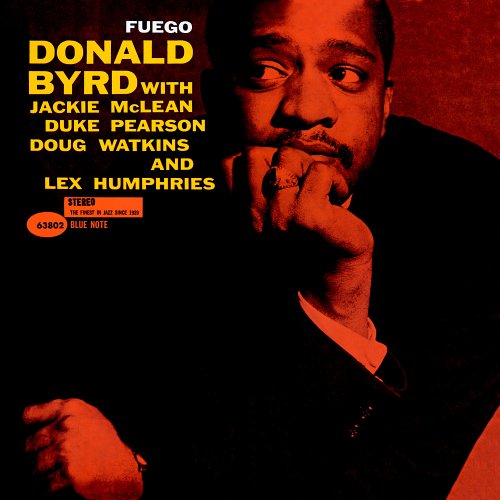
fuego
Donald Byrd stoked a funky fire with the smoldering soul of this low life lament. Trumpeter Donaldson Toussaint L’Ouverture Byrd II had graduated from Detroit’s Cass Technical High School and Wayne State University before receiving his master’s from the Manhattan School of Music. After playing with the U.S. Air Force Band he moved to New York where he joined Art Blakey’s Jazz Messengers replacing Clifford Brown.
He recorded nine albums as a bandleader (as well as dozens more as a sideman) on Transition Records, Prestige Records, Verve Records, and Columbia Records before signing with Blue Note Records in 1958. He released two albums Off to the Races and Byrd in Hand in 1959 before going into Van Gelder Studio in Englewood Cliffs, New Jersey with producer Alfred Lion and engineer Rudy Van Gelder to record 'Fuego' with a new quintet. The session on October 4, 1959 featured Donald Byrd on trumpet; Jackie McLean on alto saxophone; Duke Pearson on piano; Doug Watkins on bass; and Lex Humphries on drums.
'Fuego'
full album:
https://myspace.com/donaldbyrdjazzfunk/music/album/fuego-20120992
https://www.youtube.com/playlist?list=PL6F9A3D0E4CC3A36F
All compositions by Donald Byrd
"Fuego" - 6:38
"Bup a Loup" - 4:05
"Funky Mama" - 10:58
"Low Life" - 6:02
"Lament" - 8:27
"Amen" - 4:46
Wednesday, December 31, 2014
time out
The Dave Brubeck Quartet produced a jazz phenomenon with this progressive polyrhythmic pantomime. Brubeck learned piano from his mother and received a degree in music from the College of the Pacific in Stockton, California; despite the fact that he could not read music. After being drafted into Army, he formed the racially integrated "Wolfpack" band. It was during this time that he met Paul Desmond. Brubeck worked with an octet and then a trio, both of which sold well for Fantasy Records. A spinal cord injury while diving in Hawaii changed the way he played the piano. He formed the Dave Brubeck Quartet with Paul Desmond and had more success with Jazz at Oberlin and Jazz at the College of the Pacific debut before switching to Columbia Records for Jazz Goes to College in 1954; the same year he was featured on the cover of Time magazine.
Over the next five years they released nine albums (Jazz: Red Hot and Cool, Brubeck Time, Dave Digs Disney, Jazz Goes to Junior College, Jazz Impressions of the U.S.A,, Jazz Impressions of Eurasia, Dave Brubeck Quartet in Europe, Gone With the Wind, and The Riddle) with a revolving door rhythm section that included bassists Ron Crotty, Bob Bates, and Norman Bates; and drummers Lloyd Davis and Joe Dodge. Joe Morello took over the kit in 1956 and African-American bassist Eugene Wright joined in 1958, creating some controversy where racial integration was still an issue.
A tour in Turkey exposed Brubeck to complex time signatures, which inspired the experimentation that informed 'Time Out'. Teo Macero produced and Fred Plaut engineered the sessions at the Columbia 30th Street Studio in New York that featured Dave Brubeck on piano, Paul Desmond on alto saxophone, Eugene Wright on bass, and Joe Morello on drums. S. Neil Fujita did the cover artwork for 'Time Out', which became the first jazz album to sell a million copies.
http://www.davebrubeckjazz.com/
"Take Five" became one of the biggest jazz hits of all time, going to number twenty-five on the US pop chart and number five on the US easy listening chart. Brubeck remembers the label's reluctance to release it as a single: "They said no one would be able to dance to it...I’ve seen people of all ages dance to that song...Joe warned me, 'Dave, you’re going to have to keep that rhythm going when I take a drum solo' [laughs]. Paul and I framed it to feature Joe on drums. If you listen to the original recording, you can hear that the song was built around Joe's drum solo. At any rate, Paul took credit for writing the song...He thought it was his tune. I said, 'All of the tunes are being copyrighted by my company. It will be confusing if you copyright it separately.' He wasn’t crazy about doing it my way but he agreed just the same, adding, 'But it’s going to be my tune.'...The secret is the drumbeat, which was Joe Morello’s. You can't sit still when you hear it...When I first heard Joe play that beat backstage and Paul improvised against it, I said to Paul at our rehearsal for Time Out, 'Try to write down some of your improvisations.'...When he came back to the rehearsal, he said, 'I can’t write anything in 5/4.' I said, 'Well, I just heard you improvising on it and you sounded great.' Paul said, 'I wrote down some of those things.' I said, 'Great, let me see what you have.'...I looked at what Paul had done and said, 'Paul, I can put this together, and it will be a great tune.' We gave it a try, and the approach worked...The title is mine and so were the lyrics: 'Won't you stop and take a little time out with me, just take five. Stop your busy day and take the time out, to see, I'm alive.'...Teo Macero, the album’s producer, said there had to be a cover of the song with words to it. That was Columbia's way of covering its bases with the tricky 5/4 time, to have a vocal version. When I told that to Paul, he said he wanted his Picture 4 father to write them. But they didn’t come in as soon as we needed them. Teo wanted words so Carmen McRae could sing the cover almost immediately... [I finished the lyrics] probably a month or two after. Some lyricist told me later I had written some clever things that didn't quite come across in some of the vocal versions...The second stanza where the melody changes to a major key:'Though I'm going out of my way, just so I can pass by each day; not a single word do we say, it's a pantomime and not a play.' Most singers miss the nuance. 'It’s a pantomime and not a play.' There’s a double meaning there—a play can mean a spoken performance or it can mean a romantic pitch. A lyricist told me that was one of the cleverest lines ever written [laughs]."
https://www.youtube.com/watch?v=PHdU5sHigYQ
Won't you stop and take a little time out with me, just take five;
Stop your busy day and take the time out to see I'm alive.
Though I'm going out of my way,
Just so I can pass by each day,
Not a single word do we say,
It's a pantomime and not a play
Still I know our eyes often meet,
I feel tingles down to my feet,
when you smile that's much too discrete,
sends me on my way.
Wouldn't it be better not to be so polite, you could offer a light;
Start a little conversation now, it's alright, just take five, just take five.
Though I'm going out of my way,
Just so I can pass by each day,
Not a single word do we say,
It's a pantomime and not a play
Still I know our eyes often meet,
I feel tingles down to my feet,
when you smile that's much too discrete,
sends me on my way.
Wouldn't it be better not to be so polite, you could offer a light;
Start a little conversation now, it's alright, just take five, just take five
Carmen McRae version
https://www.youtube.com/watch?v=sNWsr6N72yQ
"Blue Rondo à la Turk"
Brubeck says: "I think it's equally as important as Take Five. But Columbia wanted to push Take Five. Blue Rondo is based on a street rhythm I heard while we were in Turkey. It's in 9/8 time, with the blues section in 4/4. People loved that song and still do...Take Five is a title you could put on a jukebox and remember more easily in a record store. Blue Rondo a la Turk was too long a song title. In those days the jukebox determined what became a hit. I should have called it just Blue Rondo. Blue Rondo a la Turk wound up on the B-side of the single."
https://www.youtube.com/watch?v=j9GgmGLPbWU
"Three to Get Ready"
https://www.youtube.com/watch?v=xmaC4WwspS4
'Time Out'
full album:
https://myspace.com/davidbrubeck/music/album/time-out-12220965
All compositions by Dave Brubeck, except "Take Five" by Paul Desmond.
Side one
1. "Blue Rondo à la Turk" 6:44
2. "Strange Meadow Lark" 7:22
3. "Take Five" 5:24
Side two
1. "Three to Get Ready" 5:24
2. "Kathy's Waltz" 4:48
3. "Everybody's Jumpin'" 4:23
4. "Pick Up Sticks" 4:16
Original 1959 LP Liner Notes (Copyright Columbia Records)
Should some cool-minded Martian come to earth and check on the state of our music, he might play through 10,000 jazz records before he found one that wasn't in common 4/4 time.
Considering the emancipation of jazz in other ways, this is a sobering thought ... and an astonishing one. The New Orleans pioneers soon broke free of the tyranny imposed by the easy brass key of B-flat. Men like Coleman Hawkins brought a new chromaticism to jazz. Bird, Diz and Monk broadened its harmonic horizon. Duke Ellington gave it structure, and a wide palette of colors. Yet rhythmically, jazz has not progressed. Born within earshot of the street parade, and with the stirring songs of the Civil War still echoing through the South, jazz music was bounded by the left-right, left-right of marching feet.
Dave Brubeck, pioneer already in so many other fields, is really the first to explore the uncharted seas of compound time. True, some musicians before him experimented with jazz in waltz time, notably Benny Carter and Max Roach. But Dave has gone further, finding still more exotic time signatures, and even laying one rhythm in counterpoint over another.
The outcome of his experiments is this album. Basically it shows the blending of three cultures: the formalism of classical Western music, the freedom of jazz improvisation, and the often complex pulse of African folk music. Brubeck even uses, in the first number, a Turkish folk rhythm.
Blue Rondo à la Turk
Blue Rondo à la Turk plunges straight into the most jazz-remote time signature, 9/8 - grouped not in the usual from (3-3-3) but in 2-2-2-3. When the gusty opening section gives way to a more familiar jazz beat, the three eighth-notes have become equivalent to one quarter-note, and an alternating 9/8 - 4/4 time leads to a fine solo by Paul Desmond. Dave Brubeck follows, with a characteristically neat transition into the heavy block chords which are a familiar facet of his style, and before long "Rondo à la Turk" is a stamping, shouting blues. Later the tension is dropped deliberately for Paul Desmond's re-entry, and for the alternate double-bars of 9- and 4- time which herald the returning theme. The whole piece is in classical rondo form.
Strange Meadow Lark
Strange Meadow Lark opens with Dave Brubeck playing rubato, though there are overtones of 3's and 4's, and the phrase length is an unusual 10 bars. Dave Brubeck's performance throughout is simple and expressive, with fine support from Eugene Wright and Joe Morello .Strange Meadow Lark closes with a contribution from the wistful, dream-like saxophone of Paul Desmond.
Take Five
Take Five is a Paul Desmond composition in 5/4, one of the most defiant time-signatures in all music, for performer and listener alike. Conscious of how easy the listener can lose their way in a quintuple rhythm, Dave Brubeck plays a constant vamp figure throughout, maintaining it even under Joe Morello's drum solo. It is interesting to notice how Joe Morello gradually releases himself from the rigidity of the 5/4 pulse, creating intricate and often startling counter-patterns over the piano figure. And contrary to any normal expectation - perhaps even the composer's! - Take Five really swings.
Three To Get Ready
Three To Get Ready promises, at first hearing, to be a simple 'Haydn-esque' waltz theme in C major. But before long it begins to vacillate between 3- and 4- time, and the pattern become clear: two bars of 3, followed by two bars of 4. It is a metrical scheme which suits Dave Brubeck down to the ground; his solo here is one of the high spots.
Kathy's Waltz
Kathy's Waltz (dedicated to Dave Brubeck's little daughter) starts in 4, only later breaking into quick waltz time. As in the Disney-born "Someday My Prince Will Come", Dave Brubeck starts in triple time, then urges his piano into a rocking slow 4. Theoretically it is as if Joe Morello's three beats had ceased to be the basic pulse, and had become triplets in a slow 4-beat blues -- though with Eugene Wright's 1-in-a-bar bass as the constant link between piano and drums. The listener who keeps abreast of the cross-rhythms here can congratulate themself on sharing with the Brubeck Quartet an enlightened rhythmic sense. Even feet are useless in following a time experiment of such complexity.
Everybody's Jumpin'
Everybody's Jumpin' opens without any precise feeling of key, but with a vague impression of 6/4 time, and a strong beat. Joe Morello's brief drum solo shows again what a superb colourist he is on the canvas of percussion tone.
Pick Up Sticks
With Pick Up Sticks, the earlier hint of 6/4 becomes positive. As so often in Dave Brubeck's time experiments, it is the bass part which supplies the anchor for the listener. This time Eugene Wright plays a regular pattern of six notes: a passacaglia on which is built the whole structure of this closing number. The high spot of "Pick Up Sticks" comes near the close, in a session of commanding piano. This is Dave Brubeck in the grand manner, as exciting as eight brass, but with that feeling of urgent discovery which can never be captured by the arranger's pen.
Time Out
In short: "Time Out" is a first experiment with time, which may well come to be regarded as more than an arrow pointing to the future. Something great has been attempted...and achieved. The very first arrow has found its mark.
Steve Race
Wednesday, December 17, 2014
chega de saudade
João Gilberto defined the new style samba with this luxurious expression of profound longing. Born in 1931 in Juazeiro, Bahia in in the northeastern Brazil, Gilberto was given his first guitar at the age of fourteen by his grandfather. He led a group in high school that was influenced by swing jazz, opera, and Brazilian pop. He moved to the city of Salvador where radio performances led to an invitation for his to join the vocal group Garotos da Lua (Moon Boys) in Rio de Janeiro. The group kicked him out after a year because he would often skip practices or turn up late. He is featured on two singles released by the group on the Todamerica lable in 1951: Quando Você Recordar/Amar é Bom and Anjo Cruel/ Sem Ela.
He released a single under his own name the next year (Quando Ela Sai/Meia Luz on the Copacabana label) only to spend the next several years drifting with no fixed address, staying with friends, and falling prey to chronic depression. Singer Luiz Telles took him to Porto Alegre in southern Brazil where he regained his confidence. It was while staying with his sister in Diamantina in the state of Minas Gerai that he developed a new style of singing and playing that transformed traditional samba into something more intimate and melodic. Around this time, his father had him committed to a mental institution due to concern over his lifestyle and strange manner of singing. He was released after a week.
Returning to Rio de Janeiro, Gilberto reconnected with Antonio Carlos Jobim, who was impressed with Gilberto's 'bossa nova' and helped him get signed to Odeon Records. Jobim produced two singles (Chega de Saudade/Bim Bom and Desafinado/Hô-bá-lá-lá) for Gilberto in 1958 before recording his debut album 'Chega de Saudade' the next year. The sessions featured João Gilberto on vocals and guitar; Copinha on flute; Milton Banana on drums; Rubens Bassini on percussion; Edmundo Maciel on trombone; choir by Garotos da Lua; and arrangements and piano by Antonio Carlos Jobim.
'Chega de Saudade' creates a suite of smooth samba grooves as the songs segue into one another seemlessly creating an emotional experience in which you can get lost. And that's a good thing.
http://joaogilberto.org/
'Chega de Saudade'
full album:
https://myspace.com/therealjoaogilberto/music/album/chega-de-saudade-18029999
http://grooveshark.com/#!/album/Chega+De+Saudade/3716799
https://www.youtube.com/watch?v=EQC4Ye7hr9Y
side one
00:00 "Chega de Saudade" Antônio Carlos Jobim / Vinicius de Moraes
01:59 "Lobo Bobo" Carlos Lyra / Ronaldo Bôscoli
03:17 "Brigas, Nunca Mais" Antônio Carlos Jobim / Vinicius de Moraes
05:22 "Hô-bá-lá-lá" João Gilberto
07:38 "Saudade Fez um Samba" Carlos Lyra / Ronaldo Bôscoli
09:21 "Maria Ninguém" Carlos Lyra
side two
11:46 "Desafinado" Newton Mendonça / Antonio Carlos Jobim
13:47 "Rosa Morena" Dorival Caymmi
15:52 "Morena Boca de Ouro" Ary Barroso
17:52 "Bim Bom" João Gilberto
19:08 "Aos Pés da Cruz" Marino Pinto / Zé da Zilda
20:40 "É Luxo Só" Ary Barroso / Luiz Peixoto
Saturday, November 22, 2014
miles davis and the modern jazz giants
Miles Davis and the Modern Jazz Giants were workin' and relaxin' as they laid out some cookin' and steamin' vibes on this controversial collaboration.
Most of 'Miles Davis and the Modern Jazz Giants' was recorded at Van Gelder Studio in Hackensack, New Jersy on December 24, 1954 with Miles Davis on trumpet, Milt Jackson on vibraphone, Thelonious Monk on piano, Percy Heath on bass, and Kenny Clarke on drums.
It was the only time that Monk and Davis would record together in the studio. The fact that Davis asked Monk to 'lay out' during his solo has been built up to be some kind of fisticuff. Davis would express in his autobiography: "Monk was a serious musician. When I first met him, he used to stay fucked up a lot, high off Dexedrines. At least, that's what I heard. But when I was learning music from him - and I learned a lot from him - he wasn't getting high so much. He was a big, strong motherfucker, about six feet two, and over two hundred pounds. He didn't take no shit off nobody. When I heard stories later saying that me and him was almost about to fight after I had him lay out while I was playing on "Bags' Groove," I was shocked, because Monk and I were, first, very close, and second, he was too big and strong for me to even be thinking about fighting. Shit, man, he could have just squashed me if he wanted to. All I did was tell him to lay out when I was playing. My asking him to lay out had something to do with music, not friendship. He used to tell cats to lay out himself. But as great a musician as he was, I just didn't like what he played behind me, that is, the way he used to play chords in the rhythm. See, you had to play like Coltrane to play with Monk - all that space and disjointed shit he used to play. But that shit was bad, now. It was some top of the shit music. But it was just different."
"'Round Midnight" is an early version of the song from the new quintet of Miles Davis on trumpet, John Coltrane on tenor saxophone, Red Garland on piano, Paul Chambers on bass, and Philly Joe Jones on drums. It comes from a marathon two day session to crank out four albums ('Relaxin' with the Miles Davis Quintet', 'Steamin' with the Miles Davis Quintet', 'Workin' with the Miles Davis Quintet', and 'Cookin' with the Miles Davis Quintet') to fulfill Davis' contract with Prestige so he could move on to Colombia Records and release the classic 'Round Midnight' album.
https://www.milesdavis.com/
'Miles Davis and the Modern Jazz Giants'
full album:
Side one
1. "The Man I Love" (Take 2) George Gershwin & Ira Gershwin 7:59
2. "Swing Spring" Miles Davis 10:46
Side two
1. "'Round Midnight" Bernie Hanighen, Cootie Williams & Thelonious Monk 5:25
2. "Bemsha Swing" Thelonious Monk & Denzil Best 9:33
3. "The Man I Love" (Take 1) George Gershwin & Ira Gershwin 8:29
Monday, October 27, 2014
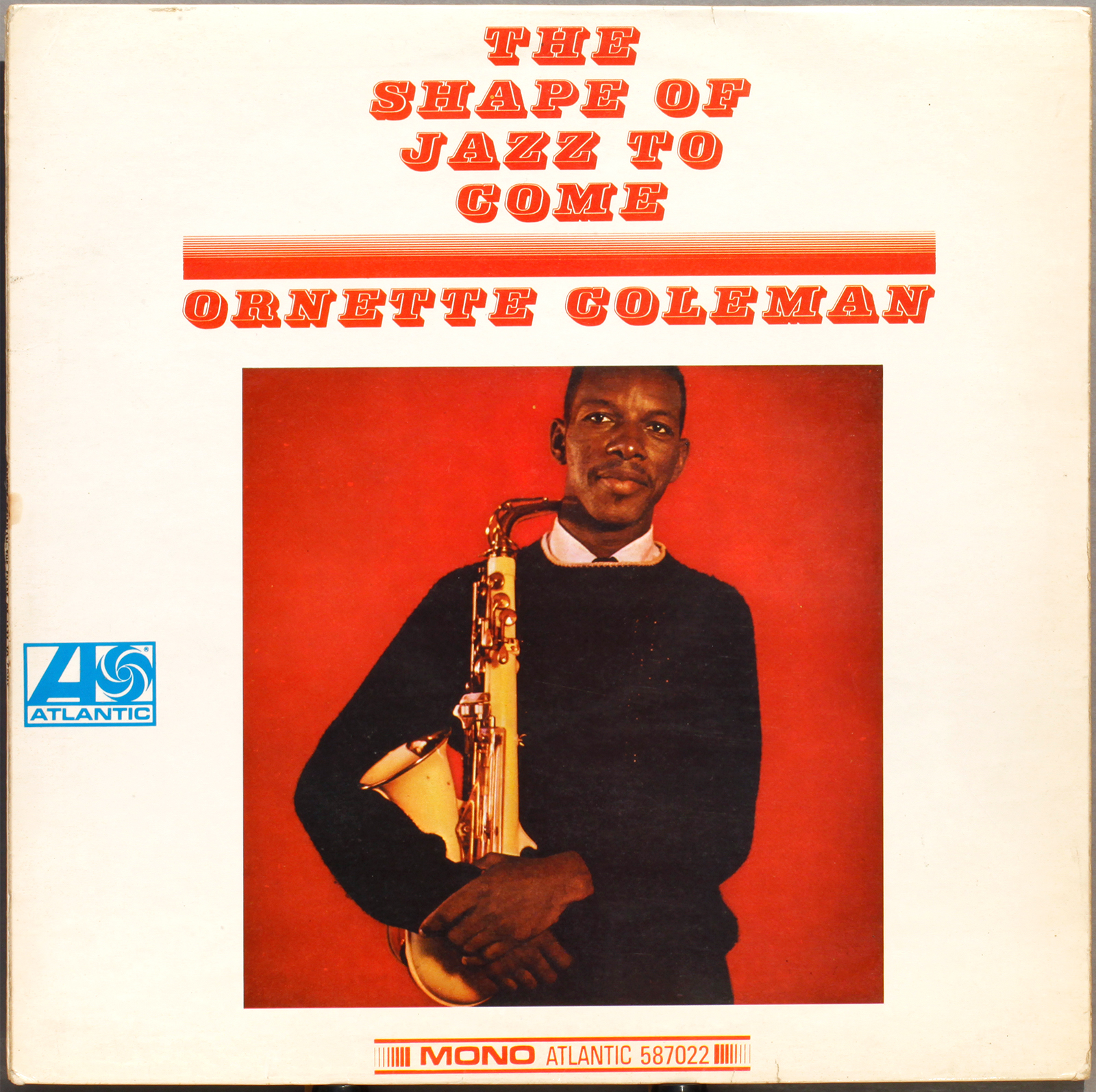
the shape of jazz to come
Ornette Coleman established the avante-garde in jazz with the unconventional improvisation and atonal acrobatics of this controversial free jazz milestone. Coleman had challenged listeners with his first two albums ('Something Else!!!!' and 'Tomorrow Is the Question!') on Contemporary Records; but for his third release he took things even further. With his second album, he did away with the pianist, a standard in jazz. For 'The Shape of Jazz to Come', he did away with chord structure, utilizing a brief theme before launching into uncharted territory. The album was his first after signing a deal with Atlantic Records, which John Lewis from the Modern Jazz Quartet helped him secure.
Coleman looks back: "Before becoming known as a musician, when I worked in a big department store, one day, during my lunch break, I came across a gallery where someone had painted a very rich white woman who had absolutely everything that you could desire in life, and she had the most solitary expression in the world. I had never been confronted with such solitude, and when I got back home, I wrote a piece that I called "Lonely Woman."
'The Shape of Jazz to Come' was recorded in Los Angeles at Radio Records, Inc with producer Nesuhi Ertegun and features the quartet of Ornette Coleman on alto saxophone; Don Cherry on cornet; Charlie Haden on bass; and Billy Higgins on drums.
Coleman considers: "The idea is that two or three people can have a conversation with sounds, without trying to dominate or lead it. What I mean is that you have to be… intelligent, I suppose that’s the word. In improvised music I think the musicians are trying to reassemble an emotional or intellectual puzzle in which the instruments give the tone. It’s primarily the piano that has served at all times as the framework in music, but it’s no longer indispensable and, in fact, the commercial aspect of music is very uncertain. Commercial music is not necessarily more accessible, but it is limited...For me, being an innovator doesn't mean being more intelligent, more rich, it's not a word, it's an action. Since it hasn't been done, there's no use talking about it...It interests me more to have a human relationship with you than a musical relationship. I want to see if I can express myself in worlds, in sound that have to do with a human relationship. At the same time, I would like to be able to speak of teh relationship between two talents, between two doings. For me, the human relationship is mush more beautiful, because it allows you to gain the freedom that you desire, for youself and for the other."
http://www.ornettecoleman.com/
'The Shape of Jazz to Come'
full album:
All compositions by Ornette Coleman.
Side one
1. "Lonely Woman" 4:59
2. "Eventually" 4:20
3. "Peace" 9:04
Side two
1. "Focus on Sanity" 6:50
2. "Congeniality" 6:41
3. "Chronology" 6:05
outtakes:
"Monk and the Nun"
https://www.youtube.com/watch?v=8VOITCYjqoE
"Just for You"
https://www.youtube.com/watch?v=h2n6e0FMWUE
Sunday, August 31, 2014
uncloudy day
Roebuck recalls: "I was the first artist with a singing group to take the guitar and go into church, which they didn’t allow. And they had faith and believed in Pops Staples and the Staple Singers. You know, we wasn’t trying to start something for money or nothing. We were just singing because we love God’s word and we love God. We were singing for the praises of God. And the ministers could see that. They let us come in with the guitar, and that started the whole ball rolling. The Soul Stirrers, Blind Boys, Nightingales, Swan Silvertones, all of them – we would come to Chicago to sing on radio. They got to their songs, and I was on one end of the studio and had a guitar, and that was fascinating to them. The next time around, everybody came to Chicago had guitar. Something new, see? They had sung themselves out, went all over the world, just singing a cappella. And that was a new thing – the guitar was new! Now, they got guitar, bass, drum, everything."
He began singing with his four children Cleotha, Pervis, Yvonne, and Mavis Staples in churches around the midwest. Radio show appearances led to the recording of a single “These Are They”/”Faith and Grace” on Pops’ own label, Royal Records. Another single "Won’t You Sit Down” on the local United label led to a contract with the Chicago-based Vee-Jay Records, which released the Staple Singers' first long-play album, titled 'Uncloudy Day', in 1959; the disc, number 5000, was additionally the first in the Vee-Jay Spiritual Series.
Pops says: "The children were so young, they didn’t know how to sing in a key, what key, or nothin’. It’s four sounds, so I just took them and... I give them a note. I said, “Now you keep that. Hold it!” So she sings [sings an A]. Each one gets a note. When they all sing together, that makes a chord. That’s the way I taught them how to sing. I said, “Now you just keep that sound all the way through.” That’s the way I taught them – no music or nothin’. I hit the string where they should be – where this one should be and where that one should be. That’s the way I taught them how to make that music...Mavis was two years before we could get her – like I was hittin’ that sting – to hold her tune. For about two years, we kept on singing around the house. That’s the reason I said, “Never think about going on no road,” so we was just singin’ for ourselves. After about two years, Pervis and me was singing lead. Mavis was singing contralto, and then Pervis’ voice got too heavy for lead. I said, “Mavis, you try it.” And right then, when she hit the first song, I said, “That’s something.” I knew then. One of the guys said, “Staples, man, you sure got a good group” – that was when Pervis and me were singin’. He said, “You did right to leave the other group and start your family.” And I said, “Yeah, you think so? You just wait a minute – you ain’t heard nothin’ yet.” Sure enough, about six more months, Mavis was taking off."

https://myspace.com/mavisstaple/music/album/swing-low-sweet-chariot-uncloudy-day-bonus-track-version-18382775
Uncloudy Day
They tell me of a home far beyond the skies
And they tell me of a home far away
They tell me of a home where no storm clouds rise
They tell me of an unclouded day
The land of cloudless days
The land of an unclouded sky
They tell me of a home where no storm clouds rise
They tell me of an unclouded day
https://www.youtube.com/watch?v=vVlEyt2S3Ws
Will the Circle be Unbroken?
I was standing by my window
On a cold and cloudy day
When I saw the hearse come rollin'
For to take my mother away
Will the circle be unbroken?
By and by Lord, by and by
There's a better home a-waitin'
In the sky Lord, in the sky
I told the undertaker
"Undertaker, please drive slow
For this lady that you're haulin' Lord
I hate to see her go."
Well I followed close behind
Tried to hold the family grace
But I could not hide my sorrow
When they laid herein the grave
I went back home, my house was lonesome
Cause my mother, she was gone
All my brothers, sisters, crying
What a home, so sad and lone
One by one the seats were empty
One by one they went away
Now my family, they are parted
Will they meet again someday
Will the circle be unbroken?
By and by Lord, by and by
There's a better home a-waitin'
In the sky Lord, in the sky
https://www.youtube.com/watch?v=1UagEgEp2ok
Let Me Ride
https://www.youtube.com/watch?v=M_NJdMAkvZI
God's Wonderful Love
Help Me Jesus
https://www.youtube.com/watch?v=yf9ZzOzb7Hk
I'm Coming Home
https://www.youtube.com/watch?v=Ics41WtssVc
If I Could Hear My Mother
Low Is the Way
https://www.youtube.com/watch?v=9jEmJG3CTEs
I Had a Dream
https://www.youtube.com/watch?v=BJECEIzBQRk
On My Way to Heaven
https://www.youtube.com/watch?v=M3qu2zAk4go
Going Away
https://www.youtube.com/watch?v=b8-qaLuEdz8
I'm Leaning
https://www.youtube.com/watch?v=wIHM2Mflhgs
I Know I Got Religion
https://www.youtube.com/watch?v=VZPh7U5IB14
Ain't That Good News
https://myspace.com/mavisstaple/music/song/ain-t-that-good-news-80220478-88350325
This May Be the Last Time
https://www.youtube.com/watch?v=j1jGF-6bFpI
Will the Circle Be Unbroken
https://www.youtube.com/watch?v=8W7Y8R1xQNk
Stand by Me
https://www.youtube.com/watch?v=1PsE_CyX108
Come on Up in Glory
https://www.youtube.com/watch?v=fKt9zW0aPIY
Pray On
https://www.youtube.com/watch?v=wJhSIl-ABhM
Somebody Save Me
https://www.youtube.com/watch?v=S1UeQGTFYe8
Each Day
https://www.youtube.com/watch?v=ateICMYPl6g
So Soon
https://www.youtube.com/watch?v=wcM-EpYe6SI
Too Close
https://myspace.com/mavisstaple/music/song/too-close-9199211-98835136
https://www.youtube.com/watch?v=_5QBdUSsbMw
Let's Go Home
Vee-Jay Records released the Staple Singers' first long-play album, titled 'Uncloudy Day', in 1959; the disc, number 5000, was additionally the first in the Vee-Jay Spiritual Series.
The songs for this video I selected from the album; they are
1) On My Way To Heaven;
2) Going Away;
3) I'm Leaning;
4) I Know I Got Religion.
Subscribe to:
Posts (Atom)