Showing posts with label gospel. Show all posts

Sunday, March 27, 2016

messiah


This sacred oratorio has become one of the most recognized musical pieces of all time.  George Frideric Handel composed the music with lyricist Charles Jennens who drew from the King James Bible.  

The German born Handel had been trained in German and Italian schools before relocating to England in 1712.  He had quite a bit of success with Italian operas; but as the demand for music in English grew, he gradually made the transition to meet the demand.  Handel had written oratorio about Christ in Italy (La Resurrezione, 1708) and Germany (The Brockes Passion, 1716); but when Charles Jennens, 
with whom he had already collaborated (Saul, 1739), offered him the libretto for another collection from Scripture, he waited three years before he began to compose music for it.  

'Messiah' made its debut in Dublin in 1742 to rave reviews and universal acclaim.  When the oratorio came to London the next year, it was not so warmly received.  There were complaints about the sacred piece being performed in a secular theatre.  Also Jennings was not happy with some of the sections.  Handel reworked them and the oratorio was revived in 1749.  Since then, it has received more expansive orchestral arrangements and is one of the most performed oratorios ever.  


Hallelujah Chorus


'Messiah'
full oratorio:


PART I
Scene 1: Isaiah's prophecy of salvation
01:46 : 1. Ouverture
05:34 : 2. Comfort ye my people (Tenor)
08:30 : 3. Ev'ry valley shall be exalted (tenor)
11:50 : 4. And the glory of the Lord (chorus)
Scene 2: The coming judgment
14:48 : 5. Thus saith the Lord of hosts (bass)
16:16 : 6. But who may abide the day of His coming (bass)
20:45 : 7. And he shall purify the sons of Levi (chorus)
Scene 3: The prophecy of Christ's birth
23:25 : 8. Behold, a virgin shall conceive (alto)
23:49 : 9. O thou that tellest good tidings to Zion (alto and chorus)
29:24 : 10. For behold, darkness shall cover the earth (bass)
31:22 : 11. The people that walked in darkness have seen a great light (bass)
34:55 : 12. For unto us a child is born (chorus)
Scene 4: The annunciation to the shepherds
39:03 : 13. Pifa ("pastoral symphony": instrumental)
41:46 : 14a. There were shepherds abiding in the fields (soprano)
42:03 : 14b. And lo, the angel of the Lord (soprano)
42:25 : 15. And the angel said unto them (soprano)
43:06 : 16. And suddenly there was with the angel (soprano)
43:23 : 17. Glory to God in the highest (chorus)
Scene 5: Christ's healing and redemption
45:22 : 18. Rejoice greatly, O daughter of Zion (soprano)
49:55 : 19. Then shall the eyes of the blind be opened (alto)
50:28 : 20. He shall feed his flock like a shepherd (alto and soprano)
55:42 : 21. His yoke is easy (chorus)

PART II
Scene 1: Christ's Passion
58:17 :    22. Behold the Lamb of God (chorus)
1:01:08 : 23. He was despised and rejected of men (alto)
1:12:50 : 24. Surely he has borne our griefs and carried our sorrows (chorus)
1:14:32 : 25. And with his stripes we are healed (chorus)
1:16:24 : 26. All we like sheep have gone astray (chorus)
1:20:11 : 27. All they that see him laugh him to scorn (tenor)
1:20:52 : 28. He trusted in God that he would deliver him (chorus)
1:23:19 : 29. Thy rebuke hath broken his heart (tenor)
1:25:10 : 30. Behold and see if there be any sorrow (tenor)
Scene 2: Christ's Death and Resurrection
1:26:18 : 31. He was cut off (tenor)
1:26:48 : 32. But thou didst not leave his soul in hell (tenor)
Scene 3: Christ's Ascension
1:29:04 : 33. Lift up your heads, O ye gates (chorus)
Scene 4: Christ's reception in Heaven
1:34:20 : 34. Unto which of the angels (tenor)
1:34:35 : 35. Let all the angels of God worship Him (chorus)
Scene 5: The beginnings of Gospel preaching
1:36:07 : 36. Thou art gone up on high (alto)
1:39:18 : 37. The Lord gave the word (chorus)
1:40:24 : 38. How beautiful are the feet (soprano)
1:42:48 : 39. Their sound is gone out (chorus)
Scene 6: The world's rejection of the Gospel
1:44:21 : 40. Why do the nations so furiously rage together (bass)
1:47:16 : 41. Let us break their bonds asunder (chorus)
1:49:00 : 42. He that dwelleth in heaven (tenor)
Scene 7: God's ultimate victory
1:49:12 : 43. Thou shalt break them with a rod of iron (tenor)
1:51:17 : 44. Hallelujah (chorus)

PART III
Scene 1: The promise of eternal life
1:55:20 : 45. I know that my Redeemer liveth (soprano)
2:01:30 : 46. Since by man came death (chorus)
Scene 2: The Day of Judgment
2:03:40 : 47. Behold, I tell you a mystery (bass)
2:04:14 : 48. The trumpet shall sound (bass)
Scene 3: The final conquest of sin
2:13:06 : 49. Then shall be brought to pass (alto)
2:13:23 : 50. O death, where is thy sting (alto and tenor)
2:15:21 : 51. But thanks be to God (chorus)
2:17:45 : 52. If God be for us, who can be against us (soprano)
Scene 4: The acclamation of the Messiah
2:23:05 : 53. Worthy is the Lamb (chorus)
Amen (chorus)


Sunday, October 25, 2015

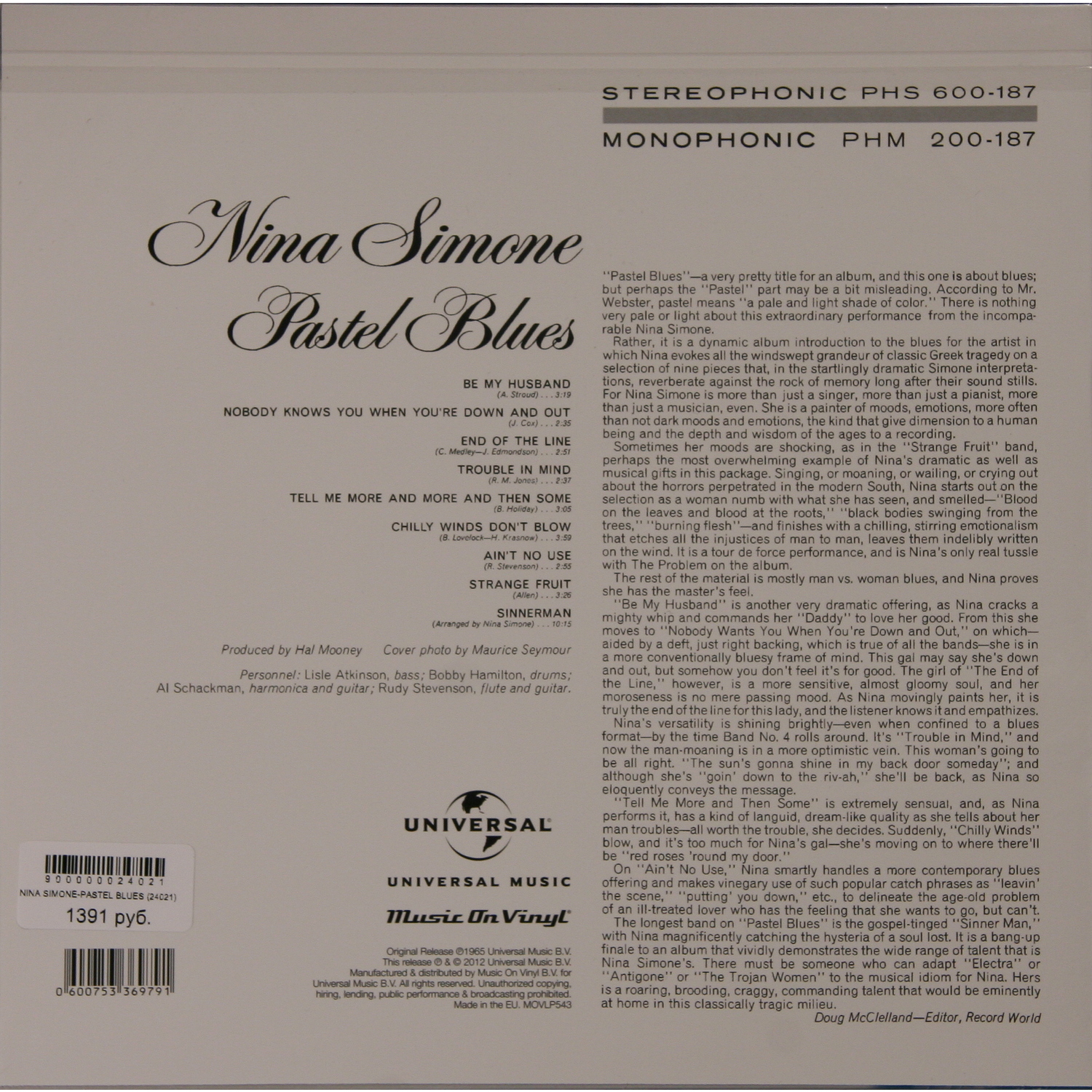
pastel blues


Nina Simone ran to the rock with trouble in mind to find power and then some in the dark spiritual yearning of this edgy eclectic catharsis.    She had defied expectations with her unique blend of jazz, classical, pop, and blues with ten albums  (Little Girl Blue in 1958;     Nina Simone and Her Friends,   The Amazing Nina Simone,   and  Nina Simone at Town Hall in 1959;   Nina Simone at Newport  and  Forbidden Fruit in 1960;    Nina at the Village Gate  and  Nina Simone Sings Ellington  in 1962;   Nina Simone at Carnegie Hall  in 1963;  and  Folksy Nina in 1964) before transitioning to Mercury Records subsidiary Philips in 1964.  Her first album for that label  Nina Simone in Concert featured the controversial song "Mississippi Goddam"  inspired by the the murder of Medgar Evers and the bombing of a church in Birmingham, Alabama, in which four black schoolgirls were killed.  The song was banned by some radio stations and brought her to the forfront of the civil rights movement.   

Simone would express:    "I hope the day comes when I will be able to sing more love songs, when the need is not quite so urgent to sing protest songs. But for now, I don't mind."

She released two more albums  (Broadway-Blues-Ballads  in 1964  and   I Put a Spell on You  in 1965) before going into the studio to record  'Pastel Blues' with producer Hal Mooney.   The sessions featured  Nina Simone on piano, vocals, and arrangements;   Al Schackman on guitar and harmonica;  Rudy Stevenson on guitar and flute;  Lisle Atkinson on bass;  and  Bobby Hamilton on drums.   


The album draws heavily from blues and gospel, with the sophistication of her jazz classical idiom.  Simone considered:   "Some of my most fantastic experiences - experiences that really shake me, now that I think of them - happened in the church when we'd have these revival meetings. I'd be playinnnnng, boy! I'd really be playing. I loved it! Folks would be shoutin' all over the place. Now that's my background!"

 'Pastel Blues' reached number one hundred and thirty-nine on the US pop album chart and number eight on the R&B album chart.  


http://www.ninasimone.com/


lyrics:
http://genius.com/albums/Nina-simone/Pastel-blues


"Sinnerman"


'Pastel Blues'
full album:


"Be My Husband" (Andy Stroud) – 3:20
"Nobody Knows You When You're Down and Out" (Jimmie Cox) – 2:38
"End of the Line" (John Edmondson, Cynthia Medley) – 2:54
"Trouble in Mind" (Richard Jones) – 2:40
"Tell Me More and More and Then Some" (Billie Holiday) – 3:08
"Chilly Winds Don't Blow" (Hermann Krasnow, William Lovelock) – 4:01
"Ain't No Use" (Rudy Stevenson) – 3:00
"Strange Fruit" (Lewis Allan) – 3:29
"Sinnerman" (traditional) – 10:19


Live In Holland 1965


01. Brown Baby
02. Four Women
03. The Ballad Of Hollis Brown
04. Tomorrow Is My Turn
05. Images
06. Go Limp
07. Mississippi Goddam


Sunday, August 23, 2015

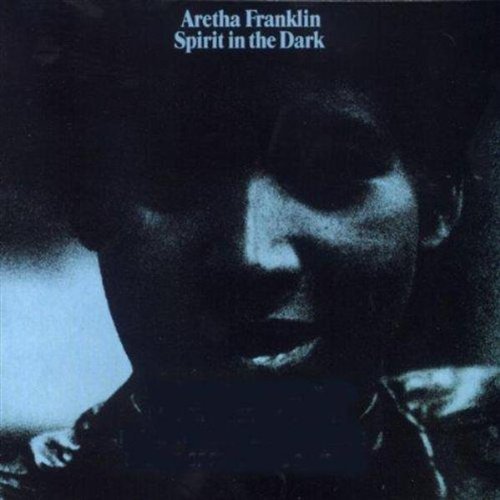
spirit in the dark


Aretha Franklin went back to her gospel roots and took four different bands to church movin and groovin with this serious southern soul.    Already established as "The Queen of Soul",  she had released nineteen albums over fourteen years (Songs of Faith in  1956; Aretha: With The Ray Bryant Combo in 1961;    The Electrifying Aretha Franklin   and The Tender, the Moving, the Swinging Aretha Franklin in 1962; Laughing on the Outside in 1963;     Unforgettable: A Tribute to Dinah Washington   and Runnin' Out of Fools  in 1964; Yeah!!!   in 1965;
1966 Soul Sister  in 1966;    Take It Like You Give It, I Never Loved a Man the Way I Love You,   Aretha Arrives, and Take a Look  in 1967;     Lady Soul,   Aretha in Paris,  and    Aretha Now in 1968; Soul '69 and  Soft and Beautiful in 1969; and This Girl's in Love with You  already in 1970)  with twenty-eight top thirty singles on the R&B chart (eight of them chart toppers) and eight top ten singles on the pop chart.  


After years of physical abuse, Franklin divorced her husband and manager Ted White in 1969 and gave birth to her son Kecalf Cunningham (with Ken Cunningham) in March of 1970.    She would express at the time:   "I am an old woman in disguise.  Trying to grow up is hurting, you know. You make mistakes. You try to learn from them and when you don't it hurts even more. And I've been hurt – been hurt bad."


'Spirit in the Dark' was recorded during May of 1969 and March of 1970 with such luminaries as Duand Allman,  the Dixie Flyers, and the Muscle Shoals Rhythm Section ("the swampers")  at Atlantic South-Criteria Studios in Miami, Florida.   The sessions were produced by  Tom Dowd, Arif Mardin, and Jerry Wexler  and featured:    Aretha Franklin on vocals and piano;      Howard "Buzz" Feiten, Jimmy Johnson, Jay O'Rourke, Jimmy O'Rourke,  Cornell Dupree, Charlie Freeman, Eddie Hinton, and Duane Allman on guitar;     Dave Crawford on organ;    Jim Dickinson and Mike Utley on keyboards;   Barry Beckett on organ and electric piano;    Tommy McClure, Harold "Hog" Cowart, and  David Hood on bass;    Sammy Creason,  Ronald "Tubby" Ziegler,  Roger Hawkins,  and  Ray Lucas on drums;     and     Wyline Ivy, Margaret Branch, Almeda Lattimore, Pat Lewis, Evelyn Greene, Brenda Bryant, and  The Sweet Inspirations on background vocals.   


'Spirit in the Dark' reached number sixty-eight in Canada, twenty-five in Australia and the US, and number two on the US R&B album chart.  


http://www.aretha-franklin.com/

http://www.arethafranklin.net/


"Spirit in the Dark"
https://www.youtube.com/watch?v=uc0bHrffNrE

with Ray Charles
https://www.youtube.com/watch?v=nSaAjzgt_CI


'Spirit in the Dark' 
full album:
https://www.youtube.com/watch?v=ZQEuVKDJx1I&list=PL5QGdCJcpgGmbd7FLXSW3EL-PejYX_JKg

https://www.youtube.com/watch?v=PNvqTrElJZc


00:00  "Don't Play That Song (You Lied)" (Ahmet Ertegün, Betty Nelson) 
02:59  "The Thrill Is Gone (From Yesterday's Kiss)" (Rick Darnell, Roy Hawkins) 
07:39  "Pullin'" (Carolyn Franklin, Jimmy Radcliffe) 
11:18  "You and Me" (Aretha Franklin) 
14:53  "Honest I Do" (Ewart Abner, Jimmy Reed) 
18:15  "Spirit in the Dark" (Aretha Franklin) 
22:19  "When the Battle Is Over" (Jessie Hill, Malcolm Rebennack) 
24:58  "One Way Ticket" (Aretha Franklin) 
27:52  "Try Matty's" (Aretha Franklin) 
30:25  "That's All I Want from You" (Fritz Rotter) 
33:12  "Oh No Not My Baby" (Gerry Goffin, Carole King) 
36:05  "Why I Sing the Blues" (Dave Clark, Riley King) 


Thursday, July 2, 2015

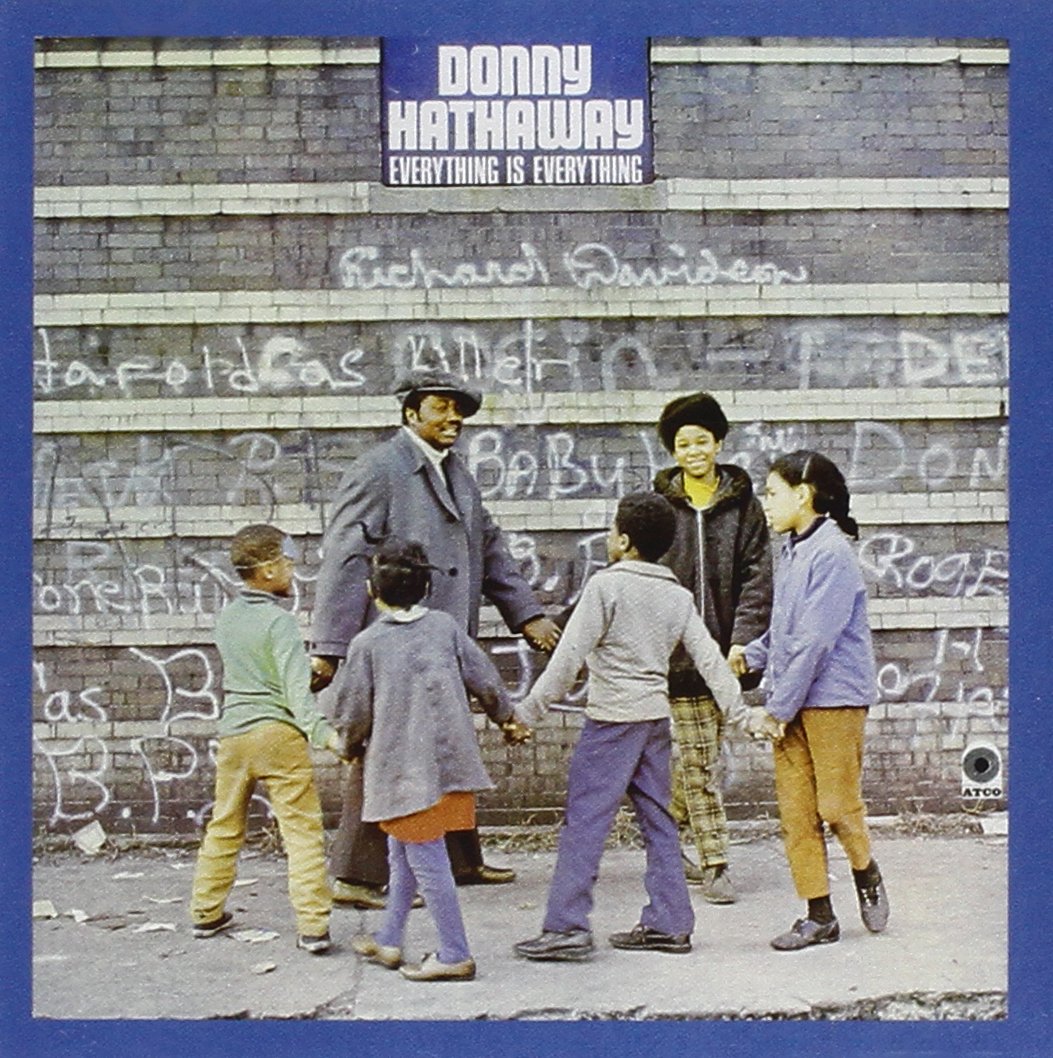
everything is everything


Donny Hathaway found his voice in tryin' times with the spiritual soul of this gifted ghetto graduation.  Born in Chicago and raised in St. Louis by his grandmother, gospel singer Martha Crumwell, Hathaway attended Howard University where he studied piano and music theory.  He dropped out of school and began working as a songwriter, session musician, and producer for Curtis Mayfield's Custom Records.  His first record was a single ("I Thank You Baby" bw "Just Another Reason") for Custom recorded as a duet with singer June Conquest.  It was at this point that he took a job with Chess Records as a studio musician.  

Hathaway would reveal:    "In the space of about two years, I had come from being simply a gospel singer and musician into all of this and I was feeling confused, tired and somewhat bewildered. Phil Upchurch recommended me to Chess and at the time they were especially busy in their studios in Chicago...Now, I realised my loyalties were to Chess and so I always put them first but, frankly, the arrangements for Curtis meant far more money to me. So, I decided to quit the studio job and make a try for myself.  So, I got in touch with my old partner Ric Powell and we formed a company, Don-Ric Enterprises Inc. and a publishing business, Don-Pow Music. Then I started work for Curtis on arranging the material for what became the Impressions' 'Young Mods Forgotten Story' album and that was probably when I first made my name. People were extremely aware of my arrangements and I was suddenly making it."

Hathaway signed with Atco Records and got to work on his debut album with his old friend Ric Powell co-producing:   "I'd written, for example, "Thank You Master For My Soul" back at Howard. The message was a combination of what I believed in at that time — and basically my beliefs now, I guess — and how I wanted to relate it with the world I was living in. It really only took me thirty minutes once I had formulated the actual idea. "The Ghetto" was written at around the same time — 1967 — but the companies that I took it to turned it down because they thought it might incite a riot! But it was and still is nothing but music. Curtis was the one who introduced me to the other Curtis, King Curtis. And King liked my songs, especially "Thank You Master", so I cut the first album, 'Everything Is Everything', for Atlantic."


The sessions featured Donny Hathaway on vocals, electric piano, and organ;   Master Henry Gibson on conga;   King Curtis on guitar;   Phil Upchurch on bass and guitar;   John Littlejohn on guitar and vocals;   John Avant and Morris Ellis on trombone;   Johnny Board on tenor saxophone;  Oscar Brashear, John Howell, and Robert A. Lewis on trumpet;   Clifford Davis and Don Myrick on alto saxophone;   Aaron Dodd on tuba;   Marshall Hawkins and Louis Satterfield on bass;   Willie Henderson on baritone saxophone;   Morris Jennings on drums;   John Lounsberry and Ethel Merker on French horn;   and  Richard Powell on drums and percussion.    'Everything Is Everything' went to number seventy-three on the pop album chart and thirty-three on the R&B album chart.  


http://donnyhathaway.blogspot.com/


'Everything Is Everything' 
full album:
https://myspace.com/fansofdonny/music/album/everything-is-everything-16811329
https://myspace.com/fansofdonny/music/album/everything-is-everything-19552469


Side One
"Voices Inside (Everything Is Everything)" (Richard Evans, Ric Powell, Phil Upchurch) – 3:28 
"Je Vous Aime (I Love You)" (Donny Hathaway, Leroy Hutson, Edward Kennedy) – 3:31
"I Believe to My Soul" (Ray Charles) – 3:51
"Misty" (Johnny Burke, Erroll Garner) – 3:38
"Sugar Lee" (Hathaway, Powell) – 4:05
"Tryin' Times" (Hathaway, Hutson) – 3:15
Side Two
"Thank You Master (For My Soul)" (Hathaway) – 5:50
"The Ghetto" (Hathaway, Hutson) – 6:50
"To Be Young, Gifted and Black" (Weldon Irvine, Nina Simone) – 6:43 
bonus track:
"A Dream" (Robert Ayers, Hathaway) – 4:14


Thursday, April 30, 2015

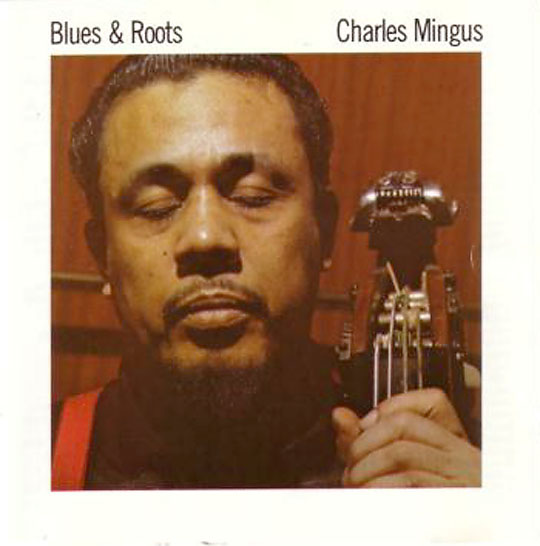
blues & roots


Charles Mingus got down to earth with the holy rolling swing of this moaning groaning jelly roll soul.   After a series of adventurous albums that included Pithecanthropus Erectus, The Clown, and East Coasting;  as well as Mingus Ah Um and Mingus Dynasty (both recorded in 1959 after Blues & Roots; but released before), Mingus accepted a challenge from producer Nesuhi Ertegün to record an entire album in the swinging blues style of "Haitian Fight Song" from The Clown.  'Blues & Roots' was recorded with a nine piece band on February 4, 1959 at Atlantic Studios in New York City with Nesuhi Ertegün producing with engineer Tom Dowd.   The session featured Charles Mingus on bass;   John Handy and Jackie McLean on alto sax;  Booker Ervin on tenor sax;  Pepper Adams on baritone sax;  Jimmy Knepper and Willie Dennis on trombone;  Dannie Richmond on drums;  and Horace Parlan on piano, except for "E's Flat Ah's Flat Too" where Mal Waldron sat in.  


http://mingusmingusmingus.com/


'Blues & Roots' 
full album:

https://www.youtube.com/watch?v=Y9KcMfQhn6w


All tracks composed by Charles Mingus.

1. Wednesday Night Prayer Meeting - 0:00
2. Cryin' Blues - 5:42
3. Moanin' - 10:44
4. Tensions - 18:48
5. My Jelly Roll Soul - 25:18
6. E's Flat Ah's Flat Too - 32:08


Original Liner Notes

My music is as varied as my feelings are, or the world is, and one composition or one kind of composition expresses only part or the total world of my music. In the notes for another album, I go into more detail as to why my pieces are so different from one another and ·don't have one specific, unalleviated mood, sound or style. At a concert or night club I call tunes in an order that I feel is right for the particular situation and what I'm trying to say in that situation. Each composition builds from the previous one, and the succession of compositions creates the statement I'm trying to make at that moment. The greatness of jazz is that it is an art of the moment. It is so particularly through improvisation, but also, in my music, through the successive relation of one composition to another. 

This record is unusual - it presents only one part of my musical world, the blues. 

A year ago, Nesuhi Ertegun suggested that I record an entire blues album in the style of Haitian Fight Song (in Atlantic LP 1260), because some people, particularly critics, were saying I didn't swing enough. He wanted to give them a barrage of soul music: churchy, blues, swinging, earthy. I thought it over. I was born swinging and clapped my hands in church as a little boy, but I've grown up and I like to do things other than just swing. But blues can do more than just swing. So I agreed. 

I decided to memorize the compositions and then phrase them on the piano part by part to the musicians. I wanted them to learn the music so it would be in their ears, rather than on paper, so they'd play the compositional parts with as much spontaneity and soul as they'd play a solo. And I decided to use a larger group to play in a big band form I'd like to hear that has as many lines going as there are musicians. I called musicians that I knew had great ears for playing and understanding my music. 

The first tune, Wednesday Night Prayer Meeting, is church music. I heard this as a child when I went to meetings with my mother. The congregation gives their testimonial before the Lord, they confess their sins and sing and should and do a little Holy Rolling. Some preachers cast out demons, they call their dialogue talking in tongues or talking unknown tongue (language that the Devil can’t understand). The solos are taken by John Handy, Willie Dennis, Horace Parlan, Booker Ervin and Dannie Richmond.

The Cryin’ Blues is a blues without the usual tonic, sub-dominant, tonic, dominant changes. Booker Ervin opens with the group. After the last solo, Horace Parlan solos on piano, and Jackie McLean plays with the ensemble on the out chorus.

Some time before making this album I’d bought a book of Jelly Roll Morton tunes that I planned to arrange. I then misplaced the book, and later I wrote My Jelly Roll Soul – an impression of or afterthoughts on Jelly Roll’s forms and soul. The solos are by Jimmy Knepper, Horace Parlan, Jackie McLean and Dannie Richmond and I pass the progressions around in bars of four and two.

E’s Flat Ah’s Flat Too is composed in pyramid lines and canon form. The solos are by Mal Waldron, Booker Ervin, Jackie McLean, John Handy and Dannie Richmond.

The solos on Tensions are by myself, Jackie McLean, Booker Ervin and Horace Parlan.

In Moanin’, each musician plays separate lines, simple blues lines.  The solos are by Jackie McLean, Pepper Adams and Booker Ervin.

We played down to earth and together, and I think this music has a tremendous amount of life and emotion.

- Charles Mingus
(as told to Diane Dorr-Dorynek) 


Thursday, February 26, 2015

orange blossom special


Johnny Cash got back to basics to talk about a ramblin' with the restless railroad blues of this country and western wildwood outlaw urban folk gospel revival.    Continuing his winning streak from the past year with 'I Walk The Line' and 'Bitter Tears:  Ballads of the American Indian' , 'Orange Blossom Special' was produced by Don Law and Frank Jones;  and featured  Johnny Cash on vocals and guitar;   June Carter on vocals;  Luther Perkins, Norman Blake, and Ray Edenton on guitar;  Marshall Grant on bass;  W.S. Holland on drums;   Bill Pursell on piano;   Charlie McCoy on harmonica;   Bill McElhiney and Karl Garvin on trumpet;  Boots Randolph on saxophone;  and Pop Staples on call and response vocal on  “Orange Blossom Special”.   

'Orange Blossom Special' went to number forty-nine on the US pop album chart and number three on the US country album chart.  The album featured three compositions by Bob Dylan.  Cash would later express:  "There's no doubt about Bob Dylan's influence on my music and myself...We became friends, but I already was a fan of his.  I still am...Bob is timeless.  Invariably, before every day ends, there will be a Bob Dylan song that'll float through me."


http://www.johnnycash.com/


"Orange Blossom Special" was released before the album, and peaked at number three on the US country singles chart.  Cash would recount in the album liner notes:      "I  recorded “Orange Blossom Special” in the mid 60’s and in those days everybody that recorded it claimed the arrangement because no one knew who wrote it. But Mother Maybelle Carter was at the session, and I asked her, do you know who really wrote “Orange Blossom special”? She said, Sure I Do. Ervin Rouse and his brother Gordon. And I said. Last time I heard, they were in Florida. It was the only clue I had. I called a disc jockey down there named Cracker Jim Brooker, and I asked Cracker Jim, Did you ever hear of Ervin Rouse? And he said, Aw, I know Ervin. He lives with the Seminoles out in the swamp buggies for a living. I said, You got any idea how I can talk to him?   And he said, Sure. I’ll announce it on the air Evrin call me and I’ll give you Johnny Cash’s number. It wasn’t an hour till Ervin Rouse called me from some little settlement in the swamps. I said, Ervin, I happen to be coming to Miami on tour. Would you come to my show and do “Orange Blossom Special” with me? He and Gordon came in the clothes they worked in. I brought Evrin up to play the fiddle, and he absolutely killed them. At the end of the song, they were applauding and he literally got down on his knees. He was such a sweet humble man. Gordon’s still living. I still see him every time I’m down there." 
https://www.youtube.com/watch?v=n4-uoUpN1c4


Look yonder coming, coming down that railroad tarck
It's the oOrange Blossom Special. Bring my baby back

Well, I'm going down to florida, and get some sand in my shoes 
Or maybe California, and get some sand in my shoes.
I'll ride the Orange Blossom Special, and lose these New York Blues

"say man, when you going back to Florida ?"
Going back to Florida 
Don't know, don't reckon I ever will 
"ani't you worried about getting your nourishment in New York ?" 
I don't care if I do-die-dodie-do.....

Hey talk about a-rambling, she's the fastest train on the line.
It's the Orange Blossom Special, rolling down the seaboard line

https://www.youtube.com/watch?v=nAmrKeyeHKA


"The Long Black Veil"
https://www.youtube.com/watch?v=0TE8445gIBo

https://www.youtube.com/watch?v=-OZeFt16oDY


"It Ain't Me Babe"
https://www.youtube.com/watch?v=HBHXUOogpOg

https://www.youtube.com/watch?v=2R2NrV4ve1o


'Orange Blossom Special' 
full album:  


Side one
1. "Orange Blossom Special"   Ervin T. Rouse, Gordon Rouse 3:06
2. "The Long Black Veil"   Marijohn Wilkin, Danny Dill 3:06
3. "It Ain't Me Babe"   Bob Dylan 3:03
4. "The Wall"   Harlan Howard 2:09
5. "Don't Think Twice, It's All Right"   Bob Dylan 2:56
6. "You Wild Colorado"   Johnny Cash 1:45
Side one
1. "Mama, You've Been on My Mind"   Bob Dylan 3:02
2. "When It's Springtime in Alaska"   Tillman Franks 2:36
3. "All of God's Children Ain't Free"   Johnny Cash 2:11
4. "Danny Boy"   Frederick Weatherly 5:08
5. "Wildwood Flower"   A.P. Carter 2:10
6. "Amen"   Jester Hairston 2:05