Showing posts with label free jazz. Show all posts
Tuesday, June 2, 2015
change of the century
Ornette Coleman found an emotional ethos in the ramblin' abandon of this impressionist ensemble improvisation. After recording two albums of unconventional jazz for Contemporary Records (Something Else !!!! and Tomorrow Is the Question!), Coleman had moved to Atlantic Records to take things even further with The Shape of Jazz to Come. 'Change of the Century' features the same cast of characters as The Shape of Jazz to Come: with producer Nesuhi Ertegün and engineer Bones Howe capturing the magical interplay between Ornette Coleman on his plastic alto saxophone; Don Cherry on pocket trumpet; Charlie Haden on bass; and Billy Higgins on drums. The sessions took place on October 8 and 9, 1959, at Radio Recorders in Hollywood, California.
www.biography.com/ornette-coleman
'Change of the Century'
full album:
https://www.youtube.com/playlist?list=PL26E7604B1A8FC8F0
All compositions by Ornette Coleman
Side one
1. "Ramblin'" 6:39
2. "Free" 6:24
3. "The Face of the Bass" 6:59
Side two
1. "Forerunner" 5:16
2. "Bird Food" 5:31
3. "Una Muy Bonita" 6:02
4. "Change of the Century" 4:41
outtakes:
"Music Always"
"The Circle with the Hole in the Middle"
liner notes:
Some musicians say, if what I’m doing is right, they should never have gone to school.
I say, there is no single right way to play jazz. Some of the comments made about my music make me realize though that modern jazz, once so daring and revolutionary, has become, in many respects, a rather settled and conventional thing. The members of my group and I are now attempting a break-through to a new, freer conception of jazz, one that departs from all that is “standard” and cliché in “modern” jazz.
Perhaps the most important new element in our music is our conception of free group improvisation. The idea of group improvisation, in itself, is not at all new; it played a big role in New Orleans’ early bands. The big bands of the swing period changed all that. Today, still, the individual is either swallowed up in a group situation, or else he is out front soloing, with none of the other horns doing anything but calmly awaiting their turn for their solos. Even in some of the trios and quartets, which permit quite a bit of group improvisation, the final effect is one that is imposed beforehand by the arranger. One knows pretty much what to expect.
When our group plays, before we start out to play, we do not have any idea what the end result will be. Each player is free to contribute what he feels in the music at any given moment. We do not begin with a preconceived notion as to what kind of effect we will achieve. When we record, sometimes I can hardly believe that what I hear when the tape is played back to me, is the playing of my group. I am so busy and absorbed when I play that I am not aware of what I’m doing at the time I’m doing it.
I don’t tell the members of my group what to do. I want them to play what they hear in the piece for themselves. I let everyone express himself just as he wants to. The musicians have complete freedom, and so, of course, our final results depend entirely on the musicianship, emotional make-up and taste of the individual member. Ours is at all times a group effort and it is only because we have the rapport we do that our music takes on the shape that it does. A strong personality with a star-complex would take away from the effectiveness of our group, no matter how brilliantly he played.
With my music, as is the case with some of my friends who are painters, I often have people come to me and say, “I like it but I don’t understand it.” Many people apparently don’t trust their reactions to art or to music unless there is a verbal explanation for it. In music, the only thing that matters is whether you feel it or not. You can’t intellectualize music; to reduce it analytically often is to reduce it to nothing very important. It is only in terms of emotional response that I can judge whether what we are doing is successful or not. If you are touched in some way, then you are in with me. I love to play for people, and how they react affects my playing.
A question often asked of me is why I play a plastic alto. I bought it originally because I needed a new horn badly, and I felt I could not afford a new brass instrument. The plastic horn is less expensive, and I said to myself, “Better a new horn than one that leaks.” After living with the plastic horn, I felt it begin to take on my emotion. The tone is breathier than the brass instrument, but I came to like the sound, and I found the flow of music to be more compact. I don’t intend ever to buy another brass horn. On this plastic horn I feel as if I am continually creating my own sound.
Now to the music. They are all originals. Each is quite different from the other, but in a certain sense there really is no start or finish to any of my compositions. There is a continuity of expression, certain continually evolving strands of thought that link all my compositions together. Maybe it’s something like the paintings of Jackson Pollock.
RAMBLIN’ is basically a blues, but it has a modern, more independent melodic line than older blues have, of course. I do not feel so confined to the blues form as do so many other jazz musicians. Blues are definite emotional statements. Some emotional statements can only be told as blues.
FREE is well-explained by the title. Our free group improvising is well demonstrated here. Each member goes his own way and still adds tellingly to the group endeavor. There was no predetermined chordal or time pattern. I think we got a spontaneous, free-wheeling thing going here.
FACE OF THE BASS begins as a vehicle for our bassist. Charlie Haden is from Missouri and he has a lot of heart. It is unusual to come across someone as young as he is and find that he has such a complete grasp of the “modern” bass: melodically independent and non-chordal.
FORERUNNER shows the interchangeability and flexibility of the component parts of the group. I like the way the melody here often runs through the rhythm instruments, with the melody instruments – the horns – providing rhythm accents (the traditional function of drums and bass).
BIRD FOOD has echoes of the style of Charlie Parker. Bird would have understood us. He would have approved our aspiring to something beyond what we inherited. Oddly enough, the idolization of Bird, people wanting to play just like him, and not make their own soul-search, has finally come to be an impediment to progress in jazz.
UNA MUY BONITA, in Spanish, means “a very pretty girl.” I had no one in particular in mind. It is perhaps a little lighter in mood than some of our other pieces. It has a relaxed feeling and a more settled rhythm – and yes, I suppose, a “prettier” melody.
CHANGE OF THE CENTURY expresses our feeling that we have to make breaks with a lot of jazz’s recent past, just as the boppers did with swing and traditional jazz. We want to incorporate more musical materials and theoretical ideas – from the classical world, as well as jazz and folk – into our work to create a broader base for the new music we are creating.
Every member of the group made an important and distinctly personal contribution to this album, which I think is the best we have made so far.
ORNETTE COLEMAN (as told to Gary Kramer)
Monday, October 27, 2014
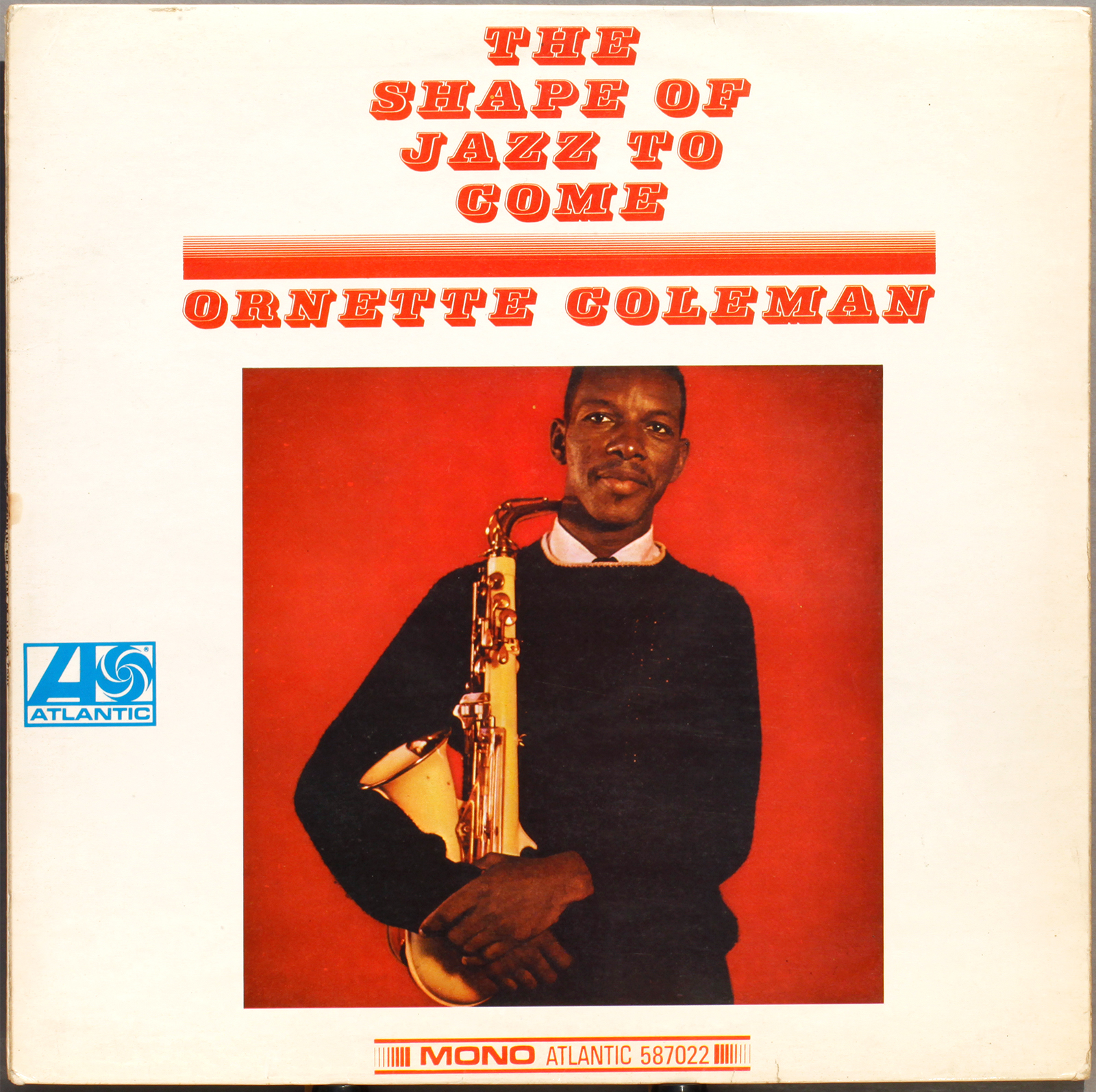
the shape of jazz to come
Ornette Coleman established the avante-garde in jazz with the unconventional improvisation and atonal acrobatics of this controversial free jazz milestone. Coleman had challenged listeners with his first two albums ('Something Else!!!!' and 'Tomorrow Is the Question!') on Contemporary Records; but for his third release he took things even further. With his second album, he did away with the pianist, a standard in jazz. For 'The Shape of Jazz to Come', he did away with chord structure, utilizing a brief theme before launching into uncharted territory. The album was his first after signing a deal with Atlantic Records, which John Lewis from the Modern Jazz Quartet helped him secure.
Coleman looks back: "Before becoming known as a musician, when I worked in a big department store, one day, during my lunch break, I came across a gallery where someone had painted a very rich white woman who had absolutely everything that you could desire in life, and she had the most solitary expression in the world. I had never been confronted with such solitude, and when I got back home, I wrote a piece that I called "Lonely Woman."
'The Shape of Jazz to Come' was recorded in Los Angeles at Radio Records, Inc with producer Nesuhi Ertegun and features the quartet of Ornette Coleman on alto saxophone; Don Cherry on cornet; Charlie Haden on bass; and Billy Higgins on drums.
Coleman considers: "The idea is that two or three people can have a conversation with sounds, without trying to dominate or lead it. What I mean is that you have to be… intelligent, I suppose that’s the word. In improvised music I think the musicians are trying to reassemble an emotional or intellectual puzzle in which the instruments give the tone. It’s primarily the piano that has served at all times as the framework in music, but it’s no longer indispensable and, in fact, the commercial aspect of music is very uncertain. Commercial music is not necessarily more accessible, but it is limited...For me, being an innovator doesn't mean being more intelligent, more rich, it's not a word, it's an action. Since it hasn't been done, there's no use talking about it...It interests me more to have a human relationship with you than a musical relationship. I want to see if I can express myself in worlds, in sound that have to do with a human relationship. At the same time, I would like to be able to speak of teh relationship between two talents, between two doings. For me, the human relationship is mush more beautiful, because it allows you to gain the freedom that you desire, for youself and for the other."
http://www.ornettecoleman.com/
'The Shape of Jazz to Come'
full album:
All compositions by Ornette Coleman.
Side one
1. "Lonely Woman" 4:59
2. "Eventually" 4:20
3. "Peace" 9:04
Side two
1. "Focus on Sanity" 6:50
2. "Congeniality" 6:41
3. "Chronology" 6:05
outtakes:
"Monk and the Nun"
https://www.youtube.com/watch?v=8VOITCYjqoE
"Just for You"
https://www.youtube.com/watch?v=h2n6e0FMWUE
Sunday, September 21, 2014
interstellar space

John Coltrane went to the outer limits with this intense and energetic free jazz exploration. Recorded at the Van Gelder Studio on February 22, 1967 just months before his death, 'Interstellar Space' is a series of duets with drummer Rashied Ali. The lack of any melodic framework frees the duo to new levels of experimental improvisation. Coltrane unleashes a firestorm of notes that are abrasive and overwhelming as Ali provides a percussive response that drives everything even further along toward a transcendent interplanetary ascension. 'Interstellar Space' was not released until 1974; but it stands as a testament to the uncompromising creativity of 'Trane.
http://www.johncoltrane.com/
'Interstellar Space'
full album:
https://www.youtube.com/playlist?list=PL7D089D2C50E97018
01 Mars 10:43
02 Leo 10:56
03 Venus 8:36
04 Jupiter variation 6:43
05 Jupiter 5:25
06 Saturn 11:43
Tuesday, September 9, 2014
judgement!
Andrew Hill found a rhythmic reconciliation in the swinging avante-garde vibes of this flea flop postbop yakety yak. He had switched around his backing band with his first two albums on Blue Note Records ('Black Fire' and 'Smokestack'), retaining only bassist Richard Davis for the January 8, 1964 session at Van Gelder Studio in Englewood Cliffs that produced 'Judgement!'. The album features Andrew Hill on piano; with Bobby Hutcherson on vibraphone; and the rhythm section of Richard Davis on double-bass and Elvin Jones on drums. The lack of horns and the harmonic interplay between Hill and Hutcherson reveal a deeper, more complex percussive dynamic that opens up the sound.
Hill would later reveal: "It was basically drafts written off my interpretation of someone else's playing, so that really was the catalyst...[All the music] was set up for [Elvin Jones' style]...While I was at Portland State, and then I came into this phrase "African retention" (all this after the fact). To me, it's more like an alternative approach to music...In Western civilization, melody is the major voice. Rhythm and harmony is just an accessory. I’ve always, especially since emerging on accordion with the Blues groups and the Boogie Woogie, approached rhythm as the predominant voice, with harmony as an accessory. Though many things have changed traditionally, that dynamic hasn’t changed. Always check the rhythm to hear the integrity of the music then and now, whether it’s retrospective or trying to go ahead. If it’s static and stagnant, that means the music is dead, because they have such an academic approach, and they learned all the melodies but they have no rhythmic interaction.”
Hutcherson considers: “Andrew’s music is very heavily mental...You go into rooms you wouldn’t normally enter. There’s always a little story in the melody, a reason why this tune is being played; it’s your own story, what you’re seeing as you play. He’d give you melancholy, long notes, you’d think, ‘man, how long can you hold this note so that there will be this texture?’ — then all of a sudden it burst into a chant, a hope within the note. Religious, I guess you can say…well, the religion of the bandstand…of someone’s thoughts. It was very challenging, just because of its openness; the melody could be loose as a rubber band. But just remember that it’s going to come down; the bar line is still moving at the same pace.”
http://www.andrewhilljazz.com/
'Judgement!'
full album:
https://myspace.com/andrewhillmusic/music/album/judgment-rudy-van-gelder-edition-18984962
"Siete Ocho" - 8:58
"Flea Flop" - 7:21
"Yokada Yokada" - 5:17
"Alfred" - 7:04
"Judgment" - 6:53
"Reconciliation" - 7:24
Thursday, May 22, 2014
sun ra
Sun Ra
(born Herman Poole Blount, legal name: Le Sony'r Ra)
(May 22, 1914 – May 30, 1993)
This prolific avante garde jazz composer had a visionary experience that revealed to him that he was a visitor from Saturn and had a mission to change the world with his music. Born in Birmingham, Alabama, he was composing music by the age of twelve. He received scholarship at Alabama Agricultural and Mechanical University where he studied music theory for a year before dropping out. It was around this time that he claimed to have a religious awakening: “My whole body changed into something else. I could see through myself. And I went up...I wasn’t in human form...I landed on a planet that I identified as Saturn...they teleported me and I was down on [a] stage with them. They wanted to talk with me. They had one little antenna on each ear. A little antenna over each eye. They talked to me. They told me to stop [attending college] because there was going to be great trouble in schools…the world was going into complete chaos...I would speak [through music], and the world would listen. That’s what they told me.”
He turned his family home into a musical waystation where he composed and rehearsed with his group the Sonny Blount Orchestra, creating a reputation around the area with their diverse performances. When he was drafted in 1942, he sought exemption as a conscientious objector and served in the forestry service until he was eventually released from service due to his hernia. After his aunt died, he left Birmingham for Chicago. He played around Chicago with such luminaries as blues singer Wynonie Harris and bandleader Fletcher Henderson before starting his Space Trio. He became increasingly interested in African-American political activism and it was around this time that he legally changed his name to Le Sony'r Ra. As he drew more musicians into his circle, Ra dubbed his group the Arkestra; and, drawing from Egyptian mythology and space age imagry, the members of the group wore costumes and headgear that set them apart from other groups as much as their eclectic music. He found a partner in Alton Abraham, who became his business manger and co-founded their independent El Saturn Records. Sun relocated to New York bringing longstanding bandmembers John Gilmore and Marshall Allen as well. The group developed a following there among beatniks, hippies, and critics and stayed in the city until 1969, when the building they had been renting went up for sale. They relocated to the Germantown section of Philadelphia in a house on Morton Street that would become Ra's homebase for the rest of his life. The group toured internationally and Ra even taught music courses at the University of California in Berkeley.
He continued to compose and perform throughout his life (even after a stroke in 1990) with a revolving cast of musicians that involved dozens of different musicians, recording over one hundred albums and over one thousand original compositions. Ra would expound on the role of his band in the world: "It's demonstrating that some people in the form of men can stick together, along with the marriages, and along with the Black Panthers. Along with the many things you put up there, it's still here. And they're not with me because I promised them anything, because I always said 'they're in the Ra jail.' And my jail is the best jail in the world, and they learn things in my jail. And that's what I express: they're in jail, and they're not going anywhere, because they can't, because the creative God knows me, that if I had my way I'd just [inaudible] and go to Egypt, and be in the desert and hide out and do some of my research cycle. But I can't do that because he got these fellows with me, and I can't just desert them! They don't necessarily believe what I'm saying, because it's so fantastic. I got a picture of John - I'm out there talking to people, and he's standing in the wings terrified with what I'm saying! Because I'll be doing things according to what I'm told, and I have to do equational things, and establish things, and in Philadelphia where it all started, I said I want an audience [inaudible] but all the people there were white, [except for] about three black people in there - as usual - so I came out, off the stage where the band was playing, and I said I was tired of the situation on this planet, with black people still sleeping - dead, not helping me, and the condition they're in - they shouldn't want to be in. They shouldn't want to be like white people; white people are in trouble. And basically they're ignorant of spiritual things. [inaudible] And I would do something to change things, so I said I have to use the book. So I went out in the audience, and then there was a black person on [one] side, and I took him by the head [inaudible] and said, 'Now, it is written: those who I have called my people, I call not my people. The white race are my people now. And the black folk are still over there until they wake up.' Now, they was up in the air; I had them held by their hair, and they were astounded and they were scared. But the white people didn't say nothing; they just looked up and they smiled. And so I did something then. I said, well, if the black people aren't going to wake up, I'm just going to take over the white race, so go ahead and [inaudible], I've got it now. I said, because, you know, they've got a lot of money - down in Texas I told them this: I'm going to do something wrong tonight. I'm trying to do right, but if I can't so something right, I can do something wrong. Whatever it is, it's wrong, but I'm going to do it in Texas. In Fort Worth. I got up and told the people, they said that God is love; I'm going to abolish that thing. It is no good, because people are more than love, so how come God's got to be limited to one attribute? I've got a song that's called, 'God is more than Love can ever be.' So don't be talking about 'God is love.' I said, 'but God does love you if you want to call it that, and he sent me to demonstrate it. Now God's not love. But I am a message of love for you, and I'm going to come out there in the audience and - God sent love in person - I'm coming out there in Texas, and I'm going to walk past you, and whatever you do, do not let Love walk by you without the touch and the feel of Love.'"
http://www.sunraarkestra.com/
https://www.youtube.com/watch?v=mSNvdLpLx-0
Face the Music / Space is the Place
https://www.youtube.com/watch?v=1qjiQwD7VCI
'A Joyful Noise'
'Jazz in Silhouette' 1959
Sun Ra on piano, celeste, and gong; Hobart Dotson on trumpet; Marshall Allen on alto sax and flute; James Spaulding on alto sax, flute, and percussion; John Gilmore on tenor sax and percussion; Bo Bailey on trombone; Pat Patrick -on baritone sax, flute, and percussion; Charles Davis on baritone sax and percussion; Ronnie Boykins on bass; and William Cochran on drums.
https://www.youtube.com/playlist?list=PLpszlaVYHIX4mUBBaxh071T4OaQAECpU7
Side A:
"Enlightenment" (Hobart Dotson, Ra) – (5:02)
"Saturn" – (3:37)
"Velvet" – (3:18)
"Ancient Aiethopia" – (9:04)
Side B:
"Hours After" (Ra, Turner) – (3:41)
"Horoscope" – (3:43)
"Images" – (3:48)
"Blues at Midnight" – (11:56)
'The Heliocentric Worlds of Sun Ra, Volume One' 1965
Sun Ra on piano, bass marimba, electric celeste, and timpani; Chris Capers on trumpet; Teddy Nance on trombone; Bernard Pettaway on bass trombone; Marshall Allen on piccolo, alto sax, bells, and spiral cymbal; Danny Davis on flute, alto sax; Robert Cummings on bass clarinet and woodblocks; John Gilmore on tenor sax and timpani; Pat Patrick on baritone sax and timpani; Ronnie Boykins on bass; and Jimhmi Johnson on drums, percussion, and timpani.
Side A:
"Heliocentric" – 4:00
"Outer Nothingness" – 7:40
"Other Worlds" – 4:18
Side B:
"The Cosmos" – 7:20
"Of Heavenly Things" – 5:40
"Nebulae" – 3:16
"Dancing in the Sun" – 1:50
'Atlantis' 1969
Sun Ra on Solar Sound Organ, Solar Sound Instrument; John Gilmore on tenor saxophone and percussion; Pat Patrick on baritone saxophone and flute; Marshall Allen on alto saxophone and oboe; Danny Thompson on alto saxophone and flute; Bob Barry on drums and lightning drum; Wayne Harris on trumpet; Ebah on trumpet; Carl Nimrod on space drums; James Jacson on log drums; Robert Cummins on bass clarinet; Danny Davis on alto saxophone; and Ali Harsan on trombone.
Side A:
"Mu" – 4:30
"Lemuria" – 5:02
"Yucatan" 3:38
"Bimini" – 5:45
Side B:
"Atlantis" – 21:51
'Space Is the Place' 1972
Sun Ra on piano, Farfisa Professional = space organ; Akh Tal Ebah on trumpet, flugelhorn, and vocal; Kwame Hadi (Lamont McClamb) on trumpet; Marshall Allen on alto saxophone and flute; Danny Davis on alto saxophone and flute; John Gilmore on tenor saxophone and vocal; Danny Thompson on baritone saxophone, flute, and vocal; Eloe Omoe on bass clarinet and flute; Pat Patrick on electric bass, baritone saxophone, and vocal; Lex Humphries on drums; Atakatun (Stanley Morgan) and Odun (Russel Branch) on percussion; and the Space Ethnic Voices: June Tyson, Ruth Wright, Cheryl Banks, and Judith Holton.
"Space is the Place" - 21:14
"Images" - 6:15
"Discipline" - 4:50
"Sea of Sounds" - 7:42
"Rocket Number Nine" - 2:50
'Languitity' 1978
Sun Ra on organ, synthesizer, piano, arrangements, keyboards, organ (Hammond), piano (Electric), vocals, bells, production, arp, fender rhodes, orchestra bells, and mini Moog; John Gilmore on tenor sax; Danny Ray Thompson on flute and baritone sax; Eddie Gale on trumpet; Michael Ray on trumpet and flugelhorn; Marshall Allen on flute, oboe, and alto sax; Luqman Ali on percussion; Artaukatune on drums and tympani; Disco Kid ( Slo Johnson ) on guitar; Dale Williamson guitar; Atakatun Odun on congas; Elo Omoe on flute and bass clarinet; Julian Pressley on baritone sax; Richard Williams on bass; James Jacson on oboe, basson, flute, and voices; and June Tyson on voices.
"Lanquidity" – 8:19
"Where Pathways Meet" – 6:30
"That's How I Feel" – 8:09
"Twin Stars of Thence" – 9:30
"There Are Other Worlds (They Have Not Told You Of)" – 10:58
'Sleeping Beauty' 1979
Sun Ra on piano, electric piano, organ, and vocals; Noel Scott on alto saxophone, baritone saxophone, and percussion; Marshall Allen on alto saxophone and flute; Hutch Jones on alto saxophone, and tenor saxophone; Danny Ray Thompson on baritone saxophone, flute, and percussion; Eloe Omoe on bass clarinet, flute, and percussion; James Jacson on bassoon, flute, and percussion; Stanley Morgan on congas; Eddie Thomas and Reg McDonald on drums; Luqman Ali on drums and vocals; Richard Williams and Steve Clark on electric bass; Taylor Richardson on electric guitar; Vincent Chancey on french horn; Atakatune on percussion; Sylvester Baton on reeds; Kenny Williams on tenor saxophone and flute; John Gilmore on tenor saxophone, percussion, and vocals; Craig Harris and Tony Bethel on trombone; Curt Pulliam and Walter Miller on trumpet; Michael Ray on trumpet and vocals; Harry Wilson on vibraphone; Damon Choice on vibraphone and vocals; and June Tyson and Rhonda Blout on vocals.
Springtime Again 9:17
Door of the Cosmos 8:58
Sleeping Beauty 11:52
'The Sound Of Joy'
Sun Ra - Piano, pianoforte elettrico Wurlitzer
Art Hoyle - Tromba
Dave Young - Tromba
John Avant - Trombone
Pat Patrick - Sax alto, sax baritono
John Gilmore - Sax tenore
Charles Davis - Sax baritono
Victor Sproles - Basso
William Cochran - Batteria
Jim Herndon - Timpani, timbales
1. El is a Sound of Joy 0:00
2. Overtones of China 04:03
3. Two Tones ( Pat Patrick, Charles Davis) 07:28
4. Paradise 11:09
5. Planet Earth 15:39
6. Ankh 20:04
7. Saturn 26:35
8. Reflections in Blue 30:36
9. El Viktor 36:57
10. As You Once Were (Bonus Track) 39:30
11. Dreams Come True (Bonus Track) 43:50
'Mayan Temples' 1990
Sun Ra on piano and synthesizer; Michael Ray and Ahmed Abdullah on trumpet and vocals; Tyrone Hill on trombone; Marshall Allen on alto saxophone and flute; Noel Scott on alto saxophone; John Gilmore on tenor saxophone and timbales; James Jacson on bassoon and Ancient Egyptian Infinity Drum; Ronald Wilson on tenor saxophone; Carl LeBlanc on electric guitar; Jothan Callins on bass and electric bass; Clifford Barbaro and Earl "Buster" Smith on drums; Ron McBee on congas and percussion; Jorge Silva on percussion; Elson Nascimento on surdo and percussion; and June Tyson on vocals.
"Dance of the Language Barrier" - 3:58
"Bygone" - 5:15
"Disciple No. 1" - 4:57
"Alone Together" (Howard Dietz, Arthur Schwartz) - 7:02
"Prelude to Stargazers" - 5:17
"Mayan Temples" - 7:40
"I'll Never Be the Same" (Gus Kahn, Matty Malneck, Frank Signorelli) - 4:57
"Stardust from Tomorrow" - 3:38
"El Is a Sound of Joy" - 5:26
"Time After Time" (Sammy Cahn, Jule Styne) - 4:21
"Opus in Springtime" - 6:41
"Theme of the Stargazers" - 14:09
"Sunset on the Nile" - 5:42
Saturday, May 10, 2014
karma
Farrell 'Pharoah' Sanders reached a soulful spiritual intensity with the meditative ostinato of this screeching reaching free jazz working plan. He had started out playing clarinet when he was a boy in Little Rock, Arkansas; but switched to tenor saxophone in high school. He played with various groups in the Oakland, California area before relocating to New York City where he struggled and became homeless before connecting with John Coltrane with whom he played on the seminal albums 'Ascension' and 'Meditations' before starting his own group. He recorded 'Pharoah's First', 'Tauhid', and 'Izipho Zam' before moving on to Impulse! Records to record 'Karma' at RCA Studios in New York City with Leon Thomas on percussion and vocals; pianist Lonnie Liston Smith; bassist Reggie Workman; and French-horn player Julius Watkins; with flautist James Spaulding; second bassist Richard Davis; and percussionist Nathaniel Bettis adding to the din of "The Creator Has a Master Plan"; and bassist Ron Carter and drummer Freddie Waits played on 'Colors'.
Sanders remembers: "At that time, when I was making those albums, I was trying to do both kinds of things, play in and out. I was working a little bit with John Coltrane and at the same time, I always had my own band at the same time. I was trying to work both bands and try to figure out what I wanted to do. It kept me moving ... Guys like to play their little solo and that is it and then the next guy plays his solo and that is it. In New York, by me living there so long, guys are into more energy. We play much longer and that makes me want to play longer. If you build the intensity up to where I can come in on that energy, that is what I want. Then you would see me playing for a long time. If I have to do it all by myself, then it is not working right. I look at it that the whole band is like one big solo. I like to build. If nobody is building with me, then there is no sense in me trying to play because that is not creative. You never get a lot of creativity out of me because I am not pushed to do it. Nobody is looking at the energy. They are all looking at the piece of music and this guy is soloing and they already have it all figured out. I could play the whole set by myself and I am giving them a chance to play and be heard and they don't take advantage of that and do something with it, then it is not going anywhere. That is why I am not getting enough work because I would like to work all the time. Nobody really calls me. Ever since I have been playing, I never worked every month. I will work this month and then I am off two months. That is the way it has been going. I don't know why, but I guess that is just the way it is."
http://pharoahsanders.wordpress.com/
"The Creator Has a Master Plan" (Sanders, Thomas)
https://www.youtube.com/watch?v=QZ6lB7FKxi8
https://www.youtube.com/watch?v=z0jH9JxaeBg
"There was a time,
When peace was on the earth,
And joy and happiness did reign
And each man knew his worth.
In my heart how I yearn for that spirit's return
And I cry, as time flies,
Om, Om.
There is a place where love forever shines,
And rainbows are the shadows of a presence so divine,
And the glow of that love lights the heavens above,
And it's free, can't you see, come with me.
The creator has a master plan,
peace and happiness for every man
The creator has a working plan,
peace and happiness for every man
The creator makes but one demand,
happiness through all the land."
"Colors"
https://www.youtube.com/watch?v=iBK4SIeFz9Q
http://www.dailymotion.com/video/x59ct8_pharoah-sanders-colors_music
Pharoah Sanders - Colors by blackmoon0808
'Karma' full album
"The Creator Has a Master Plan" (Sanders, Thomas) (32:46)
"Colors" (Sanders, Thomas) (5:37)
Subscribe to:
Posts (Atom)