Mazzy Star rummaged through desire and doubt to find illumination in this hazy velvet venture. David Roback and his brother Steven had been in the Unconscious with their neighbor Susanna Hoffs before forming Rain Parade with David's college roommate Matt Piucci, becoming a major part of the Los Angeles Paisley Underground scene. Roback remembers: "I went to New York mainly to be part of the art scene; but I gradually found myself getting more inspired by what was happening in music than in art...People like Patti Smith and Television...I felt like a punk. That's the attitude I identified with. But when I picked up the guitar and started playing it, the music didn't come out sounding punk. It was something else...When I started playing music, it came out sounding very psychedelic for whatever reason. I guess it was just what I grew up liking. The Beatles and Jimi Hendrix were the best groups for me...The late Beatles more than the early Beatles--their message, the whole political and spiritual involvement."
At the same time, Hope Sandoval formed folk duo Going Home with classmate Sylvia Gomez. They managed to slip backstage after a Rain Parade gig and give Roback a copy of their demo tape. He offered to produce an album for them: "I felt I was the luckiest person ever. I could not believe that he wanted to join our band. He called me and said: ‘I really love your music, and I want to play guitar for you guys."
Roback left Rain Parade and formed a new project Opal with Kendra Smith (from Dream Syndicate ): "I was very idealistic. I thought I would retire and make music on my own, not be part of any scene. It didn't seem all that radical because my heroes had done it--people like John Lennon and Syd Barrett--at certain points in their lives ...I didn't feel the acceptance or attention was important to me. I wanted to make music that I felt and if people liked it, fine, otherwise the music would be enough reward ...At times, I felt like the music world was on a dead-end street, that everyone was simply rehashing the same old ideas...But rock is still a potentially great art form...No matter how down you are, there may be a light in a song that gives you strength...something spiritually regenerating. To me, that's the goal of a musician--to find that light."
Sandoval ended up joining Opal after Smith quit during a tour with the Jesus and Mary Chain. They toured and began work on a second album (Ghost Highway She Hangs Brightly at Hyde Street Studios in San Francisco. Sandoval says she wanted to "start something completely new ... David definitely knew more about music and equipment than me. He knew more about the Velvet Underground; I didn’t really know their music. Sylvia was really into them and I was always saying: ‘Turn that off: it’s too noisy’. But when I started working with David, he turned me on to them. I liked modern stuff like Soul II Soul, along with Syd Barrett and the Rolling Stones. So it worked, even though we were coming from different places."
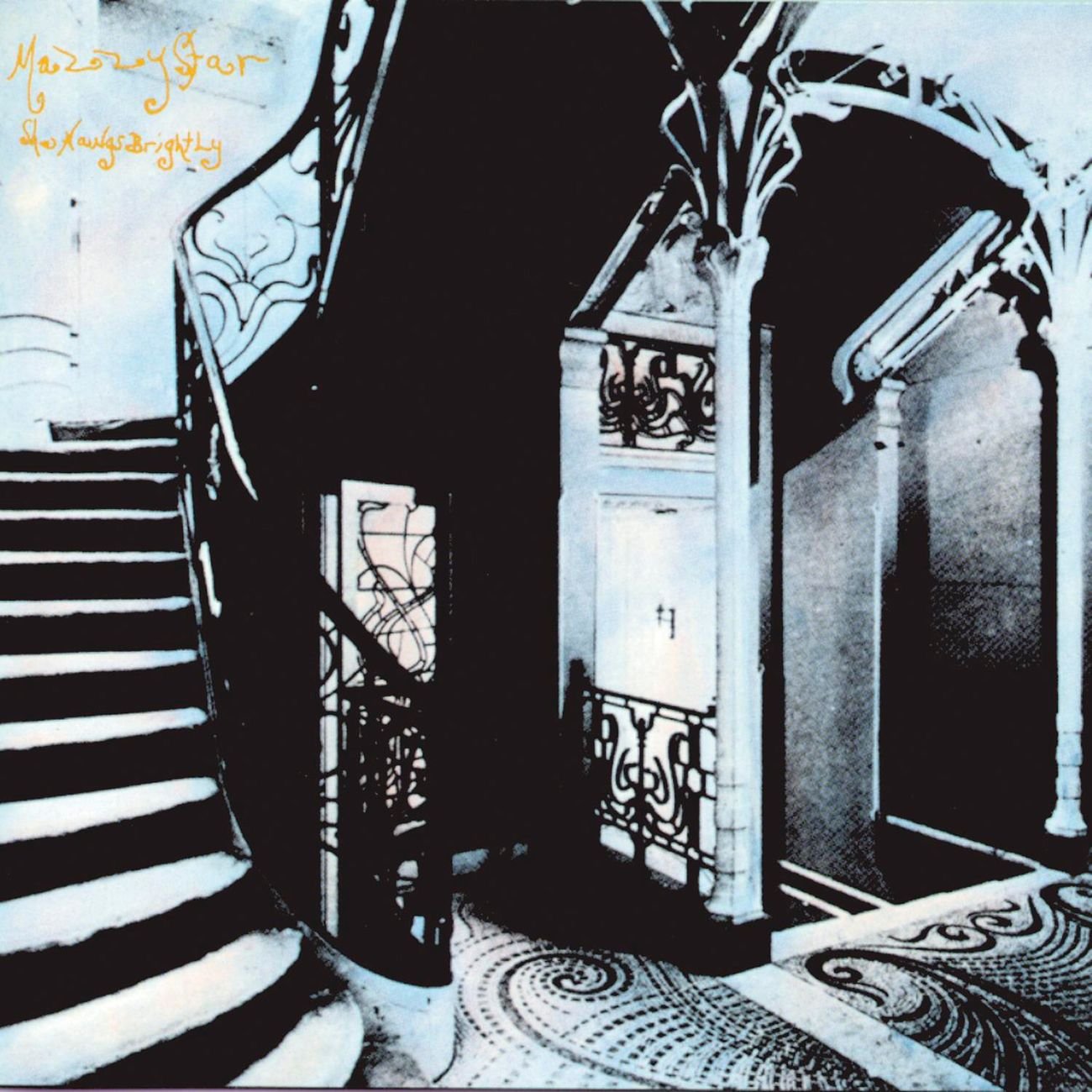
She Hangs Brightly did not chart; but it became a hit on college radio. In the UK it sold over seventy thousand copies and in the US it eventually sold a half a million units, earning a gold certification. The album cover is from the Hôtel Tassel in Brussels.Roback reveals: "I think Hope deserves a lot of attention. I think she is a great singer and a great songwriter. When I first heard her, I though she could be someone like Bob Dylan, someone who could speak for a lot of people her age...I see a lot of hope in her songs. It's like that movie... 'A Tree Grows in Brooklyn.'
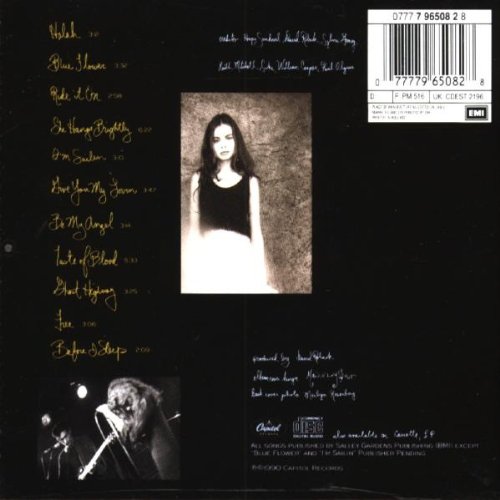
http://mazzystarstore.co.uk/ http://www.hopesandoval.com/music/mazzystar.shtml http://www.hopesandoval.com/ "Halah" reached number nineteen on the US modern rock tracks chart.VIDEO VIDEO "Blue Flower" is a cover of the song by Slapp Happy . It charted at number twenty-nine on the US modern rock tracks chart. VIDEO She Hangs Brightly full album: VIDEO All songs written and composed by Hope Sandoval and David Roback, except where noted.
00:00 "Halah" 3:16
03:16 "Blue Flower" (Peter Blegvad, Anthony Moore) 3:35 06:51 "Ride It On" 3:01
09:51 "She Hangs Brightly" 6:24
16:16 "I'm Sailin'" (Minnie McCoy) 3:13 19:28 "Give You My Lovin'" (Sylvia Gomez) 3:50 23:19 "Be My Angel" 3:17
26:36 "Taste Of Blood" 5:36
32:13 "Ghost Highway" (David Roback) 3:28 35:42 "Free" 3:11
38:51 "Before I Sleep" 2:10
Sufjan Stevens found healing in the transformative power of extraordinary ordinary things through a primal cacophonous expression of the language of ghosts, eternal living, and impossible soul. It had been five years since he had his breakthrough with his celebrated concept album 'Illinois' The Avalanche Songs for Christmas The BQE I think I just got fed up with my own existential quandary, and got really bored with this sort of circular, philosophical pondering and my obsession with naming things and categorizing things. I think I wasn’t so much [disillusioned] with songwriting as I was disillusioned with form, and I was really frustrated with the limitations of the song. And I think a lot of that was suffering the repercussions of The BQE ... It signalled a big sea-change for me in terms of my process...[The BQE
In 2009 he began recording again, releasing Run Rabbit Run , a reworking with strings of his electronic album from 2001 Enjoy Your Rabbit All Delighted People 'Illinois'
Stevens admits: " I was aware that the textures and the sonic environment was a little dirtier, more cacophonous, or whatever. I was aware of that, cause I feel like I was also extremely aware during the making of Illinois of how much effort I put into making it listenable. It’s such a populist record—there’s just so much effort in appealing to the listener, you know there’s such a kind of a pageant of sound, and it’s constantly entertaining and rewarding, and it’s just sort of a patchwork of this sort of harmonic beauty, harmonic what do you call it, I don’t know—It’s very harmonious. You know, The Age of Adz , these are pop songs, but they’re based on sound experimentation and noise. They’re more aggressive, and even my tone of—the way I’m singing—it’s more in my throat and not always pretty. So I was aware of that, and I just felt like an imperative to experiment with these tones, and generally, I think now more than ever, I’m making music for that elite 5%—you know, the listener who’s been with me from the very beginning and understands my interest in electronic music and noise and in sound sculpting and minimalism and all that stuff. So I think that that record, The Age of Adz , is really for that listener, you know? I don’t think it’s meant to be for the casual listener who likes the song “Chicago,” which is fine. There’s no condescension at all in that remark. I don’t condescend to any of my music or to any listener. But I just am not in a season right now of feeling that kind of populist thrust. I don’t feel motivated to make things so listenable.
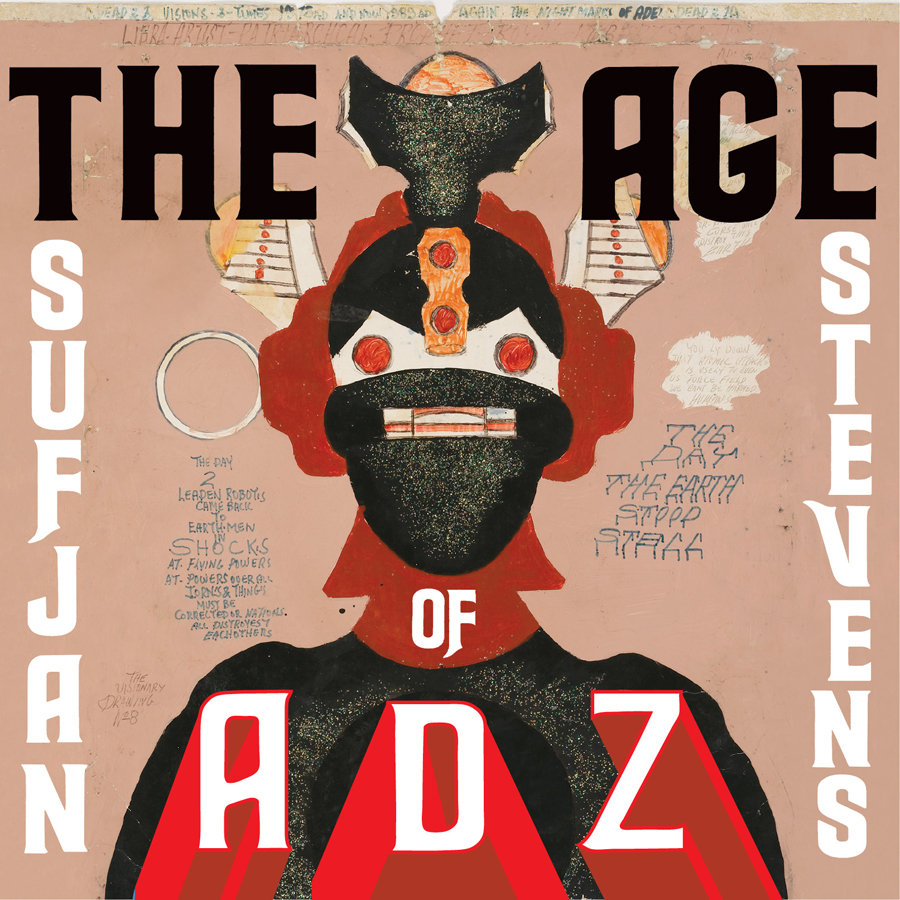
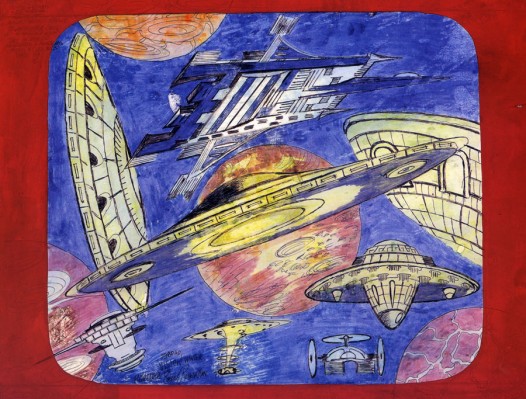
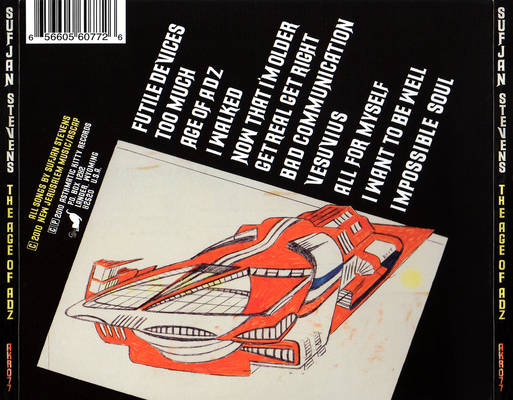
During this creative upheaval, Stevens fell prey to an unspecified nervous disorder that manifested in lethargy, painful sensations all over his body, adrenaline surges, and hypersensitivity. He recalls: "This was really supernatural. It was like I was possessed ... For several months, I couldn't really work and was forced to focus on my physicality and restoring myself. It took several months before I could even get back to working again and writing music. " The tormented work of paranoid schizophrenic artist Prophet Royal Robertson seemed to help Stevens work through his pain and coalesce the edgy music he was creating for his next album that had become, as he says, "really monstrous and hazardous in its ambition ... I was really, really desperate to get better because I had started so much music; I had begun all of these projects and was recording a lot. Then when I went back to it, I found it really overwhelming and I didn't know how to approach it. So, this record, The Age of Adz , is, in some ways, a result of that process of working through health issues and getting much more in touch with my physical self. That's why I think the record's really obsessed with sensation and has a hysterical melodrama to it." The album drew its title from one of Robertson's pieces, and most of the artwork on the album was taken from pieces done by Robertson.
Stevens expounds: "I can't apologize for the direction I'm going because it feels necessary and obvious. I know it's confusing because I'm something of an aesthetic nightmare, and I kind of suffer from multiple personality disorder. But that's part of me and my character. So, I guess I don't care. It's a big shift, and it may not be for some people. They should stay home. [laughs] Don't listen to the record; don't buy it. I'm very aware that this material is far less popular and accessible than the kind of songwriting on Illinois. I'm also willing to admit that these songs don't measure up to the songs I was writing five years ago; these aren't great songs in terms of the palpable, fundamental nature of a song. But I'm not interested in songwriting anymore. I'm interested in sound and movement. And this material is all about that. Unfortunately, we sold the tickets to the tour before I even had the record done, so a lot of people didn't really have the chance to know what they were investing in. I apologize for that...Life is all about toiling and labor. But obviously I get great joy in confronting challenge and taking risk. I don't ever want to be comfortable ...I have a hard time distinguishing what is valuable when it comes to the real world and the fantasy world. Like, should I invest my time in the ordinary world or the imaginary world? Royal made a decision and completely escaped the ordinary world. Maybe that's enlightenment. Maybe that's what it's like to be in heaven. I don't know ...For me, the sensory pleasure of sound and music is so transcendent that I begin to distrust it and worry if it's a distraction from ordinary life. Maybe I should be spending my time doing something else, like start a family. Or build an amusement park-- actually, that's still a fantasy world. Engineering? Investment banking? Real estate? There are all kinds of people who make the world go 'round. [laughs] ...I wanted to be a graphic designer, a teacher, a writer. We all have our plans, but they're worth nothing. There's a sequence of events that takes over. But I'm not quitting now. I'm fully embracing the life of the musician ...I'm less interested in songwriting and more into just making noise. "
'The Age of Adz' reached number sixty-one in Australia, thirty in the UK, twenty-three in Ireland, thirteen in Canada, and became his highest charting album at number seven in the US. Stevens considers: "I went through a period of questioning motive and function and now I no longer have the privilege of questioning. I just have the privilege of celebrating my music and sharing it. I don't really want to get caught up in that self-doubt any more. I've always been really insecure about what I do, but those existential conundrums are really circuitous and – what's the word? – unproductive. You know, I don't think my music is important, I don't think it's changing the world, I don't think it's art. I just think it's music. It is what it is."
http://music.sufjan.com/ lyrics: http://genius.com/albums/Sufjan-stevens/The-age-of-adz "Too Much" VIDEO "Get Real Get Right" VIDEO "All For Myself" VIDEO 'The Age of Adz' full album:
http://music.sufjan.com/album/the-age-of-adz https://www.youtube.com/playlist?list=PLZqsyBiYZFQ2aB-JyI-J1-tyxaD-73TSa VIDEO All songs written and composed by Sufjan Stevens.
1. "Futile Devices" 2:11
2. "Too Much" 6:44
3. "Age of Adz" 8:00
4. "I Walked" 5:01
5. "Now That I'm Older" 4:56
6. "Get Real Get Right" 5:10
7. "Bad Communication" 2:24
8. "Vesuvius" 5:26
9. "All for Myself" 2:55
10. "I Want to Be Well" 6:27
11. "Impossible Soul" 25:35
Total length: 74:49
Jorge Ben and Gilberto Gil played with order and disorder in the extended improvisations and subtle hypnotic grooves of this fluid acoustic jam session. Jorge Ben had established himself over a decade with seven albums (Samba Esquema Novo Sacundin Ben Samba Ben É Samba Bom O Bidú Jorge Ben Força Bruta A Tábua de Esmeralda Louvação Gilberto Gil [Frevo Rasgado] Os Mutantes ] and the Tropicália: ou Panis et Circencis Caetano Veloso , Os Mutantes , Gal Costa , Nara Leão , and Tom Zé ] in 1968, Gilberto Gil (Cérebro Eletrônico) Copacabana Mon Amour Gilberto Gil (Nêga) Expresso 2222 and Barra 69: Caetano e Gil Ao Vivo Na Bahia in 1972, Gilberto Gil Ao Vivo Refazenda
Gil e Jorge aka Ogum Xangô was recorded at CIA Brasiliera De Discos Phonogram in Rio De Janeiro. The twelve hour marathon session was produced by Paulinho Tapajós and Perinho Albuquerque with technicians Ary, João Moreira, Luigi, and Luis Claudio. The album features Jorge Ben and Gilberto Gil on vocals and violão (acoustic guitar), with Djalma Corrêa adding percussion and Wagner Dias providing bass. According to Afro Brazilian mythology, Ogum is the Yoruba deity or orixá of iron and war and the patron deity for warriors; while Xangô is the Yoruba orixá or deity of thunder, lightening, and fire.
http://www.jorgebenjor.com.br/ http://www.gilbertogil.com.br/ "Taj Mahal" inspired Rod Stewart's number one smash hit "Da Ya Thing I'm Sexy?" . A court agreed and awarded damages to Jorge Ben.
https://www.youtube.com/watch?v=LL-MWkMb07A VIDEO Gil e Jorge aka Ogum Xangô
full album:
https://www.youtube.com/watch?v=SRMIgrvXsNk VIDEO side one
1-Meu Glorioso São Cristóvão (Jorge Ben) -00:00
2-Nêga (Gilberto Gil) -08:12
side two
3-Jurubeba (Gilberto Gil) -18:42
4-Quem Mandou (Pé na Estrada) (Jorge Ben) -30:22
side three
5-Taj Mahal (Jorge Ben) -37:13
6-Morre O Burro Fica O Homem (Jorge Ben) -49:19
side four
7-Essa É Pra Tocar No Rádio (Gilberto Gil) -55:21
8-Filhos De Gandhi (Gilberto Gil) -1:01:26
9-Sarro (Jorge Ben/Gilberto Gil) -1:13:29
Camper Van Beethoven crossed over the bitter borderline for the tension release of this mysterious matchstick collapse. The band had successfully made the transition to the majors with their previous album 'Our Beloved Revolutionary Sweetheart' ; but from the onset, the sessions for 'Key Lime Pie' were fraught with division. David Lowery remembers: "First, we basically kicked Jonathan [Segel] out of the band because we got to the point where we didn’t feel like we could function with him in the band. He just made a lot of ultimatums, and there was literally no way the band could function. So he was asked to leave, and then Victor and Greg had the Monks of Doom prog-rock project, and I was heading in another direction. And when Key Lime Pie came out, that didn’t get great reviews, so I think in a lot of ways it seemed like we’d made a wrong turn. If we’d been clearly successful on that album, I think we could have got past our differences, but it didn’t seem like we were successful. So I think it was really easy for everybody to split apart. The record label wanted me to continue on as Camper Van Beethoven and I refused to do it. I just started a different project." Jonathan Segel: "I was in the band from 1983 through the tour for Our Beloved Revolutionary Sweetheart and the demos for Key Lime Pie ...It was weird, because I wrote some of the songs and played on the demos, but I didn’t record with them. I didn’t actually hear it until months after it came out, and I was shocked because, for one thing, the production and songwriting on that record is astounding. It was the best Camper Van Beethoven album ever. Funnily enough, we had actually recorded a version of “Pictures Of Matchstick Men” during Our Beloved Revolutionary Sweetheart , but we didn’t want our first single on a major label to be a cover."
Greg Lisher: "Before then, we had never been able to afford to put much attention towards making a record. It was always kind of a dream of mine to make a record where we had a producer and could afford to pay attention to the details. It was a real exciting time for all of us; we learned a lot from Dennis [Herring, who produced Our Beloved Revolutionary Sweetheart and Key Lime Pie ] that sort of paved the way for how I think about music...Back when we made those records, we would write the songs as a band, which is different to how we do it now. David [Lowery] would come in with the chords and the lyrics, and we’d just write our own parts. Then, we’d go into a rehearsal space with Dennis, and he’d adjust things like tempo and arrangements and stuff like that. There was a lot more pre-production work than we had done before, so we all had a really good idea of what we were doing. To me, that makes a big difference when you’re making a record...I never worried about [selling out] personally, but I remember overhearing other people talking about it once and a while. You’d hear something about how we sold out and stuff. I never really understood that. Our goals were the same: we wanted to make a great record, and now we had more resources to make that happen. Who wouldn’t want that? I guess because we started out as this indie band, people held us to this standard as a result, but I never saw things like that."
'Key Lime Pie' was produced by Dennis Herring and features Tim Steelbone Cook on pedal steel; Morgan Fichter on violin and vocals; Garth Hudson on organ and talking; Victor Krummenacher on bass and vocals; Don Lax on fiddle and strings; Greg Lisher on guitar and vocals; David Lowery on guitar, harmonica, keyboards, and vocals; Chris Pedersen on percussion, drums, and vocals; and Hammer Smith on harmonica; with Davey Faragher, Mary O'Neil, and Wally Sound on background vocals.
Lowery: "The two that are the most coherent are “Key Lime Pie” [“Telephone Free Landslide Victory” . They just have something that runs through them that kind of stays the same the whole time, in a good way. “Key Lime Pie” "In a lot of ways I really like the third record [“Camper Van Beethoven” . It’s the bridge between the great spontaneity that was the first record and the kind of sophomore weirdness that was the second record [“II and III” , and it’s refined and it’s organic and it’s really pretty psychedelic, and we were really pretty psychedelic at the time, and it’s got this feel to it that I really like. I also really like “Key Lime Pie”
www.campervanbeethoven.com http://www.the-van.co.uk/
"Pictures of Matchstick Men" went to number one on the US alternative singles chart.
https://www.youtube.com/watch?v=wAkcSd5l9Qg "Sweethearts"
https://www.youtube.com/watch?v=dLt4e-l4DxQ "Come on Darkness"
https://www.youtube.com/watch?v=GvyLXndLiXE 'Key Lime Pie' full album:
https://myspace.com/campervanbeethoven/music/album/key-lime-pie-10872714 https://www.youtube.com/playlist?list=ALBTKoXRg38BD5BFHK6ObK9kRcoD88QFy_ VIDEO All songs written by Krummenacher/Lisher/Lowery/Pedersen, except where noted.
"Opening Theme" – 2:21 "Jack Ruby" – 5:22 "Sweethearts" – 4:45 "When I Win the Lottery" – 3:38 "(I Was Born in a) Laundromat" – 3:43 "Borderline" – 3:48 "The Light from a Cake" – 2:43 "June" – 4:24 "All Her Favorite Fruit" – 5:14 "Interlude" – 1:03 "Flowers" (Curkendall/Hart/Lowery) – 2:58 "The Humid Press of Days" – 2:44 "Pictures of Matchstick Men" (Rossi) – 4:08 "Come on Darkness" – 3:14 lyrics
http://mrl.nyu.edu/~hertzman/cvb/albums/klp/
Robyn Hitchcock found an acoustic autumnal expression of intimate ache in the dodgey nocturnes of this crystal cathedral of pure poetry. After the breakup of The Soft Boys, Hitchcock released two albums, 'Black Snake Dîamond Röle' and 'Groovy Decay' ; but he became so dissatisfied with the music business, he dropped out: "I wanted to see how much I really wanted to do this. The early ‘80s were a barren time for the likes of me on the surface, but little seeds were sprouting in the sheltered cracks below that sprouted into organisms like R.E.M., who, God bless them, made the place more habitable. Meanwhile, I wrote those songs out of compulsion, not because anybody wanted me to make a new album—even me. It’s been that way ever since, really. 'IODOT' , as you put it—one letter short of IDIOT—is its own world, an echo of the world I lived in which is now gone. Even then, I was thinking about a gone world. Now I remember remembering. It’s those spirals again...I go from light to dark, it’s all part of the spiral. I don’t see myself as whimsical. There has to be some basis on which an artist makes selections, and mine are instinctive. They don’t always work, I admit—perhaps that’s when they seem whimsical. The main thing is to tell it like it seems, not as you would wish it to seem. But to tell it like it is might require a sharper eye than mine ... I don't think about it while I'm doing it—I'm more aware of it afterward. You go over the dateline of rage and despair into humor. If you want to see it as a kind of spectrum, you might go from anxiety to fear to rage to humor to regret to acceptance… and then possibly even to some kind of happiness, and then 'round again. I'm good at maybe one or two of those particular hues on the spectrum. People often complain that I was covering up my emotions by making a joke of things, but humor is also what makes stuff bearable, and I think one of the things I hated about early-'70s singer-songwriters was how humorless they were. It was my kind of punk [attitude], you know, 'Jesus, I hate this self-pitying shit.' I really didn't like that kind of mellow from-the-canyon self-involved crap. Obviously, I grew up to be just as self-involved as the rest of them, but I felt that a joke would at least justify that. Just because there are jokes in my stuff doesn't mean that I don't fundamentally take it seriously. But feelings travel, thank God. You don't stay in one mood forever, and you find yourself drifting across those datelines. I think some of the really great songs have many moods overlaid on them. I don't know how much I've achieved that, but I always think back to things like "Visions Of Johanna" by Minnesota's own Bob Dylan, and how it's a sort of fundamental sadness with a lot of humor applied as a glaze over that, and then over that, there's a lot of anger and questions being asked: "What do you mean? What's all that for? You've got a lot of nerve"—that usual Dylan stuff. The whole thing comes out as a kind of meditation, as a sort of acceptance. Those are my favorite songs, where different emotions are layered on top of each other. I suppose the trick is to get the feelings to flow correctly from each other when you make a record or write a song. But Jesus, if I thought about that, I'd never write anything!...Well, it's easiest to deal with that stuff as a kind of music-hall song to make those points. If you clear your throat and say, 'Ladies and gentlemen, I am now about to make a serious point,' everyone can bow their heads and start burrowing their fingers in their ears and looking for earwax or texting each other or looking pious. 'Here he comes—here's a serious point. Boy!'
Recorded in London, 'I Often Dream of Trains' was essentially a one man show with Hitchcock doing all of the vocals and instruments save for contributions from James Fletcher on saxophone for one track ("Flavour of Night") and Chris Cox adding bass and backup vocals on two ("Ye Sleeping Knights of Jesus" and "My Favourite Buildings"). Engineers Pat Collier, Iain O'Higgins, and Pascal Gabriel also assisted in the proceedings. Hitchcock remembers: "I mean, that was pretty cheap. The one they used to like was Underwater Moonlight Trains http://www.robynhitchcock.com/ http://themuseumofrobynhitchcock.tumblr.com/ https://myspace.com/robynhitchcock "Autumn Is Your Last Chance" https://www.youtube.com/watch?v=LMnixVOw2Bk "Uncorrected Personality Traits" https://www.youtube.com/watch?v=s5sUfV1Mi7w "I Often Dream of Trains" https://www.youtube.com/watch?v=C4HZkGYXcW4 https://www.youtube.com/watch?v=U60yj35FmGs "Furry Green Atom Bowl" https://www.youtube.com/watch?v=DcTlxQOYDYI "Sometimes I Wish I Was a Pretty Girl" https://www.youtube.com/watch?v=OnPse1Dcrcc "Sounds Great When You're Dead" https://www.youtube.com/watch?v=tr3FX0RD8S4 'I Often Dream of Trains' full album:
http://www.amazon.com/Often-Dream-Trains-Robyn-Hitchcock/dp/B000VO8O44
https://www.youtube.com/playlist?list=PLOyBJamk0U9ERDfITH4o-sp4hkPGZ3GG6 VIDEO Side one "Nocturne (Prelude)" "Sometimes I Wish I Was a Pretty Girl" "Cathedral" "Uncorrected Personality Traits" "Sounds Great When You're Dead" "Flavour of Night" "Ye Sleeping Knights of Jesus" Side two
"This Could Be the Day" "Trams of Old London" "Furry Green Atom Bowl" "Heart Full of Leaves" "Autumn Is Your Last Chance" "I Often Dream of Trains" "Nocturne (Demise)" bonus tracks "Mellow Together" "Winter Love" "The Bones In The Ground" "My Favourite Buildings" "I Used To Say I Love You"






_Back.jpg)