Showing posts with label paul simon. Show all posts

Monday, October 12, 2015

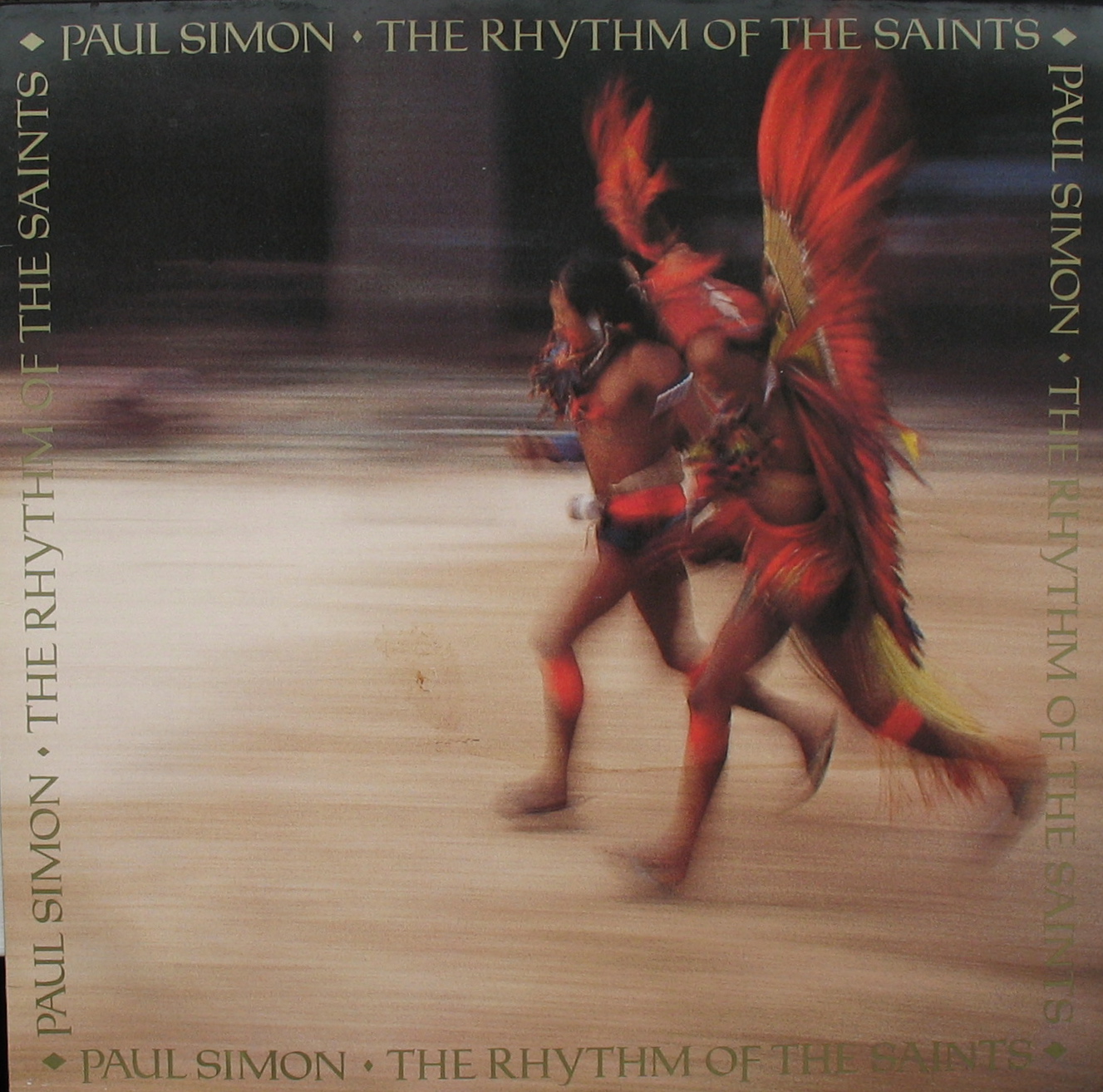
the rhythm of the saints


Paul Simon reached in the darkness with a rattling deep emotion to find magical stories in the open palm of desire.   The acclaim afforded his Graceland album had revitalized his career; and he decided to expand its musical exploration from South African influences to West African and Brazilian polyrhythms.   In 1987, Simon worked with Milton Nascimento on his Yuarete album, and was invited to Brazil.  Simon and engineer Roy Halee began recording drums and rhythmic patterns with various groups.  These drum patterns formed the basis of his next project.  He reveals:  "I liked the idea of just going down there and wandering around musically, so to speak...The idea started with something Quincy Jones said to me during Graceland, about how the great singers come from the south of Africa, but the great drummers and instrumentalists come from the west coast of Africa. The path taken by the drum is similar to the African experience in the West. It follows the diaspora from the west coast of Africa to Brazil, up to the Caribbean and eventually into Louisiana...Some of these drum patterns are hundreds of years old.  Whether we know it or not, we all are affected by the culture that surrounds us - American popular music is primarily African-American in origin. These drums, in their pure form, had a hypnotic effect. They were used to bring people to a state where they could more easily access the spiritual aspects of their existence...That's why it's called The Rhythm of the Saints...If you've got a motor that's as powerful as those drums, you can touch on these subjects and not make everybody reach for a Valium. You can hit at the tender spots, then back off and let the groove come back and flow over you...Life is like that, isn't it?  A bleak thing occurs to you, you save it for some time and think about it, then the defense mechanisms come in and you go, 'Yeah, but you know, it's not so bad.' Or you'll be walking along, feeling fine and then pass some homeless person, and you're powerless all of a sudden. That's just the way the mind reacts."

The album included a parade of guest contributors including:   Paul Simon on vocals, acoustic guitar, and electric guitar;   Clifton Chenier on accordion;  Ladysmith Black Mambazo on background vocals;  Milton Nascimento on vocals;  Naná Vasconcelos on percussion, conga, triangle, berimbau, and gourd;  Adrian Belew on synthesizer;  J.J. Cale on guitar;  Rigo Star on guitar;  Michael Brecker on saxophone and EWI synthesizer;  Hugh Masekela on flugelhorn;  Giovanni Hidalgo on congas;  Kim Wilson on harmonica;  Clifton Anderson on trombone;  Francisco Aguabella on congas;  Artur Andres on percussion;  Mingo Araujo on percussion, castanets, congas, cymbals, drums, triangle, shaker, African bells, agogo bells, and casinette;  Isaac Asante on percussion;  Martin Atangana on electric guitar;  Dave Bargeron on euphonium;  Karen Bernod on background vocals;  Jude Bethel on tenor saxophone;  Jacques Bolognesi on trombone;  Randy Brecker on piccolo trumpet;  Briz on background vocals;  Anthony Carrillo on bongos;  Elolongue Mbango Catherine on background vocals;  Don Chacal on bongos, congas, bata, and gourd;  C.J. Chenier on accordion;  Wilson DasNeves on percussion and cowbell;  Djana'd on background vocals;  Charles Doherty on tenor & alto saxophone;  Steve Gadd on drums;  Florence Gnimagnon on background vocals;  Myrna Lynn Gomila on background vocals;  Gordinho on surdo;  Grupo Cultural Olodum on drums;  Alain Hatot on saxophone;  Errol Ince on trumpet;  Kia Jeffries on background vocals;  Remi Kabaka on percussion;  Bakithi Khumalo on bass;  Armand Sabal-Lecco on bass;  Charlotte M'bango on background vocals;  Andre Manga on bass;  Mazzola on percussion and chicote;  Jimmy McDonald on accordion;  Clyde Mitchell on trumpet;  Madeleine Yayodele Nelson on chekere;  Vincent Nguini on guitars, bass, and claves;  Greg Phillinganes on synthesizer;  Ray Phiri on guitar;  Raphael Rabello on guitar;  Decio Ramos on drums;  Felix Sabal-Lecco on drums;  Paul Santos on percussion;  Paulo Sérgio Santos on chicote;  George Seba on electric guitar;  Phillipe Slominski on trumpet;  Pedro Sorongo on percussion and scraper;  Justin Tchounou on synthesizer;  Antonio Luis Alves de Souza as director;  Remi Kabaka on drums;  Beloba on percussion;  Marçalzinho on percussion;  Armandinho on guitar;  Canegal on percussion;  Sidinho Moreira on bongos, conga, drums, bottle, and water bowl;  Madeleine Yayodele Nelson on shekere;  Jorge Ferreira da Silva on percussion;  Kofi Electrik on guitar;  and  Uakti on percussion.  


"I was really trying to draw the lyrics out of the sounds of the drums and the music.  I would do that over and over, and even if I reached a point in the sequence where I felt like that song was finished, I would sing it anyway, because I might find another way of phrasing the line, or another line would suggest itself...I think these songs are more stream-of-consciousness than Graceland. Inevitably there will be things that don't make sense. You have to be patient. You have to wait for the song to grow, and grow organically. It's like, you wait for it to reveal itself...If I was a major recording star who was black, I don't believe I would have come into that vehement a discussion, even if you disagreed with Graceland on some level, at least it was an interesting idea at a time when nobody in the industry even cared, when they were all so busy imitating whatever a hit was...The only answer to the lowest-common-denominator argument is to make a really good record that sells.  You can't wait around hoping that your set of values will prevail. You've got to think as hard as you can about how to sell your point of view, and then work hard doing it...It's like all those people who were worried about lip-syncing at concerts. Well, the answer to that is to do a concert of live musicians interacting in such a way that the audience is moved. Simple. Hard work will always pay off...People will respond to something that is real."

'The Rhythm of the Saints' elicited an international response, going to number eighty-seven in Japan;  twenty-two in France;  seventeen in Spain;  thirteen in Hungary and Italy;  eleven in Germany;  eight in Sweden;  seven in Finland;  six in Belgium, Norway, and New Zealand;  four in Austria and the US;  three in Australia and Switzerland;  two in the Netherlands;  and number one in Canada and the UK.    The album was nominated for Grammy Awards for Album of the Year and Producer of the Year.  


http://www.paulsimon.com/


lyrics
http://www.paulsimon.com/us/music/rhythm-saints


"The Obvious Child"


Well, I’m accustomed to a smooth ride
Or maybe I’m a dog who’s lost its bite
I don’t expect to be treated like a fool no more
I don’t expect to sleep through the night
Some people say a lie’s a lie’s a lie
But I say why
Why deny the obvious child?

And in remembering a road sign
I am remembering a girl when I was young
And we said, “These songs are true
These days are ours
These tears are free”
And hey
The cross is in the ballpark

We had a lot of fun
We had a lot of money
We had a little son and we thought we’d call him Sonny
Sonny gets married and moves away
Sonny has a baby and bills to pay
Sonny gets sunnier
Day by day by day by day

Well, I’ve been waking up at sunrise
I’ve been following the light across my room
I watch the night receive the room of my day
Some people say the sky is just the sky
But I say
Why deny the obvious child?

Sonny sits by the window and thinks to himself
How it’s strange that some roots are like cages
Sonny’s yearbook from high school
Is down on the shelf
And he idle thumbs through the pages
Some have died
Some have fled from themselves
Or struggled from here to get there
Sonny wanders beyond his interior walls
Runs his hands through his thinning brown hair

Well, I’m accustomed to a smoother ride
Or maybe I’m a dog who’s lost its bite
I don’t expect to be treated like a fool no more
I don’t expect to sleep the night
Some people say a lie is just a lie
But I say
The cross is in the ballpark
Why deny the obvious child?


'The Rhythm of the Saints'
full album:


All tracks composed by Paul Simon, except where indicated.

"The Obvious Child" – 4:10
"Can't Run But" – 3:36
"The Coast" (Simon, Vincent Nguini) – 5:04
"Proof" – 4:39
"Further to Fly" – 5:36
"She Moves On" – 5:03
"Born at the Right Time" – 3:48
"The Cool, Cool River" – 4:33
"Spirit Voices" (Simon, Milton Nascimento) – 3:56
"The Rhythm of the Saints" – 4:12

bonus tracks
"Born at the Right Time" (Acoustic demo) – 3:50
"Thelma" (Outtake) – 4:14
"The Coast" (Work-in-progress version) – 5:13
"Spirit Voices" (Work-in-progress version) – 3:49


Monday, January 26, 2015

bridge over troubled water


Simon and Garfunkel sailed on to their greatest success with the pristine pop perfection of their sublime swansong.  The duo had seen their previous three albums 'Parsley, Sage, Rosemary and Thyme', the soundtrack album for Mike Nichols' film The Graduate,  and 'Bookends' all reached the top five of the US album chart as their music developed from acoustic folk to a more sophisticated studio sound.  Both of them had been asked to be a part of Nichols' adaptation of Joseph Heller's 'Catch 22'; but Simon's part was written out of the script by Buck Henry who felt that there were too many characters.  Garfunkel spent eight months in Mexico for the production, during which time Simon wrote "The Only Living Boy in New York"  Garfunkel considers:  "Our way of working was for Paul to write while we recorded. So we'd be in the studio for the better part of two months working on the three or four songs that Paul had written, recording them, and when they were done, we'd knock off for a couple of months while Paul was working on the next group of three or four songs. Then we'd book time and be in the studio again for three or four months, recording those ... rather than wait for Paul to write the next bunch of songs, I went off and did this movie."

'Bridge over Troubled Water' was co-produced by Paul Simon, Art Garfunkel, and engineer Roy Halee over the course of a year.   The sessions featured Paul Simon on lead vocals and guitar;   Art Garfunkel on lead vocals;    with Joe Osborn on bass guitar;  Larry Knechtel on piano;  Fred Carter, Jr. on guitar;  Peter Drake on dobro and pedal steel guitar; and Hal Blaine on drums.  Jimmie Haskell and Ernie Freeman did the strings;  Jon Faddis, Randy Brecker, Lew Soloff, and Alan Rubin handled brass;  and the Peruvian instruments were performed by Los Incas.  

Simon remembers:  "That was a great little unit - Hal [Blain], Larry Knechtel, and Joe Osborne. It was a great, great band out of LA. And of course until they got really tired because everybody used them, they were fantastic. Very musical...very musical guys. They made life easy. I preferred to work with them, and that's probably why I was recording in California. I preferred working with those guys rather than what I had to work with in New York...The snare drum on "The Boxer": It was recorded in the elevator shaft of the CBS studios in New York at 52nd Street. That was a pure Roy [Halee] sound. He situated the drum in the elevator shaft and he hit it and he recorded that.  It was just huge ... Roy's brilliant. He's a brilliant sound guy. He was great with echoes, he always had a great sense of echo. The drum from "Bridge Over Troubled Water" was recorded in the echo chamber of a studio in LA, but it was recorded on one machine and played back on another machine to create the effect of a misalignment so that's what created that feeling of (sings drum delay sound - "tututu-tu-tu").  It was because the heads of the machines didn't match up. It was a fortuitous thing...[The blending of our voices] was the double. As soon as everything was doubled, then the blend was there. It was there without doubling, but if we doubled it exactly - then there really was a blend. We really didn't have to do anything - just sing it, double it, there it was...basically you're looking for as long a take as you can get, one that has continuity and feeling. That's all.  But if you get that and then you've got some passage or some notes that are either not phrased right or are out of tune, maybe you try and repair it. But basically you're looking for as long a take as you can find. I wasn't looking to make up words...What it comes down to is a sense of musicality.  If something feels musical and right to me then I leave it. I don't feel like it's all about being perfect. But, you really don't want to hear too much out of tune - out of tune is hard to take. A little bit can be nice."


'Bridge over Troubled Water' went to number one in eleven countries including Australia, Canada, France, Japan, the Netherlands, Norway, Spain, Sweden, the UK, the US, and West Germany.  It was the biggest selling album of that year (and the two to follow), becoming the best selling album ever up to that point, and eventually selling over twenty-five million copies worldwide.  'Bridge over Troubled Water' won Grammys for Album of the Year and Best Engineered Recording.   Despite the massive success and accolades, it would be the final studio album that the duo would record together.  After the album was completed, Garfunkel went to work on another Mike Nichols film 'Carnal Knowledge', while Simon studied songwriting at New York University and began working on his eponymous solo album.  Simon says:   "Partnerships… are destined to break up, as are most business partnerships,  And just after a while, everybody gradually changes, and has their own agenda of what they want to do in life, and it doesn’t coincide with the way it did in the very beginning. And so, you’re naturally inclined to go your separate ways."


http://www.simonandgarfunkel.com/

http://www.simonandgarfunkel.com/us/music/bridge-over-troubled-water-40th-anniversary-edition


The gospel inspired title song became an international smash, going to number twenty-three in Belgium; seven in Norway; five in the Netherlands and Switzerland; four in Austria and South Africa; three in Germany; two in Australia, Ireland, and Spain; and number one in Canada, France, New Zealand, the UK, and the US.  It went on to win Grammy Awards for Record of the Year, Song of the Year, Best Contemporary Song, and Best Arrangement Accompanying Vocalists.  

Simon admits:  "I have no idea where it came from. It came all of the sudden. It was one of the most shocking moments in my songwriting career ... 'Bridge Over Troubled Water' is something of a mystery to me; because nothing prompted me to write it. I was listening to a lot of gospel quartets, particularly the Swan Silvertones and the Everly Brothers album Songs Our Daddy Taught Us. I was stunned and I thought, 'that’s a lot better than I usually write.'"

Garfunkel convinced Simon to add a third verse to the song:  "You can look at songwriting, at which Paul Simon is clearly a master, and you can look at singing, the Frank Sinatra part of the thing, which we both did. In between the two is record making. I heard "Bridge over Troubled Water" first as this two-verse beautiful hymn of peace. But I thought it had the possibility to go into high gear, do this Phil Spector thing, and take off...[Paul] is like a purist, in that way. "No Artie, I wrote it as a hymn." But he did open himself up to it and wrote the third verse…When I did the vocal I did the big last verse first and nailed it. But the first verse required a delicacy that was maddening. I couldn't get it. So it was, just: Lord help me relax. Help me find that lovely place as a performer when you believe you get a visitation from higher powers, and it passes through you."


https://www.youtube.com/watch?v=iIm-YTrs4tM


When you're weary
Feeling small
When tears are in your eyes
I will dry them all
I'm on your side
When times get rough
And friends just can't be found
Like a bridge over troubled water
I will lay me down
Like a bridge over troubled water
I will lay me down
When you're down and out
When you're on the street
When evening falls so hard
I will comfort you
I'll take your part
When darkness comes
And pain is all around
Like a bridge over troubled water
I will ease your mind
Like a bridge over troubled water
I will ease your mind
Sail on silver girl
Sail on by
Your time has come to shine
All your dreams are on their way
See how they shine
If you need a friend
I'm sailing right behind
Like a bridge over troubled water
I will ease your mind
Like a bridge over troubled water
I will ease your mind


"The Boxer"
https://www.youtube.com/watch?v=MYPJOCxSUFc

https://www.youtube.com/watch?v=MXIBB0QjkQU


"Cecelia"
https://www.youtube.com/watch?v=MZeTmgI1Eb4


'Bridge over Troubled Water'
full album:


All songs written and composed by Paul Simon except where noted.

Side one
00:00 "Bridge over Troubled Water"   4:52
04:56 "El Condor Pasa (If I Could)" (Daniel Alomía Robles, English lyrics by Paul Simon, arranged by Jorge Milchberg) 3:06
08:05 "Cecilia"   2:55
11:00 "Keep the Customer Satisfied"   2:33
13:37 "So Long, Frank Lloyd Wright"   3:41
Side two
17:23 "The Boxer"   5:08
22:36 "Baby Driver"   3:14
25:53 "The Only Living Boy in New York"   3:58
29:55 "Why Don't You Write Me"   2:45
32:41 "Bye Bye Love" (live recording from Ames, Iowa) (Felice and Boudleaux Bryant) 2:55
35:40 "Song for the Asking"   1:49


Monday, November 4, 2013

hearts and bones


Paul Simon worked out his personal pain through the resigned reflections of this underrated and understated musical therapy.  After the poor performance of 'One Trick Pony', Simon was depressed and suffered from writer's block:     "It was many things, but essentially, it was my work and my  relationship with Carrie. She and I were breaking up, which we were always doing. Faced with a problem that made us uncomfortable, we were inclined to say, 'Hey, I don't need this.' We were spoiled, because we were both used to being the center of attention... I had a severe loss of faith over the response to 'One-trick Pony'. Also, I had switched labels, from Columbia to Warner Bros., with great trauma. When I left CBS, it became company policy there to make life as difficult as possible for me. And that began a terrible personal battle between me and Walter Yetnikoff, the president of the company. It ended only when I threatened to subpoena people to testify that he had told them he was going to ruin my career." 

He worked with psychiatrist Rod Gorney who helped him overcome the block:    "He was able to penetrate someone whose defenses were seemingly  impenetrable. He was able to make me feel that I wasn't there to work just for the satisfaction of having a hit but that there was a contribution to be made. Of course, the reason I'd been blocked was that I felt what I did was of absolutely no importance. He was able to say, 'I'm telling you that the way to contribute is through your songs. And it's not for you to judge their merits, it's for you to write the songs.' For me, that was brilliant - and liberating." 

Around that time, he was invited to perform a concert in New York's Central Park and he invited Art Garfunkel to perform with him for the entire concert, playing to over half a  million people.  The concert was such a success that Simon brought Garfunkel in on the sessions for his new album; but the sessions degenerated as the pair could not work together in the studio.  Garfunkel wanted to record his vocal tracks without Simon around; and Simon wanted to be in control of the process:    "I wanted to be there when it happened, because I knew that if what he did wasn't all right with me, I wasn't going to let it go. And that was the difference from the Sixties. What we didn't realize at first was how big a difference it was. It was huge. As wide as his solo records are from mine.   Meanwhile, we had a time limit. We were trying to get the record out, following the conventional wisdom, to precede the tour that was going to begin in the spring of 1983. We had the time, but it didn't get done. Artie wasn't happy with his performances. Or he wanted to think more about the part. A year sailed by.  So now, not only was the work process painful, in that the personality clash was constant, but the artistic differences were becoming more articulated. I was getting to feel that I didn't want him to paint on my painting. Finally, I said, 'This is not a good idea. I think what we have here is the partnership that wasn't.'...It's too bad, because everybody wanted to have two guys who had their differences and split up and then came back together and resolved them and lived happily ever after. It was really a bitch to say, 'Well, we didn't' really get back together.' The truth is, we were always able to sing and blend well together; that's our gift. And that was always a turn-on for both of us. But aside from that, we're really two different guys. As much as we wanted to be a partnership, we're not. "

'Hearts and Bones' was produced by Roy Halee with Paul Simon on guitar, programming, and vocals; Rob Mounsey on synthesizer and vocoder; Nile Rodgers on guitar and programming; Wells Christy and Tom Coppola on synthesizer and synclavier; Bernard Edwards, Gordon Edwards, and Marcus Miller on bass; Steve Ferrone, Steve Gadd, and Jeff Porcaro on drums; Airto Moreira on percussion; Michael Boddicker on synthesizer; Al Di Meola, Eric Gale, Sid McGinnis, and Dean Parks on guitar; Anthony Jackson on contrabass guitar; Michael Mainieri, Jr. on marimba, vibraphone, and background vocals; George Marge on bass clarinet; David Nichtern on synclavier; Greg Phillinganes on piano and Fender Rhodes; Robert Sabino on synthesizer and piano; Richard Tee on synthesizer, piano, Fender Rhodes, and vocals; Dave Matthews on horn arrangements; Mark Rivera on alto saxophone; Peter Gordon on French horn; Michael Riesman on synthesizer and conducting;  Carol Wincenc on flute; Marin Alsop on violin; Jill Jaffe on viola; Jesse Levy and Frederick Zlotkin on cello; and The Harptones on background vocals.  

'Hearts and Bones' was even less of a success than 'One Trick Pony', only charting at number ninety-nine in Australia, fifty-one in Germany, thirty-five in the US, thirty-four in the UK, nineteen in France, fourteen in the Netherlands, eleven in Sweden, and peaking at number three in Norway.  It was the worst chart performance of his career until 'Songs of the Capeman' in 2007.  Despite its poor chart performance 'Hearts and Bones' remains one of the most affecting and personal in his catalogue.  


http://www.paulsimon.com/

http://www.paulsimon.com/us/music/hearts-and-bones


interview
http://www.youtube.com/watch?v=59ELMdiXGkI


"Allergies" 
http://www.youtube.com/watch?v=MxHulLNKizk


"Hearts and Bones" was written about his relationship with Carrie Fisher.
http://www.youtube.com/watch?v=kZ425RKCqco


"When Numbers Get Serious" 
http://www.youtube.com/watch?v=cYLH0rPLjUg


"Think Too Much (b)" 
http://www.youtube.com/watch?v=CDi64fShuS0


"Song About the Moon" 
http://www.youtube.com/watch?v=Z25Fkgi1ASQ
http://www.youtube.com/watch?v=Hc-sF3tb9EE


"Think Too Much (a)" 
http://www.youtube.com/watch?v=hR-WAfxOEKY


"Train in the Distance" was about his ex-wife  Peggy Harper.  
http://www.youtube.com/watch?v=gCFTHhcvRT0


"Rene and Georgette Magritte with Their Dog After the War" 
http://www.youtube.com/watch?v=iFnNbPePS1k


"Cars Are Cars" 
http://www.youtube.com/watch?v=aMyyZb7nebM


"The Late Great Johnny Ace" is a tribute to John Lennon and features a  one-minute coda written by Philip Glass.  
http://www.youtube.com/watch?v=tI8q5GtfVpw


Sunday, May 5, 2013

there goes rhymin' simon


Paul Simon hit his solo stride with the confident and eclectic stylistic mix of this sparkling and savory sophomore spread.  Building on the success of his eponymous solo debut, Simon brings in elements of gospel, jazz, and soul for the follow-up.  'There Goes Rhymin' Simon' was recorded at Muscle Shoals Sound Studio in Muscle Shoals, Alabama; Malaco Recording Studios in Jackson, Mississippi; and Morgan Studios in London with production by Paul Simon, Phil Ramone, Muscle Shoals Rhythm Section, Paul Samwell-Smith, and Roy Halee.  The sessions featured Paul Simon on vocals and guitar; Pete Carr on guitar and electric guitar; Jimmy Johnson on electric guitar; Cornell Dupree, Alexander Gafa, David Spinozza, and Jerry Puckett on guitar; David Hood, Gordon Edwards, Bob Cranshaw, and Vernie Robbins on bass guitar; Richard Davis on double bass; Barry Beckett on keyboard, piano, and vibraphone; Paul Griffin and Bobby Scott on piano; Bobby James on keyboard; Carson Witsett on organ; Don Elliott on vibraphone; Roger Hawkins, Rick Marotta, Grady Tate, and James Straud on drums; Airto Moreira on percussion; The Onward Brass Band on horns; The Dixie Hummingbirds on group vocals; Rev. Claude Jeter on falsetto vocals; Maggie and Terre Roche on backing vocals; Allen Toussaint on horn arrangements; and Quincy Jones and Del Newman on string arrangements.  


Simon mused:   "I believe it's no good to talk about your songs; it's wrong. You should leave your songs alone and let them say what they say; let people take what they want from them.  All I try to do in the songs is write about the world that I'm in, and I try to do it honestly. But it's not good to explain. If they were meant to be explained then they wouldn't be written...I think my songs are lyrically...grown-up, you know?  I've seen some reviews of [There Goes Rhymin 'Simon] where they say it's disillusioned or bitter, but I strongly don't feel that it is--nor do I feel that I am.  I think that those guys, those songwriters who grew up in rock and roll and were prominent in the 1960's have to keep writing about their lives as they reach their thirties...One of the big things that revitalized popular music in the 1960's was the Beatles, who came around and wrote the truth when the lyrics were still based on a 1950's mentality of 'We're not too young to fall in love' and shit like that. The Beatles wrote about their age. That's what I'm doing. I can't stay writing the same lyrics I wrote when I was twenty-three...So much of what I hear on the radio is boring.  I think part of the reason is because it's not real. It may be real-- maybe--if you're eighteen, but not if you're thirty. People thirty years old wonder why they're not getting off on popular music the way they once did, and it's because nobody's singing for them. When you reach a certain age you're not naive anymore. Everything I write can't be a philosophical truth, but it certainly isn't innocent--because I'm not. Music is forever; music should grow and mature with you, following you right on up until you die." 


'There Goes Rhymin' Simon' went to number seventeen in Finland; ten in Japan; seven in Australia; six in Norway; five in France; four in the UK; three in Canada; two in the US; and number one in Spain and Sweden.  

'There Goes Rhymin' Simon'
full album:


All songs were written by Paul Simon. The melody of "American Tune" was almost note-for-note written by Johann Sebastian Bach (St Matthew Passion), who was not credited on the album. In turn, Bach had imitated the melody of Mein G'mueth ist mir verwirret by Hans Leo Hassler.

Side one
"Kodachrome" – 3:32
"Tenderness" – 2:53
"Take Me to the Mardi Gras" – 3:27
"Something So Right" – 4:33
"One Man's Ceiling Is Another Man's Floor" – 3:44
Side two
"American Tune" – 3:43
"Was a Sunny Day" – 3:41
"Learn How to Fall" – 2:44
"St. Judy's Comet" – 3:19
"Loves Me Like a Rock" – 3:31

Sunday, February 19, 2012

paul simon


Paul Simon broke free from the constraints of his past and broadened his musical palatte for his eponymous American solo debut. He began making demos in San Francisco; but also recorded in Jamaica. He worked with such diverse musicians as violinist Stephane Grappelli, bassist Ron Carter, guitarist Stefan Grossman, and percussionist Airto Moreira, as well as vocalists Cissy Houston, Von Eva Sims, Renelle Stafford and Deirdre Tuck. Though he had ended his collaboration with Art Garfunkel; he continued to work with producer Roy Halee. Simon says, "It left me free to do what I want. I wanted to sing other types of songs that Simon and Garfunkel wouldn't do. 'Mother and Child Reunion,' for example, is not a song that you would have normally thought that Simon and Garfunkel would have done. It's possible that they might have. But it wouldn't have been the same, and I don't know whether I would have been so inclined in that direction. So for me it was a chance to back out and gamble a little bit; it's been so long since it was a gamble." 'Paul Simon' went to the top of the charts in Finland, Norway, Japan, Sweden, and the UK. In the US, it peaked at number four.


About 'Mother and Child Reunion', Simon says: "I got that by making a mistake. Because 'Why Don't You Write Me?' was supposed to sound like that, but it came out a bad imitation. So I said, 'I'm not going to get it out of the regular guys. I gotta get it out of the guys who know it.' And I gotta go down there willing to change for them. I started to play with them. I started to show them the song and play, and we started to work it out, and they were playing, and I would play, but I couldn't play with it. Couldn't fit. So I sat down and said, 'You play it. Play what you want.' That's the key thing. Let them play whatever they want, and then you change. You go their way. That's how you get that." The track was recorded in Jamaica with legendary reggae guitarist Hux Brown and bassist Jackie Jackson. Simon admits the unlikely origin of the song title: "I was eating in a Chinese restaurant downtown. There was a dish called 'Mother and Child Reunion.' It's chicken and eggs. And I said, 'Oh, I love that title. I gotta use that one.'" He explains further from where the emotional depth came: "We had a dog that was run over and killed, and we loved this dog. It was the first death I had ever experienced personally. Nobody in my family died that I felt that. But I felt this loss--one minute there, next minute gone, and then my first thought was, 'Oh, man, what if that was Peggy? What if somebody like that died? Death, what is it, I can't get it.' And there were lyrics straight out forward like that. 'I can't for the life of me remember a sadder day. I just can't believe it's so.' Those are the lyrics. The chorus for 'Mother and Child Reunion'--well, that's out of the title. Somehow there was a connection between this death and Peggy, and it was like heaven, I don't know what the connection was. Some emotional connection. It didn't matter to me what it was. I just knew it was there."


"No I would not give you false hope
On this strange and mournful day
But the mother and child reunion
Is only a motion away, oh, little darling of mine.
I can't for the life of me
Remember a sadder day
I know they say let it be
But it just don't work out that way
And the course of a lifetime runs
Over and over again"


'Me and Julio Down by the Schoolyard' describes the fallout after Mama Pajama witnesses a crime. About exactly what that crime is, even Simon claims ignorance: "I have no idea what it is...Something sexual is what I imagine, but when I say 'something', I never bothered to figure out what it was. Didn't make any difference to me."

"In a couple of days they come and
Take me away
But the press let the story leak
And when the radical priest
Come to get me released
We was all on the cover of Newsweek
And I'm on my way
I don't know where I'm going
I'm on my way, I'm taking my time
But I don't know where
Goodbye to Rosie the queen of Corona
See you, me and Julio
Down by the school yard"


"Duncan" features Andean group Los Incas who also appeared on the Simon and Garfunkel song 'El Condor Pasa (If I Could)'.

"My father was a fisherman
My mama was a fisherman's friend
And I was born in the boredom and the chowder
So when I reached my prime
I left my home in the maritimes
Headed down the turnpike for new england, sweet New England
Holes In my confidence
Holes In the knees of my jeans
I was left without a penny in my pocket
Oo-we I was about destituted
As a kid could be
And I wished I wore a ring
So I could hock it, I'd like to hock it."


"Peace Like a River"

"You can beat us with wires
You can beat us with chains
You can run out your rules
But you know you can't outrun the history train
I've seen a glorious day"


"Paranoia Blues"

"I got some so-called friends
They’ll smile right to my face
But, when my back is turned
They’d like to stick to me
Yes, they would
Oh no, no
Oh no no
There’s only one thing I need to know
Whose side are you on?"


"Congratulations"

"Congratulations
Oh, seems like you’ve done it again
And I ain’t had such misery since
Since I don’t know when,
Oh, and I don’t know when"


'Paul Simon'
full album:


All songs written by Paul Simon, except "Hobo's Blues" co-written by Stéphane Grappelli.

Side one
"Mother and Child Reunion" – 3:05
"Duncan" – 4:39
"Everything Put Together Falls Apart" – 1:59
"Run That Body Down" – 3:52
"Armistice Day" – 3:55
Side two
"Me and Julio Down by the Schoolyard" – 2:42
"Peace Like a River" – 3:20
"Papa Hobo" – 2:34
"Hobo's Blues" – 1:21
"Paranoia Blues" – 2:54
"Congratulations" – 3:42