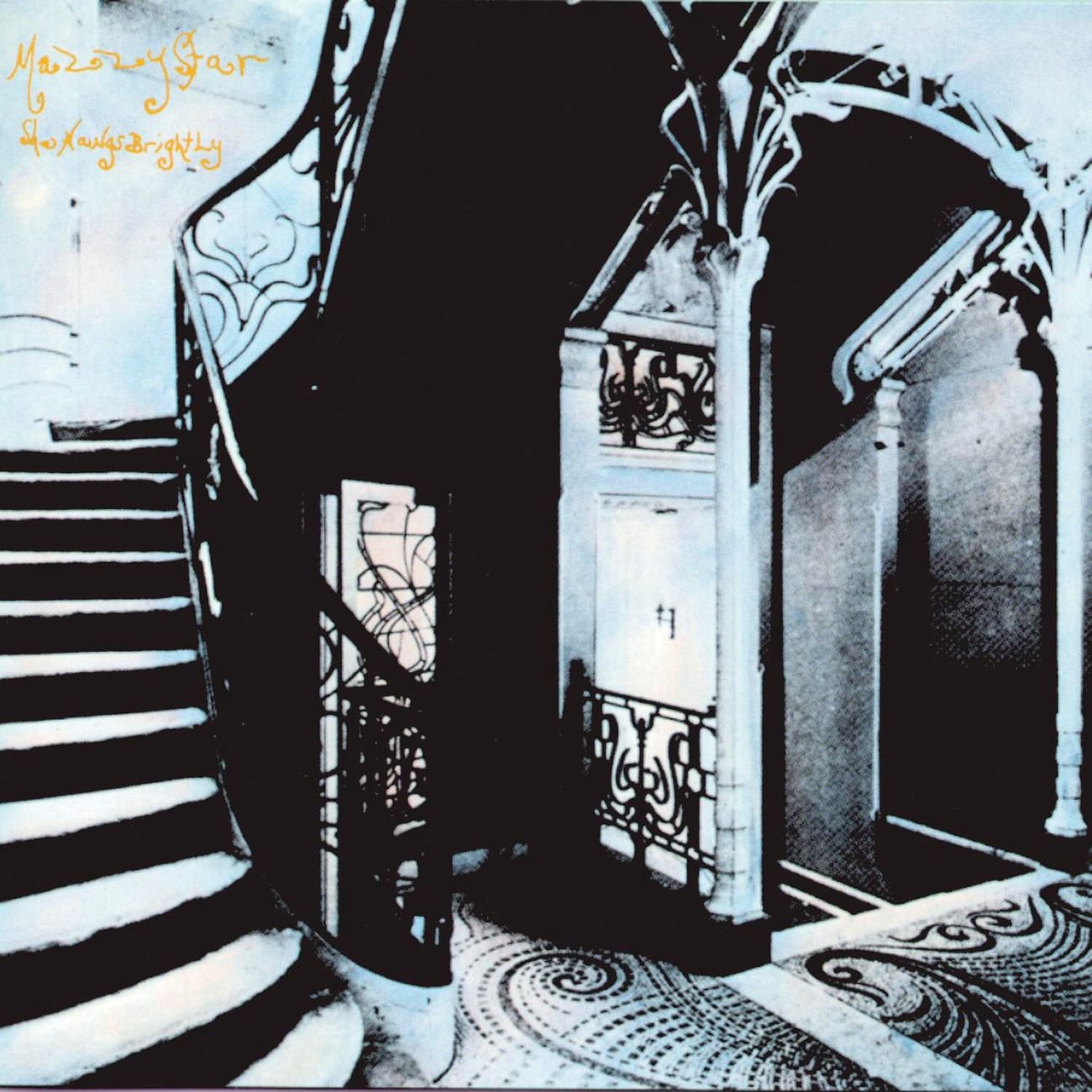
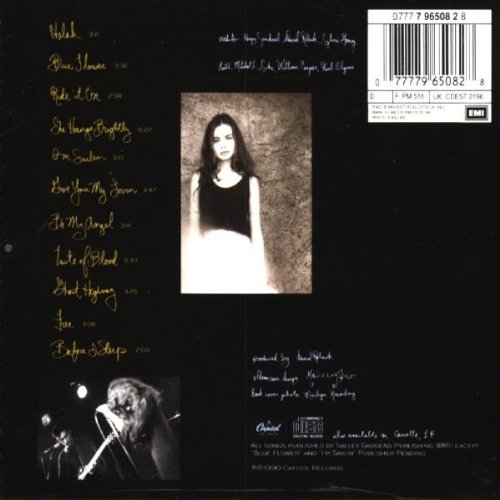
Mazzy Star rummaged through desire and doubt to find illumination in this hazy velvet venture. David Roback and his brother Steven had been in the Unconscious with their neighbor Susanna Hoffs before forming Rain Parade with David's college roommate Matt Piucci, becoming a major part of the Los Angeles Paisley Underground scene. Roback remembers: "I went to New York mainly to be part of the art scene; but I gradually found myself getting more inspired by what was happening in music than in art...People like Patti Smith and Television...I felt like a punk. That's the attitude I identified with. But when I picked up the guitar and started playing it, the music didn't come out sounding punk. It was something else...When I started playing music, it came out sounding very psychedelic for whatever reason. I guess it was just what I grew up liking. The Beatles and Jimi Hendrix were the best groups for me...The late Beatles more than the early Beatles--their message, the whole political and spiritual involvement."
At the same time, Hope Sandoval formed folk duo Going Home with classmate Sylvia Gomez. They managed to slip backstage after a Rain Parade gig and give Roback a copy of their demo tape. He offered to produce an album for them: "I felt I was the luckiest person ever. I could not believe that he wanted to join our band. He called me and said: ‘I really love your music, and I want to play guitar for you guys."
Roback left Rain Parade and formed a new project Opal with Kendra Smith (from Dream Syndicate ): "I was very idealistic. I thought I would retire and make music on my own, not be part of any scene. It didn't seem all that radical because my heroes had done it--people like John Lennon and Syd Barrett--at certain points in their lives ...I didn't feel the acceptance or attention was important to me. I wanted to make music that I felt and if people liked it, fine, otherwise the music would be enough reward ...At times, I felt like the music world was on a dead-end street, that everyone was simply rehashing the same old ideas...But rock is still a potentially great art form...No matter how down you are, there may be a light in a song that gives you strength...something spiritually regenerating. To me, that's the goal of a musician--to find that light."
Sandoval ended up joining Opal after Smith quit during a tour with the Jesus and Mary Chain. They toured and began work on a second album (Ghost Highway She Hangs Brightly at Hyde Street Studios in San Francisco. Sandoval says she wanted to "start something completely new ... David definitely knew more about music and equipment than me. He knew more about the Velvet Underground; I didn’t really know their music. Sylvia was really into them and I was always saying: ‘Turn that off: it’s too noisy’. But when I started working with David, he turned me on to them. I liked modern stuff like Soul II Soul, along with Syd Barrett and the Rolling Stones. So it worked, even though we were coming from different places."
She Hangs Brightly did not chart; but it became a hit on college radio. In the UK it sold over seventy thousand copies and in the US it eventually sold a half a million units, earning a gold certification. The album cover is from the Hôtel Tassel in Brussels.Roback reveals: "I think Hope deserves a lot of attention. I think she is a great singer and a great songwriter. When I first heard her, I though she could be someone like Bob Dylan, someone who could speak for a lot of people her age...I see a lot of hope in her songs. It's like that movie... 'A Tree Grows in Brooklyn.'
http://mazzystarstore.co.uk/ http://www.hopesandoval.com/music/mazzystar.shtml http://www.hopesandoval.com/ "Halah" reached number nineteen on the US modern rock tracks chart.VIDEO VIDEO "Blue Flower" is a cover of the song by Slapp Happy . It charted at number twenty-nine on the US modern rock tracks chart. VIDEO She Hangs Brightly full album: VIDEO All songs written and composed by Hope Sandoval and David Roback, except where noted.
00:00 "Halah" 3:16
03:16 "Blue Flower" (Peter Blegvad, Anthony Moore) 3:35 06:51 "Ride It On" 3:01
09:51 "She Hangs Brightly" 6:24
16:16 "I'm Sailin'" (Minnie McCoy) 3:13 19:28 "Give You My Lovin'" (Sylvia Gomez) 3:50 23:19 "Be My Angel" 3:17
26:36 "Taste Of Blood" 5:36
32:13 "Ghost Highway" (David Roback) 3:28 35:42 "Free" 3:11
38:51 "Before I Sleep" 2:10
Tim Burton and Danny Elfman collaborated to create a cartoonish catharsis in the surreal suburban shrubbery of this this magical musical romantic fable. Tim Burton collaborated with screenwriter Caroline Thompson to bring a story he conceived about his childhood in Burbank, California. Despite the massive success of his previous film Batman 'Edward Scissorhands'
Burton would express: "It's harder because it's something I'm completely connected with. I feel more volatile. I feel myself in weirder moods. I'm more interiorized. Emotionally, it's harder, but it's more satisfying...The problem I have with some of the things I've done is that because they have such strong surface level images, I don't know if people see below that. In Edward Scissorhands ...The character is both simple and complicated Both beautiful and off-putting, both creative and horrifically clumsy ...They're an interesting invention; they cut through things...I mean, scissors are both simple and complicated. They're a very simple design. But I remember as a kid I could never figure out how they worked."
Burton had orginally conceived of the project as a musical. From the beginning he worked with Oingo Boingo frontman Danny Elfman, who had done the music for each of his previous films: Pee-wee's Big Adventure Beetlejuice Batman "It has gotten easier for [Elman and I] to work together, but I don't think we have had to work at it too much. I used to go see Danny in clubs, before I knew him. I just always connected with him and Oingo Boingo's music, even though it had nothing to do with film ."
Elfman admits: "You search and search for compatible relationships. It's so rare that when you find it, you want to stick with it ...It's getting harder, and that's why I am starting to pull back a little bit, touring less and doing fewer films. It was easier to pass between the two worlds in the beginning because I rarely spent more than four weeks on a film. But for the last couple of years, I've been getting so deep into it that it's become a barrier in both directions, and I really have to push through. When I'm in the middle of a film score, it's inconceivable for me to think about performing live or writing songs ...But it's unheard of for a composer not to have formal musical training and write an orchestral score. Guys like me are supposed to write synthesizer-based scores or pop scores; we're not supposed to dive into the sacred well. I made the mistake of being honest early on and saying I had no training, and I know there are people who have a low opinion of me for that reason ... Tim opened every door for me. Every score for the next 10 years opened up a new side of my career. “Pee-wee’s Big Adventure Beetle Juice. Batman Edward Scissorhands Pee-wee
Elfman recorded the soundtrack with a 79-piece orchestra: [Burton] can be very intense while working on the scores but he gets very fun and jokey when we're recording later in the studio. But his process can be very tortured and torturous — and isn't easy at all. People think, "Oh, I know what he's gonna like. I'll write something. He's gonna love this." I never have any idea what he's gonna like...It's always a mystery to me...Very little [direction]. Less than most directors. He'll tell me how he feels about a movie, but until I have music to play back, he's not gonna say, "Do it like this or like that." Often I think he has to learn what he's responding to by hearing. I can tell by his body language what he likes. But then, as intense as it can be developing the music, when we're actually recording, he can be hysterical and funny. It's almost like the pressure of the whole thing is now on my shoulders and he enjoys the fact that he doesn't have a lot of responsibility now. It's like I have to suffer...On Edward Scissorhands
Burton considers: "That [notion of chronicling my own uneasiness in the world] freaks me out too much. I wouldn't have approached a film like that. I don't want to get so interiorized that it's just . . . I'm hoping the feelings are fairly universal. It is not a new story. It's 'Frankenstein 'Phantom of the Opera.' 'Hunchback of Notre Dame 'King Kong ' 'Creature From the Black Lagoon ... Well, being a big monster-movie fan, the Universal monster movies and the Japanese science-fiction movies, like the ones by Ishir¯o Honda [ had the greatest impact on me]. Then there were the Italians, like Mario Bava...The thing I love about the old monsters is that they had such a strong, immediately identifiable image. I find that a lot of monsters today are just so busy. They have so many little tentacles and flaps and whatever else that they don’t have the kind of strength in their images that the old monsters had. It’s also due to the CGI heaviness. You’re missing the human element—like Boris Karloff, who actually played the monsters. Even in Creature From the Black Lagoon
'Edward Scissorhands' 'Edward Scissorhands' trailer
VIDEO 'Edward Scissorhands' full soundtrack: VIDEO 1. Introduction (Titles) 0:00
2. Storytime 2:36
3. Castle On The Hill 5:11
4. Beautiful New World/Home Sweet Home 11:35
5. The Cookie Factory 13:43
6. Ballet De Suburbia (Suite) 15:55
7. Ice Dance 17:12
8. Edward Meets the World: Etiquette Lesson 18:58
9. Edwardo The Barber 20:35
10. Esmeralda 23:53
11. Death! 24:20
12. The Tide Turns (Suite) 27:50
13. The Final Confrontation 33:21
14. Farewell... 35:38
15. The Grand Finale 38:22
16. The End 41:50
17. With These Hands - Tom Jones 46:35
'Edward Scissorhands' full film: VIDEO
Mother Love Bone transcended grunge with crystal-sheen dance electra and golden words of faded glory. The band initially came together from various Seattle bands in 1988 when Andrew Wood (from Malfunkshun ) joined with Jeff Ament and Stone Gossard (from Green River ) as Lords of the Wasteland. They changed their name to Mother Love Bone when Bruce Fairweather (also from Green River) and Greg Gilmore (from Ten Minute Warning ) joined the fold. The buzz over their live shows led to a deal with PolyGram subsidiary Polydor in which the label created the Stardog Records imprint just for them. Their debut EP Shine
'Apple'
Wood would express in his final interview: "There were some mixes that were sent to us, and we sent them back to be remixed; and there was still, like, four or five songs that still had to be remixed again. Now it's all settled and ready to be pressed. Apple is nearly an hour long...I guess there's still a little grunge in the guitars from the Green River days. We didn't lose any of the grunge we needed, but we may be right in throwing some of the ugly grunge away. It's called stale grunge... I'm pretty content with the sound right now. I think I'm a bit more mellow than anybody else in the band. The whole set is pretty mid-tempo. We're not like a real "head swinging" type of band..."Stardog Champion" is a kinda...fake, kinda patriotic rock anthem of sorts. That's gonna be the first single and video. When I wrote "Holy Roller," I didn't even know what a holy roller was. I just thought it was a cool term. Actually, I was thinking of a Paul McCartney and Wings song "Let Me Roll It." I don't know why it made me think of holy rollers. "Captain High-Top" is just a total rock propaganda kinda thing. I kinda see "Heartshine" as our "Achilles' Last Stand" of the album. It's long and real powerful. I was kinda depressed about leaving Malfunkshun for a long time. Still am, kinda. I feel like, you know, I left them stranded. I've got a brother besides Kevin who, ah, is kinda insane in a way, and he makes the whole family worry about him, so "Heartshine" is a little about both of my brothers...Nobody else has really brought any in. I think I'd find it hard to sing someone else's lyrics. I've got a guitar but I've written most of my songs with keyboards as of late. I wrote "Stargazer" on guitar. I don't really consider myself a songwriter but, rather, a guy who makes up music. I don't know chords. I don't know notes. I can't even tell the guys in my band what I'm playing. I can't say, "Well, it's G-A-C-D," or whatever. They have to come and watch me and figure it out... just kinda making up my own method of playing. That's been my whole thing...[Rehab is] a total struggle. When you first get out, you're on this pink cloud, and it's pretty easy. After a while things start getting more real, and you have to just stay straight a second at a time."
Stargazer
https://www.youtube.com/watch?v=p9n9gW1wCks
VIDEO Stardog Champion
https://www.youtube.com/watch?v=k7CPIXnaeeQ
VIDEO Chloe Dancer / Crown Of Thorns - Live 1989
https://www.youtube.com/watch?v=pAF3BksqxZ0
VIDEO 'Apple' full album: VIDEO This Is Shangrila - 00:00
Stardog Champion - 03:44
Holy Roller - 08:45
Bone China - 13:15
Come Bite The Apple - 17:04
Stargazer - 22:33
Heartshine - 27:28
Captain Hi-Top - 32:08
Man Of Golden Words - 35:17
Capricorn Sister - 39:01
Gentle Groove - 43:22
Mr. Danny Boy - 47:29
Crown Of Thorns - 52:21
interview with Gossard and Ament 1990 VIDEO Malfunkshun: The Andrew Wood Story http://www.dailymotion.com/video/x2hupqy Malfunkshun - The Andrew Wood Story (DVD) by AlfredoPangue http://www.veoh.com/watch/v704980228N6Xe7X5 Watch Malfunkshun: The Andrew Wood Story (2005) in Music | View More Free Videos Online at Veoh.com
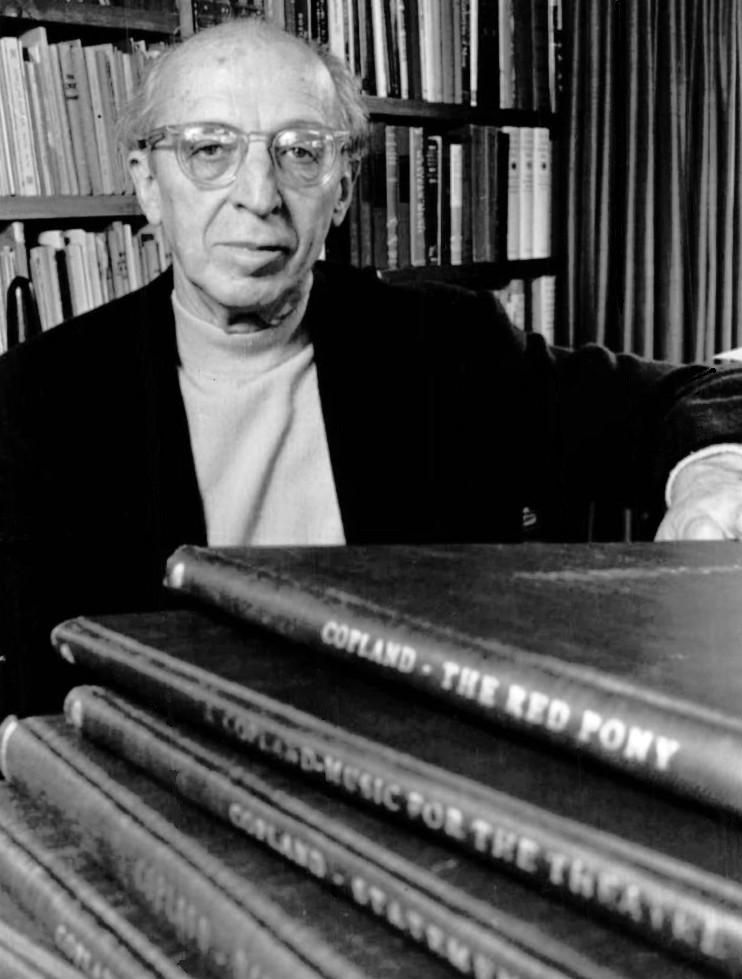
Aaron Copland (November 14, 1900 – December 2, 1990)
The Dean of American Composers evolved from a provocative modernist to an accessible populist. Born in Brooklyn, he composed his first piece of music at the age of eleven. He studied music through his teens, and, rather than go to college, he went to Paris to study the latest European trends with Nadia Boulanger. His planned year stretched to three and during that time he was exposed to the heady intellectual expatriate culture of Paris in the 1920's. Upon his return to New York, he began working on material that was decidedly avante-garde. The premiere of his Organ Symphony in 1925 established him as a serious composer. He became a part of the vanguard of modernism in American music; but began to rethink this approach with the onset of the Great Depression. His work began to reflect the ideas of American democracy. He wrote pieces that would appeal to a larger audience and his ballet Appalachian Spring won him the Pulitzer Prize in 1944. He also composed music for films, wrote extensively on musical criticism, and became a conductor of his own and other work. He was also awarded the Presidential Medal of Freedom, the National Medal of Arts.and a special Congressional Gold Medal.
Copland would express: " Why is it that the musical public is seemingly so reluctant to consider a musical composition as, possibly, a challenging experience? When I hear a new piece of music that I do not understand I am intrigued -- I want to make contact with it again at the first opportunity. It's a challenge -- it keeps my interest in the art of music thoroughly alive. But sadly I've observed that my own reaction is not typical. Most people use music as a couch; they want top be pillowed on it, relaxed and consoled for the stress of daily living. But serious music was never meant to be used as a soporific. Contemporary music, especially, is created to wake you up, not put you to sleep. It is meant to stir and excite you -- it may even exhaust you. But isn't that the kind of stimulation you go to the theatre for or read a book for? Why make an exception of music? ... As I see it, twelve-tonism is nothing more than an angle of vision. Like fugal treatment, it is a stimulus that enlivens musical thinking, especially when applied to a series of tones that lend themselves to that treatment. It is a method, not a style; and therefore it solves no problems of musical expressivity. As a method, it seems nowadays to be pointing in two opposite directions: toward the extreme of "total organization" with its concomitant electronic applications, and toward a gradual absorption into what has become a very freely interpreted tonalism. But these are preoccupations of the musical kitchen; audiences have other things to think of, things that are more fundamental to the expressive content of the piece. ... No true musical enthusiast wants to be confined to a few hundred years of musical history. He naturally seeks out every type of musical experience; his intuitive understanding gives him a sense of assurance whether he is confronted with the recently deciphered treasures of Gothic art, or the quick with of a Chabrier or a Bizet, or the latest importation of Italian dodecaphonism. A healthy musical curiosity and a broad musical experience sharpens the critical faculty of even the most talented amateur. All this has bearing on our relation to the classic masters also. To listen to music in a familiar style and to listen freshly, ignoring what others s have said or written and testing its values for oneself is a mark of the intelligent listener. The classics themselves must be reinterpreted in terms of our own period if we are to hear them anew and "keep their perennial humanity living and capable of assimilation." But in order to do that, we must have a balanced musical diet that permits us to set off our appraisals of the old masters against the varied and different musical manifestations of more recent times. The dream of every musician who loves his art is to involve gifted listeners everywhere as an active force in the musical community. The attitude of each individual listener, especially the gifted listener, is the principal resource we have in bringing to fruition the immense musical potentialities of our own time. "
http://www.coplandhouse.org/ Fanfare for the Common Man VIDEO
The Promise of Living VIDEO Appalachian Spring VIDEO Billy the Kid VIDEO Rodeo VIDEO
Third Symphony
VIDEO
The Pet Shop Boys were never being boring when they faced the truth and changed the dedication from revolution to revelation with the melodic miserablism of this nervous nostalgia. The synthpop duo had found continued success over three albums in as many years ( Please in 1986, Actually in 1987, and Introspective in 1988); but for their next project, they were looking to do something different. The Pet Shop Boys co-produced 'Behaviour' with Harold Faltermeyer at his "Red Deer" studio in Munich, Germany over ten weeks in the spring of 1990. They chose Faltermeyer because of his previous work with Giorgio Moroder and Donna Summer . The sessions featured Neil Tennant on vocals and guitar and Chris Lowe on keyboards, programming, and vocoder; with Dominic Clarke on plastic tube, J.J. Belle and Johnny Marr on guitar, Angelo Badalamenti did the Orchestra arrangement and conduction; Alexander Bălănescu did the String quartet arrangement for the The Balanescu Quartet; and Jay Henry provided additional vocals. Tennant: "At the time, I believe we were thinking of bringing out an album of fab pop songs, like ten Kylie Minogue singles...We had the idea before we started that we were going to use analogue synthesisers, and we weren’t going to use samples, because even by the beginning of 1990 everything was mega-samples, and we wanted to make something much cleaner. We thought it would sound fuller and more original if all the sounds were programmed for it...At the end of 1989 Chris and I flew to Munich to meet him. He has a positive museum of ancient synthesisers. And he had an engineer from America, Brian Reeves, who worked on a lot of Donna Summer records...We stayed in this little apartment hotel in the centre of Munich. They were very ordinary rooms...I kept wanting to hire a suite in the best hotel in Munich, but Chris wanted to save the money...I used to like walking in the English garden. I occasionally went to the opera. I like the beer; I liked the buildings...We were listening to Violator which was a very good album and we were deeply jealous of it...When [ 'Behaviour' ] came out people said they were amazed that the whole rave thing seemed to have passed us by. We, of course, thought we had shamelessly jumped on the rave bandwagon.” Lowe: “The Germans then hadn’t heard of house music. There was nowhere to go. Miserable times. I felt like I was missing out on so much that was happening in England—it was possibly the most exciting time in English culture ever including the Sixties, and we were in Munich. But Neil liked it...The thing is, we were ahead of it, because some of Behaviour is like deep house, and the naff old reviewers were still trapped in acid house. Whereas we had moved on.”
'Behaviour' found its way to number fifty-one in the Netherlands, forty-seven in New Zealand, forty-five in the US, thirty-four in Canada, twenty-seven in Australia, twenty-two in Austria, twelve in Switzerland, nine in Sweden, four in Germany, and number two in the UK.
http://www.petshopboys.co.uk/ "So Hard" video directed by Eric Watson.
b-sides: "It Must Be Obvious" , Italian Mix of "Paninaro" , and The KLF versus Pet Shop Boys CD and 12" of the single.
VIDEO "Being Boring" video directed by Bruce Weber
b-side: "We All Feel Better in the Dark"
VIDEO "How Can You Expect to Be Taken Seriously?" video directed by Liam Kan
double a-side in the UK with "Where the Streets Have No Name (I Can't Take My Eyes off You)" .
US b-sides: Techno Funk mix of "I Want a Dog", the Marshall Jefferson remix of "Being Boring" and the Trevor Horn 7" mix of "It's Alright" .
VIDEO "Where the Streets Have No Name (I Can't Take My Eyes off You)" video directed by Liam Kan
b-side, "Bet She's Not Your Girlfriend" ,
VIDEO
"Jealousy" video directed by Eric Watson.
b-side: "Losing My Mind"
VIDEO 'Behaviour' full album:
VIDEO
All the songs were written by Neil Tennant and Chris Lowe
"Being Boring" – 6:49
"This Must Be the Place I Waited Years to Leave" – 5:30
"To Face the Truth" – 5:33
"How Can You Expect to Be Taken Seriously?" – 3:56
"Only the Wind" – 4:20
"My October Symphony" – 5:18
"So Hard" – 3:58
"Nervously" – 4:06
"The End of the World" – 4:43
"Jealousy" – 4:48
bonus
"Miserablism" – 4:11
I quickly sort of became aware of Creation when we were at art school. This is how ridiculous it was. I remember being at art school and we taking our art history A levels or something because I'd botched it up at school, and I remember coming back home to put a sort of pasty in the oven or something, and it was a guy from Warner Bros. saying that we want to speak to your band, we'd like to sign your band. And I just went back and completely botched up the exam again, because I obviously I just sort of felt like, 'Well, I won't be needing my art history exam now.' ...It was only a matter of weeks. I think we ended up on a tour with Soup Dragons of all people, and that was when McGee started coming on the road. So it was all that little period at art school. Also, you have to understand that me and Andy were at school, and we knew Steve from school, but up to the time we went to art school, that's where who should we meet at art school but one of the most amazing drummers, which is Loz. So it was all coming into place. You have your dream lineup in a sense, so things were feeling great. "Ride Play Fall 'Nowhere'
"Every time we came back to a town, we were playing a bigger venue. We got signed after six shows and there were a few major labels after us, it was a bit of a whirlwind ...I love Nowhere ...I think that underneath the shoegazing sound, there is a classic rock band structure holding everything together. If anything gives the music longevity, it's probably that." 'Nowhere' Obviously, with Ride and being involved with Creation and Sire, and the other bands that were around at the time, I feel very quite proud now to be in the middle of it and, to look back on it, I have to say that I have no regrets about any of it, and I'd sort of do it all again if I had that time again. There's not a lot I would change about it. At the time, you're always thinking, maybe you can change this, change that, but actually I kind of understand now that there's a great sort of freshness, rawness, and sort of naiveté about it, which is very sort of natural, and that's what really I hear in it now. And I think it really helps it sound fresh, you know? ... Creation was very happy because, for the first time they were starting to see a band on their label hitting the charts. So there was expectation around us. Alan McGee was coming in quite a lot as well when we were recorded Nowhere ... An art school foundation year was about sending you after that to a university to do an art master's degree or something like that. At a certain point, throughout the foundation—I was probably the first one—I was just like, 'Fuck going to do our art masters, let's just do this band.' So you make those choices, and on the outside of that, you have like your parents just despairing, and everyone just going, 'Oh my god, what are these guys doing?' At that time it could have all gone wrong, but we made certain choices, individually and collectively, and then it all just started to work, so it just vindicated the fact that we made the right choice. We followed our dreams, and that's the thing. It's kind of a cliché, but we did, and it worked out for us. So that's kind of what I say to anyone now, whether they're trying to play football or be in a band or whatever. Dare to dream. You can actually achieve it. "http://ridemusic.net/ http://www.markgardener.com/ http://andybellmusic.com/ "Vapour Trail" VIDEO "Taste" made it to number twenty-four on the US modern rock tracks chart. VIDEO 'Nowhere' full album:
VIDEO All songs were equally credited to Ride (Andy Bell, Loz Colbert, Mark Gardener, Steve Queralt). Lyrics by Andy Bell, except where noted.
1. "Seagull" sung by Gardener and Bell 6:09 2. "Kaleidoscope" sung by Gardener with Bell 3:01 3. "In a Different Place" sung by Gardener 5:29 4. "Polar Bear" sung by Gardener 4:45 5. "Dreams Burn Down" sung by Gardener 6:04 6. "Decay" (Mark Gardener) sung by Gardener 3:35 7. "Paralysed" sung by Bell 5:34 8. "Vapour Trail" sung by Bell 4:18 bonus 9. "Taste" (Mark Gardener) sung by Gardener 3:17 10. "Here and Now" sung by Bell 4:26 11. "Nowhere" (Loz Colbert) sung by Bell 5:23 VIDEO Live at Reading Festival 1990 VIDEO Polar Bear Seagull
Taste
Dreams Burn Down
Like A Daydream
Drive Blind
Vapour Trail
Perfect Time
Chelsea Girl
The 'Today Forever' VIDEO all songs composed by Bell, Colbert, Gardener, Queralt and sung by Gardener and Bell 12. "Unfamiliar" 5:03 13. "Sennen" 4:23
14. "Beneath" 4:06
15. "Today" 6:26
Live at the Roxy, 10 April 1991 bonus disk VIDEO 01. Polar Bear 00:00 02. Seagull 05:03
03. Unfamiliar 10:53
04. Dreams Burn Down 15:10
05. Like A Daydream 20:25
06. Vapour Trail 23:07
07. In A Different Place 26:34
08. Perfect Time 32:05
09. Taste 35:27
10. Nowhere 38:45
11. Chelsea Girl 46:57
12. Drive Blind 50:50