Showing posts with label simon and garfunkel. Show all posts

Monday, January 26, 2015

bridge over troubled water


Simon and Garfunkel sailed on to their greatest success with the pristine pop perfection of their sublime swansong.  The duo had seen their previous three albums 'Parsley, Sage, Rosemary and Thyme', the soundtrack album for Mike Nichols' film The Graduate,  and 'Bookends' all reached the top five of the US album chart as their music developed from acoustic folk to a more sophisticated studio sound.  Both of them had been asked to be a part of Nichols' adaptation of Joseph Heller's 'Catch 22'; but Simon's part was written out of the script by Buck Henry who felt that there were too many characters.  Garfunkel spent eight months in Mexico for the production, during which time Simon wrote "The Only Living Boy in New York"  Garfunkel considers:  "Our way of working was for Paul to write while we recorded. So we'd be in the studio for the better part of two months working on the three or four songs that Paul had written, recording them, and when they were done, we'd knock off for a couple of months while Paul was working on the next group of three or four songs. Then we'd book time and be in the studio again for three or four months, recording those ... rather than wait for Paul to write the next bunch of songs, I went off and did this movie."

'Bridge over Troubled Water' was co-produced by Paul Simon, Art Garfunkel, and engineer Roy Halee over the course of a year.   The sessions featured Paul Simon on lead vocals and guitar;   Art Garfunkel on lead vocals;    with Joe Osborn on bass guitar;  Larry Knechtel on piano;  Fred Carter, Jr. on guitar;  Peter Drake on dobro and pedal steel guitar; and Hal Blaine on drums.  Jimmie Haskell and Ernie Freeman did the strings;  Jon Faddis, Randy Brecker, Lew Soloff, and Alan Rubin handled brass;  and the Peruvian instruments were performed by Los Incas.  

Simon remembers:  "That was a great little unit - Hal [Blain], Larry Knechtel, and Joe Osborne. It was a great, great band out of LA. And of course until they got really tired because everybody used them, they were fantastic. Very musical...very musical guys. They made life easy. I preferred to work with them, and that's probably why I was recording in California. I preferred working with those guys rather than what I had to work with in New York...The snare drum on "The Boxer": It was recorded in the elevator shaft of the CBS studios in New York at 52nd Street. That was a pure Roy [Halee] sound. He situated the drum in the elevator shaft and he hit it and he recorded that.  It was just huge ... Roy's brilliant. He's a brilliant sound guy. He was great with echoes, he always had a great sense of echo. The drum from "Bridge Over Troubled Water" was recorded in the echo chamber of a studio in LA, but it was recorded on one machine and played back on another machine to create the effect of a misalignment so that's what created that feeling of (sings drum delay sound - "tututu-tu-tu").  It was because the heads of the machines didn't match up. It was a fortuitous thing...[The blending of our voices] was the double. As soon as everything was doubled, then the blend was there. It was there without doubling, but if we doubled it exactly - then there really was a blend. We really didn't have to do anything - just sing it, double it, there it was...basically you're looking for as long a take as you can get, one that has continuity and feeling. That's all.  But if you get that and then you've got some passage or some notes that are either not phrased right or are out of tune, maybe you try and repair it. But basically you're looking for as long a take as you can find. I wasn't looking to make up words...What it comes down to is a sense of musicality.  If something feels musical and right to me then I leave it. I don't feel like it's all about being perfect. But, you really don't want to hear too much out of tune - out of tune is hard to take. A little bit can be nice."


'Bridge over Troubled Water' went to number one in eleven countries including Australia, Canada, France, Japan, the Netherlands, Norway, Spain, Sweden, the UK, the US, and West Germany.  It was the biggest selling album of that year (and the two to follow), becoming the best selling album ever up to that point, and eventually selling over twenty-five million copies worldwide.  'Bridge over Troubled Water' won Grammys for Album of the Year and Best Engineered Recording.   Despite the massive success and accolades, it would be the final studio album that the duo would record together.  After the album was completed, Garfunkel went to work on another Mike Nichols film 'Carnal Knowledge', while Simon studied songwriting at New York University and began working on his eponymous solo album.  Simon says:   "Partnerships… are destined to break up, as are most business partnerships,  And just after a while, everybody gradually changes, and has their own agenda of what they want to do in life, and it doesn’t coincide with the way it did in the very beginning. And so, you’re naturally inclined to go your separate ways."


http://www.simonandgarfunkel.com/

http://www.simonandgarfunkel.com/us/music/bridge-over-troubled-water-40th-anniversary-edition


The gospel inspired title song became an international smash, going to number twenty-three in Belgium; seven in Norway; five in the Netherlands and Switzerland; four in Austria and South Africa; three in Germany; two in Australia, Ireland, and Spain; and number one in Canada, France, New Zealand, the UK, and the US.  It went on to win Grammy Awards for Record of the Year, Song of the Year, Best Contemporary Song, and Best Arrangement Accompanying Vocalists.  

Simon admits:  "I have no idea where it came from. It came all of the sudden. It was one of the most shocking moments in my songwriting career ... 'Bridge Over Troubled Water' is something of a mystery to me; because nothing prompted me to write it. I was listening to a lot of gospel quartets, particularly the Swan Silvertones and the Everly Brothers album Songs Our Daddy Taught Us. I was stunned and I thought, 'that’s a lot better than I usually write.'"

Garfunkel convinced Simon to add a third verse to the song:  "You can look at songwriting, at which Paul Simon is clearly a master, and you can look at singing, the Frank Sinatra part of the thing, which we both did. In between the two is record making. I heard "Bridge over Troubled Water" first as this two-verse beautiful hymn of peace. But I thought it had the possibility to go into high gear, do this Phil Spector thing, and take off...[Paul] is like a purist, in that way. "No Artie, I wrote it as a hymn." But he did open himself up to it and wrote the third verse…When I did the vocal I did the big last verse first and nailed it. But the first verse required a delicacy that was maddening. I couldn't get it. So it was, just: Lord help me relax. Help me find that lovely place as a performer when you believe you get a visitation from higher powers, and it passes through you."


https://www.youtube.com/watch?v=iIm-YTrs4tM


When you're weary
Feeling small
When tears are in your eyes
I will dry them all
I'm on your side
When times get rough
And friends just can't be found
Like a bridge over troubled water
I will lay me down
Like a bridge over troubled water
I will lay me down
When you're down and out
When you're on the street
When evening falls so hard
I will comfort you
I'll take your part
When darkness comes
And pain is all around
Like a bridge over troubled water
I will ease your mind
Like a bridge over troubled water
I will ease your mind
Sail on silver girl
Sail on by
Your time has come to shine
All your dreams are on their way
See how they shine
If you need a friend
I'm sailing right behind
Like a bridge over troubled water
I will ease your mind
Like a bridge over troubled water
I will ease your mind


"The Boxer"
https://www.youtube.com/watch?v=MYPJOCxSUFc

https://www.youtube.com/watch?v=MXIBB0QjkQU


"Cecelia"
https://www.youtube.com/watch?v=MZeTmgI1Eb4


'Bridge over Troubled Water'
full album:


All songs written and composed by Paul Simon except where noted.

Side one
00:00 "Bridge over Troubled Water"   4:52
04:56 "El Condor Pasa (If I Could)" (Daniel Alomía Robles, English lyrics by Paul Simon, arranged by Jorge Milchberg) 3:06
08:05 "Cecilia"   2:55
11:00 "Keep the Customer Satisfied"   2:33
13:37 "So Long, Frank Lloyd Wright"   3:41
Side two
17:23 "The Boxer"   5:08
22:36 "Baby Driver"   3:14
25:53 "The Only Living Boy in New York"   3:58
29:55 "Why Don't You Write Me"   2:45
32:41 "Bye Bye Love" (live recording from Ames, Iowa) (Felice and Boudleaux Bryant) 2:55
35:40 "Song for the Asking"   1:49


Wednesday, April 3, 2013

bookends


Simon and Garfunkel reflected on lost innocence and the American Dream with the slick studio sophistication of this captivating concept album.  'Bookends' was produced and engineered by Roy Halee with Paul Simon on vocals, guitar, and production; Art Garfunkel on vocals and production; Hal Blaine on drums and percussion; Joe Osborn on bass; Larry Knechtel on piano and keyboards; and Jimmie Haskell on arrangements.  

Garfunkel recalls:    "The concept of 'Bookends', and I remember when Paul started writing it he was very excited, that it was going to have this thematic .element. The concept was to take side one and let there be a bunch of songs that progressed from youthfulness to old age, in their lyric, in their feeling, in the tempo, in the spirit of the song. Everything about the opening cut should represent adolescence and everything about the final cut should be slow and winter like."

Simon says:    "That album had the most use of the studio, I'd say, of all the Simon and Garfunkel records...In 'Bookends' we started taking much more time with the singing. I remember, in 'Bookends', we were into punching in...Well, we might have repaired a line or something like that, but the concept in Parsley, Sage wasn't to get each line perfect, and it was in 'Bookends'...To a degree, that would happen to Simon and Garfunkel. They'd get too perfect, which could be disturbing. A part of Roy and Artie's thing more than mine. Because I always liked more sloppiness than they did. They got to the point where it had to be just right. Sometimes it worked. Like, "Mrs. Robinson" was punched in a lot, and it worked really good. 'Bookends' was recorded sort of half and half. Bookends is really the one side...With the exception of 'Mrs. Robinson', which was recorded at the same time as the songs on the 'Bookends' side. Those other songs were for me, the dry patch of Simon and Garfunkel, which was from 'The Dangling Conversation'. I think the next was 'Hazy Shade of Winter', 'At the Zoo' and 'Fakin' It'--those four.... They didn't mean a lot. They weren't well recorded. They just didn't have it. Then, The Graduate happened as we were working on 'Bookends'." 

'Bookends' went to number forty in Germany, three in Australia and France, and number one in the UK and the US.  


www.simonandgarfunkel.com


'Bookends' 
full album:


1. "Bookends Theme"   0:32
2. "Save the Life of My Child"   2:49
3. "America"   3:34
4. "Overs"   2:14
5. "Voices of Old People" 2:36
6. "Old Friends"   2:36
7. "Bookends"   1:16
8. "Fakin' It"   3:14
9. "Punky's Dilemma"   2:10
10. "Mrs. Robinson"   4:02
11. "A Hazy Shade of Winter"   2:17
13. "At the Zoo"   2:21


Monday, October 10, 2011

parsley, sage, rosemary and thyme


Simon and Garfunkel took control of their sound with this thoughtful and elegiac folk masterpiece. Produced with Bob Johnson and engineered with Roy Halee, 'Parsley, Sage, Rosemary and Thyme' saw the duo overseeing the entire recording process over several months, rather than the relatively rushed production of their previous albums. They took time to layer tracks of vocals and effects to open their sound up even further. The arrangements are suited to Simon's youthful reflections of love and loss in a world at war. 'Parsley, Sage, Rosemary and Thyme' reached number four in the US, thirteen in the UK, and fourteen in Australia.


The mesmerizing opening track gives the album its title with the refrain from an old Scottish ballad. This traditional tune was set in counterpoint to 'Canticle' which was an adaptation of Simon's 'The Side of a Hill'. In Medieval times, parsley, sage, rosemary, and thyme were used to ward off the smell of the dead. Simon (and Bob Dylan) learned the song from British folk giant Martin Carthy. 'Scarborough Fair / Canticle' was also featured prominently in the film 'The Graduate'.

"Tell her to find me an acre of land
- On the side of a hill, a sprinkling of leaves
Parsley, sage, rosemary, and thyme
- Washes the ground with so many tears
Between the salt water and the sea strand
- A soldier cleans and polishes a gun
Then she'll be a true love of mine."


'Homeward Bound' sings of the loneliness of the road and of returning to both his girlfriend Kathy Chitty in England, as well as of returning back the US. Simon says: "That was written in Liverpool when I was traveling. What I like about that is that it has a very clear memory of Liverpool station and the streets of Liverpool and the club I played at and me at age twenty-two. It's like a snapshot, a photograph of a long time ago. I like that about it but I don't like the song that much. First of all, it's not an original title. That's one of the main problems with it. It's been around forever. No, the early songs I can't say I really like them. But there's something naive and sweet-natured and I must say I like that about it. They're not angry. And that means that I wasn't angry or unhappy. And that's my memory of that time: it was just about idyllic. It was just the best time of my life, I think, up until recently, these last five years or so, six years... This has been the best time of my life. But before that, I would say that that was."

"Tonight I'll sing my songs again,
I'll play the game and pretend.
But all my words come back to me in shades of mediocrity
Like emptiness in harmony I need someone to comfort me."


'The 59th Street Bridge Song (Feelin' Groovy)' refers to the Queensboro Bridge in New York City. The rhythm section for Dave Brubeck Quartet, Joe Morello and Eugene Wright played on the studio version.

"Slow down, you move too fast, you've got to make the moment last
Just kickin' down the cobble-stones, lookin' for fun and feelin' groovy"


'For Emily, Whenever I May Find Her' is sublime.

"What a dream I had:
Pressed in organdy;
Clothed in crinoline of smoky burgundy;
Softer than the rain.
I wandered empty streets, down
past the shop displays.
I heard cathedral bells
Tripping down the alley ways,
As I walked on.

And when you ran to me
Your cheeks flushed with the night.
We walked on frosted fields of juniper and lamplight,
I held your hand.
And when I awoke and felt you warm and near,
I kissed your honey hair with my grateful tears.
Oh I love you, girl.
Oh, I love you."


full album:


All songs by Paul Simon except where noted.

Side one
"Scarborough Fair/Canticle" (Traditional, arranged by Paul Simon, Art Garfunkel) – 3:10
"Patterns" – 2:42
"Cloudy" (Paul Simon, Bruce Woodley) – 2:10
"Homeward Bound" – 2:30 
"The Big Bright Green Pleasure Machine" – 2:44
"The 59th Street Bridge Song (Feelin' Groovy)" – 1:43
Side two
"The Dangling Conversation" – 2:37
"Flowers Never Bend with the Rainfall" – 2:10
"A Simple Desultory Philippic (Or How I Was Robert McNamara'd into Submission)" – 2:12
"For Emily, Whenever I May Find Her" – 2:04
"A Poem on the Underground Wall" – 1:52
"7 O'Clock News/Silent Night" (Josef Mohr, Franz Gruber) – 2:01


Saturday, January 1, 2011

the sound of silence


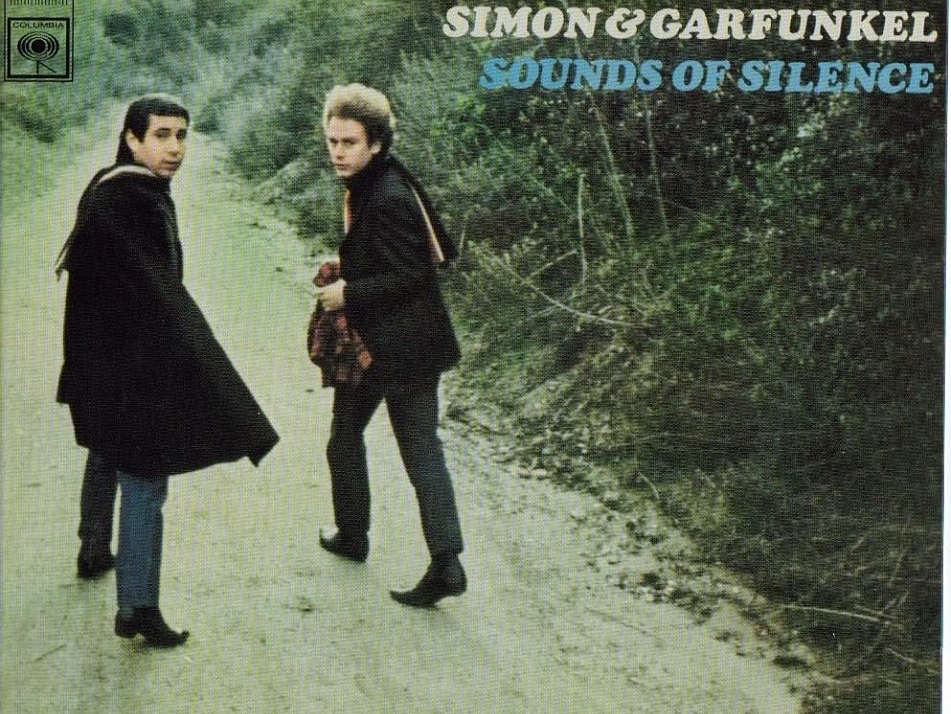
Simon and Garfunkel ushered in the new year with this vision softly creeping into the top of the charts. Paul Simon began writing this song in the wake of the assassination of John F. Kennedy. 

Simon says:    "It was just when I was coming out of college. My job was to take the songs that this huge publishing company owned and go around to record companies and see if any of their artists wanted to record the songs. I worked for them for about six months and never got a song placed, but I did give them a couple of my songs because I felt so guilty about taking their money. Then I got into an argument with them and said, 'Look, I quit, and I'm not giving you my new song.' And the song that I had just written was 'The Sound of Silence.' I thought, 'I'll just publish it myself,' and from that point on I owned my own songs, so that was a lucky argument.   I think about songs that it's not just what the words say but what the melody says and what the sound says. My thinking is that if you don't have the right melody, it really doesn't matter what you have to say, people don't hear it. They only are available to hear when the sound entrances and makes people open to the thought. Really the key to 'The Sound of Silence' is the simplicity of the melody and the words, which are youthful alienation. It's a young lyric, but not bad for a 21-year-old. It's not a sophisticated thought, but a thought that I gathered from some college reading material or something. It wasn't something that I was experiencing at some deep, profound level - nobody's listening to me, nobody's listening to anyone - it was a post-adolescent angst, but it had some level of truth to it and it resonated with millions of people. Largely because it had a simple and singable melody."


It has seen several different versions, been titled alternately as 'The Sounds of Silence' and 'The Sound of Silence', and is one of the first and finest examples of folk rock.


http://www.paulsimon.com/


http://www.artgarfunkel.com/


Hello darkness, my old friend
I've come to talk with you again
Because a vision softly creeping
Left its seeds while I was sleeping
And the vision that was planted in my brain
Still remains
Within the sound of silence

In restless dreams I walked alone
Narrow streets of cobblestone
'Neath the halo of a street lamp
I turned my collar to the cold and damp
When my eyes were stabbed by the flash of a neon light
That split the night
And touched the sound of silence

And in the naked light I saw
Ten thousand people, maybe more
People talking without speaking
People hearing without listening
People writing songs that voices never share
And no one dared
Disturb the sound of silence

"Fools", said I, "You do not know
Silence like a cancer grows
Hear my words that I might teach you
Take my arms that I might reach you"
But my words, like silent raindrops fell
And echoed
In the wells of silence

And the people bowed and prayed
To the neon god they made
And the sign flashed out its warning
In the words that it was forming
And the sign said,
"The words of the prophets are written on the subway walls
And tenement halls"
And whispered in the sound of silence


This is the original acoustic version recorded for their debut album'Wednesday Morning, 3 A.M.'


An overdubbed version that was released as a single in late 1965. It included drums and electric instrumentation and was later released as the centerpiece of their album 'Sounds of Silence'.


This slightly faster version was recorded for the soundtrack to 'The Graduate'.