Showing posts with label 1983. Show all posts

Sunday, December 29, 2013

construction time again


Depeche Mode rebuilt their sound with the industrial rhythms of this socially conscious stepping stone.  With the departure of founding member and principal songwriter Vince Clark after their debut 'Speak and Spell', the band had settled into a holding pattern with 'A Broken Frame' and began to feel typecast as bubblegum synth band and wanted to break out of that mold with their new album.  'Construction Time Again' was recorded at John Foxx's newly built London studio The Garden and as well as at Hansa Mischraum Studios in West Berlin.  Martin Gore looks back:   "The city was still surrounded by the wall. But you know why we chose to record in cities like...West Berlin? Because these were exotic cities to us. I still remember how we’d hang around in London and ask ourselves where to record the next album. Somebody would say 'Berlin' and we all immediately liked the idea. We liked Berlin because cool bands like Einstürzende Neubauten lived there. Not least Gareth Jones used to live in Berlin—he was our producer. He’d say, 'What about the Hansa studio at the Berlin wall?' And we all just agreed. We found it exciting. We actually wanted to undergo an adventure and Berlin just promised that to us. So there we went and we did indeed record 'Construction Time Again' at Hansa studios. It was a pretty awesome time. So why not record the next and the following album there as well? During that time we decided to always fathom a period of recording in any given city as an adventure trip."


The sessions featured Dave Gahan on lead vocals and sampling; Martin Gore on keyboards, guitar, sampling, backing vocals, recorder on "Shame", melodica on "Everything Counts", and lead vocals on "Pipeline"; Alan Wilder on keyboards, sampling, piano on "Love, in Itself", programming, and backing vocals;  and Andy Fletcher on sampling and backing vocals; with production by Daniel Miller and Depeche Mode.   Tonmeister Gareth Jones started as the engineer for the record; and, by the time it was completed, made the transition to production:    "We felt that a lot of what we were doing was defining new sonic territories.  Even on 'Construction Time', one of the things I brought to the table was to put the synthesizers through guitar amps. That wasn't being done very much back then — as far as we were concerned, we were the first people to do it — and that was part of the gradual darkening of the Depeche Mode sound. The band members wanted to experiment and they wanted to grow, and they were fed up with their synth-pop image. They didn't feel it did justice to what they wanted to express. They clearly wanted to go a long way, and at that time they were starting out on the journey...I felt I'd made a massive contribution to the sound of that album.  With Depeche, the studio was very much an instrument, too, and since that's what I played I felt entitled to ask if I could produce as well. Luckily for me, they said yes. The guy who'd founded Mute Records, Daniel Miller, was also the de facto manager — the band didn't have management at that time — and so he was the boss. He was fascinated by synthesizers and electronic music, and much of what he did musically was based on synthesizer sounds. Once those sounds came out of the synths I'd take over and build acoustic spaces around them, and at the same time we'd all work on the arrangements. Still, looking back, I'd say I was a very junior co-producer.  Daniel did a lot of hands-on crafting of those sounds, as did Martin Gore and Alan Wilder, who was also a major production figure within the band. Alan was extremely involved in the crafting of the studio product; a full-on, very musical guy, very interested in beats programming, and very interested in every aspect of the studio, be it compression or equalization or reverb or delays or anything. So, there was a trio of us all the time in the studio, with Alan representing the band, Daniel overseeing everything while crafting many of the sounds, and me taking care of the engineering side. I had no responsibility for schedule or budget, and I was only starting to really understand how pop songs worked. I was on a big learning curve. In fact, I think we were all on a learning curve — that's one of the things that was so exciting.  Sonically, I was contributing to the record big-time, and that's why I asked to be on the production team. I was just a young engineer, also with a long way to go, who knew I could add greatly to the production side of things, too, and the band and the record label obviously felt the same way because they took me on board."


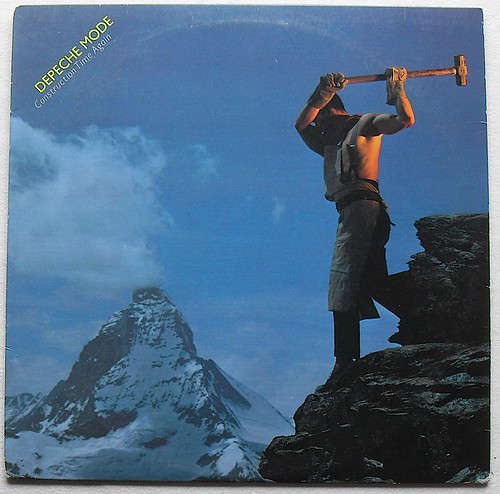
'Construction Time Again' marked a change in the band's sound and image, with a more industrial musical approach combining with a leftist political perspective.  Wilder would wax: “The general tendency of the album is very socialised and The Worker sums it up – it’s the obvious image to get across socialism.  It’s like, the first thing you think seeing the cover is that the hammer is smashing down the mountain, but not to destroy. Because he’s a worker, it’s to rebuild it, it’s positive. That was the overall idea of the album, to be positive – that’s why it’s construction time, not destruction time...When we decided on the theme for the album, the first word that came up was caring, and that’s the main idea behind it. We’re not out and out, you know… but we are socialist and we are caring.”


Gahan considered: “With the hammer on this one we wanted to symbolise the force of a worker. It’s a very powerful force, it needed a very powerful image, whereas I think the sickle was a little bit more subtle...We do feel for those things and it’s a bit more important to sing about something of substance than sing about nonsense. If you’re in a band in our position, you’re in a very strong position to write about those things, so why not do it?    Obviously, for a lot of bands that aren’t so successful, it seems an obvious thing to do. Whereas a band in our position could quite easily sing about nonsense – I think a lot of people just expected us to sing about nonsense...A lot of people had no idea that we was capable of writing something like 'Construction Time'.   We’d been portrayed for ages in one way. Like, we did every interview going and just sorta said exactly the same thing. 'Yeah, we started in so and so…' y’know. But then we suddenly realised – what are we doing? If we want to carry on, we’ve got to do something a little more lasting.   I think Martin and Alan have both got a lot more substance in their writing…When I hear tracks from ['Speak and Spell'], I get embarrassed. Though at the time we thought it was great. Then on the second album, it was very hard in the studio, people were letting us drift, there was a lack of enthusiasm… but then with 'Construction Time' it was very up in the studio, everyone was really working to make it happen.”

'Construction Time Again'  went to two hundred and one in the US, thirty-four in the Netherlands, twenty-one in Switzerland, sixteen in France, seven in Germany, and number six in the UK.


http://www.depechemode.com/


"Everything Counts" went to number fifty in the Netherlands, twenty-four in Italy, twenty-three in Germany, eighteen in Sweden, seventeen on the US dance chart, fifteen in Ireland, eight in Switzerland, and number six in the UK.  Gahan says:  “Some people have thought it was about different things, like eating too much, or it was just about the music business but really though it’s about multinational corporations, y’know, that they’ve got too much power.  But it was a conscious move to come across fuller and more definite and not just floating through. People used to think before: 'Depeche Mode? Oh yeah, they’re that band that just sorta float by.' 'Everything Counts' was a definite move to make something stronger, more lasting."

Gore adds: “I think that was partly going to Thailand as well – that’s where the oriental flavour comes in, like Korea ‘n’ all that.   But you go over there and all the hotels are full of, like, businessmen and basically they tend to treat people as though they’re nothing. All they’re interested in is their business – that’s what I really hate about big business, people just don’t seem to matter. Just money.  You see all the women over there ‘n’ they’re all prostitutes – that’s the only way they can make any money. ’Course, the businessmen love it.”

http://www.youtube.com/watch?v=1t-gK-9EIq4


The handshake
Seals the contract
From the contract
There's no turning back
The turning point
Of a career
In Korea, being insincere
The holiday
Was fun packed
The contract
Still intact
The grabbing hands
Grab all they can
All for themselves
After all
The grabbing hands
Grab all they can
All for themselves
After all
It's a competitive world
Everything counts in large amounts
The graph
On the wall
Tells the story
Of it all
Picture it now
See just how
The lies and deceit
Gained a little more power
Confidence
Taken in
By a sun tan
And a grin
The grabbing hands
Grab all they can
All for themselves
After all
The grabbing hands
Grab all they can
All for themselves
After all
It's a competitive world
Everything counts in large amounts
The grabbing hands
Grab all they can
Everything counts in large amounts
The grabbing hands
Grab all they can
Everything counts in large amounts


 "Love, in Itself" found its way to twenty-eight in Germany, twenty-seven in Ireland, twenty-one in the UK and number one in the Netherlands.


'Construction Time Again'
full album:


All songs written and composed by Martin L. Gore, except where noted.

Side one
1. "Love, in Itself"   4:29
2. "More Than a Party"   4:45
3. "Pipeline"   5:54
4. "Everything Counts"   4:20
Side two
5. "Two Minute Warning"   Alan Wilder 4:13
6. "Shame"   3:51
7. "The Landscape Is Changing"   Wilder 4:49
8. "Told You So"   4:26
9. "And Then..."   5:39


Tuesday, December 17, 2013

before hollywood


The Go-Betweens moved to London and coalesced into the bigger brighter world of a new masquerade with the pretty and primitive post punk grooves of this indie pop pleasure.  The trio of Robert Forster on vocals and rhythm guitar; Grant McLennan on vocals, bass guitar, and lead guitar; and Lindy Morrison on drums and vocals formed in Brisbane, Australia and recorded their debut 'Send Me a Lullabye' in Melbourne.  Their sound was influenced by new wave groups like Wire, Television, and Talking Heads.  They were signed to Rough Trade Records and relocated to England to record the follow up, 'Before Hollywood' at the International Christian Communications studio at the seaside resort of Eastbourne in East Sussex with producer John Brand.   The sessions featured Robert Forster on vocals, lead guitar, and rhythm guitar; Grant McLennan on vocals, bass guitar, and guitars; and Lindy Morrison on drums and backing vocals with Bernard Clarke adding organ and piano.  

Forster says:   "John Brand, who produced 'Before Hollywood', was supposed to be the 'real' producer we had never really worked with. He had done XTC, Aztec Camera, and he was amazed:  'Do you realize that everything you're doing is in fours? The song constructions are all classical, the middle eights, everything.'  You couldn't hear this because the music was quite strange. But Grant, myself, and Lindy knew all this stuff. We did have classical underpinnings...It was like the middle eight, intro here, the two verses, there's another, there's an outro, then we bring back the middle eight.. And it's all in eighths, and fourths, and sixteenths, and it's all classic punk stuff. But it didn't sound like it, because we were experimenting with rhythms. And because my guitar parts were quite skittish. Rhythm and lead guitar mixed. Our singing might not have been traditional. We didn't have a baritone rock star up front."

McLennan would expound:   "As a statement, 'Before Hollywood' was less about braggadocio, before we were famous, and way more about that period in America at the end of the 19th century when the film industry was based on the East Coast, before Hollywood.  It's a mixture of nostalgia but also a tribute to the east coast art, as exposed to the sunlight, business and style of Hollywood. No, not arrogance.   I think we were to go on and make far more arrogant statements."

Morrison muses:  "Grant was incredibly homesick for the first couple of years we were in England and he spent those first couple of years thinking about his past. He was obsessed with it. A lot of those songs on 'Before Hollywood' have the imagery of Australia. I think "Catttle and Cane" is a master song."

'Before Hollywood'  went to number two on the UK independent album chart.  


http://www.go-betweens.net/


"Cattle and Cane" reached number four on the UK independent singles chart.


"Two Steps Step Out" 


"Dusty in Here"


"By Chance" 


"That Way" 


'Before Hollywood' 
full album:


1. "A Bad Debt Follows You"   G. McLennan 2:24
2. "Two Steps Step Out"   G. McLennan 3:28
3. "Before Hollywood"   R. Forster 3:44
4. "Dusty in Here"   G. McLennan 4:09
5. "Ask"   R. Forster 5:14
6. "Cattle and Cane"   G. McLennan 4:20
7. "By Chance"   R. Forster 2:20
8. "As Long As That"   G. McLennan, R. Forster 5:25
9. "On My Block"   R. Forster 3:49

10. "That Way"   G. McLennan 4:07


Thursday, December 12, 2013

perverted by language


The Fall expanded (uh) into new musical and emotional territory with this experimental post punk pop perversion.  After releasing 'Hex Enduction Hour' and 'Room to Live' on Kamera Records, the band was convinced to return to Rough Trade.  Guitarist and keyboardist Marc Riley had been fired from the band early on in 1983 after tensions arose between him and Mark E. Smith during their tour of Australia and New Zealand (documented by the live album 'In a Hole' on Flying Nun Records) the previous year.  He was replaced later that year by Smith's new American wife Brix (Laura Elisse Salenger) Smith, who was instrumental in moving the group in a more pop friendly direction.  The single "The Man Whose Head Expanded" became a hit on the UK indie chart and in New Zealand.  

'Perverted By Language' was recorded at Pluto in Manchester with producer Steve Parker and features Mark E. Smith on vocals, piano, and violin; Craig Scanlon on guitar and vocals; Steve Hanley on bass guitar; Paul Hanley on drums and keyboards; Karl Burns on drums and bass guitar; and Brix(e) Smith on guitar and lead vocals on "Hotel Blöedel", backing vocals on "Eat Y'Self Fitter".  


Mark E. Smith considered at the time:    “It’s wrong to spoil yourself with sound in my line of work. I like to hear my records distorted to a degree, but I am pretty fussy when it comes to other people’s records. I really love the sound of those early Elvis and Gene Vincent things. I’d like to capture that atmosphere myself...Everything sounds good in the studio but that isn’t the way everybody else hears it. Some things don’t come across too well on it though. The bass can be very fuzzy, but then I don’t like much bass anyway. I particularly hate the very clean thudding bass on a lot of new records which I find very irritating. It’s too clean and becomes like a metronome...I don’t like Walkmans. I can’t say why, I just don’t. But I usually take a small cassette player on tour and I use it on stage for echo and backing effects. At home I have a small Hitachi cassette player and a JVC portable cassette recorder with Dolby, which I use for demos. I use it to jot down ideas with just voice and guitar. Sometimes I like to use it in the studio, putting the vocal on to it and then from there on to a track, but out of sync, so that it adds atmosphere. Sometimes I do the same for the guitar. I use that trick a lot on stage too.  I’ve got a little black box in the guitar and if I tune the JVC to FM [radio] I can put the guitar through it to get odd noises. I like unique sounds but as I’m not mechanically minded I prefer simple methods like that. You lose a lot of atmosphere when you try to recreate a demo in the studio, that’s why I like those early Elvis things. It’s all one-mike stuff. I don’t like using separate tracks for the drums, etc., in the studio but our latest album, ‘Perverted By Language’, was well-produced by our standards. It’s not so offensive to the ears this time!”

'Perverted By Language' went to number one on the UK indie album chart.  


http://www.visi.com/fall/


http://www.thefall.org/


1. "Eat Y'self Fitter"   Mark E. Smith 6:38
http://www.youtube.com/watch?v=yFCOt6wbm80


2. "Neighbourhood of Infinity"   Smith, Karl Burns, Paul Hanley, Steve Hanley, Craig Scanlon 2:41
http://www.youtube.com/watch?v=6_IF_qtgxLU
http://www.youtube.com/watch?v=6eNlbabuYk8


3. "Garden"   M. Smith, Scanlon 8:42
http://www.youtube.com/watch?v=8fIKzhUL2qs
http://www.youtube.com/watch?v=OMJJmdlZoPw


4. "Hotel Blöedel"   M. Smith, S. Hanley, Brix Smith 3:47
http://www.youtube.com/watch?v=kDR-OISJX8c


5. "Smile"   M. Smith, Scanlon 5:06
http://www.youtube.com/watch?v=jhk6ZT6T0xA


6. "I Feel Voxish"   M. Smith, S. Hanley, Marc Riley 4:19
http://www.youtube.com/watch?v=93POvcAyQ08
http://www.youtube.com/watch?v=ENxezdcIa4Q


7. "Tempo House" (recorded live at The Haçienda, Manchester in July 1983) M. Smith, S. Hanley 8:51
http://www.youtube.com/watch?v=48z01TSaImM
http://www.youtube.com/watch?v=bTJdWN6BqwU


8. "Hexen Definitive / Strife Knot"   M. Smith, Burns, Adrian Niman, Scanlon 6:57
http://www.youtube.com/watch?v=6LRobcK8ULk


The full length video the band wanted to make for the album led to another falling out with Rough Trade.  They funded it themselves.  


Monday, December 9, 2013

yip/jump music


Daniel Johnston recorded these sweet and tender songs of pain and passion  on a $59.00 Sanyo mono boom box in his brother's garage.  Johnston had recorded a series of cassettes while at community college with piles of songs inspired by God, the Beatles, Casper the friendly ghost, and a girl named Laurie.  Beginning with his 'Songs of Pain' in 1981, and continuing with 'Don't Be Scared' and 'The What of Whom' in 1982;  Johnston battled with manic depression within the songs even as he struggled with it (and the devil) in his personal life.  The rudimentary instrumentation and his tremulous warble combine to create an otherworldly effect that is compelling and confounding.   Johnston reveals:    "Yeah, I believe in spiritualism. It's like, when you listen to music or something and then you're sort of primed. If you're an artist, you're sort of primed and inspired, and you start drawing, you sort of have the spirit of what you're listening to, still in you. You just have sort of an inspiration. Or a feeling, would probably best describe it. You have a feeling from the music, so you start drawing and it's an influence. That's spiritualism."

 In 1983, he recorded and released three more cassettes; and, sandwiched between 'More Songs of Pain' and 'Hi, How Are You?', is 'Yip/Jump Music'.  Johnston says:  "Well I worked in AstroWorld in 1983, I was writing  'Yip/Jump Music' on a chord organ because I didn't have any instruments, I didn't have a piano, I didn't really play guitar yet, so I borrowed my nephew's chord organ. I know it's ridiculous, but that's all I had to play. That's silly. And my tapes were made originally just for my friends. But I didn't take it ever so seriously. You know, I never really thought that it was going to be an album that was going to be sold to the world—I thought it was just another tape for my friends."

The cassettes were eventually put out on Jeff Tartakov's  Austin, Texas based Stress Records; but before that, Johnston was a one-man marketing machine, handing out copies of his tapes to anyone he met.  In 1988, 'Yip/Jump Music' was released on CD and double LP by Homestead Records.  Songs from the album have been covered by Mike Doughty, Karen O, Tom Waits, and Yo La Tengo; and Kurt Cobain put it on a list of his favorite albums.


http://www.hihowareyou.com/


http://www.rejectedunknown.com/


http://www.museumoflove.com/


@danieljohnston


'The Devil and Daniel Johnston' documentary trailer
http://www.youtube.com/watch?v=2qtFPOxDMs4


Speeding Motorcycle
http://www.youtube.com/watch?v=zojEIR_SGSk


Casper The Friendly Ghost


Don't Let The Sun Go Down On Your Grievances
http://www.youtube.com/watch?v=C6ZiZmQ5V2s
http://www.youtube.com/watch?v=Dg-EAYkoLyU


King Kong


God
http://www.youtube.com/watch?v=Dut9qPAjR3o


 'Yip/Jump Music'

full album:
http://www.youtube.com/watch?v=C5hVsTXJ-yo


1-Chord Organ Blues
2-The Beatles
3-Sorry Entertainer
4-Speeding Motorcycle
5-Casper The Friendly Ghost
6-Don't Let The Sun Go Down On Your Grievances
7-Danny Don't Rap
8-Sweetheart
9-King Kong
10-The Creature / Third Chair
11-I Live For Love
12-Almost Got Hit By A Truck
13-Worried Shoes
14-Dead Lover's Twisted Heart
15-Rocket Ship
16-God
17-Love Defined (the Bible)
18-Museum Of Love
19-Rarely
20-I Remember Painfully


Tuesday, November 26, 2013

touch


Eurythmics painted a rumor and cemented their place pop history with the expansive electronic experimentation of this stylish pop sequel.  The duo of Annie Lennox and Dave Stewart had found worldwide success with their sophomore album 'Sweet Dreams (Are Made of This)' and struck while the iron was hot, going right into their studio that they had just set up.   Stewart recalls:  “We made 'Touch' very quickly recording it upstairs in the Church Studios in Crouch End. We made it so quickly in fact that they hadn’t actually finished the studio and Michael Kamen ended up conducting the orchestra in the corridor...The first cheque I ever got was for 'Sweet Dreams' and I’d always dreamed of going to the Caribbean. So I booked a flight and arrived on Christmas Eve and I spent the night on the beach thinking, ‘What am I doing here?’  Before 'Touch' we were focused on an icy, cold, electronic, European type of music and the success of 'Sweet Dreams' meant that we could experiment. We were free in our minds and we didn’t have to repeat ourselves.”

'Touch' features Annie Lennox on vocals, flute, percussion, and keyboard; Dave Stewart on vocals, dulcimer, bass, guitar, drum programming, keyboard, and xylophone;    with Dick Cuthell on trumpet, cornet, and flugelhorn; Martin Dobson on baritone saxophone; Dean Garcia (later of Curve) on bass; and Michael Kamen  conducting the British Philharmonic on strings.  Kamen did the string arrangements and Stewart and Lennox were arrangers for the album.  Stewart produced the sessions with engineer Jon Bavin.   


'Touch' surpassed the success of 'Sweet Dreams (Are Made of This)' by going to number twenty in France, fourteen in Switzerland, nine in Germany and Sweden, eight in Norway, seven in the US, four in Australia, and number one in New Zealand and the UK.    Lennox looks back on Stewart's influence on her:   "Wherever he is, whoever he's with, he's not fazed by anything at all.  He's fearless in that sense. And when it comes to music-making he's a facilitator...I didn't have the drive. I didn't have the self-belief....I was actually content to be defined as half of a duo... I really divested my own independent, individual self into being one half of a duo. In fact I didn't often say 'I'. I would quite purposely say 'we'. It seemed appropriate."


http://eurythmics.com/


http://davestewart.com/


http://www.annielennox.com/


http://www.eurythmics-ultimate.com/


"Here Comes the Rain Again"  
Stewart says he and Lennox wrote this sweeping mini epic when they were staying at the Mayflower Hotel in New York City:   "I'd been out on 46th Street and bought an early Casio keyboard, about 20 inches long with very small keys. It was an overcast day. Annie was sitting in my room, and I was playing some little riff on the keyboard sitting on the window ledge, and I was playing these little melancholy A minor-ish chords with the B note in it. I kept on playing this riff, and Annie was looking out the window at the slate grey sky above the New York skyline and just sang spontaneously, 'Here Comes The Rain Again.' And that was all we needed. you see, like with a lot of our songs, you only need to start with that one line, and that one atmosphere, that one note, or that intro melody. And the rest of it was like a puzzle where we needed to just fill in the missing pieces...'Here Comes The Rain Again' is kind of a perfect one where it has a mixture of things, because I'm playing a b-minor, but then I change it to put a b-natural in, and so it kind of feels like that minor is suspended, or major. So it's kind of a weird course. And of course that starts the whole song, and the whole song was about that undecided thing, like here comes depression, or here comes that downward spiral. But then it goes, 'so talk to me like lovers do.' It's the wandering in and out of melancholy, a dark beauty that sort of is like the rose that's when it's darkest unfolding and bloodred just before the garden, dies. And capturing that in kind of oblique statements and sentiments."

http://www.youtube.com/watch?v=TzFnYcIqj6I


"Right By Your Side"  
http://www.youtube.com/watch?v=aY_6ejm0AX0


"Who's That Girl?"  
http://www.youtube.com/watch?v=-5iDKWV6Chg


"No Fear, No Hate, No Pain (No Broken Hearts)"  
http://www.youtube.com/watch?v=XoCGygFAIGo


"Paint a Rumour"  
http://www.youtube.com/watch?v=MuTq-r51LS4


'Touch'
full album:


All tracks written by Annie Lennox and David A. Stewart


1. "Here Comes the Rain Again"   4:54
2. "Regrets"   4:43
3. "Right By Your Side"   4:05
4. "Cool Blue"   4:48
5. "Who's That Girl?"   4:46
6. "The First Cut"   4:44
7. "Aqua"   4:36
8. "No Fear, No Hate, No Pain (No Broken Hearts)"   5:24
9. "Paint a Rumour"   7:30