'Goo'was recorded in New York City at Sorcerer Sound Recording Studios and Greene St. Recording and featured Thurston Moore on vocals, guitar, and production; Lee Ranaldo on guitar, vocals, and production; Kim Gordon on vocals, bass guitar, and production; and Steve Shelley on drums, percussion, and production; with J Mascis on backing vocals and additional production; Don Fleming on backing vocals, additional production, and additional percussion; and Chuck D providing additional vocals. Nick Sansano was involved in production, recording, additional engineering, and additional percussion; while Ron Saint Germain handled production, engineering, mixing. Dan Wood, John Herman, and Judy Kirschner were assistant engineers. Howie Weinberg did the mastering and Jim Waters did additional recording. The working title for the album was 'Blowjob?', which the band submitted to the executives at Geffen just to shake them up.
All tracks written by Sonic Youth, except as noted.
1."Pattern Recognition"lyrics: Gordonvocals: Gordon6:33 2."Unmade Bed"lyrics:Moorevocals:Moore3:53 3."Dripping Dream"lyrics:Moorevocals:Moore7:46 4."Kim Gordon and the Arthur Doyle Hand Cream"vocals:Gordon4:51 5."Stones"lyrics:Moorevocals:Moore7:06 6."Dude Ranch Nurse"lyrics:Gordonvocals:Gordon5:44 7."New Hampshire"lyrics:Moorevocals:Moore5:12 8."Paper Cup Exit"lyrics:Ranaldovocals:Ranaldo, background vocals Moore5:57 9."I Love You Golden Blue"lyrics:Gordonvocals:Gordon7:03 10."Peace Attack"lyrics:Moorevocals:Moore6:10
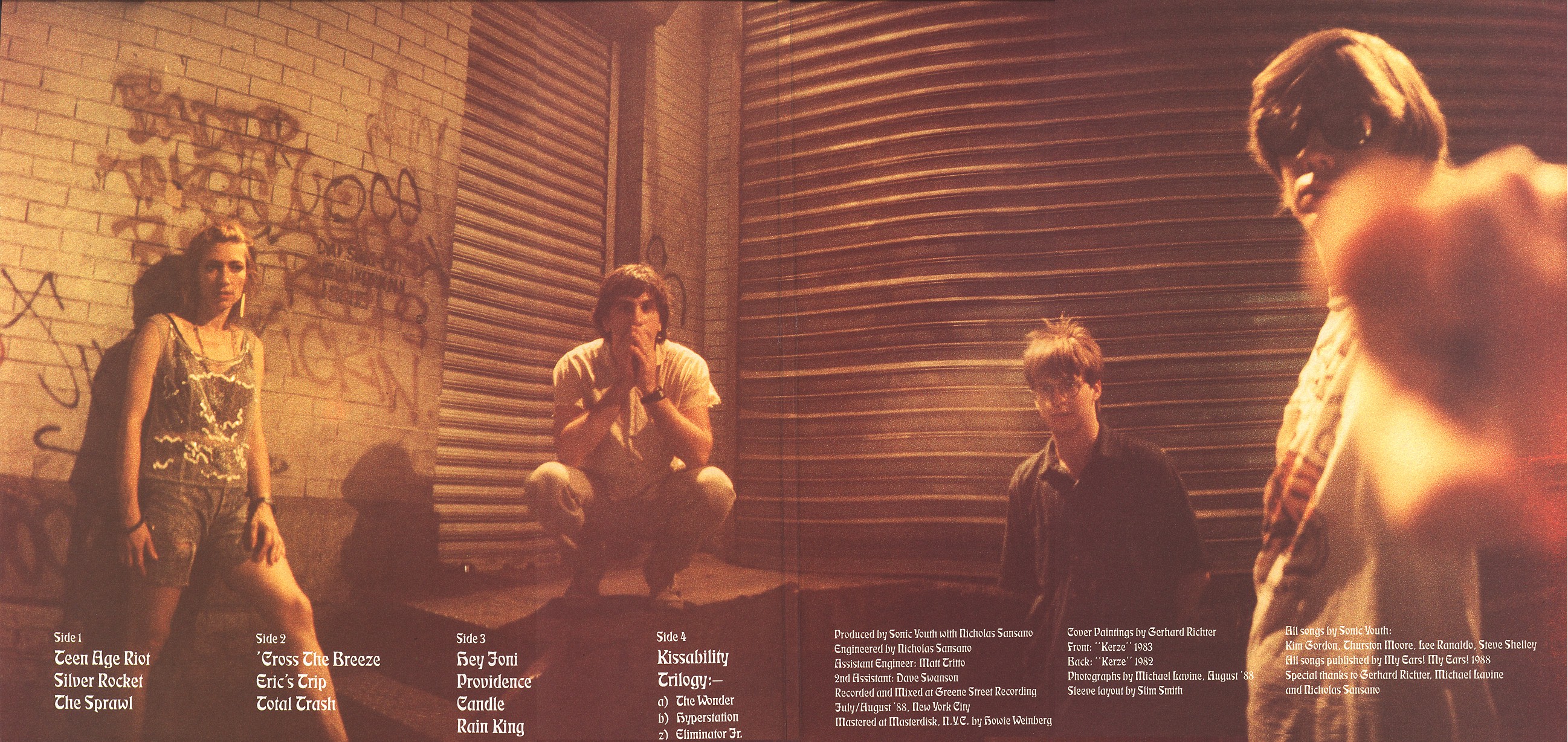
Sonic Youth took their underground art noise to the hypernation with the extended hazy exaltations and inverted pop structures of this bold and breathtaking landmark. Building on the artistic triumphs of 'EVOL' and 'Sister', the band co-produced 'Daydream Nation' with Nick Sansano in the basement at Greene Street Recording in New York City. The sessions featured Thurston Moore on guitar, vocals, and piano; Kim Gordon on bass guitar and vocals; Lee Ranaldo on guitar and vocals; and Steve Shelley on drums.
'Daydream Nation' did not chart in the US and only reached number ninety-nine in the UK; but it was featured prominently in numerous critical lists for the best albums of 1988. It has subsequently been lauded as one of the greatest albums of all time. The album cover features a painting by Gerhard Richter called Kerze ("Candle").
Side one 1."Teen Age Riot" Moore6:57 2."Silver Rocket" Moore3:47 3."The Sprawl" Gordon7:42 Side two 4."'Cross the Breeze" Gordon7:00 5."Eric's Trip" Ranaldo 3:48 6."Total Trash" Moore7:33 Side three 7."Hey Joni" Ranaldo4:23 8."Providence" 2:41 9."Candle" Moore4:58 10."Rain King" Ranaldo4:39 Side four 11."Kissability" Gordon3:08 12."Trilogy" Moore, Gordon 14:02 A. "The Wonder" B. "Hyperstation" Z. "Eliminator Jr." "Teen Age Riot" made it to number twenty on the Billboard modern rock tracks chart. https://www.youtube.com/watch?v=tPytYrYqDbA
Sonic Youth focused their energies and found their greatest commercial success with the elegant chaos of this pop punk noise rock exposition. After their major label debut 'Goo' broadened their audience, they brought in the team producer Butch Vig and mixer Andy Wallace that handled 'Nevermind' for their Geffen labelmates Nirvana. Vig convinced the band to condense their extended instrumental jams into more cohesive song structures before they even started recording at the Magic Shop studio with Kim Gordon on bass and vocals, Thurston Moore on guitar and vocals, Lee Ranaldo on guitar and vocals, and Steve Shelley on drums. He also had them record multiple takes of the songs, and the result is a cleaner more urgent sound. Vig recalls: "'Dirty' was recorded on an old radio broadcast console, and cut in a smaller room, where we tracked a lot of things live with the band playing in a circle round Steve's kit. Again, a simple set-up...Over the years, I've found that the fewer mics you use, the better the sound is going to be...It's important to understand how a drummer plays – do they hit the cymbals loud, or do they play the fills louder than the groove? Steve Shelley is amazing in the way he fits into the symphonic sound that Sonic Youth make. Often, he'll play drums more as a pulse than a clearly defined part. He glues it all together." Shelly says: "In a way it seems like we maybe made some concessions to the label, at least in how we recorded the last two albums. But I think that 'Dirty' is easily the best sounding thing we've done- you can really hear everything that's going on. It's the first time I really felt like the album's musical base was as deep and wide as it could be. So I'm Not sure I'd even consider that any kind of concession, really." Renaldo adds: "And some of the songs on 'Dirty'-mostly ones that Kim ended up singing- are as abstracted as anything we've done. As far as the difference in major and indie labels.....it's really more in your head then anywhere else. You do a record and give it to some people who try to sell it for you. Weather it's a major label or any independent label doing the selling makes little difference to the way you live your life. We're fortunate in the fact that we've not allowed anyone to take much control out of our hands- but that's something we've never done. Maybe other bands are just to willing to sign that away. I think we've all been pretty happy with the way things have gone with our label, and I don't think we could've made a record that's better than 'Dirty', regardless of where we were."
Moore says the band goes out of its way to find different, more extreme sounds “because it’s a gas, and sometimes it’s the only way to make it sound interesting...Just do it, and don’t let anybody tell you you can’t do it. That way you can free yourself up from an uptight music world.” Gordon admits: "I think in general we wanted to have as much power as any mainstream rockband...We don't want to be thought of as an indie band or a noise band. We think of ourselves as a guitar oriented rock band." Moore quips: "We can't get rid of our punk roots. We try washing them out-We try bleaching them out." 'Dirty' became their biggest selling album; reaching eighty-three in the US, twenty-two in Australia, six in the UK; and charting for the first time in several countries: going to fifty-nine in Germany, fifty-three in Japan, twenty-six in Sweden, and five in New Zealand, their highest position on any album chart.
http://www.sonicyouth.com/ '100%' hit twenty-six in the UK and went to number four on the US modern rock chart, their best showing on any singles chart. It was dedicated to Joe Cole, the roadie and friend of Henry Rollins who was murdered. The music video was directed by Tamra Davis and Spike Jonze.
'Sugar Kane' peaked at twenty-six in the UK.
The political ranting of 'Youth Against Fascism' fifty-two in the UK. It features Ian MacKaye of Fugazi on guitar. The video was directed by Nick Egan.
'Chapel Hill' is inspired by the burgeoning music scene.
'Purr' is a hyper-driven rocker that slows down to an mindblowing melting solo before kicking back into gear.