Showing posts with label modal. Show all posts

Monday, December 28, 2015

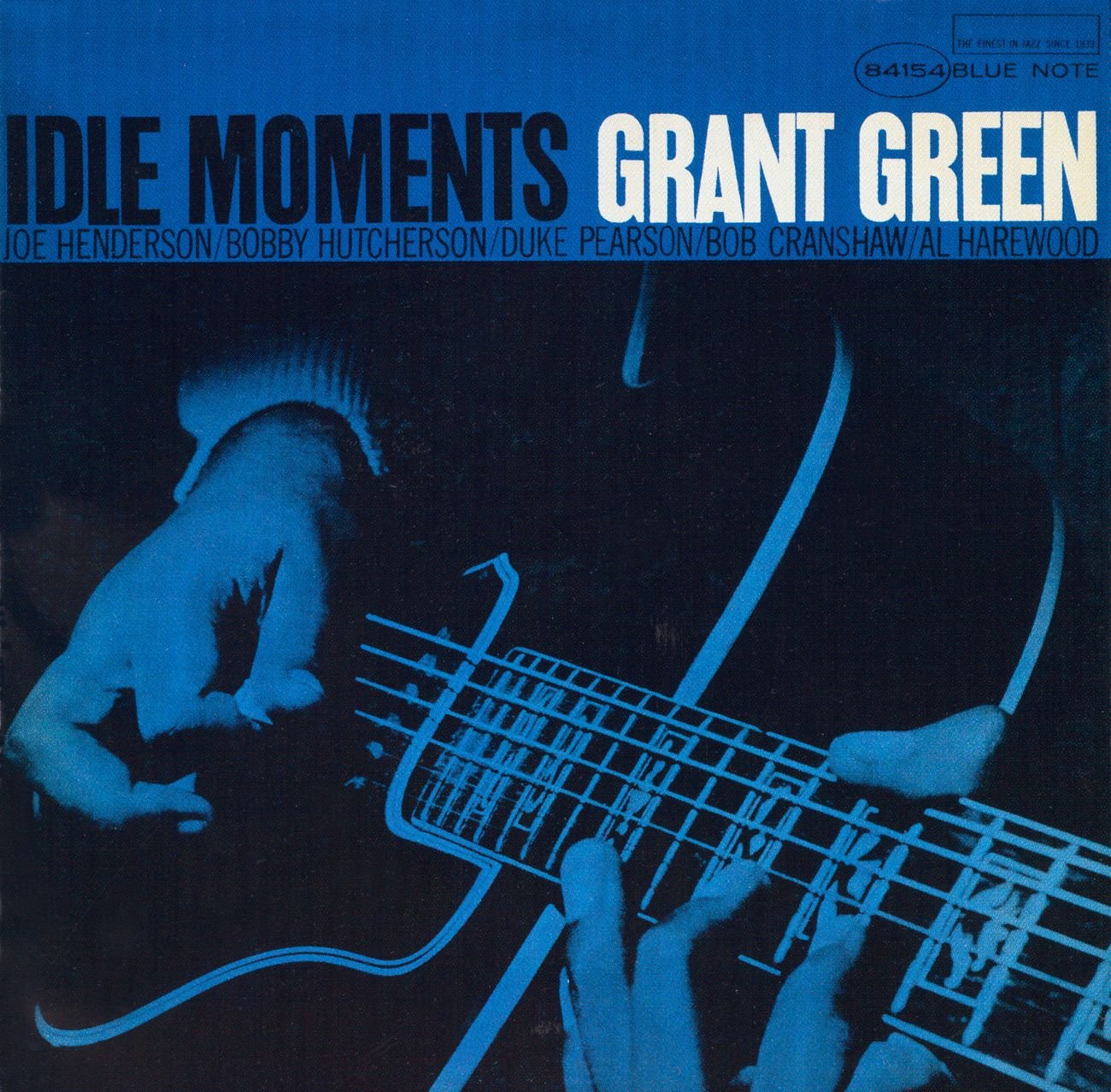
idle moments


Grant Green let things wander into the smooth and soulful serenity of this laid back lounge daydream. He had first played guitar professionally at the age of twelve in his native St. Louis; and by the time he was thirty, he had appeared on dozen of albums with various jazz heavyweights and recorded seven albums (along with material that would make seven more)  as a bandleader (Grant's First Stand  and  Green Street  in 1961,   Sunday Mornin'   and   Grantstand  in 1962,   The Latin Bit  and  Feelin' the Spirit  in 1963,  and  Am I Blue  in 1964)  by the time he went back into the studio with sax man Joe Henderson in November of 1963 at Van Gelder Studio in Englewood Cliffs, New Jersey.   

Idle Moments features  Joe Henderson on tenor saxophone,   Bobby Hutcherson on vibraphone,  Grant Green on guitar,  Duke Pearson on piano,  Bob Cranshaw on bass,  and  Al Harewood on drums.  It was recorded during two sessions with producer Alfred Lion and engineer Rudy Van Gelder.  During the first session, the recording of the title track was intended to be shorter to fit the time they had left that would fit on an album; but Green got lost in the song and played his solo for sixty four bars instead of the planned thirty two.   Henderson and Hutcherson did the same and the song went twice as long.  They rerecorded it; but found it couldn't match the feeling that they had captured on that first take.  


Idle Moments
full album:

"Idle Moments" (Pearson) – 14:56
"Jean De Fleur" (Green) – 6:49
"Django" (John Lewis) – 8:44
"Nomad" (Pearson) – 12:16


1. Idle Moments 00:00
2. Jean De Fleur 15:00
3. Jean De Fleur (Alternate Version) 21:50
4. Django 30:01
5. Django (Alternate Version) 38:47
6. Nomad 52:01




Tuesday, October 6, 2015

outward bound / out there


Far out multi-instrumentalist Eric Dolphy went quickly from hard bop swing to the periphery of the classical third stream.  Born in Los Angeles California to West Indian parents.  He began playing the clarinet in the first grade and branched out to the oboe and the alto saxophone in junior high.  He studied at  Los Angeles City College and the United States Naval School and spent two years in the army stationed in Washington D.C.   He appeared on several albums (The Teddy Charles Tentet with the Teddy Charles Tentet in 1956;   Ernie Andrews Ernie Andrews in 1957;   It's All Over but the Swingin' with Sammy Davis, Jr. in 1957; and Gongs East! and Three Faces of Chico with the Chico Hamilton Quintet in 1959,  as well as the posthumously released compilation Hot & Cool Latin  from sessions in 1959 half of which was recorded with Chico Hamilton and the other half with The Latin Jazz Quintet) before starting his own group in 1960 in New York City.   


On April first of that year, he went into the Van Gelder Studio in Englewood Cliffs, New Jersey to record his first album as a bandleader Outward Bound with Freddie Hubbard on trumpet, Jaki Byard on piano, George Tucker on bass, and Roy Haynes on drums.   While the music is based in the post bop sound; but edges ever so slightly toward the avante garde.  Four months later, he was back with a streamlined new cast that maintained Haynes and brought in George Duvivier on bass, and Ron Carter on bass and cello.  Out There  combined improvisational jazz with classical components to create surreal sketches of serene satisfaction.   


That same year he recorded six albums with Charles Mingus  (Charles Mingus Presents Charles Mingus Mingus Revisited Mingus at Antibes Mingus! Mysterious Blues, and Pre-Bird) and at least a half dozen others (CaribĂ©  with The Latin Jazz Quintet Looking Ahead with Ken McIntyre,  Screamin' the Blues with Oliver Nelson,  The Wonderful World of Jazz with John Lewis,  Trane Whistle with Eddie "Lockjaw" Davis, and  Free Jazz with Ornette Coleman) before recording Far Cry with the Eric Dolphy Quintet.


Dolphy would explain the root of his improvisations: “They’re based on freedom of sound. You start with one line and you keep inventing as you go along. And you keep creating until you state a phrase."


Outward Bound

Eric Dolphy — flute, bass clarinet, alto saxophone
Freddie Hubbard — trumpet
Jaki Byard — piano
George Tucker — bass
Roy Haynes — drums


All songs by Eric Dolphy unless otherwise indicated.

"G.W." - 7:57
"On Green Dolphin Street" (Bronislaw Kaper, Ned Washington) – 5:44
"Les" - 5:12
"245" - 6:49
"Glad To Be Unhappy" (Richard Rodgers, Lorenz Hart) - 5:26
"Miss Toni" (Charles "Majeed" Greenlee) - 5:40


Out There 

Eric Dolphy — flute, bass clarinet, alto saxophone, clarinet
Ron Carter — bass, cello
George Duvivier — bass
Roy Haynes — drums


All songs by Eric Dolphy unless otherwise indicated.


"Out There" (Eric Dolphy, Charles Mingus) – 6:55
"Serene" – 7:01
"The Baron"  – 2:57
"Eclipse" (Mingus) – 2:45
"17 West"  – 4:50
"Sketch of Melba" (Randy Weston) – 4:40
"Feathers" (Hale Smith) – 5:00


Monday, February 9, 2015

alban berg


Alban Maria Johannes Berg 
(February 9, 1885 – December 24, 1935) 


This Austrian composer from the Second Viennese School created a more emotional and accessible version of the twelve-tone technique by combining it with Romanticism.  Born in Vienna, he taught himself musical composition as a teenager before studying under Arnold Schoenberg.  He became involved in the cultural elite of Vienna and the performance of his Five Songs on Picture Postcard Texts by Peter Altenberg became known as the Skandalkonzert of March 31, 1913, when the audience, shocked by the experimental music of the Second Viennese School started a riot.  Berg served in the Austro-Hungarian Army during the first world war and released his first opera Wozzeck.  Berg assisted Schoenberg with his Society for Private Musical Performances, in which the radical music of their peers could be performed in a safe setting.  His final opera Lulu remained unfinished as he interrupted work on it to compose his Violin Concerto, a commission from the Russian-American violinist Louis Krasner.  He would not live to hear either performed.  He died at the age of fifty on Christmas Eve, from blood poisoning contracted from an insect-sting-induced carbuncle on his back.  


Berg would express:    "Music is at once the product of feeling and knowledge, for it requires from its disciples, composers and performers alike, not only talent and enthusiasm, but also that knowledge and perception which are the result of protracted study and reflection."


playlist


Violin Concerto
https://www.youtube.com/watch?v=oqSSHwFEn_8


Wozzeck


Lulu


Five Songs on Picture Postcard Texts by Peter Altenberg  caused a riot when it premiered in 1913.


Wednesday, January 28, 2015

giant steps


John Coltrane leaped forward with energetic and emotional sheets of condensed notes that created a sweeping new jazz sound.  After recording his first album as a band leader with 'Blue Train' on Blue Note Records; he played with the Miles Davis on his seminal  'Milestones' and 'Kind of Blue'  albums.  It was during this time that Davis' manager Harold Lovett helped Coltrane sign a sweet deal with Atlantic Records.  His first album for his new label was recorded at Atlantic Studios in New York City with producer Nesuhi ErtegĂĽn and engineers Tom Dowd and Phil Iehle.  Most of 'Giant Steps' was cut during a session on  May 4, 1959 with John Coltrane on tenor saxophone and  Tommy Flanagan on piano; with the rhythm section of Paul Chambers on bass and Art Taylor on drums.   "Naima" was recorded on  December 2, 1959 with Wynton Kelly taking over on piano and Jimmy Cobb handling drums.   


The onslaught of notes during some of the solos was too much for some.  Coltrane would address his critics at the time:   "Maybe it sounds angry because I'm trying so many things at one time. I haven't sorted them out. I have a whole bag of things I'm trying to work through and get the one essential. There are some set things that I know, some harmonic devices that will take me out of the ordinary path if I use them. But I'm not familiar enough with them yet to take the one single line through them. So I play all of them, trying to accli­mate my ear so I can hear.   Tonewise, I would like to be able to produce a more beautiful sound, but now I'm primarily inter­ested in trying to work what I know down into a more lyrical line —That's what I mean by beauti­ful... so that it can be more easily understood."


http://www.johncoltrane.com/


"Giant Steps"
https://www.youtube.com/watch?v=2kotK9FNEYU


"Naima"
https://www.youtube.com/watch?v=9OuD9VqpgNc


'Giant Steps'
full album:
https://www.youtube.com/watch?v=wG2DOjU81Bk


All compositions written by John Coltrane.

Side one 
1. "Giant Steps"   4:43
2. "Cousin Mary"   5:45
3. "Countdown"   2:21
4. "Spiral"   5:56
Side two 
1. "Syeeda's Song Flute"   7:00
2. "Naima"   4:21
3. "Mr. P.C."   6:57


liner notes:  


Along with Sonny Rollins, John Coltrane has become the most influential and controversial tenor saxophonist in modern jazz. He is becoming, in fact, more controversial and possibly more influential than Rollins. While it's true that to musicians especially, Coltrane's fiercely adventurous harmonic imagination is the most absorbing aspect of his developing style, the more basic point is that for many non-musician listeners, Coltrane at his best has an unusually striking emotional impact. There is such intensity in his playing that the string of adjectives employed by French critic Gerard Bremond in a Jazz-Hot article on Coltrane hardly seems at all exaggerated. Bremond called his playing "exuberant, furious, impassioned, thundering." 

There is also, however, an extraordinary amount of sensitivity in Coltrane's work. Part of the fury in much of his playing is the fury of the search, the obsession Coltrane has to play all he can hear or would like to hear -often all at once - and yet at the same time make his music, as he puts it, "more presentable." He said recently, "I'm worried that sometimes what I'm doing sounds like just academic exercises, and I'm trying more and more to make it sound prettier." It seems to me he already succeeds often in accomplishing both his aims, as sections of this album demonstrate. 

This is the first set composed entirely of Coltrane originals. John has been writing since 1948. He was born in Hamlet, North Carolina, September 23, 1926. His father played several instruments, and interested his son in music. At 15, John learned E-flat alto horn and clarinet, and in high school, he switched to tenor. He studied in Philadelphia at the Granoff Studios and the Ornstein School of Music, became a professional at 19, and played in a Navy band based in Hawaii from 1945-46. From 1947-49, he worked with Joe Webb (Big Maybelle was in the same entourage), King Kolax, Eddie Vinson and Howard McGhee. Charlie Parker had become a dominant influence on his playing. 

He was on alto with the Dizzy Gillespie band in 1949, and after Dizzy disbanded, John returned to Philadelphia, discouraged and trying to find his own way in music. From 1952-53, he was with Earl Bostic, and then played with Johnny Hodges, Jimmy Smith, and Bud Powell. He first joined Miles Davis from 1955-56. Miles regards Coltrane and Rollins as the two major modern tenors. "I always liked Coltrane." Miles said recently. "When he was with me the first time, people used to tell me to fire him. They said he wasn't playing anything. They also used to tell me to get rid of Philly Joe Jones. I know what I want though. I also don't understand this talk of Coltrane being difficult to understand. What he does, for example, is to play five notes of a chord and then keep changing it around, trying to see how many different ways it can sound. It's like explaining something five different ways. And that sound of his is connected with what he's doing with the chords at any given time," 

Miles encouraged Coltrane and also stimulated his harmonic thinking. In terms of writing as well, John feels he's learned from Miles to make sure that a song "is in the right tempo to be its most effective. He also made me go further into trying different modes in my writing." After two years with Miles, there was a period in 1957 with Thelonious Monk that Coltrane found unusually challenging. "I always had to be alert with Monk," he once said, "because if you didn't keep aware all the time of what was going on, you'd suddenly feel as if you'd stepped into an empty elevator shaft." 

Coltrane worked briefly with a Red Garland quintet, then rejoined Miles, and has been with him ever since. He has nothing of his own in the Davis book at present, but he has devoted more and more of his time to composing. He is mostly self-taught as a writer, and generally starts his work at the piano. "I sit there and run over chord progressions and sequences, and eventually, I usually get a song - or songs - out of each little musical problem. After I've worked it out on the piano, I then develop the song further on tenor, trying to extend it harmonically." Coltrane tries to explain what drives him to keep stretching the harmonic possibilities of improvisation by saying, "I feel like I can't hear but so much in the ordinary chords we usually have going in the accompaniment. I just have to have more of a blueprint. It may be that sometimes I've been trying to force all those extra progressions into a structure where they don't fit, but this is all something I have to keep working on. I think too that my rhythmic approach has changed unconsciously during all this, and in time, it too should get as flexible as I'm trying to make my harmonic thinking." 

In her analysis of Coltrane's style in the November and December, 1959, issues of The Jazz Review, pianist Zita Carno pointed out that Coltrane's range "is something to marvel at: a full three octaves upward from the lowest note obtainable on the horn (concert A-flat) ... There are a good many tenor players who have an extensive range, but what sets Coltrane apart from the rest of them is the equality of strength in all registers, which he has been able to obtain through long, hard practice. His sound is just as clear, full and unforced in the topmost notes as it is down in the bottom." She describes his tone as "a result of the particular combination of mouthpiece and reed he uses plus an extremely tight embouchure" and calls it "an incredibly powerful, resonant and sharply penetrating sound with a spine-chilling quality." 

Of the tunes, Coltrane says of Giant Steps that it gets its name from the fact that "the bass line is kind of a loping one. It goes from minor thirds to fourths, kind of a lop-sided pattern in contrast to moving strictly in fourths or in half-steps." Tommy Flanagan's relatively spare solo and the way it uses space as part of its structure is an effective contrast to Coltrane's intensely crowded choruses. 

Cousin Mary is named for a cousin of Coltrane who is indeed called Mary. The song is an attempt to describe her. "She's a very earthy, folksy, swinging person. The figure is riff-like and although the changes are not conventional blues progressions, I tried to retain the flavor of the blues." 

Countdown’s changes are based in large part on Tune Up, but against that, Coltrane uses essentially the same sequence of minor thirds to fourths that characterizes Giant Steps. His solo here, and in the others as well, illustrates Zita Carno's point that Coltrane, for all he's trying to express in any given solo, has a remarkable sense of form. 

Syeeda’s Song Flute has a particularly attractive line and is named for Coltrane's 10-year-old daughter. "When I ran across it on the piano," he says, "It reminded me of her because it sounded like a happy, child's song." 

The tender Naima - an Arabic name - is also the name of John's wife. "The tune is built," Coltrane notes, "on suspended chords over an Eb pedal tone on the outside. On the inside-the channel-the chords are suspended over a Bb pedal tone." Here again is demonstrated Coltrane's more than ordinary melodic imagination as a composer and the deeply emotional strength of all his work, writing and playing. There is a "cry" - not at all necessarily a despairing one - in the work of the best of the jazz players. It represents a man's being in thorough contact with his feelings, and being able to let them out, and that "cry" Coltrane certainly has. 

Mr. P.C. is Paul Chambers who provides excellent support and thoughtful solos on the record as a whole and whom Coltrane regards as "one of the greatest bass players in jazz. His playing is beyond what I could say about it. The bass is such an important instrument, and has so much to do with how a group and a soloist can best function that I feel very fortunate to have had him on this date and to have been able to work with him in Miles' band so long." Tom Dowd's engineering, incidentally, has caught Paul's sound as well as it's ever been heard on records, and for an insight into the importance of the bass's function, it might be valuable to go through the record once, paying attention primarily to Paul. Also worth noting is the steady, generally discreet drumming of Arthur Taylor and Jimmy Cobb throughout. 

What makes Coltrane one of the most interesting jazz players is that he's not apt to ever stop looking for ways to perfect what he's already developed and also to go beyond what he knows he can do. He is thoroughly involved with plunging as far into himself and the expressive possibilities of his horn as he can. As Zita Carno wrote, "the only thing to expect from John Coltrane is the unexpected." I’d qualify that dictum by adding that one quality that can always be expected from Coltrane is intensity. He asks so much of himself that he can thereby bring a great deal to the listener who is also willing to try relatively unexplored territory with him. 

Nat Hentoff
Co-Editor, The Jazz Review 


Monday, December 8, 2014

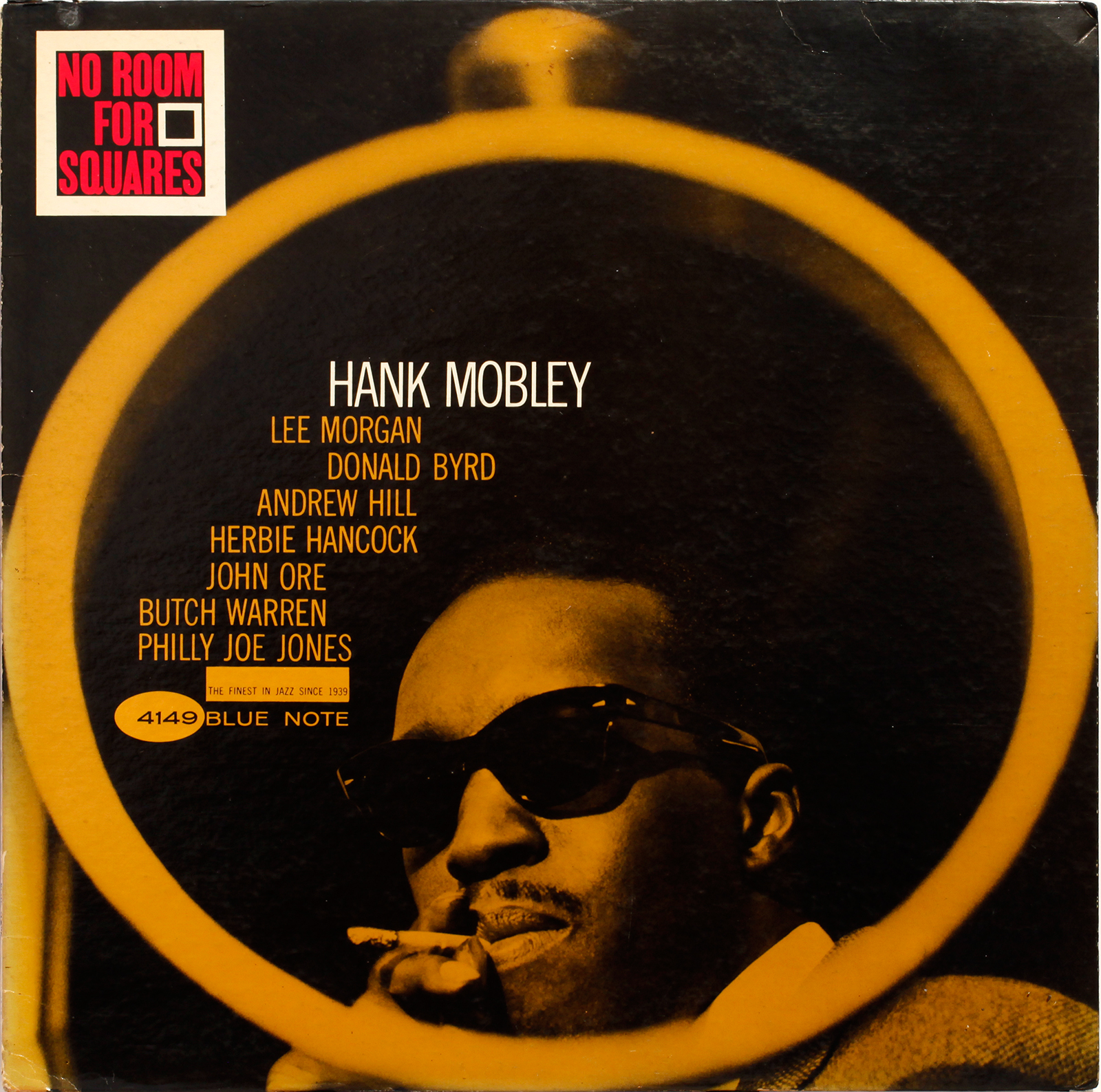
no room for squares


Hank Mobley carved out his own shapely sound with the fierce fluidity of these modal hardbop blues. Mobley had taught himself to play saxophone when he was a teenager and worked with Paul Gayten, Max Roach, and Dizzy Gillespie before taking part in the seminal hardbop sessions that produced  'Horace Silver and the Jazz Messengers'.  As a bandleader, he recorded with his quartet, quintet, and sextet; as well as with His All Stars before an arrest for drugs sidelined him for a couple of years.  He rejoined the Jazz Messengers briefly before embarking on a string of hard bop classics:    'Soul Station''Role Call', and 'Workout'.  Around this same period he joined Miles Davis' quintet as a replacement for John Coltrane on 'Someday My Prince Will Come'.  (as well as two live albums:  'In Person Friday and Saturday Nights at the Blackhawk' and 'Miles Davis at Carnegie Hall')

Mobley would recall:  “I had the knowledge. When I got strung out it was my own fault. A person getting strung out at age 18; that’s a problem. He doesn’t even have a chance to learn what life is about. By the time I got strung out I had learned my instrument, I was making money...I told Miles ‘I never played with somebody who plays like Art Tatum on the saxophone.’ Miles said, ‘That’s why I hired you. I want to put your interpretation with his.'...But when I left Miles, I was so tired of music, the whole world, man, I just went back to drugs.” 


Mobley's next wave would be even more daring.  'No Room For Squares' was recorded for Blue Note Records at the Van Gelder Studio, Englewood Cliffs, New Jersey.  The album is culled from two sessions with different lineups.   On March 7, 1963 he recorded "Up a Step" and "Old World, New Imports" (more tracks from this session would be released later on 'The Turnaround') with Donald Byrd on trumpet, Herbie Hancock on piano, and Butch Warren on bass;  while October 2, 1963 his band featured Lee Morgan on trumpet, Andrew Hill on piano, and John Ore on bass.  Both sessions feature Hank Mobley on tenor saxophone with Philly Joe Jones on drums.  

Mobley would describe his own style thusly:   “not a big sound, not a small sound, just a round sound”.    


http://hankmobley.blogspot.com/

http://hankmobley.jazzgiants.net/


"No Room For Squares"
https://www.youtube.com/watch?v=KZu42x8LWVM


"Carolyn"
https://www.youtube.com/watch?v=n2PPbeBVHwQ


'No Room For Squares' 
full album:

https://myspace.com/hankmobleymusic/music/album/no-room-for-squares-the-rudy-van-gelder-edition-18989476


https://www.youtube.com/watch?v=Xcq_zg-Zw5k&list=PLFBADE21A3C6C7A53


All compositions by Hank Mobley except as indicated

"Three Way Split" – 7:49
"Carolyn" (Morgan) – 5:30
"Up a Step" – 8:31
"No Room for Squares" – 6:57
"Me 'N You" (Morgan) – 7:17
"Old World, New Imports" – 6:08

bonus
"Comin' Back"
"Syrup and Biscuits"


Friday, January 20, 2012

miles smiles


Miles Davis and his second great quintet hit their stride with the effortless improvisation of this freebop studio masterwork. 'Miles Smiles' shows jazz's prince of darkness lightening up, allowing the rest of the band to contribute equally to the sound that flows through elements of hard bop, avante-garde, modal, and free jazz. Herbie Hancock's piano playing utilized new chord structures that combined with the polyrhythmic explorations of double-bassist Ron Carter and drummer Tony Williams. Saxophonist Wayne Shorter contributes half of the compositions on the album. Hancock considers, "The master writer to me, in that group, was Wayne Shorter. He still is a master. Wayne was one of the few people who brought music to Miles that didn't get changed." Davis said, "Wayne is a real composer. He writes scores, write the parts for everybody just as he wants them to sound... Wayne also brought in a kind of curiosity about working with musical rules. If they didn't work, then he broke them, but with musical sense; he understood that freedom in music was the ability to know the rules in order to bend them to your own satisfaction and taste." 'Miles Smiles' was recorded at Columbia 30th Street Studio with producer Ted Macero. It was the quintet's second album. The way they would explore musical themes and their sophisticated improvisational interplay came to be known as "time, no changes."


https://www.milesdavis.com/


'Orbits' (Wayne Shorter)


'Miles Smiles' 
full album:


Side one
"Orbits" (Wayne Shorter) - 4:37
"Circle" (Miles Davis) - 5:52
"Footprints" (Wayne Shorter) - 9:46
Side two
"Dolores" (Wayne Shorter) - 6:20
"Freedom Jazz Dance" (Eddie Harris) - 7:13
"Gingerbread Boy" (Jimmy Heath) - 7:43


Thursday, May 26, 2011

miles davis


Miles Dewey Davis III

(May 26, 1926 – September 28, 1991)


Controversial and influential icon of jazz and rock whose unique and haunting work on the trumpet played a key part in bebop, cool jazz, modal, and fusion.


He learned music from his mother during his youth in St. Louis. When his father sent him to the Juilliard School of Music in New York, Davis sought out saxophonist Charlie Parker.  He dropped out of school and began playing professionally in clubs and recording studios, leading his own group within a year.  


https://www.milesdavis.com/


'Now's The Time' was one of the songs recorded during the first of the legendary Savoy Sessions 1945 with a nineteen year old Davis playing trumpet with Charlie Parker on alto sax, Curley Russell on bass, Max Roach on drums and "Hen Gates" (Dizzy Gillespie) playing piano.


'Boplicity' came from his groundbreaking 'Birth of the Cool' compilation that marked his turn from the hard edge of bop to a more introspective sound. It was recorded in 1949 and 1950; but not released until 1957. The song was credited to Cleo Henry and Gil Evans. Henry was a pseudonym based on his Davis' mother's maiden name that he never used again.


'Doxy' was composed by Sonny Rollins. It first appeared on Davis' 'Bags' Groove', performed with Davis on trumpet, Rollins on tenor saxophone, Horace Silver on piano, Percy Heath on bass, and Kenny Clarke on drums.


''Round Midnight' was the centerpiece of Davis' debut on Columbia Records 'Round About Midnight' recorded in 1955. The song was composed by Thelonious Monk and features a saxophone solo from John Coltrane.


'Milestones' was originally called 'Miles' when the album 'Milestones' came out in 1958. It was his first foray into modal jazz. It features Miles on trumpet, Cannonball Adderley on alto saxophone, Red Garland on piano, Paul Chambers on double bass, Philly Joe Jones on drums,
and a fabulous solo from John Coltrane on tenor saxophone.


The impressionistic modal jazz of 'So What' opens his seminal 1959 'Kind of Blue' album.


The title track to his 1963 'Seven Steps To Heaven' was co-written with pianist Victor Feldman, who Davis replaced with Herbie Hancock for the album. It includes George Coleman on tenor saxophone, Ron Carter on double bass, and Tony Williams on drums.


'Footprints' appeared on his 1967 album 'Miles Smiles'. It was composed by saxophonist Wayne Shorter.


'Spanish Key' is from his 1970 jazz fusion double album 'Bitches Brew' featuring what Miles called "the best damn rock and roll band in the world."


'Black Satin' is from his 1973 album 'On The Corner' which saw Davis experimenting with funk and electronic music.


The title track to his 1986 album 'Tutu' was written by bassist Marcus Miller, and dedicated to Archbishop Desmond Tutu.