Showing posts with label kraftwerk. Show all posts
Thursday, November 6, 2014
autobahn
Kraftwerk explored synthesized soundscapes with the progressive poise of this expansive electronic excursion. Ralf Hütter and Florian Schneider had met while students at the Robert Schumann Hochschule in Düsseldorf. They became involved in experimental music and recorded an album 'Tone Float' as part of the group the Organisation, before forming Kraftwerk. Recording three albums ('Kraftwerk', 'Kraftwerk 2', and 'Ralf and Flor') that increasingly incorporated audio tape manipulation to distort the sound of their instruments, they gradually brought synthesizers into the mix.
Hütter recalls: “We’d seen [Moogs] with other artists who were very popular at the time. We knew there was this type of instrument; we had very small sine-wave generators, and we had an EMS synthesizer—very simple, basic instruments, because we were students. There was no budget. We couldn’t afford the consoles or anything, so we played it monophonic, but we recorded to multitrack.”
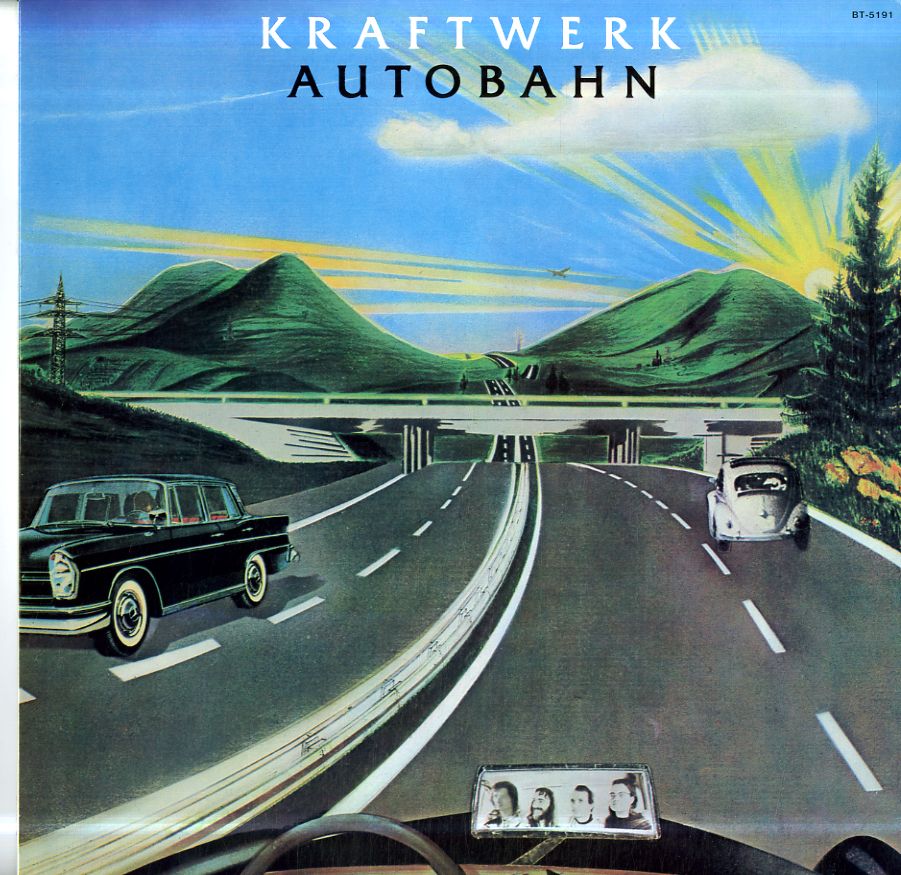
Their fourth album 'Autobahn' was recorded at Conny Plank's Studio in Köln, Germany and produced by Plank, Ralf Hütter, and Florian Schneider. The album features Ralf Hütter and Florian Schneider on vocals and electronics; Klaus Röder on violin and guitar; and Wolfgang Flür on percussion; with Konrad "Conny" Plank as sound engineer.
Schnieder says: "We were on tour and it happened that we just came off the autobahn after a long ride and when we came in to play we had this speed in our music. Our hearts were still beating so fast so the whole rhythm became very fast ... The whole complex we use can be regarded as one machine, even though it is divided into different pieces...Emotion is a strange word. There is a cold emotion and other emotion, both equally valid. lt’s not body emotion, it’s mental emotion. We like to ignore the audience while we play, and take all our concentration into the music. We are very much interested in origin of music. the source of music. The pure sound is something we would very much like to achieve.”
Hütter considers: “'Autobahn' is our first concept album, when I worked with my first electronic drum box I developed with my friend Florian. And from there into monophonic synthesisers...It’s a process...We experiment and make things happen. Sometimes the fingers play themselves when you press record. There’s things like that on ‘Numbers’, those free-floating sound patterns: we’re not connected strictly with music, we work with sounds. Take the name of our studios, Kling Klang: 'klang' is a word for sound, and 'kling' is the verb: ‘sounding sound’, kling klang. And it has that metallic, percussive element. It’s a very good description of our music ... We are fine when the idea comes to a clear statement. It could be short, it could be long. We also have structure that’s very minimal, so it’s not drama. It’s more modular, minimal. It’s components, it’s conceptual. There’s development, gradual. Whereas in classical music there is drama. That’s not our thing ... When we started in the late 60s in art galleries and student clubs, there might have been 50 people or whatever, and it just developed this way. Then in the early 70s and with 'Autobahn', suddenly the world was-- it was possible for us to tour around the world. Well, in France, Italy, and America. And then from there on, it was for us like a vision of electronic music as a universal language. It became our reality...It's more like a cultural photograph. Like, say, you have the Beach Boys from California, but from Germany you would have Kraftwerk, a song about the Autobahn. It's the language of German electro music, and within our language, developed from our mother language...so this strong quality and the motors are being tuned, and the tires are-- whatever, I don't know the English word for the noise they make. And we try to incorporate all kinds of elements."
'Autobahn' became an international sensation, going to number twenty-seven in Sweden, eleven in the Netherlands, nine in Australia, seven in Germany and New Zealand, five in Canada and the US, and number four in the UK.
http://www.kraftwerk.com/
The 'Autobahn' single edit charted at number thirty in Australia, twenty-five in the US, twenty in Ireland, sixteen in the Netherlands, twelve in Canada, eleven in the UK, nine in Germany, and number four in New Zealand.
https://www.youtube.com/watch?v=iukUMRlaBBE
'Autobahn'
full album:
Side one
"Autobahn" ("Motorway") (Ralf Hütter, Florian Schneider, Emil Schult) – 22:43
Side two
"Kometenmelodie 1" ("Comet Melody 1") (Hütter, Schneider) – 6:26 (inspired by Comet Kohoutek)
"Kometenmelodie 2" ("Comet Melody 2") (Hütter, Schneider) – 5:48
"Mitternacht" ("Midnight") (Hütter, Schneider) – 3:43
"Morgenspaziergang" ("Morning Walk") (Hütter, Schneider) – 4:04
Monday, May 20, 2013
the man-machine / die mensch-maschine
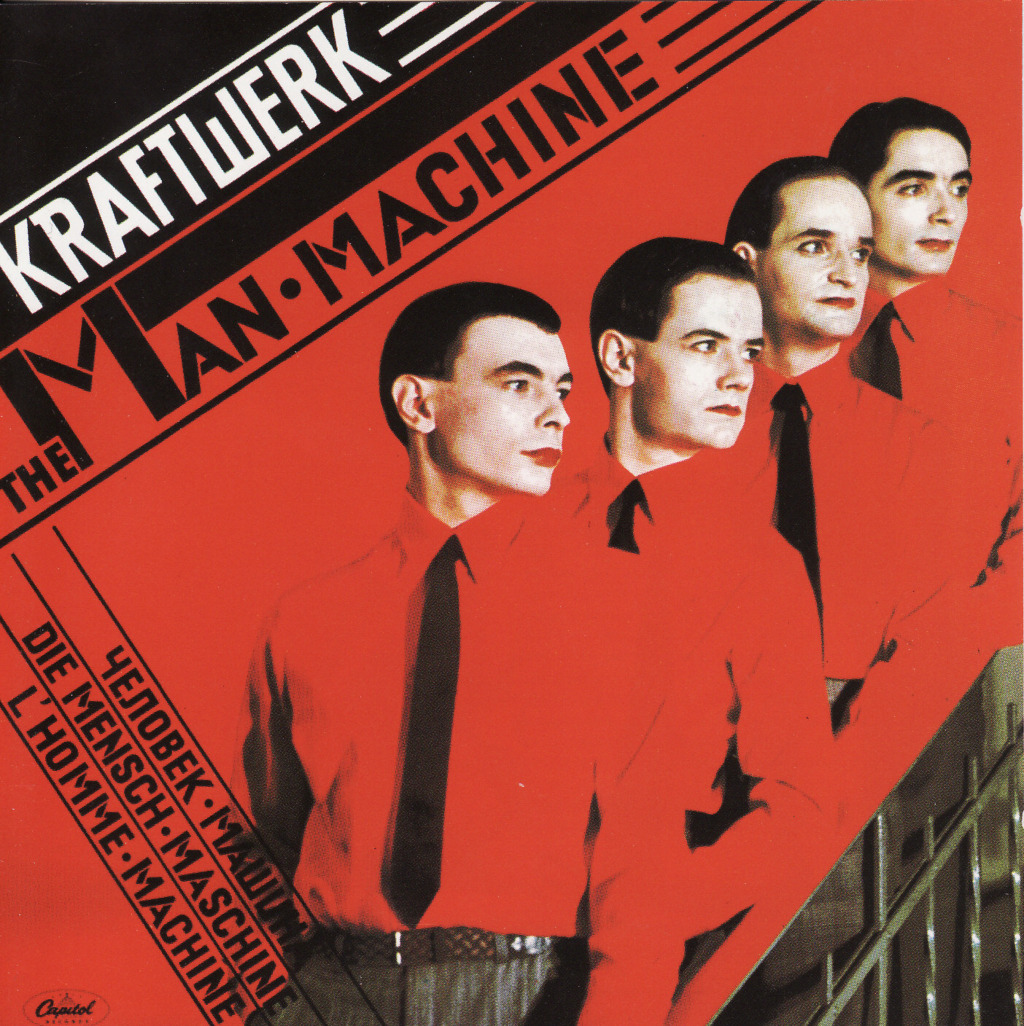
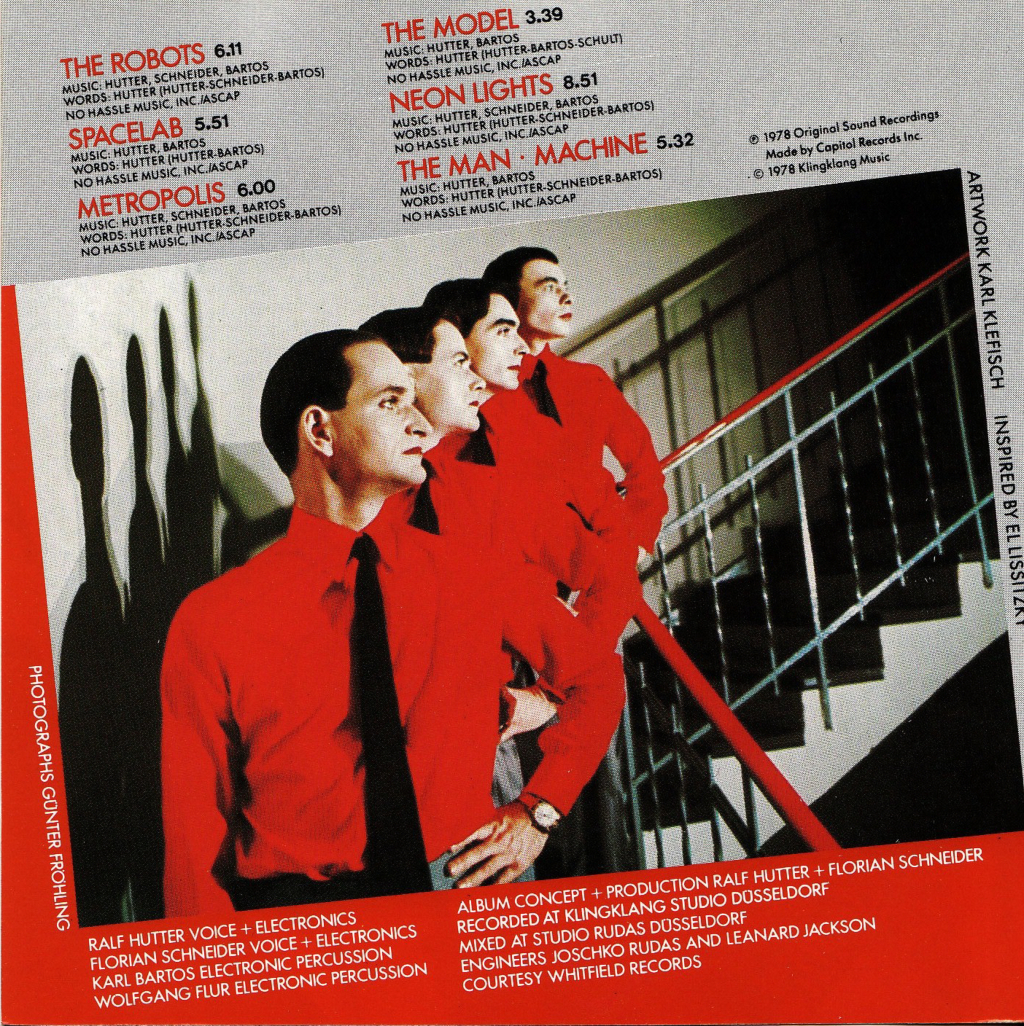
Kraftwerk invented synthpop with the hypnotic science fiction sheen of this conceptual electronic landmark. Building on the advances of 'Trans Europe Express' the band moves closer to pop music with the straightforward sound of 'The Man-Machine' ('Die Mensch-Maschine'). The album was produced by Ralf Hütter and Florian Schneider at Kling Klang Studio in Düsseldorf, Germany with Ralf Hütter on voice, vocoder, synthesizer, keyboards, orchestron, synthanorma sequenzer, electronics, and art direction; Florian Schneider on vocoder, votrax, synthesizer, electronics , Prophet 5 , Prophet 10, and Yamaha CS-80; and Karl Bartos and Wolfgang Flür on electronic drums.
Schneider explains the concept behind the title: "It’s rather a more sophisticated relationship. There is an interaction. Interaction on both sides. The machine helps the man, and the man admires the machine. (Showing the Sony tape recorder) This is the extension of your brain. It helps you remembering. It’s the third man sitting at this table. As for ourselves, we love our machines. We have an erotic relationship with them...The man machine has a hyper-ego...We say “blank tape” for the brain. A blank tape, and a microphone in each ear. In music, it’s important to develop an art of listening based on emptyness...It’s a movie theater for us. Everyone is a star. The spotlights search the stars... for a few seconds only...the stars that spotlights reveal and then abandon...In german, there’s an expression: to walk beside yourself. It means that you’re absent and conscious of it. The image is here, and the camera is there."
Hütter considers: "For me, the music is immaterial: It is sounds and visions. We have gone through many different formats, from vinyl to audiocassettes to 8-tracks to CDs and now downloads. And of course, live Kraftwerk. 'The Man-Machine' is a live electronic music machine. For me, the music is spiritual and I think comes to life when we perform it in concert...It's this combination of human sounds and machine sounds, so as you probably know, electronic music has been very, very intellectualized in the 50s, 60s, or whatever, and I think we always felt strong elements ourselves of these machine rhythms, repetition and charm. Like the motor humming on 'Autobahn', radio waves playing in fantastic melodies in the air. All these ideas have been in our minds and we try to combine them into the different albums."
The Man-Machine' ('Die Mensch-Maschine') went to number one hundred and thirty in the US, fifty-six in Australia, twenty-nine in the Netherlands, twenty-four in Sweden, fifteen in Austria and Italy, fourteen in France, twelve in Germany, and number nine in the UK. Three years later, 'The Model' was re-released as a single by EMI and went to number one on the UK charts. The album went on to influence a whole generation of musicians in the development of synthpop and electronica: "vorsprung durch technik".
http://www.kraftwerk.com/
'The Man-Machine' ('Die Mensch-Maschine')
full album:
1. The Robots: 0:00
2. Spacelab: 6:12
3. Metropolis: 12:09
4. The Model: 18:13
5. Neon Lights: 21:58
6. The Man-Machine: 30:55
bonus:
7 - The Robots (Single Version) [36:19]
8 - Spacelab (Single Edit) [40:03]
9 - Neon Lights (Single Edit) [43:37]
10 - The Man-Machine (Promo Edit) [47:07]
11 - The Man-Machine (Remix) [50:53]
Sunday, March 4, 2012
trans-europe express
Kraftwerk took their electronic blues to the next station with the mechanized rhythms and panoramic pulses of this conceptual, pan-cultural tour de force. 'Trans-Europe Express' reflects a move away from their nationalistic German roots toward a more diverse European focus. During the tour for their previous album 'Radio Activity', the band decided to abstain from drugs and alcohol while performing. Karl Bartos reflects that "it's not easy to turn knobs on a synthesizer if you are drunk or full of drugs. ... We always tried to keep very aware of what we were doing while acting in public."
The band began recording 'Trans-Europe Express' at their experimental Kling Klang studio in Düsseldorf after they had installed the Synthanorma Sequenzer, a customized 32-step 16-channel analogue sequencer made for them by Matten & Wiechers. Ralf Hütter (synthesizer, orchestron, synthanorma-sequenzer, electronics) and Florian Schneider (vocoder, votrax, synthesizer, electronics) produced the album and steered the direction of the sound, while Bartos and Wolfgang Flür provided electronic percussion. Hütter and Schneider had also met with David Bowie and Iggy Pop while they were recording in Berlin, which influenced the theme and lyrics. They did field recordings from train bridges to get the actual sound that the locomotives would produce and altered them with synthesizers to make them danceable. The minimalistic melodies evoke a sense of modern alienation that comes hand in hand with technology and travel in a post-war world. In the US, 'Trans-Europe Express' didn't break the top 100 of the album chart; but in Europe it did much better, going to number thirty-two in Sweden and the UK, number eight in Italy, and peaking at number two in France.
'Franz Schubert' / 'Endless Endless'
'Trans-Europe Express'
full album:
1 - Europe Endless [00:00]
2 - The Hall of Mirrors [09:42]
3 - Showroom Dummies [17:39]
4 - Trans-Europe Express [23:54]
5 - Metal on Metal [30:31]
6 - Abzug [32:42]
7 - Franz Schubert [37:37]
8 - Endless Endless [42:04]
Bonus:
9 - Les Mannequins (French Version) [43:01]
10 - Les Mannequins (Single Version) [49:02]
11 - Showroom Dummies (Remix) [51:43]
12 - Showroom Dummies (Special Disco Version) [54:22]
13 - The Hall of Mirrors (Single Edit) [1:00:21]
14 - Trans-Europe Express (Single Edit) [1:05:01]
15 - Trans-Europe Express (Instrumental) [1:08:54]
16 - Trans-Europe Express/Metal on Metal (Long Version) [1:12:14]
17 - Europe Endless (Live at Paradiso '76) [1:25:55]
18 - Trans-Europe Express (Live at Paradiso '76) [1:39:15]
Subscribe to:
Posts (Atom)