Showing posts with label grateful dead. Show all posts

Tuesday, September 1, 2015

blues for allah


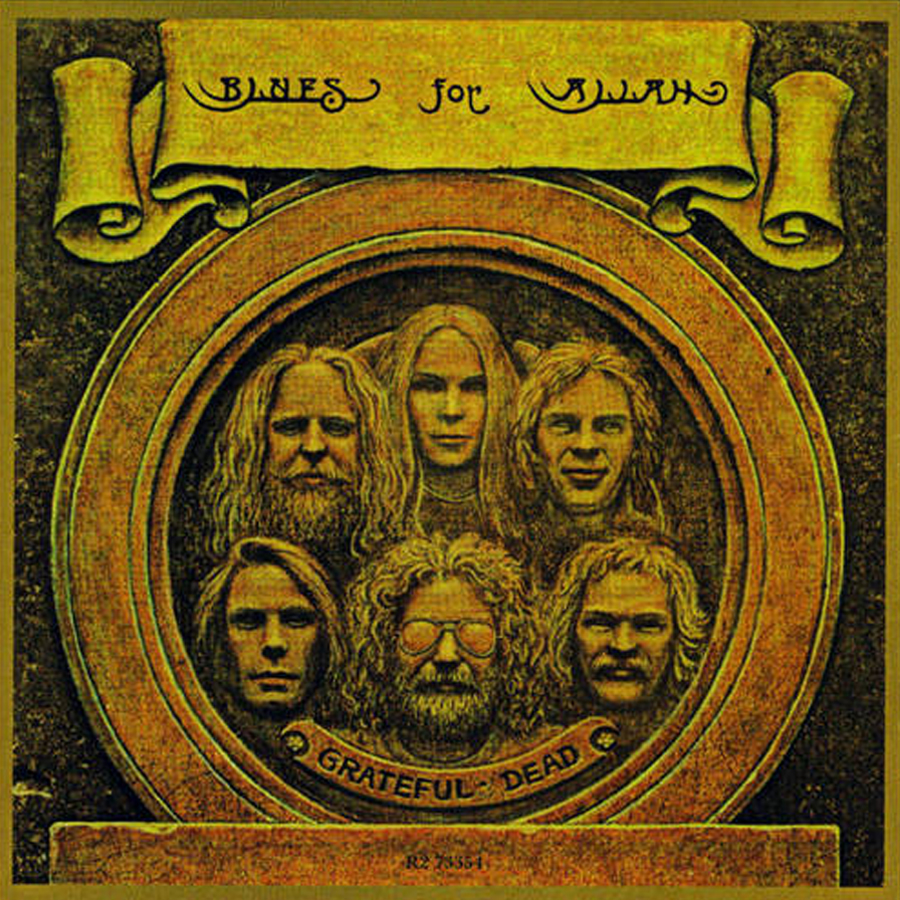
The Grateful Dead sailed on mirage to roll away the dew as the music played the band.  After twelve albums  (The Grateful Dead in 1967,   Anthem of the Sun in 1968,   Aoxomoxoa  and  Live/Dead  in 1969,   Workingman's Dead  and  American Beauty in 1970,   Grateful Dead (Skull & Roses) in 1971,   Europe '72 in 1972,   History of the Grateful Dead, Volume One (Bear's Choice)  and  Wake of the Flood in 1973,  and  From the Mars Hotel in 1974)  the group decided to take a hiatus.   It wasn't long before they went back to recording.  In February of 1975, the band began working at Ace's, Bob Weir's home studio in Mill Valley.  

Jerry Garcia would reveal:    "We went into the studio with no preconceptions and no material...We kind of made a ground rule for that record:  'Let's make a record where we get together every day and we don't bring anything in [in advance],'...The whole idea was to get back to that band thing, where the band makes the main contribution to the eveolution of the material.  So we'd go into the studio, we'd jam for a while, and then if something nice turned up we'd say, 'Well, lets' preserve this little hunk and work with it, see if we can't do something with it.'  And that's how we did most of the album...Our development [historically] has been to synthesize various forms, like playing jazz, playing country and western, playing rhythm and blues and forming combinations of those genres and styles within what we're doing, within our instrumentation.  Now we're working on creating styles rather than just being eclectic or synthesizing other styles.  Thus, it's a little bit more difficult, and considerably more experimental. It's still questionable as to whether the things will be successful musically, but we're sort of into defining new spaces for ourselves musically to go to."


Phil Lesh says:   "We wanted to free ourselves from our own clichés, to search for new tonalities, new structures and modalities.  I think we succeeded."  


'Blues for Allah' features  Jerry Garcia on guitar and vocals,  Donna Jean Godchaux on vocals,  Keith Godchaux on keyboards and vocals,   Phil Lesh on bass guitar,  Bill Kreutzmann on drums,   Bob Weir on guitar and vocals,  and a returning Mickey Hart on drums,   with  Steven Schuster on flute and reeds.   'Blues for Allah' was their biggest charting album to date, going to number twelve in the US.  


http://www.dead.net/


'Blues for Allah' 
full album:

https://www.youtube.com/watch?v=sE_hm9qKRyc


Side one 

00:00  "Help on the Way" (Jerry Garcia and Robert Hunter) 
/ "Slipknot!" (Garcia, Keith Godchaux, Bill Kreutzmann, Phil Lesh, and Bob Weir) 
 07:21  "Franklin's Tower" (Garcia, Hunter, and Kreutzmann) 
11:55   "King Solomon's Marbles" (Lesh)
"Stronger Than Dirt or Milkin' the Turkey" (Mickey Hart, Kreutzmann, and Lesh)  
17:11   "The Music Never Stopped" (John Perry Barlow and Weir) 

Side two 
21:47  "Crazy Fingers" (Garcia and Hunter)  
28:29  "Sage & Spirit"  (Weir) 
31:40  "Blues for Allah" (Garcia and Hunter)  
"Sand Castles and Glass Camels" (Garcia, Donna Godchaux, Keith Godchaux,Hart, Kreutzmann, Lesh, and Weir) 
"Unusual Occurrences in the Desert" (Garcia and Hunter) 

bonus
44:20  "Groove #1" (Instrumental Studio Outtake)  
50:07  "Groove #2" (Instrumental Studio Outtake)  
57:41  "Hollywood Cantana" (Studio Outtake) 

https://www.youtube.com/playlist?list=PLxmCyo4jldzVj3aQ-0qpQi6kHL5G6ve3r


Sunday, June 14, 2015

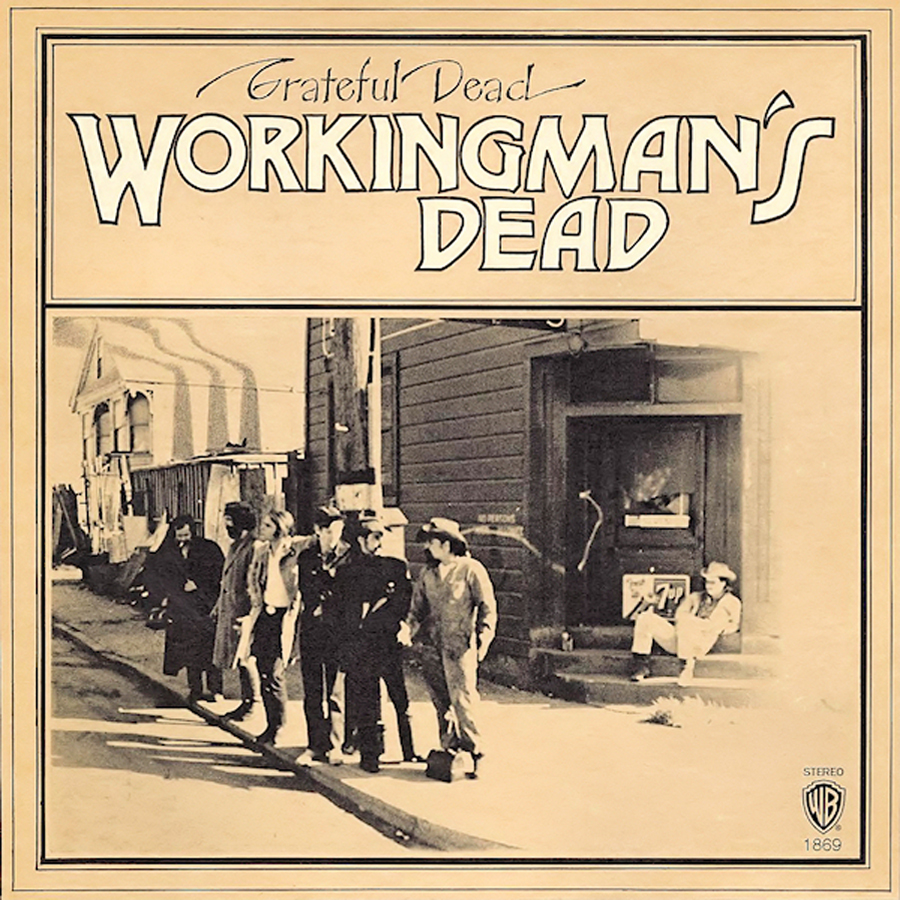
workingman's dead


The Grateful Dead went back to their roots and played to the tide with the acoustic country rock notions of this harmonic high time.   Even as the band had reached the apex of their psychedelic experimentation with 'Live / Dead', they were beginning to explore more traditional sounds.    The move from San Francisco’s Haight-Ashbury district across the Golden Gate Bridge to rustic Larkspur in Marin County inspired songwriters Jerry Garcia and Robert Hunter over the course of several months to create some of their most enduring songs as they harkened back to the country blues sound of their days as Mother McCree’s Uptown Jug Champions.  


Hunter reveals:   “The direction [Robbie Robertson] went with the Band was one of the things that made me think of conceiving Workingman’s Dead. I was very much impressed with the area Robertson was working in. I took it and moved it to the West, which is an area I’m familiar with…regional but not the South, because everyone was going back to the South for inspiration at that time.”


'Workingman's Dead' was recorded over nine days in San Francisco at Pacific High Recording Studio with  Jerry Garcia on lead guitar, pedal steel guitar, banjo, and vocals;   Bob Weir on guitar and vocals;   Pigpen (Ron McKernan) on keyboards, harmonica, and vocals;  Phil Lesh on bass and vocals;  and  Bill Kreutzmann and Mickey Hart on drums;    with  David Nelson playing acoustic guitar on "Cumberland Blues"  and  Tom Constanten contributing keyboards on reissue live bonus tracks "Dire Wolf", "Black Peter", "Easy Wind", "Cumberland Blues", and "Mason's Children".   The sessions were produced by Bob Matthews, with Betty Cantor, and the Grateful Dead;  and engineered by Alembic.   The album credits  Ramrod, Rex Jackson, and S. Heard as the equipment crew;   Jon McIntire as Big nurse;  Sam Cutler as Executive nanny;  Cosmic Gail as Lady in waiting;  David Parker and Bonnie Parker as Guardians of the vault;   Mouse Studios, with Toon N Tree for Cover photo, art, and design;  and gives special thanks to John Dawson.   The shadows of a drug bust that January in New Orleans, manager Lenny Hart taking off with most of their money, and the huge recording cost of 'Aoxomoxoa' the year before gave the proceedings a sense of urgency.  


Matthews says:  Workingman’s Dead was done very quickly,..We went into the studio first and spent a couple of days rehearsing—performing—all the tunes, recording them onto two-track. When that was done, I sat down and spliced together the tunes—beginning of side one to end of side one, beginning of side two to end of side two. I got that idea from Sgt Pepper’s: ‘Before we even start, let’s have a concept of what the end product is going to feel like, sequencing-wise.’


'Workingman's Dead' was their biggest album yet, going to number twenty-seven on the US album chart and became their first to be certified platinum.  Along with their next album 'American Beauty' recorded just months later it is considered to be the pinnacle of their studio work. 


Garcia would expound:   Workingman’s Dead was our first true studio album, insofar as we went in there to say ‘These are the limitations of the studio for us as performers; let’s play inside those limitations.’ That is we decided to play more or less straight-ahead songs and not get hung up with effects and weirdness. For me, the models were music that I’d liked before that was basically simply constructed but terribly effective – like the old Buck Owens records from Bakersfield. Those records were basic rock & roll: nice, raw, simple, straight-ahead music, with good vocals and substantial instrumentation but nothing flashy.  Workingman’s Dead was our attempt to say, ‘We can play this kind of music – we can play music that’s heartland music. It’s something we do as well as we do anything’  ...  We were into a much more relaxed thing at that time. We weren’t feeling like an experimental music group, but were feeling more like a good old band  ...  I liked all those tunes. I loved them all, to give you the absolute and unashamed truth. I felt that they were all good songs. They were successful in the sense you could sing ‘em and get off and enjoy singing ‘em. Uncle John’s Band was a major effort, as a musical piece. It’s one we worked on for a really long time, to get it working right. Cumberland Blues was also difficult in that sense  ...  Hunter and I always had this thing where we liked to muddy the folk tradition by adding our versions of songs to the tradition...We had our ‘Casey Jones’ song. We had our ‘Stagger Lee’ song. ‘Dupree’s Diamond Blues’ is another of those. It’s the thing of taking a well-founded tradition and putting in something that’s totally looped.  It has a kind of carnival or medicine show kind of feel, and also a ragtime feel.”


http://www.dead.net/


'Workingman's Dead' 
full album:


All songs written by Jerry Garcia and Robert Hunter, except where noted.

Side one 
1. "Uncle John's Band" 0:00
2. "High Time" 4:44
3. "Dire Wolf" 10:00
4. "New Speedway Boogie" 13:13
Side two 
5. "Cumberland Blues" (Garcia, Hunter, and Phil Lesh) 17:20
6. "Black Peter" 20:37
7. "Easy Wind" (Hunter) 26:21
8. "Casey Jones" 31:19

reissue bonus tracks 
9. "Dire Wolf" 36:00 recorded at Santa Rosa Veteran's Memorial Hall on 6/27/1969
10 "Black Peter" 38:30 recorded at Golden Hall Community Concourse in San Diego on 1/10/1970
11 ."Easy Wind" 47:37 recorded at Springer's Ballroom in Portland on 1/16/1970
12. "Cumberland Blues" 55:50 recorded at the Oregon State University Gym on 1/17/1970
13. "Mason's Children" 1:00:37 recorded at the Civic Auditorium in Honolulu on 1/24/1970
14. "Uncle John's Band" 1:07:17 recorded at Winterland on 10/04/1970


'Workingman's Dead' 
live:  


Side one 
1. "Uncle John's Band" 0:00 
2. "High Time" 6:51 Dead Set -1981
3. "Dire Wolf" 15:32 Workingman'sDead Re-Issued Bonus Tracks-Santa Rosa Veteran's Memorial Hall in Santa Rosa CA on 6/27/1969
4. "New Speedway Boogie" 18:04 7/3/70 Canada
Side two 
5. "Cumberland Blues" 24:41  9-26-1972 Stanley Theatre, Jersey City NJ
6. "Black Peter" 31:36 9-10-1972 Hollywood Palladium, Hollywood CA
7. "Easy Wind" 40:21  From The Vault 1-3\Three From The Vault
8. "Casey Jones" 48:40 9-9-1972 Hollywood Palladium, Hollywood CA


Live - February 14, 1970 - Fillmore East, NY 


Dark Star
Hard To Handle
I've Been All Around This World
Me & My Uncle
Not Fade Away
Mason's Children

Monday, November 10, 2014

live / dead


The Grateful Dead turned on their love light and gathered what another man spilled in this transitive nightfall of diamonds.   With three studio albums ('The Grateful Dead', 'Anthem of the Sun', and 'Aoxomoxoa') under their belt, the band was still not satisfied with the limitations of their music.  According to keyboardist Tom Constanten, the decision to record a live album was a practical one:     "Warner Bros. had pointed out that they had sunk $100,000-plus into Aoxomoxoa ... so someone had the idea that if we sent them a double live album, three discs for the price of one wouldn't be such a bad deal."

'Live/Dead'  was taken from three live performances at the Fillmore West with a sixteen track mobile recording studio.  The album was produced by Grateful Dead, with engineers Bob Matthews and Betty Cantor.  Owsley and Ron Wickersham were consulting engineers and sound was done by Bear.  At this point, The Grateful Dead consisted of  Tom Constanten on keyboards;  Jerry Garcia on guitar and vocals;  Mickey Hart and Bill Kreutzmann on drums and percussion;  Ron "Pigpen" McKernan on vocals, congas, and organ on "Death Don't Have No Mercy";  Phil Lesh on bass guitar and vocals;  and Bob Weir on guitar and vocals.  


Garcia considered:     "We got more into wanting to go...to take it farther. In the nightclubs, in bars, mostly what they want to hear is short fast stuff, uhm...and we were always trying to play a little, stretch out a little...So our trip with the Acid Test was to be able to play long and loud. Man, we can play long and loud, as long and loud as we wanted and nobody would stop us...Of course, we were improvising cosmically, too. Because being high, each note, you know, is like a whole universe. And each silence. And the quality of the sound and the degree of emotional...when you’re playing and you’re high on acid in these scenes it is like the most important thing in the world. It’s truly, pshew, cosmic...Our consciousness concerning music is opening up more, so the music is becoming,...is having more facets than it seemed to, having more dimensions...and we’ve also seen the effect of all of a sudden we find a certain kind of feeling or a certain kind of rhythm and the whole place is like a sea and it goes boom...boom...boom, it’s like magic and it’s like that something you discover on LSD and you discover that another kind of sound will like create a whole other, you know...We’re just playing what’s there, is finally what it comes down to, because we’re not in a position to be deciding."

'Live/Dead' made it to number sixty-four on the US album chart.  It was not only the first of many live albums to be released by the band; it was the first live album ever to be recorded on a sixteen track.  


http://www.dead.net/


"Dark Star" was the first song that the band wrote with lyricist Robert Hunter.  The song evolved from a brief single to an extended improvisational template in their live shows.  It was the centerpiece for 'Live/Dead'. 

Hunter:   "I arrived in San Francisco with a case of walking pneumonia and the clothes on my back. The next day I was writing Dark Star, feeling pretty much as the lyric suggests...I was in my cabin. They were rehearsing in the hall, and you could hear from there. I heard the music and just started writing Dark Star lying on my bed. I wrote the first half of it and I went in and handed what I'd written to Jerry. He said, 'Oh, this will fit in just fine,' and he started singing it... [When] I heard the Grateful Dead playing, those were the words it seemed to be saying.... That did it for the time being...I was very impressed with T.S. Eliot around the time I was writing Dark Star," Hunter said, and one line was clearly influenced by a line in 'The Love Song of J Alfred Prufrock' - "Let us go then, you and I, when the evening is spread out against the sky." "Beyond that, that's just my kind of imagery.... I don't have any idea what the 'transitive nightfall of diamonds' means. It sounded good at the time. It brings up something that you can see."

Garcia:   "You gotta remember that you and I are talking about two different "Dark Stars." You're talking about the "Dark Star" which you have heard formalized on a record, and I'm talking about the "Dark Star" which I have heard in each performance as a completely improvised piece over a long period of time. So I have a long continuum of "Dark Star" which range in character from each other to real different extremes. "Dark Star" has meant, while I'm playing it, almost as many things as I can sit here and imagine, so all I can do is talk about "Dark Star" as a playing experience."

studio single version
https://www.youtube.com/watch?v=oUcMyVi9xJk


Dark star crashes, pouring its light into ashes.
Reason tatters, the forces tear loose from the axis.
Searchlight casting for faults in the clouds of delusion.
Shall we go, you and I while we can

Through the transitive nightfall of diamonds?
Mirror shatters in formless reflections of matter.
Glass hand dissolving to ice petal flowers revolving.
Lady in velvet recedes in the nights of goodbye.

Shall we go, you and I while we can
Through the transitive nightfall of diamonds?


https://www.youtube.com/watch?v=ZvRKsyAF-h8


"Turn On Your Love Light"
https://www.youtube.com/watch?v=aJhnOq2q3ag

single edit
https://www.youtube.com/watch?v=UGNcZKheoOY


'Live/Dead' 
full album:
https://www.youtube.com/watch?v=aL-dUZJydcw


Side one
00:00 "Dark Star" (Jerry Garcia, Mickey Hart, Robert Hunter, Bill Kreutzmann, Phil Lesh, Ron "Pigpen" McKernan, and Bob Weir) 23:18
Side two
23:18 "St. Stephen" (Garcia, Hunter, and Lesh) 6:31
29:50 "The Eleven" (Hunter and Lesh) 9:18
Side three
39:10 "Turn On Your Love Light" (Deadric Malone and Joseph Scott) 15:05
Side four
54:15 "Death Don't Have No Mercy" (Reverend Gary Davis) 10:28
01:04:43 "Feedback" (Tom Constanten, Garcia, Hart, Kreutzmann, Lesh, McKernan, and Weir) 7:49
01:12:33 "And We Bid You Goodnight" (Traditional, arr. by Grateful Dead) 0:35

bonus tracks
01:13:10  "Dark Star" (studio)
01:15:52  "Live/Dead radio promo"


'Playboy After Dark'
"Mountains on the Moon" and "St. Stephen" 
January 18, 1969.
https://www.youtube.com/watch?v=P05TCXp6CKA


'Fillmore West 1969'
http://grooveshark.com/#!/playlist/Fillmore+West+1969+Grateful+Dead/94750571


February 27, 1969
https://www.youtube.com/watch?v=U4uOhfjU8ig


First set: "Good Morning Little Schoolgirl" (Sonny Boy Williamson) - 00:00 "Doin' That Rag" (Robert Hunter, Jerry Garcia) - 11:48 "That's It for the Other One" (Garcia, Bill Kreutzman, Bob Weir) - 19:40
Second set: "Dupree's Diamond Blues" (Hunter, Garcia) - 39:43 "Mountains of the Moon" (Hunter, Garcia) - 43:40 "Dark Star" (Hunter, Garcia, Mickey Hart, Kreutzman, Phil Lesh, Pigpen, Weir) - 49:36 "St. Stephen" (including William Tell Bridge)" (Hunter, Garcia, Lesh) - 1:11:21 "The Eleven" (Hunter, Lesh) - 1:19:37 "Turn On Your Love Light" (Joseph Scott, Deadric Malone) - 1:32:47
Encore: "Cosmic Charlie" (Hunter, Garcia) - 1:51:56


February 28, 1969
https://www.youtube.com/watch?v=gFBkjBYWcFM


First set: "(Walk Me Out in the) Morning Dew" (Bonnie Dobson, Tim Rose) - 0:00 "Good Morning Little School Girl" (Williamson) - 10:58 "Doin' That Rag" (Hunter, Garcia) - 22:00 "I'm a King Bee" (Slim Harpo) - 28:59 "Turn on Your Love Light" (Scott, Malone) - 36:04
Second set: "That's It for the Other One" (Garcia, Kreutzman, Weir) - 55:17 "Dark Star" (Hunter, Garcia, Hart, Kreutzman, Lesh, Pigpen, Weir) - 1:15:02 "St. Stephen (including William Tell Bridge)" (Hunter, Garcia, Lesh) - 1:34:48 "The Eleven" (Hunter, Lesh) - 1:42:37 "Death Don't Have No Mercy" (Reverend Gary Davis) - 1:57:52


Monday, November 5, 2012

europe '72


The Grateful Dead celebrated their first big tour of Europe with this live triple album opus.  'Europe '72' captures the band during the peak of its creative powers in the wake of two stellar studio albums ('Workingman's Dead' and 'American Beauty'), another live double album ('Grateful Dead' aka 'Skull and Roses'), and three solo albums from members of the group ('Garcia' by Jerry Garcia, 'Ace' by Bob Weir, and 'Rolling Thunder' by Mickey Hart).  The tour took place during April and May of 1972 and included Jerry Garcia on lead guitar and vocals; Donna Jean Godchaux on backing vocals; Keith Godchaux on piano; Bill Kreutzmann on drums; Phil Lesh on bass guitar and vocals; Ron "Pigpen" McKernan on organ, harmonica, and vocals; and Bob Weir on rhythm guitar and vocals.  It was the first release to include Jean and Keith Godchaux and the last to include Ron "Pigpen" McKernan before his death in 1973.  Some vocal overdubs were added later in the studio.

'Europe '72' charted at number twenty on the US album chart and has been certified double-platinum.  A single of 'Sugar Magnolia' charted at number ninety-one on the Billboard hot 100.  On September 1, 2011, 'Europe '72: The Complete Recordings' was released with all of the band's spring 1972 concert tour of Europe: twenty-two complete shows on seventy-three compact disks.  This box set has been certified gold.  


http://www.dead.net/


'China Cat Sunflower / I Know You Rider'


'The Other One'


'Dark Star'


'Europe '72' 
full album:


Side one 
1. "Cumberland Blues" (Jerry Garcia, Robert Hunter, and Phil Lesh) 0:00
2. "He's Gone" (Garcia and Hunter) 5:42
3. "One More Saturday Night" (Bob Weir) 12:39
Side two 
4. "Jack Straw" (Hunter and Weir) 17:28
5. "You Win Again" (Hank Williams) 22:18
6. "China Cat Sunflower" (Garcia and Hunter) 26:20
7. "I Know You Rider" (trad., arr. The Grateful Dead) 31:54
Side three 
8. "Brown-Eyed Woman" (Garcia and Hunter) 36:58
9. "It Hurts Me Too" (Elmore James) 41:36
10. "Ramble On Rose" (Garcia and Hunter) 48:57
Side four 
11. "Sugar Magnolia" (Hunter and Weir) 55:01
12. "Mr. Charlie" (Hunter and Ron "Pigpen" McKernan) 1:02:11

13. "Tennessee Jed" (Garcia and Hunter) 1:05:50 


Side five 
14. "Truckin'" (Garcia, Hunter, Lesh, and Weir) 0:00
15. "Epilogue" (Garcia, Donna Jean Godchaux, Keith Godchaux, Bill Kreutzmann, Lesh, McKernan, and Weir) 13:04
Side six
16. "Prelude" (Garcia, Donna Jean Godchaux, Keith Godchaux, Kreutzmann, Lesh, McKernan, and Weir) 18:16
17. "(Walk Me Out in the) Morning Dew" (Bonnie Dobson and Tim Rose) 25:53
18. "Looks Like Rain" (John Perry Barlow and Weir) 37:35
19. "Good Lovin'" (Rudy Clark and Arthur Resnick) 45:18
20. "Caution (Do Not Stop on Tracks)" (Garcia, Kreutzmann, and Lesh) 1:03:49
21. "Who Do You Love" (Bo Diddley) 1:08:27

22. "The Yellow Dog Story" (Garcia, Donna Jean Godchaux, Keith Godchaux, Kreutzmann, Lesh, McKernan, and Weir) 1:08:51


Friday, July 6, 2012

in the dark


The Grateful Dead found their greatest commercial success with the remarkable late career comeback of this studio album recorded live in a darkened theatre. The band's longest running lineup of Jerry Garcia and Bob Weir on guitar and vocals; Brent Mydland on keyboards and vocals; Phil Lesh on bass; and Bill Kreutzmann and Mickey Hart on drums recorded the basic tracks for 'In the Dark' in just over a week at Marin County Veterans Auditorium. Most of the songs had been written years before; so they were very comfortable with them. Jerry Garcia co-produced the album with engineer John Cutler. 


Micky Hart came up with the title: "I was thinking of sensory deprivation; and when you don't see, usually other senses are heightened - hearing perhaps. So I thought we should take all of the light away from the Grateful Dead. While we were recording at Marin Vets we took all the lights down including the exit lights and we played in the dark. I wanted to get blindfolds...another one of my foolish notions."

Jerry Garcia recalls: "Marin Vets turns out to be an incredibly nice room to record in. There's something about the formal atmosphere in there that makes us work. When we set up at Front Street to work, a lot of times we just sort of dissolve into hanging out. Going in without an audience and playing just to ourselves was in the nature of an experiment."

Bob Weir had taken up vocals after a long hiatus. He said at the time: "It's a delight to be singing again...My voice, I lost the high range - it fell apart...Most of the singing I used to do was the high part and I lost that. There were no nodes on my vocal chords or anything. I went to see an expert and he said, 'It's just your aging vocal chords'."

The year before they began recording, Garcia had slipped into a diabetic coma and had to re-learn the guitar to a certain extent. Garcia reflects: "It wasn't that weird for me; it didn't feel weird. I only know about it because that's what everybody told me later... It's like a non-experience...It felt like i was really tired."


'In the Dark' went to number six on the US album chart and has been certified double platinum. It was the highest charting album of their extensive catalogue.


http://www.dead.net/


Garcia and Robert Hunter's 'Touch of Grey' became an unexpected smash hit. It was the only single of the Grateful Dead to break into the US top forty. It peaked at number six. Robert Hunter wrote the lyrics, except for one line from Garcia: "Light a candle, curse the glare."


'Hell in a Bucket' was written by Weir with John Perry Barlow.


Written with Barlow, Weir calls 'Throwing Stones' "an anarchist diatribe".


 'In the Dark' 
full album:


Side one
"Touch of Grey" (Garcia, Hunter) – 5:47 (lead singer: Jerry Garcia)
"Hell in a Bucket" (Barlow, Weir, Mydland)[8] – 5:35 (lead singer: Bob Weir)
"When Push Comes to Shove" (Garcia, Hunter) – 4:05 (lead singer: Jerry Garcia)
"West L.A. Fadeaway" (Garcia, Hunter) – 6:39 (lead singer: Jerry Garcia)
Side two
"Tons of Steel" (Mydland) – 5:15 (lead singer: Brent Mydland)
"Throwing Stones" (Barlow, Weir) – 7:18 (lead singer: Bob Weir)
"Black Muddy River" (Garcia, Hunter) – 5:58 (lead singer: Jerry Garcia)


Thursday, May 31, 2012

ace


Sessions for Bob Weir's solo debut became just another excuse to jam with his bandmates from the Grateful Dead.  Warner Brothers Records offered solo record deals to members of the band as their contract was expiring to entice them to stay.  Jerry Garcia released his solo album in January of 1972; which is when sessions began for 'Ace'.  It was recorded at Wally Heider's Studio in San Francisco by Bob Matthews and Betty Cantor with everyone from the Grateful Dead taking part except for Ron "Pigpen" McKernan and Mickey Hart.    Weir recalls:  "That was a Grateful Dead record, as far as I'm concerned. And I don't do that material with my side groups...It was all me singing, all my songwriting. I started by using a couple of different musicians, and it just settled in to being a Grateful Dead record right quick."

Included in the studio action were Bob Weir on lead vocals, electric and acoustic guitars; Jerry Garcia on lead guitar, pedal steel guitar, and backup vocals; Phil Lesh on bass guitar, and backup vocals;  Bill Kreutzmann on Drums and Percussion; Keith Godchaux on piano and organ; Donna Jean Godchaux on harmony and "chick" vocals; Dave Torbert on bass guitar; with Snooky Flowers, Luis Gasca, and the Space Rangers playing horns; and Ed Bogus doing string arrangements.  

Weir admits:  "I pretty much knew in the back of my mind what would happen. I go and get the time booked and start putting the material together. Everybody gets wind of the fact that I got the time booked and I may be going into the studio. So one by one they start coming around. Lesh and Garcia, 'Hey man, I hear you got some time booked...Need a bass player? A guitarist?'...Of course I ended up with the Grateful Dead on the record, which I figured up front...And we had a great time making the record."  Production credits were given to "everybody involved".  Most of the songs on 'Ace' became concert staples for the Grateful Dead.  Weir says:  "That was when I really first kicked into gear and started writing."


http://bobweir.net/


"Greatest Story Ever Told" was composed by Weir, Mickey Hart, and Ian Hunter.   This is the only song on the album that has Dave Torbert.  It also appeared on Hart's solo album as  "The Pump Song".


"Black-Throated Wind" was written by Weir and John Parry Barlow


"Cassidy" (Weir, Barlow) "I wrote it shortly after Neil checked out down in Mexico. The song came to me—I was living at a ranch in the middle of Marin County in California. There were a number of us. We were living sort of communally there at the time. One of the ladies here was busy birthing a baby. I went out into the living room. There were a lot of folks sort of helping in that. It was a bit much for me so I went in the living room, picked up my guitar, and just started playing. This tune came. She named the kid Cassidy. Meanwhile, when this tune was coming through, you know, coming through the sky or wherever they come from, I was still thinking, I was still sort of meditating on Neil and his effect on my life and stuff like that. The song was sort of—the music was sort of about the new Cassidy and it was also sort of about the old Cassady. Barlow and I sat down and we hashed that out, we talked that down a bit, and then the lyrics came out."


'Ace'
full album:


Side one
 "Greatest Story Ever Told" (Mickey Hart, Robert Hunter, and Bob Weir) -- 0:00 
"Black-Throated Wind" (John Perry Barlow and Weir) -- 3:39 
"Walk in the Sunshine" (Barlow and Weir) -- 9:21 
"Playing in the Band" (Hart, Hunter, and Weir) -- 12:23

Side two 
"Looks Like Rain" (Barlow and Weir) -- 20:01 
"Mexicali Blues" (Barlow and Weir) -- 26:09 
"One More Saturday Night" (Weir) -- 29:32 
"Cassidy" (Barlow and Weir) -- 33:59