Mazzy Star rummaged through desire and doubt to find illumination in this hazy velvet venture. David Roback and his brother Steven had been in the Unconscious with their neighbor Susanna Hoffs before forming Rain Parade with David's college roommate Matt Piucci, becoming a major part of the Los Angeles Paisley Underground scene. Roback remembers: "I went to New York mainly to be part of the art scene; but I gradually found myself getting more inspired by what was happening in music than in art...People like Patti Smith and Television...I felt like a punk. That's the attitude I identified with. But when I picked up the guitar and started playing it, the music didn't come out sounding punk. It was something else...When I started playing music, it came out sounding very psychedelic for whatever reason. I guess it was just what I grew up liking. The Beatles and Jimi Hendrix were the best groups for me...The late Beatles more than the early Beatles--their message, the whole political and spiritual involvement."
At the same time, Hope Sandoval formed folk duo Going Home with classmate Sylvia Gomez. They managed to slip backstage after a Rain Parade gig and give Roback a copy of their demo tape. He offered to produce an album for them: "I felt I was the luckiest person ever. I could not believe that he wanted to join our band. He called me and said: ‘I really love your music, and I want to play guitar for you guys."
Roback left Rain Parade and formed a new project Opal with Kendra Smith (from Dream Syndicate ): "I was very idealistic. I thought I would retire and make music on my own, not be part of any scene. It didn't seem all that radical because my heroes had done it--people like John Lennon and Syd Barrett--at certain points in their lives ...I didn't feel the acceptance or attention was important to me. I wanted to make music that I felt and if people liked it, fine, otherwise the music would be enough reward ...At times, I felt like the music world was on a dead-end street, that everyone was simply rehashing the same old ideas...But rock is still a potentially great art form...No matter how down you are, there may be a light in a song that gives you strength...something spiritually regenerating. To me, that's the goal of a musician--to find that light."
Sandoval ended up joining Opal after Smith quit during a tour with the Jesus and Mary Chain. They toured and began work on a second album (Ghost Highway She Hangs Brightly at Hyde Street Studios in San Francisco. Sandoval says she wanted to "start something completely new ... David definitely knew more about music and equipment than me. He knew more about the Velvet Underground; I didn’t really know their music. Sylvia was really into them and I was always saying: ‘Turn that off: it’s too noisy’. But when I started working with David, he turned me on to them. I liked modern stuff like Soul II Soul, along with Syd Barrett and the Rolling Stones. So it worked, even though we were coming from different places."
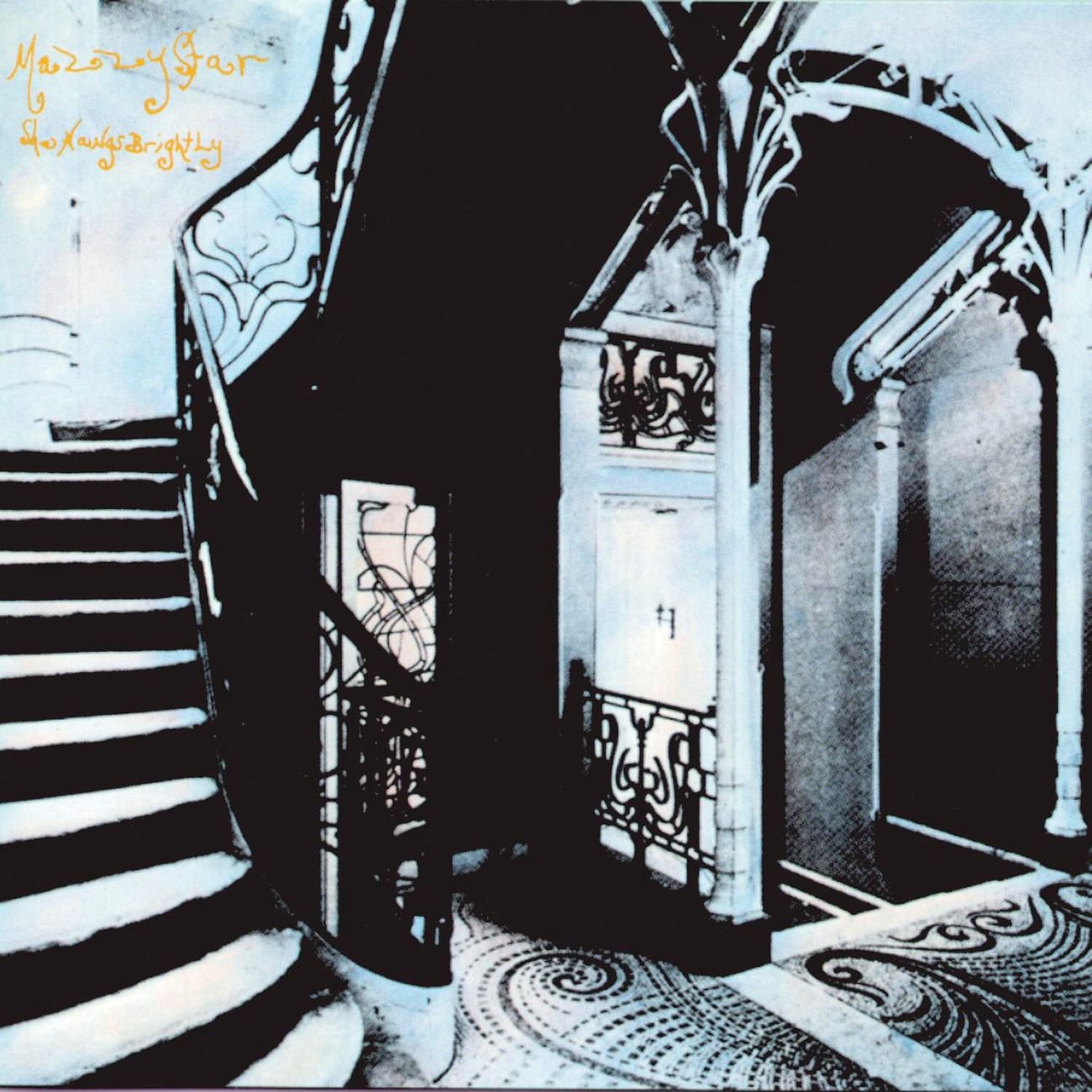
She Hangs Brightly did not chart; but it became a hit on college radio. In the UK it sold over seventy thousand copies and in the US it eventually sold a half a million units, earning a gold certification. The album cover is from the Hôtel Tassel in Brussels.Roback reveals: "I think Hope deserves a lot of attention. I think she is a great singer and a great songwriter. When I first heard her, I though she could be someone like Bob Dylan, someone who could speak for a lot of people her age...I see a lot of hope in her songs. It's like that movie... 'A Tree Grows in Brooklyn.'
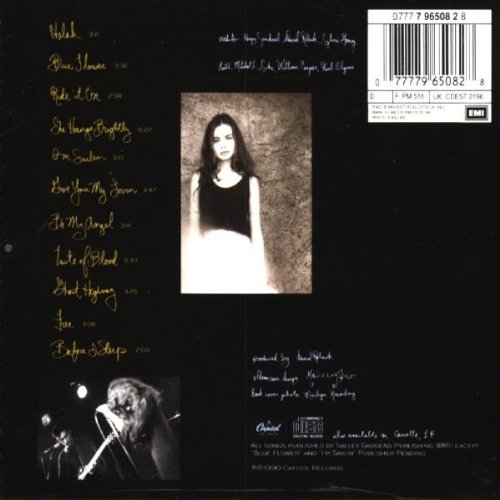
http://mazzystarstore.co.uk/ http://www.hopesandoval.com/music/mazzystar.shtml http://www.hopesandoval.com/ "Halah" reached number nineteen on the US modern rock tracks chart.VIDEO VIDEO "Blue Flower" is a cover of the song by Slapp Happy . It charted at number twenty-nine on the US modern rock tracks chart. VIDEO She Hangs Brightly full album: VIDEO All songs written and composed by Hope Sandoval and David Roback, except where noted.
00:00 "Halah" 3:16
03:16 "Blue Flower" (Peter Blegvad, Anthony Moore) 3:35 06:51 "Ride It On" 3:01
09:51 "She Hangs Brightly" 6:24
16:16 "I'm Sailin'" (Minnie McCoy) 3:13 19:28 "Give You My Lovin'" (Sylvia Gomez) 3:50 23:19 "Be My Angel" 3:17
26:36 "Taste Of Blood" 5:36
32:13 "Ghost Highway" (David Roback) 3:28 35:42 "Free" 3:11
38:51 "Before I Sleep" 2:10
Emmylou Harris had nowhere to hide and nowhere to go except the other side of desire and went looking for the water from a deeper well with the turbulent rhythms of this country reinvention. She had enjoyed an incomparable career in the traditional Nashville country idiom with eighteen studio albums (Gliding Bird Pieces of the Sky and Elite Hotel Luxury Liner Quarter Moon in a Ten Cent Town Light of the Stable - The Christmas Album Blue Kentucky Girl Roses in the Snow Evangeline Cimarron White Shoes The Ballad of Sally Rose Thirteen Trio Angel Band Bluebird Brand New Dance Cowgirl's Prayer , two live releases (Last Date At the Ryman , and guest appearances and collaborations on dozens of albums (including Will the Circle Be Unbroken 'GP' Feats Don't Fail Me Now 'Grievous Angel' Heart Like a Wheel Home Plate Prisoner in Disguise Two Lane Highway All I Can Do Desire Mike Auldridge Sleepless Nights Starland Vocal Band Texas Cookin' Ain't Living Long Like This with Rodney Crowell, American Stars 'N Bars Long Time Gone Hiding with Albert Lee, Right or Wrong with Rosanne Cash, and Sweet Temptation with Ricky Skaggs in 1979; Honeysuckle Rose with Willie Nelson in 1980; Seven Year Ache with Rosanne Cash and The Innocent Age Heartland Higher Ground with Tammy Wynette, and Pontiac Don't Close Your Eyes with Keith Whitley and Lucinda Williams in 1988; Lying to the Moon Another Country with The Chieftains, Hearts in Armor with Trisha Yearwood, Infamous Angel Joshua Judges Ruth ; Other Voices, Other Rooms Flyer Train a Comin' ; but she had seemed to reach a plateau with sales.
Harris reveals: "I will say that there were some good people at the company [Elektra] who were disappointed with the reaction to Cowgirl's Prayer. They came to me and said, 'Listen, we've done our best, we don't know what to do. Who would you like to work with?' I had become a huge fan of Daniel's first solo record and the record Oh Mercy
The sessions in New Orleans featured Emmylou Harris on vocals, acoustic guitar, and harmony vocals; Daniel Lanois on mandolin, electric guitar, acoustic guitar, bass, dulcimer, duet vocals, chant vocals, percussion, and bass pedals; Malcolm Burn on piano, tambourine, vibes, organ, synthesizer, keyboards, slide guitar, bass, drums, and harmony vocals; Larry Mullen, Jr. on drums, cymbal, and hand drum; Tony Hall on percussion, bass, and stick drum; Daryl Johnson on high harmony vocals, tom tom, drum kit bass pedals, backing vocals, harmonic bass, and harmony vocals; with Brian Blade adding drums and Indian hand drum; Steve Earle adding acoustic guitar; Sam O'Sullivan adding roto wheel; Neil Young adding harmony vocals and harmonica; Kufaru Mouton adding extro percussion; Lucinda Williams adding acoustic guitar; Richard Bennett adding tremolo guitar; and Anna McGarrigle and Kate McGarrigle adding harmony vocals.
It wasn't a huge band. It was Larry Mullen, Tony Hall, Daniel, Malcolm [Burn], and myself. People think the more you put on a record, the more exciting and emotional it's going to be. Sometimes I think that works, but for me, what they did leaves more room for vocal interpretation, and what I was hearing was so inspiring that I think it raised the bar for me...I think it was a certain time in my life. My father had died the year before. A few years earlier I had a divorce, I was living alone, except my mother had come to live with me. I was just going through a lot of changes. I've always lived through music and expressed myself through music. I chose "All My Tears" because I had sung on Julie Miller's version of that song, so I was aware of it. "Orphan Girl," I loved. I had met Gillian Welch. And I had heard Kate and Anna perform "Goin' Back to Harlan" a few years earlier, and just absolutely loved the way they did that song. It evoked something in me. At our first meeting, Dan gave me a huge book of Dylan songs. Malcolm suggested "Every Grain of Sand" and he also brought Neil Young's "Wrecking Ball." ... For me, Wrecking Ball was a watershed, if that's the right word. Before that, I felt, especially at the record company, like I'd done my bit. I'm not really on the radio, but I still had my loyal fans, I was still able to make a living touring. But it had gotten to a point where the record I made just before it, Cowgirl's Prayer in 1993, we put a lot of energy into it, and I was trying to be a good Girl Scout and give radio something they could play without compromising myself. Basically I was told, 'You're just not invited to this party anymore'." 'Wrecking Ball' I think when Wrecking Ball Wrecking Ball "http://www.emmylouharris.com/ "Sweet Old World" Sweet Old World from Craig Culver on Vimeo ."Orphan Girl"
VIDEO 'Wrecking Ball' full album:
https://myspace.com/emmylouharris/music/album/wrecking-ball-20138503 https://www.youtube.com/playlist?list=PLSy831CbqEp3jWCk3ftk5sBukCddY_LJ- VIDEO "Where Will I Be?" [with Daniel Lanois] (Daniel Lanois) – 4:15
"Goodbye" (Steve Earle) – 4:53
"All My Tears" (Julie Miller) – 3:42
"Wrecking Ball" (Neil Young) – 4:49
"Goin' Back to Harlan" (Anna McGarrigle) – 4:51
"Deeper Well" (David Olney, Lanois, Emmylou Harris) – 4:19
"Every Grain of Sand" (Bob Dylan) – 3:56
"Sweet Old World" (Lucinda Williams) – 5:06
"May This Be Love" [with Daniel Lanois] (Jimi Hendrix) – 4:45
"Orphan Girl" (Gillian Welch) – 3:15
"Blackhawk" (Daniel Lanois) – 4:28
"Waltz Across Texas Tonight" (Rodney Crowell, Emmylou Harris) – 4:46
Ryan Adams stripped his music down to the bone to create a country catharsis in this winding wheel of ruined romance. Adams had played with The Patty Duke Syndrome before he went on to start Whiskeytown, who became rising stars in the alternative country scene with two acclaimed albums ( Faithless Street in 1995 and Strangers Almanac in 1997) until their record label Outpost got lost in the midst of a merger between Universal and Polygram. Their third album Pneumonia was already finished; but it wouldn't be released for another two years. In the meantime, Whiskytown had broken up. Adams says: "The decision was made for us, really, just by time and circumstance, and I respect things that happen like that. By the time we went to make Pneumonia, there were only three surviving members. Everybody kind of pooled thoughts together for that album, and when it didn't come out, it was kind of like we reached an end that's inevitable, and we all knew it in the back of our minds ... I can’t be proud or embarrassed of what I did in Whiskeytown because I was so young,” he says. “I really was not a fully developed human being...I started this damn country band, ‘cause punk rock was too hard to sing...There’s this wrong idea about me being identified with things that are Southern or country. I do not fucking like country music and I don’t own any of it. I watched Hee-Haw as a kid with my grandmother, I only like country music as an irony. I liked it when I would get drunk...I suppose playing country music felt like learning how to build a beautiful bookshelf or something. There was a certain amount of honesty that had to be there and it had to hurt. I loved the discipline of that. It reminded me of the challenge of playing punk rock. But me playing country music … it was a false face. It was style appropriation.”
In the wake of his breakup with music publicist Amy Lombardi, Adams went to Nashville to record his solo debut. 'Heartbreaker' was produced by Ethan Johns at Woodland Studios and features Ryan Adams on vocals, acoustic guitar, electric guitar, harmonica, piano, and banjo; Ethan Johns on drums, bass, Chamberlain, glockenspiel, B-3, vibes, and backing vocals; David Rawlings on backing vocals, acoustic guitar, electric guitar, banjo, and tambourine; Gillian Welch on backing vocals, banjo, acoustic guitar, electric bass, and the "voice of Lucy"; Pat Sansone on piano, Chamberlin, organ, and backing vocals; and Emmylou Harris, Kim Richey, and Allison Pierce on backing vocals. Johns (son of legendary engineer and producer Glyn Johns) remembers: " Heartbreaker was done in 10 days flat, including the mixing. I mixed that record on the monitor section of the Neve. There's no EQ on those mixes. I had a pan and two echoes, that's it. I had been working through the monitor section of the console and when it came time to mix, I put the tapes up back through the console and it sounded terrible. So I immediately went, 'Fuck that,' and put it back through the monitor section ... The leakage on Heartbreaker is good leakage, 'cause it was a nice room...Most of the drum sound you're hearing — probably about 70 percent — is coming through the guitar and the vocal ... What you're doing is completely living with the drum sound that you get through the vocal mic. How you set up in the room is going to dictate the sound that you get, so you're thinking about the distances and all that kind of stuff. You're miking the kit to complement the sound that's coming through the vocal mic. It's the way they were doing it in the '50s, and it worked pretty well back then.” 'Heartbreaker' charted at number one hundred and eighty-three in the UK and number sixty-seven in Ireland. Adams would reveal: "It's about being really sad and missing somebody. [Amy] changed my whole life. I was like one piece of pizza. She taught me how to be the whole pie ... The songs are me, and the guitars are me. The style of the way something is recorded … it’s a ritual. It’s a preparation. So, you know … we can all make each other a meal. Anybody can make pasta and take pasta and put it in the pot. But how it’s gonna come out is gonna be different. I’m going to do it differently than you’re gonna do it. So if we do it together, it’s going to be really fucking different. It’s not wrong. It’s just like … the raw elements of truth and meaning are there. And the way that somebody kind of boils that up, and fixes it, and serves it to people, it’s still going to nourish them. But the flavors are going to be different, and the intentions are going to be different...I’m not saying that I’ve never made any other records that are me, I mean, that’s not true. I’m not going to say Heartbreaker’s not me, either. It is me. I’m just saying, there’s a way that those songs can come across, by the way the studio is prepared, the musicians who are chosen, the leader of the session. The producer sets the stage for everything that’s going to happen. But when you get to the end of a record and you don’t hear a style being invented, that’s when I think the bones of the record are strong. And the character of the record is strong. When you don’t know what it is. It hints that it’s something that it is, but it doesn’t really know what it is. I don’t think many people know what records really are anyway till a couple years later. There’s a time and place for some records, you know? Sure, there’s incidental records you can listen to every day, put in your car and do this and do that. But imagine if all records were supposed to have a general, over-arching reach. That would be so bad. A lot of my records, because they’re kind of about, in my opinion, they’re a little darker or a little more focused on the internal, sometimes focused on the eternal...They’re contemplations maybe meant for individuals." http://paxamrecords.com/ http://ryanadams.shopfirebrand.com/ "To Be Young (Is to Be Sad, Is to Be High)"
https://www.youtube.com/watch?v=moJ3xLL6SFc VIDEO "Oh My Sweet Carolina"
https://www.youtube.com/watch?v=9_D14fDloWM VIDEO "Don't Ask for the Water"
https://www.youtube.com/watch?v=BPBIibNoV7E VIDEO "Shakedown on 9th Street"
https://www.youtube.com/watch?v=UvLuWFoLIKQ VIDEO https://www.youtube.com/watch?v=yYNnVcWyvN4 VIDEO 'Heartbreaker' full album:
https://www.youtube.com/playlist?list=PLxdrYaOoYAFFgB8wnX57jIwlCSUL0-tVX VIDEO All songs written and composed by Ryan Adams, unless otherwise noted.
1. "(Argument with David Rawlings Concerning Morrissey)" (An argument regarding the Morrissey track "Suedehead".) 0:37 2. "To Be Young (Is to Be Sad, Is to Be High)" Ryan Adams and David Rawlings 3:04 3. "My Winding Wheel" 3:13
4. "AMY" 3:46
5. "Oh My Sweet Carolina" 4:57
6. "Bartering Lines" Ryan Adams and Van Alston 3:59 7. "Call Me On Your Way Back Home" 3:09
8. "Damn, Sam (I Love a Woman That Rains)" 2:08
9. "Come Pick Me Up" Ryan Adams and Van Alston 5:18 10. "To Be the One" 3:01
11. "Why Do They Leave?" 3:38
12. "Shakedown on 9th Street" 2:53
13. "Don't Ask for the Water" 2:56
14. "In My Time of Need" 5:39
15. "Sweet Lil Gal (23rd/1st)" 3:39
A Heartbreaker Road Trip
part one
https://www.youtube.com/watch?v=d21eStQcDmA VIDEO part two
https://www.youtube.com/watch?v=UHqIWtE4pbc VIDEO
Uncle Tupelo laid their burden down and sparked a new flame with thrash and twang; persuaded, paraded, inebriated and down in a land of paradise and a land of pain. The group had begun with Jay Farrar and his brothers Wade and Dade in Belleville, Illinois as The Plebes. After Jeff Tweedy and Mike Heidorn joined they became The Primatives before taking the name Uncle Tupelo. They recorded a demo 'Not Forever, Just for Now' with producer Matt Allison in Champaign, Illinois, leading to a deal with Giant Records which would soon change its name to Rockville Records. They recorded their debut album 'No Depression' over ten days in January 1990 at Fort Apache South, a musician-run studio in the Roxbury neighborhood of Boston, Massachusetts. The sessions featured Jay Farrar on vocals, guitar, banjo, mandolin, fiddle, and harmonica; Mike Heidorn on drums and cymbals; and Jeff Tweedy on vocals, acoustic guitar, and bass guitar; with Rich Gilbert adding pedal steel guitar; Paul Q. Kolderie on production, audio engineering, and sound effects; and Sean Slade on production, piano, engineering, and background vocals. J. Hamilton did the photography.
Farrar says: "Belleville’s where we were growing up, getting our start, playing in bars. St. Louis has always represented the gateway to the rest of the world. We were late teens and early twenties around the time these recordings were made. Belleville was a relatively economically depressed area, and it was also a relatively small town. I think its population was around 40,000. There weren’t that many high-profile businesses in Belleville, but there was one, the Stag Beer Factory, which closed down during that time period—or shortly before. I think it was mid ‘80s. It’s interesting to see how pervasive the references to the small-town lifestyle are in these songs..There’s definitely a sense of place. Another thing that is remarkable to me is how intertwined the music and bar culture were. That’s where we played the music, was in bars, and so much of the lyrical content reflects that. The overriding aspect of the lyrics is that so many references to moving on—seeing the rest of the world outside of Belleville...We started writing songs when we were about twenty years old, and then you hit twenty-one and all of a sudden you’re exposed to a different world and a different culture. Bar culture. It’s both a problem and a solution, and it’s something our society is still trying to figure out...We tried to stake a musical claim that shaped the band, and we put everything we listened to in a blender and came up with music to call our own."
http://uncletupelo.com/ "Graveyard Shift"
https://www.youtube.com/watch?v=nblSYuIVGlU VIDEO 'No Depression' full album:
https://myspace.com/uncletupelomusic/music/album/no-depression-8114683 VIDEO All songs written by Jay Farrar, Jeff Tweedy, and Mike Heidorn except as indicated.
"Graveyard Shift" – 4:43 "That Year" (Farrar, Tweedy) – 2:59 "Before I Break" – 2:48 "No Depression" (A.P. Carter) – 2:20 "Factory Belt" – 3:13 "Whiskey Bottle" – 4:46 "Outdone" (Farrar, Tweedy) – 2:48 "Train" (Tweedy) – 3:19 "Life Worth Livin'" – 3:32 "Flatness" (Tweedy) – 2:58 "So Called Friend" (Farrar) – 3:12 "Screen Door" – 2:42 bonus
"John Hardy" (traditional, arr. Lead Belly) – 2:21 "Left in the Dark" (Draznik) – 3:09 "Won't Forget" – 2:51 "Sin City" (Parsons, Hillman) – 3:53 "Whiskey Bottle" (Live Acoustic) – 4:40 "No Depression" (1988 Demo) – 2:19 "Blues Die Hard" (1987 Demo) (A. P. Carter) – 4:08
Steve Earle came back from oblivion with the mercenary mystery of this stripped down hometown blues. He had found early success with the rock country sound of his debut Guitar Town Exit 0 Copperhead Road The Hard Way
Earle would reveal: "At forty it becomes clear - especially if you get to be forty the way I did, defying gravity - that what's important is your life and your wife and your kids. There is an edge in things you do when you're younger, and you think it's life or death. But if you survive long enough, artistically and otherwise, it suddenly dawns on you one day that you didn't have to go through maybe all the shit that you went through, but there ain't nobody in the world that could have told you that when it was goin' on. It's just that simple."
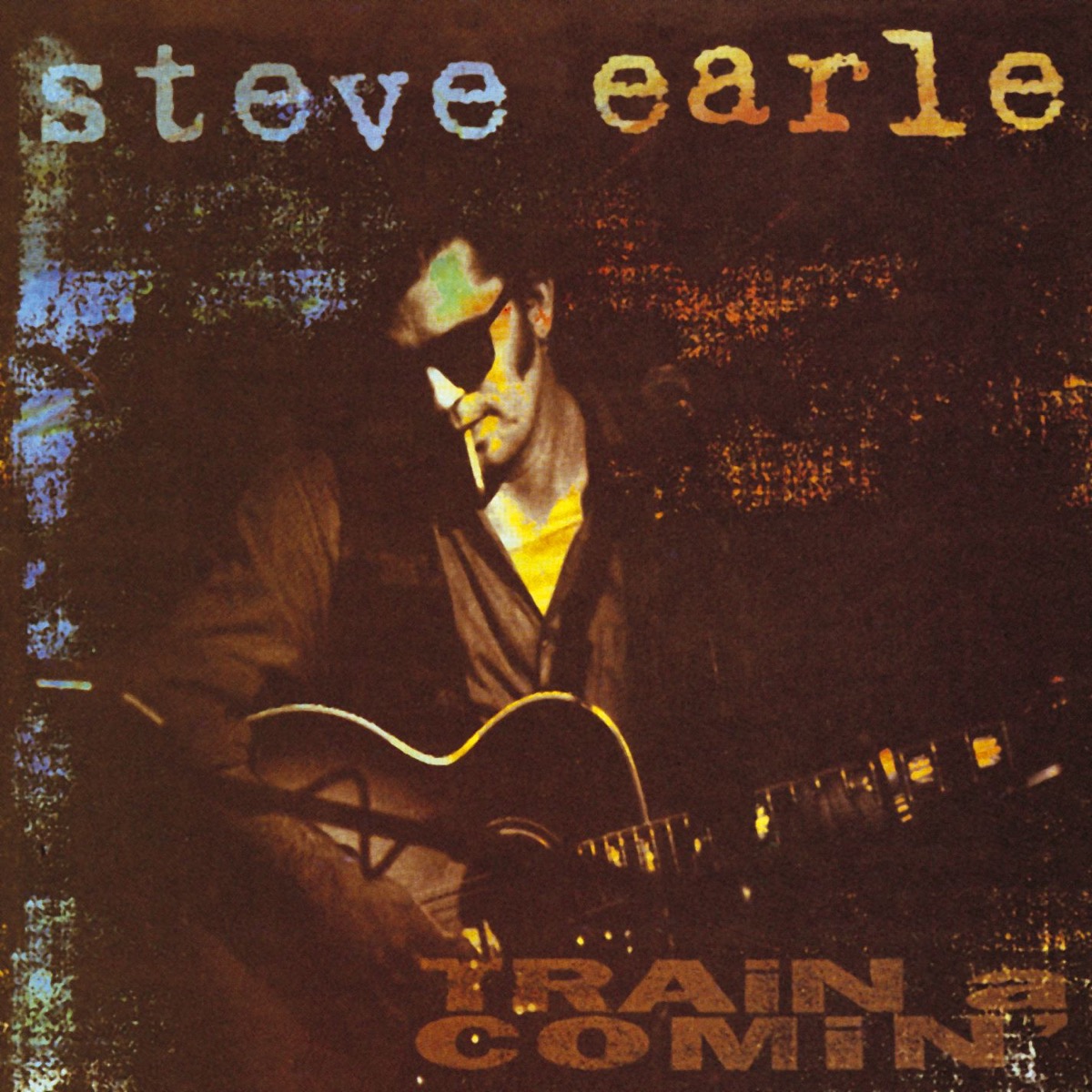
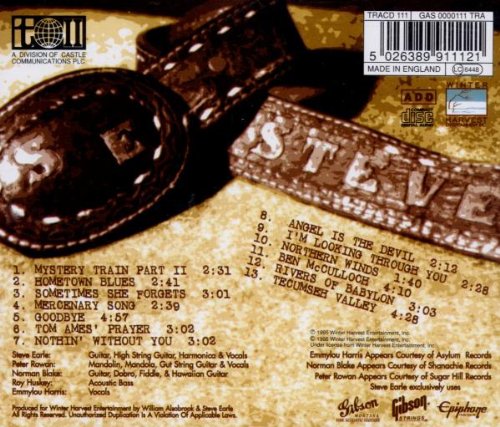
After his release, he signed with Winter Harvest Records and recorded 'Train A Comin'' in Nashville over the course of five days. The sessions featured Steve Earle on guitar, high string guitar, 12 string guitar, harmonica, mandolin, and vocals; Peter Rowan on mandolin, mandola, gut string guitars, and vocals; Norman Blake on Hawaiian guitar, dobro, mandolin, fiddle, and guitar; Roy Huskey, Jr. on acoustic bass (and inspiration on "I'm Looking Through You"); and Emmylou Harris on vocals for "Nothin' Without You" and "The Rivers of Babylon". Earle would exclaim: "I was goin' for a sound where it sounded like old Opry stuff, where everybody stepped around the mike, which is real close to what we actually did. It ended up being even more of an organic record than I thought it was gonna be ... This ain't my unplugged record! ... This is what I used to do, and it is what the great players on this record do every day of their lives, come hell or high water; but make no mistake, this ain't no part of no unplugged nothin' ... [ 'Train A Comin'' is ] exactly the record I needed right now. No major label would let me make this record coming back after four years especially. I always wanted to do it. It was a low-pressure record." 'Train A Comin'' did not chart; but it was nominated for a Grammy for Best Contemporary Folk Album.
http://steveearle.com/ "Goodbye"
https://www.youtube.com/watch?v=7nb2JmcBuEo VIDEO I remember holdin' on to you,
"Mercenary Song"
https://www.youtube.com/watch?v=WHE1dM4hYCw VIDEO "Hometown Blues"
https://www.youtube.com/watch?v=yvAbusE1veU VIDEO "Angel is the Devil" with The Supersuckers
https://www.youtube.com/watch?v=JEuYs7Dls0Y VIDEO 'Train A Comin'' full album:
VIDEO
https://myspace.com/steveearlemusic/music/album/train-a-comin-9813237 All songs written by Steve Earle unless otherwise noted. Listing reflects Earle's sequencing of the record.
"Mystery Train, Pt. 2" - 2:31 "Hometown Blues" - 2:41 "Sometimes She Forgets" - 3:01 "Mercenary Song" - 2:39 "Goodbye" - 4:57 "Tom Ames' Prayer" - 3:02 "Nothin' Without You" - 3:02 "Angel Is the Devil" - 2:12 "I'm Looking Through You" - 2:28 (John Lennon and Paul McCartney) "Northern Winds" - 1:40 (Norman Blake) "Ben McCulloch" - 4:10 "Rivers of Babylon" - 3:30 (Brent Dowe, Trevor McNaughton, Frank Farian, George Reyam) "Tecumseh Valley" - 4:28 (Townes Van Zandt)