The Kinks kontinued to kompound their konversion from koarse krunching riffage to more konceptual kompositions through the kreative konflict of this killer kollection. The group had established themselves as major players in the burgeoning British explosion with two albums (Kinks You Really Got Me Kinda Kinks "You Really Got Me" , "All Day and All of the Night" , "Tired of Waiting for You" , "Set Me Free" , "See My Friends" , and "A Well Respected Man" ; but there was trouble brewing. Their fighting onstage during their tour of the US in 1965 led to them being banned from performing anywhere in the country for three years.
Mick Avory: "It used to blow hot and cold with Kinks on the road. It could absolutely euphoric or a real downer...All a bit hazy now [how we got banned in the US]; but we did shows when the unions had called a strike and arguments started and the Kinks had their own strike, right on this bloke's nose...My relationship with Dave was up and down as he was a volatile character and didn’t take a lot to upset him, and had a foul temper, but he was good company and sociable on his good side. I used to call him Mr Hyde. I let grievance build up in me and it finally came to a head ... [After Dave knocked over my kit, I hit him in the head with a cymbal stand] because that was all I had left to hit him with. He went down, and I left the building at speed."
Dave Davies: "We were so green, and our management was green, too, We were rough and rebellious and we didn't realize the power of the unions. Management may have rubbed them the wrong way. Also, the name 'Kinks' was connected to perversion and weird people. We didn't have a lot going for us ... Looking back, I met some really unusual characters, some wonderful people and some of them are still friends. But intertwined in all that were some pretty shady people. It's the sort of business where you meet some wonderfully talented people but there are also some shark-infested waters, to say the least."
After the tour, the pressure got to Ray Davies and he had a nervous breakdown: “I’d been ill, partly because of all the lawsuits and partly because I realised other people depended on me for a living ... Some albums that we struggled with at the time, like The Kink Kontroversy Kinda Kinks ... Yeah, [pop music is disposable]; but it's also dealing with people's dreams and their emotions, and you've got to tread carefully. Because you're dealing with something that becomes somebody's memory, something they carry around with them. They come home - I've been the same - they want to hear a great record today...It gets you though the evening, sets you up. It becomes the soundtrack to people's lives. It's disposable, but a lot of people rely on that to get them through. So it can't be trivialized that much."
Pete Quaife: "Mick was already with us and playing when we went into Pye studios and I think it was him that had to do most of the adjusting! Mick was our drummer and it was a great surprise to us to find that he was not allowed to play on most of the early recordings...That was in the very beginning of our career. At this time, because we were still trying to get used to recording, we just let everything go and happily banged away at our instruments, hoping that the producer could put it all together again! So the strange bass lines in Milk Cow Blues was simply me showing off and trying to be nothing more that the lead guitarist! I cringe now when I hear it! As far as arrangements go - there were none! Nothing serious anyway. We knew the numbers off by heart and we simply started each one and then did anything we could possibly think of to make the number more exciting. It didn't always work!"
'The Kink Kontroversy' 'The Kink Kontroversy' http://www.thekinks.info/ http://www.kindakinks.net/ "Milk Cow Blues" VIDEO "Till the End of the Day" VIDEO "Dedicated Follower of Fashion" VIDEO 'The Kink Kontroversy' full album:
VIDEO All songs written and composed by Ray Davies, except where noted.
Side one
1. "Milk Cow Blues" (Sleepy John Estes; arranged by The Kinks)
2. "Ring the Bells"
3. "Gotta Get the First Plane Home"
4. "When I See That Girl of Mine"
5. "I Am Free"
6. "Till the End of the Day"
Side two
7. "The World Keeps Going Round"
8. "I'm On an Island"
9. "Where Have All the Good Times Gone"
10. "It's Too Late"
11. "What's in Store for Me"
12. "You Can't Win"
Liner Notes: Milk Cow Blues - Ray and Dave swop over lead Ring The Bells - Ray, solo Gotta Get The First Plane Home - Ray singing and playing harmonica When I See That Girl Of Mine - Dave and Ray share vocal I Am Free - Dave moans on his own Till The End Of The Day - Ray, Dave and (help!) Pete, but Ray sings lead The World Keeps Going Round - Ray mainly but with Dave and Pete in background I'm On An Island - I Think it's Ray? Where Have All The Good Times Gone - Ray and Dave It's Too Late - Ray and Dave singing, but with Shel Talmy on guitar and Ray in the control box What's In Store For Me - Dave sings assisted by Ray You Can't Win - Ray and Dave, share Before you proceed any further, ask yourself why you are reading this. Surely, the important thing is not to read about, but to listen to, the LP? It is because you are attracted by the look of the four young men enticing you to sample some KINKS KONTROVERSY? Or is it because you hope that by reading something on the back of an album cover, it will make you desperately want to buy what is inside? Maybe you are simply hung up on the Kinks. If you are, then you are wasting valuable listening time reading what is, after all, only the designer's fill-in on the back. And, you should really be gazing, enraptured, at the photograph of Ray, Dave, Pete and Mick on the other side. Should you be idly browsing through a stack of LP sleeves without the slightest intention of buying anything, read on. It will help absorb a few brief seconds of your life. And who knows, your curiosity might even be sufficiently aroused for you to want to hear this LP. For the uninitiated--and it is conceivable that there may be one or two people around who still aren't hip--the Kinks compromise two brothers, Ray and Dave Davies; a bassist by the name of Peter Quaife, and a drummer, Mick Avory. They are four seperate identities and four conflicting personalities. Yet, somehow, they gell with a magnetism and force that has made them not only one of the country's most consistent groups, but gathered them hordes of followers throughout Germany, Scandinavia, France and America as well. Ray, is one of England's most enlightened songwriters. His lyrics are very simple, to the point of being basic. They mask the complex character that evolves them. Dave's main preoccupation is the diverse pursuit of happiness. But, he too, swings between the extremes of frustration, elation and black boredom. Peter Quaife is everybody's friend. Rarely upset, he regards being a Kink infinitely preferable to being a commercial artist--his former occupation. Mick Avory is at his happiest when he is drumming. He says little, and drums a great deal. But enough is enough. Now is the fatal moment of decision. Take out the LP, listen and buy. You won't be disappointed. You never are with the Kontroversial Kinks. MICHAEL ALDRED
The Hoodoo Gurus turned their bittersweet blues into a primitive powerpop paradise with the death defying diversity of this wonderfully weird wipeout. The strength of their debut album 'Stoneage Romeos' had sparked interest for the group on the college circuit. They cut loose drummer James Baker and replaced him with Mark Kingsmill from The Hitmen to record their next album. 'Mars Needs Guitars!' was recorded with producer Charles Fisher and engineer John Bee and features Clyde Bramley on bass and backing vocals; Dave Faulkner on lead vocals, guitar, and keyboards; Brad Shepherd on lead guitar, backing vocals, lead vocals, and harmonica; and new addition Mark Kingsmill on drums and cymbals. Shepherd says: "The recording of it was just kind of workman like, and we just went up there at 301, here in Castle High Street in Sydney… and got through it fairly briefly. My recollections are that we started playing that album, we started playing the songs a whole lot better actually when we were on tour for that album. That’s my strongest recollection, that we were very busy in the wake of Stoneage Romeos
Faulkner: "When we commence the sessions for 'Mars Needs Guitars!' we had a brand new drummer, Mark Kingsmill who altered our lives forever with his distinctive explosive style. At the same time I vowed to myself that I would write less comic narratives and try to express my sentiments in a more forthright way. I feel I succeeded with 'Bittersweet' though at the time I didn't think that a) the band would want to play it and b) our audience would want to hear it. I was happily wrong on both counts ... 'Mars Needs Guitars!' was a turning point for me as a writer. I started being more personal in my lyrics, not just writing colourful stories ... The final straw with A&M was for Mars. We gave them that, and they were like, “Oh yes, ‘Bittersweet,’ we love that song! But it’s completely wrong. You’ve got to have a chorus that’s fast enough and all that, so we’re gonna show you how it should be.” The A&R guy took it into a studio in L.A., remixed it and chopped it up, and did this hideous abomination to the song. Because he thought he could do better than us, how to write a song. When we said, ‘Get fucked, you can’t release it like that!’ they dropped us. That was because it was his thing: he was going to make ‘Bittersweet’ a hit record. Of course, to this day, people would laugh at the idea of you changing that song at all.” 'Mars Needs Guitars!' charted at number one hundred and forty on the US Billboard 200 album chart, five in Australia (where it has been certified platinum), and number one on the US college album chart.
http://www.hoodoogurus.net/ "Bittersweet" reached number sixteen in Australia.
https://www.youtube.com/watch?v=oNNHEZzBDZk VIDEO You are my sword.
Your love is its own reward.
My heart, I have found,
Gets carved surely by the pound.
God knows. I tried,
Tried to hold you with all my might
But time has won,
And I could never be that strong.
(Don't cry) I couldn't be that strong,
(Don't cry) That used to be my favourite song.
(Don't cry) Tears so bittersweet
Fill my eyes whenever we meet,
It's always bittersweet.
I cut and I bleed.
You seem to find that so hard to believe!
That's just too, too bad.
You could never touch the love that we had.
(Don't cry) For the love we had,
(Don't cry) Sometimes we try to take it back.
(Don't cry) Tears so bittersweet
Kiss my cheeks whenever we meet.
It's always bittersweet.
(Don't Cry) For a love-gone-wrong
(Don't cry) That used to be my favourite song
(Don't cry) Tears so bittersweet
Kiss my eyes whenever we meet.
Anyway...
We've grown and times change.
When we meet now it feels so strange.
I hold you like a sword
You won't cut me like you did before.
It's always bittersweet.
"Like Wow – Wipeout" went to number fifteen in Australia. Faulkner: "We recorded thinking that we could make a bit of racket and have some studio fun ... as a b-side but producer Charles Fisher thought it 'had something' and should be included on the album. No-one was more surprised than us when it became the second single and our biggest hit at the time. We just liked it because it was noisy."
https://www.youtube.com/watch?v=bkgOumIrSY8 VIDEO "Death Defying"
https://www.youtube.com/watch?v=aRHvTrfpiTI VIDEO 'Mars Needs Guitars!' full album:
https://www.youtube.com/playlist?list=PLEvr99j7ruPzNF50_3yPpzyVT8vTveD0G VIDEO All written tracks by Dave Faulkner unless otherwise indicated.
"Bittersweet" – 3:44
"Poison Pen" – 4:09
"In the Wild" – 3:07
"Death Defying" – 3:21
"Like Wow – Wipeout" – 3:09
"Hayride to Hell" – 3:15
"Show Some Emotion" – 2:56
"Other Side of Paradise" – 3:31
"Mars Needs Guitars" (James Baker, Clyde Bramley, Faulkner, Mark Kingsmill, Brad Shepherd) – 2:52
"She" – 3:28
Neil Young + Crazy Horse took a chance on love to overcome hate with the healing light of a psychedelic grunge resurgence. Young had endured numerous stylistic changes with twenty-three albums ( Neil Young in 1968, Everybody Knows This Is Nowhere in 1969, After the Gold Rush in 1970, Harvest in 1972, Time Fades Away in 1973, On the Beach in 1974, Tonight's the Night and Zuma Long May You Run American Stars 'n Bars Comes a Time Rust Never Sleeps Live Rust Hawks & Doves Re-ac-tor Trans Everybody's Rockin' Old Ways Landing on Water Life This Note's for You Eldorado Freedom released over twenty-one years; but his work over the past decade had not been well received by critics or fans. With the political fire of the hit single "Rocking in the Free World" from Freedom
His next album 'Ragged Glory' was recorded during April of 1990 at Plywood Digital in Woodside, California (except "Mother Earth" which was recorded live at The Hoosier Dome). The sessions were produced by Young and David Briggs and featured Neil Young on guitar and vocals, Frank Sampedro on guitar and vocals, Billy Talbot on bass guitar and vocals, and Ralph Molina on drums and vocals.
The sound harkens back to the aggressive guitar rock of albums like Everybody Knows This Is Nowhere . Young would express: "Things just keep cycling around. I really don't know what brought me back to it. I woke up one morning and all I could hear was the loudest . . . drum I ever heard in my life in my head -- so I knew that wasn't country!...We did the whole thing in three months, from before the songs were written until the album was mastered and turned in, It happened kind of fast. It was like something comes along and you have to jump on and do it. You can't stop until it's done because obviously we knew we were onto it. And we've learned over the years that when the wave comes along, you'd better grab it. So that's what we did, and we just stayed on it until it was up on the beach. It wore me out, but in a real good way. I feel real lucky to have caught that one...With Crazy Horse, it's all one big, growing, smoldering sound, and I'm part of it. It's like gliding, or some sort of natural surfing, or something. . . . It's like a long ride...They've been around a long time. In some ways, they're related to roots of other families of my music in my past and even other music in my past that I didn't make myself. I don't go through this album without hearing Hendrix, Cream and the Doors as well as my own roots...I don't know. I just do what I do. I like to make music, and I feel real lucky to have made this one here, which has really attained a height of some sort. There's definitely some kind of height to this I haven't felt in some time."
'Ragged Glory' went to number thirty-one in the US, twenty-five in Sweden, twenty-two in New Zealand, twenty in Canada, and fifteen in the UK.
http://www.neilyoung.com/ http://neilyoung.warnerbrosrecords.com/music-1/ragged-glory-cd.html "Farmer John"
https://www.youtube.com/watch?v=GXOeNLs0EBY VIDEO "Mansion on the Hill"
https://www.youtube.com/watch?v=c1WpgTzf8nk VIDEO "F*!#in' Up"
https://www.youtube.com/watch?v=BKaDCP-wKr8 VIDEO "Love to Burn"
https://www.youtube.com/watch?v=a9wceu6Qxb0 VIDEO "Mother Earth (Natural Anthem)"
https://www.youtube.com/watch?v=ZQCcMisYSLw VIDEO 'Ragged Glory' full album:
VIDEO All songs written by Neil Young except as noted.
1. "Country Home" 7:05
2. "White Line" 2:57
3. "F*!#in' Up" 5:54
4. "Over and Over" 8:28
5. "Love to Burn" 10:00
6. "Farmer John" (Don Harris, Dewey Terry) 4:14 7. "Mansion on the Hill" 4:48
8. "Days That Used to Be" 3:42
9. "Love and Only Love" 10:18
10. "Mother Earth (Natural Anthem)" 5:11
bonus
"Don't Spook the Horse" 7:36 VIDEO
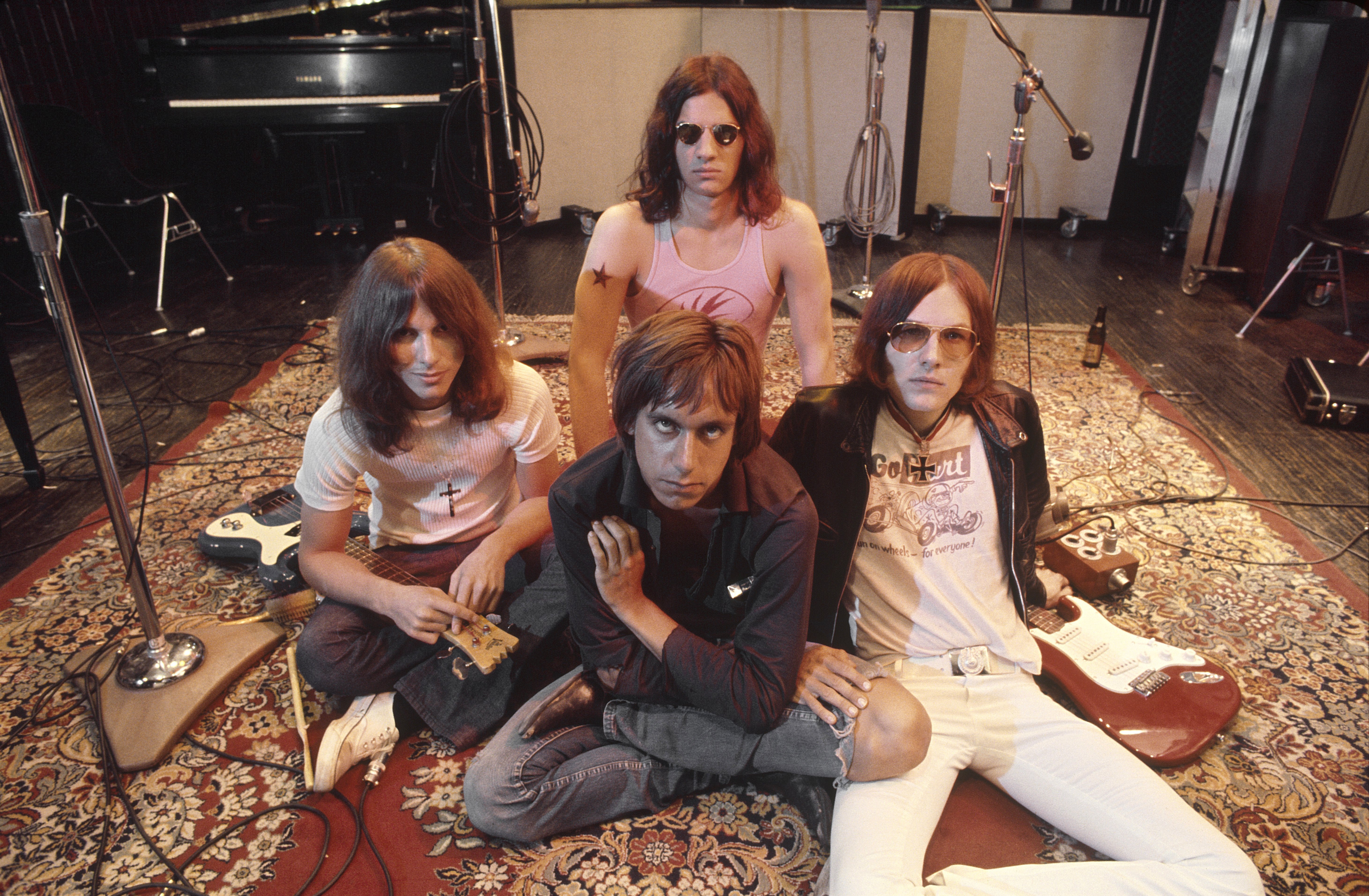
The Stooges came to play live and loose in the studio with a real low mind on this primitive punk freak out. The Detroit band had defied expectations with their audacious live shows with lead singer Iggy Stooge (James Newell Osterberg aka Iggy Pop) gyratic outrageously and diving off of the stage into the audience. Guitarist Ron Asheton says: "I empathize with [Iggy] only in the sense that he had set a precedent with his stage antics, and he had to come up with stuff all the time. I didn't know, he actually told me that he took acid for every show for a year. And I went "What?" I was so used to him, I didn't even know he was on acid. His eyes always looked like he was crazy. He just smoked a bunch of pot...He had to come up with stuff, and it did start to drain him, mentally and physically, and he found the heroin probably to be relaxing in the beginning, but then it was like oh, man...When we did ['Fun House'], we still liked each other, we were still a band, all that was smoked was hashish or marijuana, that was the only drugs. No one was taking...at least I wasn't, or Dave or Scotty; Iggy was taking acid. In other words, it was just back to the so-called soft drugs."
Although their eponymous debut had only charted at number one hundred and six on the US album chart, the band got the green light to record another album. 'Fun House' was recorded during two weeks in May of 1970 at Elektra Sound Recorders, Los Angeles. The sessions featured Iggy Pop on vocals, Ron Asheton on guitar, Dave Alexander on bass guitar, Scott Asheton on drums, and Steve Mackay on saxophone. Don Gallucci, who at the age of fourteen had played keyboards on the Kingsmen's classic "Louie Louie" , was brought in to produce and even played organ. Gallucci remembers: "Iggy was using the mic just like he did onstage, and you're going to get distortion that way. We used limiters, but there is only so much they can do! We didn't think it hurt for this record to have distorted vocals. No one wanted to wear headphones, except for Ron Asheton...We all knew it was awful. However, there was no subsequent big discussion about a different recording technique. Iggy was clearly frustrated. He wanted to have close contact with his guitarist. He wanted to be able to lean over into Ron's amp and hear the guitar jump out at him. I knew nothing could sound worse than what we had, so we got rid of the baffles, set the band up just as they would be onstage and brought in the P.A. speakers [and split the singer's mic feed between the P.A. amplifier and the recording console]...That way Iggy could be comfortable and have the live sound experience he was used to, and he didn't need headphones. We absolutely wanted everything to bleed. That gave us the much-needed natural sound quality and the familiar aural environment the band wanted. I think some of the best recordings-at least in terms of fatness, texture and warmth-were made with one microphone at the back of a bar, so I thought it was at least worth a try ... Everything in music had gotten so fey. At around the same time as Fun House , I went to this big Columbia Records dinner, and the main event was Simon & Garfunkel performing 'Bridge Over Troubled Water.' That's a beautiful song, but to The Stooges, taking rock and pop and making it so acceptable and refined was sacrilegious. Their whole thing was to go Zen, to cut the music right back to its essence ."
Ron Asheton reveals: "Gallucci had a very cool concept. He wanted to find another aural direction for The Stooges, to capture a total live feeling, one where the sounds would encompass themselves like onstage. And that's the beauty of that record, because it was as close to our live sound as could be captured in a studio ... They picked him, and we didn't even know that he was coming to a lot of shows in the beginning, and seeing us play, and then we kinda met him, and knew he was gonna be there, and "He's gonna be your producer," and we're like, "Hunh?... He was a short guy, he was always impeccably dressed in a really nice suit, and I'm going, "How is this guy, who's dressed in this really nice suit, gonna relate to the Stooges?" But he did an excellent job. He wanted to capture the show. I think he only changed the order of the set; he switched two songs, I can't even remember. What was even more amazing is when we first met him and we met the engineer, Ross Meyer -- he was pretty quiet, probably in his 50s at the time -- and I thought "Oh boy, we're in trouble." Little did we know we had very competent people in the control room. He finally started talking a little bit, and he goes, "Yeah, this stuffs all right. It's a big change from Barbara Streisand. " Hunh? He just got done doing Barbara Streisand's record. From Barbara Streisand to the Stooges... Whaat? It turned out they did a fantastic job. And we had a great time, and we'd just come off the road, so our chops were...man, we were there. I mean, it was literally off the road, a week to get our house in order so we could go to L.A. for a month. So we were ready to go, and that's why that record was as smooth and good as it was. We did minimal takes; I don't think we did more than five takes, or four takes, and a lot of times we'd take the first one or the second one. It went really well...Well, basically by then, everybody had learned to play and had a little bit more of a handle on what to do. The first record was a big pain, because all we knew was stack of Marshalls on ten. And that was the big fight. "You can't play a double stack of Marshall amps on ten in this little studio." I'm going, "Yeah, but man, that's the sound." So there'd be big fights...I think the compromise was I went down to like nine. But still, they overcompensated, taking a lot of the edge off. And I used the Flying V for half the tunes, every song but three. But by the Fun House record, I went down to a Marshall 50, which could be on nine, ten...just a smaller cabinet, what I call "the refrigerator top;" I think it had six tens in it. And Dave just used a hundred watt with one speaker. So yeah, it was a bigger studio and it was a lot more fun. And we were treated like not stupid kids, but actually "professional musicians," which was like Hunh? I mean, that was only the second time I'd ever been in a recording studio. But by then, being that we'd been on the road so long, we really progressed. We learned an awful lot in a short amount of time. You can see the progression of our playing from the first record to the second record. Gee, that was like a year. We just played so much, everyone's abilities just increased unbelievably. I never thought of it until just recently..."On the job training." That's how the Stooges learned everything..."on the job."...That whole Funhouse album was our set. Gallucci wanted to capture our set the best he could on record. He did a good job. We were playing all those tunes at the time we recorded them, but we didn't have to be in the studio and go, "Oh, we need some more songs." It was already all there."
'Fun House' didn't even chart in the US, and despite going on to become cited as a major influence on the punk movement that came years later, the album has still only sold less than a hundred thousand copies. Iggy considers: " I have a suspicion that the design of some of the songs was ahead a few years. I've always hated that phrase "it was ahead of its time", but it was. Some of the albums, like Fun House , but certain parts of each of the three... Some of the lyrics have allowed the songs to stick around, but then again some of the terms and phrases were a little out there when we were coming up with them. But right now, it fits. The music itself in all its aspects may have become...it may have found a utility for younger musicians that it didn't have when we started. In other words, I know when I was first starting John Lee Hooker was incredibly useful to me...In 1965, when great young white artists in the English-speaking world were successfully re-channeling hillbilly and black music-- you know Bob Dylan, Ray Davies, Pete Townsend, Keith Richards-- they didn't get any money at first. They were all broke. All those giant people had to stay around quite a while to cash in because the industry ripped them off more efficiently ." www.iggyandthestoogesmusic.com "TV Eye"
live in Cincinnati
June 13, 1970
https://www.youtube.com/watch?v=XR2rl_OVcl4 VIDEO "Funhouse Freak" (aka LA Blues) first take
Iggy says: "We used to call that song "Freak Out", and when we recorded Funhouse, because we were in L.A., I gave it the title "L.A. Blues". On the very end of that record, you'll hear me repeat that lyric a little different. I think I say the phrase "I am", and then the last sound on that record is the word "you" and for some reason I enjoy doing it live. The one thing it means to me, maybe, is that I'm still that person in the audience. Maybe that's what I'm trying to say there, because for some reason I'm still…I get outraged when I see some fat bottom creep…I can't explain it. It's as near to a religion as I ever got, this thing, and I really don't like getting any more than casual about it, but I do have certain deep feeling about it that do come out time to time."
https://www.youtube.com/watch?v=p1aS_3tjSog VIDEO 'Fun House' full album:
VIDEO All songs written and composed by The Stooges.
Side one
1. "Down on the Street" 3:42
2. "Loose" 3:33
3. "T.V. Eye" 4:17
4. "Dirt" 7:00
Side two
5. "1970" (aka "I Feel Alright") 5:14
6. "Fun House" 7:45
7. "L.A. Blues" 4:52
outtakes
Lost In The Future – 5:42 Slide [Slidin' The Blues] – 4:35 VIDEO