Showing posts with label proto punk. Show all posts

Friday, September 4, 2015

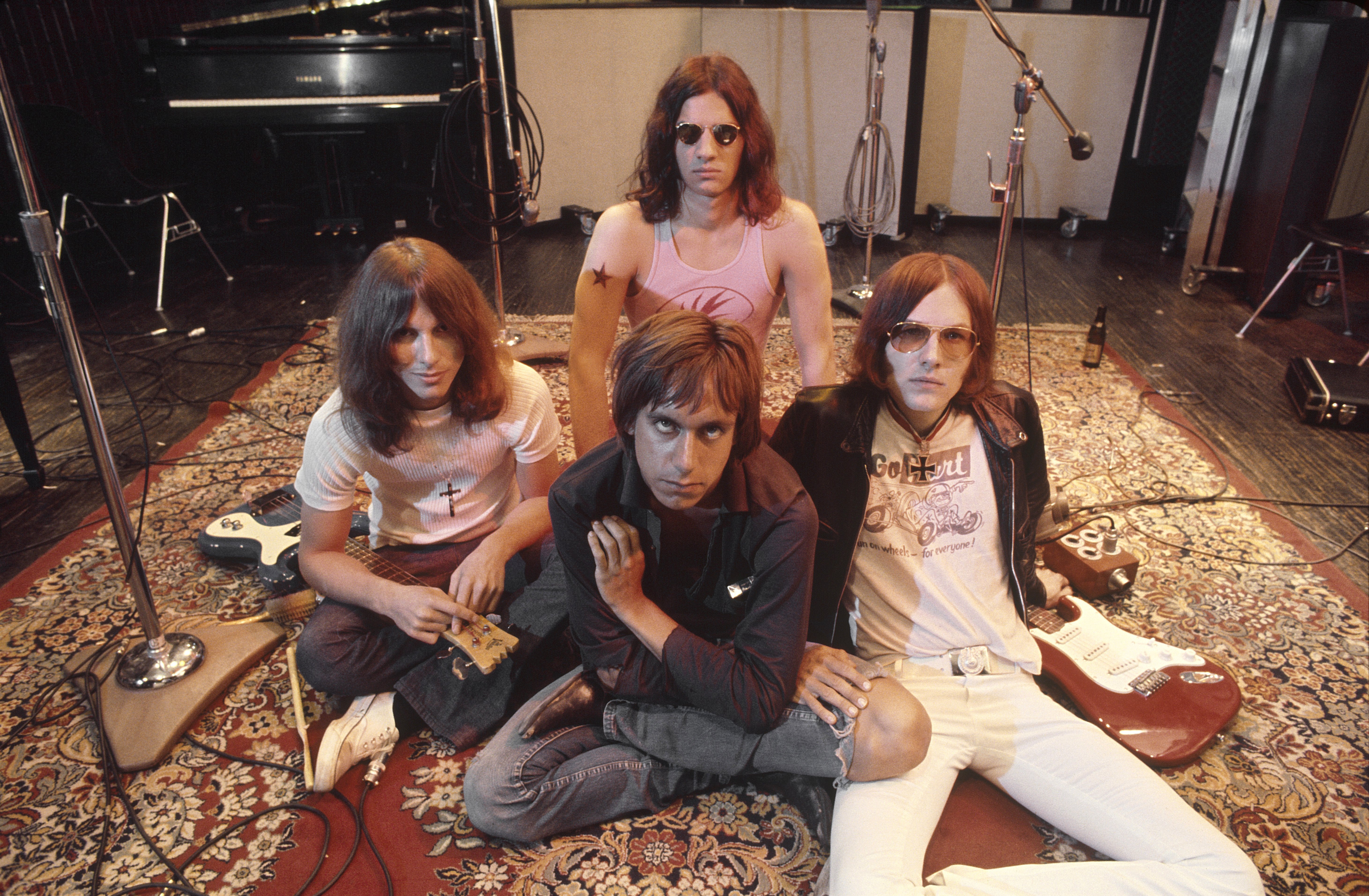
fun house


The Stooges came to play live and loose in the studio with a real low mind on this primitive punk freak out.   The Detroit band had defied expectations with their audacious live shows with lead singer Iggy Stooge (James Newell Osterberg aka Iggy Pop) gyratic outrageously and diving off of the stage into the audience.  Guitarist Ron Asheton says:   "I empathize with [Iggy] only in the sense that he had set a precedent with his stage antics, and he had to come up with stuff all the time. I didn't know, he actually told me that he took acid for every show for a year. And I went "What?" I was so used to him, I didn't even know he was on acid. His eyes always looked like he was crazy. He just smoked a bunch of pot...He had to come up with stuff, and it did start to drain him, mentally and physically, and he found the heroin probably to be relaxing in the beginning, but then it was like oh, man...When we did ['Fun House'], we still liked each other, we were still a band, all that was smoked was hashish or marijuana, that was the only drugs. No one was taking...at least I wasn't, or Dave or Scotty; Iggy was taking acid. In other words, it was just back to the so-called soft drugs."


Although their eponymous debut had only charted at number one hundred and six on the US album chart, the band got the green light to record another album.   'Fun House' was recorded during two weeks in May of 1970 at Elektra Sound Recorders, Los Angeles.  The sessions featured  Iggy Pop on vocals,  Ron Asheton on guitar, Dave Alexander on bass guitar, Scott Asheton on drums, and Steve Mackay on saxophone.  Don Gallucci, who at the age of fourteen had played keyboards on the Kingsmen's classic "Louie Louie", was brought in to produce and even played organ.    Gallucci remembers:   "Iggy was using the mic just like he did onstage, and you're going to get distortion that way.  We used limiters, but there is only so much they can do! We didn't think it hurt for this record to have distorted vocals.  No one wanted to wear headphones, except for Ron Asheton...We all knew it was awful.  However, there was no subsequent big discussion about a different recording technique. Iggy was clearly frustrated. He wanted to have close contact with his guitarist. He wanted to be able to lean over into Ron's amp and hear the guitar jump out at him. I knew nothing could sound worse than what we had, so we got rid of the baffles, set the band up just as they would be onstage and brought in the P.A. speakers [and split the singer's mic feed between the P.A. amplifier and the recording console]...That way Iggy could be comfortable and have the live sound experience he was used to, and he didn't need headphones. We absolutely wanted everything to bleed. That gave us the much-needed natural sound quality and the familiar aural environment the band wanted.  I think some of the best recordings-at least in terms of fatness, texture and warmth-were made with one microphone at the back of a bar, so I thought it was at least worth a try...Everything in music had gotten so fey. At around the same time as Fun House, I went to this big Columbia Records dinner, and the main event was Simon & Garfunkel performing 'Bridge Over Troubled Water.' That's a beautiful song, but to The Stooges, taking rock and pop and making it so acceptable and refined was sacrilegious. Their whole thing was to go Zen, to cut the music right back to its essence."


Ron Asheton reveals:   "Gallucci had a very cool concept. He wanted to find another aural direction for The Stooges, to capture a total live feeling, one where the sounds would encompass themselves like onstage. And that's the beauty of that record, because it was as close to our live sound as could be captured in a studio  ...  They picked him, and we didn't even know that he was coming to a lot of shows in the beginning, and seeing us play, and then we kinda met him, and knew he was gonna be there, and "He's gonna be your producer," and we're like, "Hunh?... He was a short guy, he was always impeccably dressed in a really nice suit, and I'm going, "How is this guy, who's dressed in this really nice suit, gonna relate to the Stooges?" But he did an excellent job. He wanted to capture the show. I think he only changed the order of the set; he switched two songs, I can't even remember. What was even more amazing is when we first met him and we met the engineer, Ross Meyer -- he was pretty quiet, probably in his 50s at the time -- and I thought "Oh boy, we're in trouble." Little did we know we had very competent people in the control room. He finally started talking a little bit, and he goes, "Yeah, this stuffs all right. It's a big change from Barbara Streisand. " Hunh? He just got done doing Barbara Streisand's record. From Barbara Streisand to the Stooges... Whaat?  It turned out they did a fantastic job. And we had a great time, and we'd just come off the road, so our chops were...man, we were there. I mean, it was literally off the road, a week to get our house in order so we could go to L.A. for a month. So we were ready to go, and that's why that record was as smooth and good as it was. We did minimal takes; I don't think we did more than five takes, or four takes, and a lot of times we'd take the first one or the second one. It went really well...Well, basically by then, everybody had learned to play and had a little bit more of a handle on what to do. The first record was a big pain, because all we knew was stack of Marshalls on ten. And that was the big fight. "You can't play a double stack of Marshall amps on ten in this little studio." I'm going, "Yeah, but man, that's the sound." So there'd be big fights...I think the compromise was I went down to like nine. But still, they overcompensated, taking a lot of the edge off. And I used the Flying V for half the tunes, every song but three.  But by the Fun House record, I went down to a Marshall 50, which could be on nine, ten...just a smaller cabinet, what I call "the refrigerator top;" I think it had six tens in it. And Dave just used a hundred watt with one speaker. So yeah, it was a bigger studio and it was a lot more fun. And we were treated like not stupid kids, but actually "professional musicians," which was like Hunh? I mean, that was only the second time I'd ever been in a recording studio. But by then, being that we'd been on the road so long, we really progressed. We learned an awful lot in a short amount of time. You can see the progression of our playing from the first record to the second record. Gee, that was like a year. We just played so much, everyone's abilities just increased unbelievably. I never thought of it until just recently..."On the job training." That's how the Stooges learned everything..."on the job."...That whole Funhouse album was our set. Gallucci wanted to capture our set the best he could on record. He did a good job. We were playing all those tunes at the time we recorded them, but we didn't have to be in the studio and go, "Oh, we need some more songs." It was already all there."


 'Fun House'  didn't even chart in the US, and despite going on to become cited as a major influence on the punk movement that came years later, the album has still only sold less than a hundred thousand copies.   Iggy considers:   "I have a suspicion that the design of some of the songs was ahead a few years. I've always hated that phrase "it was ahead of its time", but it was. Some of the albums, like Fun House, but certain parts of each of the three... Some of the lyrics have allowed the songs to stick around, but then again some of the terms and phrases were a little out there when we were coming up with them. But right now, it fits. The music itself in all its aspects may have become...it may have found a utility for younger musicians that it didn't have when we started. In other words, I know when I was first starting John Lee Hooker was incredibly useful to me...In 1965, when great young white artists in the English-speaking world were successfully re-channeling hillbilly and black music-- you know Bob Dylan, Ray Davies, Pete Townsend, Keith Richards-- they didn't get any money at first. They were all broke. All those giant people had to stay around quite a while to cash in because the industry ripped them off more efficiently."


www.iggyandthestoogesmusic.com


"TV Eye"
live in Cincinnati
June 13, 1970
https://www.youtube.com/watch?v=XR2rl_OVcl4


"Funhouse Freak" (aka LA Blues) first take
Iggy says:   "We used to call that song "Freak Out", and when we recorded Funhouse, because we were in L.A., I gave it the title "L.A. Blues". On the very end of that record, you'll hear me repeat that lyric a little different. I think I say the phrase "I am", and then the last sound on that record is the word "you" and for some reason I enjoy doing it live. The one thing it means to me, maybe, is that I'm still that person in the audience. Maybe that's what I'm trying to say there, because for some reason I'm still…I get outraged when I see some fat bottom creep…I can't explain it. It's as near to a religion as I ever got, this thing, and I really don't like getting any more than casual about it, but I do have certain deep feeling about it that do come out time to time."

https://www.youtube.com/watch?v=p1aS_3tjSog


 'Fun House' 
full album:


All songs written and composed by The Stooges.

Side one
1. "Down on the Street"   3:42
2. "Loose"   3:33
3. "T.V. Eye"   4:17
4. "Dirt"   7:00

Side two
5. "1970" (aka "I Feel Alright") 5:14
6. "Fun House"   7:45
7. "L.A. Blues"   4:52


outtakes

Lost In The Future – 5:42

Slide [Slidin' The Blues] – 4:35


Friday, May 29, 2015

neu! '75


Neu! brought their divergent musical streams together to craft this ambient motorik proto-punk amalgam.     Michael Rother  and   Klaus Dinger  started the project after a brief stint with Kraftwerk in 1971.  They recorded two experimental albums ('Neu' and 'Neu 2' ) before taking a brief hiatus.  During the recording of the second album, they ran out of money and used remixed versions of singles from the album to flesh out side two.    Michael Rother left Düsseldorf to form Harmonia with Dieter Moebius and Hans-Joachim Roedelius in Forst/Weserbergland; while  Klaus Dinger started his own label Dingerland which soon went bankrupt.


Dinger:    "I studied architecture for three years and gave that up and jumped into a black hole, and, ja, let’s say this official way of life was gone at that time, so somehow I had to express myself, or together with Michael, but still myself — or himself. I also was very, I mean I believed in his originality from the beginning. It was very obvious. So, ja, what else, what more can you ask for? But, ja, self-consciousness, I think that is a very individual thing ... Neu! 75 happened in December 74, and, ja, in this year, early 74, I made my own label, and had produced another group, called Lilac Angels...I spent a lot of money on that and I didn’t get the response I wanted from the industry...Anyway, the deal didn’t happen and I was very angry, bankrupt for the first time in my life, lots of debts for my experience so far at that time, it was about 50,000 marks. And I made two more attempts to get this label going, and organised, and also borrowed money to finance two free concerts in 74, which happened in a place quite close to Düsseldorf. And also then nobody appeared from the industry, and, ja, I think at that time I already had a quite bad image — which didn’t get much better in the meantime over the years ... My then girlfriend, which you find one way or the other in many songs, “Lieber Hönig”, for instance, that is this one, or the one who sat with me in this rowing boat you can hear on the first album. This was a bit difficult relation, because she had to go to Norway with her parents, and during the whole Neu!, this whole time, these three years, we nearly never met, or so on, somehow strange to believe today, ne?, how this can happen, and in 74, in this year when all these things didn’t happen, also this relationship finished, and all these bad feelings and, ja, not so much perspective, I must say, at that time, the only chance was to, OK, there was one more record to make for Metronome, and we did that. But as you can hear... it’s maybe quite interesting to really write it down these “Hero” words..."


'Neu '75' was recorded and mixed at Conny Plank's studio between December 1974 and January 1975 with Konrad "Conny" Plank acting as producer and engineer.   The sessions featured  Michael Rother on guitar, keyboards, and vocals;   and   Klaus Dinger on drums for side 1, and guitar and vocals for side 2;    with Thomas Dinger and Hans Lampe playing drums on side 2.  


'Neu '75' 
full album:

https://www.youtube.com/watch?v=GT0f1Tw3YXM


All songs written and composed by Klaus Dinger and Michael Rother.

Side one
00:00 "Isi" 5:06
05:06 "Seeland" ("Sea Land") 6:54
12:01 "Leb' Wohl" ("Farewell") 8:50

Side two
20:52 "Hero"   7:11
28:03 "E-Musik" ("Ernste Musik") 9:57
38:01 "After Eight" 4:44


Tuesday, August 5, 2014

the stooges


Iggy and the Stooges prefigured punk with the savage swaggering subversive sonic boredom blues of their dark and dangerous debut.  James Newell Osterberg had played in various bands around Ann Arbor, Michigan, getting his nickname 'Iggy' after a stint in the Iguanas.  He was inspired to create a new kind of blues music after a visit to Chicago.  He hooked up with brothers Ron and Scott Asheton and their friend Dave Alexander, who gave Iggy his pseudonymous surname 'Pop'.  

Osterberg reveals:  "I had some basic ideas. One idea was when I woke up - like Steve Martin does in The Jerk - and realised that I wasn’t old or poor or black (laughs), and that I wasn’t going to be a great blues man, I thought I would like to emulate everything that I’d seen hanging around with some of these guys briefly, some of these blues guys that I’d kinda groupied in Chicago for a while. I thought, ‘These guys are just a bunch of hoods anyway. I’d like to be like them and sound like them and write like them, but about things that concern who I am and who my people are.’ That didn’t really go far at first, honestly, when I tried to hook up with Scott and Ron based on that. A lot of the ideas were too wildly arty and creative, and it wasn’t really going anywhere. It was interesting: the more it didn’t go anywhere, the more the ideas got simpler, noisier and crazier. That was really step-by-step, inch-by-inch: simple, noisy and crazy! (Laughs) And that seemed to work for us...It was always my impression - and it still is - that the only possible positive drug effect that I can pin-point for any of the drugs, is not what it leads you to or what it lets you see, it’s just what it blocks out. It blocks out other choices so that you’re allowed to relax and believe and concentrate on the one or two things that always were really important and that you always liked anyway. That’s all it ever really did. And then, of course, what happens is you run into problems. A few drug experiences turn over and things begin to spin out of control, they don’t work for you that way anymore. But honestly, no. It was just something... I mean, for instance, naming the group - we’d been up all night taking psychedelics together, because we didn’t know how to hang out any other way! (Laughs) And it was I, basically - the rest of the guys would have just enjoyed themselves to death - who was a little more ambitious than the other fellas. I said, ‘Listen, we’re not gonna waste this trip without getting something out of this - we’re not rehearsing’. At this particular time the big excuse for not rehearsing was that the cops would bust us, which was true, but things like that never ever stopped me. But the other guys were not as nuts as I am. So I said, ‘Well, let’s talk about what we’re gonna call our band’, because we didn’t have a good name for it yet. Then, after a little discussion, Ron came up with the idea, ‘Well, we’ll be like the Stooges except we’ll be the Psychedelic Stooges.’ It was inevitable that anything creative that Ron did in his life was gonna come back to the Stooges, because he’d already spent probably seventeen thousand man hours watching The Three Stooges’ films when he was supposed to be doing something else since he was twelve. (Laughs) So did it really take psychedelic drugs for him to think of that? Well, that’s your call. So that’s kinda how I feel about the whole thing. I was always meant to take off my clothes and jump up and down. That’s who I am!...From Mick Jagger, the idea that there should be a performance, that there is a performance; just that. That there has to be a level of staginess that he learned, I quickly found out, from good black R&B performers, America’s own, which we had rejected. And the other thing from him that was great - from both of them actually - was that yes, the vocal thing could be built from two notes, that they could always be the same. You did not need to be Wilson Pickett. From Morrison, it was the same way but with the elements of surprise. Here you have surprise, you have poetry and you have a further violation, a little different take on this sort of thing. So with both of them, it was more the ideas of the thing, not the actual thing. I mean, we had all sorts of people around our local area that did Mick Jagger - I never did that. There must have been a thousand guys doing him in 1968 in the USA - you could get a gig that way, you know? The one that finally did it best was the guy out of Aerosmith [Steven Tyler]; he got a good gig out of that. But yeah, there were guys who actually used to do him down to the clothes and do the exact little moves and everything. The cover band culture in the US was intense...It was quite a while before I opened my mouth and ever had the impression that what I was hearing come out was something that was really exciting that I was ready to share with the world, let’s put it that way! (Laughs) I don’t think I concentrated. I don’t think I gave it real consideration until we got a record deal, and then as soon as we did and I realised, ‘Oh, holy shit: we’re gonna be recording’ then everything changed and I thought about it a great deal. It was probably very lucky that in our primitive times and given our primitive personalities, these thoughts were nothing that I could really practice very much, because I could never really hear myself sing, either at our gigs or at our rehearsals. So I just imagined all the elements that I would want in a good Iggy Pop vocal, and I practiced them in my room when I thought nobody was around. But before the first album, it was more about just throwing my voice out into a place that helped the music. I was just one more instrument. Nobody had any leads - there was no real lead guitar. It’s hard to tell what we were doing for most people, but we did it like a pack of dogs - until we made the first album, and then we became more rockist."


'The Stooges' was produced by John Cale for Elektra Records and featured Iggy Pop ("Iggy Stooge") on vocals;  Dave Alexander on bass guitar;  Ron Asheton on guitar and vocals;  and Scott Asheton on drums;  with John Cale adding piano, sleigh bell on "I Wanna Be Your Dog", and viola on "We Will Fall".  The story goes that Cale tried to convince the band to use smaller amps than their Marshall stacks; but the group sat down in the middle of the studio and smoked hash until Cale finally acquiesced.  Even so, the initial mix of the album was deemed unsatisfactory by the band and was ultimately remixed by Elektra founder Jac Holzman and Iggy Pop.  That was after the band was told they needed to record more material than the five songs that were part of their standard live set:   "We handed [it] in and they refused it. They said, 'There aren't enough songs!' So we lied and said, 'That's OK, we've got lots more songs.'"

'The Stooges'  made it to number one hundred and six on the Billboard album chart.  The sheets of feedback and the primative proto-punk sound were too much for critics and fans alike.  Osterburg reflects:  "It was just a completely different world than any of the people in Detroit or in the universe at that time. It sold enough for me. It never bothered me. Everybody is so wrong about these concepts, and I can tell you that in fact the entire capitalist system has over-emphasised money to the point where we’re now on the verge of the same sort of collapse that happened in the Soviet Union a few years ago. It led to the Balkanisation of their country, because they made themselves vulnerable too. It’s become a one-horse system. You can’t run the fuckin’ world as a goddamn business. Fuck! And honestly, as a kid, that wasn’t the dream. That wasn’t the dream. Maybe for some of the other guys - I never talked to anybody about this, including the guys in the band - but my dream was just to do something really good and really cool. I didn’t think I’d heard music that sold millions - the really good music that sold millions was by people much more accomplished than us, so I knew we weren’t gonna sell like that. And the bad stuff that sold millions, I thought, ‘I don’t care about that, because if we make an album and we’re better and we just sell a few, I would rather be the guy to do something better selling a few than be the fuckin’ schmidiot idiot selling a bunch of shit.’ And I knew that there was no future for these people either. And, by the way, when people say that the group sells or an artists sells an album, this is a misnomer. A company sells them. A company generally owns the master, the company owns the right to manipulate the accounts and will cheat and steal from the artists. The artist gets zilch. The artist also has to fend off divorce settlements, girlfriends, drug dealers, managers, lawyers, agents - a whole panoply of crooks. I always thought, when we put out our first thing, there must be about fifty thousand people in America who would be interested in this. I thought that was pretty good. And we sold thirty-five thousand. That’s what I was told. Of course, that could have been a lie too - the whole industry’s corrupt. I thought that was pretty good. And by the second album, I was so into it I didn’t even really care! (Laughs) Or pay attention. But I knew we weren’t the fuckin’ Ronnettes. They could sing better than what I could, but I thought we sounded pretty cool. (Laughs) That was all I really wanted. I listen to it now and it’s better than I realised. It took a while. It may be that kind of music."


www.iggyandthestoogesmusic.com


http://www.iggypop.com/


I Wanna be your Dog
https://www.youtube.com/watch?v=vwmU343eBu0


No Fun
https://www.youtube.com/watch?v=CVyqsRfUZ60


'The Stooges' 
full album:
http://www.youtube.com/watch?v=vH6iDPhUjWs


1_ 1969 [00:00]
2_ I Wanna be your Dog [04:03]
3_ We Will Fall [07:10]
4_ No Fun [17.30]
5_ Real Cool Time [22:48]
6_ Ann  [25:20]
7_ Not Right [28:20]
8_ Little Doll [31:10]


bonus track:  
"Asthma Attack"  06:26
https://www.youtube.com/watch?v=7cfH93B9ono


Monday, January 6, 2014

kick out the jams


The Motor City Five unleashed the irresistible force of their revolutionary live performances on this incendiary proto punk polemic.   The group had started in Lincoln Park, Michigan when teenage friends Wayne Kramer and Fred Smith combined their separate rock groups (the Bounty Hunters and the Vibratones) into MC5.  Rob Derminer came into the group initially as a manager and played bass for a short while until they discovered his unique vocal talents.  He took on the name Rob Tyler and came up with the name of the band.  The lineup was solidified with the addition of the rhythm section of Michael Davis and Dennis Thompson.  Kramer and Smith experimented with feedback and an explosive energy to emulate their free jazz heroes like John Coltrane and Sun Ra.  They built a following in the Detroit area and caught the attention of White Panther Party radical John Sinclair, who became their "advisor".  MC5 became involved in protests against the Vietnam War, playing for several hours at the 1968 Democratic National Convention in Chicago where riots broke out between protesters and police.  It was around this time that the band was offered a recording contract with Elektra Records.  Rather than go into a studio, they decided to record their debut album during two nights (Devil's Night and Halloween) at the Detroit's Grande Ballroom.  'Kick Out the Jams' was produced by Jac Holzman and Bruce Botnick with Rob Tyner on lead vocals; Wayne Kramer on lead and rhythm guitar, backing vocals, and lead vocals on "Ramblin' Rose"; Fred "Sonic" Smith on rhythm and lead guitar, and backing vocals; Michael Davis on bass guitar and backing vocals; and Dennis Thompson on drums.  

Sinclair says:    "We did it over two days, October 30 and 31. We didn’t think it was at all strange that we were going to record 'Kick Out The Jams' live. We thought it was the way we should do it. Over the years, Wayne has made comments that he didn’t like the way it turned out, but you couldn’t have a more accurate representation of how the band sounded. It was bold to do a live album as a first album, but that was our aesthetic. We were a band that put on a show when nobody put on a show, except for The Who. We cut two nights at the Grande. It was a free concert, so our fans were there. We wanted everybody to enjoy this with us. We felt they brought us there." 

'Kick Out the Jams' was a national sensation, breaking into the top thirty on the album chart, despite the fact that several retailers refused to carry the album because of the rhetoric of Sinclair's liner notes and the opening salvo of the title track:  "Kick out the jams, motherfuckers!"  The album was re-released in an edited version that removed both the notes and the profanity.  

Kramer reveals:    "We picked '...Jams' as a single because it best summed up what we were doing at that moment. Most of that generation of songs, Rob and I wrote in the kitchen at our house near the John C Lodge Expressway in Detroit. We had this kitchen that used to be a dentist’s office. I had a little amp and we would sit there and I’d throw riffs at Rob and chord changes, and he would usually have a couplet or two of lyrics and we’d just try to fit them together. We just tried to knock something out pretty quickly. Which we did. The song came out of bandspeak. Tyner heard the expression and it fitted in with this idea of total commitment, total assault on the culture. So we used the expression to harass other bands. I couldn’t tell you which bands, because we harassed every band we played with. Well, if they were losers, we let them know that. We’d stand by the edge of the stage and holler: 'Kick out the jams or get off the stage!'    So it was like an expression, and Tyner crafted that into a tune. He talked later about how he was writing it to us in the band. He was telling us, “Don’t try and change me, let me be who I am.” He was framing it like the story of what happened on a night when we played. We all got in tune. When the dressing room got hazy, it got hazy with reefer smoke. And then we got crazy. And those other lines, Miss McKenzie, that just rhymed good with leaping frenzy. There was no Miss McKenzie. Hate to deflate the thought, but that’s how it is in the songwriting business.   Everybody got credit on the songs because, you know, we were communists...I think the reason the song lives on is because it seems to sum up that slightly over-the-top enthusiasm that youth have, that 19-year-old punks on a meth power trip have? I say that quoting Lester Bangs. We were 19 years old and we were punks, but we weren’t on a meth power trip. We were just on a power trip."


http://www.mc5.org/


'Kick Out the Jams' full album:
http://www.youtube.com/watch?v=eAGIIopsBLI


All tracks written by MC5 (Rob Tyner, Wayne Kramer, Fred "Sonic" Smith, Michael Davis, Dennis Thompson), except as noted.

1. "Ramblin' Rose"   Fred Burch, Marijohn Wilkin 4:15
2. "Kick Out the Jams"   2:52
3. "Come Together"   4:29
4. "Rocket Reducer No. 62 (Rama Lama Fa Fa Fa)"   5:41
5. "Borderline"   2:45
6. "Motor City Is Burning"   Al Smith 6:04
7. "I Want You Right Now"   Colin Frechter, Larry Page 5:31
8. "Starship"   MC5, Sun Ra 8:15


from the liner notes:
"The MC5 is totally committed to the revolution, as the revolution is totally committed to driving people out of their separate shells and into each other's arms...The MC5 will make you feel it, or leave the room. The MC5 will drive you crazy out of your head and into your body. The MC5 is rock and roll. Rock and roll is the music of our bodies, of our whole lives...They are a working model of the new paleocybernetic culture in action.  There is no separation.  They live together to work together, they eat together, fuck together, get high together, walk down the street and through the world together.  There is no separation...Separation is doom.  We are free men, and we demand a free music, a free high energy source that will drive us wild into the streets of America yelling and screaming and tearing down everything that would keep people slaves.   The MC5 is that force."

Wednesday, May 29, 2013

eternally yours


The Saints relocated to London and expanded on their protopunk sound to the chagrin of their new label.  The group had formed in Brisbane, Australia and started their own label Fatal Records to release their first single '(I'm) Stranded' in 1976.  The song was overlooked in their home country; but became a sensation in the UK, leading to a three album deal with EMI.  Their audacious debut album '(I'm) Stranded' was cranked out in two days.  The group was encouraged to come to England to record and tour.  By this time, bassist Kym Bradshaw had quit the band.  

'Eternally Yours' was recorded at Roundhouse Studios in London with Chris Bailey on vocals, Ed Kuepper on guitar, Ivor Hay on drums, and Algy Ward on bass; with brass arrangements by Graham Preskett and harmonica by Iain Ward.  The sessions were produced by Chris Bailey & Ed Kuepper, who also wrote all of the songs.  EMI tried to market the Saints as a typical punk band; but the members of the band were resistant.  Bailey recounts in the reissue liner notes:    "I suspect EMI was expecting some kind of 'punk' opus and whilst 'Eternally Yours' is not a million miles away from the 'noisy angst' of the first album, I guess they found the inclusion of a horn section and lack of obvious 'punkoid sentiment' a bit daunting as a marketing exercise. I can still recall the disappointed grimaces in the A & R department when the album was delivered.  It was also around this time that the band had it's first encounter with the showbiz phenomenon known as the 'makeover'.  Suffice to say it wasn`t a terribly happy meeting for either side, fortunately though for the world of fashion the dreaded 'saints suit' never made it off the drawing board....So poor sales and lack of communication between all concerned parties led to the disillusionment and subsequent disintegration of the early band.  In retrospect it's clear to me that the mood of the record was a cynical response to the hype\hypocrisy of the pre fab anarchy of the english punky rock marketing machine. I think the band was still pretty naive at this stage and the stubborn resistance to the repeated attempts to make us over as some kind of antipodean Sex Pistols (ie;turn us into a pop product) didn't endear the group to either management or the record company. It was the height of punky hysteria and I guess we showed extremely bad taste by not wishing to be swept up in it. Anyway apparently the record didn't sell well and even before the next album was considered it was pretty obvious that our patrons were rapidly losing interest."


http://www.saintsmusic.com/


'Know Your Product' in solarised colour.  


(Yeah
All right
Sing it up, west coast
Too much!)

I'm just sitting in my chair when a voice comes on the air
Says "Why don't you try it? You'll feel allright!"
"Got some great new brand of smokes
"Cool your head and clear your throat
"Keeps you young and so in touch."

Cheap advertising, you're lying
Never gonna get me what I want
I said, smooth talking, brain washing
Ain't never gonna get me what I need

"Our new soap that's peachy keen saves your soul and keeps you clean
"It's recommended, used by the queen
"Gonna improve your IQ, help in everything you do
"It's economic, don't cost too much."

Said advertising, you're lying
Never gonna give me what I want
I said, smooth talking, brain washing
Ain't never gonna get me what I need

(I said take it,
Come on,
Soul man.
Let's shoot the professor!
Alright!)

I'm just sitting in my chair when a voice comes on the air
Says "Why don't you try it? You'll feel allright!"
"It's a great new brand of smokes
"Cool your head and clears your throat
"Keeps you young and so in touch."

Said advertising, you're lying
You're never gonna give me what I want
I said smooth talking, brain washing
You're never gonna get me what I need

(What do I care?
Yeah! Hey man,
Where's the professor?
We need him now!
Gonna tell you 'bout them
Yeah we take it all the way 'round the world
For that west coast feel
Yeah man.
Yeah everything, let it out
It's not what you love
Look out on the radio
All right.
Yeah.
Yeah...)


'Eternally Yours'

full album:


All tracks composed by Ed Kuepper and Chris Bailey; except where indicated

"Know Your Product" - 3:15
"Lost and Found" - 3:50
"Memories Are Made of This" - 2:20 (Ed Kuepper)
"Private Affair" - 2:05
"A Minor Aversion" - 3:07
"No, Your Product" - 4:07
"This Perfect Day" - 2:30
"Run Down" - 2:32
"Orstralia" - 2:24 (Ed Kuepper)
"New Centre of the Universe" - 2:21
"Untitled" - 2:47
"(I'm) Misunderstood" - 2:46
"International Robots" - 1:58


Sunday, March 31, 2013

easter


 Patti Smith found redemption after a near death experience to achieve her greatest success with this profound and provocative confessional catechism.  Smith broke her neck in a fall from a stage in Tampa, Florida onto a concrete orchestra pit.  She spent a year recovering and reflecting on Christianity:    "The myth of Christ is still exciting and stimulating to me, and whether he's a real guy or not doesn't really matter anymore. I did say 'Jesus died for somebody's sins but not mine', and I still believe that.  I wasn't saying that I didn't like Christ or didn't believe in him, just that I wanted to take the responsibility for the things I do -- I didn't want some mythical or ethical symbol taking the credit for what I do.  When I steal, if I commit murder or adultery, whatever I do -- I believe that crime goes hand in hand with art, and I didn't want some unknown entity taking the blame or credit for anything I do.  I like coming on the earth fresh. I mean, it's bad enough being a Smith, 'cos the word Smith means Cain, and being a true Smith it means I came on the earth marked anyway, and marked once is enough.  Also, I'm a very Old Testament kind of person in that in the Old Testament man communicated with God directly; in the New Testament man has to communicate with God through Christ. Well, I'm a one-to-one girl and I have always sought to communicate with God through myself.  And I feel that was one of the reasons I fell offstage.  I fell during 'Ain't It Strange'. Now all this sounds like mythical bull but it is a truth -- just like the guy at Altamont got shot during 'Under My Thumb', I fell just as I was saying 'hand of God, I feel the finger'.  And I did feel the finger push me right over. It was like, I spend so much time challenging God when I perform and in everything I do, trying to get God to answer me, trying to feel some kind of cerebral of sexual communication with God, that I feel it was his way of saying, 'you keep battering against my door and I'm gonna open that door and you'll fall in'.  And that's how I think Hendrix died, that's what I was saying in 'Land' when Johnny felt himself disintegrating and went through the black tube -- that to me is like Hendrix who also wished to communicate with higher orders, whether evil or good, who also sought wisdom.  And if you keep knocking on the door, the ultimate communication with God is death. Because God is an energy-force and has nothing to do with earth. God is after life, He is something that I do believe exists. He's something with which we have complete cerebral and sexual communication when we're dead.  I do wish to communicate with God but not at the expense of my life -- I'm very into this plane of being, I like being here.  There was a moment -- real or surreal it doesn't matter -- when I had my fall that I felt I could have gone through the black tube, I felt myself disintegrating and I didn't wanna go.  And that's why in 'Till Victory' it says 'God do not seize me, please, till victory' because I felt like my work wasn't done. In 'Ain't It Strange' I keep calling for some kind of communication with God, but I've had a certain communication now which is in a way 'you'd better watch your step, Smith'.  So I'm re-evaluating my state of being, I'm learning to accept a more New Testament kind of communication. So as part of that acceptance I have to re-evaluate exactly who Christ was.  To me, the greatest thing about Christ is not necessarily Christ himself but the belief of the people that have kept him alive through the centuries -- the guy must have had powerful magnetism."

 'Easter' was produced by Jimmy Iovine at Record Plant Studios in New York; and House of Music in West Orange, New Jersey with Patti Smith on vocals and guitar; Lenny Kaye on guitar, bass guitar, and vocals; Jay Dee Daugherty on drums and percussion; Ivan Kral on bass guitar, vocals, and guitar; and Bruce Brody on keyboards and synthesizer; with Richard Sohl and Allen Lanier on keyboards on "Space Monkey"; John Paul Fetta on bass on "Till Victory" & "Privilege"; Andi Ostrowe on percussion on "Ghost Dance"; Jim Maxwell on bagpipes on "Easter"; and Tom Verlaine did the arrangement on "We Three".  'Easter' rose to number thirty-four in Sweden, twenty in the US, sixteen in the UK, and number ten in Norway.  


http://www.pattismith.net/


"Because the Night" was co-written with Bruce Springsteen.  It became her biggest hit, going to number thirteen in the US and five in the UK.

Take me now baby here as I am 
Pull me close, try and understand 
Desire is hunger is the fire I breathe 
Love is a banquet on which we feed 
Come on now try and understand 
The way I feel when I'm in your hands 
Take my hand come undercover 
They can't hurt you now, 
Can't hurt you now, can't hurt you now 
Because the night belongs to lovers 
Because the night belongs to lust 
Because the night belongs to lovers 
Because the night belongs to us 
Have I doubt when I'm alone 
Love is a ring, the telephone 
Love is an angel disguised as lust 
Here in our bed until the morning comes 
Come on now try and understand 
The way I feel under your command 
Take my hand as the sun descends 
They can't touch you now, 
Can't touch you now, can't touch you now 
Because the night belongs to lovers
Because the night belongs to us
Because the night belongs to lovers
Because the night belongs to us
With love we sleep 
With doubt the vicious circle 
Turn and burns 
Without you I cannot live 
Forgive, the yearning burning 
I believe it's time, too real to feel 
So touch me now, touch me now, touch me now 
Because the night belongs to lovers
Because the night belongs to us
Because the night belongs to lovers
Because the night belongs to us 

http://www.youtube.com/watch?v=0brHGJ6xqbk


'Easter'

Easter Sunday, we were walking.
Easter Sunday, we were talking.
Isabel, my little one, take my hand. Time has come.
Isabella, all is glowing.
Isabella, all is knowing.
And my heart, Isabella.
And my head, Isabella.
Frederick and Vitalie, savior dwells inside of thee.
Oh, the path leads to the sun. Brother, sister, time has come.
Isabella, all is glowing.
Isabella, all is knowing.
Isabella, we are dying.
Isabella, we are rising.
I am the spring, the holy ground,
The endless seed of mystery,
The thorn, the veil, the face of grace,
The brazen image, the thief of sleep, 
The ambassador of dreams, the prince of peace.
I am the sword, the wound, the stain.
Scorned transfigured child of Cain.
I rend, I end, I return.
Again I am the salt, the bitter laugh.
I am the gas in a womb of light, the evening star,
The ball of sight that leads that sheds the tears of Christ
Dying and drying as I rise tonight.
Isabella, we are rising.
Isabella, we are rising

http://www.youtube.com/watch?v=WH8KCo8IG5A


'Easter'
full album:


1."Till Victory" (Patti Smith, Lenny Kaye) -- 2:45
2."Space Monkey" (Smith, Ivan Kral, Tom Verlaine) -- 4:04
3."Because the Night" (Smith, Bruce Springsteen) -- 3:32
4."Ghost Dance" (Smith, Kaye) -- 4:40
5."Babelogue" (Smith) -- 1:25
6."Rock N Roll Nigger"  (Smith, Kaye)  -- 3:13
7."Privilege (Set Me Free)" (Mel London, Mike Leander, Psalm 23) -- 3:27
8."We Three" (Smith) -- 4:19
9."25th Floor" (Smith, Kral) -- 4:01
10."High on Rebellion" (Smith) -- 2:37
11."Easter" (Smith, Jay Dee Daugherty) -- 6:15
12"Godspeed" (Smith, Kral) -- 6:09