Showing posts with label the who. Show all posts

Saturday, May 16, 2015

live at leeds


The Who captured their ferocious live energy with this incendiary performance recorded at the peak of their powers.    In the wake of the tour supporting 'Tommy', the band had developed a reputation for their concerts that led them to consider putting out a live album.  Faced with the prospect of listening to countless hours of tapes from their recent tour, Pete Townshend decided that they should instead record a couple of shows for the purpose of creating the live album.  The first show at the University of Leeds took place on February 14, 1970 and the second then next night in Hull utilizing the Pye Mobile Recording Unit.  Jon Astley and Kit Lambert produced the recording alongside The Who; but, when there were problems with some of the recording at Hull, the concert at Leeds was the only one used.  


Townshend looks back:    "There was some nice stuff there. I don’t know what possessed me to actually start to play like that. I suppose it just must have been the influence of Hendrix. Because up to that point I just wasn’t interested in single-note work. It seemed mad for me to even try to compete with the likes of Beck and Clapton and Jimmy Page. I first saw Jimmy Page when I was 14 or 15 and he was already in a professional band. He was one year older than me and he was in a professional band at 16 and he was earning 30 pounds a week when I was just still in school. He was playing really fast stuff and Ritchie Blackmore was in a heavy pop band like a Ventures-type outfit. You would just listen to records like that open-mouthed at the time. But at one particular time after Hendrix I decided it was worth trying to express myself through single note work. I think a lot of the help was when Henry introduced me to the SG. It fitted my sound and had a lyrical quality to it because the neck was so uncluttered at the top you could play high."


'Live at Leeds' charted at number thirteen in Norway, eight in Germany, six in Australia, five in the Netherlands, four in the US, three in the UK, and number two in Canada.  It is considered by many to be one of the greatest live rock albums ever released.  


http://thewho.com/


Side one
1. "Young Man Blues" (Mose Allison) 4:46
2. "Substitute" (Pete Townshend) 2:10
3. "Summertime Blues" (Jerry Capehart and Eddie Cochran) 3:22
4. "Shakin' All Over" (Johnny Kidd) 4:20


Side two
1. "My Generation" (Pete Townshend) 14:45


2. "Magic Bus" (Pete Townshend) 7:57


'Live at Leeds'
full album:
original LP


Side one
1. "Young Man Blues" (Mose Allison) 4:46
2. "Substitute" (Pete Townshend) 2:10
3. "Summertime Blues" (Jerry Capehart, Eddie Cochran) 3:22
4. "Shakin' All Over" (Johnny Kidd) 4:20
Side two
1. "My Generation" (Townshend) 14:45
2. "Magic Bus" (Townshend) 7:57


'Live at Leeds'
deluxe edition full concert:  


All songs written by Pete Townshend, except where noted.


1. "Heaven and Hell"  (John Entwistle) 5:07
2. "I Can't Explain"   2:26
3. "Fortune Teller"  (Naomi Neville)   2:35
4. "Tattoo"   3:01
5. "Young Man Blues"   5:14
6. "Substitute"   3:04
7. "Happy Jack"   2:14
8. "I'm a Boy"   2:46
9. "A Quick One, While He's Away"   8:41
10. "Summertime Blues"   3:22
11. "Shakin' All Over"   4:35
12. "My Generation"   15:25
13. "Magic Bus"   7:56

Friday, May 23, 2014

tommy


The Who broke through to shake the deaf, dumb, and blind with the sensational story and transformative glory of this insightful and articulate rock opera.  The band had developed with each album taking the explosive sound of 'My Generation' into a more theatrical direction with the mini-operatic title track of 'A Quick One', and developing a full-blown concept album on pirate radio with 'The Who Sell Out'.  Inspired by the The Pretty Things' 'S.F. Sorrow', the band set to work on their most ambitious project to date.  'Tommy' was recorded over six months at IBC Studios in London, England with producer Kit Lambert and features Roger Daltrey on lead vocals, harmonica, and tambourine;  Pete Townshend on lead and backing vocals, guitars, and keyboards;  John Entwistle on bass guitar, French horn, trumpet, flugelhorn, backing and lead vocals;  and Keith Moon on drums, percussion, and backing vocals.  


Entwistle considered:  "I think it's just an association of ideas really. It took us eight months altogether, six months recording, two months mixing. We had to do so many of the tracks again, because it took so long we had to keep going back and rejuvenating the numbers, that it just started to drive us mad, we were getting brainwashed by the whole thing, and I started to hate it. In fact I only ever played the record twice- ever. I don't think 'Tommy' was all about [what] was on the record- I think it's on the stage. The message is much stronger on stage than on record."


Towshend explained at the time:     "Well, the album concept in general is complex. I don't know if I can explain it in my condition, at the moment. But it's derived as a result of quite a few things. We've been talking about doing an opera, we've been talking about doing like albums, we've been talking about a whole lot of things, and what has basically happened is that we've condensed all of these ideas, all this energy and all these gimmicks, and whatever we've decided on for future albums, into one juicy package. The package I hope is going to be called "Deaf, Dumb and Blind Boy." It's a story about a kid that's born deaf, dumb and blind and what happens to him throughout his life. The deaf, dumb and blind boy is played by the Who, the musical entity. He's represented musically, represented by a theme which we play, which starts off the opera itself, and then there's a song describing the deaf, dumb and blind boy. But what it's really all about is the fact that because the boy is "D, D & B," he's seeing things basically as vibrations which we translate as music. That's really what we want to do: create this feeling that when you listen to the music you can actually become aware of the boy, and aware of what he is all about, because we are creating him as we play.     Yes, it's a pretty far-out thing, actually. But it's very, very endearing to me because the thing is...inside; the boy sees things musically and in dreams, and nothing has got any weight at all. He is touched from the outside, and he feels his mother's touch, he feels his father's touch, but he just interprets them as music. His father gets pretty upset that his kid is deaf, dumb and blind. He wants a kid that will play football and God knows what.     One night he comes in and he's drunk, and he sits over the kid's bed and he looks at him and he starts to talk to him, and the kid just smiles up, and his father is trying to get through to him, telling him about how the other dads have a kid that they can take to football and all this kind of crap, and he starts to say, "Can you hear me?" The kid, of course, can't hear him. He's groovin' in this musical thing, this incredible musical thing; he'll be out of his mind. Then there's his father outside, outside of his body, and this song is going to be written by John. I hope John will write this song about the father who is really uptight now.     The kid won't respond, he just smiles. The father starts to hit him, and at this moment the whole thing becomes incredibly realistic. On one side you have the dreamy music of the boy wasting through his nothing life. And on the other you have the reality of the father outside, uptight, but now you've got blows, you've got communication. The father is hitting the kid; musically then I want the thing to break out, hand it over to Keith - "This is your scene man, take it from here."     And the kid doesn't catch the violence. He just knows that some sensation is happening. He doesn't feel the pain, he doesn't associate it with anything. He just accepts it.      A similar situation happens later on in the opera, where the father starts to get the mother to take the kid away from home to an uncle. The uncle is a bit of a perv, you know. He plays with the kid's body while the kid is out. And at this particular time the child has heard his own name; his mother called him. And he managed to hear the word: "Tommy." He's really got this big thing about his name, whatever his name is going to be, you know, "Tommy." And he gets really hung up on his own name. He decides that this is the king and this is the goal. Tommy is the thing, man.     He's going through this, and the uncle comes in and starts to go through a scene with the kid's body, you know, and the boy experiences sexual vibrations, you know, sexual experience, and again it's just basic music; it's interpreted as music, and it is nothing more than music. It's got no association with sleaziness or with undercover or with any of the things normally associated with sex. None of the romance, none of the visual stimulus, none of the sound stimulus. Just basic touch. It's meaningless. Or not meaningless; you just don't react, you know. Slowly but surely the kid starts to get it together, out of his simplicity, this incredible simplicity in his mind. He starts to realize that he can see, and he can hear, and he can speak; they are there, and they are happening all the time. And that all the time he has been able to hear and see. All the time it's been there in front of him, for him to see.      This is the difficult jump. It's going to be extremely difficult, but we want to try to do it musically. At this point, the theme, which has been the boy, starts to change. You start to realize that he is coming to the point where he is going to get over the top, he's going to get over his hang-ups. You're gonna stop monkeying around with songs about people being tinkered with, and with Father's getting uptight, with Mother's getting precious and things, and you're gonna get down to the fact of what is going to happen to the kid.     The music has got to explain what happens, that the boy elevates and finds something which is incredible. To us, it's nothing to be able to see and hear and speak, but to him, it's absolutely incredible and overwhelming; this is what we want to do musically. Lyrically, it's quite easy to do it; in fact, I've written it out several times. It makes great poetry, but so much depends on the music, so much. I'm hoping that we can do it. The lyrics are going to be okay, but every pitfall of what we're trying to say lies in the music, lies in the way we play the music, the way we interpret, the way things are going during the opera.      The main characters are going to be the boy and his musical things; he's got a mother and father and an uncle. There is a doctor involved who tries to do some psychiatric treatment on the kid which is only partly successful. The first two big events are when he hears his mother calling him and hears the word "Tommy," and he devotes a whole part of his life to this one word. The second important event is when he sees himself in a mirror, suddenly seeing himself for the first time: He takes an immediate back step, bases his whole life around his own image. The whole thing then becomes incredibly introverted. The music and the lyrics become introverted, and he starts to talk about himself, starts to talk about his beauty. Not knowing, of course, that what he saw was him but still regarding it as something which belonged to him, and of course it did all of the time anyway.     It's a very complex thing, and I don't know if I'm getting it across."


'Tommy' did get across.  It launched the band into international stardom going gold in France and the UK, and double platinum in the US; and charting at eight in Australia, four in the Netherlands and the US, and number two in the UK.  The album has become an enduring classic, being made into a major motion picture in 1975 and a staged musical production in 1993.  


https://www.thewho.com/


Pinball Wizard
was a top twenty hit in the US and became the band's eighth top ten hit in the UK.  
https://www.youtube.com/watch?v=4AKbUm8GrbM
https://www.youtube.com/watch?v=U2aIsj8lcik

https://www.youtube.com/watch?v=7n--XqizDjY


Underture
https://www.youtube.com/watch?v=1ZtR_-TPYIc


Sensation
https://www.youtube.com/watch?v=lyR8vcyi14M


I'm Free
https://www.youtube.com/watch?v=uRD_gIoVOmY

https://www.youtube.com/watch?v=xlJ_B-xjYik
https://www.youtube.com/watch?v=Ux1vBolJf5Q


We're Not Gonna Take It
https://www.youtube.com/watch?v=06pIHuL631c


'Tommy' 
full album:


All tracks written by Pete Townshend, except where noted. Lead vocalist(s) listed.

Side one
1. "Overture" Townshend 3:50
2. "It's a Boy" Townshend 2:07
3. "1921" (aka "You Didn't Hear It" on original MCA LP and CD pressings) Townshend, Roger Daltrey on chorus 3:14
4. "Amazing Journey" Daltrey 3:25
5. "Sparks" Instrumental 3:45
6. "The Hawker" (words by Sonny Boy Williamson, music by Townshend) Daltrey 2:15

Side two
1. "Christmas" Daltrey, Townshend in middle eight 5:30
2. "Cousin Kevin" (John Entwistle) Entwistle and Townshend 4:03
3. "The Acid Queen" Townshend 3:31
4. "Underture" Instrumental 9:55

Side three
1. "Do You Think It's Alright?" Daltrey and Townshend 0:24
2. "Fiddle About" (Entwistle) Entwistle 1:26
3. "Pinball Wizard" Daltrey, Townshend on bridge 3:01
4. "There's a Doctor" Townshend, with Daltrey and Entwistle 0:25
5. "Go to the Mirror!" Daltrey and Townshend 3:50
6. "Tommy Can You Hear Me?" Daltrey, Townshend and Entwistle 1:35
7. "Smash the Mirror" Daltrey 1:20
8. "Sensation" Townshend 2:32

Side four
1. "Miracle Cure" Daltrey, Townshend and Entwistle 0:10
2. "Sally Simpson" Daltrey 4:10
3. "I'm Free" Daltrey 2:40
4. "Welcome" Daltrey, Townshend ("more at the door") and Entwistle (spoken part) 4:30
5. "Tommy's Holiday Camp" (Keith Moon) Townshend 0:57
6. "We're Not Gonna Take It" Daltrey, Townshend and Entwistle 6:45


Woodstock performance

See Me, Feel Me
https://www.youtube.com/watch?v=m7AHblQ3_oM


full set:


00:00:17 "Heaven and Hell"
00:03:51 "I Can't Explain"
The Who's 1969 Rock Opera, "Tommy":
00:06:17 "It's a Boy"
00:06:54 "1921" or "You Didn't Hear It"
00:09:24 "Amazing Journey"
00:12:42 "Sparks"
00:18:13 "Eyesight to the Blind" or "The Hawker"
00:20:12 "Christmas"
00:23:27 "The Acid Queen"
00:27:00 "Pinball Wizard"
00:29:43 The Abbie Hoffman Incident
00:30:23 "Do You Think It's Alright?"
00:31:09 "Fiddle About" (a)
00:32:23 "There's a Doctor"
00:32:45 "Go to the Mirror!"
00:36:05 "Smash the Mirror"
00:37:09 "I'm Free"
00:39:32 "Tommy's Holiday Camp"
00:40:32 "We're Not Gonna Take It"
00:49:29 "Summertime Blues" 
00:53:03 "Shakin' All Over" 
ENCORE:
00:57:44 Intro by Pete
00:58:24 "My Generation"
01:00:07 "Naked Eye" and the smashing of the instruments


'Tommy' 
trailer:


'Tommy' 
full movie:

part 1

Tommy (1975 film) Pt.1 by Sidney_Tucker


part 2

Tommy (1975 film) Pt.2 by Sidney_Tucker


Saturday, October 19, 2013

quadrophenia


The Who nearly crumbled under the weight of the dynamic examination of their conflicted relationship with each other and their past that rendered this mad and majestic rock opera. They had taken some time off after touring for 'Who's Next'; but when the band began sessions for a new album things dissolved with creative tensions and overindulgence in drugs and alcohol. During this time, the band also decided to find new management from Kit Lambert and Chris Stamp (who had taken money from their royalties to fund their own drug habit), eventually settling on Bill Curbishley.

'Quadrophenia' was produced by the Who with Lambert, Stamp, and Glyn Johns at Olympic Studios in London and at Ramport Studios in Battersea, London with Ronnie Lane's Mobile Studio. The sessions included Roger Daltrey on lead vocals and percussion; Pete Townshend on 6 and 12-string acoustic and electric lead and rhythm guitars, backing vocals, synthesisers, piano, violin, banjo, percussion, sound effects, pre-production, special effects, co-lead vocals on "Cut My Hair", "The Punk and the Godfather", "I've Had Enough", "5:15", and "Sea and Sand", lead vocals on "I'm One"; John Entwistle on bass guitar, horns, backing vocals, and partial vocals on "Is It in My Head?"; and Keith Moon on drums, percussion, and co-lead vocals on "Bell Boy"; with Jon Curle as newsreader voice; Chris Stainton on piano on "The Dirty Jobs", "5:15", and "Drowned"; Rod Houison on special effects; and Ron Nevison on engineering and special effects. Townshend also made field recordings with a portable reel-to-reel recorder that were included on the album.


'Quadrophenia' focuses on Jimmy, a teenager growing up in Brighton during the clashes between Mods and Rockers in the 60's. His 'double schizophrenia' was also a reflection of the four different personalities in the Who. Townshend would reveal: "I identify very strongly with Jimmy in several ways, but...he's a workshop figure. An invention. And while he may seem a lot more real than Tommy, he isn't. Tommy was set in fantasy, but there was something very real about its structure. Jimmy, on the surface, looks like a simple kid with straightforward hang-ups, but he's far more surrealistic. I don't fully identify with Jimmy's early experiences. . . his romanticism, his neurosis, his craziness. I never went through a tormented childhood. When I was a kid, it was just me and the guitar and the belief that if I ever learned the secret of rock'n'roll I would own the world. I feel closest to Jimmy when he's reached the stage, late in the album, of being stuck on the Rock. He's surrendered himself to the inevitable, whatever that is, and has put all his problems behind him. Jimmy's not become any kind of saint or sage, he hasn't even found anything, much less himself. Basically, he isn't gonna be any different. He's just reached the point in his life where he's seriously contemplated suicide -- as we all have -- and the fact that he chose not to kill himself has left him with a fantastic emptiness. A need to be filled. A lot of kids today try to fill that void by waving the rock 'n' roll flag, but they just don't understand it or feel it or live it. In a way, they should be totally immersed in rock 'n' roll the way I do which is practically in a religious sense ... The four-personality concept grew out of a naive understanding of schizophrenia -- a misunderstanding of schizophrenia. Jimmy is a kid who suffers from schizophrenia, and when he takes pills, his schizophrenia divides up and he suffers from quadrophrenia. It was a silly gag but it was something I felt. I tend towards manic depresssion -- I don't think I am a classic manic-depressive, but I tend towards it; I have, or have had, high highs and low lows in my life. In the times when I abused drugs, when I was very young -- and particularly when I used to use the amphetamines of the mods -- I used to feel that my manic depression became very complicated. That aspect is still there, it's just we don't hang it so obviously on the characters in the band ... Trying to project into the future, what I think will hurt me about 'Quadrophenia' when I'm old is its deliberate self-consciousnes. But I felt it was time for the Who to be self-conscious. It's incredible how well it works on record and how badly it works on stage. I found it so embarrassing to have to explain the album in between numbers. It's a bloody admission of growing old, to stand up an talk about "When I was nineteen..." Nineteen isn't too fucking young and that was years ago. When I walk onstage I feel time less. I feel abundantly athletic, free, and liberated and unfettered and complete unselfconscious. I don't feel like I'm Pete Townshend, I feel like one of the Who -- a group with tremendous collective impact on that audience. I get lost in the rush and then all of a sudden, there you are trying to explain yourself. Well, it won't happen again because another conscious aspect of 'Quadrophenia' is that it's a rejection of that sort work ever again. Or at least the adolescent obsession, the teenage frustration thing. I've got some lyrical growing up to do ... What happened with 'Quadrophenia' is it's a very elegant piece of work that to an extent is confused by its grandiosity. But it's a very very simple story. A young man has a bad day, basically, and that's really all there is. It's a series of events...He just realizes that all he has in his life is himself and some spiritual future ... The music is as good as it gets from me – as a collection it covers a lot of my broadest skills as a song-writer. And it was a very important time for The Who and for me personally. The band were really hot in the studio, all of us, and it was an excellent joint production. Ron Nevison’s role must not be underestimated: it was his first major engineering project and he was faultless. (That’s why we worked together again straight away on the 'Tommy' movie soundtrack album. I’m surprised we didn’t go on to do more together to be honest.) The story endures because it is turnkey: it allows the listener to easily enter the action and believe they might be the central character, the hero...I believe this empty glass system to be at the heart of the best modern music: a place – or even an actual performer – the listener can occupy, supported by a movement of music and themes, and of course a setting of appropriate fashion and ideology, that he or she can fully identify with and make their own."


'Quadrophenia' went to number thirty-five in Australia, seventeen in the Netherlands, eight in Austria and Norway, seven in Germany, and number two in Canada, the UK, and the US (the highest chart performance for any of their albums). Daltry says: “['Quadrophenia' ] is easy to understand. It’s that period of your life when you’re going through adolescence and you’re trying to find out who you are. Hopefully you get to that point quite soon after your teens. Obviously some people would get into their 30s before they get there. Maybe even their 70s. That kind of story doesn’t change. The songs are so superb, but they come from a very deep space within the psyche.”

Townshend considers: “I think if you’re one of those people that gets left out of the loop somehow, if you can’t do twitter, God you must feel pretty lonely. This is about a young man who doesn’t fit in, that’s all. Everybody are now starting to communicate through texting, through emails, through Facebook, through all kinds of social media. And one of the difficulties with that is if it’s not a place where you can be absolutely authentic to yourself, you will have great difficulty when you try to, in a sense, mature, grow...And that’s what 'Quadrophenia' is about. It’s this young man who realizes that he hasn’t quite managed to solve the problems of growing up and what he has to do is he has to sit and offer up to the universe and that’s all he can do. And I can well imagine that there are young people all over the planet at the moment coming to that point in their life, where they put their computer aside and they just try to sit with themselves and find out what does it feel like to sit in the rain and pray? I don’t know. I can imagine it’s happening everywhere.”


"Love, Reign o'er Me"


"5:15"


'Quadrophenia' 
full album:

1. "I Am the Sea"   2:08
2. "The Real Me"   3:20
3. "Quadrophenia"   6:13
4. "Cut My Hair"   3:44
5. "The Punk and the Godfather"   5:10
6. "I'm One"   2:37
7. "The Dirty Jobs"   4:28
8. "Helpless Dancer" (Roger's theme) 2:33
9. "Is It in My Head?"   3:43
10. "I've Had Enough"   6:14
11. "5:15"   5:00
12. "Sea and Sand"   5:01
13. "Drowned"   5:26
14. "Bell Boy" (Keith's theme) 4:55
15. "Doctor Jimmy (containing "Is It Me?")" (John's theme) 8:36
16. "The Rock"   6:37
17. "Love, Reign o'er Me" (Pete's theme) 5:48


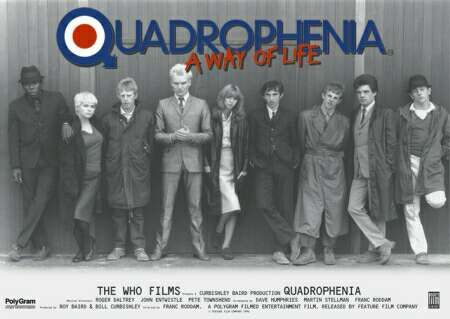
Six years later 'Quadrophenia'  was made into a motion picture directed by Franc Roddam.