The Ventures made an impact when they broke into the mainstream with this sinewy surf rock saunter. Bob Bogle and Don Wilson started playing music together in Tacoma, Washington during weeknights while doing masonry work by day; at first as the Impacts and then as the Versatones. When their demo tape was rejected by Liberty Records subsidiary Dolton Records, they decided to form their own record label, Blue Horizon. Wilson says: "There were actually three partners: My partner and I, Bob Bogle and me, and my Mom. See, he was a bricklayer and I was a hot carrier. We were working eight hours a day, five, sometimes, six days a week. We didn't have time to run things around. She did. She did a lot of leg work. We were a three way partnership in that record company. But, it didn't take too much money to do."
After their first single "Cookies and Coke" didn't go anywhere; they decided to stick with instrumentals and brought in the rhythm section of Nokie Edwards and Skip Moore. Their second single was inspired by the Chet Atkins version of a song written by Johnny Smith called "Walk, Don't Run". Bogle: "We found that on a Chet Atkins album. When we staked learning how to play, we started buying guitar records to listen to. It was on an album called 'Hi-Fi In Focus'
Wilson adds: "He played it in a classical jazzy style and we couldn't play it like that. We weren't good enough. So we decided to make our own arrangement of it and simplify it and that's how that happened ... When we went to record it, we went to the only studio in Seattle at the time (it was in the guy’s basement). It was considered a commercial studio and he had 2-track Ampex equipment. His name was Joe Boles and it was called Boles Studio. We put the rhythm and drums on one track, and bass and lead on the other-and that’s the one you got!"
They brought the single to a DJ they knew at KJR in Seattle, who played the song as the lead-in to the news. It became a local sensation and Dolton Records offered them a deal for national distribution. The song went to number two on the national pop chart for a month, being kept out of the top spot by Elvis Presley's "It’s Now Or Never" , Brian Hyland's "Itsy Bitsy Teenie Weenie Yellow Polka-Dot Bikini" , and Chubby Checker's "The Twist" .
With their smash hit, the band was given the green light to record a full length album; so they quickly put together a collection of originals and covers as 'Walk, Don't Run' "You don’t know how many songs we have that are ‘Original No. 1’ or ‘Original No. 2’. A lot of times we’d write 4 or 5 songs for an album", adds Bob, "and wind up getting some of the girls who worked at Liberty to help us title them. "
Bogle: "When we did the first album, they didn’t have any pictures of us because we went on the road right away. In our place they used a picture of the guys who worked in the stock room downstairs at Liberty. They put dark glasses on them and had them falling over the drums and stuff. They put some pretty model walking by in the forefront so no one would notice their faces."
Four years later, they re-recorded the song as the centerpiece of the 'Walk-Don’t Run, Volume 2'
http://www.theventures.com/ "Walk, Don't Run" VIDEO "Walk, Don't Run 64"
VIDEO "Perfidia" was the follow-up single, a top twenty hit later that same year. Bogle: "We had ‘Perfidia’ worked out before we even released Walk-Don’t Run". It was part of our original repertoire, as was most of the material from our first two albums. I played lead on those things because Don and I already had those things worked out." VIDEO 'Walk, Don't Run' full album:
VIDEO Side 1
"Morgen" (2:07) - Peter Mosser, Noel Sherman
"Raunchy" (2:16) - William E. Justis Jr.
"Home" (2:18) - Harry Clarkson, Jeff Clarkson, Peter Van Steeden
"My Own True Love (Tara's Theme)" (2:14) - Max Steiner
"The Switch" (1:56) - Bob Bogle, Nokie Edwards, Howard Johnson, Don Wilson
"Walk, Don't Run" (2:03) - Johnny Smith
Side 2
"Night Train" (2:50) - Jimmy Forrest, Lewis Simpkins, Oscar Washington
"No Trespassing" (1:58) - Bogle, Edwards, Wilson
"Caravan" (2:09) - Duke Ellington, Irving Mills, Juan Tizol
"Sleepwalk" (2:04) - Ann Farina, John Farina, Santo Farina
"The McCoy" (2:07) - Bogle, Wilson
"Honky Tonk" (2:44) - Billy Butler, Bill Doggett, Johnnie Scott, Shep Shepherd
The Beach Boys reached a new level of maturity and depth with the spellbinding studio sophistication of this romantic rock reinvention. In the months since the release of 'All Summer Long' the band had released their first live album 'Beach Boys Concert' and 'The Beach Boys' Christmas Album' and made an appearance on 'The T.A.M.I. Show' ; but there was trouble brewing as the pressure was beginning to take its toll on band leader and producer Brian Wilson: "I used to be Mr. Everything. I felt I had no choice. I was run down mentally and emotionally because I was running around, jumping on jets from one city to another on one-night stands, also producing, writing, arranging, singing, planning, teaching—to the point where I had no peace of mind and no chance to actually sit down and think or even rest. I was so mixed up and so overworked...We were on a tour, December 23rd, 1964 (two days before Christmas). We were going to Houston to kick off a two-week tour. I said goodbye to Marilyn. We weren't getting along too good. The plane had been in the air only five minutes when I told Al Jardine I was going to crack up any minute. He told me to cool it. Then I started crying. I put a pillow over my face and began screaming and yelling...Then I started telling people I'm not getting off the plane. I was getting far out, coming undone, having a breakdown, and I just let myself go completely. I dumped myself out of the seat and all over the plane. I let myself go emotionally. They took care of me well. They were as understanding as they could be. They knew what was happening and I was coming apart. The rubber band had stretched as far as it would go...What it amounted to was a guilt feeling. I knew I should have stopped going on tours much earlier to do justice to our recordings and business operations. I was also under pressure from my old man, who figured I'd be a traitor if I didn't travel on one-nighters with the other guys. He always has had a problem of understanding people and their feelings. I had a lot of static from everyone outside the group as well as the members. The only way I could do it was by breaking down as I did...The boys stayed home for a long rest, about two weeks, then, we started recording 'The Beach Boys Today!' album. We were about half way through the album, and one night I told the guys I wasn't going to perform on stage anymore, that I can't travel...I told them I foresee a beautiful future for the Beach Boys group but the only way we could achieve it was if they did their job and I did mine. They would have to get a replacement for me ... I didn't say 'they.' I said 'we' because it isn't they and me, it's 'us.'... Now it was just a matter of time until the guys adjusted to the new scene. The first replacement we had was Glenn Campbell. He was adequate, but he wasn't really a Beach Boy. He didn't look or act like one. That must have gone on for three or four months. Then Glenn got sick and couldn't tour. The Beach Boys were really in trouble now because they couldn't cancel out the tour...So Mike in the last minute called up Bruce Johnston and found he was free. Bruce and Carl got together. Carl taught Bruce all the songs we were doing on the stage. Bruce learned enough songs in one day to perform with the Beach Boys the next night. In one day's practice, he got in the group...The logical thing to do from then on was to expand in our publicity, photographically, and to make a much more planned production in records. I always knew what I was doing but I had a rough time communicating with people for a while...The fellows are just growing up and adjusting to the position in life which we are in. I think that being actually originally a teenage group that made that much money and success in such a short time, was a little bit hard to handle for obvious reasons. It's been almost five years since we started, and it's taken just about that long to adjust and reach present maturity...You learn so much about people's motives, especially when you're in a position to bring out greed and such in people. But understanding the weaknesses of other people helps you to see your own weaknesses as well as strength, and so it's been helpful to us all...I don't think there'll ever be a dull moment in my career as I'm too dedicated to some kind of a sceance. I don't want to be static, I must keep functioning ... No, I'm not a genius, I'm just a hardworking guy."
The sessions for 'Today!' took place in Hollywood at United Western Recorders, Gold Star Studios, and RCA Victor Studios and featured The Beach Boys: Al Jardine on lead, harmony and backing vocals; electric rhythm guitar; bass guitar; and handclaps; Mike Love on lead, harmony and backing vocals; and handclaps; Brian Wilson on lead, harmony and backing vocals; four and six-string bass guitar; grand, upright and tack piano; baldwin harpsichord; hammond organ; and handclaps; Carl Wilson on harmony and backing vocals; lead, rhythm and twelve-string guitar; six-string bass guitar; and handclaps; Dennis Wilson on lead, harmony and backing vocals; drums, tambourine, and handclaps; with an increasing circle of studio musicians that included: Hal Blaine on drums, woodblocks, sleigh bells, triangle, tambourine, castanets, and temple block; Glen Campbell on guitar; Peter Christ on English horn; Steve Douglas and Plas Johnson on tenor saxophone; David Duke on French horn; John Gray on grand piano; Carl Fortina on accordion; Carol Kaye and Ray Pohlman on bass guitar; Barney Kessel on classical nylon rhythm guitar and twelve-string guitar; Larry Knechtel on bass; Carrol Lewis on double-reed harmonica; "Louie" on castanets; Jack Nimitz on saxophone; Jay Migliori on baritone saxophone; Earl Palmer on drums and timbales; Don Randi on tack upright piano and organ; Bill Pitman on electric guitar and acoustic guitar; Billy Lee Riley on harmonica; Leon Russell on piano and organ; Billy Strange on electric guitar and electric mandolin; Ron Swallow on tambourine; Tommy Tedesco on autoharp, electric guitar, and mandolin; Russ Titelman on percussion (microphone boom hit with screwdriver); Julius Wechter on vibraphone, bell-tree, timpani, tambourine, and congas; Jerry Williams on vibraphone and timpani; Marilyn Wilson on backing vocals; and unknown contributions on oboe, cellos, violins, violas, and English horn. Chuck Britz and Larry Levine engineered the proceedings. 'Today!' went to number six in the UK and number four in the US. The first side stuck to the uptempo rock and roll formula that had made them superstars while the second consisted of lush ballads would characterize their later work.
http://www.thebeachboys.com/ "Please Let Me Wonder" charted at number fifty-two in the US.
https://www.youtube.com/watch?v=WjB9u85WSmo VIDEO "When I Grow Up To Be A Man" hit thirty-nine in Australia, twenty-seven in the UK, nine in the US, and number one in Canada.
https://www.youtube.com/watch?v=0EzEhW1VO9M VIDEO "The Little Girl I Once Knew" reached twenty in the US and seven in Canada.
https://www.youtube.com/watch?v=64N5OCo0zxQ VIDEO "Help Me, Rhonda" was released as a single with a different take and a different spelling. The single became went to the top of the charts in Canada and the US.
VIDEO "Do You Wanna Dance?" made it to number seventeen in Canada, twelve in the US, and nine in Sweden.
https://www.youtube.com/watch?v=nztxd92hl0g VIDEO "Dance, Dance, Dance" grooved on up to number fifty-two in Australia, twenty-four in the UK, eight in the US, seven in Canada, and six in Sweden.
http://www.dailymotion.com/video/xu6v90_beach-boys-dance-dance-dance-ii-hd-video-excellent-picture-quality-live-1964_music Beach Boys - Dance, Dance, Dance [II] [HD video... by ladcrp 'Today!' full album:
VIDEO
All songs written and composed by Brian Wilson and Mike Love, except where noted. Lead vocalist listed.
Side one
1. "Do You Wanna Dance?" (Bobby Freeman) Dennis Wilson 2:19 2. "Good to My Baby" B. Wilson with Love 2:16 3. "Don't Hurt My Little Sister" Love with B. Wilson 2:07 4. "When I Grow Up (To Be a Man)" Love with B. Wilson 2:01 5. "Help Me, Ronda" Al Jardine 3:08 6. "Dance, Dance, Dance" (B. Wilson/Carl Wilson/Love) Love with B. Wilson 1:59 Side two
1. "Please Let Me Wonder" B. Wilson with Love 2:45 2. "I'm So Young" (William H. "Prez" Tyus, Jr.) B. Wilson 2:30 3. "Kiss Me, Baby" B. Wilson with Love 2:35 4. "She Knows Me Too Well" B. Wilson 2:27 5. "In the Back of My Mind" D. Wilson 2:07 6. "Bull Session with the 'Big Daddy'" (The Beach Boys) none (spoken word) 2:10 bonus tracks
"The Little Girl I Once Knew" B. Wilson, Jardine with C. Wilson 2:40 "Let Him Run Wild" B. Wilson 2:18 "Graduation Day" (J. Sherman/N. Sherman) Love with B. Wilson 2:18 VIDEO 'The T.A.M.I. Show'
https://www.youtube.com/watch?v=LTj83LBHtlQ VIDEO
The Pixies expanded their sonic pallet with the surreal mix of polished surf pop, primal punk noise, country & western, reggae, and brooding balladry that comprise this alternative rock and roll animal. The band had built up a reputation for their aggressive alternative sound with their debut EP 'Come On Pilgrim' and its full length followup 'Surfer Rosa' . For their next album they decided to work with producer Gil Norton, who also engineered the sessions at Downtown Recorders in Boston, Massachusetts and Carriage House Studios in Stamford, Connecticut. The album features Black Francis on vocals and rhythm guitar; Kim Deal on bass guitar, vocals, and slide guitar on "Silver"; Joey Santiago on lead guitar and backing vocals; David Lovering on drums, lead vocal on "La La Love You", and bass guitar on "Silver"; with the addition of Arthur Fiacco and Ann Rorich on cello, and Karen Karlsrud and Corine Metter on violin for "Monkey Gone to Heaven".
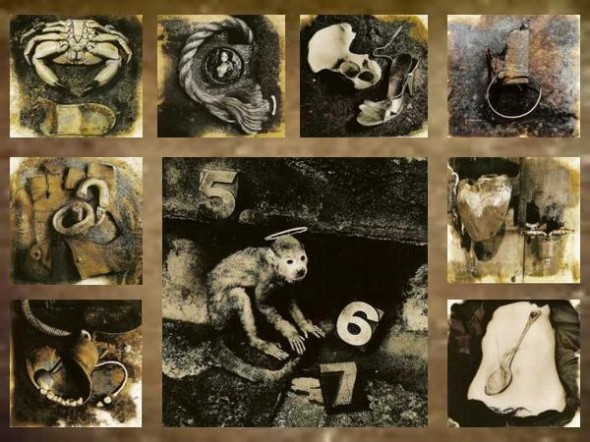
The working title for the album was 'Whore' 'Doolittle' from a lyric in the song "Mr. Grieves": "I thought people were going to think I was some kind of anti-Catholic or that I'd been raised Catholic and trying to get into this Catholic naughty-boy stuff...A monkey with a halo, calling it Whore, that would bring all kinds of shit that wouldn't be true. So I said I'd change the title." Dave Lovering “We didn’t feel like we were making a masterpiece. I guess I can see that it’s a classic now. At the time of its release, I just thought of it as another Pixies album. It was the next thing we were doing...When we did 'Doolittle' with Gil, the production became more polished and pro. The songs were more accessible, too, which just might have been where we were going as a band. Not to say that I didn’t like it; in fact, I was extremely proud of 'Doolittle' when I first heard it being played back. I couldn’t believe it was us – it sounded so big and accomplished...It’s a great record. After all these years, it’s like it hasn’t aged. Time sort of caught up with it.”
Kim Deal reflects: "It’s OK actually. I think Charles’ singing is really strong, I think it’s a lot better now. I think his singing is really good, so…maybe if he couldn’t hit the notes the songs wouldn’t have aged very well. Some singers write really high when they’re younger...It felt different but it was like… we were gone from our home. I can’t even remember what state we recorded it in now."
Black Francis AKA Frank Black AKA Charles Michael Kittridge Thompson IV considers: "I’m very much about the moment, not necessarily in my life, but in my music. When I’m making music, or performing music or writing music, I’m just very much about what I’m doing at the moment, and it doesn’t require different hats really, it doesn’t require different ways of thinking. For example, I really like playing with musicians that are really great, but I also really like playing with musicians who are not great — they’re just simple musicians because the goal is the same. As long as everyone understands, we have to make this moment, we have to make this song or performance as good as we can, and you can be really rough about it or you can be really inept about it, but there’s a spirit of 'We’ve gotta make this good' — as long as everyone’s on that page, it doesn’t really matter...It might be a nostalgic [thing] for certain members of the audience, but it’s not really [nostalgic] for me. It’s part of my repertoire, my canon of songs; it’s what I do. It’s not like in 1989 I was trying a different kind of music altogether, or something that was about the moment in fashion. It’s hard for me to think about it in terms of nostalgia. I think that it’s all gotten so blurry anyway with all of the different pop genres. Everything is essentially so derivative that I think it’s pretty rare that you get a totally new form of popular music. I mean, think about something like hip-hop and rap records, for example: There are a couple of hip-hop records that I’m very familiar with that came out, like, 25 years ago. They were, like, doing the rap 25 years ago, and that has become such a big part of the mainstream cultural vocabulary. It’s hard to say, 'What really is new?' There may be new tags, but what popular music form would you say — I’m not saying there aren’t any — but to me, the last new thing that I can remember that was really, truly new, is rap and hip-hop music...I like the Iggy Pop quote: 'It’s all disco.' I totally get it, I totally get it, it’s all disco."
'Doolittle' became the band's biggest success, going to number ninety-eight in the US (eventually being certified platinum), sixty-six in France, fifty-three in the Netherland, eighteen in the Netherlands, and number eight in the UK (where it has been certified gold). It has sold over a million copies worldwide and has been cited as one of the greatest albums of all time by numerous music publications. http://www.pixiesmusic.com/ "Here Comes Your Man"
"Monkey Gone to Heaven"
"Debaser" was inspired by the silent surrealist short film by the Spanish director Luis Buñuel and artist Salvador Dalí 'Un Chien Andalou' (An Andalusian Dog) from 1929.
https://www.youtube.com/watch?v=PVyS9JwtFoQ
'Doolittle' VIDEO All tracks were written by Black Francis, except where noted.
"Debaser" – 2:52
"Tame" – 1:55
"Wave of Mutilation" – 2:04
"I Bleed" – 2:34
"Here Comes Your Man" – 3:21
"Dead" – 2:21
"Monkey Gone to Heaven" – 2:56
"Mr. Grieves" – 2:05
"Crackity Jones" – 1:24
"La La Love You" – 2:43
"No. 13 Baby" – 3:51
"There Goes My Gun" – 1:49
"Hey" – 3:31
"Silver" (Francis/Deal) – 2:25
"Gouge Away" – 2:45
demos VIDEO