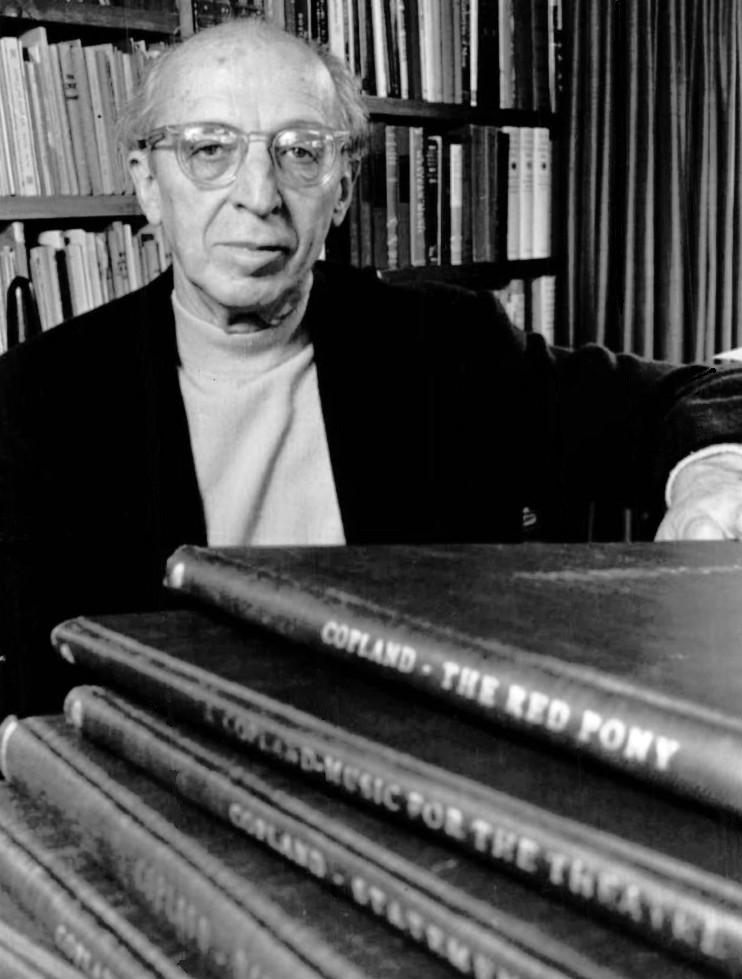
Aaron Copland
(November 14, 1900 – December 2, 1990)
The Dean of American Composers evolved from a provocative modernist to an accessible populist. Born in Brooklyn, he composed his first piece of music at the age of eleven. He studied music through his teens, and, rather than go to college, he went to Paris to study the latest European trends with Nadia Boulanger. His planned year stretched to three and during that time he was exposed to the heady intellectual expatriate culture of Paris in the 1920's. Upon his return to New York, he began working on material that was decidedly avante-garde. The premiere of his Organ Symphony in 1925 established him as a serious composer. He became a part of the vanguard of modernism in American music; but began to rethink this approach with the onset of the Great Depression. His work began to reflect the ideas of American democracy. He wrote pieces that would appeal to a larger audience and his ballet Appalachian Spring won him the Pulitzer Prize in 1944. He also composed music for films, wrote extensively on musical criticism, and became a conductor of his own and other work. He was also awarded the Presidential Medal of Freedom, the National Medal of Arts.and a special Congressional Gold Medal.
Copland would express: "Why is it that the musical public is seemingly so reluctant to consider a musical composition as, possibly, a challenging experience? When I hear a new piece of music that I do not understand I am intrigued -- I want to make contact with it again at the first opportunity. It's a challenge -- it keeps my interest in the art of music thoroughly alive. But sadly I've observed that my own reaction is not typical. Most people use music as a couch; they want top be pillowed on it, relaxed and consoled for the stress of daily living. But serious music was never meant to be used as a soporific. Contemporary music, especially, is created to wake you up, not put you to sleep. It is meant to stir and excite you -- it may even exhaust you. But isn't that the kind of stimulation you go to the theatre for or read a book for? Why make an exception of music? ... As I see it, twelve-tonism is nothing more than an angle of vision. Like fugal treatment, it is a stimulus that enlivens musical thinking, especially when applied to a series of tones that lend themselves to that treatment. It is a method, not a style; and therefore it solves no problems of musical expressivity. As a method, it seems nowadays to be pointing in two opposite directions: toward the extreme of "total organization" with its concomitant electronic applications, and toward a gradual absorption into what has become a very freely interpreted tonalism. But these are preoccupations of the musical kitchen; audiences have other things to think of, things that are more fundamental to the expressive content of the piece. ... No true musical enthusiast wants to be confined to a few hundred years of musical history. He naturally seeks out every type of musical experience; his intuitive understanding gives him a sense of assurance whether he is confronted with the recently deciphered treasures of Gothic art, or the quick with of a Chabrier or a Bizet, or the latest importation of Italian dodecaphonism. A healthy musical curiosity and a broad musical experience sharpens the critical faculty of even the most talented amateur. All this has bearing on our relation to the classic masters also. To listen to music in a familiar style and to listen freshly, ignoring what others s have said or written and testing its values for oneself is a mark of the intelligent listener. The classics themselves must be reinterpreted in terms of our own period if we are to hear them anew and "keep their perennial humanity living and capable of assimilation." But in order to do that, we must have a balanced musical diet that permits us to set off our appraisals of the old masters against the varied and different musical manifestations of more recent times. The dream of every musician who loves his art is to involve gifted listeners everywhere as an active force in the musical community. The attitude of each individual listener, especially the gifted listener, is the principal resource we have in bringing to fruition the immense musical potentialities of our own time."
http://www.coplandhouse.org/
Fanfare for the Common Man
The Promise of Living
Appalachian Spring
Billy the Kid
Rodeo
Third Symphony

