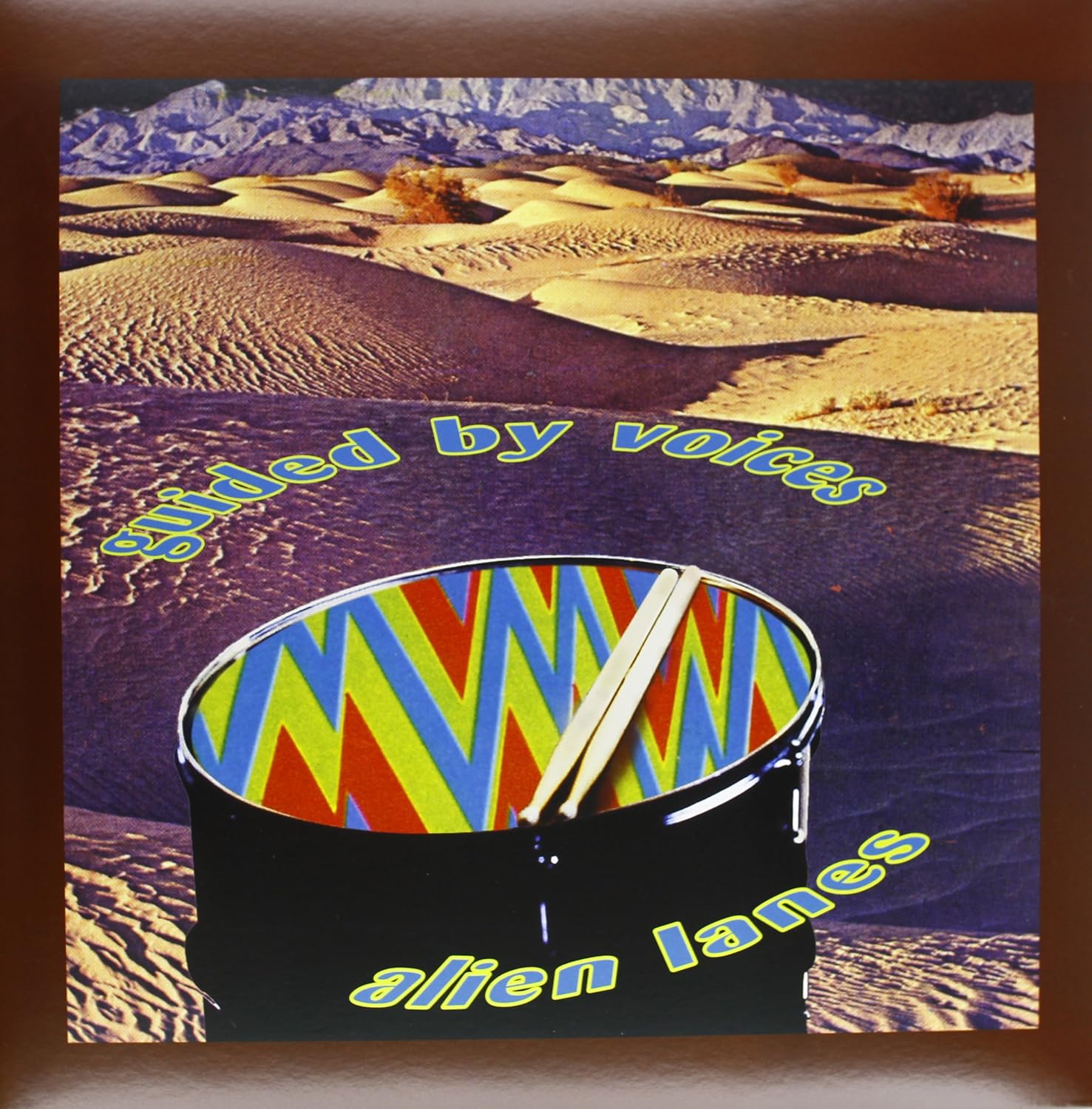
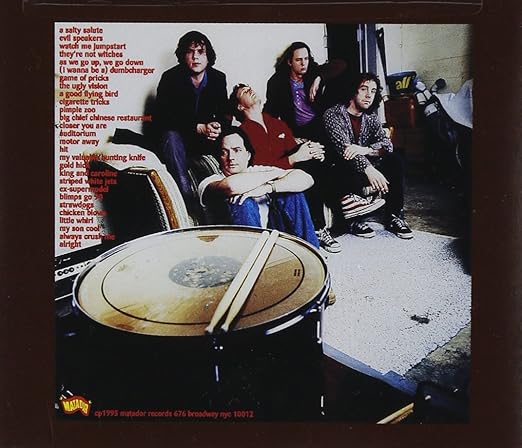
Guided By Voices peeled the old skin to motor away onto the indie powerpop superhighway with a satisfying salty salute. The Dayton, Ohio stalwarts had delivered 'Bee Thousand' 'Bee Thousand' 'Alien Lanes' was produced by Mr. Japan, engineered by The Red-Nosed Driver, and mastered by Bob Ludwig with Robert Pollard on vocals, guitar, acoustic guitar, drums, and percussion; Tobin Sprout on bass guitar, guitar, drums, percussion, vocals, and piano; Kevin Fennell on drums and percussion; Greg Demos on bass guitar, guitar, and violin; Jim Pollard on bass guitar and guitar; Jim Greer on bass guitar and backing vocals; Mitch Mitchell on guitar; Dan Toohey on bass guitar; and Larry Keller on drums and percussion.
Jim Pollard considers: "Well, we finished [ 'Alien Lanes' ] before we were signed. We were actually carrying it around with us saying, "Listen, if you're gonna sign us, you have to put this out as it is," kind of our last completely four track deal. And everybody said they would. It's not as if we deliberately being contrarians or something. At the time, we really didn't have the money. And actually, there's some 8 track stuff on there, too...We like the 4-track for two reasons: for one--we like the way it enables to be more spontaneous. If we have a song, we can just go into Toby’s basement and record it that day. You can't really do that with a big studio. Second, some things just sound better on four track. We've spent a lot of time in the studio trying to get the vocals to sound as good as they do on the four track, that natural compression that you get. There are other things that we like about the four-track: the way it simplifies the arrangement, the way it allows you to get away with maybe not being technically perfect, which you're not going to be anyway because you just learned the song. Like the rhythm section is usually buried on four-track, all the low end gets kind of squashed out of existence, and the high end is really emphasized, so mainly what you hear is guitar and vocals, and this kind of clatter. But that's kind of the way that you used to hear songs on transistor radios back in the 60s, which is cool."
Bob Pollard reveals: "Whenever I hear phrases I like, I write them down in a notebook, and then when I feel like writing lyrics, I'll usually come up with the title first, and then I go from point A to point Z in a stream-of-consciousness-kind-of-way. And when I need a line, sometimes I use phrases. Most of the time it's for the imagery, and the look of the words on paper, and the sound of them...Sometimes I feel like I'm being inspired in an abstract way, like I'm trying to write something about something but not specifically. Usually we can analyze it later, so I just write it and then look at it and say, "well, maybe that's a song about ecology or...' ... Titles are important. Titles are what used to make me buy records as a kid. If I wasn't too familiar with the band, and they had a good band name, and the titles were cool on the record, and it had a fairly neat cover, I’d buy it. I use other points of reference now, because now I know certain producers and engineers and labels and stuff better, I use that. But I used to just go on titles and covers...I don’t know. We're just wanna-be classical rockers, really. We've just always had access to our basements and living rooms and four tracks and stuff. We used to go into big studios and it never worked. We were working with people who didn't have the slightest idea what we wanted, and at the time, neither did we...We can afford to go into a big studio and make a record, but we're still not doing it, because we've gotten used to the four track process, so we can't completely quit that. We're in the enviable position of having been around for 15 years. We're a new band, yet we're an established band. We're considered peers with Sonic Youth. We've been around as long as REM. But we want to show signs of progression, whatever that is."
http://www.gbv.com/ "Watch Me Jumpstart"
https://www.youtube.com/watch?v=uSyIa2aGdfA VIDEO "As We Go Up, We Go Down"
https://www.youtube.com/watch?v=l7FqlArPFwI VIDEO "Game of Pricks"
https://www.youtube.com/watch?v=HLINRoC4f1k VIDEO "Motor Away"
https://www.youtube.com/watch?v=meshV00_Jns VIDEO "My Valuable Hunting Knife"
https://www.youtube.com/watch?v=1A8LyAqtaa0 VIDEO "Little Whirl"
https://www.youtube.com/watch?v=c1H0_NhJar8 VIDEO 'Alien Lanes' full album:
https://youtu.be/7Jo9edHmk28?list=PLSKV_9TOjhK36dMGpK-S3t8hmvtLlv3db http://www.last.fm/music/Guided+by+Voices/Alien+Lanes VIDEO All songs written by Robert Pollard unless otherwise noted.
"A Salty Salute" (R. Pollard, Tobin Sprout) – 1:29 "Evil Speakers" – :58 "Watch Me Jumpstart" – 2:24 "They're Not Witches" (Greg Demos, Jim Pollard, R. Pollard) – :51 "As We Go Up, We Go Down" – 1:37 "(I Wanna Be a) Dumbcharger" – 1:13 "Game of Pricks" – 1:33 "The Ugly Vision" – 1:34 "A Good Flying Bird" (Sprout) – 1:07 "Cigarette Tricks" (Demos, J. Pollard, R. Pollard, Sprout) – :18 "Pimple Zoo" – :42 "Big Chief Chinese Restaurant" (J. Pollard, R. Pollard) – :56 "Closer You Are" – 1:56 "Auditorium" (R. Pollard, Sprout) – 1:02 "Motor Away" (R. Pollard, Sprout) – 2:06 "Hit" – :23 "My Valuable Hunting Knife" – 2:00 "Gold Hick" – :30 "King and Caroline" (R. Pollard, Sprout) – 1:36 "Striped White Jets" – 2:15 "Ex-Supermodel" (R. Pollard, Sprout) – 1:06 "Blimps Go 90" – 1:40 "Strawdogs" (Sprout) – 1:17 "Chicken Blows" – 2:21 "Little Whirl" (Sprout) – 1:46 "My Son Cool" – 1:41 "Always Crush Me" – 1:44 "Alright" – 2:56
Guided By Voices were better than ever with the incurable basement belief of these lo-fi lessons and true pop confessions (or something like that). The Dayton group had formed in 1983 and began making their own records in limited pressings ('Devil Between My Toes' 'Sandbox' 'Self-Inflicted Aerial Nostalgia' 'Same Place the Fly Got Smashed' Propeller' 'Vampire on Titus' 'Bee Thousand' were 'All That Glue' and 'Instructions for the Rusty Time Machine'. The raw recordings were finished in three days and featured Robert Pollard on vocals, guitar, and other instruments; Jim Pollard on bass guitar and feedback; Tobin Sprout on bass guitar, guitar, piano, and other instruments; Mitch Mitchell on guitar; and Don Thrasher on drums and percussion; with Dan Toohey and Greg Demos on bass guitar; Kevin Fennell on drums and percussion; and Randy Campbell on backing vocals.
Robert Pollard reflects: "Most record stores wouldn't have those [early] records. There was even a label guy who put our first record out -- his label was called I Wanna Records -- Rev Cool, he called himself. When we made our first record, we didn't even have a label, so we put his label on our record. He got all pissed off about it. Then he did a compilation record of all the bands that were on his label, and he didn't put us on there. Now he's kicking himself in the ass, because he'd probably be getting a lot of money from those records. But anyway, most record stores wouldn't even put our records in the store. Then a friend of mine, Greg Demos, who was actually playing bass, not only did he take them to record stores but he actually started sending them out for review. We started getting some pretty good reviews on some of those early records. We got a good review in Spin, a "Spin Underground" thing. But I just totally said, "I'm not going to do anything with this stuff... I'm afraid" [laughs]. I was, like [whispers], "we suck." [Laughs] I thought we did suck. Maybe we did suck. I was really afraid of big cities like New York and Cleveland, because those were the rock and roll towns. I thought if Cleveland and New York heard our stuff, we'd be laughed off the planet. I really did, that's why I didn't send anything out. But critics seem to like us. We have a story [laughs] ... I have an addiction to songwriting. You know, there are people who like to play softball all the time, or basketball, or darts, or whatever. I like to write songs, so when I'm here at home, I get up in the morning and make myself some coffee, and I just get my guitar and turn on my tape recorder. I really love to write songs. Another reason is that I'm bored with music for some reason. I don't know what it is. I don't know if it's because we've become part of "rock" now, but when I was just a fan, I was an avid, enthusiastic record buyer and listener. Now I'm just bored, because I've found everything, I think. When I go into record stores, I don't look at the new-music section too much. It's pretty pathetic. There are some good underground bands coming from the same place we are, bands we've known for a long time that are still doing good stuff. Bands like Superchunk, Pavement, Sebadoh, and The Grifters are still doing good stuff. But if you look for good new music, it's just not there, so I'm always looking for old '60s and '70s compilations. If you're looking for a particular type of song that's not around or that doesn't exist anymore, the only thing you can really do is try to write it yourself, and try to find it in your own mind. So that's why I write, 'cause I'm addicted...When you write short songs, you can write more of 'em. A lot of bands like to labor over one song until they get it perfect, but I can't stand it. I don't have the patience to try to make it perfect, because it's pointless to try to labor over it. You can always make it better. The only important thing is that you capture what you heard in your head. It doesn't matter if it fits any kind of MTV standard, or radio standard, or whatever. You do the song, then you move on to the next one. That way, you get a lot of 'em out, and it's more fun."
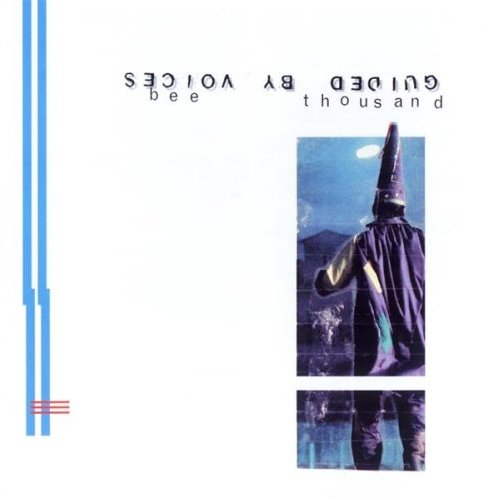
'Bee Thousand' didn't chart; but it was named Album of the Year by the Village Voice and led to a deal with Matador Records.
http://www.gbv.com/ I Am A Scientist
https://www.youtube.com/watch?v=zN9x6zckn18 Hot Freaks
https://www.youtube.com/watch?v=VlcuOU1tAUg 'Bee Thousand' full album:
VIDEO "Hardcore UFO's" – 1:54
"Buzzards and Dreadful Crows" (Jim Pollard, R. Pollard) – 1:43
"Tractor Rape Chain" – 3:04
"The Goldheart Mountaintop Queen Directory" – 1:45
"Hot Freaks" (R. Pollard, Tobin Sprout) – 1:42
"Smothered in Hugs" (Mitch Mitchell, J. Pollard, R. Pollard) – 2:59
"Yours to Keep" – 1:15
"Echos Myron" – 2:42
"Gold Star for Robot Boy" – 1:39
"Awful Bliss" (Sprout) – 1:12
"Mincer Ray" (Sprout) – 2:21
"A Big Fan of the Pigpen" (Randy Campbell, J. Pollard, R. Pollard) – 2:09
"Queen of Cans and Jars" – 1:55
"Her Psychology Today" (Mitchell, J. Pollard, R. Pollard, Sprout) – 2:04
"Kicker of Elves" – 1:04
"Ester's Day" (Sprout) – 1:51
"Demons Are Real" (Mitchell, J. Pollard, R. Pollard, Sprout) – 0:48
"I Am a Scientist" – 2:30
"Peep-Hole" – 1:25
"You're Not an Airplane" (Sprout) – 0:33
VIDEO 'Bee Thousand: The Director's Cut' came out ten years later with a thirty-three track early version of the album with other songs that made it onto the final version and two subsequent EP's, fifty-five tracks in all!
http://www.gbvdb.com/album.asp?albumid=1766