Showing posts with label gothic. Show all posts

Monday, December 7, 2015

seventh dream of teenage heaven


Love and Rockets saw beyond the outside and found their path in the seminal spark of this hypnotized and haunted quicksilver chemistry.   The trio of Daniel Ash, David John Haskins "David J", and his brother Kevin Michael Dompe "Kevin Haskins" had played together since their youth in various bands.  Their diverse work with Peter Murphy in Bauhaus over four albums (In the Flat Field in 1980, Mask in 1981, The Sky's Gone Out in 1982, and Burning from the Inside in 1983) helped to define gothic rock.  Ash and Haskins worked together briefly as Tones on Tail before getting back with David J (who had released two solo albums and produced two more with The Jazz Butcher) to form Love and Rockets, taking the name from the independent comic series  by the Hernandez brothers: Gilbert, Jaime, and Mario.   


Haskins harkens back:   "[I first started playing music when] I was 13. David formed a band and they needed a drummer. I never thought about drumming before. Since they needed a drummer it spurred me on. Luckily I have some talent at it. That was a great experience for me...I suppose because we grew up in the same town, same culture, kept us together. But there are clashes. I think it's the music at the end of the day. We're writing together, in the studio, playing a show and it all goes well, that's what keeps us together ... After Bauhaus, the three of us (Kevin, David J, Daniel Ash) went on and did Love and Rockets for actually like a decade and a half. I feel we have this intuition now that was born from that period of time of working together — almost a psychic connection in a way."


Ash asserts:  "Myself, David, and Kevin were in about three or four different groups in Northampton where we come from...Going back to 1978...There was a group called The Craze...Then '79 I contacted Peter Murphy...We used to go to school together...Asked him if he fancied starting a group or whatever.  So we both went at a rehearsal together and within about a half hour it started to really work; so then the other two came in automatically...Bauhaus carried on for about four years...That's just the basic story.   It was us playing in pubs like everybody does when they first start out.   And then we started Love and Rockets...although there were things in between:  Tones on Tail, David solo things, and him working with The Jazz Butcher...Kevin had the idea of recording Ball Of Confusion, with that group anyway, but we split up.  But as we were driving over, we had a cassette of it; so we were just playing it in the car.  And we thought it would be a good starting off point with this particular group.   Something just to start working together with.  And within about three or four hours after reworking it - In effect, it took about four weeks to rework it so it sounded relevant for 1985,"

They recorded their debut album that same year at Woodbine Street Recording Studios and Royal Leamington Spa with co-producer John A. River.   'Seventh Dream of Teenage Heaven' credits Daniel Ash on vocals, guitar, keyboards, and lyrics;   David J. on vocals, bass, keyboards, lyrics, and guitar;   and  Kevin Haskins on drums and keyboards.  John A. Rivers also handled the engineering, string arrangements, and played keyboards.  Love and Rockets did the sleeve design.   


David J:  "I didn’t really get into psychedelics until ’85. It was the time of the first Love and Rockets album. In fact, the collage that’s on the inside of the gatefold sleeve—that was finished on LSD, on the day of my first trip. I remember being quite delighted with it! I remember sitting on the floor, looking at Daniel’s antique furniture and thinking how sexy the legs of the furniture were, and remarking on this! [Laughs] The curvature of the furniture, and Daniel just smiling ... I think we were really ahead of our time. We were provocateurs. We knew were winding people up, and we delighted in that actually. But we still were just being true to ourselves and making music that we thought was just bloody good. And yeah it was kind of going against the grain of the time...Post punk, there was an attitude of being sort of humble and unpretentious and working class and meat and potatoes, whereas we delighted in being pretentious. But in being pretentious we were being ourselves. You know, it’s the lie that tells the truth. Like how camp is the lie that tells the truth. We were being truer to our real selves by being that glam and that avant-garde and outside the meat and potatoes...But musically we were just ahead. And that’s been borne out by the number of bands influenced by Bauhaus. They’ve told me personally that they have, and that’s really gratifying. I hear the influence coming through a lot. And Love and Rockets. In America certainly. We focused on America. We turned down tours in Europe and Australia and focused on America and Canada...I think it’s the appeal of the alien. In England, we liked the American bands. They were exotic to us: Television, Talking Heads, Patti Smith Group. Huge in England. The appeal was so exotic. The Englishness of Love and Rockets—and we were very English—I think was appealing to Americans."


http://www.davidjonline.com/

https://twitter.com/danielashmusic

https://www.facebook.com/Kevin-Haskins-Official-174176679267103/


"The Dog-End of a Day Gone By"


There's a man on the corner
Coming on like Moses
Found a new religion
that rebuts your plastic roses
He's found his path
To the living heart of Jesus
You tell him
You've found yours

Been to the future
You've never made
There is nothing less than music
Then the amusement arcade
In a city without a soul
Newspaper boys selling you the hard truth
Lucifer employs by the hands of malady

Stuck at the dog-end of a day gone by, boy
Stuck at the dog-end of a day gone by
Stuck at the dog-end of a day gone by, boy
Don't let the smoke get in your eyes

Well the drunk outside the Wendy's
Is becoming less than friendly
A dog is barking at the moon
The drunk outside the windy
Is becoming less than friendly
A dog is barking at the moon

You want to get away
From the city of light
Then when you've gone
You want to get back
It is some strange addiction
When you need to put yourself
Back in your eye

Stuck at the dog-end of a day gone by, boy
Stuck at the dog-end of a day gone by
Stuck at the dog-end of a day gone by, boy
Don't let the smoke get in your eye

Stuck at the dog-end of a day gone by, boy
Stuck at the dog-end of a day gone by
Stuck at the dog-end of a day gone by, boy
Don't let the smoke get in your...

Stuck at the dog-end of a day gone by, boy


"If There's a Heaven Above" 


"Ball of Confusion"


'Seventh Dream of Teenage Heaven'
full album:


All songs written and composed by Love and Rockets (Daniel Ash, David J, Kevin Haskins).

Side A
1. "If There's a Heaven Above"   Ash, J 4:57
2. "A Private Future"   Ash 5:06
3. "The Dog-End of a Day Gone By"   J 7:38
4. "The Game"   Ash 5:09
Side B
1. "Seventh Dream of Teenage Heaven"   6:37
2. "Haunted When the Minutes Drag"   8:03
3. "Saudade"   5:00


bonus

8    Ball Of Confusion (UK Mix)
9    Inside the Outside
10  If There's a Heaven Above (12" Mix)
11  God and Mr. Smith
12  Haunted When the Minutes Drag (USA Edit)
13  If There's a Heaven Above (Canada Mix)


Tuesday, October 27, 2015

love


The Cult embraced the wind and hung up their blues in the big neon glitter of this gothic psychedelic sanctuary.   The band evolved out of the punk scene where singer Ian Astbury and guitarist Billy Duffy were involved in different bands.   Duffy reveals:  "Very much in my DNA is growing up in the U.K. and punk rock. That’s in there, and that’s in the songwriting, and that’s never really gone away, a bit of that punk attitude. It wasn’t like anybody wanting to put a safety pin through their nose. It was more like taking that music… it kind of got accessible to people. That was why it was a life-changing thing for me. Because I went from a guy who aspired to be maybe a guitar roadie at best, to maybe I could actually be in a band, and people would come and see, and we could do shows. That’s why punk was so great. Sadly, like most movements it became tenth-generation copyists ... I mean, I was lucky to find Ian. I met him in ’81, I think, and we formed the band in ’83. We were lucky to find a songwriting partnership that has endured, and has some sort of, I guess, unique qualities that you have to find to make a band last for 30 years ... I was in another band, I was in a band called Theatre of Hate who never came to America. They were a great band. I was in that band, and Ian was the singer in a support band on a tour. He was in a band called The Southern Death Cult. That’s how we met, in a place called Stoke, which is actually where Slash was raised, interestingly or not interestingly enough. It was just a gig, and they were a support band on the tour. We met and became friends, and stayed in contact.  When I was no longer in Theatre of Hate, and he was no longer in Southern Death Cult, we got together and started writing some songs. Before we knew it we’d formed a band, and we’d made a little EP. We were going to tour and we needed a name, and he thought of the name The Southern Death Cult, so we decided back that – and this was thirty years ago – well, we should probably keep part of the name, but we don’t want to call it The Southern Death Cult, because that’s a different band. How about we just call it Death Cult? And that’s what we started with. We did that for about nine months, and the band started getting popular. We felt we’d kind of outgrew the name. There was a real gothic movement going on, and people dressing in kind of cliche… It was like, it doesn’t really fit. We don’t fit our own name. So we ended up just changing it to The Cult. As a matter of fact, it was January the 14th, 1984 when we changed our name to The Cult." 


Their debut album 'Dreamtime' was released on Beggar's Banquet in 1984 with the single "Spirit Walker" going to the top of the UK independent singles chart.    'Love' was recorded  at Jacobs Studios at Farnham in Surrey, England and Olympic Studios in London with producer Steve Brown, who had helmed albums before with Elton John and Wham!.  The sessions featured  Ian Astbury on vocals;  Billy Duffy on electric guitars, acoustic guitars, and backing vocals;  Jamie Stewart on bass, keyboards, strings, and backing vocals;   with   Mark Brzezicki on drums on all tracks except "She Sells Sanctuary", "No. 13" and "The Snake";   Simon Kliney on Fairlight programming;   Nigel Preston on drums for "She Sells Sanctuary", "No. 13" and "The Snake";   and   The Soultanas (Mae McKenna, Lorenza Johnson, Jackie Challenor) adding backing vocals on "Rain" and "Revolution".    The album went to number eighty-seven in the US, thirty-seven in New Zealand, twenty in the Netherlands, and four in the UK.   


Astbury aserts:    "There was a lot going on at that time and because we made it, it's hard to have any real perspective in a way.  We didn't analyse it or check the process, but I do remember it being very intense and that we were just so engaged in it.  We were in the studio all of the time, you know, rather than just going in every other day. We weren't distracted at all from what we were doing, no one was on the phone or just hanging out, we were working very long hours with no breaks at all and experimenting with so many ideas.  I think that's why that record has a constant unity all the way through, it was probably the most honest album we did, in that we had no career at that time. We were young and making music because we wanted to and everything was still so fresh...The good thing about the songs on Love is that they deal with things that are no less relevant now than they were then; life, death, sex, materialism, spiritualism; all the human experiences...Sanctuary came together very easily in fact, I took the bass line from a song called Spiritwalker, which was one left over from our Southern Death Cult days. Billy came up with the melody, and we worked out a vaguely psychedelic guitar sound which seemed to fit it well - we were heavily into '60s psychedelic music like The Doors, Hendrix and early Zeppelin – Also the producer, Steve Brown, had had a lot of pop success, so he really knew how to structure a song.  It's funny, you write a song like that were everything comes together far beyond what you could've expected and then you spend the rest of your life trying to write another one as good...Because of its earnestness, its honesty and depth.  It's the album that made us, so why not claim our rightful place in the legacy of alternative rock music." 


http://thecult.us/


http://www.cultcentral.com/


lyrics
http://www.darklyrics.com/lyrics/thecult/love.html


"She Sells Sanctuary"
became the band's breakthrough hit, going to number thirty-five in the Netherlands and number fifteen on the UK pop chart.  

Astbury:  “She Sells Sanctuary” was probably referring to the power of finding solitude in a woman’s arms and the matriarchal energy, whether it be an actual physical person or in a spiritual sense, the greatest matriarch, and thinking of the cosmos as a female energy rather than a male energy. These are archetypal things I was picking up from discovering things like Joseph Campbell and Buffy Sainte-Marie or even Jim Morrison. All these things were flying around, and the songs “Spiritwalker” and “She Sells Sanctuary” are quite similar, in a way. In fact, “Spiritwalker” was going to be a Southern Death Cult song, but they didn’t want to do it for whatever reason, so I said, “Fine, I’m leaving, and I’m taking my songs with me.” [Laughs.] That ended up being recorded by The Cult, and it really helped to define our sound ... It was the first real success we had anywhere. [Laughs.] It made it to No. 15 on the UK charts. It actually came out before the Love album was recorded. We’d written the song, it was released as a single, and it came out and did so well. 

Duffy:   “Sanctuary” was touch and go and was a game changer for the band. It got us an American record deal with Seymour Stein from Sire who came over and signed us, because we released it as a single right around the time Live Aid ... Somebody took a chance and played it on the BBC Radio 1 in England.  I’ll be eternally grateful and so will my offspring to this producer who gave it a chance. It was very different from what was going on and to play it in a national radio breakfast show to tens of millions of people changed the game. It’s just about exposure.  There’s never been anything wrong with the music we do, it’s just to get a wider audience, people need to be exposed to it and not have any kind of pre-prejudice for the name or what it should be or it should be an underground band or it should be this or that. If the music just gets out there without any kind of fear attached to it, we do great.  That was kind of why “Sanctuary” was a game changer. I like the riff. I don’t even know where it came from. I have no clue ...  That song has a whole life of its own. I’ve never tired of playing it." 


"Rain"


"Revolution"


'Love' 
full album:


All songs written by Ian Astbury and Billy Duffy.

"Nirvana" – 5:24
"Big Neon Glitter" – 4:45
"Love" – 5:35
"Brother Wolf, Sister Moon" – 6:49
"Rain" – 3:57
"The Phoenix" – 5:06
"Hollow Man" – 4:45
"Revolution" – 5:20
"She Sells Sanctuary" – 4:23
"Black Angel" – 5:22


Thursday, October 15, 2015

what does anything mean? basically


The Chameleons looked inwardly through the suffocating intrigue of the chaos and the crass to see what lies behind the mask.  Formed in 1981 in the Middleton area in the north of Greater Manchester, the original lineup included Mark "Birdy" Burgess, Reg Smithies, Dave Fielding, and Brian Schofield.   John Lever took over for Schofield before they secured a deal with Epic Records in 1982 to release their debut single "In Shreds".  The band was dropped from Epic over creative differences and they moved on to Virgin Records subsidiary Statik to record their debut album Script of the Bridge with producer Colin Richardson.  

Richardson helmed the sessions for the follow-up 'What Does Anything Mean? Basically' at Highland Studios in Inverness, Scotland during January of 1985.  The album features Mark Burgess on vocals, bass guitar, strings, and production;   Dave Fielding on guitar, strings, and production;   Reg Smithies on guitar, acoustic guitar, album cover illustration, and production;  and  John Lever on drums and production;  with  engineering by Ian Caple.  


Burgess admits:   "We had no idea what we were going to do next. Obviously there was a guitar sound. Dave (Fielding, guitar) had a sound. Reg (Smithies, guitar) had a style. I ha a style. The drums had a style in keeping with a lot of the stuff John (Lever, drums) was into. However, in terms of what we actually produced with that sound was varied. There was nothing typical about it. The only reason why the second album sounds remotely like the first one is because a lot of the songs which ended up on it were written around the same time but didn't end up on Script Of The Bridge for one reason or another. I think there's only two or three brand new ideas on the second album. The rest were all done around the same time as Script.... Songs like 'Looking Inwardly' and 'Singing Rule Britannia' especially we'd been playing for such a long time ... Some of the songs off the second record stretch us a bit. For example, 'P.S. Goodbye' is very untypical of anything we've ever done as a band. We wrote it in the studio, put it together in the studio and basically did it one piece at a time."


http://www.thechameleons.com/


lyrics
http://lyrics.wikia.com/wiki/The_Chameleons:What_Does_Anything_Mean%3F_Basically_(1985)


 'What Does Anything Mean? Basically' 
full album:


All lyrics written by Mark Burgess, all music composed by The Chameleons (Burgess, Dave Fielding, Reg Smithies and John Lever).

Side A
00:00 "Silence, Sea and Sky"   1:59
02:01 "Perfume Garden"   4:36
06:41 "Intrigue in Tangiers"   5:17
11:59 "Return of the Roughnecks"   3:26
15:27 "Singing Rule Britannia (While the Walls Close In)"   4:17

Side B
19:47 "On the Beach"   4:10
24:01 "Looking Inwardly"   4:29
28:35 "One Flesh"   4:28
33:02 "Home Is Where the Heart Is"   4:54
38:57 "P.S. Goodbye"   4:02

bonus tracks
11. 42:02 In Shreds
12. 46:14 Nostalgia


Intrigue in Tangiers [live at Candem Palace, 1984]


Singing Rule Britannia - (Live at the Camden Palace, London, UK, 1985)
Burgess;   "There were a lot of political writers in music at that time who were raising awareness and that was brilliant but I would only write about what I had direct experience of. I've never even been arrested so I was never going to write about being in solitary confinement because I feel like I'm in solitary anyway when I walk down the street. There are plenty of writers cleverer than me who can bring that stuff to people's awareness so I tended to avoid a lot of the heavy political issues. What I wrote about I don't regard as political; it's more social. 'Sing Rule Britannia' is very much about Thatcherite Britain but I'm there I'm trying to write from the perspective of the social repercussions of that rather than the politics of it."


Thursday, October 1, 2015

in the flat field


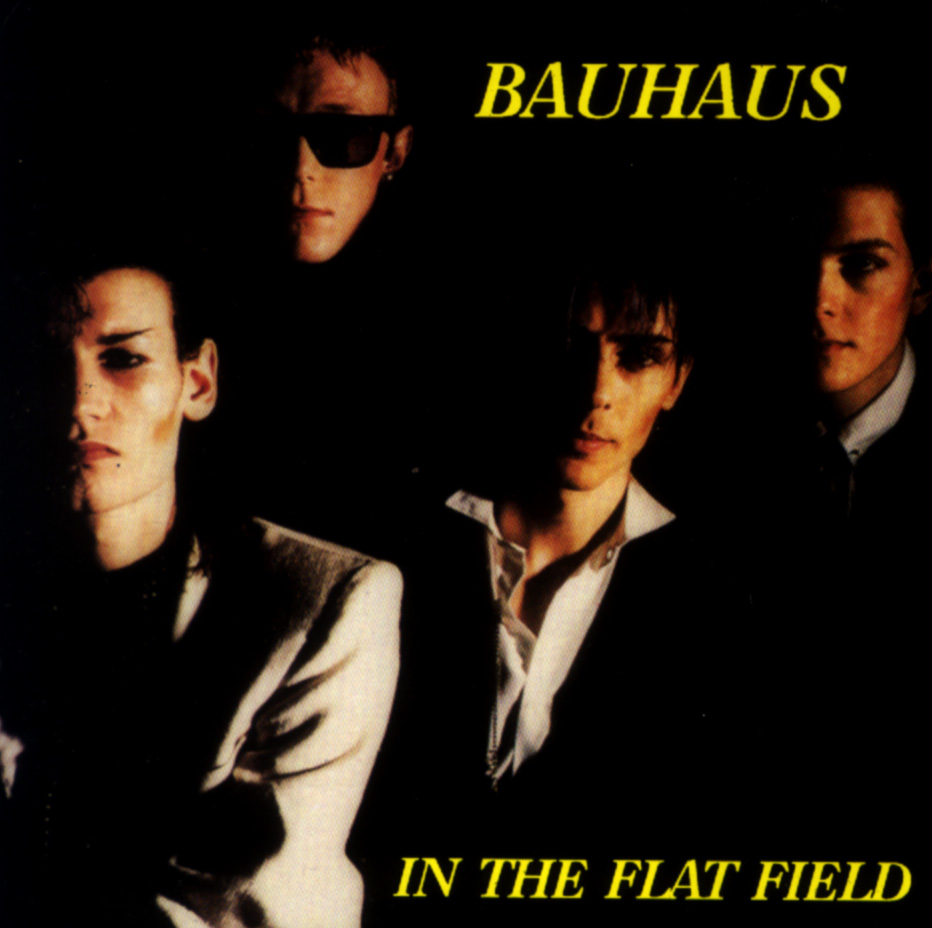
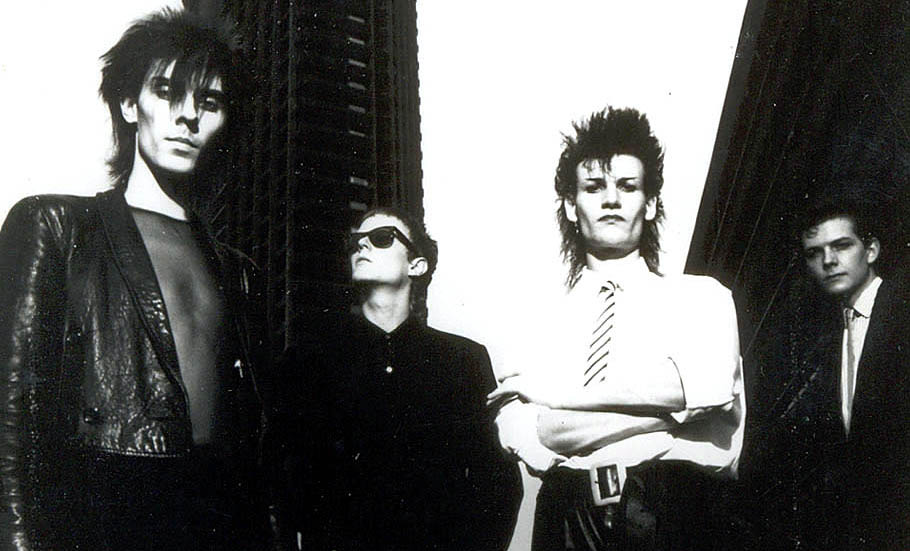
Bauhaus took their dark delight in escaping the mundane with nervy necromantic ecstasy in the crack contortions of this gothic genesis.  The group formed in Northampton in 1978 with Daniel Ash and Kevin Haskins.  They recruited front man Peter Murphy and eventually decided to have Kevin's older brother David J (who had been in The Craze with his brother and Ash) take over for original bassist Chris Barber.  They played their first gig on New Year's Eve of 1978 at the Cromwell pub in Wellingborough.  

They initially called themselves Bauhaus 1919 after the German art movement.  Their first single, the nine-minute opus "Bela Lugosi's Dead" was released eight months later on Small Wonder Records.  The exposure from the single led to a session on John Peel's radio show on BBC and a deal with 4AD Records and a promotional tour.  In June of 1980, the band went into Southern Studios in London to record 'In the Flat Field' with engineer Paul Cook.   The sessions featured Peter Murphy on vocals and guitar;   Daniel Ash on guitar and saxophone;   David J on bass guitar;   and  Kevin Haskins on drums.   The band handled production and sleeve design with the front cover photograph, Homage to Puvis de Chavannes, done by Duane Michals. The album was delayed for nearly a month while the band worked out permission for using the version of "Double Dare" they recorded on John Peel's show in December at BBC Maida Vale Studios.  


Murphy muses:     "When I think back, when we started writing songs in that mobile classroom I knew that I’d made it already.  Daniel and I brought the psychodrama to the band, and I would exorcise a lot of that repressed psychodrama that had been left over from Catholicism.  Personally, I used to really enjoy Mass and the hymns and there was a great contemplation of the Anti-Christ. I really enjoyed it but I also wanted a shag, which is why I went into a band, I guess...My passion, really - which came out in the first album, In The Flat Field - was escaping the flat fields of the mundane; the escape from the working class ghetto of the 'jobs for life' mentally and its forced ignorance. That reflected in the Church’s idea of hierarchical supremacy where the priests would say, 'Listen to me. We mediate between you and God; you just get on with it.' There was a lot of that that came out in the music."


Ash asserts:         "To me, the whole Goth thing is very one dimensional. It’s sort of cloak and dagger. It’s ok, it has its place, it’s fun, but we just find it funny that we’re thought of as that. In the same breath, if you wear black and your first single is “Bela Lugosi’s Dead,” you’ve pretty much got a stamp on you. That’s always been one of our strongest songs, so it’s sort of undeniable. I think a lot of it is the imagery, but we never actually spoke about what we looked like when we started out. We never mentioned wearing black, never mentioned makeup or any of it...My personal obsession was to make the band sound like nobody else. If we started working on a song and we’d got to a particular chord change that sounded like pop music or something, or just sounded corny or something we’d heard before, I would deliberately change that and take it somewhere else and do a chord progression or something to make it sound original. Also, I’d use the e-bow a lot, or a drum stick on the strings – anything to avoid sounding like just another rock band.   A big part of the band was to stand out and be something different. I do remember over here when we were first signed up with A&M Records, they couldn’t put us in a category because they didn’t know what we were. They couldn’t put us in rock, or reggae, or pop music; it was just something else, and I personally was chuffed about that. I thought that was great, there wasn’t a category they could put us into. I thought that was an achievement for us."


Despite unfavorable reviews,  'In the Flat Field'  went to the top of the British independent album chart and broke into the pop album chart, peaking at number seventy-two.  


https://www.waste.org/bauhaus/


http://www.petermurphy.info/


http://www.davidjonline.com/


https://twitter.com/danielashmusic 


"In The Flat Field"


'In the Flat Field'


full album:


All songs written and composed by Bauhaus (Peter Murphy, Daniel Ash, David J, Kevin Haskins), except as noted. 

1. "Dark Entries" (single version) 3:52
side one of original album
2. "Double Dare"   4:54
3. "In the Flat Field"   5:00
4. "God in an Alcove"   4:08
5. "Dive"   2:13
6. "Spy in the Cab"   4:31
side two of original album
7. "Small Talk Stinks"   3:35
8. "St. Vitus Dance"   3:31
9. "Stigmata Martyr"   3:46
10. "Nerves"   7:06
bonus
11. "Telegram Sam" (single version) Marc Bolan 2:11
12. "Rosegarden Funeral of Sores"   John Cale 5:34
13. "Terror Couple Kill Colonel" (single version) 4:21
14. "Scopes"   1:34
15. "Untitled"   1:27
16. "God in an Alcove"   4:09
17. "Crowds"   3:15


Friday, July 17, 2015

closer


Joy Division approached the last stand at the abyss of destiny with the painstaking permanence of this gothic procession.    Although their debut album 'Unknown Pleasures' had reached the top of the British independent album chart, the band was unsatisfied.  Lead singer Ian Curtis continued to suffer epileptic seizures, which compromised their live shows and left him increasingly depressed.  They recorded their final studio album at Britannia Row Studios in Islington, London with producer Martin Hannett.   The sessions featured Ian Curtis on lead vocals, guitar, and melodica;   Bernard Sumner on guitar, bass guitar, and synthesizers;   Peter Hook on bass guitar, guitar, and six-string bass guitar;   and  Stephen Morris on drums, electronic drums, and percussion.  


Hook:   "It was quite odd with 'Closer', because Martin Hannett had gotten into this sort of nocturnal recording, and Ian went along with it heartily. So they were in the studio late at night on quite a few occasions. Don’t forget, “Closer” was done, lock, stock and barrel in three weeks ... We were all enjoying ourselves, and this meant that the songs kept getting better and better.  If you listen to one of our first ever tracks like ‘At A Later Date,’ and then listen to ‘Decades,’ the final track from ‘Closer’, you can already see a clear progression there — we had become much more sophisticated as songwriters." 


Morris:   "We'd start a beat and then just jam.  And Ian was good at picking up bits, saying' You play that four times.'  The great thing about Joy Division was you could write a song very quickly.  Ian had all these lyrics and he'd just start singing on top, and all of a sudden you had a song ... Martin went and bought an AMS, which was made in Burnley.  A delay line.  You could do reverb with it and stuff like that.  Another hting you could do wih it was you could feed a sample into it.  It was the first sampler, shortly before a Fairlight.  We did it a few times - put a noise into it and hit a switch, and it would play back the sound you put into it.  We used that quite a lot on 'Closer'.  It was his box of tricks and he'd paid a fortune for it and he brought it to the studio, so we had to use it!"


Curtis confessed:  "I’ve got a little book full of lyrics and I just fit something in. I have a lot of lyrics in reserve so I’ll use them when the right tune comes along. The lines are usually made up of all sorts of odd bits. Leaders of Men, for example – some of the lines are two or three years old...I don’t write about anything in particular, I write very subconsciously...I leave it open to interpretation.”


On May 18, 1980, on the eve of the band's departure for their first American tour, Curtis hung himself in his kitchen.  The warning signs had been there with an overdose of his anti-seizure medication just a month before.  


Hook:   "A poetic, sensitive, tortured soul, the Ian Curtis of the myth — he was definitely that.  But he could also be one of the lads — he was one of the lads as far as we were concerned...He had three personas he was trying to juggle: he had his married-man persona, at home with the wife; the laddish side; and the cerebral, literary side. By the end he was juggling home life and band life, and had two women on the go. There were just too many Ians to cope with...I must admit, that if you look back on the lyrics of 'Closer', you could derive that. You could come to that conclusion, right? But the thing is, that  was in complete contrast to him, how he was acting as a person. He wasn’t there on the floor, curled up in a ball, with his head in his hands. He was actually, most of the time, acting quite normal. Quite nice."


Sumner:   "It's a heavy album.  It was a voyage into the dark side of yourself...We wanted it to be more powerful.  The madder the music sounded, the more pleased [Ian] would be with it ... We’d go to rehearsals and sit around and talk about really banal things.  We’d do that until we couldn’t talk about banal things any more, then we’d pick up our instruments and record into a little cassette player. We didn’t talk about the music or the lyrics very much. We never analysed it."


Curtis would express:    "I just want to carry on the way we are, I think. Basically we want to play and enjoy what we like playing. I think when we stop doing that I think, well, that will be the time to pack it in. That’ll be the end."


'Closer' reached number wenty-three in Australia, six on the UK pop chart, three in New Zealand, and number one on the UK independent album chart.  


http://www.joydiv.org/


"Heart and Soul"
https://www.youtube.com/watch?v=l9bH6R3gj0I


Instincts that can still betray us,
A journey that leads to the sun,
Soulless and bent on destruction,
A struggle between right and wrong.
You take my place in the showdown,
I'll observe with a pitiful eye,
I'd humbly ask for forgiveness,
A request well beyond you and I.

Heart and soul, one will burn.

An abyss that laughs at creation,
A circus complete with all fools,
Foundations that lasted the ages,
Then ripped apart at their roots.
Beyond all this good is the terror,
The grip of a mercenary hand,
When savagery turns all good reason,
There's no turning back, no last stand.

Heart and soul, one will burn.

Existence well what does it matter?
I exist on the best terms I can.
The past is now part of my future,
The present is well out of hand.

Heart and soul, one will burn.
One will burn, one will burn.

Heart and soul, one will burn.


"Isolation"


In fear every day, every evening,
He calls her aloud from above,
Carefully watched for a reason,
Painstaking devotion and love,
Surrendered to self preservation,
From others who care for themselves.
A blindness that touches perfection,
But hurts just like anything else.

Isolation, isolation, isolation.

Mother I tried please believe me,
I'm doing the best that I can.
I'm ashamed of the things I've been put through,
I'm ashamed of the person I am.

Isolation, isolation, isolation.

But if you could just see the beauty,
These things I could never describe,
These pleasures a wayward distraction,

This is my one lucky prize.


"Twenty Four Hours"
https://www.youtube.com/watch?v=3zo4JdTfDw0


So this is permanence, love's shattered pride.
What once was innocence, turned on its side.
A cloud hangs over me, marks every move,
Deep in the memory, of what once was love.

Oh how I realised how I wanted time,
Put into perspective, tried so hard to find,
Just for one moment, thought I'd found my way.
Destiny unfolded, I watched it slip away.

Excessive flashpoints, beyond all reach,
Solitary demands for all I'd like to keep.
Let's take a ride out, see what we can find,
A valueless collection of hopes and past desires.

I never realised the lengths I'd have to go,
All the darkest corners of a sense I didn't know.
Just for one moment, I heard somebody call,
Looked beyond the day in hand, there's nothing there at all.

Now that I've realised how it's all gone wrong,
Gotta find some therapy, this treatment takes too long.
Deep in the heart of where sympathy held sway,

Gotta find my destiny, before it gets too late


'Closer'
full album:

https://www.youtube.com/watch?v=GVVdEqBbr4k


00:00  Atrocity Exhibition 
06:03  Isolation
08:59  Passover
13:42  Colony
17:38  A Means to an End
21:48  Heart and Soul
27:38  Twenty Four Hours
32:05  The Eternal
38:11  Decades