Showing posts with label acid rock. Show all posts

Tuesday, February 24, 2015

physical graffiti


Led Zeppelin sailed across the sea of years to unfold a vagabond vandalism of brownstone boogie, progressive rock, wanton blues, and lilting acoustic grace into this masterful mélange.  

With five uncompromising albums (Led Zeppelin,  Led Zeppelin II, Led Zeppelin III, Led Zeppelin IV, and Houses of the Holy) and nine tours behind them, the band began work on their next album in November of 1973 at Headley Grange in East Hampshire, England with Ronnie Lane's Mobile Studio; however, these sessions soon dissolved as exhaustion had taken its toll.  

Producer and guitarist Jimmy Page would reveal:  "It took a long time for this album mainly because when we originally went in to record it, John Paul Jones wasn't well and we had to cancel the time ... everything got messed up. It took three months to sort the situation out...I love playing. If it was down to just that, it would be utopia. But it's not. It's airplanes, hotel rooms, limousines and armed guards standing outside rooms. I don't get off on that part of it at all. But it's the price I'm willing to pay to get out and play. I was very restless over the last 18 months where we laid off and worked on the album."

Recording resumed in January of 1974 at Headley Grange, and by February they had several new songs fleshed out.  Robert Plant recalled:   "We got eight tracks off... and a lot of them were really raunchy. We did some real belters with live vocals, off-the-wall stuff that turned out really nice...Some of the tracks we assembled in our own fashioned way of running through a track and realising before we knew it that we had stumbled on something completely different."

With the wealth of new material, the project began to expand.  Page relates:   "Well, as usual, we had more material than the required 40-odd minutes for one album. We had enough material for one and a half LPs, so we figured let's put out a double and use some of the material we had done previously but never released. It seemed like a good time to do that sort of thing, release tracks like "Boogie With Stu" which we normally wouldn't be able to do..."Black Country Woman" and "The Rover" were both done at the same time we did "D'yer Mak'er." "Bron-Yr-Aur" was done for the third record. "Down By The Seaside," "Night Flight," and "Boogie With Stu" were all from the sessions for the fourth album. We had an album and a half of new material, and this time we figured it was better to stretch out than to leave off. I really fancied putting out a song called "Houses of the Holy" on the album."


'Physical Graffiti' features John Bonham on drums and percussion;   John Paul Jones on bass guitar, organ, acoustic and electric piano, mellotron, guitar, mandolin, VCS3 synthesiser, Hohner clavinet, Hammond organ, and string arrangement;   Jimmy Page on electric, acoustic, lap steel and slide guitar, mandolin, and production;   and Robert Plant on lead vocals, harmonica, and acoustic guitar on "Boogie with Stu";    with Ian Stewart adding piano on "Boogie with Stu";   and   George Chkiantz, Andy Johns, and Ron Nevison on engineering;   Keith Harwood and Eddie Kramer on engineering and mixing;  Peter Corriston and Mike Doud on artwork, design, and cover design;  and executive producer Peter Grant. 

In May of 1974, the band launched their own record label, Swan Song.  Page relates:  "We'd been thinking about it for a while and we knew if we formed a label there wouldn't be the kind of fuss and bother we'd been going through over album covers and things like that. Having gone through, ourselves, what appeared to be an interference, or at least an aggravation, on the artistic side by record companies, we wanted to form a label where the artists would be able to fulfill themselves without all of that hassle."

'Physical Graffiti' became the first release on Swan Song Records.  It was the first album to go platinum on advance orders alone, going to number seventeen in Italy; thirteen in Japan;  four in Norway;  three in New Zealand;  two in Australia, Austria, France, and Spain;   and number one in the UK and the US.  'Physical Graffiti'  would win a Grammy Award for Best Recording Package.   It has sold more than eight million copies in the US alone, making it one of the best selling albums of all time.  


Page would admit:   "I may not believe in myself, but I believe in what I'm doing. I know where I'm going musically. I can see my pattern and I'm going much slower than I thought I'd be going. I can tell how far I ought to be going, I know how to get there, all I've got to do is keep playing. That might sound a bit weird because of all the John McLaughlins who sound like they're in outer space or something. Maybe it's the tortoise and the hare...I'm not a guitarist as far as a technician goes, I just pick it up and play it. Technique doesn't come into it. I deal in emotions. It's the harmonic side that's important. That's the side I expected to be much further along on than I am now. That just means to say that I've got to keep at it...There's such a wealth of arts and styles within the instrument ... flamenco, jazz, rock, blues ... you name it, it's there. In the early days my dream was to fuse all those styles. Now composing has become just as important. Hand-in-hand with that, I think it's time to travel, start gathering some real right-in-there experiences with street musicians around the world. Moroccan musicians, Indian musicians ... it could be a good time to travel around now. This year. I don't know how everyone else is gonna take that, but that's the direction I'm heading in right now. This week, I'm a gypsy. Maybe next week it'll be glitter rock."


http://www.ledzeppelin.com/


"Kashmir"


Oh let the sun beat down upon my face, stars to fill my dream
I am a traveler of both time and space, to be where I have been
To sit with elders of the gentle race, this world has seldom seen
They talk of days for which they sit and wait and all will be revealed

Talk and song from tongues of lilting grace, whose sounds caress my ear
But not a word I heard could I relate, the story was quite clear
Oh, oh.

Oh, I been flying... mama, there ain't no denyin'
I've been flying, ain't no denyin', no denyin'

All I see turns to brown, as the sun burns the ground
And my eyes fill with sand, as I scan this wasted land
Trying to find, trying to find where I've been.

Oh, pilot of the storm who leaves no trace, like thoughts inside a dream
Heed the path that led me to that place, yellow desert stream
My Shangri-La beneath the summer moon, I will return again
Sure as the dust that floats high in June, when movin' through Kashmir.

Oh, father of the four winds, fill my sails, across the sea of years
With no provision but an open face, along the straits of fear
Ohh.

When I'm on, when I'm on my way, yeah
When I see, when I see the way, you stay-yeah

Ooh, yeah-yeah, ooh, yeah-yeah, when I'm down...
Ooh, yeah-yeah, ooh, yeah-yeah, well I'm down, so down
Ooh, my baby, oooh, my baby, let me take you there

Let me take you there. Let me take you there 


"In the Light"

Led Zeppelin-In the Light by sadlimbic


"Bron-Yr-Aur"
https://www.youtube.com/watch?v=2YZ_lIpG1XQ


"Down by the Seaside" 
https://www.youtube.com/watch?v=atuU12Ye9F8


"Boogie with Stu"
https://www.youtube.com/watch?v=keLDX8VLkUU


'Physical Graffiti' 
full album: 


All songs written and composed by Jimmy Page and Robert Plant, except where noted. 

Side one
1. "Custard Pie"   January–February 1974 4:13
2. "The Rover"   May 1972 5:37
3. "In My Time of Dying" (John Bonham, John Paul Jones, Page, and Plant) January–February 1974 11:04
Side two
4. "Houses of the Holy"   May 1972 4:02
5. "Trampled Under Foot" (Jones, Page, and Plant) January–February 1974 5:37
6. "Kashmir" (Bonham, Page, and Plant) January–February 1974 8:32
Side three
7. "In the Light" (Jones, Page, and Plant) January–February 1974 8:46
8. "Bron-Yr-Aur" (Page) July 1970 2:06
9. "Down by the Seaside"   February 1971 5:13
10. "Ten Years Gone"   January–February 1974 6:32
Side four
11. "Night Flight" (Jones, Page, and Plant) December 1970 – January 1971 3:36
12. "The Wanton Song"   January–February 1974 4:10
13. "Boogie with Stu" (Bonham, Jones, Page, Plant, Ian Stewart) December 1970 – January 1971 3:53
14. "Black Country Woman"   May 1972 4:24
15. "Sick Again"   January–February 1974 4:42


cover art
https://www.youtube.com/watch?v=sv1NiEh3sa0


Sunday, February 1, 2015

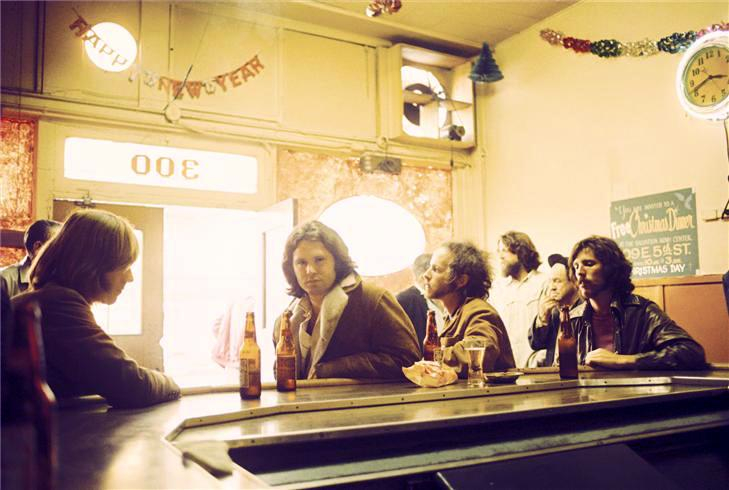
morrison hotel


The Doors made it real and let it roll with this mysterious union of hard rock and roadhouse blues.   The band had been in a slump with the poor response to 'The Soft Parade' and 'Absolutely Live'.  Legal problems came as Morrison's antagonistic onstage behavior made him the first rock artist to be arrested while performing when he was dragged off by police in New Haven.  After another show in Miami, he was charged for exposing himself in public.  

Morrison would reflect on the recent charges from police and critics:   "I think that really it was a life style that was on trial more than my specific incident. I guess that what it boiled down to was that I told the audience that they were a bunch of fucking idiots to be members of an audience...you know...what were they doing there anyway? The basic message was...realize that you're not really here to listen to a bunch of songs by some fairly good musicians. You're here for something else, and why not admit it and do something about it...I think that the music has gotten progessively better...tighter...and more professional...more interesting. I just think that people resent the fact that...three years ago, if you remember, there was a great renaissance of spirit and emotion and revolutionary sentiment. When things didn't change overnight, I think people resented the fact that we were just still around doing good music...A hero is someone who rebels, or seems to rebel, against the facts of existence and seems to conquer them, but obviously that can work at moments. It can't be a lasting thing...but that's not saying that people shouldn't keep trying to rebel against the facts of existence...Who knows, someday we might conquer death....and disease and war... I think of myself as...a...as an intelligent...sensitive human being with the soul of a clown...which always forces me to blow it at the...a...most important moments."


'Morrison Hotel' featured Jim Morrison on lead vocals, maracas, and tambourine;   Ray Manzarek on tack piano, Gibson G-101 organ, Vox Continental organ, piano, Wurlitzer electric piano, Fender Rhodes Piano Bass, Hammond C-3 organ, Rocksichord, and Moog modular synthesizer;   Robby Krieger on guitar;   and  John Densmore on drums;     with Lonnie Mack and Ray Neapolitan on bass guitar;   John Sebastian (as "G. Puglese") on harmonica.   Produced by Paul A. Rothchild with Bruce Botnick engineering, the album was a return to the heavy blues sound of their earlier albums.  Two of the songs were recorded during earlier sessions:   "Indian Summer" in late August 1966 during sessions for The Doors  and  "Waiting for the Sun" during sessions for Waiting for the Sun in 1968.  


'Morrison Hotel'  went to number thirty-two in France, thirteen in Norway, twelve in the UK, six in the Netherlands, four in Australia and the US, and number three in Canada.  


https://www.thedoors.com/


"Peace Frog"


"Roadhouse Blues"


'Morrison Hotel' 
full album:


Side A: Hard Rock Café
1. "Roadhouse Blues"   (The Doors) 4:03
2. "Waiting for the Sun"   (Jim Morrison) 3:58
3. "You Make Me Real"   (Morrison) 2:53
4. "Peace Frog"   (Morrison, Robby Krieger) 2:51
5. "Blue Sunday"   (Morrison) 2:13
6. "Ship of Fools"   (Morrison, Krieger) 3:08
Side B: Morrison Hotel
7. "Land Ho!"   (Morrison, Krieger) 4:10
8. "The Spy"   (Morrison) 4:17
9. "Queen of the Highway"   (Morrison, Krieger) 2:47
10. "Indian Summer"   (Morrison, Krieger) 2:36
11. "Maggie M'Gill"   (The Doors) 4:23


Friday, November 22, 2013

the white album


The Beatles wiped the slate clean with this sprawling and diverse collection of solo songs.  The unprecedented success of 'Sgt Pepper's Lonely Hearts Club Band' had left the band uncertain about which direction they would go next.  They worked on two feature films and their soundtracks ('Magical Mystery Tour' and 'Yellow Submarine') before embarking on a trip to the ashram of Maharishi Mahesh Yogi in Rishikesh, India to study Transcendental Meditation.  Ringo left after only ten days.  Paul left after a month.  George and John stuck around for another month until they heard that the Maharishi had made sexual advances toward women at the compound.  

When the band reconvened at Abbey Road Studios, they had amassed over thirty songs, most of which had been written while in India.  The sessions were produced by George Martin and Chris Thomas and were fraught with tension as each member of the band fought for control of their own songs.  Ringo quit the band for two weeks during the recording of the album; but was convinced to return.  The album features John Lennon on lead, harmony and background vocals; acoustic, lead, bass and rhythm guitars; keyboards (electric and acoustic pianos, Hammond organ, harmonium and mellotron); extra drums and assorted percussion (tambourine, maracas, cymbals, thumping on the back of an acoustic guitar, handclaps and vocal percussion); harmonica, whistling and saxophone; tapes, tape loops and sound effects (electronic and home-made);      Paul McCartney on lead, harmony and background vocals; acoustic, lead, rhythm and bass guitars; keyboards (electric and acoustic pianos and Hammond organ); assorted percussion (timpani, tambourine, cowbell, hand shake bell, handclaps, foot taps and vocal percussion); drums (on "Back in the U.S.S.R.","Dear Prudence", "Wild Honey Pie", and "Martha My Dear"); recorder and flugelhorn; sound effects;    George Harrison on lead, harmony and background vocals; acoustic, rhythm, bass and lead guitars; Hammond organ; extra drums and assorted percussion (tambourine, handclaps and vocal percussion) and sound effects;     and Ringo Starr on drums and assorted percussion (tambourine, bongos, cymbals, maracas and vocal percussion); electric piano and sleigh bell (on "Don't Pass Me By"), lead vocals (on "Don't Pass Me By" and "Good Night") and backing vocals ("The Continuing Story of Bungalow Bill");    with contributions from Eric Clapton on lead guitar on "While my Guitar Gently Weeps";   Mal Evans on backing vocals and handclaps on "Dear Prudence", handclaps on "Birthday", and trumpet on "Helter Skelter";   Jack Fallon on violin on "Don't Pass Me By";   Grant Mansell on drums on "Martha My Dear";   Pattie Harrison on backing vocals on "Birthday";   Jackie Lomax on backing vocals and handclaps on "Dear Prudence";  Maureen Starkey on backing vocals on "The Continuing Story of Bungalow Bill";   Yoko Ono on backing vocals, brief lead vocals and handclaps on "The Continuing Story of Bungalow Bill", backing vocals on "Birthday", speech, tapes and sound effects on "Revolution 9";   and including session musicians Ted Barker on trombone on "Martha My Dear";   Leon Calvert on trumpet and flugelhorn on "Martha My Dear";   Henry Datyner, Eric Bowie, Norman Lederman, and Ronald Thomas on violin on "Glass Onion";   Bernard Miller, Dennis McConnell, Lou Soufier and Les Maddox on violin on "Martha My Dear";   Reginald Kilby on cello on "Glass Onion" and "Martha My Dear";  Eldon Fox  on cello on "Glass Onion";   Frederick Alexander  on cello on "Martha My Dear";   Harry Klein on saxophone on "Savoy Truffle" and "Honey Pie";   Dennis Walton, Ronald Chamberlain, Jim Chest, and Rex Morris on saxophone on "Honey Pie";   Raymond Newman and David Smith on clarinet on "Honey Pie";   Art Ellefson, Danny Moss, and Derek Collins on tenor sax on "Savoy Truffle";   Ronnie Ross and Bernard George on baritone sax on "Savoy Truffle";   Alf Reece on tuba on "Martha My Dear";   The Mike Sammes Singers on backing vocals on "Good Night";   Stanley Reynolds and Ronnie Hughes on trumpet on "Martha My Dear";   Tony Tunstall on French horn on "Martha My Dear";   John Underwood and Keith Cummings on viola on "Glass Onion";   Leo Birnbaum and Henry Myerscough on viola on "Martha My Dear";     and the overwrought production team of  Geoff Emerick on engineering, and  speech on "Revolution 9";   George Martin on record production and mixing; string, brass, clarinet, orchestral arrangements and conducting; and piano on "Rocky Raccoon";   Ken Scott as engineer and mixer;   Barry Sheffield as engineer ( at Trident Studio);   Chris Thomas on production; Mellotron on "The Continuing Story of Bungalow Bill", harpsichord on "Piggies",piano on "Long, Long, Long", and saxophone arrangement on "Savoy Truffle".  During the sessions, the band would often separate into different recording spaces to focus on their own tracks, with the various engineers and producers scrambling to keep everything together.  George Martin left suddenly to go on holiday amid the chaos, leaving his star assistant struck Chris Thomas in charge for the first time.   


John:    "I wasn't interested in following up 'Sgt Pepper' and I don't know whether the others were or not, but I know that what I was going for was to forget about  'Sgt Pepper' . You know that was  'Sgt Pepper'  and that's alright, fine, it's over... and just get back to basic music ... The songs and most of it is just as good as anything we recorded and there was lots of group activity going down. I love the White Album ... Dylan broke his neck and we went to India. Everybody did their bit. And now we’re all just coming out, coming out of a shell, in a new way, kind of saying, remember what it was like to play...I’ve got no regrets at all, ‘cuz it was a groove and I had some great experiences meditating eight hours a day -- some amazing things, some amazing trips -- it was great. And I still meditate off and on. George is doing it regularly. And I believe implicity in the whole bit. It’s just that it’s difficult to continue it. I lost the rosy glasses. And I’m like that. I’m very idealistic.  So I can’t really manage my exercises when I’ve lost that. I mean, I don’t want to be a boxer so much. It’s just that a few things happened, or didn’t happen. I don’t know, but something happened. It was sort of like a (click) and we just left and I don’t know what went on. It’s too near -- I don’t really know what happened....There’s no point in dropping out because it’s the same there and it’s got to change. But I think it all comes down to changing your head and, sure, I know that’s a cliche... If destruction’s the only way he can do it, there’s nothing I can say that could influence him ‘cuz that’s where he’s at, really. We’ve all got that in us, too, and that’s why I did the 'Out and In' bit on a few takes and in the TV version of 'Revolution' -- 'Destruction, well, you know, you can count me out, and in,' like yin and yang. I prefer 'out.' But we’ve got the other bit in us. I don’t know what I’d be doing if I was in his position. I don’t think I’d be so meek and mild. I just don’t know."


Paul:    "Well it is another step, you know, but it's not necessarily in the way people expected. Uhh... On 'Sgt Pepper' we had more instrumentation than we'd ever had. More orchestral stuff than we'd ever used before, so it was more of a production. But we didn't really want to go overboard like that this time, and we've tried to play more like a band this time-- only using instruments when we had to, instead of just using them for the fun of it...Well, since we were in India we started writing this batch of songs. And we've written a few since. And this is mainly the Indian batch that we've sort of finished...We've always been a rock & roll group, I suppose, you know. It's just that we're not just completely rock & roll. That's what I was trying to say before about 'Obladi,' 'USSR,' they're all different kinds of things. We're not just completely one kind of group. 'Cuz like, when we played in Hamburg, we didn't just do rock all evening 'cuz we had to have these sort of fat old businessmen coming in and saying... (jokingly) or THIN old businessmen, as well, were coming in and saying 'Play a mambo. Can you do a rhumba?' And we couldn't just keep saying no, you know, so we had to get into mambos and rhumbas a bit. So this kind of thing is like a pretty sort of smootchy ballad-- 'I Will.' But we have to do that kind of stuff, you know, so we always played alot of kind of things. I don't know if it's getting off the subject, but that's why there's great variety in this LP-- 'cuz in everything we do, you know, we just haven't got one bag, The Beatles, you know. And 'cuz on one hand you'll get something like 'I Will' and then you'll get 'Why Don't We Do It In The Road,' you know. Just completely different things-- completely different feelings and... But it's me singing both of them. It's the same fella. Uhh, and I've wrote both of them, you know. So you can't explain it. I don't know why I do 'Why Don't We Do It In The Road' shouting it like that... and then do this sort of smootchy laughing American 'Girl From Ipenema.' ... Originally George [Martin] was the supreme producer but as things loosened up George gave us a bit of the control of the tools...I think it's a fine little album and the fact that it's got so much on it is one of the things that's cool about it."


George:    "It became apparent that there was more songs than would make a single album ... Obviously, we go through cycles. At the moment, it's all that bit like getting my guitar out again, and it's happened quite a bit on this next album of the Beatles...We've got 'together' for it. Like, in the early days we were pretty good because we played for so long in one place. That's why I'd like to do a resident spot. Then you've got your amps and your drums set up, and get used to the one sound...All these people come to see you, too, so you can't hide. You can't fake anything. It's like, you know, you've got your trousers down. And  there's nothing to hide...Now, we're trying to get as funky as we were in the Cavern. 'Cuz in the Cavern and Hamburg, all we really were was thump-thump-thump. But so together, you know, because we were playing all the time. And those were the days when we used to think that 'Twist and Shout' was too way-out for a single. All very 'Shadows' it was, then, and getting into suits...The next album is much simpler than 'Pepper' because it's more down to guitars, bass and drums, and maybe a piano. There's a nice one of Paul just playing with his guitar, singing by himself but with just a bit of brass on it."


Ringo:     "'Sgt Pepper' did its thing, it was the album of the decade - of the century maybe. It was very innovative. Great songs, glad I was on it. But the White Album... We ended up being more of a band again and that's what I always love, I love being in a band ... You know, there's that famous old saying, you'll always hurt the one you love. And we all love each other and we all know that. But we still sort of hurt each other, occasionally. You know... where we just misunderstand each other and we go off, and it builds up to something bigger than it ever was. Then we have to come down to it and get it over with, you know. Sort it out. And so we're still really very close people...You know, when we first started we were the nice clean mop tops and every mother's son. And everyone loved us. And then suddenly, you know, there's a few things that they don't understand, and they don't get, and they don't like. And so it turns them off us a bit, you know. But I still think we're very popular. It's just that, we're men now, you know. We're a bit older than those lads that started out. And we've got a lot of things to do, you know. And you've got to do a few of them. It doesn't matter, you know, what people say. You can't live all your life by what they want. You know, we can't go on forever as four clean little mop tops, playing She Loves You...I'm quite happy to finish an LP and go and sit back. I can enjoy myself just sitting back, you know, and playing at home with all the toys, and the kids, and the wife. (jokingly) I enjoy playing with the wife."

'The Beatles' was the first album released on the band's own Apple Records.  The eclectic mix of musical styles on the two album set was too much for many critics; but the public went crazy for it.  In the UK, it made its debut at the top of the album charts, and went to number one in Australia, Canada, France, Germany, Norway, and in the US, where it remains the tenth biggest selling album of all time due to its status as a double album.  On account of its plain white packaging, it is most commonly referred to as "the White Album".  


http://www.thebeatles.com/


"Back in the U.S.S.R." 


Back In the U.S.S.R. from JHu on Vimeo.


"Ob-La-Di, Ob-La-Da"


OB LA DI OB LA DA from vinod on Vimeo.


"While My Guitar Gently Weeps"

The Beatles-While My Guitar Gently Weeps by numberonereturn1


"Birthday"

Happy Birthday-Beatles from Ehtesham-Al-Huq Sagar on Vimeo.


Also recorded during the sessions was 'Hey Jude', which was released as a single three months before 'The Beatles'.  It became the biggest single of their career.  


The b-side was a sped up version of 'Revolution'. 


'Revolution' and 'Revolution 9' were originally part of the same track; but were eventually separated.  


unplugged


'The Beatles' 

full album:
(as best as the internets will allow)


All songs written and composed by Lennon–McCartney, except where noted. Lead vocalist listed.


Side one
1. "Back in the U.S.S.R."   McCartney 2:43
2. "Dear Prudence"   Lennon 3:56
3. "Glass Onion"   Lennon 2:17
4. "Ob-La-Di, Ob-La-Da"   McCartney 3:08
5. "Wild Honey Pie"   McCartney 0:52
6. "The Continuing Story of Bungalow Bill"   Lennon 3:14
7. "While My Guitar Gently Weeps" (George Harrison) Harrison 4:45
8. "Happiness Is a Warm Gun"   Lennon 2:43
Side two
1. "Martha My Dear"   McCartney 2:28
2. "I'm So Tired"   Lennon 2:03
3. "Blackbird"   McCartney 2:18
4. "Piggies" (Harrison) Harrison 2:04
5. "Rocky Raccoon"   McCartney 3:33
6. "Don't Pass Me By" (Richard Starkey) Starr 3:51
7. "Why Don't We Do It in the Road?"   McCartney 1:41
8. "I Will"   McCartney 1:46
9. "Julia"   Lennon 2:54
Side three
1. "Birthday"   McCartney and Lennon 2:42
2. "Yer Blues"   Lennon 4:01
3. "Mother Nature's Son"   McCartney 2:48
4. "Everybody's Got Something to Hide Except Me and My Monkey"   Lennon 2:24
5. "Sexy Sadie"   Lennon 3:15
6. "Helter Skelter"   McCartney 4:29
7. "Long, Long, Long" (Harrison) Harrison 3:04
Side four
1. "Revolution 1"   Lennon 4:15
2. "Honey Pie"   McCartney 2:41
3. "Savoy Truffle" (Harrison) Harrison 2:54
4. "Cry Baby Cry"   Lennon, with McCartney 3:02
5. "Revolution 9"   Speaking from Lennon, Harrison, George Martin and Yoko Ono 8:22
6. "Good Night"   Starr 3:13