Showing posts with label 1971. Show all posts

Wednesday, April 20, 2016

east of the river nile


Augustus Pablo legitimized the melodica in a natural way and gave new life to dub instrumentals.  Born Horace Swaby, he learned to play the organ while a student at the Kingston College School.  He acquired a melodica from "a little sistren" and began playing the instrument incessantly.  The blow-organ instrument had not been taken seriously at this point and was primarily used in school music classes.  

Herman Chin Loy, owner of the Aquarius record shop, heard him playing the instrument and booked him in a studio the next day.  He cut his first single "Iggy Iggy" as well as an instrumental track that would eventually become the title track for 'East of the River Nile'.   In the meantime, he recorded four albums   (This Is...Augustus Pablo  and Ital Dub in 1974,  Thriller  in 1975,  and  King Tubbys Meets Rockers Uptown in 1976) and set up his own Rockers record label.  

'East of the River Nile' was recorded at Harry J's, Channel One, King Tubby's, and Black Ark in Kingston.  Pablo produced the sessions and played organ, piano, strings, keyboards, clavinet, and melodica;  with  Aston "Family Man" Barrett, Clayton Downie, Robert "Robbie" Shakespeare, and Earl "Bagga" Walker trading off on bass;  Carlton "Carlie" Barrett, Noel "Alphonso" Benbow, and Max Edwards sitting in on drums;  Earl "Chinna" Smith on guitar; Everton DaSilva on percussions;  and the Ja-Malla Band playing on "Chant to King Selassie I" and "Natural Way".   The Upsetters played on "Upfull Living", "Unfinished Melody", and "Memories of the Ghetto".  King Tubby and Lee Perry did the mixing.  


East of the River Nile 
original version


Natural Way


'East of the River Nile'
full album:


00:00 - 1 - Chant To King Selassie I
03:42 - 2 - Natural Way
11:08 - 3 - Nature Dub
15:00 - 4 - Upfull Living
19:58 - 5 - Unfinished Melody
22:32 - 6 - Jah Light
24:48 - 7 - Memories Of The Ghetto
28:10 - 8 - Africa (1983) 
31:13 - 9 - East Of The River Nile
34:06 - 10 - Sounds Form Levi
38:06 - 11 - Chapter 2 
42:23 - 12 - Addis-A-Baba 
46:08 - 13 - East Africa 
48:56 - 14 - East of the River Nile (original)
51:54 - 15 - Memories of the Ghetto Dub 
55:28 - 16 - Jah Light Version 
58:00 - 17 - Islington Rock
1:00:00 - 18 - Meditation Dub


Saturday, December 17, 2011

hunky dory


The Actor found a new record label and finally hit his stride with the cinematic sweep of this kaleidoscopic pop masterpiece. David Bowie hadn’t been able to follow up the success of ‘Space Oddity’ and was embroiled in a legal battle with his former manager Ken Pitt. Abandoning the heavy rock sound of ‘The Man Who Sold the World’ along with producer and bassist Tony Visconti, he promoted engineer Ken Scott to co-produce his new album. He did not have a recording contract when the sessions began at Trident Studios in London; but the tapes impressed executives at RCA Records and they signed him to a three album deal. The sound of ‘Hunky Dory’ prominently features the pianowork of session man Rick Wakeman. Guitar ace Mick Ronson also contributed mellotron and string arrangements. The rhythm section retained Mick Woodmansey on drums and added Trevor Bolder on bass and trumpet.


Bowie says 'Changes' "started out as a parody of a nightclub song, a kind of throwaway". It was his first single for RCA and his first to chart in the US, peaking at number forty-one. It's theme of reinvention and exploration made it an anthem for the changlings.

"I watch the ripples change their size
But never leave the stream
Of warm impermanence
So the days float through my eyes
But stil the days seem the same
And these children that you spit on
As they try to change their worlds
Are immune to your consultations
They're quite aware of what they're going through"


"Oh! You Pretty Things" was inspired by the writings of Aleister Crowley and Friedrich Nietzsche.

"What are we coming to
No room for me, no fun for you
I think about a world to come
Where the books were found by the golden ones
Written in pain, written in awe
By a puzzled man who questioned
What we were here for
All the strangers came today
And it looks as though they're here to stay
Oh you pretty things (oh you pretty things)
Don't you know you're driving your
Mamas and papas insane
Oh you pretty things (oh you pretty things)
Don't you know you're driving your
Mamas and papas insane
Let me make it plain
You gotta make way for the homo superior"


"Life on Mars?" was released as a single in 1973 and went to number three in the UK. Bowie wrote it as his own version of 'My Way'; Paul Anka's rewrite of Claude François’ “Comme d’Habitude”, which Bowie had rewritten himself as “Even a Fool Learns to Love” . The song pokes fun at some of Frank Sinatra's film roles.

"Sailors fighting in the dance hall
Oh man! Look at those cavemen go
It's the freakiest show
Take a look at the lawman
Beating up the wrong guy
Oh man! Wonder if he'll ever know
He's in the best selling show
Is there life on Mars?"


Bowie wrote "Kooks" after the birth of his son Duncan Zowie Haywood Jones, inspired by Neil Young.
 
"Will you stay in our Lovers' Story
If you stay you won't be sorry
'Cause we believe in you
Soon you'll grow so take a chance
With a couple of Kooks
Hung up on romancing"


"Fill Your Heart" was written by Biff Rose and Paul Williams.

Fill your heart with love today
Don't play the game of time
Things that happened in the past
Only happened in your Mind
Only in your Mind, ah forget your Mind
And you'll be free-yeah
The writing's n the wall
Free-yeah And you can know it all
If you choose. Just remember
Lovers never lose
'Cause they are Free of thoughts unpure
And of thoughts unkind
Gentleness clears the soul
Love cleans the mind
And makes it Free


"Andy Warhol"

"Like to take a cement fix
Be a standing cinema
Dress my friends up just for show
See them as they really are
Put a peephole in my brain
Two New Pence to have a go
I'd like to be a gallery
Put you all inside my show"


"Queen Bitch" draws heavily from the music of Lou Reed and the Velvet Underground.

"She's an old-time ambassador
Of sweet talking night walking games
Oh and she's known in the darkest clubs for pushing ahead of the dames
And if she says she can do it then she can do it
She don't make false claims
Oh she's a queen and such are queens
That your laughter is sucked in their brains
Now she's leading him on, and she'll lay him right down
Yes she's leading him on, and she'll lay him right down
But it could've been me, yes it could've been me
Why didn't I say, why didn't I say?"


'Hunky Dory'

full album:


All tracks written by David Bowie, except where noted.

Side one
1. "Changes"   3:37
2. "Oh! You Pretty Things"   3:12
3. "Eight Line Poem"   2:55
4. "Life on Mars?"   3:53
5. "Kooks"   2:53
6. "Quicksand"   5:08
Side two
7. "Fill Your Heart" (Biff Rose, Paul Williams) 3:07
8. "Andy Warhol"   3:56
9. "Song for Bob Dylan"   4:12
10. "Queen Bitch"   3:18
11. "The Bewlay Brothers"   5:22


Sunday, December 4, 2011

family affair


Sly and the Family Stone came back after more than two years with this deep, dark, funky reflection of the troubled times. 'Family Affair' was produced without most of the Family Stone. Sly had become disillusioned with performing and had missed a lot of concert dates. He had become paranoid and addicted to drugs, surrounding himself with gangsters. This led to friction with the band. For 'Family Affair', Sly played most of the instruments, recording many of the tracks alone in his Winnebago and his home studio. His sister Rose Stone sang lead vocals along with him. Billy Preston played piano while Bobby Womack handled guitar. Sly didn't think much of the song and had to be convinced to release it as the leadoff single for 'There's a Riot Goin' On' by his manager and Epic Records. His manager, David Kapralik, suggested that the song was about the factions in Sly's life and his own family; but Sly retorted, "Song's not about that. Song's about a family affair, whether it's a result of genetic processes or a situation in the environment." The somber soulful single became his fourth and final number one hit.


It's a family affair, it's a family affair
One child grows up to be
Somebody that just loves to learn
And another child grows up to be
Somebody you'd just love to burn
Mom loves the both of them
You see it's in the blood
Both kids are good to Mom
Blood's thicker than mud
It's a family affair, it's a family affair

Newlywed a year ago
But you're still checking each other out, yeah.
Nobody wants to blow
Nobody wants to be left out
You can't leave, 'cause your heart is there
But you can't stay, 'cause you been somewhere else!

You can't cry, 'cause you'll look broke down
But you're cryin' anyway 'cause you're all broke down!

It's a family affair


Friday, December 2, 2011

the silver tongued devil and i


Kris Kristofferson finally had a hit on his own with the assured outlaw country and boozy romanticism of his second album. His debut album didn't sell well; but many of his songs proved successful for others. He won Song of the Year from the Academy of Country Music and from the Country Music Association for two different songs in 1970. This created a lot of anticipation for his next album, and his label Monument Records allowed for the expense of strings and a horn section. Even so, the sound of the album is minimalistic and masterful. 'The Silver Tongued Devil and I' went gold, hitting number twenty-one on the pop chart and number four on the country chart.


http://www.kriskristofferson.com/


"The Silver Tongued Devil and I"

"I took myself down to the Tally-Ho Tavern
to buy me a bottle of beer
I sat me down by a tender young maiden
whose eyes were as dark as her hair
And as I was searchin' from bottle to bottle
for somethin' unfoolish to say
That silver tongued devil just slipped
from the shadows and smilingly stole her away
I said hey little girl don't you know he's the devil
he's everything that I ain't
Hidin' intentions of evil
under the smile of a saint
All he's good for is gettin' in trouble
and shifting his share of the blame
And some people swear he's my double
and some even say we're the same
But the silver tongued devil's got nothing to lose
I'll only live till I die
We take our own chances and pay our own dues
the silver tongued devil and I"


"The Taker" had been a hit for Waylon Jennings. Kristofferson's version features vocals by Rita Coolidge and Joan Baez.

"He's a charmer, and he'll charm her
with money and manners that I never learned
He's a leader, and he'll lead her
across pretty bridges he's planning to burn
He's a talker, he'll talk her
right off of her feet, but he won't talk for long
Cause he's a doer, and he'll do her
the way that I never
And damned if he won't do her wrong
'cause he's a taker, he'll take her
to places and make her fly higher than she's ever dared to
He'll take his time before takin' advantage
takin' her easy and slow
And after he's taken the body and soul
that she gives him, he'll take her for granted
Then he'll take off and leave her
takin' all of her pride as he goes"


In the intro to "The Pilgrim, Chapter 33" Kristofferson says "I started writing this song about Chris Gantry. Ended up writing about Dennis Hopper and Johnny Cash, Jerry Jeff Walker... Ramblin' Jack Elliott...". The song also figures prominently in the film 'Taxi Driver'.

"He's a poet, he's a picker,
He's a prophet, he's a pusher,
He's a pilgrim and a preacher, and a problem when he's stoned.
He's a walking contradiction, partly truth and partly fiction,
Taking every wrong direction on his lonely way back home."


'The Silver Tongued Devil and I' 
full album:


All songs by Kris Kristofferson except as noted

"The Silver Tongued Devil and I" – 4:18
"Jody and the Kid" – 3:06
"Billy Dee" – 2:57
"Good Christian Soldier" (Bobby Bare, Billy Joe Shaver) – 3:22
"Breakdown (A Long Way from Home)" – 2:44
"Lovin' Her Was Easier (Than Anything I'll Ever Do Again)" – 3:47
"The Taker" (Kristofferson, Shel Silverstein) – 3:16
"When I Loved Her" – 3:03
"The Pilgrim, Chapter 33" – 3:12
"Epitaph (Black and Blue)" (Donnie Fritts, Kristofferson) – 3:23


Wednesday, November 30, 2011

the low spark of high heeled boys


Traffic's newly expanded lineup focused their live energies into the studio without Dave Mason but with more than a little blind faith. The trio of remaining original members Steve Winwood, Chris Wood, and Jim Capaldi were joined by Ric Grech on bass and violin, Jim Gordon on drums, Rebop Kwaku Baah on percussion. 'The Low Spark of High Heeled Boys' was produced by Winwood at Island Studios in London. It went gold, hitting number seven on the US album chart and went on to sell over a million copies.


http://www.stevewinwood.com/

http://chriswood-lunarmusic.com/

http://www.jimcapaldi.com/


Jim Capaldi and Steve Winwood co-wrote the disillusioned title track. According to Capaldi: "Pollard and I would sit around writing lyrics all day, talking about Bob Dylan and the Band, thinking up ridiculous plots for the movie. Before I left Morocco, Pollard wrote in my book 'The Low Spark of High Heeled Boys.' For me, it summed him up. He had this tremendous rebel attitude. He walked around in his cowboy boots, his leather jacket. At the time he was a heavy little dude. It seemed to sum up all the people of that generation who were just rebels. The 'Low Spark,' for me, was the spirit, high-spirited. You know, standing on a street corner. The low rider. The 'Low Spark' meaning that strong undercurrent at the street level."

"The percentage you're paying is too high-priced,
While you're living beyond all your means.
And the man in the suit has just bought a new car
From the profit he's made on your dreams
But today you just read that the man was shot dead
By a gun that didn't make any noise.
But it wasn't the bullet that laid him to rest,
Was the low spark of high-heeled boys."


'Light Up or Leave Me Alone'

"Sometimes I feel like I'm fading away
You're looking at me, I've got nothing to say
Don't make me angry with the games that you play
Either light up or leave me alone"


'Rainmaker'


'The Low Spark of High Heeled Boys' 
full album:


Side 1
"Hidden Treasure" (Steve Winwood, Jim Capaldi) – 4:16
"The Low Spark of High-Heeled Boys" (Steve Winwood, Jim Capaldi) – 11:35
"Light Up or Leave Me Alone" (Jim Capaldi) – 4:55
Side 2
"Rock & Roll Stew" (Ric Grech, Jim Gordon) – 4:29
"Many a Mile to Freedom" (Steve Winwood, Anna Capaldi) – 7:26
"Rainmaker" (Steve Winwood, Jim Capaldi) – 7:39


Saturday, November 26, 2011

fragile


Yes coalesced into their classic lineup and produced their big commercial breakthrough with this expansive progressive rock masterwork. Original keyboardist Tony Kaye refused to play the synthesizer that the rest of the band wanted and quit early in the sessions, paving the way for multi-instrumentalist session man Rick Wakeman to fill in on Hammond organ, piano, RMI 368 Electra-Piano and Harpsichord, Mellotron, as well as the disputed Moog synthesizer. Wakeman remembers: "I had heard Yes live, as Strawbs had supported them at a gig in Hull. I thought they were amazing – incredibly different. When they asked me to join, I said 'no' initially, as I had decided to go back to just doing sessions. But after going along to one rehearsal, I was sold instantly. I wanted to add orchestral sounds in the keyboard department, and that’s exactly what Yes wanted. A match made in Heaven!"

Chris Squire says, "Yes has had quite a few changes over the years. Every time someone new has come in they’ve obviously injected more energy or new energy into the band and changed the sound a bit, and the approach, etc., depending on how much input the new member has had." Wakeman's contributions went uncredited, due to contractual obligations. Jon Anderson recalls: “Those songs still stand the test of time for sure. Steve and Rick added amazing amounts of different styles, music, new chords, new ideas. It was that perfect storm of energy that created 'Fragile'.”

Wakeman says, "Yes were always prepared before we went into the studio. The studio is not the place to write. You need to be seventy-five percent ready when you go into the studio, and then the music can develop to the next stage. The studio is the end of the assembly line. David Bowie taught me this. It’s a lesson I never forgot and will be eternally grateful for."

Steve Howe explains the band's differing methods of recording: "There are two schools of thought. In one, you start making an album, and then you never stop until you completely finish it. The opposite of that is you do tracks, and then you come back to them. You do some more tracks, and then you come back even later to the mixing. So, you’re always thinking fresh. You’re not thinking, 'God, I’ve been on this record for three months. I just want to stop hearing it!' This is how we made our earlier records, and it may prove to be a much better way. In the early days, we could never have one period of total immersion, until we did 'Topographic Oceans'. That was the first time we said, 'Okay, life stops until we finish this record.' But the records made before that were made around, and involved, life. 'Close to the Edge', 'Fragile', and 'The Yes Album' were made as we lived and toured, and stopped and started. I think, most probably, they were better because of it. They benefitted from renewing that fresh approach."


Squire ponders the band's influences and contemporaries: "Strange enough, around that time that you start realizing that you’ve got a band that could work and could become popular—and of course you see that in growing audiences, etc.—you don’t really listen to necessarily people who say you’re from the same country or whatever. In fact, I probably listened to Crosby, Stills and Nash more than I listened to Led Zeppelin in those formative years. Because that was more what Yes was about; a band that had great vocal harmonies. So, of course, I was influenced by Simon and Garfunkel and bands with great vocals. And of course we wanted to be band who were good instrumentalists as well, and Bill Bruford, our original drummer, was of course very influenced by jazz. So that was another element that was sewn into the makeup of Yes. We were kind of eclectic really. We kind of stood slightly aside from other acts."

Bill Bruford reminisces: “If you say to people that rock music is made up of three chords, there will always be guys, especially in the UK, who say, ‘What if we added a fourth chord and put it into 5/4?’ Those people fell into something called progressive rock. The British working class guys who assumed that rock ’n’ roll was their property got very pissed off at these art school guys who brought in all the nuts and bolts of progressive rock and added classical music, vocal harmony, poetry, and art. The Black Sabbaths of the world were very pissed off, and then the punks came and trashed it. I was fortunate enough to grow up in an era where everything went on. It was great. People even cared what the drummer thought!”

Anderson elaborates: "Each person in the band was great at what he did. Bill had that jazz-rock style, Chris Squire was of course a great bass player, Rick Wakeman was classically trained, and of course Steve Howe was terrific. There was so much talent, at a variety of levels. I was sort of the musical director, the person who decided which direction we should go with an idea. I might bring in a song and say, 'I don’t want you to simply play the chords. Why don’t you play some unusual figures, and jump around within the song?' Oftentimes the song might be very simple, so I wanted everyone to come up with music that would be entertaining for them to play. That’s how 'Long Distance Runaround' and 'Roundabout' were written. They were variations on the idea of, 'You find what you like playing, and let’s make it all work together.' Pulling those elements together is what created that unique sound. Everyone is playing his unique part, but we somehow made it all fit."

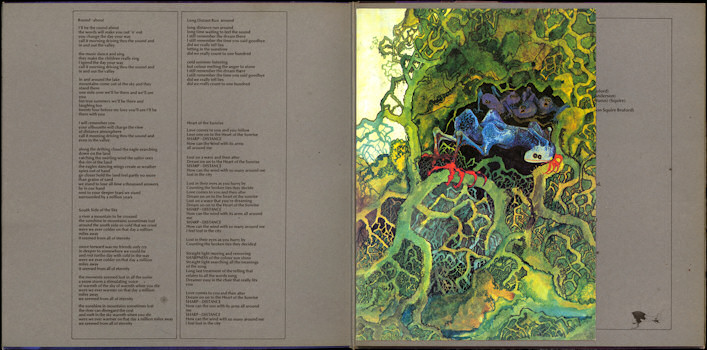
'Fragile' consists of four long group pieces and five individual showcase tracks. Anderson says: “Steve wanted to do a piece … Rick had ideas for his solo … so I suggested we all try one.” As laid out in the liner notes: "Five tracks on this album are the individual ideas, personally arranged and organised, by the five members of the band. 'Cans and Brahms' is an adaptation by Rick Wakeman on which he plays electric piano taking the part of the strings, grand piano taking the part of the woodwind, organ taking the brass, electric harpsichord taking reeds, and synthesizer taking contra bassoon. 'We Have Heaven' is a personal idea by Jon Anderson in which he sings all the vocal parts. 'Five Per Cent For Nothing' is a sixteen bar tune by Bill Bruford, played twice by the group, and taken directly from the percussion line. In Chris Squire’s 'The Fish,' each riff, rhythm, and melody is produced by using the different sounds of the bass guitar. Steve Howe concludes with a solo guitar piece 'Mood For A Day.' The remaining tracks on the album are group arranged and performed." 'Fragile' was recorded with Eddy Offord at Advision Studios in London. It went to number seven in the UK and number four in the US, selling double-platinum. Roger Dean did the iconic artwork.


"Tell the Moon Dog, Tell the March Hare".


An edited version of 'Roundabout' made it to number twenty seven in the Netherlands and number thirteen in the US. “It was written on the way from Aberdeen to Glasgow in Scotland, and we went through so many roundabouts (traffic circles on Scottish roadways), maybe 40 or so. It has a Scottish feel about it. Just listen to the solo, just like a ‘reel’. It changed everything. 'Roundabout' was a hit! And that’s what the band needed.”

"In and around the lake
Mountains come out of the sky
And they stand there
One mile over we'll be there
And we'll see you
Ten true summers we'll be back
And laughing too
Twenty four before my love
You'll see, I'll be there with you"


'Long Distance Runaround'

"Long distance runaround
Long time waiting to feel the sound
I still remember the dream there
I still remember the time you said goodbye
Did we really tell lies
Letting in the sunshine
Did we really count to one hundred"


'Heart of the Sunrise'

"Lost on a wave and then after
Dream on on to the Heart of the Sunrise
SHARP-DISTANCE
How can the wind with so many around me
Lost in the city "


'Fragile'
full album:
https://www.youtube.com/watch?v=87xx5pzHDlY


"Roundabout" (Jon Anderson/Steve Howe) -- 8:33
"Cans And Brahms" (Johannes Brahms, Arr. Rick Wakeman) -- 1:38
"We Have Heaven" (Jon Anderson) -- 1:40
"South Side Of The Sky" (Jon Anderson/Chris Squire) -- 7:58
"Five Per Cent For Nothing" (Bill Bruford) -- 0:35
"Long Distance Runaround" (Jon Anderson) -- 3:30
"The Fish (Schindleria praematurus)" (Chris Squire) -- 2:39
"Mood For A Day" (Steve Howe) -- 3:00
"Heart Of The Sunrise" (Jon Anderson/Chris Squire/Bill Bruford) -- 11:27