Showing posts with label 1944. Show all posts

Sunday, July 13, 2014

the wayfaring stranger


Burl Icle Ivanhoe Ives took to the road and became a folk legend with his adoption of the character of a travelling balladeer.  Ives started singing as a child in Hunt City, Jasper County, Illinois.  He would recount:    "Before l was born I'm certain that l was fashioned to sing, and to sing simple songs, because l went to church prenatally and my parents sang in this simple little church. They sang all these wonderful evangelistic hymns that are very dramatic, poetic, and exciting. What I'm talking about is folk poetry, pure religious folk songs, the basic four-part hymn from which the Hawaiians got their folk music and from which black people got their spirituals ... To me [my grandmother's] ballads brought a world shining with excitement and color; they brought people — like Barbara Allen dying of love and a lone lover sitting on top of a snow-covered mountain. I had never seen a mountain on the prairies of Illinois. Pictures, romance, passion, bravery, gallantry, sorrow, joy — she sang a storybook of tales culled through centuries and tempered by time into beautiful poetry. Kate loved the ballads and loved to sing them for the boys and girls, and that was her religion. I personally liked her point of view better than Grandfather’s in regard to religion."


He played football while attending Eastern Illinois State Teachers College:   "I had done pretty well with my grades the first year. In my sophomore year a greater interest in football, girls and other pleasures distracted my attention from the pains of Pillsbury's Psychology and other "academia." One day in English class, during the last semester of my junior year, I was listening to a lecture on Beowulf. There was a large map on the side of the wall, a map of the United States. As the teacher's voice grew dimmer, the map became more luminous. In my imagination I saw the mighty mountains, silver rivers, and wide sweeping plains, magnificent cities, a nation of people I knew nothing of. How I longed to see these things; how I longed to see the Liberty Bell and walk on the streets where Thomas Jefferson, Tom Paine and Benjamin Franklin had walked.    Before I realized what I was doing, I rose and started for the door. The professor shocked me from my reverie by the remark, 'Yes, Mr. Ives, I think you better go home and sleep.'   I stopped and gazed on the little dull man who was being paid to he a teacher of teachers. I turned and walked to the door, slammed it closed with a bang, and broken glass crashed to the floor. There was uproar behind me in the class, which did not interest me at all. I went to my room and packed a change of clothes, got my banjo, and started walking down the road.    Soon I found myself on the open highway headed east. The cool wind blew in my face and all at once I felt as if I had shed dullness from myself. Before me lay a long gray line with a black mark down the center. The birds were singing. It was spring. My heart jumped for joy. Life, excitement, experience was on this long road.   I became a 'Wayfaring Minstrel'."


He spent years on the road riding boxcars, working odd jobs, and playing his banjo; all the while learning new songs.  He was arrested for vagrancy at one point; but he also was able to perform on the radio.  Ives he studied at Indiana State Teachers College and the Juilliard School in New York with  Ella Töedt who urged him take classes on music theory at NYU.  The debut in 1941 of his radio show 'The Wayfaring Stranger' was preempted by the news that France had fallen to Germany.  


That year his debut album 'Okeh Presents Burl Ives: the Wayfaring Stranger' was released; although it did not contain the eponymous song "Poor Wayfaring Stranger".  In 1942, Ives was drafted and performed on armed services radio before his honorable discharge the next year.  His second collection of songs  'Burl Ives: the Wayfaring Stranger' came out in 1944.  The character of 'The Wayfaring Stranger' would inform Ives' career for decades, as he would appear in numerous comedic and dramatic roles on television, radio, commercials, and motion pictures.  He popularized many traditional songs and became a larger than life cultural figure.  


http://www.burlives.com/


His autobiography is also entitled 'The Wayfaring Stranger'
http://www.amazon.com/Wayfaring-Stranger-Burl-Ives/dp/1432515438


Poor Wayfaring Stranger 

I'm just a poor wayfaring stranger

Traveling through this world of woe
And there's no sickness, no toil, no danger
In that fair land to which I go

I'm going there to see my mother

I'm going there no more to roam
I'm just going over Jordan
I'm just going over home

https://www.youtube.com/watch?v=S5sHrOTXX0s


Buckeye Jim
https://www.youtube.com/watch?v=YiljtRj6hqM


The Sow Took the Measles
https://www.youtube.com/watch?v=6IMDF_RhQPw


The Foggy Foggy Dew
https://www.youtube.com/watch?v=tzyteR2_nOU


Black Is the Color


The Blue Tail Fly
https://www.youtube.com/watch?v=Rr4jeaaVGCA


'The Wayfaring Stranger'
full album:


Side One:
---
Leather-Winged Bat - 00:00
Cotton-Eyed Joe - 01:22
Sweet Betsy From Pike - 02:15
On Top Of Old Smoky - 03:56
I Know Where I'm Going - 05:35
I Know My Love - 07:08
Cowboy's Lament - 08:51
Wee Cooper O' Fife - 11:33
Riddle Song - 13:04
Tam Pierce (Old Englisher) - 14:38
Peter Gray - 16:57
Darlin' Cory - 19:32
John Hardy - 22:52
Colorado Trail - 25:26
Roving Gambler - 26:12

Side Two:
---
Bonnie Wee Lassie - 27:59
The Devil And The Farmer - 30:11
On Springfield Mountain - 32:21
Little Mohee - 34:52
Troubadour Song - 37:58
Robin, He Married - 40:20
Lavender Cowboy - 41:48
Green Broom - 43:09
High Barbaree - 46:05
I've Got No Use For Women - 49:25
Old Paint - 52:37


'Return of the Wayfaring Stranger' 
https://www.youtube.com/watch?v=_Fd8RyBmOkg


Side A:
John Henry - 00:00
Billy the Kid - 02:57
Fare Thee Well, O Honey - 05:29
Mah Lindy Lou - 08:00
Mule Train - 10:49
The Worried Man Blues - 13:32

Side B:
Greer County Bachelor - 16:14
Lilly Munroe - 19:14
Old Blue - 22:00
Ballanderie - 23:49
Lord Randall - 24:20
Riders in the Sky - 27:37
Wayfaring Stranger - 30:47
Woolie Boogie Bee - 32:00


Monday, May 19, 2014

blues by basie


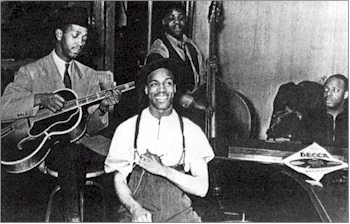
Count Basie and His All American Rhythm Section recorded this swing blues jam in one session less than a week before a musicians' strike.  'Blues By Basie' features an intimate sextet made up of members of his orchestra.  For all eight sides, Basie played piano with the legendary rhythm section of  'Papa' Jo Jones on drums, Freddie Green on guitar, and Walter Page on bass.  Buck Clayton sat in on trumpet with Don Byas on tenor sax for half of the tracks cut for Colombia Records in Los Angeles on July 24, 1942.

American Federation of Musicians' president James Petrillo had called the strike to address the fact that record companies were not paying royalties to musicians.  The musicians' union strike began on August 1 and no union musician could record for any recording company until it was over more than twenty-seven months later when holdouts RCA/Victor and Colombia finally caved on November 11, 1944.    'Blues By Basie' was not released until May of 1944, consisting of four 10" 78 rpm records.


Freddie Green would consider:  "I think it is the type of rhythm you play that has a lot to do with swing. And it is the rhythm section that determines most whether a band swings...Sometimes we get to a point where we're so tired, but we get up there and swing like mad. Another time, you can have had an awful lot of rest, and you don't swing at all...It depends on how everybody feels. I can't put my finger on any special thing that determines the possibility or the extent of swing. It just happens. Sometimes it gets off the ground and sometimes it doesn't. The audience has a lot to do with it, too...The rhythm section is the foundation of it all. If the rhythm section isn't swinging, then you can forget about it. If it isn't clicking, moving together...Well, I mean, the rest of the band has to rely upon it."


Basie would admit:  “You may think you’re the boss, but the drummer is really the head man. When he isn't feeling right, nothing is going to sound good...We still keep a beat in the back line, relaxed and solid behind the horns.  So it doesn't matter what they do up front; the audience gets the beat ... Of course, there are a lot of ways you can treat the blues, but it will still be the blues ...  I just think swing is a matter of some good things put together that you can really pat your foot by. I can't define it beyond that."


www.basieband.org


www.thecountbasieorchestra.com


http://www.last.fm/music/Count+Basie/Blues+By+Basie

http://www.last.fm/music/Count+Basie+&+His+Orchestra/Blues+By+Basie


Sugar Blues 
(L. Fletcher, C. Williams)
https://www.youtube.com/watch?v=Ijfv_Qag5nk


Bugle Blues 
(Basie)
https://www.youtube.com/watch?v=WIlVuHtdf58


Royal Garden Blues 
(S. Williams, C. Williams)
https://www.youtube.com/watch?v=vzy4FWb9ClA


How Long Blues 
(Carr)
https://www.youtube.com/watch?v=x1v-q9POp8A


St. Louis Blues 
(Handy)
https://www.youtube.com/watch?v=It_BHKDeUjs


Farewell Blues 
(Schoebel, Mares, Rappolo)
https://www.youtube.com/watch?v=qELQ023f3SU


Way Back Blues 
(Basie)
https://www.youtube.com/watch?v=usZWrjubhSk


Cafe Society Blues 
(Basie)
https://www.youtube.com/watch?v=FRPBOXZAeZo


Sunday, April 6, 2014

benny goodman sextet


Benny Goodman created some of his most engaging music in the laid back small group setting of his various sextets. Establishing himself as the 'King of Swing' with seminal performances at the Palomar Ballroom in Los Angeles and at Carnagie Hall in New York, Goodman helped to bring jazz to mainstream audiences with his accessible arrangements.  A struggle with sciatica in July of 1940 forced him to break up his band; and, when he got back into the swing of things three months later, he had a new lineup with a new sound.  The sextet became the standard for Goodman's small combo recordings; although he continued to record and perform in a big band setting.  Often the group would swell to seven or eight; but Goodman hung on the sextet moniker.  


http://www.bennygoodman.com/


Released in 1944, 'Benny Goodman Sextet' was compiled from four individual 78 rpm records recorded between October of 1939 and March of 1942 with different lineups featuring:   Goodman on clarinet; Charlie Christian on guitar; Count Basie, Fletcher Henderson, and Johnny Guarnieri on piano;  Lionel Hampton on vibraphone;  Cootie Williams on trumpet; Georgie Auld on saxophone;  Arthur Bernstein on bass;  and Dave Tough, Harry Jager, and Nick Fatool on drums.   Goodman considered these selections to be some of the best recordings he did for Columbia Records.  


https://itunes.apple.com/us/album/benny-goodman-sextet/id192488650


http://www.last.fm/music/Benny+Goodman/Benny+Goodman+Sextet


1  
Rose Room (In Sunny Roseland)
Written-By – Hickman, Williams
https://www.youtube.com/watch?v=x4H7M2YFK0s


2  
Air Mail Special
Written-By – Benny Goodman


3  
Flying Home
Written-By – Goodman, De Lange, Hampton
https://www.youtube.com/watch?v=kizoLacjV2k


4  
I Found A New Baby
Written-By – Palmer, S. Williams
https://www.youtube.com/watch?v=DMYYjSIU2kQ


5
Poor Butterfly
Written-By – Golden, Hubell
https://www.youtube.com/watch?v=7a9YRDHO5-4


6  
Grand Slam
Written-By – Goodman
https://www.youtube.com/watch?v=oNdCgtg0xEY


7  
The Wang Wang Blues
Written-By – Johnson, Mueller, Busse
https://www.youtube.com/watch?v=GIsRI8cDcI4


8
As Long As I Live
Written-By – Arlen, Koehler
https://www.youtube.com/watch?v=XfMKfxHmEgc


Released in 1954, 'New Benny Goodman Sextet' shows Goodman revisiting the sextet setting after dissolving the band he had recorded with for Capitol Records.  It was recorded at Columbia's 30th Street Studio in New York City and the various permutations of the band included:   Goodman on clarinet (and vocal!);  Terry Gibbs on vibraphone;  Lou Stein and Teddy Wilson on piano;  Allen Hanlon and Mundell Lowe on guitar;   Eddie Safranski and Sid Weiss on bass;  and Don Lamond and Terry Snyder on drums.   


http://www.last.fm/music/Benny+Goodman+Sextet/The+New+Benny+Goodman+Sextet

https://myspace.com/thebennygoodmansextet/music/album/benny-goodman-sextet-8110629


1  
Between The Devil And The Deep Blue Sea
Written-By – Arlen, Koehler
https://www.youtube.com/watch?v=LF115U_Si-U


2
East Of The Sun (And West Of The Moon)
Written-By – Bowman


3
 Under A Blanket Of Blue
Written-By – Neiburg, Levinson, Symes
https://www.youtube.com/watch?v=VEuJj_n7lDc


4  
Undecided
Written-By – Shaver, Robin
https://www.youtube.com/watch?v=DoFhrKXJQEo


5  
I'll Never Be The Same
Written-By – Signorelli, Kahn, Malneck
http://www.last.fm/music/Benny+Goodman+Sextet/_/I'll+Never+be+the+Same
https://myspace.com/thebennygoodmansextet/music/song/i-ll-never-be-the-same-28369907-28179836


6
I've Got A Feeling I'm Falling
Vocals – Helen Ward
Written-By – B. Rose, Waller, Link
http://www.last.fm/music/Benny+Goodman+Sextet/The+New+Benny+Goodman+Sextet/I%27ve+Got+A+Feeling+I%27m+Falling
https://myspace.com/thebennygoodmansextet/music/song/i-ve-got-a-feeling-i-m-falling-28369910-28179839


7
How Am I To Know!
Written-By – D. Parker, King
https://www.youtube.com/watch?v=aeg1056UDck


8 
Four Or Five Times
Vocals – Benny Goodman
Written-By – Gay, Hellman
https://www.youtube.com/watch?v=NjrE1ZpeiBU


9
Bye Bye Blues
Written-By – Lown, C. Gray, D. Bennett, Hamm
https://www.youtube.com/watch?v=8X8UOS2FkLE