Showing posts with label hard rock. Show all posts

Friday, November 6, 2015

ace of spades


Motörhead bit the bullet and pushed up the ante to bring the hammer down in this fast and loose rock and roll conflagration.  The trio had established themselves at the forefront of the new wave of heavy metal in the UK with their high octane sound.  Bassist and founder Lemmy Kilmister had been ousted from Hawkwind and wanted to "concentrate on very basic music: loud, fast, city, raucous, arrogant, paranoid, speedfreak rock n roll ... it will be so loud that if we move in next door to you, your lawn will die."

Their first album On Parole  was recorded in 1976 for United Artists, but not released until 1979 because the label thought it would not sell.  Motörhead came out in 1977 on Chiswick.  In 1979, they moved to Bronze Records to record Overkill and Bomber with producer Jimmy Miller.  

For 'Ace Of Spades' they worked with Vic Maile at Jackson's Studios in Rickmansworth, England.    The sessions lasted just over a month and featured  Lemmy Kilmister on bass and lead vocals;   "Fast" Eddie Clarke on guitar, backing vocals on "Emergency";  and  Phil "Philthy Animal" Taylor on drums.   Maile's soft-spoken approach defused the band's typically wild studio behavior and helped to create a sleeker sound.  

Taylor: "Even if he was angry, [Vic] was angry like this: (assumes soft-spoken tone) 'You're not supposed to do it like that', or 'Stop that boys' ...He got me playing more solid"


Clarke:  "[Vic] didn't drink, he didn't smoke, and he was very delicate because he was diabetic. He had to have his Ryvita at six o'clock. We couldn't get heavy with him, couldn't fucking shake him, you know what I mean? He might die! So we had to listen to him...We only thought of ourselves as a good time rock 'n' roll band, really...But we weren't trying to get a message across, apart from have a good time, you know: get pissed, get stoned, and fuck a chick. And that'll do...[On 'Ace of Spades' you can finally hear everything that's going on."


Kilmister:    "He used to own a mobile studio — Hawkwind hired it out to do Space Ritual and he came with it...Vic was a great man and a great producer, really brilliant...Those were good times; we were winning, we were younger, and we believed it...Vic was great. He was the first one who told us we were all cunts and work harder. He had a very dry personae: 'Is that really the best shot you've got?'...Vic got me singing instead of just shouting all the time"


'Ace Of Spades' went to number four in the UK and helped to break the band around the world.  It became an influential cornerstone in the development of thrash metal.  


http://imotorhead.com/


lyrics:
http://www.darklyrics.com/lyrics/motorhead/aceofspades.html


"Ace of Spades" 
Lemmy says:  "I used gambling metaphors, mostly cards and dice — when it comes to that sort of thing, I'm more into the slot machines actually, but you can't really sing about spinning fruit, and the wheels coming down. Most of the song's just poker, really: 'I know you've got to see me read 'em and weep, Dead man's hand again, aces and eights' — that was Wild Bill Hickock's hand when he got shot. To be honest, although Ace of Spades is a good song, I'm sick to death of it now. Two decades on, when people think of Motörhead, they think Ace of Spades. We didn't become fossilized after that record, you know. We've had quite a few good releases since then. But the fans want to hear it so we still play it every night. For myself, I've had enough of that song."


If you like to gamble, I tell you I'm your man,
You win some, lose some, all the same to me,
The pleasure is to play, makes no difference what you say,
I don't share your greed, the only card I need is
The Ace Of Spades

Playing for the high one, dancing with the devil,
Going with the flow, it's all the game to me,
Seven or Eleven, snake eyes watching you,
Double up or quit, double stake or split,
The Ace Of Spades

You know I'm born to lose, and gambling's for fools,
But that's the way I like it baby,
I don't wanna live for ever,
And don't forget the joker!

Pushing up the ante, I know you wanna see me,
Read 'em and weep, the dead man's hand again,
I see it in your eyes, take one look and die,
The only thing you see, you know it's gonna be,
The Ace Of Spades


'Ace Of Spades'
full album:


All tracks composed by Ian Kilmister, Phil Taylor, Eddie Clarke

side one
1. Ace of Spades 
2. Love Me Like a Reptile 2:48
3. Shoot You in the Back 6:12
4. Live to Win 8:50
5. Fast and Loose 12:30
6. (We Are) The Road Crew 15:52
side two
7. Fire Fire 19:03
8. Jailbait 21:49
9. Dance 25:22
10. Bite the Bullet 28:00
11. The Chase Is Better Than the Catch 29:40
12. The Hammer 33:57
bonus 
13. Dirty Love 36:45
14. Please Don't Touch 39:41
15. Emergency 42:31


Tuesday, October 27, 2015

love


The Cult embraced the wind and hung up their blues in the big neon glitter of this gothic psychedelic sanctuary.   The band evolved out of the punk scene where singer Ian Astbury and guitarist Billy Duffy were involved in different bands.   Duffy reveals:  "Very much in my DNA is growing up in the U.K. and punk rock. That’s in there, and that’s in the songwriting, and that’s never really gone away, a bit of that punk attitude. It wasn’t like anybody wanting to put a safety pin through their nose. It was more like taking that music… it kind of got accessible to people. That was why it was a life-changing thing for me. Because I went from a guy who aspired to be maybe a guitar roadie at best, to maybe I could actually be in a band, and people would come and see, and we could do shows. That’s why punk was so great. Sadly, like most movements it became tenth-generation copyists ... I mean, I was lucky to find Ian. I met him in ’81, I think, and we formed the band in ’83. We were lucky to find a songwriting partnership that has endured, and has some sort of, I guess, unique qualities that you have to find to make a band last for 30 years ... I was in another band, I was in a band called Theatre of Hate who never came to America. They were a great band. I was in that band, and Ian was the singer in a support band on a tour. He was in a band called The Southern Death Cult. That’s how we met, in a place called Stoke, which is actually where Slash was raised, interestingly or not interestingly enough. It was just a gig, and they were a support band on the tour. We met and became friends, and stayed in contact.  When I was no longer in Theatre of Hate, and he was no longer in Southern Death Cult, we got together and started writing some songs. Before we knew it we’d formed a band, and we’d made a little EP. We were going to tour and we needed a name, and he thought of the name The Southern Death Cult, so we decided back that – and this was thirty years ago – well, we should probably keep part of the name, but we don’t want to call it The Southern Death Cult, because that’s a different band. How about we just call it Death Cult? And that’s what we started with. We did that for about nine months, and the band started getting popular. We felt we’d kind of outgrew the name. There was a real gothic movement going on, and people dressing in kind of cliche… It was like, it doesn’t really fit. We don’t fit our own name. So we ended up just changing it to The Cult. As a matter of fact, it was January the 14th, 1984 when we changed our name to The Cult." 


Their debut album 'Dreamtime' was released on Beggar's Banquet in 1984 with the single "Spirit Walker" going to the top of the UK independent singles chart.    'Love' was recorded  at Jacobs Studios at Farnham in Surrey, England and Olympic Studios in London with producer Steve Brown, who had helmed albums before with Elton John and Wham!.  The sessions featured  Ian Astbury on vocals;  Billy Duffy on electric guitars, acoustic guitars, and backing vocals;  Jamie Stewart on bass, keyboards, strings, and backing vocals;   with   Mark Brzezicki on drums on all tracks except "She Sells Sanctuary", "No. 13" and "The Snake";   Simon Kliney on Fairlight programming;   Nigel Preston on drums for "She Sells Sanctuary", "No. 13" and "The Snake";   and   The Soultanas (Mae McKenna, Lorenza Johnson, Jackie Challenor) adding backing vocals on "Rain" and "Revolution".    The album went to number eighty-seven in the US, thirty-seven in New Zealand, twenty in the Netherlands, and four in the UK.   


Astbury aserts:    "There was a lot going on at that time and because we made it, it's hard to have any real perspective in a way.  We didn't analyse it or check the process, but I do remember it being very intense and that we were just so engaged in it.  We were in the studio all of the time, you know, rather than just going in every other day. We weren't distracted at all from what we were doing, no one was on the phone or just hanging out, we were working very long hours with no breaks at all and experimenting with so many ideas.  I think that's why that record has a constant unity all the way through, it was probably the most honest album we did, in that we had no career at that time. We were young and making music because we wanted to and everything was still so fresh...The good thing about the songs on Love is that they deal with things that are no less relevant now than they were then; life, death, sex, materialism, spiritualism; all the human experiences...Sanctuary came together very easily in fact, I took the bass line from a song called Spiritwalker, which was one left over from our Southern Death Cult days. Billy came up with the melody, and we worked out a vaguely psychedelic guitar sound which seemed to fit it well - we were heavily into '60s psychedelic music like The Doors, Hendrix and early Zeppelin – Also the producer, Steve Brown, had had a lot of pop success, so he really knew how to structure a song.  It's funny, you write a song like that were everything comes together far beyond what you could've expected and then you spend the rest of your life trying to write another one as good...Because of its earnestness, its honesty and depth.  It's the album that made us, so why not claim our rightful place in the legacy of alternative rock music." 


http://thecult.us/


http://www.cultcentral.com/


lyrics
http://www.darklyrics.com/lyrics/thecult/love.html


"She Sells Sanctuary"
became the band's breakthrough hit, going to number thirty-five in the Netherlands and number fifteen on the UK pop chart.  

Astbury:  “She Sells Sanctuary” was probably referring to the power of finding solitude in a woman’s arms and the matriarchal energy, whether it be an actual physical person or in a spiritual sense, the greatest matriarch, and thinking of the cosmos as a female energy rather than a male energy. These are archetypal things I was picking up from discovering things like Joseph Campbell and Buffy Sainte-Marie or even Jim Morrison. All these things were flying around, and the songs “Spiritwalker” and “She Sells Sanctuary” are quite similar, in a way. In fact, “Spiritwalker” was going to be a Southern Death Cult song, but they didn’t want to do it for whatever reason, so I said, “Fine, I’m leaving, and I’m taking my songs with me.” [Laughs.] That ended up being recorded by The Cult, and it really helped to define our sound ... It was the first real success we had anywhere. [Laughs.] It made it to No. 15 on the UK charts. It actually came out before the Love album was recorded. We’d written the song, it was released as a single, and it came out and did so well. 

Duffy:   “Sanctuary” was touch and go and was a game changer for the band. It got us an American record deal with Seymour Stein from Sire who came over and signed us, because we released it as a single right around the time Live Aid ... Somebody took a chance and played it on the BBC Radio 1 in England.  I’ll be eternally grateful and so will my offspring to this producer who gave it a chance. It was very different from what was going on and to play it in a national radio breakfast show to tens of millions of people changed the game. It’s just about exposure.  There’s never been anything wrong with the music we do, it’s just to get a wider audience, people need to be exposed to it and not have any kind of pre-prejudice for the name or what it should be or it should be an underground band or it should be this or that. If the music just gets out there without any kind of fear attached to it, we do great.  That was kind of why “Sanctuary” was a game changer. I like the riff. I don’t even know where it came from. I have no clue ...  That song has a whole life of its own. I’ve never tired of playing it." 


"Rain"


"Revolution"


'Love' 
full album:


All songs written by Ian Astbury and Billy Duffy.

"Nirvana" – 5:24
"Big Neon Glitter" – 4:45
"Love" – 5:35
"Brother Wolf, Sister Moon" – 6:49
"Rain" – 3:57
"The Phoenix" – 5:06
"Hollow Man" – 4:45
"Revolution" – 5:20
"She Sells Sanctuary" – 4:23
"Black Angel" – 5:22


Friday, October 23, 2015

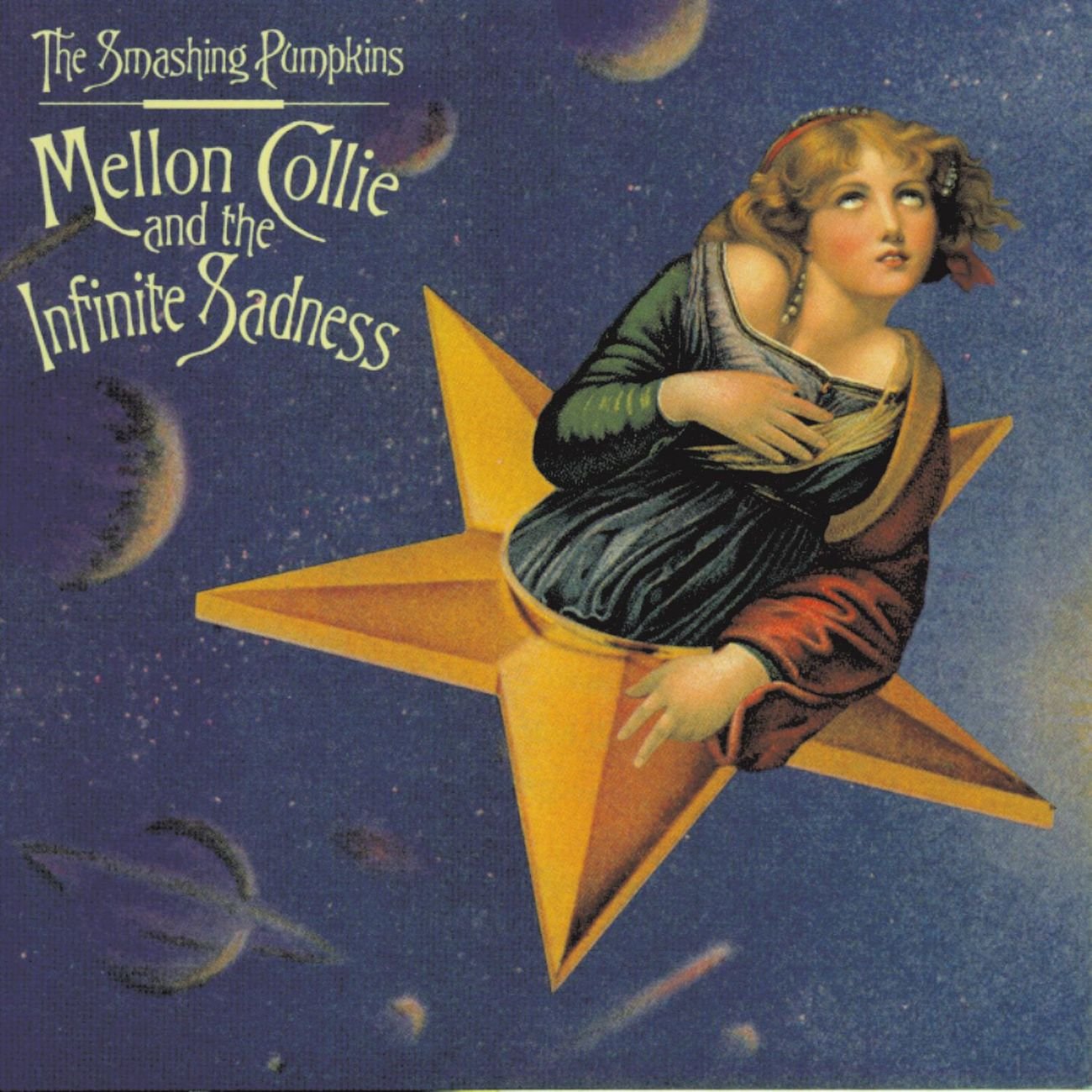
mellon collie and the infinite sadness


The Smashing Pumpkins wreaked havoc with restless resolute rage in the enchanted emptiness of sacred starlight to find meaning in the mad murmurs of this mysterious musical missive.   The band had broken through with the multi-platinum success of their second album Siamese Dream and during the exhausting thirteen month tour that followed, band leader Billy Corgan had hatched a plan for an ambitious followup:   "After Siamese Dream, I really felt that we had no future, that it was the end of the line as far as the band went, emotionally and creatively. I felt that I had completely stretched my abilities beyond the beyond. Also, I started to feel my age. And I could sense other band members starting to root down. You start to lose just that little bit of edge. I think about the attack posture that the band had in the early days, the hunger, and then you see people getting more worried about mortgages and stuff like that...The third thing was that we were reaching the end of a creative cycle. Or at least I was, where the basic format of up-and-down rock guitars, pounding drums--all these elements that are classic Smashing Pumpkins was reaching its end point It's become such a formulaic thing and not just by us. People don't even bat an eye anymore. You start to lose at your own game just from sheer imitation...So I said, 'Let's approach this like it's our last album.' Because it either will be our last album, or it will be our last album as people know the Smashing Pumpkins. And it was a very freeing decision to make. It was just a matter of pushing it as far as we could go--in harmony."


 D'Arcy Wretzky considers the pressure going in: "If you don't sell more than the last record, it means you're going downhill...We all had our own head things going on that summer.  Not so much tension within the band, but just not being able to deal with other people in general."


Jimmy Chamberlin: "After putting everybody's egos and personal shortcomings aside, you have what you love to do, which is to make music...It was the sound of four people together."

James Iha:   "It was time to make another record or disband.  Nobody wanted to go through the high dramatic b.s. anymore. It was totally necessary for everyone to do the next record...It was about going for a feel rather than editing or cutting something into shape."


The band opted out of working again with Butch Vig (who had produced Gish and Siamese Dream) and tried to change things up by bringing in Flood and Alan Moulder as co-producers.  Some tracks were started in the fall of 1994 at Corgan's home studio Sadlands as well as Bugg Studios at Iha's home; but Flood insisted that they play live together on a daily basis.  They began recording basic tracks at their Pumpkinland rehearsal space on the North Side of Chicago, which ended up forming the foundation of the album.  More work was done at the Chicago Recording Company and The Village Recorder with multiple recording booths making it easier to get more work done.  And there was a lot of work to be done, adding sythesizers, sequencers, loops, and other embellishments gave each track its own sound.   In the end, 'Mellon Collie and the Infinite Sadness'  had twenty-eight songs and clocked in at over two hours long.  


'Mellon Collie and the Infinite Sadness' features  Jimmy Chamberlin on drums, vocals on "Farewell and Goodnight";   Billy Corgan on lead vocals, lead guitar, piano, mellotron, production, mixing, string arrangement on "Tonight, Tonight", art direction and design;   James Iha on rhythm guitar; backing vocals, mixing, and additional production on "Take Me Down" and "Farewell and Goodnight"; vocals on "Take Me Down";   D'arcy Wretzky on bass guitar, vocals on "Beautiful" and "Farewell and Goodnight";    with   the Chicago Symphony Orchestra playing on "Tonight, Tonight";   Greg Leisz adding pedal and lap steel guitar on "Take Me Down";  and  Audrey Riley doing the string arrangement for "Tonight, Tonight".   


It was a painstaking process.  Corgan admits:   "I know it looks anal...It is a means to an end  It's not the best means to an end. It's not the shortest distance between two points. But it is a means to an end. In a weird kind of way, music has afforded me an idealism and perfectionism that I could never attain as me...It's really the end of an era.  Most people don't know us except for Siamese Dream. In their minds this is our second album. But for me, it's seven years of playing in clubs, dragging your equipment upstairs, dealing with my dad, all those doubts, people writing stuff about us, the band almost falling apart--you look at all those things, and you can't help but go, 'We fucking did it.'...We finally managed to manifest everything I always thought we could do...Somehow we managed to get a lot of blood out of the stone...We've talked about it as a band.  It's a pretty amazing war horse, a great accomplishment. Fuck, nobody can take this away...It will be totally misunderstood by plus-30-year-old rock critics.  I'm not writing it for them, even though I'm on the edge of losing my connection to youth, as is anyone entering their late 20s, and you've got a house, you get married, and the things that are important in your life begin to change. But I wanted to communicate from the edge of it, an echo back to the generation that's coming, to sum up all the things I felt as a youth but was never able to voice articulately."


'Mellon Collie and the Infinite Sadness' soared to number thirty-six in Austria;  thirty-three in Japan;  twenty-one in Germany;  eighteen in Italy;  fourteen in Finland;  eight in Scotland and Spain;  seven in Norway;  six in France and the Netherlands;  five in Portugal;  four in the UK;  two in Belgium;  and number one in Australia, Canada, New Zealand, Sweden, and the US.   In the US, the album made its debut at number one.  


'Mellon Collie and the Infinite Sadness'  earned The Smashing Pumpkins Grammy nominations for Album of the Year, Record of the Year ("1979"), Best Alternative Music Performance, Best Rock Performance by a Duo or Group with Vocal ("1979"), Best Hard Rock Performance with Vocal ("Bullet with Butterfly Wings"), Best Pop Instrumental Performance ("Mellon Collie and the Infinite Sadness"), and Best Music Video, Short Form ("Tonight, Tonight").  The band won only one:   Best Hard Rock Performance with Vocal for "Bullet with Butterfly Wings".   

'Mellon Collie and the Infinite Sadness' has sold over ten million copies in the US alone.  


http://www.smashingpumpkinsnexus.com/


"Tonight, Tonight" went to forty-six in the Netherlands, thirty-nine in Belgium, thirty-six on the US pop chart, twenty-one in Australia, thirteen in Ireland, seven in the UK, five on the US alternative chart, four on the US mainstream rock tracks chart, and number two in New Zealand. 


"1979" became the band's biggest hit, reaching number thirty-eight in France, twenty-nine in the Netherlands, twenty-one in Belgium, sixteen in Australia and the UK, twelve on the US pop chart, nine in New Zealand, six in Ireland, two in Canada, and number one on the US alternative chart and the US mainstream rock tracks chart.


"Bullet with Butterfly Wings" reached number forty-one in New Zealand, thirty-three in Australia, twenty-two on the US pop chart, twenty in the UK, eighteen in Canada and the Netherlands, seventeen in France, number four on the US mainstream rock tracks chart, and number two on the US alternative chart.  It gave the band their first top forty hit and their first Grammy.  


"Thirty-Three" hit fifty-one in Australia, thirty-nine on the US pop chart, twenty-four in Canada, twenty-one in the UK, eighteen on the US mainstream rock tracks chart, seven in New Zealand, and number two on the US alternative chart.  


"Zero"  found value at number fifteen on the US mainstream rock tracks chart,  nine on the US alternative chart, and number three in New Zealand.  

smashing pumpkins - zero by aquarius3


'Mellon Collie and the Infinite Sadness' 
full album:


All songs written by Billy Corgan, except where noted.

Disc one – Dawn to Dusk
1. "Mellon Collie and the Infinite Sadness"     2:52
2. "Tonight, Tonight"     4:14
3. "Jellybelly"     3:01
4. "Zero"     2:41
5. "Here Is No Why"     3:45
6. "Bullet with Butterfly Wings"     4:18
7. "To Forgive"     4:17
8. "Fuck You (An Ode to No One)"     4:51
9. "Love"     4:21
10. "Cupid de Locke"     2:50
11. "Galapogos"     4:47
12. "Muzzle"     3:44
13. "Porcelina of the Vast Oceans"     9:21
14. "Take Me Down"   Iha 2:52

Disc two – Twilight to Starlight
1. "Where Boys Fear to Tread"     4:22
2. "Bodies"     4:12
3. "Thirty-Three"     4:10
4. "In the Arms of Sleep"     4:12
5. "1979"     4:25
6. "Tales of a Scorched Earth"     3:46
7. "Thru the Eyes of Ruby"     7:38
8. "Stumbleine"     2:54
9. "X.Y.U."     7:07
10. "We Only Come Out at Night"     4:05
11. "Beautiful"     4:18
12. "Lily (My One and Only)"     3:31
13. "By Starlight"     4:48
14. "Farewell and Goodnight"   Iha 4:22


demos


01 - Mellon Collie and the Infinite Sadness [0:00]
02 - Lily (My One and Only) [2:34]
03 - To Forgive [5:53]
04 - Bullet With Butterfly Wings [9:40]
05 - Here Is No Why [14:10]
06 - Galapogos - [17:50]
07 - Frantic Ab Groove [22:05]
08 - Autumn Nocturne [24:57]
09 - Ugly [26:27]
10 - Wishing You Were [29:14]
11 - Thirty-Three [32:21]
12 - Beautiful [36:35]


The album cover was done by illustrator John Craig, using a composite of images from classic paintings.   The face is Greuze by French painter Jean-Baptiste.


The body is from a Raphael painting of Saint Catherine of Alexandria.


Moon demo


Wednesday, October 7, 2015

james gang rides again


The James Gang found their groove with the electric acoustic blues bomb balladry of this funky fandango.  Bassist Tom Kriss quit the band before their debut Yer’ Album had been released.  Jim Fox  called up drummer turned bassist Dale Peters:   “I said,..'Why don’t you come down tonight after the gig and we’ll play for a while?’ And he did and it was magic. It was instantaneously an upgrade, which we never expected...With Dale on the same page, there didn’t seem to be direction issues.  It all seemed to be pulling in the same direction and that was very helpful during those days, because it went together more easily. Joe for instance, was less likely to say, ‘Listen, Tom, I want you to do this, Jimmy, I’d like you to do this.’ Because what we were playing was organically more naturally right to us all...We felt we were going from a position of strength. When we were working on the record, it felt very much like we were pulling in the same direction. It felt very much like we were doing positive things.  When it was finished, we think we did it well. Our attitude was, ‘We’ve accomplished it.'”

Peters remembers:   “We could just play instantly.  I mean, we had the same record collections, we liked the exact same kind of music — we could just play. We can still do it. If we got together tomorrow, it would just work. It just works, I don’t know why. We’re completely different people and we never really hung around together, but we could always play together. So it was great. It was great fun. It was easy. It was fabulous. It was just natural right from the beginning...We jammed in the dressing rooms before each show, so that’s kind of where it all came from. All of those riffs and all of those little things we had thought about month after month, just to get warmed up, they turned into tunes.  I mean, it was easy. Bill got a great sound and he was really great to work with. You know, he was really loose and never said, ‘No, we can’t do that’ or ‘We don’t want to do that.’ We could do whatever we wanted...It was all working. Everything was working. We had found our sound, we had a good recording thing going, we had the right agents, you know, all of this stuff was in place.”

'James Gang Rides Again' featured  Joe Walsh on guitars, vocals, keyboards, piano, and percussion;   Dale Peters on bass guitars, vocals, guitars, keyboards, and percussion;   and  Jim Fox on drums, vocals, percussion, keyboards, organ, and piano;   with  Rusty Young adding pedal steel guitar.   Walsh looks back:   “We recorded at a studio called the Record Plant in Los Angeles — it now is legendary,  Stevie Wonder got the studio next to us and was in there for a month. Marvin Gaye was in another studio for two weeks. Everybody was recording at the Record Plant. … It was a brand new studio and it was state-of-the-art, and being in that environment creatively was like a B-12 shot. We didn’t know how to record, but we could do anything we wanted, so we did. We tried a bunch of stuff out and a lot of that was not knowing exactly what we wanted to do, but just, ‘Well, why don’t we do this?’ ‘Okay.’ And then we’d record it. That’s what’s special about Rides Again. When you know how to make records, you do it totally different.”

Producer and engineer  Bill Szymczyk reveals:   “Townshend heard them and put them on a Who tour opening for them, and that’s all it took in those days and they were on their way. So when it came time for Rides Again, they had … especially Walsh, he had a giant head full of ideas. I don’t mean a giant head, but he had a head full of ideas...[Splitting the album between 'electric' and 'acoustic' sides] was kind of the game plan from the get-go...The way that I always like to sequence stuff is that you have a hard hitter in front — you’ve got a good lead-off man. And it’s got to be short and to the point and it’s got as much of what the band is about as you can put into the first song. … When you’re at the end of almost 20 minutes, then you’ve got to have a great closer — you’ve got to close out the first half. And then the same on the other side, you’ve got to open big and you’ve got to close strong. The four corners, as I used to call them, would take care of themselves. Then it was strictly a matter of filling in the blanks....That was it. That was it — that was the great James Gang album. Period.”


http://www.joewalsh.com/


"Funk #49"  peaked at number fifty-nine on the US singles chart.  

Walsh says:   “The James Gang started out doing cover songs.  And then the next thing for us was to do the beginning of a cover song and then do a five-minute jam in the middle that was different every night. And ‘Funk #49’ was actually a groove that we’d come up with — one of our tools that we would throw into the middle of cover songs. And finally we just wrote some words for it.”


Joe Walsh - Funk 49 (Live) by Killer_Tomato


"The Bomber: Closet Queen"/ "Boléro"/ "Cast Your Fate to the Wind" 

Peters:   “The guy who owned the Record Plant had just put in these new expensive monitors, and Bill was the first guy to use them, which was a real mistake, because you know, Bill’s original [motto was] ‘Made Loud to Be Played Loud,'...[During “The Bomber” playback] the speaker just physically blew out of the wall.”

Szymczyk:   “We blew eight of those speakers up...The next day, [Record Plant co-founder] Gary Kellgren went to his maintenance guy, his head tech, who was Tom Hidley, and he said to Tom, ‘Make me a monitor that Szymczyk can’t blow up!’ That was the birth of the Hidley monitor, which is in hundreds of studios around the world at this point.”

Walsh reveals the legal issues regarding the inclusion of a passage from  Ravel’s “Boléro,”:    “Ravel was French, and French copyright law and French law in general is insane. The French copyright, Ravel’s heirs and Ravel’s estate stipulated in the French copyright law that the piece had to be played in its entirety, top to bottom.  You could never play little parts of it. And it had to be played by the full orchestra that it was written for. Well, we didn’t know that!...[Years later the full version was restored when] the copyright length ran out. It was like 60 years or something and it got to the point where it was 60 years and it kind of became … you know, at the time, this was for albums. CDs didn’t exist when they wrote the law.  So when CDs replaced the albums as a format, there’s nothing that said we couldn’t do that!”


"Ashes, the Rain and I" 


'James Gang Rides Again'

full album:


All songs by Joe Walsh, except where noted.

1. "Funk #49" (Fox, Peters, Walsh) 3:54
2. "Asshtonpark" (Fox, Peters, Walsh) 2:01
3. "Woman" (Fox, Peters, Walsh) 4:37
4. "The Bomber: Closet Queen"/ "Cast Your Fate to the Wind" (Fox, Peters, Walsh, Vince Guaraldi) 5:39
5. "Tend My Garden"   5:45
6. "Garden Gate"   1:36
7. "There I Go Again"   2:51
8. "Thanks"   2:21
9. "Ashes, the Rain and I"   5:00

bonus 
10.    "The Bomber: Closet Queen"/ "Boléro"/ "Cast Your Fate to the Wind" (Fox, Peters, Walsh, Maurice Ravel, Vince Guaraldi) 7:04

11.    "Down on the Farm"  3:12