Showing posts with label outlaw. Show all posts

Thursday, February 26, 2015

orange blossom special


Johnny Cash got back to basics to talk about a ramblin' with the restless railroad blues of this country and western wildwood outlaw urban folk gospel revival.    Continuing his winning streak from the past year with 'I Walk The Line' and 'Bitter Tears:  Ballads of the American Indian' , 'Orange Blossom Special' was produced by Don Law and Frank Jones;  and featured  Johnny Cash on vocals and guitar;   June Carter on vocals;  Luther Perkins, Norman Blake, and Ray Edenton on guitar;  Marshall Grant on bass;  W.S. Holland on drums;   Bill Pursell on piano;   Charlie McCoy on harmonica;   Bill McElhiney and Karl Garvin on trumpet;  Boots Randolph on saxophone;  and Pop Staples on call and response vocal on  “Orange Blossom Special”.   

'Orange Blossom Special' went to number forty-nine on the US pop album chart and number three on the US country album chart.  The album featured three compositions by Bob Dylan.  Cash would later express:  "There's no doubt about Bob Dylan's influence on my music and myself...We became friends, but I already was a fan of his.  I still am...Bob is timeless.  Invariably, before every day ends, there will be a Bob Dylan song that'll float through me."


http://www.johnnycash.com/


"Orange Blossom Special" was released before the album, and peaked at number three on the US country singles chart.  Cash would recount in the album liner notes:      "I  recorded “Orange Blossom Special” in the mid 60’s and in those days everybody that recorded it claimed the arrangement because no one knew who wrote it. But Mother Maybelle Carter was at the session, and I asked her, do you know who really wrote “Orange Blossom special”? She said, Sure I Do. Ervin Rouse and his brother Gordon. And I said. Last time I heard, they were in Florida. It was the only clue I had. I called a disc jockey down there named Cracker Jim Brooker, and I asked Cracker Jim, Did you ever hear of Ervin Rouse? And he said, Aw, I know Ervin. He lives with the Seminoles out in the swamp buggies for a living. I said, You got any idea how I can talk to him?   And he said, Sure. I’ll announce it on the air Evrin call me and I’ll give you Johnny Cash’s number. It wasn’t an hour till Ervin Rouse called me from some little settlement in the swamps. I said, Ervin, I happen to be coming to Miami on tour. Would you come to my show and do “Orange Blossom Special” with me? He and Gordon came in the clothes they worked in. I brought Evrin up to play the fiddle, and he absolutely killed them. At the end of the song, they were applauding and he literally got down on his knees. He was such a sweet humble man. Gordon’s still living. I still see him every time I’m down there." 
https://www.youtube.com/watch?v=n4-uoUpN1c4


Look yonder coming, coming down that railroad tarck
It's the oOrange Blossom Special. Bring my baby back

Well, I'm going down to florida, and get some sand in my shoes 
Or maybe California, and get some sand in my shoes.
I'll ride the Orange Blossom Special, and lose these New York Blues

"say man, when you going back to Florida ?"
Going back to Florida 
Don't know, don't reckon I ever will 
"ani't you worried about getting your nourishment in New York ?" 
I don't care if I do-die-dodie-do.....

Hey talk about a-rambling, she's the fastest train on the line.
It's the Orange Blossom Special, rolling down the seaboard line

https://www.youtube.com/watch?v=nAmrKeyeHKA


"The Long Black Veil"
https://www.youtube.com/watch?v=0TE8445gIBo

https://www.youtube.com/watch?v=-OZeFt16oDY


"It Ain't Me Babe"
https://www.youtube.com/watch?v=HBHXUOogpOg

https://www.youtube.com/watch?v=2R2NrV4ve1o


'Orange Blossom Special' 
full album:  


Side one
1. "Orange Blossom Special"   Ervin T. Rouse, Gordon Rouse 3:06
2. "The Long Black Veil"   Marijohn Wilkin, Danny Dill 3:06
3. "It Ain't Me Babe"   Bob Dylan 3:03
4. "The Wall"   Harlan Howard 2:09
5. "Don't Think Twice, It's All Right"   Bob Dylan 2:56
6. "You Wild Colorado"   Johnny Cash 1:45
Side one
1. "Mama, You've Been on My Mind"   Bob Dylan 3:02
2. "When It's Springtime in Alaska"   Tillman Franks 2:36
3. "All of God's Children Ain't Free"   Johnny Cash 2:11
4. "Danny Boy"   Frederick Weatherly 5:08
5. "Wildwood Flower"   A.P. Carter 2:10
6. "Amen"   Jester Hairston 2:05


Wednesday, June 4, 2014

at san quentin


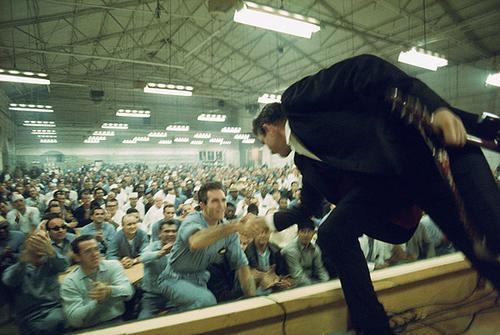
Johnny Cash shook every inch of livin' hell with this wild electric gospel blues jailhouse rock sequel.  After his album 'At Folsom Prison' became a smash hit, his guitarist Luther Perkins died after falling asleep at his home with a lit cigarette.  His "boom-chicka-boom" guitar style had given Cash his signature sound.  Cash carried on and put together the follow-up 'At San Quentin'.  The show took place on February 24, 1969 and was taped for a film for Granada Television that was produced and directed by Michael Darlow.  The accompanying album was produced by Bob Johnston and features Johnny Cash on vocal and acoustic guitar;  June Carter Cash on vocal;  the Carter Family on vocals, autoharp, and guitar;  Marshall Grant on bass guitar;  W.S. Holland on drums;  Carl Perkins (no relation to Luther) on electric guitar;  Bob Wootton on electric guitar;  and The Statler Brothers on vocals.   'At San Quentin' surpassed the success of its predecessor, going to number one in Canada and on the US pop and country album charts.    The album was nominated for a Grammy Award for Album of the Year.    It was re-released in 2000 with bonus tracks that doubled its length.  

Cash would consider:   "You've got a song you're singing from your gut, you want that audience to feel it in their gut. And you've got to make them think that you're one of them sitting out there with them too. They've got to be able to relate to what you're doing."


http://www.johnnycash.com/


I Walk the Line 
https://www.youtube.com/watch?v=EQWYc3_vE0I


Big River 
https://www.youtube.com/watch?v=R-0UsSTQy7g


A Boy Named Sue 
was released as a single and went to number two on the pop chart and number one on the country chart.  It also won a Grammy Award for Best Male Country Vocal Performance.  
https://www.youtube.com/watch?v=tGeLwq7j2pw


"Wanted Man"
was co-written with Bob Dylan.
https://www.youtube.com/watch?v=fuNMikHQ2I0


'At San Quentin' full album playlist


setlist

Big River 
I Still Miss Someone 
The Wreck of the Old '97 (Henry Whitter)
I Walk the Line 
Long Black Veil / Give My Love to Rose (Danny Dill, Marijohn Wilkin)
Folsom Prison Blues 
Orange Blossom Special  (Ervin T. Rouse)

 (with June Carter Cash and Carl Perkins)
Jackson   (Jerry Leiber, Billy Edd Wheeler)
Darlin' Companion (John B. Sebastian)

(Carl Perkins and The Carter Family)
Break My Mind  (John Loudermilk)

(with Carl Perkins)
I Don't Know Where I'm Bound  (Terry Cuddy)

Starkville City Jail 
San Quentin 
San Quentin (encore)
Wanted Man  (Johnny Cash, Bob Dylan)
A Boy Named Sue (Shel Silverstein)

(with Carl Perkins)
Blistered  (Billy Edd Wheeler)

 (with Carl Perkins and The Carter Family)
Peace in the Valley  (Thomas A. Dorsey)
Ring of Fire 
He Turned the Water Into Wine 
Daddy Sang Bass  (Carl Perkins)
The Old Account Was Settled Long Ago  (Larry Dalton)

(June Carter/The Carter Family/The Statler Brothers/Carl Perkins/Johnny Cash/Johnny Cash)
Closing Medley: Folsom Prison Blues/I Walk The Line/Ring of Fire/Folsom Prison Blues/The Rebel - Johnny Yuma/Folsom Prison Blues  (Johnny Cash/Johnny Cash/June Carter, Merle Kilgore/Johnny Cash/Andrew Fenady, Richard Markowitz/Johnny Cash)


Sunday, December 15, 2013

shotgun willie


Willie Nelson cleared his throat and found a new voice when he came blasting out of retirement with the outlaw funk of this crossover country classic.  Discouraged by the dwindling response to his albums, the fiery destruction of his ranch in  Ridgetop, Tennessee, and the end of his marriage to Shirley Collie; Nelson quit the music business and moved to Austin, Texas.  It was there that he got caught up in the burgeoning music scene that was bringing together rock and country audiences at the Armadillo World Headquarters music hall.  Nelson was inspired to create his own blend of country music that incorporated elements of rock, soul, and jazz; and decided to get back into the music business.  He hired Neil Rashen as his manager, who negotiated with RCA to release Nelson from his contract for a repayment of money that the label had overpaid him.  Nelson had met Atlantic Records vice-president Jerry Wexler at party in Nashville and was offered a contract with Atlantic for their new country music division.  

Sessions took place at Atlantic Studios in New York; Quadraphonic Studios in Nashville; and Sam Phillips Recording Studio in Memphis with Arif Mardin, Jerry Wexler, David Briggs all taking part in the production that featured Willie Nelson on vocals and acoustic guitar; Steve Burgh on electric guitar and acoustic guitar; James Clayton Day on dobro, pedal steel guitar, and background vocals; Bobbie Nelson on piano; Mickey Raphael on harmonica; Jeff Gutcheon on electric piano and organ; Dan Spears, Hugh McDonald, and Jack Barber on bass; George Rains, Paul English, and Steve Mosley on drums; Wayne Jackson on trumpet; Andrew Love on tenor sax; James Mitchell on baritone sax; Jack Hale on trombone; Willie Bridges on baritone sax; Dave Bromberg on electric guitar; Doug Sahm on electric guitar and background vocals; Waylon Jennings on acoustic guitar and background vocals; Augie Meyers and Red Lane on acoustic guitar; Johnny Gimble on fiddle; Jimmy Day on pedal steel guitar; Jessi Colter, Dee Moeller, and Larry Gatlin on background vocals; and Arif Mardin and Donny Hathaway on string arrangements.  


Nelson was unsatisfied with the early sessions, which ended up being released years later as 'The Troublemaker' when Nelson would move on to Columbia Records.  After more than twenty songs had been recorded, Nelson had a breakthrough one night when the title song came to him:  "In my room I paced from corner to corner...the old sensation of need surging through me.  Then I went into the bathroom and sat down.  I saw a sanitary napkin envelope on the sink.  I picked up the envelope and wrote out the lyrics."

'Shotgun Willie' was a nickname Nelson received after a shootout with his daughter's husband and his brothers that took place after Nelson threatened to kill him if he hit his daughter again.  The album only made it to number two hundred and five on the US album chart and forty-one on the US country album chart; but it established Nelson as a performer that could not be contained by the narrow confines of the country music establishment in Nashville.  'Shotgun Willie' was also the debut of his new outlaw image with a beard and long hair; and the sound that incorporated horns and electric guitar made him a crossover sensation.  


http://willienelson.com/


"Shotgun Willie"  went to number sixty-six on the Canadian country chart and number sixty on the US country chart.

http://www.youtube.com/watch?v=eK-7k8MHvnE


"Whiskey River"
http://www.youtube.com/watch?v=HiVunqkZ1RM


"Stay All Night (Stay a Little Longer)" 
http://www.youtube.com/watch?v=Ej-u1H8xRWc


"Devil in a Sleepin' Bag"  
http://www.youtube.com/watch?v=B4rST3Mo-dU


"A Song for You" 
http://www.youtube.com/watch?v=xcr8XlnPF1Y


'Shotgun Willie' 

full album:


All tracks written by Willie Nelson, except where noted. 

Side one
1. "Shotgun Willie"   2:40
2. "Whiskey River" (Johnny Bush, Paul Stroud) 4:05
3. "Sad Songs and Waltzes"   3:08
4. "Local Memory"   2:19
5. "Slow Down Old World"   2:54
6. "Stay All Night (Stay a Little Longer)" (Bob Wills, Tommy Duncan) 2:36
Side two
1. "Devil in a Sleepin' Bag"   2:40
2. "She's Not for You"   3:15
3. "Bubbles in My Beer" (Duncan, Cindy Walker, Wills) 2:34
4. "You Look Like the Devil" (Leon Russell) 3:26
5. "So Much to Do"   3:11
6. "A Song for You" (Russell) 4:20

Thursday, October 3, 2013

mama tried


Merle Haggard and the Strangers etched themselves in country legend with the Bakersfield blues of these autobiographical honky tonk rebel child reminiscences.  Haggard was a rising star in the country world by the time he recorded 'Mama Tried' in the early months of 1968.  He had won four awards from the Academy of Country Music, including Top Male Vocalist in 1967; and had a string of hit albums and singles for Capitol Records.  The album was produced by Ken Nelson at Capitol Recording Studios in Hollywood with Merle Haggard on vocals and guitar; Tommy Collins, James Burton, Billy Mize, Roy Nichols, and Lewis Talley on guitar; Norman Hamlet on steel guitar; George French on piano; Jerry Ward on bass; Eddie Burris on drums; and Bonnie Owens on harmony vocals.  

Haggard helped to establish the Bakersfield sound with its rough mix of steel guitar and twangy fender telecaster that set it apart from the more polished music being produced in Nashville:  "Bakersfield was some sort of a I don't know, it was like country music artists found their way to Bakersfield, and then had this success out of there. I don't understand why, actually. Maybe because of the migration that took place in the '30s, or whatever. There was a lot of people that came out there from Oklahoma and Arkansas and Texas, that had a lot of soul. And this thing we call country music kind of came out of those honky tonks, you know, and some of the same area that a lot of other things came out of."

 'Mama Tried' went to number four on the country album chart and established Haggard as country music visionary. 


http://merlehaggard.com/


http://www.rhapsody.com/artist/merle-haggard/album/mama-tried/

https://itunes.apple.com/us/album/mama-tried/id14826785


"Mama Tried" became his fifth number one country hit in the US and his first in Canada.  Haggard says it's one of the songs for which he'd most like to be remembered; and is mostly autobiographical:    "Well, it really is very close, at least. There's some things we fudged on slightly to make it rhyme, but the majority of it, I'd say ninety-seven percent of it's pretty accurate, I guess...I was, to say the least, probably the most incorrigible child you could think of. I was just I was already on the way to prison before I realized it, actually. I was just I was really kind of a screw-up. But and I really don't know why. I think it was mostly just out of boredom and lack of a father's attention, I think...[My mother] didn't put me in a juvenile home. The authorities put me in there for truancy, for not going to school. And that they gave me six months in like, a road camp situation. And I ran off from there and stole a car. And so then the next time I went back, it was something serious. And I spent the next seven years running off from places. I think I escaped seventeen times...There was different institutions and different methods. There was some of them were minimum security, some were maximum security, and some of them were kid joints, and some of them were adult jailhouses.  And I just didn't stay nowhere. I was just I think Willie Sutton was my idol, if you know him. At the time, I was in the middle of becoming an outlaw. And escaping from jail, and escaping from places that they had me locked up in, was part of the thing that I wanted to do... I've had a lot of those things in my life. And, you know, those are the sort of things that a guy, unknowingly, like myself I guess I was gathering up meat for songs, you know. I don't know what I was doing.  I really kind of was crazy as a kid, and then all of a sudden, you know, while I was in San Quentin, I just - I one day understood that I saw the light, and I just didn't want to do that no more. And I realized what a mess Id made out of my life, and I got out of there and stayed out of there, never did go back. And went and apologized to all of the people I wronged, and tried to pay back the people that I'd taken money from, borrowed money from or whatever.  I think when I was 31 years old, I paid everybody back that I'd ever taken anything from, including my mother...I mean, there was no I don't think there was ever any time that anybody in my family was worried about me staying with this. It was just the way that you know, some people grow up in the Army and, you know, it's hard to be 18 years old. And, you know, they send 18-year-old boys to war because they don't know what to do with them.  And I was one; I wound up going to prison rather than war. And instead of growing up in the middle of a battlefield with bullets flying around me, I grew up on the isolation ward of Death Row. And that's where the song "Mama Tried" gets close to being autobiographical...I got caught for making beer...I was making some beer up there, and I got too much of my own beer, and got drunk in the yard and got arrested. It's hard to get arrested in San Quentin, but I did.  And they sent me to what was known as The Shelf, and The Shelf is a part of the north block, which you share with the inmates on Death Row. And that was the - as you put it, the sobering experience for me. I wound up with nothing to lay on except a Bible and an old, concrete slab, and woke up from that drunk - that I'd been on that day, and I could hear some prisoners talking in the area next to me. In other words, there was a - alleyway between the back of the cells. And I could hear people talking over there.  And I recognized the guy as being...the guy that they were fixing to execute. And I don't know, there was just something about the whole situation that I knew that if I ever got out of there, if I was lucky enough to get out, I made up my mind while I still had that hangover, that I was all finished...I went back down on the yard, and went down and asked for the roughest job in the penitentiary, which was a textile mill. And went down and just started building my reputation, you know - just started running in reverse from what I'd been doing, and started trying to build up a long line of good things to be proud of. And that's what I've been doing since then...I think, that these friends of mine talked me out of going on that escape. I mean, they felt that I had talent, and they felt that I was just an ornery kid and could probably make something out of my life.  And you know, believe it or not, in the penitentiary, there's some pretty nice people - and very unfortunate people. And they love to let somebody, so to speak, get up on their shoulders. You know, they like to boost somebody over the wall, if they can. If they can't make it themselves, they, I think sincerely, love to see someone else make it."


The first thing I remember knowing was a lonesome whistle blowing

And a young un’s dream of growing up to ride
On a freight train leaving town, not knowing where I’m bound
No one could change my mind but Mama tried
One and only rebel child from a family meek and mild
My mama seemed to know what lay in store
Despite all my Sunday learning towards the bad I kept on turning
‘Til Mama couldn’t hold me anymore
And I turned twenty-one in prison doing life without parole
No one could steer me right but Mama tried, Mama tried
Mama tried to raise me better, but her pleading I denied
That leaves only me to blame ’cause Mama tried
Dear old Daddy, rest his soul, left my mom a heavy load
She tried so very hard to fill his shoes
Working hours without rest wanted me to have the best
She tried to raise me right but I refused
And I turned twenty-one in prison doing life without parole
No one could steer me right but Mama tried, Mama tried
Mama tried to raise me better, but her pleading I denied
That leaves only me to blame ’cause Mama tried

http://www.youtube.com/watch?v=ziFI_0Fx5ts


"In the Good Old Days (When Times Were Bad)" 
http://www.youtube.com/watch?v=4Nn6us9fBls


"I Could Have Gone Right"
http://www.youtube.com/watch?v=t6g9EC7z9Kc


"I'll Always Know" 
http://www.youtube.com/watch?v=YInmrplQlsM


"Teach Me to Forget" 
http://www.youtube.com/watch?v=OeKZnKa4jY0


"Folsom Prison Blues" 
http://www.youtube.com/watch?v=Ue9Rq2U_LcE
http://www.youtube.com/watch?v=SSBxtXwu5PA


 'Mama Tried' 
full album:

Mama Tried from Merle Haggard and the Strangers on Myspace.

"Mama Tried" (Merle Haggard) – 2:12
"Green, Green Grass of Home" (Curly Putman) – 3:14
"Little Ole Wine Drinker Me" (Dick Jennings, Hank Mills) – 2:38
"In the Good Old Days"(Dolly Parton) – 2:45
"I Could Have Gone Right" (Mel Tillis) – 2:33
"I'll Always Know" (Haggard) – 2:22
"The Sunny Side of My Life" (Haggard) – 2:11
"Teach Me to Forget" (Leon Payne) – 2:24
"Folsom Prison Blues" (Johnny Cash) – 3:15
"Run 'Em Off" (Troy Martin, Onie Wheeler) – 2:47
"You'll Never Love Me Now" (Haggard) – 2:51
"Too Many Bridges to Cross Over" (Dallas Frazier) – 2:45

Wednesday, May 1, 2013

at folsom prison


Johnny Cash revitalized his career with a raucous live performance at a penitentiary that has become an outlaw country classic.  Cash convinced new Colombia executive Bob Johnston to make a live recording of a concert at a prison.  Folsom Prison was the first to respond to requests and Cash performed two shows on January 13, 1968.  Johnston produced the recording which featured Johnny Cash on vocals, guitar, and harmonica; June Carter on vocals; Marshall Grant on bass guitar; W.S. Holland on drums; Carl Perkins and Luther Perkins on electric guitar; and The Statler Brothers (Lew DeWitt, Don Reid, Harold Reid, and Phil Balsley) on vocals.  The set included many songs about prison life, despair, and humorous anecdotes about criminal behavior.   

Cash would later consider:   "I think prison songs are popular because most of us are living in one little kind of prison or another, and whether we know it or not the words of a song about someone who is actually in a prison speak for a lot of us who might appear not to be, but really are."


'At Folsom Prison' became one of his most enduring successes, going to number twenty-seven in Canada; thirteen on the US pop album chart; seven in Norway and the UK; and number one on the US country album chart.  The single of the live version of 'Folsom Prison Blues' was recalled after the assassination of Robert Kennedy and re-released with the line "I shot a man in Reno, just to watch him die" omitted.  The single would break through to number thirty-seven on the US pop chart; seventeen on the Canadian pop chart; and number one on the Canadian and US country charts.  


http://www.johnnycash.com/


'Johnny Cash at Folsom Prison'

documentary:


'At Folsom Prison'

full album:


Side 1
1. "Folsom Prison Blues" Johnny Cash 2:42
2. "Dark as the Dungeon" Merle Travis 3:05
3. "I Still Miss Someone" J. Cash, Roy Cash Jr. 1:38
4. "Cocaine Blues" T.J. Arnall 3:01
5. "25 Minutes to Go" Shel Silverstein 3:31
6. "Orange Blossom Special" Ervin T. Rouse 3:01
7. "The Long Black Veil" Marijohn Wilkin, Danny Dill 3:57
Side 2
1. "Send a Picture of Mother" Cash 2:11
2. "The Wall" Harlan Howard 1:49
3. "Dirty Old Egg-Suckin' Dog" Jack H. Clement 1:17
4. "Flushed From the Bathroom of Your Heart" Clement 2:39
5. "Jackson" (with June Carter) Billy Edd Wheeler, Jerry Leiber 2:56
6. "Give My Love to Rose" (with June Carter) Cash 2:41
7. "I Got Stripes" Cash, Charlie Williams 1:42
8. "Green, Green Grass of Home" Curly Putman 2:57
9. "Greystone Chapel" Glen Sherley 5:34