Showing posts with label johnny cash. Show all posts

Saturday, October 17, 2015

american III: solitary man


Johnny Cash faced the darkness and didn't back down with the ravaged reinvention and singular storytelling of this wild wayfaring merciful measure of truth.  After thirty-six albums in nearly thirty years, Columbia Records dropped Cash from their roster in 1987.  He spent the next five years with Mercury Records, who also let him go.  It was around this time that he connected with producer Rick Rubin, who convinced Cash to sign with his American Recordings label.  Their first project together American Recordings was recorded primarily in his living room with just his guitar.   It became a huge success and won a Grammy for Best Contemporary Folk Album.  

The next collaboration American II: Unchained  featured Tom Petty and the Heartbreakers as his backing band and went on to win the Best Country Album Grammy.  It was around this time that 'The Man In Black' began to suffer from a degenerative nerve disorder that affected his ability to perform.   Cash would later reveal:  "I have had some tough times. I have had pneumonia three times in the last three years -- four times in the last three years. And it debilitates you. It takes the strength away. Took the life out of my legs and I can walk, but not very well...Autonomic neuropathy...it's kind of -- the way I understand it, it's a deadening of the nerve cells of the nerve endings in the lower extremities and sometimes the hands and other extremities.  And for me that's really about the only thing it's really affected a lot. I'm not sure that it's affected my lung power but I don't have the lung power I did. But of course, pneumonia will take that away too...It was 1993 and I was hospitalized with a -- I went into a coma and I was there for 12 days. They all thought I was dying and they couldn't diagnose what was wrong with me. They finally came up with a diagnosis of Shydreger (ph) Syndrome. It was few months later they realized I didn't have that so it was Parkinson's. And then it was not that.  Then finally it was autonomic neuropathy...Finally got it right. And I'm pretty well resolved to the fact that that's what it is. And it's a slow process of the nerve endings...I don't think [there's a cure]. But that's all right. There's no cure for life either...I don't go out and sing. I don't do concerts any more because the physical thing of going out there and doing concerts and the planes and the cars and the hotels and all that. And the backstage is where it's so dark I have a hard time.  My vision is -- my vision is over. I'd probably say 60 percent gone because of the neuropathy. And the diabetes...I can still record, yes. I have been in the studio a lot. I have focused my energies from the road to the studio and it really feels good. I'm really enjoying it...I'm not bitter. Why should I be bitter? I'm thrilled to death with life. Life is -- the way God has given it to me was just a platter -- a golden platter of life laid out there for me. It's been beautiful...Things have been good. And things will get better all time...No regrets."


Rubin remembers:   "I know he wanted to be able to do more than he was physically able to do. He couldn’t understand why one day he would come in and be able to sing great, and feel good, and then the next day he would come in and not be able to catch his breath, or would have to lie down between takes. He was suffering a lot. Actually, he had suffered for a lot of years, and yet he could still get the job done whenever he wanted to. But now, for the first time, he was experiencing times when he wanted to be working, and the frustration of either physically not being able to do it, or mentally not being able to stay focused, or voice-wise, not being of strong voice. This was all new to him, and it was very difficult for him to deal with...I know there were times when he wished his voice was better. Sometimes he felt embarrassed, and it really took the people around him to say, 'This is beautiful, and we love it.' And again, he trusted the people who were saying that, because we really did feel that way. But there were times, I know, when he felt a little insecure about his voice and wished he sounded stronger...[He had an ability to inhabit other people's songs completely.]  I think part of it has to do with just what a bright and wise person he was. Putting aside singing songs, if he just told you a story, he was able to explain things in such a way that you really understood them. And he knew so much about so much, and had lived so much in his life; the wisdom that came along with that showed up whenever he spoke. That transferred into his storytelling in his songs. He just had that power. When he said it, you believed it. It’s an unusual gift."

The third installment of his partnership with Rubin American III: Solitary Man combined the stripped down approach of American Recordings with the collaboration of American II: Unchained  and included the vocal talents of June Carter Cash, Sheryl Crow, Merle Haggard, Will Oldham, and Tom Petty.  Haggard, Norman Blake, Mike Campbell, Larry Perkins, Randy Scruggs, and Marty Stuart also contributed guitar.  

American III: Solitary Man became his highest charting album in nearly twenty-five years, going to number eighty-eight on the pop album chart and number eleven on the country album chart.  


http://www.johnnycash.com/


"The Mercy Seat"


American III: Solitary Man
full album:


"I Won't Back Down" (Tom Petty/Jeff Lynne) – 2:09
Originally recorded by Petty for Full Moon Fever (1989)
"Solitary Man" (Neil Diamond) – 2:25
Originally recorded by Diamond as a single (1966)
"That Lucky Old Sun (Just Rolls Around Heaven All Day)" (Haven Gillespie/Beasley Smith) – 2:35
Originally a hit for Frankie Laine (1949)
"One" (Bono, Adam Clayton, The Edge, Larry Mullen) – 3:53
Originally recorded by U2 for Achtung Baby (1991)
"Nobody" (Egbert Williams) – 3:14
Originally recorded by Williams in 1906
"I See a Darkness" (Will Oldham) – 3:42
Originally recorded by Oldham for I See a Darkness (1999)
"The Mercy Seat" (Nick Cave/Mick Harvey) – 4:35
Originally recorded by Cave for Tender Prey (1988)
"Would You Lay with Me (In a Field of Stone)" (David Allan Coe) – 2:41
Originally recorded by Tanya Tucker for the album of the same name (1974)
"Field of Diamonds" (Cash, Jack Routh) – 3:15
Originally recorded by Cash and Waylon Jennings for Heroes (1986)
"Before My Time" (Cash) – 2:55
"Country Trash" (Cash) – 1:47
Originally recorded by Cash for Any Old Wind That Blows (1973)
"Mary of the Wild Moor" (Dennis Turner) – 2:32
Originally recorded by The Louvin Brothers for Tragic Songs of Life (1956)
"I'm Leavin' Now" (Cash) – 3:07
Originally recorded by Cash for Rainbow (1985)
"Wayfaring Stranger" (Traditional) – 3:19
Old folk song previously recorded by countless artists


American Recordings
1994


American II: Unchained
1996


American III: Solitary Man
2000


American IV: The Man Comes Around
2002


American V: A Hundred Highways
2006


American VI: Ain't No Grave
2010


Unearthed
2003


Thursday, February 26, 2015

orange blossom special


Johnny Cash got back to basics to talk about a ramblin' with the restless railroad blues of this country and western wildwood outlaw urban folk gospel revival.    Continuing his winning streak from the past year with 'I Walk The Line' and 'Bitter Tears:  Ballads of the American Indian' , 'Orange Blossom Special' was produced by Don Law and Frank Jones;  and featured  Johnny Cash on vocals and guitar;   June Carter on vocals;  Luther Perkins, Norman Blake, and Ray Edenton on guitar;  Marshall Grant on bass;  W.S. Holland on drums;   Bill Pursell on piano;   Charlie McCoy on harmonica;   Bill McElhiney and Karl Garvin on trumpet;  Boots Randolph on saxophone;  and Pop Staples on call and response vocal on  “Orange Blossom Special”.   

'Orange Blossom Special' went to number forty-nine on the US pop album chart and number three on the US country album chart.  The album featured three compositions by Bob Dylan.  Cash would later express:  "There's no doubt about Bob Dylan's influence on my music and myself...We became friends, but I already was a fan of his.  I still am...Bob is timeless.  Invariably, before every day ends, there will be a Bob Dylan song that'll float through me."


http://www.johnnycash.com/


"Orange Blossom Special" was released before the album, and peaked at number three on the US country singles chart.  Cash would recount in the album liner notes:      "I  recorded “Orange Blossom Special” in the mid 60’s and in those days everybody that recorded it claimed the arrangement because no one knew who wrote it. But Mother Maybelle Carter was at the session, and I asked her, do you know who really wrote “Orange Blossom special”? She said, Sure I Do. Ervin Rouse and his brother Gordon. And I said. Last time I heard, they were in Florida. It was the only clue I had. I called a disc jockey down there named Cracker Jim Brooker, and I asked Cracker Jim, Did you ever hear of Ervin Rouse? And he said, Aw, I know Ervin. He lives with the Seminoles out in the swamp buggies for a living. I said, You got any idea how I can talk to him?   And he said, Sure. I’ll announce it on the air Evrin call me and I’ll give you Johnny Cash’s number. It wasn’t an hour till Ervin Rouse called me from some little settlement in the swamps. I said, Ervin, I happen to be coming to Miami on tour. Would you come to my show and do “Orange Blossom Special” with me? He and Gordon came in the clothes they worked in. I brought Evrin up to play the fiddle, and he absolutely killed them. At the end of the song, they were applauding and he literally got down on his knees. He was such a sweet humble man. Gordon’s still living. I still see him every time I’m down there." 
https://www.youtube.com/watch?v=n4-uoUpN1c4


Look yonder coming, coming down that railroad tarck
It's the oOrange Blossom Special. Bring my baby back

Well, I'm going down to florida, and get some sand in my shoes 
Or maybe California, and get some sand in my shoes.
I'll ride the Orange Blossom Special, and lose these New York Blues

"say man, when you going back to Florida ?"
Going back to Florida 
Don't know, don't reckon I ever will 
"ani't you worried about getting your nourishment in New York ?" 
I don't care if I do-die-dodie-do.....

Hey talk about a-rambling, she's the fastest train on the line.
It's the Orange Blossom Special, rolling down the seaboard line

https://www.youtube.com/watch?v=nAmrKeyeHKA


"The Long Black Veil"
https://www.youtube.com/watch?v=0TE8445gIBo

https://www.youtube.com/watch?v=-OZeFt16oDY


"It Ain't Me Babe"
https://www.youtube.com/watch?v=HBHXUOogpOg

https://www.youtube.com/watch?v=2R2NrV4ve1o


'Orange Blossom Special' 
full album:  


Side one
1. "Orange Blossom Special"   Ervin T. Rouse, Gordon Rouse 3:06
2. "The Long Black Veil"   Marijohn Wilkin, Danny Dill 3:06
3. "It Ain't Me Babe"   Bob Dylan 3:03
4. "The Wall"   Harlan Howard 2:09
5. "Don't Think Twice, It's All Right"   Bob Dylan 2:56
6. "You Wild Colorado"   Johnny Cash 1:45
Side one
1. "Mama, You've Been on My Mind"   Bob Dylan 3:02
2. "When It's Springtime in Alaska"   Tillman Franks 2:36
3. "All of God's Children Ain't Free"   Johnny Cash 2:11
4. "Danny Boy"   Frederick Weatherly 5:08
5. "Wildwood Flower"   A.P. Carter 2:10
6. "Amen"   Jester Hairston 2:05


Monday, October 13, 2014

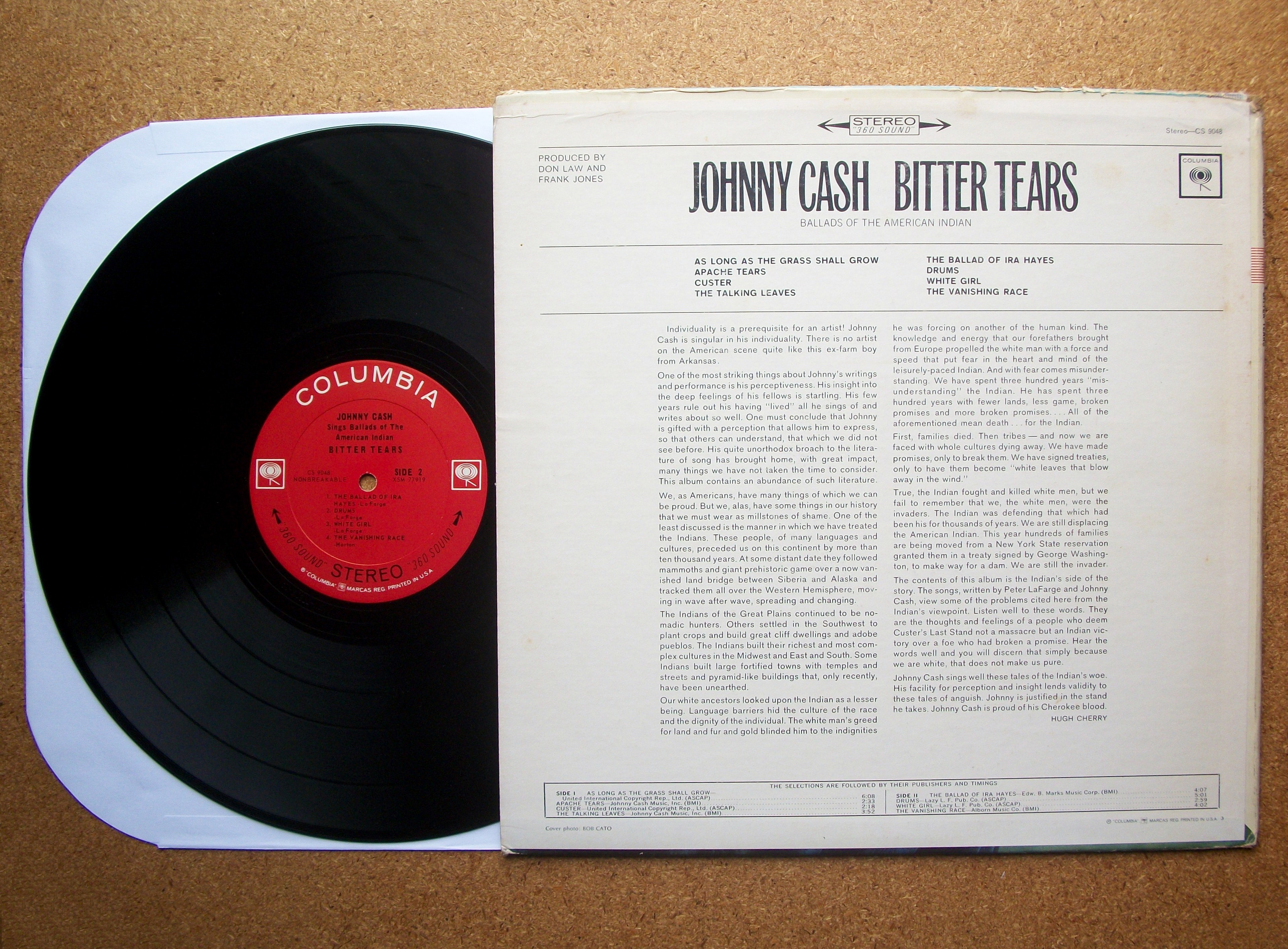
bitter tears: ballads of the american indian


Johnny Cash put it all on the line with this socially conscious concept album that spoke from the perspective of Native Americans.  The success of number one country singles like 'Ring of Fire' and 'Understand Your Man', Cash was in a position to make the topical 'Bitter Tears: Ballads of the American Indian'.  The sessions were produced by Don Law and Frank Jones and featured Johnny Cash on vocals and guitar;  with Luther Perkins, Norman Blake, and Bob Johnson on guitar;  Marshall Grant on bass;  W.S. Holland on drums;  and vocal accompaniment by The Carter Family.  


For the album, Cash recorded five songs from the songbook of Pima-Indian and Korean War veteran, Peter LaFarge. LaFarge died the same month that the album was released on October 27, 1964, making the album seem like a tribute.  The songs tell true stories of broken treaties, re-education, and brutal discrimination; not an easy sell for Colombia Records.  When they refused to promote the single "The Ballad of Ira Hayes", Cash took out a full page ad in Billboard criticizing the DJ's for not playing the song.  He also paid an independent promotional firm to push the single to the radio stations.  The result was that the song went to number three on the US country singles chart.  


Cash would reveal:   "I read a book when I was about 12 years old about an Indian named Lone Bull. Lone Bull had tried to go out and kill a buffalo. He slipped out of the village, against his father's wishes and went out. He was going to be a hero and kill a buffalo and bring it back to the village, so his family and the other people could have meat. And the elders of the village knew about the buffalo herd. They knew it was there, and they were making plans to cut into the heard and cut off some buffalo and kill them and have meat for the whole winter and into the next spring. Lone Bull wanted to be a hero. He went out with his bow and arrow and killed a calf, and ran the herd off into the next state. He drug this calf home, his family was fed, but they were ostracized from the village. They had to leave the village. Lone Bull became a wanderer, until he found a village that would take him in. In that next village where he was taken in, he organized the buffalo hunt that winter, and they had more meat than this village had ever had before. So, I learn from my mistakes. It's a very painful way to learn, but without pain, the old saying is, there's no gain. I found that to be true in my life. You miss a lot of opportunities by making mistakes, but that's part of it: is knowing that you're not shut out forever, and that there's a goal there that you still can reach. Lone Bull's philosophy was, "I'm kicked out of this village, but I will grow up and I'll come into another one and I will do what I set out to do, that was feed the people." So I'm feeding my people right now...You build on failure. You use it as a stepping stone. Close the door on the past. You don't try to forget the mistakes, but you don't dwell on it. You don't let it have any of your energy, or any of your time, or any of your space. If you analyze it as you're moving forward, you'll never fall in the same trap twice, which I can't say that I haven't been guilty of doing. But my advice is, if they're going to break your legs once when you go in that place, stay out of there." 


 'Bitter Tears: Ballads of the American Indian' went to number forty-seven on the US album chart and number two on the US country album chart.  


http://www.johnnycash.com/


"As Long as the Grass Shall Grow"

https://www.youtube.com/watch?v=HSdNDFj5zJQ


"Apache Tears" 

https://www.youtube.com/watch?v=Q4StneDiV30


"Custer" 

https://www.youtube.com/watch?v=f2Xmn954tVQ


"The Talking Leaves" 

https://www.youtube.com/watch?v=wLsE5JeAnL0


"The Ballad of Ira Hayes" 

https://www.youtube.com/watch?v=UKDLQWEvubc


"Drums" 

https://www.youtube.com/watch?v=AFcDFr2YIU8


 'Bitter Tears: Ballads of the American Indian'
full album:


1. "As Long as the Grass Shall Grow"   Peter La Farge 6:10
2. "Apache Tears"   Cash 2:34
3. "Custer"   La Farge 2:20
4. "The Talking Leaves"   Cash 3:55
5. "The Ballad of Ira Hayes"   La Farge 4:07
6. "Drums"   La Farge 5:04
7. "White Girl"   La Farge 3:01
8. "The Vanishing Race"   Cash, Johnny Horton 4:02


For As Long As The Grass Grows


Individuality is a prerequisite for an Artist! Johnny Cash is singular in his individuality. There is no artist on the American scene quite like this ex- farm boy from Arkansas.


One of the most striking things about Johnny's writings and performance is his perceptiveness. His insight into the deep feelings of his fellows is startling. His few years rule out his having "lived" all he sings of and writes about so well. One must conclude that Johnny is gifted with a perception that allows him to express, so that others understand, that which we do not see before. His quite unorthodox broach to the literature of song has brought home, with great impact, many things we have not taken the time to consider. This album contains an abundance of such literature.


We, as Americans have many things of which we can be proud. But we, alas have some things in our history that we must wear as millstones of shame. One of the least discussed is the manner in which we have treated the Indians. These people of many languages and cultures, preceded us on this continent by more than ten thousand years. At some distant date they followed mammoths and giant prehistoric game over a now vanished land bridge between Siberia and Alaska and tracked them over the Western Hemisphere, moving in wave after wave, spreading and changing. The Indians of the Great Plains continued to be nomadic hunters. Others settled in the Southwest to plant crops and build great cliff dwellings and adobe pueblos. The Indians built their richest and most complex cultures in the Midwest and East and South. Some Indians built large fortified towns with temples and streets and pyramid-like buildings that , only recently, have been unearthed.


Our white ancestors looked upon the Indian as a lesser being. Language barriers hid the culture of the race and the dignity of the individual. The white man's greed for land and fur and gold blinded him to the indignities he was forcing on another of the human kind. The knowledge and energy that our forefathers brought from Europe propelled the white man with a force and speed that put fear in the heart and mind of the leisurely-paced Indian. And with fear comes misunderstanding.


We have spent three hundred years "misunderstanding" the Indian. He has spent three hundred years with fewer lands, less game, broken promises and more broken promises . . . All of the aforementioned mean death ... for the Indian. First, families died. Then tribes and now we are faced with whole cultures dying away. We have made promises, only to break them. We have signed treaties, only to have them become "white leaves that blow away in the wind." True, the Indian fought and killed white men, but we fail to remember that we, the white men, were the invaders. The Indian was defending that which had been his for thousands of years. We are still displacing the American Indian. This year (Note, early 1960's) hundred of families are being moved from a New York State Reservation granted them in a treaty signed by George Washington, to make way for a dam. We are still the invader.


The contents of this album is the Indian's side of the story. The songs, written by Peter LaFarge and Johnny Cash, view some of the problems cited here from the Indian's viewpoint. Listen well to these words. They are the thoughts and feeling of a people who deem Custer's Last Stand not a massacre but an Indian Victory over a foe who had broken a promise. Hear the words well and you will discern that simply because we are white , that does not make us pure.


Johnny Cash sings well these tales of the Indian's woe. His facility for perception and insight lends validity to these tales of anguish. Johnny is justified in the stand he takes. Johnny Cash is proud of his Cherokee Blood.


Hugh Cherry


Wednesday, June 4, 2014

at san quentin


Johnny Cash shook every inch of livin' hell with this wild electric gospel blues jailhouse rock sequel.  After his album 'At Folsom Prison' became a smash hit, his guitarist Luther Perkins died after falling asleep at his home with a lit cigarette.  His "boom-chicka-boom" guitar style had given Cash his signature sound.  Cash carried on and put together the follow-up 'At San Quentin'.  The show took place on February 24, 1969 and was taped for a film for Granada Television that was produced and directed by Michael Darlow.  The accompanying album was produced by Bob Johnston and features Johnny Cash on vocal and acoustic guitar;  June Carter Cash on vocal;  the Carter Family on vocals, autoharp, and guitar;  Marshall Grant on bass guitar;  W.S. Holland on drums;  Carl Perkins (no relation to Luther) on electric guitar;  Bob Wootton on electric guitar;  and The Statler Brothers on vocals.   'At San Quentin' surpassed the success of its predecessor, going to number one in Canada and on the US pop and country album charts.    The album was nominated for a Grammy Award for Album of the Year.    It was re-released in 2000 with bonus tracks that doubled its length.  

Cash would consider:   "You've got a song you're singing from your gut, you want that audience to feel it in their gut. And you've got to make them think that you're one of them sitting out there with them too. They've got to be able to relate to what you're doing."


http://www.johnnycash.com/


I Walk the Line 
https://www.youtube.com/watch?v=EQWYc3_vE0I


Big River 
https://www.youtube.com/watch?v=R-0UsSTQy7g


A Boy Named Sue 
was released as a single and went to number two on the pop chart and number one on the country chart.  It also won a Grammy Award for Best Male Country Vocal Performance.  
https://www.youtube.com/watch?v=tGeLwq7j2pw


"Wanted Man"
was co-written with Bob Dylan.
https://www.youtube.com/watch?v=fuNMikHQ2I0


'At San Quentin' full album playlist


setlist

Big River 
I Still Miss Someone 
The Wreck of the Old '97 (Henry Whitter)
I Walk the Line 
Long Black Veil / Give My Love to Rose (Danny Dill, Marijohn Wilkin)
Folsom Prison Blues 
Orange Blossom Special  (Ervin T. Rouse)

 (with June Carter Cash and Carl Perkins)
Jackson   (Jerry Leiber, Billy Edd Wheeler)
Darlin' Companion (John B. Sebastian)

(Carl Perkins and The Carter Family)
Break My Mind  (John Loudermilk)

(with Carl Perkins)
I Don't Know Where I'm Bound  (Terry Cuddy)

Starkville City Jail 
San Quentin 
San Quentin (encore)
Wanted Man  (Johnny Cash, Bob Dylan)
A Boy Named Sue (Shel Silverstein)

(with Carl Perkins)
Blistered  (Billy Edd Wheeler)

 (with Carl Perkins and The Carter Family)
Peace in the Valley  (Thomas A. Dorsey)
Ring of Fire 
He Turned the Water Into Wine 
Daddy Sang Bass  (Carl Perkins)
The Old Account Was Settled Long Ago  (Larry Dalton)

(June Carter/The Carter Family/The Statler Brothers/Carl Perkins/Johnny Cash/Johnny Cash)
Closing Medley: Folsom Prison Blues/I Walk The Line/Ring of Fire/Folsom Prison Blues/The Rebel - Johnny Yuma/Folsom Prison Blues  (Johnny Cash/Johnny Cash/June Carter, Merle Kilgore/Johnny Cash/Andrew Fenady, Richard Markowitz/Johnny Cash)