Showing posts with label john cale. Show all posts
Monday, November 16, 2015
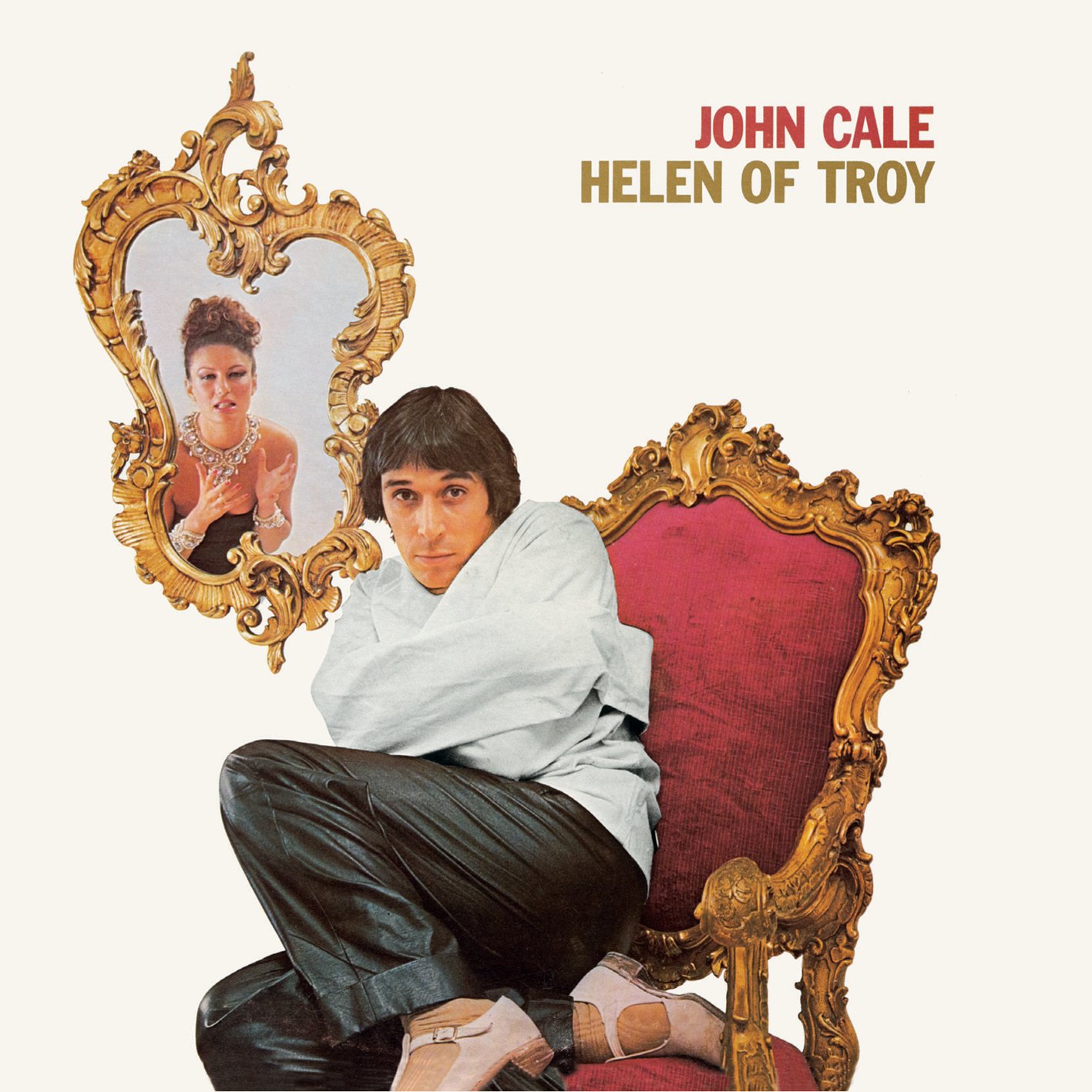
helen of troy
John Cale kept a close watch on sudden death like a banshee blistering up his spell with portraits, stories, paintings, lovers, and things. His contract with Island Records kept him busy with his own music while he made numerous guest appearances with other artists (June 1, 1974 with Kevin Ayers, Eno, and Nico; Leon Russell's Stop All That Jazz, and Brian Eno's Another Green World) as well as producing Horses for Patti Smith and The End for Nico.
'Helen of Troy' features John Cale on vocals, keyboards, guitar, and production; Chris Spedding on guitar; Pat Donaldson on bass guitar; and Timi Donald and Phil Collins on drums; Brian Eno on synthesizer; Robert Kirby on string and choir arrangement; and Liza Strike on background vocals.
According to Cale: "It could have been a great album. I came back from finishing Patti Smith and had three days to finish "Helen Of Troy" before I went on Italian tour. I was spending eighteen hours a day in the studio. When I got back, I found the record company had gone ahead and released what amounted to demo tapes. The trouble was that Island had their own ideas of what that album should sound like. They wanted to include songs I don't particularly like, but it was also an impertinent assumption on my part that I was capable managing myself. My determination to have "Helen Of The Troy" the way I did was not really fair to Island or my management, especially at a time when Island was losing it's percentage of the market, which was making everybody very paranoid."
'Helen of Troy' completes a trilogy of albums on Island Records with Fear and Slow Dazzle . Cale says: "That was one of the most productive periods because I had a solid contract with the label. You know I knew that I had three albums to do. Ever since then it has become a little sporadic...I listen to [those records]. There are some strange songs on there...[The production process] was pretty slap dash. I mean most of the songs were written in the studio, Engine especially. It was whatever you could do with a drum, bass, piano and guitar."
http://john-cale.com/
lyrics:
http://werksman.home.xs4all.nl/cale/lyrics/helen_of_troy.html
"Helen of Troy"
"Leaving It Up to You"
"Pablo Picasso"
'Helen of Troy'
full album:
https://myspace.com/johncaleofficialsite/music/album/helen-of-troy-19530468
http://www.last.fm/music/John+Cale/Helen+of+Troy
http://musicmp3.ru/artist_john-cale__album_helen-of-troy.html#.VklK_XarTIU
All songs composed by John Cale, except where indicated.
Side A
"My Maria"
"Helen of Troy"
"China Sea"
"Engine"
"Save Us"
"Cable Hogue"
Side B
"I Keep a Close Watch"
"Pablo Picasso" (Jonathan Richman)
"Leaving It Up to You"
"Baby What You Want Me to Do" (Jimmy Reed)
"Sudden Death"
Thursday, April 23, 2015
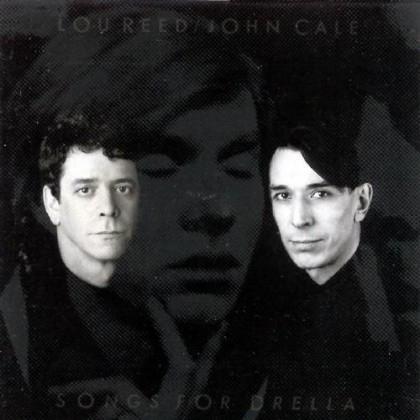
songs for drella
Lou Reed and John Cale reunited to record this touching tribute to the life of Andy Warhol. Warhol had become their mentor and manager during the early years of The Velvet Underground, bringing them into his multimedia project The Exploding Plastic Inevitable as the house band. Warhol produced the band's seminal debut 'The Velvet Underground & Nico'; but the group had moved on for their next album 'White Light/White Heat'. That would be the last album that Reed and Cale would work on together, splitting up over creative differences.
After the sudden death of Warhol in 1987, the pair decided to work together again. Reed would recall: "I think we touched base at the wake they had for Andy, at St. Patrick's. Someone had suggested to John that he write a Mass for Andy. Meantime, we had run into each other again and had started getting together at a small studio to play just for fun. Not for any record, just for fun. And then John had called me, he wanted an outside opinion about this thing he was writing, could it go this way, go that way, so I sat down with him, and while going over that, it turned into, hey, it would be interesting to write songs about Andy, and I had said, John, why don't you take this piece and divide it up, just for structure's sake -- I'm a big one on structure -- just to make it easier to look at, like, start at the beginning, boom, Pittsburgh. The next section, boom, he's in New York and wants to be a painter. Next section, starts making it as a painter, wants to be a filmmaker. Next section, okay, gets shot, changes, goes into high society, this or that, and dies. Boom. There. And this was just gonna be all instrumental. And then it turned into, oh, gee, why don't we do some songs, and it went on from there."
Cale considers: "It was on and off around Christmas time. We were planning on maybe five weeks, but when we got working on it I started adding keyboards until we had a whole MIDI setup. I had a Roland D-50, a Yamaha CP8O MIDI and a Korg Ml. And they slowly started being part of the songwriting process. A lot of it was done just on the piano to begin with...I know we set ourselves up for this idea of a theater piece, but it really is banished. Because what we have there is such a strong core idea that the simpler the better. I was really excited by the amount of power just two people could do without needing drums. When we started work I was always, in the back of my mind, wondering, "Where the hell does the backbeat go?" And by the time we finished it I was saying, "Thank God we don't have one!" The way it's going to be at BAM is exactly the same. We're going to maintain that hard-edged, clear-eyed image of it – simple and very hard."
The duo produced the sessions at Sigma Sound, New York City with John Cale on vocals, keyboards, and viola; and Lou Reed on vocals and guitar. 'Songs for Drella' takes its title from the nickname created for Warhol by actor Robert Olivo aka Ondine; a contraction of Dracula and Cinderella. Taking on the voice of Warhol in the songs, the album is very personal and insightful, providing a more well rounded picture of the life of the art pop icon.
Reed would reveal: "Some of the things that apply to Andy apply to all of us. There are things that I think are very universal, and Andy probably make Andy more of an approachable person. Through the lyrics of the songs. If you knew him and you knew the situation – and John and I spoke about this at great length – you could see things from his eyes and experience things perhaps the way he did. And some of the situations he found himself in were analogous to situations everyone finds themselves in...Andy was really an astonishing person. When he talked to you he never ceased to say the most amazing things. Just another way of looking at it that at least in my case would make me stop right in my tracks and think about what he said."
Cale sums up: "This was no fool manipulating headlines...He was a very penetrating individual."
http://www.loureed.com/
http://john-cale.com/
lyrics:
http://werksman.home.xs4all.nl/cale/lyrics/songs_for_drella.html
'Songs for Drella'
full album:
https://www.youtube.com/watch?v=aKYaKzexlHY
All songs written by Lou Reed and John Cale. All vocals by Reed except songs marked with † by Cale.
Side A
"Smalltown" – 2:04
"Open House" – 4:18
"Style It Takes" – 2:54 †
"Work" – 2:38
"Trouble with Classicists" – 3:42 †
"Starlight" – 3:28
"Faces and Names" – 4:12 †
Side B
"Images" – 3:31
"Slip Away (A Warning)" – 3:05
"It Wasn't Me" – 3:30
"I Believe" – 3:18
"Nobody But You" – 3:46
"A Dream" – 6:33 †
"Forever Changed" – 4:52 †
"Hello It's Me" – 3:13
https://www.youtube.com/watch?v=ziYus0j85oM
Tuesday, March 10, 2015
slow dazzle
John Cale found a new place to dwell with menace, melodicism, guts, and dirty ass rock and roll. His work with The Velvet Underground ('The Velvet Underground & Nico' and 'White Light/White Heat') and role as producer on seminal debut albums by The Stooges, The Modern Lovers, and Patti Smith had established Cale as a cutting edge craftsman. His own albums ('Vintage Violence' and 'Church of Anthrax' on Colombia Records, and 'Academy in Peril' and 'Paris 1919' on Reprise Records) went back and forth between folk rock and art rock until he moved back to London in 1974 where he signed with Island Records and recorded a trilogy of albums ('Fear', 'Slow Dazzle', and 'Helen of Troy') within the span of a year.
Cale would look back: "I lived in my basement flat in Shepherd’s Bush and just stacked the turntable up with Beach Boys...That was one of the most productive periods because I had a solid contract with the label. You know I knew that I had three albums to do. Ever since then it has become a little sporadic...There are some strange songs on there...It was pretty slap dash. I mean most of the songs were written in the studio...It was whatever you could do with a drum, bass, piano and guitar...[‘The Jeweller’] was to attempt to do what ‘The Gift’ did. I had a written a short story and I thought it was very nice and I thought I’d record it...[The collaboration with Brian Eno] was suggested by Island. I didn’t know at the time. I had seen him when he was signed to Warners. I had seen them at the Roxy in LA and I knew Bryan Ferry so I remembered him from before. Actually that first Roxy album was something which I was up for producing but Chris Thomas got it ... It was exciting for me. I got my teeth into having a band. I got a lot of help from Chris Spedding. It’s a little brutal, but he helped me figure out how to take what we did in the studio and make it work live. I had this penchant for making up new songs on stage. Chris was always there—he was like an eagle. He’d spot a change coming up. That’s where I got closer to the idea what the VU was—on stage."
http://john-cale.com/
"Heartbreak Hotel"
"Well, the lyrics were the first thing that struck me about it. You can hear every personality of he people involved in it in each of the verses. I tell you, I sang it at the Elvis fiftieth anniversary show in Memphis at the arena, and Aaron Neville and Iggy [Pop] and everyone was doing an Elvis song, and they were doing it really well, uptempo versions - I came out with a string quartet and did this really dark screeching gothic version of it, and the average age of the people at the places was between sixty and seventy - they were all just sitting there with their mouths open, they didn't know what to make of it. They took it off the broadcast, I think. But they put it on the international broadcast, because some friends of mine saw it."
"Mr. Wilson"
"Guts"
'Slow Dazzle'
full album:
All tracks composed by John Cale; except where indicated
Side A
"Mr. Wilson" (3:17)
"Taking It All Away" (2:59)
"Dirty-Ass Rock 'N' Roll" (4:44)
"Darling I Need You" (3:38)
"Rollaroll" (3:59)
Side B
"Heartbreak Hotel" (3:14) – Mae Boren Axton, Tommy Durden, Elvis Presley
"Ski Patrol" (2:12)
"I'm Not The Loving Kind" (3:12)
"Guts" (3:27)
"The Jeweller" (5:07)
bonus tracks
"All I Want Is You" (2:55)
"Bamboo Floor" (3:24)
Tuesday, March 19, 2013
paris 1919
John Cale found his most accomplished and accessible artistic achievement with the polished pastoral poetry of this dark, delicate, dreamy orchestral concept album inspired by the Treaty of Versailles. After a series of collaborations with Garland Jeffreys (Vintage Violence), Terry Riley (Church of Anthrax); and the Royal Philharmonic Orchestra (Academy in Peril); Cale went into Sunwest Studios in Los Angeles with producer Chris Thomas and members of Little Feat: "I didn't know how it was going to work. I didn't know how flexible they were musically, but they let it rip."
The sessions took place over three weeks and featured John Cale on vocals, bass, guitar, keyboards, and viola; Lowell George on guitar; Wilton Felder on bass; Richie Hayward on drums; Bill Payne on keyboards; and Chris Thomas on tambourine. The UCLA Symphony Orchestra provided strings with orchestra manager Joel Druckman, Esq.
'Paris 1919' never charted; but it has become his most appreciated album by fans and critics. Cale considers: "Irony doesn't really sell records. All the songs are about this Welsh guy lost in the desert of L.A., feeling nostalgic about all the things he loved about Europe. It was during the height of the Cold War, and I started thinking, 'How did we end up here?' In the '70s, everywhere felt like a target -- everyone was running to Argentina, because that was a nuclear-free zone. And that was all because of the Treaty of Versailles ... Maybe because it was genteel and kind of poised. It has mythical qualities. At the time I was at Warner Bros in 1972 in the middle of the Cold War, and I thought 'Where did all this begin?' Paris, 1919 ... This record is an example of the nicest ways of saying something ugly."
1. "Child's Christmas in Wales" 3:21
2. "Hanky Panky Nohow" 2:46
3. "The Endless Plain of Fortune" 4:13
4. "Andalucia" 3:54
5. "Macbeth" 3:08
6. "Paris 1919" 4:07
7. "Graham Greene" 3:00
8. "Half Past France" 4:20
9. "Antarctica Starts Here" 2:47
'Paris 1919'
full album:
All songs written and composed by John Cale.
Side A
1. "Child's Christmas in Wales" 3:21
2. "Hanky Panky Nohow" 2:46
3. "The Endless Plain of Fortune" 4:13
4. "Andalucia" 3:54
5. "Macbeth" 3:08
Side B
6. "Paris 1919" 4:07
7. "Graham Greene" 3:00
8. "Half Past France" 4:20
9. "Antarctica Starts Here" 2:47
Subscribe to:
Posts (Atom)