Showing posts with label byrds. Show all posts

Saturday, June 20, 2015

mr. tambourine man


The Byrds spearheaded the folk rock movement with the jingle jangle sound of this proto-psychedelic classic.   The group formed when acoustic folk regulars Jim McGuinn, Gene Clark, and David Crosby  came together onstage.  Clark remembers:   "McGuinn and I started picking together in The Troubadour bar which was called 'The Folk Den' at the time ... We went into the lobby and started picking on the stairway where the echo was good and David came walking up and just started singing away with us doing the harmony part ... We hadn't even approached him."


After a one-off single on Elektra Records, ("Please Let Me Love You" with "Don't Be Long") the band signed with Columbia Records.  Their debut album 'Mr. Tambourine Man' was recorded during the first four months of 1965 at Columbia Studios in Hollywood with producer Terry Melcher.   "Mr. Tambourine Man" and  "I Knew I'd Want You" were recorded with musical backing of The Wrecking Crew session team:  Jerry Cole on rhythm guitar, Larry Knechtel on electric bass,  Leon Russell on electric piano, and  Hal Blaine on drums.   McGuinn played guitar and sang and Clark and Crosby did the harmonies.  The rest of the album featured Jim McGuinn on lead guitar and vocals;   Gene Clark on rhythm guitar, tambourine, and vocals;   David Crosby on rhythm guitar and vocals;   Chris Hillman on electric bass;   and  Michael Clarke on drums.   The album would peak at number seven in the UK and six in the US.   


'Mr. Tambourine Man'  featured four songs written by Bob Dylan.  Crosby considers:    "[Dylan] changed my head the way he changed everybody's head, because he elevated the dialogue. lt wasn't, 'Ooh baby', it was, 'It's all right ma, l'm only bleeding'. It was the important stuff, and that stuck with me. When we had a chance to do Mr.Tambourine Man later, I was all for it...When Dylan came to the studio in LA to hear what we were doing with his song, he heard that there was something going on. When he listened to it you could hear the gears whirring in there. He was strongly impressed. I mean, Roger McGuinn is enormously talented; he took Mr. Tambourine Man and turned it into a great record. I did a good harmony but he's the one that made that record what it was. And it was the first time that I know about that anybody put good poetry on the radio. Shortly thereafter, possibly within days, Bob had an electric band and was offending people at the Newport Folk Festival. He knew exactly what he'd heard and I think he was pleased by it and I think his reaction was, 'Give me an electric guitar.'"
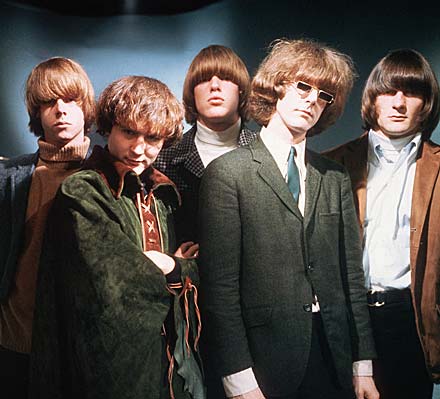


'Mr. Tambourine Man'  was hugely influencial in the development of folk rock.  McGuinn describes the Byrds' legacy:  "I guess you’d have to focus on the main points, which would be that jingle-jangle sound of the Rickenbacker electric twelve-string, the pretty harmonies, the melodies—the folk-based melodies—and combining the folk songs or style of folk songs with the energy of the Beatles, kind of combining the two because that had not been done prior to “Mr. Tambourine Man”. Now some people say it was the Animals, but that was a blues song, but (jokingly pauses), ok, anyway ... We were doing it, then exploring different territories, like country and jazz, and what they called psychedelia, which was really our jazz exploration."


http://www.thebyrds.com/


The single "Mr. Tambourine Man" was a number one smash in the UK and the US.    McGuinn reveals:    "To get that sound, that hit sound, that 'Mr. Tambourine Man' sound, we just ran it through the electronics which were available to us at that time, which were mainly compression devices and tape delay, tape-sustain. That's how we got it, by equalizing it properly and aiming at a specific frequency.   For stereo-buffs out there who noticed that 'Mr. Tambourine Man' in stereo isn't really stereo, by the way, that's because when Terry Melcher, the producer, first started mixing records he didn't know how to mix stereo, and so he made all the singles up to 'Turn Turn Turn' mono. The label is misrepresentative. See, when Columbia Records signed us, they didn't know what they had. So they gave production to someone low on the totem-pole-which was Terry Melcher who was Doris Day's son who was getting a token-job-in-the-mailroom sort of thing. They gave him the Byrds and the Byrds were supposed to flunk the test."

https://www.youtube.com/watch?v=uPqAvgN6Tyw
https://www.youtube.com/watch?v=pJO4KAv-GiY

https://www.youtube.com/watch?v=B6klDcGNpLk


"The Bells of Rhymney"
https://www.youtube.com/watch?v=B8gBysv5gYQ


'Mr. Tambourine Man' 
full album:

https://www.youtube.com/playlist?list=PLEvr99j7ruPzm5z-OyEIm_TkmunNDruK6


Side 1
"Mr. Tambourine Man" (Bob Dylan) – 2:29
"I'll Feel a Whole Lot Better" (Gene Clark) – 2:32
"Spanish Harlem Incident" (Bob Dylan) – 1:57
"You Won't Have to Cry" (Gene Clark, Jim McGuinn) – 2:08
"Here Without You" (Gene Clark) – 2:36
"The Bells of Rhymney" (Idris Davies, Pete Seeger) – 3:30
Side 2
"All I Really Want to Do" (Bob Dylan) – 2:04
"I Knew I'd Want You" (Gene Clark) – 2:14
"It's No Use" (Gene Clark, Jim McGuinn) – 2:23
"Don't Doubt Yourself, Babe" (Jackie DeShannon) – 2:54
"Chimes of Freedom" (Bob Dylan) – 3:51
"We'll Meet Again" (Ross Parker, Hughie Charles) – 2:07


Monday, February 20, 2012

younger than yesterday


The Byrds continued their turn away from pop music with the adventurous psychedelic romanticism of this diverse and transitional countrified folk rock jewel. The band had blossomed with three songwriters Jim McGuinn, David Crosby, and Chris Hillman hitting their stride, although not without contention. 'Younger Than Yesterday' was recorded in little over a week at Columbia Studios in Hollywood. Since their previous producer Allen Stanton had left the label, they went with Gary Usher, who had done work with the Beach Boys.

Hillman:
"That was my album in that sense that I started to come out of my shyness and contribute more. And I think we did some of the very first country-rock on 'Younger Than Yesterday'. I think with Clarence, 'Girl with No Name', 'Time Between', stuff like that, that was our country-rock statement of the time... And there was Roger and I in the breach, having had our fallout with David in finishing this record with Gary Usher. Gary Usher was very good at the time, a very good producer to work with, and opened all kinds of ideas."

McGuinn:
"I enjoyed working with Usher and it was great fun in the studio. We were kind of Beatles-influenced, I don't know if it was 'Revolver' or 'Rubber Soul', but we were influenced by one of those. I think they'd released something that didn't have separations between the tracks, so I think that was the inspiration for that. It was just a real artistic expression, freedom of expression. It was a lot of fun to be able to do things that were off the wall like that."

Crosby:
"Well we knew what we wanted to do and by that time, we'd gotten pretty good at it. I didn't know we did it that fast. That's probably the best record. I remember sitting up at Hillman's house looking out over Los Angeles...um...chemically enhanced and listening to the thing and thinking 'goddamn' you know? I was really knocked out by that. I thought it was an excellent piece of work."

'Younger Than Yesterday' only went to number twenty-four in the US and number thirty-seven in the UK; but has proven very influential in the ensuing years. 


http://www.thebyrds.com/


The single for 'So You Want to Be a Rock 'n' Roll Star' (Chris Hillman, Jim McGuinn) peaked at number twenty-nine in the US. Hillman remembers: "David Crosby and I had done these sessions for Hugh Masekela. We had the same manager, and we worked with all these South African musicians. I don't know why Hugh even called us in. David played guitar and I played bass, but the rest of them were real good players, jazz players. We couldn't even read a note of music, but we were working for this lady Letta Mbulu a jazz singer. It was an epiphany in my life. I went home after these sessions and started writing songs. Didn't have anything to do with what I'd been doing in the sessions, but on the second or third day I wrote Rock'n'Roll Star, and had Roger (McGuinn) come over and help me write it. Roger put in the bridge. The first part is something I absorbed from that session. Roger probably won't back me up on my version of this, but that song was just a slight jab at the Monkees. Not at the people, but at the process of taking a contrived thing and making a watered-down version of A Hard Day's Night on a weekly sitcom. It cheapened the music. It was never a jab at the four guys, in fact Mike Nesmith was a great songwriter and singer."


'Have You Seen Her Face' (Chris Hillman)


'Renaissance Fair' (David Crosby, Jim McGuinn)


'Time Between' (Chris Hillman)


'Everybody's Been Burned' (David Crosby) Crosby says: "I don't think I wrote anything that was worth a damn until I was in the Byrds. I think the first actually passable song that I wrote was 'Everybody's Been Burned.' It's certainly one of the places I'm most comfortable in (the modal feeling), no question about it. The lyric ballad, odd-changes feel."


'Thoughts and Words' (Chris Hillman) – 2:56


'My Back Pages' (Bob Dylan) – 3:08

McGuinn recalls: "I was driving my Porsche up La Ciniega, and Jim Dickson, our former producer and manager, pulled up in his Porsche, and signaled for me to roll my window down. -Hey. You ought to record Dylan's 'My Back Pages'. I said, OK. Thanks. It's a very insightful song about that thing when you think you're so knowledgeable when you're young. And then when you get a little older you realise what you didn't know."


'Why' (Jim McGuinn, David Crosby) – 2:45


'It Happens Each Day' (David Crosby) was left off of the album; but included in the re-release. 


 'Younger Than Yesterday'

full album:


 Side 1

    "So You Want to Be a Rock 'n' Roll Star" (Jim McGuinn, Chris Hillman) – 2:05
    "Have You Seen Her Face" (Chris Hillman) – 2:25
    "C.T.A.-102" (Jim McGuinn, Robert J. Hippard) – 2:28
    "Renaissance Fair" (David Crosby, Jim McGuinn) – 1:51
    "Time Between" (Chris Hillman) – 1:53
    "Everybody's Been Burned" (David Crosby) – 3:05

Side 2

    "Thoughts and Words" (Chris Hillman) – 2:56
    "Mind Gardens" (David Crosby) – 3:28
    "My Back Pages" (Bob Dylan) – 3:08
    "The Girl with No Name" (Chris Hillman) – 1:50
    "Why" (Jim McGuinn, David Crosby) – 2:45


Friday, December 24, 2010

turn! turn! turn!


The Byrds reinvented Pete Seeger's adaptation of the Book of Ecclesiastes and gave King Solomon his first number one hit. The band's harmonies and Roger McGuinn's twelve string Rickenbacker transformed the song into a folk rock standard that struck a chord with the American public during the escalation and expansion of the Vietnam War. Pete Seeger wrote the music, the refrain of the title, and the last six words that make the song a powerful call for peace.


http://www.thebyrds.com/


from the third chapter of Ecclesiastes

To every thing there is a season, and a time to every purpose under the heaven: a time to be born, and a time to die; a time to plant, and a time to pluck up that which is planted; a time to kill, and a time to heal; a time to break down, and a time to build up; a time to weep, and a time to laugh; a time to mourn, and a time to dance; a time to cast away stones, and a time to gather stones together; a time to embrace, and a time to refrain from embracing; a time to get, and a time to lose; a time to keep, and a time to cast away; a time to rend, and a time to sew; a time to keep silence, and a time to speak; a time to love, and a time to hate; a time of war, and a time of peace.


To everything, turn, turn, turn
There is a season, turn, turn, turn
And a time for every purpose under heaven
A time to be born, a time to die
A time to plant, a time to reap
A time to kill, a time to heal
A time to laugh, a time to weep
A time to build up, a time to break down
A time to dance, a time to mourn
A time to cast away stones
A time to gather stones together
A time of love, a time of hate
A time of war, a time of peace
A time you may embrace
A time to refrain from embracing
A time to gain, a time to lose
A time to rend, a time to sew
A time of love, a time of hate
A time of peace, I swear it’s not too late


full album:


Side 1
"Turn! Turn! Turn! (To Everything There is a Season)" (Book of Ecclesiastes/Pete Seeger) – 3:49
"It Won't Be Wrong" (Jim McGuinn, Harvey Gerst) – 1:58
"Set You Free This Time" (Gene Clark) – 2:49
"Lay Down Your Weary Tune" (Bob Dylan) – 3:30
"He Was a Friend of Mine" (traditional, new words and arrangement Jim McGuinn) – 2:30
Side 2[edit]
"The World Turns All Around Her" (Gene Clark) – 2:13
"Satisfied Mind" (Red Hayes, Jack Rhodes) – 2:26
"If You're Gone" (Gene Clark) – 2:45
"The Times They Are a-Changin'" (Bob Dylan) – 2:18
"Wait and See" (Jim McGuinn, David Crosby) – 2:19
"Oh! Susannah" (Stephen Foster) – 3:03