Paul McCartney and Wings found a way to go into alignment (no matter what the man said) with the rock show relics and magnetic melodicism of this strange vacation. After the critical and commercial success of 'Band on the Run' the trio of Paul and Linda McCartney and Denny Laine expanded to include guitarist Jimmy McCulloch and drummer Geoff Britton. Paul wanted to record in New Orleans in late 1974, but when Laine had trouble getting a visa, they started out recording at Abbey Road Studios in London. When the project got to Louisiana, Britton was replaced by local musician Joe English. The sessions took place at Allen Toussaint and Marshall Sehorn’s Sea-Saint Recording Studio in Gentilly while the band stayed at Le Richelieu Hotel in the French Quarter.
Paul says: "I'd never been to New Orleans, except on tour when we never saw anything except the inside of a trailer. The only thing I remembered about New Orleans was the vibrator bed in the motel and it was sweating hot. So we went down to New Orleans in search of a musical town and the weather. Then we found out Mardi Gras was on while we were there. I'd written most of the stuff before we got there and Jimmy had written one of the tracks with a mate of his. We'd been in Jamaica before we went to New Orleans and for the first time ever, I'd got all the songs together like a scroll that went from here to the end of the room. So I had all that together and we just went and turned up and started recording. With this new album I did this scroll thing and sat down and put one song there, and another song here. Fiddle about. Fiddle about. The only time I've done this before was on the mini-opera on Abbey Road
'Venus and Mars' features Paul McCartney on vocals, bass, guitars, keyboards, and piano; Linda McCartney on keyboards and backing vocals; Denny Laine on vocals, guitars, and keyboards; Jimmy McCulloch on guitars and vocals; Joe English on drums and percussion; and Geoff Britton and drums; with Kenneth "Afro" Williams on congas; Dave Mason on guitar; Tom Scott on saxophone; and Allen Toussaint on piano. Additional recording took place at Wally Heider Studios in San Francisco.
Paul reveals: ''When we had a party in the States to celebrate having finished the album, someone came up to us and said 'Hello, Venus. Hello, Mars.' I thought, 'Oh. no.'' When I write songs, I'm not necessarily talking about me, although psychoanalysts would say 'Yes, you are, mate.' But as far as I'm concerned, I'm not. The song 'Venus and Mars' is about an imaginary friend who's got a girl friend who's into astrology, the kind of person who asks you what your sign is before they say hello. That's it, 'a good friend of mine studies the stars.' In fact, in the first verse, it's 'a good friend of mine follows the stars,' so it could be ambiguous, a groupie or an astrologer...I didn't even know they were our neighbouring planets. I just thought of naming any two planets. What were the first that came to mind? I thought, Jupiter, no, that doesn't fit... Saturn... no... Venus and Mars... that's great, I'll just put those in. Later, it turns out they've just done an eclipse, Venus and Mars have lined themselves up for the first time in something like a thousand years. I didn't know they were the gods of love and war, either, and I wasn't thinking about the Botticelli picture someone ( George Melly) asked about ... I know it's sort of a rock-and-roll album but' there's other things I like that aren't necessarily rock-and-roll. On this LP I thought I'd like to get some of that in, so 'You Gave Me the Answer' is real fruity, imagining tie and tails, my impression of the Fred Astaire era ... ["Magneto and Titanium Man"] Yes, that's about Marvel Comics. When we were on holiday in Jamaica, we'd go into the supermarket every Saturday, when they got a new stock of comics in. I didn't use to read comics from eleven onwards, I thought I'd grown out of them, but I came back to them a couple of years ago. The drawings are great. I think you'll find that in twenty years time some of the guys drawing them were little Picassos. I think it's very clever how they do it. I love the names, I love the whole comic book thing...And I've been reading a bit of science fiction, things like Foundation
'Venus and Mars' reached number eleven in Germany and Italy; nine in Japan; five in the Netherlands; two in Australia; and number one in Canada, France, Norway, the UK, and the US.
http://www.paulmccartney.com/ "Listen to What the Man Said" was a top ten hit around the globe, and a number one smash in Canada and the US.
https://www.youtube.com/watch?v=kRT3V-q_gBI VIDEO "Letting Go"
https://www.youtube.com/watch?v=jvTF_njw5ps VIDEO "Junior's Farm" – 4:23
https://www.youtube.com/watch?v=CThnAJHMlao VIDEO "Lunch Box/Odd Sox"
https://www.youtube.com/watch?v=_eigBceZqbU VIDEO 'Venus and Mars' full album:
VIDEO
All songs written by Paul and Linda McCartney (listed as "McCartney"), except as noted.
1. Venus and Mars 0:00 2. Rock Show 1:17 3. Love in Song 6:48 4. You Gave Me the Answer 9:57 5. Magneto and Titanium Man 12:12 6. Letting Go 15:30 Side Two
7. Venus and Mars (Reprise) 20:02 8. Spirits of Ancient Egypt 22:07 9. Medicine Jar (Jimmy McCulloch, Colin Allen) 25:01 10. Call Me Back Again 28:36 11. Listen to What the Man Said 33:22 12. Treat Her Gently/Lonely Old People 37:16 13. Crossroads Theme (Tony Hatch) 41:39 VIDEO
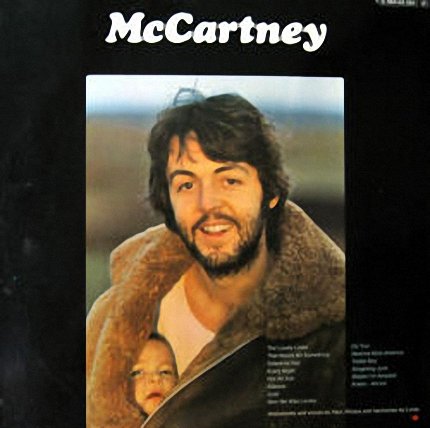
Paul McCartney began his solo career with these organic homegrown recordings of lovely leftovers and joyous junk. In the wake of the recording for The Beatles' 'Abbey Road' I nearly had a breakdown. I suppose the hurt of it all, and the disappointment, and the sorrow of losing this great band, these great friends ... I was going crazy ...I wouldn't get up in the morning; and when I did get up I wouldn't shave or bother with anything; and I'd reach for the whisky."
As a means of relieving his depression, his wife Linda convinced him to begin working on his own material apart from The Beatles. When the McCartney family returned to London in December of 1969, Paul began working on new recordings using a Studer four-track tape recorder at his home in St John's Wood. In early January of 1970, he took part in the final recording sessions for The Beatles film project 'Get Back' 'Let It Be' . In February, he booked time under the pseudonym "Billy Martin" at London's Morgan Studios to transfer his four track recordings to eight track to allow more overdubs. Later that month "Billy Martin" booked time at Abbey Road Studios for more recording and mixing.
'McCartney' features Paul McCartney on vocals, guitar, steel guitar, bass guitar, piano, keyboards, organ, Mellotron, xylophone, drums, maracas, bongos, tambourine, cowbell, wineglasses, hand percussion, aerosol, bow and arrow; with Linda McCartney adding backing vocals. McCartney muses: "I was like a professor in his laboratory. Very simple [set-up], as basic as you can get ... Even now that album has an interesting sound. Very analogue, very direct ... They were almost throwaways, you know? But that's why they were included. They weren't quite throwaways. That was the whole idea of the album: all the normal things that you record that are great and have all this atmosphere but aren't that good as recording or production jobs. Normally that stuff ends up with the rest of your demos, but all that stuff is often stuff I love ."
The release date for 'McCartney' was slated for mid-April of 1970, held back a couple of weeks so as not to compete with The Beatles US compilation 'Hey Jude' in February or Ringo Starr's solo debut 'Sentimental Journey' in March. When Phil Spector reported that the work on the 'Let It Be' soundtrack album was almost finished, the band's new manager Allen Klein (who McCartney refused to support) decided to delay 'McCartney' until June so as not to overlap with a late April release date for the soundtrack to coincide with the release of the film. McCartney was furious and took it out on the messenger: "Ringo visited me, bringing two letters signed by George and John with which, he said he agreed. These letters confirmed that my record had been stopped. I really got angry when Ringo told me that Klein had told him that my record was not ready and that he had a release date for the Let It Be
McCartney won out and got his solo album out in April; but refused to do any press for it. Instead, he did a press release for the album that explained that he was not sure if his break with The Beatles would be temporary or permanent. The press ran with the idea that Paul had broken up the band: "The world reaction was like 'The Beatles Have Broken Up – It's Official' – we'd known it for months. So that was that, really. I think it was the press who misunderstood. The record had come with this weird explanation on a questionnaire of what I was doing. It was actually only for them. I think a few people thought it was some weird move of me to get publicity, but it was really to avoid having to do the press. "
Despite having no singles, 'McCartney' went to number fifteen in Germany, thirteen in Japan, four in France, three in Australia and the Netherlands, two in Norway and the UK, and number one in the US. http://www.paulmccartney.com/ "Maybe I'm Amazed"
https://www.youtube.com/watch?v=cm2YyVZBL8U VIDEO "That Would Be Something"
https://www.youtube.com/watch?v=VHTCWY7Lvpk VIDEO "Every Night"
https://www.youtube.com/watch?v=3mt_HTeERRg VIDEO "Teddy Boy"
VIDEO 'McCartney' full album:
https://myspace.com/paulmccartney/music/album/mccartney-17720166 VIDEO
All songs written by Paul McCartney.
Side one
00:00 - The Lovely Linda
00:46 - That Would Be Something
03:27 - Valentine Day
05:11 - Every Night
07:50 - Hot As Sun
09:20 - Glasses
09:59 - Junk
11:55 - Man We Was Lonely
Side two
14:57 - Oo You
17:46 - Momma Miss America
21:53 - Teddy Boy
24:18 - Singalong Junk
26:55 - Maybe I'm Amazed
30:48 - Kreen Akrore
https://www.youtube.com/watch?v=i6mT7G08Ouc VIDEO Q: Why did you decide to make a solo album? A: Because I got a Studer four-track recording machine at home - practiced on it (playing all instruments) - liked the results, and decided to make it into an album. Q: Were you influenced by John's adventures with the Plastic Ono Band, and Ringo's solo LP? A: Sort of, but not really. Q: Are all songs by Paul McCartney alone? A: Yes sir. Q: Will they be so credited: McCartney? A: It's a bit daft for them to be Lennon/McCartney credited, so "McCartney" it is. Q: Did you enjoy working as a solo? A: Very much. I only had me to ask for a decision, and I agreed with me. Remember Linda's on it too, so it's really a double act. Q: What is Linda's contribution? A: Strictly speaking she harmonizes, but of course it's more than that because she's a shoulder to lean on, a second opinion, and a photographer of renown. More than all this, she believes in me - constantly. Q: Where was the album recorded? A: At home, at EMI (no. 2 studio) and at Morgan Studios (Willesden!) Q: What is your home equipment (in some detail)? A: Studer four-track machine. I only had, however, one mike, and as Mr Pender, Mr Sweatenham and others only managed to take six months or so (slight delay) I worked without VU meters or a mixer, which meant that everything had to be listened to first (for distortion etc...) then recorded. So the answer - Studer, one mike, and nerve. Q: Why did you choose to work in the studios you chose? A: They were available. EMI is technically very good and Morgan is cozy. Q: The album was not known about until it was nearly completed. Was this deliberate? A: Yes, because normally an album is old before it even comes out. (aside) Witness GET BACK. Q: Why? A: I've always wanted to buy a Beatles album like people do and be as surprised as they must be. So this was the next best thing. Linda and I are the only two who will be sick of it by the release date. We love it really. Q: Are you able to describe the texture or the feel of the album in a few words? A: Home, family, love. Q: How long did it take to complete? A: From just before (I think) Xmas, until now. THE LOVELY LINDA was the first thing I recorded at home, and was originally to test the equipment. That was around Xmas. Q: Assuming all the songs are new to the public, how new are they to you? Are they recent A: One was from 1959 (HOT AS SUN). Two are from India - JUNK and TEDDY BOY, and the rest are pretty recent. VALENTINE DAY, MOMMA MISS AMERICA and OO YOU were ad-libbed on the spot. Q: Which instruments have you played on the album? A: Bass, drums, acoustic guitar, lead guitar, piano and organ-mellotron, toy xylophone, bow and arrow. Q: Have you played all these instruments on earlier recordings? A: Yes, drums being the one that I normally wouldn't do. Q: Why did you do all the instruments yourself? A: I think I'm pretty good. Q: Will Linda be heard on all future records? A: Could be. We love singing together and have plenty of opportunity for practice. Q: Will Paul and Linda become a John and Yoko? A: No, they will become Paul and Linda. Q: What has recording alone taught you? A: That to make your own decisions about what you do is easy, and playing with yourself is very difficult, but satisfying. Q: Who has done the artwork? A: Linda has taken all the photos, and she and I designed the package. Q: Is it true that neither Allen Klein nor ABKCO have been nor will be in any way involved with the production, manufacturing, distribution or promotion of this new album? A: Not if I can help it. Q: Did you miss the other Beatles and George Martin? Was there a moment when you thought, 'I wish Ringo were here for this break?' A: No. Q: Assuming this is a very big hit album, will you do another? A: Even if it isn't, I will continue to do what I want, when I want to. Q: Are you planning a new album or single with the Beatles? A: No. Q: Is this album a rest away from the Beatles or the start of a solo career? A: Time will tell. Being a solo album means it's "the start of a solo career..." and not being done with the Beatles means it's just a rest. So it's both. Q: Is your break with the Beatles temporary or permanent, due to personal differences or musical ones? A: Personal differences, business differences, musical differences, but most of all because I have a better time with my family. Temporary or permanent? I don't really know. Q: Do you foresee a time when Lennon-McCartney becomes an active songwriting partnership again? A: No. Q: What do you feel about John's peace effort? The Plastic Ono Band? Giving back the MBE? Yoko's influence? Yoko? A: I love John, and respect what he does - it doesn't really give me any pleasure. Q: Were any of the songs on the album originally written with the Beatles in mind? A: The older ones were. JUNK was intended for ABBEY ROAD, but something happened. TEDDY BOY was for GET BACK, but something happened. Q: Were you pleased with ABBEY ROAD? Was it musically restricting? A: It was a good album. (No. 1 for a long time.) Q: What is your relationship with Klein? A: It isn't. I am not in contact with him, and he does not represent me in ANY way. Q: What is your relationship with Apple? A: It is the office of a company which I part own with the other three Beatles. I don't go there because I don't like offices or business, especially when I am on holiday. Q: Have you any plans to set up an independent production company? A: McCartney Productions. Q: What sort of music has influenced you on this album? A: Light and loose. Q: Are you writing more prolifically now? Or less so? A: About the same. I have a queue waiting to be recorded. Q: What are your plans now? A holiday? A musical? A movie? Retirement? A: My only plan is to grow up! 1: THE LOVELY LINDA When the Studer 4 track was installed at home, this was the first song I recorded, to test the machine. On the first track was vocal and guitar, second - another acoustic guitar - then overdubbed hand slaps on a book, and finally bass. Written in Scotland, the song is a trailer to the full song which will be recorded in the future. 2: THAT WOULD BE SOMETHING This song was written in Scotland in 1969 and recorded at home in London - mixed later at EMI (No. 2). I only had one mike, as the mixer and VU meters hadn't arrived (still haven't). 1 vocal, guitar 2 tom-tom and cymbal 3 electric guitar 4 bass 3: VALENTINE DAY Recorded at home. Made up as I went along - acoustic guitar first, then drums (maybe drums were first). Anyway - electric guitar and bass were added and the track is all instrumental. Mixed at EMI. This one and MOMMA MISS AMERICA were ad-libbed, with more concern for testing the machine than anything else. 4: EVERY NIGHT (Blues) This came from the first two lines, which I've had for a few years. They were added to in 1969 in Greece (Benitses) on holiday. This was recorded at EMI with: 1 vocal and 2 acoustic guitar. 3 drums. 4 bass. 5 lead guitar (acoustic). 6 harmony to the lead guitar. 7 double-tracked vocal in parts. 8 ? electric guitar (not used). 9 track. 5: HOT AS SUN A song written in about 1958 or 9 or maybe earlier, when it was one of those songs that you play now and then. The middle was added in Morgan Studio, where the track was recorded recently. 1 acoustic guitar. 2 electric guitar. 3 drums. 4 rhythm guitar. 5 organ. 6 maracas. 7 bass. 8 bongos. 6: GLASSES Wineglasses played at random and overdubbed on top of each other - the end is a section of a song called SUICIDE – not yet completed. 7: JUNK Originally written in India, at Maharishi's camp, and completed bit by bit in London. Recorded vocal, two acoustic guitars, and bass at home, and later added to (bass drum, snare with brushes, and small xylophone and harmony) at Morgan. 8: MAN WE WAS LONELY The chorus ("Man We Was Lonely") was written in bed at home, shortly before we finished recording the album. The middle ("I used to ride...") was done one lunchtime in a great hurry, as we were due to record the song that afternoon. Linda sings harmony on this song, which is our first duet together. The steel-guitar sound is my Telecaster played with a drum peg. 1 guitar. 2 voices (two tracks). 3 bass drum 4 bass. 5 steel guitar. 9: OO YOU The first three tracks were recorded at home as an instrument that might someday become a song. This, like MAN WE WAS LONELY, was given lyrics one day after lunch, just before we left for Morgan Studios, where it was finished that afternoon. Vocals, electric guitar, tambourine, cow bell, and aerosol spray were added at Morgan, and it was mixed there. On the mix, tape echo was used to move feedback from guitar from one side to another. 10: MOMMA MISS AMERICA An instrumental recorded completely at home. Made up as I went along - first a sequence of chords, then a melody on top. Piano, drums, acoustic guitar, electric guitar. Originally it was two pieces, but they ran into each other by accident and became one. 11: TEDDY BOY Another song started in India, and completed in Scotland and London, gradually. This one was recorded for the Get Back film, but later not used. Rerecorded partly at home ... (guitar, voices and bass) ... and finished at Morgan. Linda and I sing the backing harmonies on the chorus, and occasional oos. 12: SINGALONG JUNK This was take 1, for the vocal version, which was take 2, and a shorter version. Guitars, and piano and bass, were put on at home, and the rest added at Morgan Studios. The strings are Mellotron, and they were done at the same time as the electric guitar, bass drum, and sizzle cymbal. 13: MAYBE I'M AMAZED Written in London, at the piano, with the second verse added slightly later, as if you cared. Recorded at EMI, No. 2 Studio. First 1 piano. 2 vocal. 3 drums. 4 bass. 5 and vocal backing. 6 and vocal backing. 7 solo guitar. 8 backing guitars. Linda and I are the vocal backing group. Mixed at EMI. A movie was made, using Linda's slides and edited to this track. 14: KREEN-AKRORE There was a film on TV about the Kreen-Akrore Indians living in the Brazilian jungle, their lives, and how the white man is trying to change their way of life to his, so the next day, after lunch, I did some drumming. The idea behind it was to get the feeling of their hunt. So later piano, guitar and organ were added to the first section. The second had a few tracks of voices (Linda and I) and the end had overdubbed breathing, going into organ, and two lead guitars in harmony. Done at Morgan. Engineer, Robin Black. The end of the first section has Linda and I doing animal noises (speeded up) and an arrow sound (done live with bow and arrow - the bow broke), then animals stampeding across a guitar case. There are two drum tracks. We built a fire in the studio but didn't use it (but used the sound of the twigs breaking).
Paul McCartney & Wings defied death and dissolution in Africa to produce the ecstatic escapism of this enduring classic. Unsatisfied with the critical response to 'Wild Life' and 'Red Rose Speedway' McCartney decided he wanted to change things up and record in a more exotic location than London. After looking over a list of international studios from EMI, he was taken with the idea of going to Lagos in Nigeria . Not all of the members of Wings were as keen on the idea. Paul says: "A couple of the guys [lead guitarist Henry McCullough and drummer Denny Seiwell] left the band the night before we went to Lagos to make the record. That was like a bombshell. You can imagine me getting off that phone call: it was like, ‘Ah. Okay. Try and hold your nerve; try and keep it together. What do we do now? Sod it, we’re going’. And at that moment it was one of those, ‘I’ll show you. I will make the best album I’ve ever made now. I will put so much effort into it because I wanna just prove that we didn’t need you guys’...I don’t think the actual record is that angry. The first week of the record I felt pretty angry. You know what though? The truth is I get over things like that quite quickly. I mean, that night it was like, ‘Shit’. It was bad - two of your band has just left, and the drummer as well; he was fairly central. But Denny can play guitar - that wasn’t too bad - and then I just thought, ‘Well, I’ve done ‘McCartney’; I can drum, I can do this and that, and we’ll just completely rethink the whole thing’. But it was full of difficulties...We hadn’t actually rehearsed everything up with the band yet - we were gonna arrange them there - but I had it all planned in my head. And yeah, we did just have to think... particularly the recording method: that had to be different. We would just get the three of us - me, Linda and Denny - to do a track and get the basis of the song, and then I would do back in and add the missing parts. You did have to rethink what you were doing. I think the songs themselves were the same - it was the instrumentation and the arrangements that [changed]. But in a way I found that to be quite a good thing, because stripping things back is never the worst idea."
There were numerous challenges for the trio. The country was run by a corrupt military dictatorship that did nothing to improve the standard of living in the country despite the enormous profits being made through oil production. The studio on Wharf Road in the suburb of Apapa had a faulty control desk and only one Studer 8-track tape machine. One night, Paul and Linda were mugged at knifepoint while out walking and a bag with demo tapes and a notebook full of lyrics was taken along with their other valuables. On another occasion, Paul fainted from exhaustion and stress. Nigerian Afrobeat star Fela Kuti accused the group of trying to steal African music and showed up at the studio where they played the tapes for him to prove to him that it was not the case. Ginger Baker invited them to record at his ARC Studio in Ikeja, where the band was staying, and they went there for one day, recording one song. When the album was done, they returned to London to do orchestral overdubs at Abbey Road Studios.
'Band on the Run' http://www.paulmccartney.com/ http://www.paulmccartney.com/albums/10444-band-on-the-run McCartney interview:
http://www.youtube.com/watch?v=IfQaqJn7dC8 "Band on the Run" was a number one hit in Canada, New Zealand, and the US. Paul says it harkens back to the Beatles: "It was symbolic: 'If we ever get out of here... All I need is a pint a day'. It was feeling like that, the whole thing. Because we’d been...if you think about it, we’d started off as just kids really, who loved our music and wanted to earn a bob or two so we could get a guitar and get a nice car. It was very simple ambitions at first. But then, you know, as it went on it became business meetings and all of that, and eventually it was really not fun. You’d have to go into these meetings. So there was a feeling of ‘if we ever get out of here’, yeah. And I did." http://www.youtube.com/watch?v=KBX2dySWGew "Jet"
Paul says: "Jet was a pony in Scotland and then it morphed into a girl with marital troubles." The song made it to the top ten on charts around the world.
http://www.youtube.com/watch?v=M8V1nFCP058 "Mrs Vandebilt"
http://www.youtube.com/watch?v=hkcD-_SWblg "Let Me Roll It"
Paul says: "‘Let Me Roll It’ wasn’t to John, it was just in the style that we did with The Beatles that John was particularly known for. It was really actually the use of the echo. It was one of those: ‘You’re not going to use echo just cos John used it?’ I don’t think so. To tell you the truth, that was more [about] rolling a joint. That was the double meaning there: 'let me roll it to you'. That was more at the back of mind than anything else."
http://www.youtube.com/watch?v=Jwesp_KgoXs "Mamunia"
http://www.youtube.com/watch?v=xbZWZoYQ_Qo "Picasso's Last Words (Drink to Me)" was inspired by a challenge from Dustin Hoffman. It was the only song on the album recorded at Ginger Baker's studio in Ikeja.
http://www.youtube.com/watch?v=YD_8QkvnDLA "Nineteen Hundred and Eighty-Five"
http://www.youtube.com/watch?v=1c5pgo6zU10 http://www.youtube.com/watch?v=aarB12YaAgE http://www.youtube.com/watch?v=7xM7vq40cOU 'Helen Wheels' was released as a single before the album came out. It did not appear on the UK release; but was included on the US version. It went to number ten in the US and four in Canada.
http://www.youtube.com/watch?v=x_qdychzbz8 full album:
VIDEO All songs written by Paul and Linda McCartney, except "No Words" by Paul McCartney and Denny Laine.
Side one
"Band on the Run" – 5:10
"Jet" – 4:06
"Bluebird" – 3:22
"Mrs. Vandebilt" – 4:38
"Let Me Roll It" – 4:47
Side two
"Mamunia" – 4:50
"No Words" – 2:33
"Helen Wheels" – 3:34 (US release)
"Picasso's Last Words (Drink to Me)" – 5:50
"Nineteen Hundred and Eighty-Five" – 5:27
VIDEO