Showing posts with label cool jazz. Show all posts

Monday, December 28, 2015

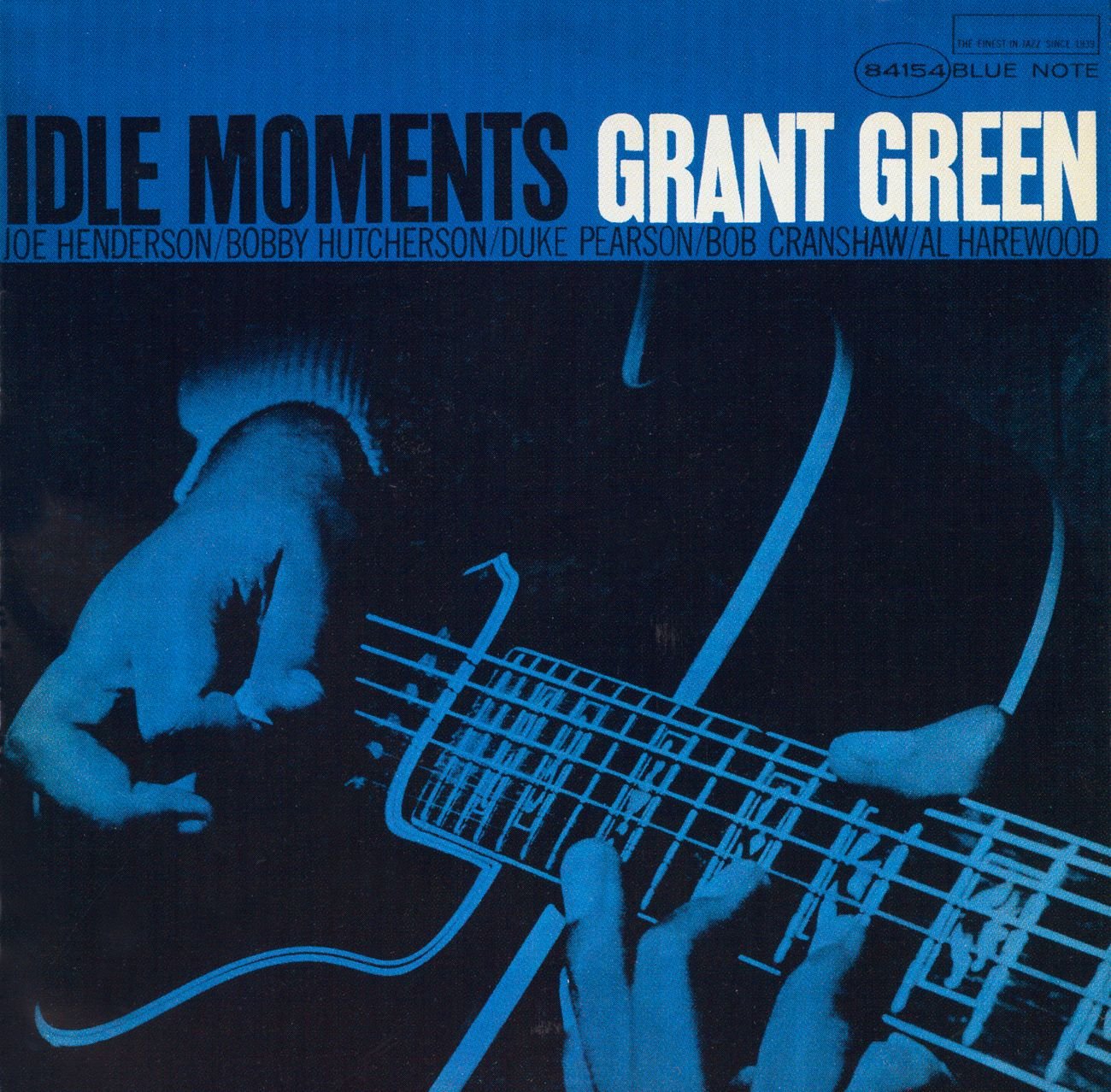
idle moments


Grant Green let things wander into the smooth and soulful serenity of this laid back lounge daydream. He had first played guitar professionally at the age of twelve in his native St. Louis; and by the time he was thirty, he had appeared on dozen of albums with various jazz heavyweights and recorded seven albums (along with material that would make seven more)  as a bandleader (Grant's First Stand  and  Green Street  in 1961,   Sunday Mornin'   and   Grantstand  in 1962,   The Latin Bit  and  Feelin' the Spirit  in 1963,  and  Am I Blue  in 1964)  by the time he went back into the studio with sax man Joe Henderson in November of 1963 at Van Gelder Studio in Englewood Cliffs, New Jersey.   

Idle Moments features  Joe Henderson on tenor saxophone,   Bobby Hutcherson on vibraphone,  Grant Green on guitar,  Duke Pearson on piano,  Bob Cranshaw on bass,  and  Al Harewood on drums.  It was recorded during two sessions with producer Alfred Lion and engineer Rudy Van Gelder.  During the first session, the recording of the title track was intended to be shorter to fit the time they had left that would fit on an album; but Green got lost in the song and played his solo for sixty four bars instead of the planned thirty two.   Henderson and Hutcherson did the same and the song went twice as long.  They rerecorded it; but found it couldn't match the feeling that they had captured on that first take.  


Idle Moments
full album:

"Idle Moments" (Pearson) – 14:56
"Jean De Fleur" (Green) – 6:49
"Django" (John Lewis) – 8:44
"Nomad" (Pearson) – 12:16


1. Idle Moments 00:00
2. Jean De Fleur 15:00
3. Jean De Fleur (Alternate Version) 21:50
4. Django 30:01
5. Django (Alternate Version) 38:47
6. Nomad 52:01


Saturday, August 6, 2011

bix beiderbecke


Leon Bismark "Bix" Beiderbecke
(March 10, 1903 – August 6, 1931)


Self-taught jazz pioneer whose unique style was precursor to the 'cool jazz' movement. He was a legend in his own time for his improvization and beautiful tone on the cornet as well as for his heavy drinking. Bix was playing the piano at the age of three and took up the cornet ten years later. He was expelled from the exclusive Lake Forest Academy for breaking curfew to catch jazz shows in Chicago. Beiderbecke joined the Wolverine Orchestra late in 1923, and the seven-man group first played a speakeasy called the Stockton Club. A year later he left them to join Jean Goldkette's Orchestra; but his inability to read music made that a short affair. After a short stint at the University of Iowa, Bix followed Frankie Trumbauer to St. Louis and then Detroit, reconnecting with Goldkette as part of his "Famous Fourteen". When that group dissolved most of them joined Paul Whiteman's Orchestra, a very popular outfit that mixed jazz and classical. He also recorded with Trumbauer and guitarist, Eddie Lang, under the name of Tram, Bix, and Eddie. The relentless touring schedule exacerbated Bix's alcoholism and on November 30, 1928 he suffered a breakdown. Spending time in and out of rehabilitation as his health gradually declined, Bix continued to play and drink with equal fervor. On Thursday, August 6, 1931, Beiderbecke died in his apartment, #1G, 43-30 46th Street, in Sunnyside, Queens, at the age of twenty eight during an alcoholic seizure. The official cause of death was lobar pneumonia and edema of the brain.


http://www.bixbeiderbecke.com/


The slow-tempo jazz classic 'Singing The Blues' by The Frankie "Tram" Trumbauer Orchestra. It starts with a sax solo by Trumbauer. Then comes Bix's cornet solo. Finally, a short clarinet solo by Jimmy Dorsey. The guitarist on this track is Eddie Lang.


'I'm Coming, Virginia' with the Trumbauer Orchestra. Frank Trumbauer, Bix Beiderbecke, Don Murray, Bill Rank, Doc Ryker, Irving Riskin, Eddie Lang, and Chauncey Morehouse.


'In A Mist' is one of a handful of his piano compositions but the only one he recorded.


'Oh Baby' with the Wolverine Orchestra with Bix Biederbecke, Al Gandee, Bob Gillette, Vic Moore, George Johnson, Dick Vonyow and Jimmy Hartwell


Jean Goldkette & His Orchestra doing 'I'd Rather Be The Girl In Your Arms (Than The Girl In Your Dreams)' with Bix Beiderbecke, Fuzzy Farrar, Ray Lodwig, Bill Rank, Speigle Willcox, Don Murray, Doc Ryker, Frank Trumbauer, Joe Venuti, Paul Mertz, Howdy Quicksell, Eddie Lang, Steve Brown, Chauncey Morehouse, Bill Challis, Frank Bessinger, Frank Magine, Joe Griffith, Frank Marvin.


'Jazz Me Blues' by Bix Beiderbecke & The Wolverines.


'Georgia (On My Mind)' with Bix Beiderbecke, Ray Lodwig, Jack Teagarden, Boyce Cullen, Jimmy Dorsey, Bud Freeman, Pee Wee Russell, Irving Brodsky, Joe Venuti, Eddie Lang, Min Leibrook, Chauncey Morehouse, and Hoagy Carmichael on September 15, 1930.

Thursday, May 26, 2011

miles davis


Miles Dewey Davis III

(May 26, 1926 – September 28, 1991)


Controversial and influential icon of jazz and rock whose unique and haunting work on the trumpet played a key part in bebop, cool jazz, modal, and fusion.


He learned music from his mother during his youth in St. Louis. When his father sent him to the Juilliard School of Music in New York, Davis sought out saxophonist Charlie Parker.  He dropped out of school and began playing professionally in clubs and recording studios, leading his own group within a year.  


https://www.milesdavis.com/


'Now's The Time' was one of the songs recorded during the first of the legendary Savoy Sessions 1945 with a nineteen year old Davis playing trumpet with Charlie Parker on alto sax, Curley Russell on bass, Max Roach on drums and "Hen Gates" (Dizzy Gillespie) playing piano.


'Boplicity' came from his groundbreaking 'Birth of the Cool' compilation that marked his turn from the hard edge of bop to a more introspective sound. It was recorded in 1949 and 1950; but not released until 1957. The song was credited to Cleo Henry and Gil Evans. Henry was a pseudonym based on his Davis' mother's maiden name that he never used again.


'Doxy' was composed by Sonny Rollins. It first appeared on Davis' 'Bags' Groove', performed with Davis on trumpet, Rollins on tenor saxophone, Horace Silver on piano, Percy Heath on bass, and Kenny Clarke on drums.


''Round Midnight' was the centerpiece of Davis' debut on Columbia Records 'Round About Midnight' recorded in 1955. The song was composed by Thelonious Monk and features a saxophone solo from John Coltrane.


'Milestones' was originally called 'Miles' when the album 'Milestones' came out in 1958. It was his first foray into modal jazz. It features Miles on trumpet, Cannonball Adderley on alto saxophone, Red Garland on piano, Paul Chambers on double bass, Philly Joe Jones on drums,
and a fabulous solo from John Coltrane on tenor saxophone.


The impressionistic modal jazz of 'So What' opens his seminal 1959 'Kind of Blue' album.


The title track to his 1963 'Seven Steps To Heaven' was co-written with pianist Victor Feldman, who Davis replaced with Herbie Hancock for the album. It includes George Coleman on tenor saxophone, Ron Carter on double bass, and Tony Williams on drums.


'Footprints' appeared on his 1967 album 'Miles Smiles'. It was composed by saxophonist Wayne Shorter.


'Spanish Key' is from his 1970 jazz fusion double album 'Bitches Brew' featuring what Miles called "the best damn rock and roll band in the world."


'Black Satin' is from his 1973 album 'On The Corner' which saw Davis experimenting with funk and electronic music.


The title track to his 1986 album 'Tutu' was written by bassist Marcus Miller, and dedicated to Archbishop Desmond Tutu.