Frank Sinatra gazed into the looking glass to appreciate the autumn of his years like vintage wine from fine old kegs with this lugubrious orchestral introspection. On the occasion of his fiftieth birthday, 'The Chairman of the Board' was feeling nostalgic. He teamed up once again with arranger and conductor Gordon Jenkins in Hollywood to provide the soundtrack to his album concept.
Sinatra would state at the time: "It was my idea [in my mid-20s] to make my voice work in the same way as a trombone or a violin — not sounding like them, but “playing” like those instruments. The first thing I needed was extraordinary breath control, which I didn’t have. I began swimming every chance I got in public pools — taking laps under water and thinking song lyrics to myself as I swam, holding my breath. One thing that was tremendously important was learning the use of a microphone. Many singers never learned to use one. They never understood, and still don’t, that a microphone is their instrument…. [Instead] of playing a saxophone, they’re playing a microphone. I don’t read a note of music. I learn songs by having them played for me a couple of times while I read the lyrics. I can pick up the melody very quickly. I learn the lyrics by writing them out in long hand. When I get a new song, I look for continuity of melody that in itself will tell a musical story. It must go somewhere. I don’t like it to ramble. And then, by the same token, I like almost the same thing — more, as a matter of fact — in the lyrics. They must tell you a complete story, from 'once upon a time' to 'the end.'" The storytelling struck a responsive chord with the public and 'September of My Years' went gold, peaking at number five on the US album chart. http://www.sinatra.com/ "It Was a Very Good Year"
written by Ervin Drake in 1961 for The Kingston Trio
Frank Sinatra In Studio - It Was A Very Good Year (1965) from Daniel Ramos on Vimeo .Sinatra's version gave him his first number one single in a decade and won Grammys in 1966 for Best Male Vocal Performance and Best Instrumental Arrangement.
VIDEO When I was seventeen, it was a very good year
It was a very good year for small town girls
And soft summer nights
We'd hide from the lights
On the village green
When I was seventeen
When I was twenty-one, it was a very good year
It was a very good year for city girls
Who lived up the stairs
With all that perfumed hair
And it came undone
When I was twenty-one
When I was thirty-five, it was a very good year
It was a very good year for blue-blooded girls
Of independent means
We'd ride in limousines
Their chauffeurs would drive
When I was thirty-five
But now the days are short, I'm in the autumn of my years
And I think of my life as vintage wine
From fine old kegs
From the brim to the dregs
It poured sweet and clear
It was a very good year
'September of My Years' full album;
VIDEO Side 1
"The September of My Years" (Jimmy Van Heusen, Sammy Cahn) - 3:12
"How Old Am I?" (Gordon Jenkins) - 3:30
"Don't Wait Too Long" (Sunny Skylar) - 3:04
"It Gets Lonely Early" (Van Heusen, Cahn) - 2:57
"This Is All I Ask" (Jenkins) - 3:03
"Last Night When We Were Young" (Harold Arlen, E.Y. Harburg) - 3:33
"The Man in the Looking Glass" (Bart Howard) - 3:25
Side 2
"It Was a Very Good Year" (Ervin Drake) - 4:25
"When the Wind Was Green" (Henry Stinson) - 3:22
"Hello, Young Lovers" (Richard Rodgers, Oscar Hammerstein II) - 3:41
"I See It Now" (Alec Wilder, William Engvick) - 2:50
"Once Upon a Time" (Charles Strouse, Lee Adams) - 3:30
"September Song" (Kurt Weill, Maxwell Anderson) - 3:30
Frank Sinatra completed his Capitol years by continuing his ongoing collaboration with Nelson Riddle on this charming collection of calming classics. Over the course of more than a decade, the singer had had several successful albums with Riddle doing the arrangements (Songs for Young Lovers In the Wee Small Hours Songs for Swingin' Lovers! A Swingin' Affair! Frank Sinatra Sings for Only the Lonely Where Are You? Come Fly With Me Come Dance With Me! No One Cares
Sinatra would describe his process: "First, I decide on the mood for an album, and perhaps pick a title. Or sometimes it might be that I had the title, and then picked the mood to fit it. But it's most important that there should be a strong creative idea for the whole package...Then I get a short list of maybe sixty possible songs, and out of these I pick twelve to record. Next comes the pacing of the album, which is vitally important. I put the titles of the songs on twelve bits of paper, and juggle them around like a jigsaw puzzle until the album is telling a complete story, lyric-wise...Once we choose the songs that will be in a particular album, I'll sit with Bill Miller, my pianist, and find the proper key. Then I will meet with the orchestrator, and give him my thought on what I feel the background should be...Usually, we wind up doing it the way the arranger feels it should be done, because he understands more than I do about it...Nelson [Riddle] is the greatest arranger in the world, a very clever musician. He's like a tranqilizer - calm, slightly aloof. There's a great depth somehow to the music he creates. And he's got a sort of stenographer's brain. If I say to him at a planning meeting, 'Make the eighth bar sound like Brahms,' he'll make a cryptic little note on the side of shome scrappy music sheet, and, sure enougtr, when we come to the session, the eighth bar will be Grahms. If I say, 'Make like Puccini,' Nelson will make exacly the same little note, and that eighth bar will be PUccini all right, and the roof will lift off!"
Riddle would relate: "Frank and I have, I think, the same musical aim. We know what we're each doing with a song - what we want the song to say. Frank would have very definite ideas about teh general treatment, particularly about the pace of the record. He'd sketch out someting brief, like 'Start with a bass figure, build up secondtime through and then fade out at the end.' That's possibly all he would say.. Sometimes, he'd follow this up with a phone call at three in the morning with some other extra little idea. But after that, he wouldn't hear my arrangements until the recording session...In those days, twelve or more songs comprised an album. Frank would start with the most agonizingly specific comments on the first few tunes, often referring to classical compositions for examples of what he expected to ehar in the orchestration. This hot, precise, demanding pace would continue for an hour or two, perhaps throught the first four of five songs. Then, as if he too were beginning to feel the strain, he would start to slack off. The comments would grow less specific, and perhaps a tune or so later, he would say, simply, 'Do what you think is best.' My headache would start to subside, my pulse return to normal, and another Sinatra-Riddle album would be launched."
'Nice 'n' Easy' was recorded from March 1 – 3, and on April 13, 1960, at Capitol Studio A in Hollywood, Los Angeles, California with producer Dave Cavanaugh. The album spent nine weeks at number one and was nominated for Grammy Awards for Album of the Year, Best Male Vocal Performance, and Best Arrangement. http://sinatra.com/ http://www.nelsonriddlemusic.com/ "Nice 'n' Easy"
Marilyn Bergman would reveal: “With ‘Nice ‘n’ Easy,’ a call had gone out, a kind of open casting call, that the Sinatra people were looking for a song for Sinatra, a title song for an album of lightly swinging love songs. Every writer in Hollywood submitted something and luckily we got the call. Writing for Frank Sinatra was like writing for a character in a play. You know exactly the language, the look, the attitude, everything.”
VIDEO "Someone To Watch Over Me"
https://www.youtube.com/watch?v=X60rq1jwyP4 VIDEO "Nevertheless"
https://www.youtube.com/watch?v=dIvRD5aDekk VIDEO 'Nice 'n' Easy' full album:
http://www.last.fm/music/Frank+Sinatra/Nice+'N'+Easy https://myspace.com/franksinatra/music/album/nice-n-easy-digitally-re-mastered-17694063 VIDEO "Nice 'n' Easy" (Alan Bergman, Marilyn Keith, Lew Spence) – 2:45 "That Old Feeling" (Lew Brown, Sammy Fain) – 3:33 "How Deep Is the Ocean?" (Irving Berlin) – 3:15 "I've Got a Crush on You" (George Gershwin, Ira Gershwin) – 2:16 "You Go to My Head" (J. Fred Coots, Haven Gillespie) – 4:28 "Fools Rush In (Where Angels Fear to Tread)" (Rube Bloom, Johnny Mercer) – 3:22 "Nevertheless" (Bert Kalmar, Harry Ruby) – 3:18 "She's Funny That Way" (Neil Moret, Richard A. Whiting) – 3:55 "Try a Little Tenderness" (Jimmy Campbell, Reginald Connelly, Harry M. Woods) – 3:22 "Embraceable You" (G. Gershwin, I. Gershwin) – 3:24 "Mam'selle" (Mack Gordon, Edmund Goulding) – 2:48 "Dream" (Mercer) – 2:57 bonus tracks:
"The Nearness of You" (Hoagy Carmichael, Ned Washington) – 2:43 "Someone to Watch Over Me" (G. Gershwin, I. Gershwin) – 2:57 "Day In, Day Out" (Bloom, Mercer) – 3:07 "My One and Only Love" (Robert Mellin, Guy Wood) – 3:12
VIDEO
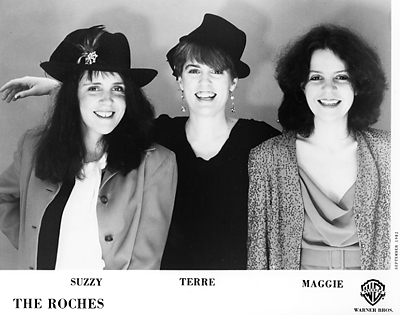
The Roches showed how it runs in the family with the warm and whimsical eclectic folk and breathtaking vocal acrobatics of this joyously off key three ring harmonic circus that was pretty and high and only partly a lie. The trio of sisters Maggie and Terre and Suzzy started out singing Christmas carols on the streets of Park Ridge, New Jersey as well as New York City when they were growing up. Maggie remembers: "When we were kids we all shared the same bedroom for a while and we used to just play and make things up and sing and write stories, and it seems like what we do now is simply an extension of that. There's still that element of those three kids in that room making up stuff...We'd find ourselves mixing it up with people from [the punk] scene. What we had in common is we both wanted to do it. There were so many rules and regulations, and the punks were kind of saying we just want to play what comes out of us. We could always relate to that, because we never passed any of the tests with any of the organized music scenes."
Maggie and Terre quit school to pursue music full time as a duo and caught the attention of Paul Simon, who invited them to sing backup vocals on his album 'There Goes Rhymin' Simon' 'Seductive Reasoning' When the album flopped, they considered giving up on their career and moved to Louisiana; but when their youngest sister Suzzy finished school, she convinced them to give it a go as a trio and they returned to busking on the streets of New York. Suzzy says: "We were trying to get enough money to go over to Ireland. This is actually true: somebody actually wanted us to come over and do a tour of clothing-store windows, to sing in windows of clothing stores so people on the street would walk by and buy clothing. It wound up not happening. That’s the sort of business sense that we had [Laughs]. But, honestly, one of the things about us is that we’ve always been able to make something out of nothing. With the caroling, it was a sense of we didn’t have any money or any prospects, but we can learn these songs and make money in the streets. Plus, there’s something very liberating about singing outside. There’s no pressure to get it right, to make it perfect. It’s also dramatic,and pretty profitable. Police would come up to you and chase you away and people would feel sorry for you and give you more money [Laughs]."
The sisters would eventually get into the studio with producer Robert Fripp for their eponymous debut as a trio. The sessions at The Hit Factory in New York featured Suzzy Roche on vocals and guitar; Maggie Roche on vocals, guitar, and synthesizer (on "Quitting Time"); Terre Roche on vocals and guitar; with Robert Fripp on electric guitar and Fripperies; Tony Levin on bass guitar; Jim Maelen on triangle and shaker; and Larry Fast as synthesizer programmer. Fripp would express at the time how he sought to get a genuine sound: "There's two senses to audio verite. The first is that it's a commitment to discover whatever the essence of the artists might be and try and express it on record. And this is done in the second sense of the term by, as far as possible, not interfering with the performance by equalization, limiting and so on. So in the second sense, yes, this is audio verite, though with a whole battery of technology which has failed, conceived to validate the main premise of the second aspect of audio verite, that too much technology gets in the way. All that one needs is a small and appropriate level of technology. I could do it on a far smaller and simpler machine than that and probably get better sound."
'The Roches' They were also invited to perform on Saturday Night Live Terre considers: "We were at that point every music career gets to where the honeymoon was over. The Roches had burst onto the music scene in 1979 with a shower of press infatuation rarely accorded a folk group. The unlikely pairing of King Crimson’s Robert Fripp, with his hard-driving English art rock, and the three singing sisters from New Jersey had caught the attention of music writers even before the album was released. Liz Rosenberg, our publicist at Warner Brothers, told us the press was calling her for interviews. She told us this was extremely unusual. When the actual record came out, the momentum accelerated. The sound of three fairly soft voices and three acoustic guitars, with songs about waitress jobs, commuter trains and longing to be accepted by your parents, issued forth into the 1970s climate of disco fever like a drop of powerful medicine into a compromised bloodstream. Fripp, in an interview, put forth that people don’t realize gentle music can be revolutionary. Some of his fans were upset that he’d traded in bombastic male music for lily-white warbling so delicate you had to turn up the dial to hear it. 'The Roches' http://www.roches.com/ "We" is a musical resume.
We are Maggie and Terre and Suzzy Maggie and Terre and Suzzy Roche
We don't give out our ages
And we don't give out our phone numbers
Give out our phone numbers
Sometimes our voices give out
But not our ages and our phone numbers
Guess which two of us made a record Guess what the other one did instead
The two who made the record
Have been a singing group for ten years
Singing group for ten years
And now a trio we are
Born on the fourth of December
We come from deepest New Jersey But now we live in New York City
We better get outa there
Before the shit hits the fan
Shit hits the fan
You might say where have they played
All over the country and in England
Who have we worked with Do we know anybody famous
Anybody famous
Do we know anybody famous
Anybody famous
And as a point of interest
We spell our last name R-o-c-h-e
We are Maggie and Terre and Suzzy
We spell our last name R-o-c-h-e
"Hammond Song"
This heartbreaking ballad was later covered by the Colourfield.
If you go down to Hammond
You'll never come back
In my opinion you're
On the wrong track
We'll always love you but
That's not the point
If you go with that fella Forget about us
As far as I'm concerned
That would be just
Throwing yourself away
Not even trying
Come on you're lying to me
Well I went down to Hammond I did as I pleased
I ain't the only one
Who's got this disease
Why don't you face the fact You old upstart
We fall apart
You'd be okay if you'd Just stay in school
Don't be a fool
Do your eyes have an answer To this song of mine
They say we meet again
On down the line
Where is on down the line
How far away?
Tell me I'm okay
If you go down to Hammond You'll never come back
"The Troubles"
"The Train"
"The Married Men" became a hit for Phoebe Snow.
VIDEO "Runs in the Family"
'The Roches' full album:
https://myspace.com/theroches/music/album/the-roches-15244053 VIDEO "We" (Suzzy Roche, Terre Roche, Maggie Roche) – 2:35
"Hammond Song" (Margaret Roche) – 5:46
"Mr. Sellack" (Terre Roche) – 4:03
"Damned Old Dog" (Margaret Roche) – 4:07
"The Troubles" (Suzzy Roche, Terre Roche, Maggie Roche) – 3:27
"The Train" (Suzzy Roche) – 3:30
"The Married Men" (Margaret Roche) – 4:32
"Runs in the Family" (Terre Roche) – 3:29
"Quitting Time" (Margaret Roche) – 4:19
"Pretty and High" (Margaret Roche) – 4:05
This classic collaboration set the standard for samba in the world of jazz. Stan Getz had been experimenting with Brazilian music by collaborating with different guitarists. It began with Charlie Byrd (who had just toured Brazil) on 'Jazz Samba' and continued with Brazilian guitarist Luiz Bonfá on 'Jazz Samba Encore!' In between he recorded 'Big Band Bossa Nova'
For his next project, he brought in João Gilberto and Antonio Carlos Jobim who had both been instrumental in creating the style of bossa nova. The sessions took place at A&R Recording Studios in New York City with producer Creed Taylor and featured Stan Getz on tenor saxophone; João Gilberto on guitar and vocals; Antonio Carlos Jobim on piano; Sebastião Neto on bass; and Milton Banana on drums; with Astrud Gilberto on vocals (in "The Girl from Ipanema" & "Corcovado").
The results were magical. 'Getz/Gilberto'
http://www.stangetz.net/ http://joaogilberto.org/ http://www.jobim.com.br/ "The Girl from Ipanema" was a worldwide smash hit in the that won a Grammy for Record of the Year in 1965 . It is one of the most covered songs of all time.
http://www.youtube.com/watch?v=UJkxFhFRFDA 1. "The Girl from Ipanema" Antônio Carlos Jobim, Vinicius de Moraes, Norman Gimbel 5:24 http://www.youtube.com/watch?v=c5QfXjsoNe4 2. "Doralice"
Dorival Caymmi, Antonio Almeida 2:46
http://www.youtube.com/watch?v=JMe52bNozYg 3. "P'ra Machucar Meu Coração"
Ary Barroso 5:05
http://www.youtube.com/watch?v=Lt6rsHa88t0 4. "Desafinado"
Jobim, Newton Mendonça 4:15
http://www.youtube.com/watch?v=EScHcS-o2oE 5. "Corcovado"
Jobim, Gene Lees 4:16
http://www.youtube.com/watch?v=lyWX5HH16vc 6. "Só Danço Samba"
Jobim, de Moraes 3:45
http://www.youtube.com/watch?v=uiWEJotU__0 7. "O Grande Amor" Jobim, de Moraes 5:27http://www.youtube.com/watch?v=4YfEMhlcX54 8. "Vivo Sonhando"
Jobim 3:04
VIDEO 9. "The Girl from Ipanema" [45 rpm issue]
Jobim, de Moraes, Gimbel 2:54
http://www.youtube.com/watch?v=YPHFu2ETIqc 10. "Corcovado" [45 rpm issue]
Jobim, Lees 2:20
VIDEO 'Getz/Gilberto' full album:
VIDEO
1. The Girl From Ipanema - 00:00:00
2. Doralice - 00:05:24
3. Para Machuchar Meu Coracao - 00:008:09
4. Desafinado (Off Key) - 00:13:15
5. Corcovado (Quiet Nights Of Quiet Stars) - 00:17:27
6. So Danco Samba - 00:21:44
7. O Grande - 00:25:30
8. Vivo Sonhando (Dreamer) - 00:30:57
9. The Girl From Ipanema (45 rpm Issue) - 00:33:50
10. Quiet Nights Of Quiet Stars (45 rpm Issue) - 00:36:38