Showing posts with label charles mingus. Show all posts

Thursday, April 30, 2015

blues & roots


Charles Mingus got down to earth with the holy rolling swing of this moaning groaning jelly roll soul.   After a series of adventurous albums that included Pithecanthropus Erectus, The Clown, and East Coasting;  as well as Mingus Ah Um and Mingus Dynasty (both recorded in 1959 after Blues & Roots; but released before), Mingus accepted a challenge from producer Nesuhi Ertegün to record an entire album in the swinging blues style of "Haitian Fight Song" from The Clown.  'Blues & Roots' was recorded with a nine piece band on February 4, 1959 at Atlantic Studios in New York City with Nesuhi Ertegün producing with engineer Tom Dowd.   The session featured Charles Mingus on bass;   John Handy and Jackie McLean on alto sax;  Booker Ervin on tenor sax;  Pepper Adams on baritone sax;  Jimmy Knepper and Willie Dennis on trombone;  Dannie Richmond on drums;  and Horace Parlan on piano, except for "E's Flat Ah's Flat Too" where Mal Waldron sat in.  


http://mingusmingusmingus.com/


'Blues & Roots' 
full album:

https://www.youtube.com/watch?v=Y9KcMfQhn6w


All tracks composed by Charles Mingus.

1. Wednesday Night Prayer Meeting - 0:00
2. Cryin' Blues - 5:42
3. Moanin' - 10:44
4. Tensions - 18:48
5. My Jelly Roll Soul - 25:18
6. E's Flat Ah's Flat Too - 32:08


Original Liner Notes

My music is as varied as my feelings are, or the world is, and one composition or one kind of composition expresses only part or the total world of my music. In the notes for another album, I go into more detail as to why my pieces are so different from one another and ·don't have one specific, unalleviated mood, sound or style. At a concert or night club I call tunes in an order that I feel is right for the particular situation and what I'm trying to say in that situation. Each composition builds from the previous one, and the succession of compositions creates the statement I'm trying to make at that moment. The greatness of jazz is that it is an art of the moment. It is so particularly through improvisation, but also, in my music, through the successive relation of one composition to another. 

This record is unusual - it presents only one part of my musical world, the blues. 

A year ago, Nesuhi Ertegun suggested that I record an entire blues album in the style of Haitian Fight Song (in Atlantic LP 1260), because some people, particularly critics, were saying I didn't swing enough. He wanted to give them a barrage of soul music: churchy, blues, swinging, earthy. I thought it over. I was born swinging and clapped my hands in church as a little boy, but I've grown up and I like to do things other than just swing. But blues can do more than just swing. So I agreed. 

I decided to memorize the compositions and then phrase them on the piano part by part to the musicians. I wanted them to learn the music so it would be in their ears, rather than on paper, so they'd play the compositional parts with as much spontaneity and soul as they'd play a solo. And I decided to use a larger group to play in a big band form I'd like to hear that has as many lines going as there are musicians. I called musicians that I knew had great ears for playing and understanding my music. 

The first tune, Wednesday Night Prayer Meeting, is church music. I heard this as a child when I went to meetings with my mother. The congregation gives their testimonial before the Lord, they confess their sins and sing and should and do a little Holy Rolling. Some preachers cast out demons, they call their dialogue talking in tongues or talking unknown tongue (language that the Devil can’t understand). The solos are taken by John Handy, Willie Dennis, Horace Parlan, Booker Ervin and Dannie Richmond.

The Cryin’ Blues is a blues without the usual tonic, sub-dominant, tonic, dominant changes. Booker Ervin opens with the group. After the last solo, Horace Parlan solos on piano, and Jackie McLean plays with the ensemble on the out chorus.

Some time before making this album I’d bought a book of Jelly Roll Morton tunes that I planned to arrange. I then misplaced the book, and later I wrote My Jelly Roll Soul – an impression of or afterthoughts on Jelly Roll’s forms and soul. The solos are by Jimmy Knepper, Horace Parlan, Jackie McLean and Dannie Richmond and I pass the progressions around in bars of four and two.

E’s Flat Ah’s Flat Too is composed in pyramid lines and canon form. The solos are by Mal Waldron, Booker Ervin, Jackie McLean, John Handy and Dannie Richmond.

The solos on Tensions are by myself, Jackie McLean, Booker Ervin and Horace Parlan.

In Moanin’, each musician plays separate lines, simple blues lines.  The solos are by Jackie McLean, Pepper Adams and Booker Ervin.

We played down to earth and together, and I think this music has a tremendous amount of life and emotion.

- Charles Mingus
(as told to Diane Dorr-Dorynek) 


Friday, May 16, 2014

mingus mingus mingus mingus mingus


Charles Mingus breathed new life into some old songs with an eleven piece powerhouse ensemble and hit us in our soul with this incandescent bloom.  Pleased with the results of his masterful 'The Black Saint and the Sinner Lady', Mingus was excited to use the same big band approach with songs from his back catalogue.  To add to the confusion, some of them have new names.  

'Mingus Mingus Mingus Mingus Mingus' was recorded in two separate sessions with slightly different lineups in 1963:  one in January and the other in September.  Bob Thiele produced the album with Charles Mingus on bass, piano, and vocals;  Jay Berliner on guitar;  Don Butterfield on trombone and tuba;  Jaki Byard on piano;  Eric Dolphy on flute and alto saxophone;  Rolf Ericson, Eddie Preston, and Richard Gene Williams on trumpet;  Booker Ervin on tenor saxophone;  Dick Hafer on clarinet, flute, oboe, and tenor saxophone;  Quentin Jackson and Britt Woodman on trombone;  Charlie Mariano on alto saxophone;  Walter Perkins and Dannie Richmond on drums; and Jerome Richardson on flute, baritone saxophone, and soprano saxophone.  


http://mingusmingusmingus.com/


"II B.S." 
 "Haitian Fight Song" on The Clown (also recorded as "Hog Callin' Blues" on Oh Yeah)
https://www.youtube.com/watch?v=R5N3kQfNaPE


"Hora Decubitus" 
"E's Flat, Ah's Flat Too" on Blues & Roots
https://www.youtube.com/watch?v=-hMBHLlEoPo


"Freedom" 
 "Freedom" on Epitaph
https://www.youtube.com/watch?v=23sah6aWk3A


This mule ain’t from Moscow.

This mule ain’t from the South.
But this mule's had some learnin' 
Mostly mouth-to-mouth.

This mule could be called stubborn, and lazy,

But in a clever sorta’ way
This mule could be workin’, waitin’ and learnin’ and plannin’ 
For a sacred kind of day- 
A day when burnin’ sticks and crosses 
Is not mere child’s play, 
But a madman in his most incandescent bloom
Whose lover’s soul is imperfection, in its most lustrous groom.

So stand, fast young Romeo

Soothe in contemplation 
Thy burning whole and aching thigh
Your stubbornness is ever-living
And cruel anxiety is about to die.

Freedom for your daddy

Freedom for your momma
Freedom for your brothers and sisters
But no freedom for me.

Freedom for your daddy’s daddy

Freedom for your momma’s momma
Freedom for your brothers and sisters
But no freedom for me.

Freedom for your daddy’s daddy

Freedom for your momma’s momma
Freedom for your brothers and sisters
But no freedom for me.


'Mingus Mingus Mingus Mingus Mingus'
full album:


https://myspace.com/charlesmingus/music/album/mingus-mingus-mingus-mingus-mingus-2246


http://www.last.fm/music/Charles+Mingus/Mingus+Mingus+Mingus+Mingus+Mingus


All tracks composed by Charles Mingus, except where noted.


"II B.S." – 4:48
"I X Love" – 7:41
"Celia" – 6:14
"Mood Indigo" (Duke Ellington/Barney Bigard) – 4:45
"Better Get Hit in Yo' Soul" – 6:30
"Theme for Lester Young" – 5:51
"Hora Decubitus" – 4:41
"Freedom" – 5:10  (bonus)


Friday, December 27, 2013

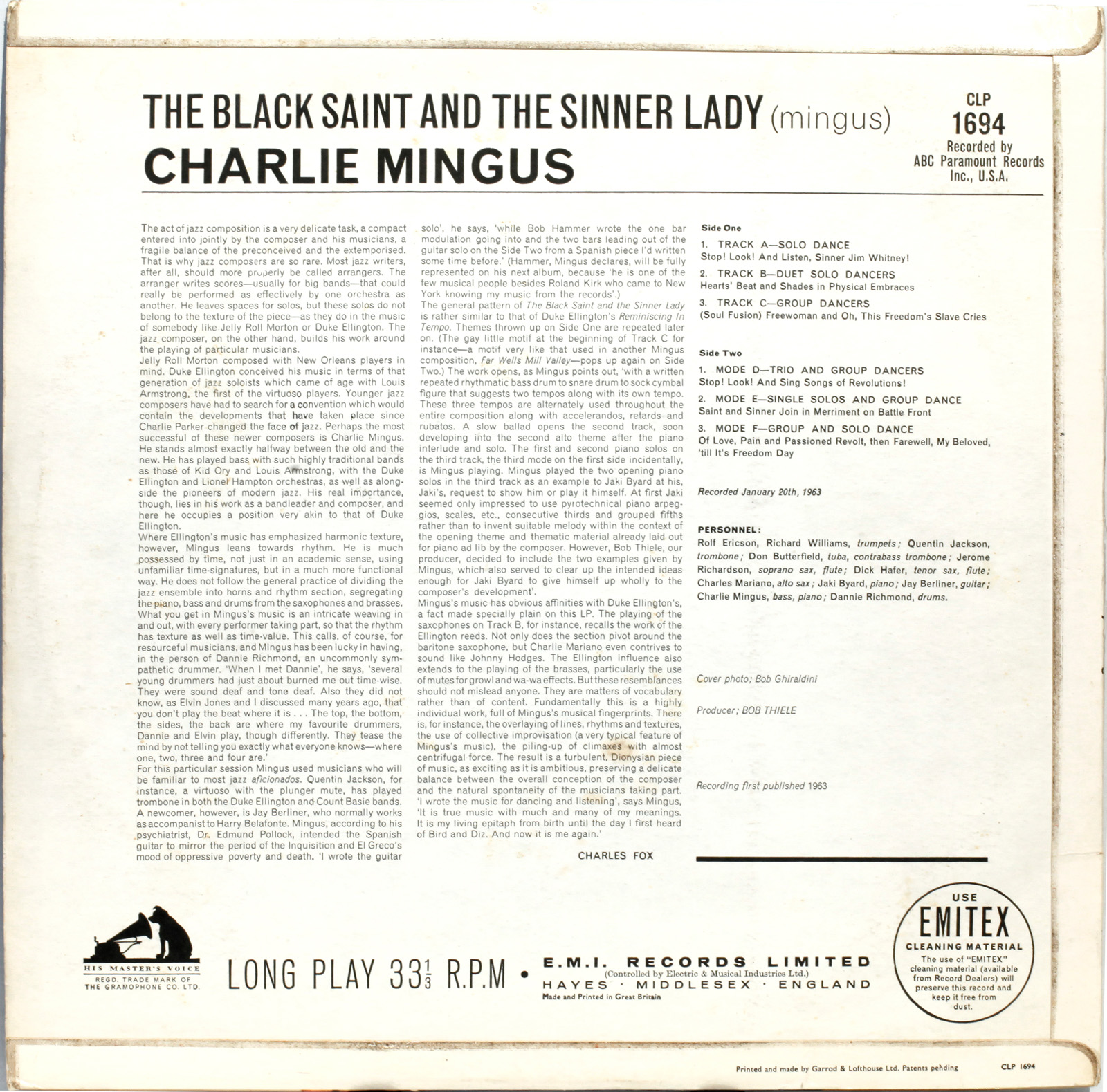
the black saint and the sinner lady


Charles Mingus and his eleven piece band recorded the organized chaos of this allegorical ethnic folk dance emancipation in one day.   'The Black Saint and the Sinner Lady' was produced by Bob Thiele and engineered by Bob Simpson with Charles Mingus on double bass and piano; Jerome Richardson on soprano saxophone, baritone saxophone, and flute; Charlie Mariano on alto saxophone; Dick Hafer on tenor saxophone and flute; Rolf Ericson and Richard Williams on trumpet; Quentin Jackson on trombone; Don Butterfield on tuba and contrabass trombone; Jaki Byard on piano; Jay Berliner on acoustic guitar; and Dannie Richmond on drums.


'The Black Saint and the Sinner Lady'
comprised six suites composed by Mingus that were conceived as a ballet.  He revealed in the liner notes:   "I wrote the music for dancing and listening. It is true music with much and many of my meanings. It is my living epitaph from birth til the day I first heard of Bird and Diz. Now it is me again. This music is only one little wave of styles and waves of little ideas my mind has encompassed through living in a society that calls itself sane, as long as you're not behind iron bars where there at least one can't be half as crazy as in most of the ventures our leaders take upon themselves to do and think for us, even to the day we should be blown up to preserve their idea of how life should be. Crazy? They'd never get out of the observation ward at Bellevue.     I did. So, listen how. Play this record."


The album was recorded shortly after Mingus was discharged from Bellevue Psychiatric Hospital.  Clinical Psychologist Dr. Edmund Pollock wrote in the liner notes:    "He feels intensively. He tries to tell people he is in great pain and anguish because he loves. He cannot accept that he is alone, all by himself; he wants to love and be loved. His music is a call for acceptance, respect, love, understanding, fellowship, freedom - a plea to change the evil in man and to end hatred. The titles of this composition suggest the plight of the black man and a plea to the white man to be aware. He seems to state that the black man is not alone but all mankind must unite in revolution against any society that restricts freedom and human rights...Mr. Mingus thinks this is his best record. It may very well be his best to date for his present stage of development as other records were in his past. It must be emphasized that Mr. Mingus is not yet complete. He is still in a process of change and personal development. Hopefully the integration in society will keep pace with his. One must continue to expect more surprises from him." 


http://mingusmingusmingus.com/


1. "Track A – Solo Dancer"   "Stop! Look! And Listen, Sinner Jim Whitney!" 6:39
http://www.youtube.com/watch?v=vgs0_TDS7Fs


"Track B – Duet Solo Dancers"   "Hearts' Beat and Shades in Physical Embraces" 6:45


'The Black Saint and the Sinner Lady' 
full album:
https://www.youtube.com/watch?v=zFA0FYQo0Gg


0:00 Solo Dancer
6:40 Duet Solo Dancers
13:23 Group Dancers
20:45 Trio and Group Dancers/ Single Solos and Group Dance/ Group and Solo Dance


Sunday, April 15, 2012

oh yeah


Charles Mingus switched from bass to piano for this loose and lively exploration of jazz and blues. Mingus went back to Atlantic Records to record 'Oh Yeah' with producer Nesuhi Ertegün. This is the only album on which Mingus plays piano. He also sings and; with Doug Watkins taking over bass, Dannie Richmond on drums, Booker Ervin on tenor saxophone, Jimmy Knepper on trombone, and multi-instrumental virtuoso Rahsaan Roland Kirk playing flute, siren, tenor saxophone, manzello, and strich; creates an explosive avante-garde party.


http://mingusmingusmingus.com/


'Hog Callin' Blues'


'Ecclusiastics'


'Oh Lord Don't Let Them Drop That Atomic Bomb on Me'


'Eat That Chicken'


full album:


All compositions by Charles Mingus.

"Hog Callin' Blues" – 7:27
"Devil Woman" – 9:42
"Wham Bam Thank You Ma'am" – 4:43
"Ecclusiastics" – 6:59
"Oh Lord Don't Let Them Drop That Atomic Bomb on Me" – 5:43
"Eat That Chicken" – 4:38
"Passions of a Man" – 4:56

 bonus

"'Old' Blues for Walt's Torin" – 7:58
"Peggy's Blue Skylight" – 9:49

"Invisible Lady" – 4:48