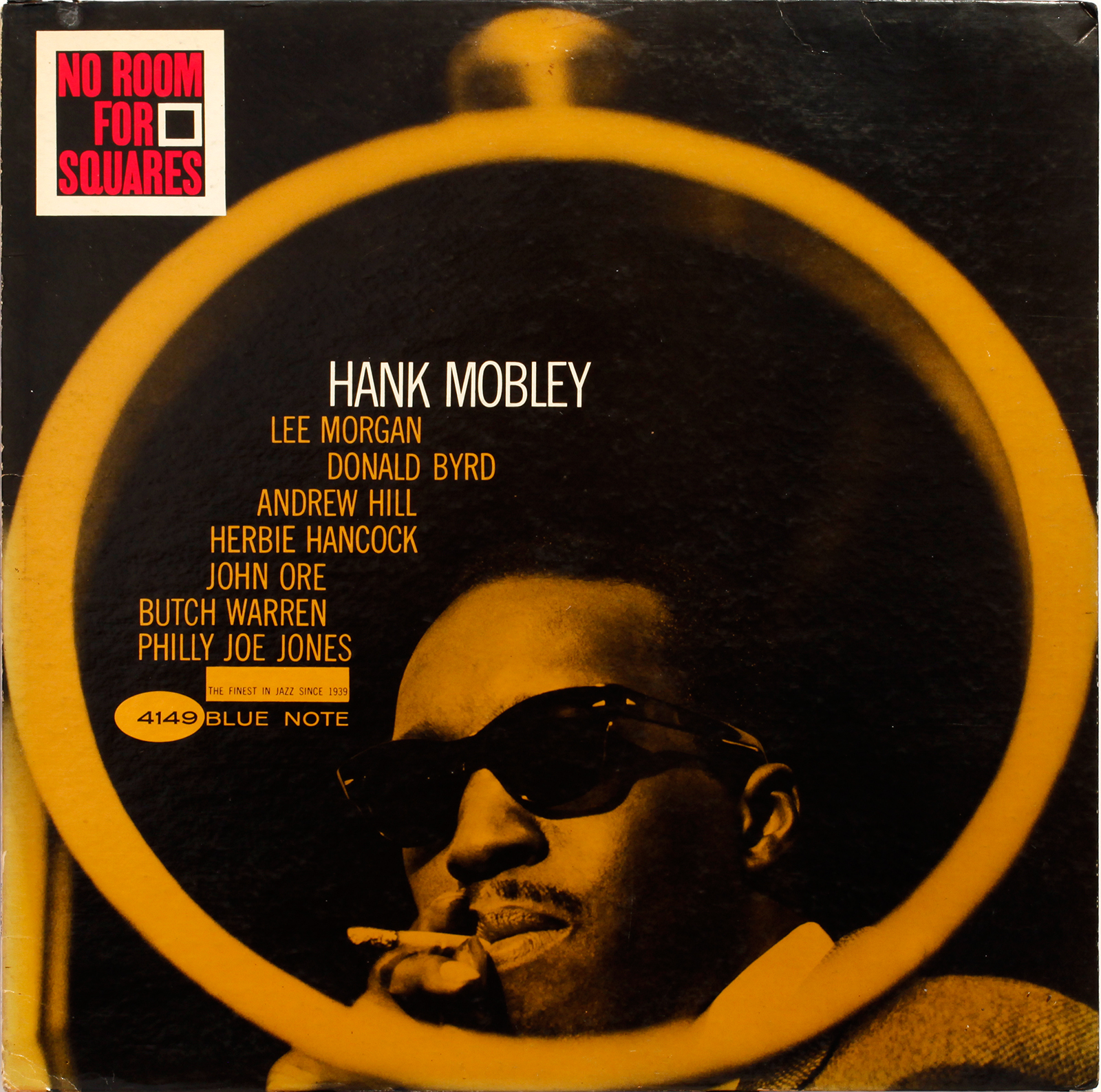
Hank Mobley carved out his own shapely sound with the fierce fluidity of these modal hardbop blues. Mobley had taught himself to play saxophone when he was a teenager and worked with Paul Gayten, Max Roach, and Dizzy Gillespie before taking part in the seminal hardbop sessions that produced 'Horace Silver and the Jazz Messengers' . 'Soul Station' , 'Role Call' , and 'Workout' . 'Someday My Prince Will Come' . (as well as two live albums: 'In Person Friday and Saturday Nights at the Blackhawk' and 'Miles Davis at Carnegie Hall' ) Mobley would recall: “I had the knowledge. When I got strung out it was my own fault. A person getting strung out at age 18; that’s a problem. He doesn’t even have a chance to learn what life is about. By the time I got strung out I had learned my instrument, I was making money...I told Miles ‘I never played with somebody who plays like Art Tatum on the saxophone.’ Miles said, ‘That’s why I hired you. I want to put your interpretation with his.'...But when I left Miles, I was so tired of music, the whole world, man, I just went back to drugs.”
Mobley's next wave would be even more daring. 'No Room For Squares' was recorded for Blue Note Records at the Van Gelder Studio, Englewood Cliffs, New Jersey. The album is culled from two sessions with different lineups. On March 7, 1963 he recorded "Up a Step" and "Old World, New Imports" (more tracks from this session would be released later on 'The Turnaround' Mobley would describe his own style thusly: “not a big sound, not a small sound, just a round sound” .
http://hankmobley.blogspot.com/ http://hankmobley.jazzgiants.net/ "No Room For Squares"
https://www.youtube.com/watch?v=KZu42x8LWVM "Carolyn"
https://www.youtube.com/watch?v=n2PPbeBVHwQ 'No Room For Squares' full album:
https://myspace.com/hankmobleymusic/music/album/no-room-for-squares-the-rudy-van-gelder-edition-18989476 https://www.youtube.com/watch?v=Xcq_zg-Zw5k&list=PLFBADE21A3C6C7A53 VIDEO All compositions by Hank Mobley except as indicated
"Three Way Split" – 7:49 "Carolyn" (Morgan) – 5:30 "Up a Step" – 8:31 "No Room for Squares" – 6:57 "Me 'N You" (Morgan) – 7:17 "Old World, New Imports" – 6:08 bonus
"Comin' Back" "Syrup and Biscuits"
John Coltrane took flight and found a transformative power in the wake of tragedy for the elegiac affirmations and fiery performances of this transcendent tour de force. When four girls were killed in a bombing at a church in Church in Birmingham, Alabama on September 15 of 1963; it shocked the nation and was a major impetus toward the passage of the Civil Rights Act. Coltrane was deeply affected by the violence, as bassist Art Davis relates: “[Coltrane] was very conscious of what was happening when those girls were murdered in the bombing in Alabama. He was incensed- we talked about that. And for this to happen in a House of God and people were there worshipping God and for people to bomb a church like that, he said, ‘that’s reprehensible. I’m livid with the hate that can happen in this country.’”
'Live at Birdland' Coltrane would consider: "My music is the spiritual expression of what I am – my faith, my knowledge, my being … When you begin to see the possibilities of music, you desire to do something really good for people, to help humanity free itself from its hangups … I want to speak to their souls."
http://www.johncoltrane.com/ https://myspace.com/johncoltrane/music/album/live-at-birdland-2261 http://grooveshark.com/#!/album/Coltrane+Live+At+Birdland/5849630 side one:
"Afro Blue" / "I Want to Talk About You"
recorded at Birdland on October 8, 1963
http://www.youtube.com/watch?v=sHRCkmNoZ9s "Afro Blue"
http://www.youtube.com/watch?v=HuOfm6nSW4A http://www.youtube.com/watch?v=H-56JerzFO4 "The Promise" – 8:10
recorded at Birdland on October 8, 1963
http://www.youtube.com/watch?v=JpkjtSPZJB4 "Alabama" – 5:09
Coltrane switched to tenor saxophone for this requiem recorded at Van Gelder studio on November 18, 1963 as a response to the bombing at the 16th Street Baptist Church in Birmingham, Alabama three months earlier.
http://www.youtube.com/watch?v=k8iKZUBDrJQ http://www.youtube.com/watch?v=5cnIZ826ZVE "Your Lady" – 6:39
http://www.youtube.com/watch?v=I1X073w2xUo bonus track
"Vilia" – 4:36
recorded in Englewood, March 6, 1963
http://www.youtube.com/watch?v=Yer5cRfrrLE liner notes by LeRoi Jones (Amiri Baraka):
One of the most baffling things about America is that despite its essentially vile profile, so much beauty continues to exist here. Perhaps it’s as so many thinkers have said, that it is because of the vileness, or call it adversity, that such beauty does exist. (As balance?).
There are three numbers on the album that were recorded Live at Birdland, Afro-Blue, I Want To Talk About You, and The Promise. And while some of the non-musical hysteria has vanished from the recording, that is, after riding a subway through New York’s bowels, and that subway full of all the things any man should expect to find in some thing’s bowels, and then coming up stairs, to the street, and walking slowly, head down, through the traffic and failure that does shape the area, and then entering “The Jazz Corner Of The World” (a temple erected in praise of what God?), and then finally amidst that noise and glare to hear a man destroy all of it, completely, like Sodom, with just the first few notes from his horn, your “critical” sense can be erased completely, and that experience can place you somewhere a long way off from anything ugly. Still, what was of musical value that I heard that night does remain, and the emotions … some of them completely new … that I experience at each “objective” rehearing of this music are as valuable as anything else I know about. And all of this is on this record, and the studio pieces, Alabama and Your Lady, are among the strongest efforts on the album.
But since records, recorded “Live” or otherwise, are artifacts, that is the way they should be talked about. The few people who were at Birdland the night of October 8 who really beard what Coltrane, Jones, Tyner and Garrison were doing will probably tell you, if you ever run into them, just “exactly” what went on, and how we all reacted. I wish I had a list of all those people so that interested parties could call them and get the whole story, but then, almost anyone who’s heard John and the others at a nightclub or some kind of live performance has got stories of their own. I know I’ve got a lot of them.
But in terms of the artifact, what you’re holding in your hand now, I would say first of all, if you can hear, you’re going to be moved. Afro-Blue, the long tune of the album, is in the tradition of all the African-Indian-Latin flavored pieces Trane has done on soprano, since picking up that horn and reclaiming it as a jazz instrument. (In this sense The Promise is in that same genre.) Even though the head-melody is simple and song-like, it is a song given by making what feels to me like an almost unintelligible lyricism suddenly marvelously intelligible. McCoy Tyner too, who is the polished formalist of the group, makes his less cautious lyrical statements on this, but driven, almost harassed, as Trane is too, by the mad ritual drama that Elvin Jones taunts them with. There is no way to “describe” Elvin’s playing, or, I would suppose, Elvin himself. The long tag of Afro-Blue, with Elvin thrashing and cursing beneath Trane’s line, is unbelievable. Beautiful has nothing to do with it, but it is. (I got up and danced while writing these notes, screaming at Elvin to cool it.) You feel when this is finished, amidst the crashing cymbals, bombarded tomtoms, and above it all Coltrane’s soprano singing like any song you can remember, that it really did not have to end at all, that this music could have gone on and on like the wild pulse of all living.
If you have heard Slow Dance or After The Rain, then you might be prepared for the kind of feeling that Alabama carries. I didn’t realize until now what a beautiful word Alabama is. That is one function of art, to reveal beauty, common or uncommon, uncommonly. And that’s what Trane does. Bob Thiele asked Trane if the title “had any significance to today’s problems.” I suppose he meant literally. Coltrane answered, “It represents, musically, something that I saw down there translated into music from inside me.” Which is to say, Listen. And what we’re given is a slow delicate introspective sadness, almost hopelessness, except for Elvin, rising in the background like something out of nature … a fattening thunder, storm clouds or jungle war clouds. The whole is a frightening emotional portrait of some place, in these musicians’ feelings. If that “real” Alabama was the catalyst, more power to it, and may it be this beautiful, even in its destruction.
Your Lady is the sweetest song in the album. And it is pure song, say, as an accompaniment for some very elegant uptown song and dance man. Elvin Jones’ heavy tingling parallel counterpoint sweeps the line along, and the way he is able to solo constantly beneath Trane’s flights, commenting, extending, or just going off on his own, is a very important part of the total sound and effect of this Coltrane group. Jimmy Garrison’s constancy and power, which must be fantastic to support, stimulate and push this group of powerful (and diverse) personalities, is already almost legendary. On tunes like Lady or Afro-Blue Garrison’s bass booms so symmetrically and steadily and emotionally, and again, with such strength, that one wild guess that he must be able to tear safes open with his fingers. All the music on this album is Live, whether it was recorded above drinking and talk at Birdland, in the studio. There is a daringly human quality to John Coltrane’s music that makes itself felt, wherever he records. If you can hear, this music will make you think of a lot of weird and wonderful things. You might even become one of them.
The Beatles invaded America with this infectious single written specifically to break into that market. Their debut 'Please Please Me' spent thirty weeks at number one in the UK, only to be replaced at the top by their second album 'With The Beatles' . The story goes that their manager Brian Epstein had challenged songwriter Paul McCartney and John Lennon to come up with a song that could effectively introduce the band to audiences in the US.
McCartney recounted in 1964: "Let's see, we were told we had to get down to it. So we found this house when we were walking along one day. We knew we had to really get this song going, so we got down in the basement of this disused house and there was an old piano. It wasn't really disused, it was rooms to let. We found this old piano and started banging away. There was a little old organ too. So we were having this informal jam and we started banging away. Suddenly a little bit came to us, the catch line. So we started working on it from there. We got our pens and paper out and just wrote down the lyrics. Eventually, we had some sort of a song, so we played it for our recording manager and he seemed to like it. We recorded it the next day." Lennon remembered in 1980 : "We wrote alot of stuff together, one on one, eyeball to eyeball. Like in 'I Want To Hold Your Hand,' I remember when we got the chord that made the song. We were in Jane Asher's house, downstairs in the cellar playing on the piano at the same time. And we had, 'Oh you-u-u/ got that something...' And Paul hits this chord, and I turn to him and say, 'That's it!' I said, 'Do that again!' In those days, we really used to absolutely write like that-- both playing into each other's noses."
McCartney added in 1994: "'Eyeball to eyeball' is a very good description of it. That's exactly how it was. 'I Want To Hold Your Hand' was very co-written."
The song was recorded in October of 1963 during the sessions for 'With the Beatles' 'She Loves You' was at the top of the UK charts at the time and kept 'I Want To Hold Your Hand' from the top spot for two weeks. It spent five weeks at number one, only to be replaced again by 'She Loves You' .
In the US, the single was slated to be released in January of 1964; but when DJ Carroll James had a copy shipped via the British Overseas Airways Corporation, Capitol Records decided to take advantage of the exposure and release it two weeks early in December of 1963. It also became the leadoff track on their Capitol Records debut album 'Meet The Beatles'
http://www.beatles.com/ VIDEO Oh yeah, I'll tell you something,
I think you'll understand.
When I'll say that something
I want to hold your hand,
I want to hold your hand,
I want to hold your hand.
Oh please, say to me
You'll let me be your man
And please, say to me
You'll let me hold your hand.
Now let me hold your hand,
I want to hold your hand.
And when I touch you I feel happy inside.
It's such a feeling that my love
I can't hide, I can't hide, I can't hide.
Yeah, you've got that something,
I think you'll understand.
When i'll say that something
I want to hold your hand,
I want to hold your hand,
I want to hold your hand.
And when I touch you I feel happy inside.
It's such a feeling that my love
I can't hide, I can't hide, I can't hide.
Yeah, you've got that something,
I think you'll understand.
When I'll feel that something
I want to hold your hand,
I want to hold your hand,
I want to hold your hand.
VIDEO The Beatles - I Want To Hold Your Hand by music-man1 'Meet The Beatles' full album:
http://my.mail.ru/mail/dmp1958/video/_myvideo/965.html 1. "I Want to Hold Your Hand" John and Paul 2:24
2. "I Saw Her Standing There" Paul 2:50
3. "This Boy" John, Paul, and George 2:11
4. "It Won't Be Long" John 2:11
5. "All I've Got to Do" John 2:05
6. "All My Loving" Paul 2:04
7. "Don't Bother Me" (George Harrison) George 2:28 8. "Little Child" John 1:46
9. "Till There Was You" (Meredith Willson) Paul 2:12 10. "Hold Me Tight" Paul 2:30
11. "I Wanna Be Your Man" Ringo 1:59
12. "Not A Second Time" John 2:03
'With The Beatles' full album: VIDEO 01. It Won't Be Long
02. All I've Got to Do
03. All My Loving
04. Don't Bother Me
05. Little Child
06. Till There Was You
07. Please Mister Postman 08. Roll Over Beethoven 09. Hold Me Tight
10. You Really Got a Hold on Me
11. I Wanna Be Your Man
12. Devil in Her Heart 13. Not a Second Time
14. Money (That's What I Want)
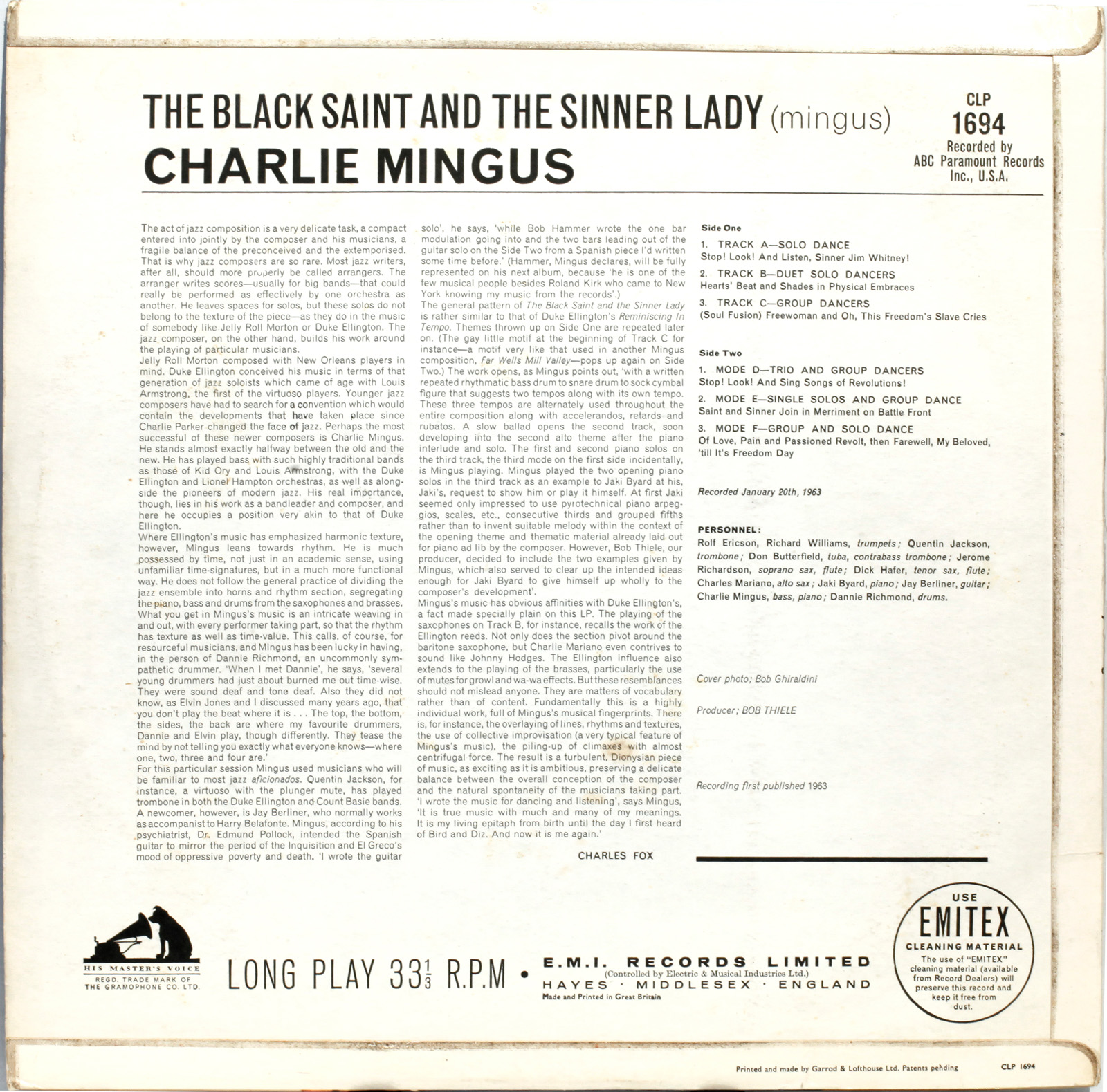
'The Black Saint and the Sinner Lady' 'The Black Saint and the Sinner Lady' comprised six suites composed by Mingus that were conceived as a ballet. He revealed in the liner notes: "I wrote the music for dancing and listening. It is true music with much and many of my meanings. It is my living epitaph from birth til the day I first heard of Bird and Diz. Now it is me again. This music is only one little wave of styles and waves of little ideas my mind has encompassed through living in a society that calls itself sane, as long as you're not behind iron bars where there at least one can't be half as crazy as in most of the ventures our leaders take upon themselves to do and think for us, even to the day we should be blown up to preserve their idea of how life should be. Crazy? They'd never get out of the observation ward at Bellevue. I did. So, listen how. Play this record."
The album was recorded shortly after Mingus was discharged from Bellevue Psychiatric Hospital. Clinical Psychologist Dr. Edmund Pollock wrote in the liner notes: "He feels intensively. He tries to tell people he is in great pain and anguish because he loves. He cannot accept that he is alone, all by himself; he wants to love and be loved. His music is a call for acceptance, respect, love, understanding, fellowship, freedom - a plea to change the evil in man and to end hatred. The titles of this composition suggest the plight of the black man and a plea to the white man to be aware. He seems to state that the black man is not alone but all mankind must unite in revolution against any society that restricts freedom and human rights...Mr. Mingus thinks this is his best record. It may very well be his best to date for his present stage of development as other records were in his past. It must be emphasized that Mr. Mingus is not yet complete. He is still in a process of change and personal development. Hopefully the integration in society will keep pace with his. One must continue to expect more surprises from him."
http://mingusmingusmingus.com/ 1. "Track A – Solo Dancer" "Stop! Look! And Listen, Sinner Jim Whitney!" 6:39
http://www.youtube.com/watch?v=vgs0_TDS7Fs
"Track B – Duet Solo Dancers" "Hearts' Beat and Shades in Physical Embraces" 6:45
'The Black Saint and the Sinner Lady'
full album:
https://www.youtube.com/watch?v=zFA0FYQo0Gg VIDEO 0:00 Solo Dancer
6:40 Duet Solo Dancers
13:23 Group Dancers
20:45 Trio and Group Dancers/ Single Solos and Group Dance/ Group and Solo Dance
Thelonious Monk found his greatest success with his first session recorded for Colombia Records. Tired of wrangling with Riverside Records over royalties after they bought his contract from Prestige Records, Monk had recorded a number of live albums to finish out his contract. The high priest of bebop had been banned from playing in New York clubs after being beaten and arrested along with his benefactor Baroness Pannonica de Koenigswarter; but after some legal negotiations he had his cabaret card back and had taken up residency at the Five Spot Cafe. His new quartet had played together on his final two Riverside albums, 'Monk in France' and 'Thelonious Monk in Italy' ; and would appear on 'Criss Cross' which was also released in 1963.
'Monk's Dream' "I was calling it bipbop, but the others must have heard me wrong...I don't have any musician friends. I was friends to a lot of musicians, but looks like they weren't friends to me...All you're supposed to do is lay down the sounds and let people pick up on them. If you ain't doing that, you just ain't a musician. Nothing more to it than that...All ways know, always night, all ways know - and dig the way I say 'all ways'...A man's a genius just for looking like himself...Play yourself!" http://www.theloniousmonk.com/ http://www.monkbook.com/ http://www.monkzone.com/ http://monkinstitute.org/ https://www.facebook.com/theloniousmonk/
"Bolivar Blues"
"Just a Gigolo"
'Monk's Dream' full album:
VIDEO All compositions by Thelonious Monk except as indicated.
Side one
"Monk's Dream" – 6:26
"Body and Soul" (Edward Heyman, Robert Sour, Frank Eyton and Johnny Green) – 4:29
"Bright Mississippi" – 8:34
"Five Spot Blues" – 3:15
Side two
"Bolivar Blues" – 6:25
"Just a Gigolo" (Julius Brammer, Irving Caesar, Leonello Casucci) – 2:29
"Bye-Ya" – 6:01
"Sweet and Lovely" (Gus Arnheim, Harry Tobias, Jules LeMare) – 7:48
http://vimeo.com/68356922 Monk's Dream - Thelonious Monk [FULL ALBUM] [HQ] - YouTube [360p] from Hamid Hajam on Vimeo .
John Coltrane made a lasting impression with this diverse collection live and studio tracks. One of seven albums Coltrane released in 1963, 'Impressions' 'Live at the Village Vanguard' 'Impressions' 'Impressions' are fiery and intense, while the studio tracks have a more restrained feel.
http://www.johncoltrane.com/ "India" Eric Dolphy and Reggie Workman join the quartet on stage for this hypnotic workout.
VIDEO "Impressions" is like an extended Coltrane solo.
http://www.youtube.com/watch?v=-mZ54FJ6h-k "After the Rain"
Roy Haynes replaces Elvin Jones for this smooth jazz classic.
http://www.youtube.com/watch?v=Je2tpX6Z-QA 'Impressions' full album:
VIDEO All songs composed by John Coltrane unless otherwise noted.
"India" – 14:10
"Up 'Gainst the Wall" – 3:16
"Impressions" – 14:57
"After the Rain" – 4:11
bonus track
"Dear Old Stockholm" (Stan Getz, Traditional) – 10:38