Tom Waits rode his junkyard jalopy 'til the wheels came off and plowed a raw and ragged folk blues with the ebb and flow of this diamond that wants to stay coal. It had been five years since his last album, 'The Black Rider' , which featured studio recordings of songs from the musical he had composed three years earlier. In the meantime, he appeared in films ( Robert Altman's 'Short Cuts' and Jim Jarmusch's 'Coffee and Cigarettes: Somewhere in California' ), worked with Gavin Bryars on a reworking of 'Jesus' Blood Never Failed Me Yet' , did the music for the Oscar winning animated short film 'Bunny' . and left Island Records for the ANTI- subsidiary of Epitaph Records. 'Mule Variations' was his first release for the new label. The album features Tom Waits on vocals, guitar, piano, organ, pump organ, percussion, chamberlin, and optigan; Andrew Borger on drums and percussion; Ralph Carney on trumpet, sax, alto-sax, bass clarinet, and reeds; Les Claypool and Dalton Dillingham III on bass; Greg Cohen on bass and percussion; Linda Deluca-Ghidossi on violin; Joe Gore and Larry LaLonde on guitar; Chris Grady on trumpet; John Hammond and Charlie Musselwhite on blues harp; Stephen Hodges and Jeff Sloan on percussion; Smokey Hormel on guitar, dobro, chumbus & dousengoni; Jacquire King on programming; Brain Mantia and Christopher Marvin on drums; Nik Phelps on bari sax; DJ M. Mark "The III Media" Reitman on turntable; Larry Rhodes on contrabassoon; Marc Ribot on guitar, lead guitar, and guitar solo: Larry Taylor on bass, guitar, and rhythm guitar; and the Wings Over Jordan Gospel, Bali Eternal from turntable samples. The sessions at Prairie Sun Recording Studios in Cotati, California were produced by Kathleen Brennan and Tom Waits.
Waits would reveal: "My wife Kathleen and I collaborated on just about all of [the songs]. Of the sixteen songs that are now on the record, we wrote ten or eleven together. We've been working together since Swordfish
'Mule Variations' went to number thirty-six in New Zealand; thirty in the US; twenty-two in France; seventeen in Canada; thirteen in Australia; twelve in the Netherlands; eleven in Finland; nine in the UK; seven in Austria, Sweden, and Switzerland; four in Germany; two in Belgium; and number one in Norway. 'Mule Variations' won a Grammy Award for Best Contemporary Folk Album. He had previously won a Grammy Award for Best Alternative Album for 'Bone Machine'
http://www.tomwaits.com/ http://www.tomwaits.com/albums/#/albums/album/8/Mule_Variations/
"Big In Japan"
https://www.youtube.com/watch?v=-RwjpG4Xh60 "Hold On" was nominated for a Grammy Award for Best Male Rock Performance.
VIDEO "Cold Water"
https://www.youtube.com/watch?v=GNqRqF1E0fc "What's He Building?"
https://www.youtube.com/watch?v=nMqxNPsfN50 "Take It With Me"
https://www.youtube.com/watch?v=Dixxse4dpQ4 "Come On Up To The House"
https://www.youtube.com/watch?v=-GugzLSbOQE 'Mule Variations' full album:
https://www.youtube.com/playlist?list=PLSthFO1xMVh8eOSnrjpwKaVRHaQM-gwmi VIDEO
All songs written and composed by Tom Waits and Kathleen Brennan unless otherwise noted.
1. "Big in Japan" 4:05 2. "Lowside of the Road" 2:59 3. "Hold On" 5:33 4. "Get Behind the Mule" 6:52 5. "House Where Nobody Lives" Waits 4:14 6. "Cold Water" 5:23 7. "Pony" Waits 4:32 8. "What's He Building?" Waits 3:20 9. "Black Market Baby" 5:02 10. "Eyeball Kid" 4:25 11. "Picture in a Frame" 3:39 12. "Chocolate Jesus" 3:55 13. "Georgia Lee" 4:24 14. "Filipino Box Spring Hog" Waits 3:09 15. "Take It with Me" 4:24 16. "Come on Up to the House" 4:36 bonus tracks
17. "Buzz Fledderjohn" Waits 4:14 18. "Big Face Money" Waits, Casey Waits 0:38 VIDEO
Mos Def was holdin' down his square with the new math and shined his light for the world to see in the beneficent testament and hammering hip hop hustle of these songs for inspiration and relaxation. Born Dante Terrell Smith in Brooklyn, New York, he became involved in acting at a young age, for which he dropped out of school his sophomore year of high school.
He reveals: "I’m grateful for those people, people like my brother, people like my grandparents, people like the streets of Brooklyn, people who created Hip Hop out of nothing, out of nuthin'...America had forgotten about New York City. There was a fiscal crisis in the late 70s, early 80s. New York City went to the federal government for aid. The federal government’s response was, 'I’m not gonna be able to do it.' New York City’s response was, 'Bet. No problem. We’re movin on.' And poor people in New York City’s response was, 'We’re going to create the strangest, most beautiful, curious, dynamic art form that the world has seen in the last hundred years. We’re going to rock and shock the world. We’re going to speak only to us, and everybody eventually is going to understand. We’re not going to compromise. We’re only going to be us a hundred percent of the time. Weird, strange, beautiful, aggressive, angry, earnest—all the time. They’ll come around, or they won’t. But we’ll be rockin on.' So, I got a lotta heroes. And Hip Hop is a huge hero for me. I love it…I love its vitality. I love the fact that it speaks to young people the way it spoke to me. It recognized my talent, it recognized that I was beautiful, it recognized that I was lonely, it recognized my despair and it told me, 'Don’t cry, don’t despair. I understand you. I got something for you to do with all your energy. I got something for you to do with the hopefulness in you. I got something for you to do with the anger inside of you, with the sadness inside of you. I got a way for you to turn that around'...While all of this thing with Hip Hop is goin on, and I’m fallin in love with language, you know, with acting, with playwrights. And I remember tellin a guy, you know, I was 15 years old, a guy I looked up to in my neighborhood. And he was askin, 'Yo, what y’all wanna be when y’all grow up?' I was like, 'I wanna be a actor.' He was like, 'You won’t be no actor.' Like that! I was like, 'Maaan, that wasn’t nice.' [Laughter] I wasn’t even mad, I was just like, 'Geez, man, I liked you… I thought we was cool.' But I just took it like—I wasn’t even angry. I was like, 'That’s not true. I am gonna do it.' I didn’t know how I was gonna do it, I just knew that I had to do it." In the midst of a successful string of television and movie roles, he began a rap career as well. He started UTD (Urban Thermo Dynamics) with his brother Derente and sister Ces in 1994 and their album 'Manifest Destiny '"Universal Magnetic" on New York indie label Rawkus Records. He joined with another Brooklyn rapper Talib Kweli to create Black Star, releasing the powerful positive underground primer 'Mos Def & Talib Kweli are Black Star'
Mos Def relates: "I'd done this 12-inch for Rawkus, and they wanted me to do an album, and I didn't want to, after the Payday experience. But me and Kweli were hanging pretty tough. He was working at [Brooklyn bookstore] Nkiru, doing open mics, and he was dope. He had this whole crew, and they were superscientifical. Their rhymes were dense, talking about Egyptology, these guys had the big brains! [Laughs] Then one day, I bought this jazz album, I think it was Milt Jackson and Lionel Hampton, and I said, 'That's it, we need to do a collabo like jazz, a one-album deal.' I was big on being sovereign and free. And they gave us, like, $80,000, $90,000 to record, which was more money than we'd ever seen at one time. I'd just had my first child, and the goal wasn't about trying to become a star, it was to become a real, working artist...Yeah, [other hip hop artists] had Bentleys and shit, and we weren't necessarily mad at them for having Bentleys — that just wasn't our focus. [Laughs] It's not like we were being holy rollers, but goddamn, don't mislead the people. Don't tell 'em they on the yellow brick road and then they crash into a brick wall. That's just not necessary. We were far from perfect; we were out here on the streets like everybody, and we all could've gone down that road. But come on, man, crack was not glamorous, it was not sexy. You know, Japan in the '40s got Hiroshima and Nagasaki, and the black community in the '80s got crack. And that shit was like a mushroom cloud you cannot fuckin' imagine. It destroyed many, many lives, and you see people living through that hell, you don't wanna glorify that shit...I mean, get as many diamond chains and fur pajamas and champagne breakfasts as you can, but the chains and pajamas and champagne can't be the endgame — not for us. Reckless capitalism kills black people. This music has given young people in our community a dangerous road map, and at the end of it, if you don't end up in some sort of trouble or grave, you may just end up a fuckin' nut. Extended exposure to commercial rap has got to have some sort of negative psychological impact on you. It's like, this shit is making me tense, this is not uplifting or relaxing, and I'm already living in an anxious environment. New drugs everywhere, violence is looked on as not that big of a deal, our leaders are sociopaths and thieves, the police hate you, and then you turn on the radio, and it's like, pour some champagne on yourself! And how does that look to the rest of the world? To the rest of our neighbors in this country who don't come from our communities? They're like, these people are morons."
His solo debut 'Black on Both Sides' was recorded with several producers: Diamond D, Ge-ology, 88-Keys, DJ Premier, Ayatollah, D. Prosper, Ali Shaheed Muhammad, Psycho Les, DJ Etch-A-Sketch, David Kennedy, and executive producer Mos Def. The album features Mos Def on bass, congas, percussion, keyboards, drums, vibraphone, and vocals; with Weldon Irvine on keyboards, Fender Rhodes, and piano; DJ Etch A Sketch on scratches; will.i.am on Fender Rhodes; Johnny Why on guitar; and Busta Rhymes, Talib Kweli, Vinia Mojica, and Q-Tip providing guest vocals.
'Black on Both Sides' went to one hundred and ten in the UK, twenty-five on the US Billboard 200, and number three on the US R&B album chart.
https://www.facebook.com/MosDef https://myspace.com/mosdef https://twitter.com/MosDefOfficial 'Black on Both Sides' full album:
https://myspace.com/mosdef/music/album/black-on-both-sides-11437 https://www.youtube.com/watch?v=0BfOQnv7-hI VIDEO 00:00 "Fear Not of Man" Mos Def 4:28
04:29 "Hip Hop" Diamond D, Mos Def* 3:16
07:45 "Love" 88-Keys 4:23
12:08 "Ms. Fat Booty" Ayatollah 3:43
15:52 "Speed Law" 88-Keys 4:16
20:08 "Do It Now" (featuring Busta Rhymes) Mr. Khaliyl 3:49
23:58 "Got" Ali Shaheed Muhammad 3:27
27:26 "Umi Says" Mos Def, David Kennedy 5:10
32:37 "New World Water" Psycho Les 3:11
36:49 "Rock n Roll" Psycho Les, Mos Def* 5:02
41:52 "Know That" (featuring Talib Kweli) Ayatollah 4:03
45:56 "Climb" (featuring Vinia Mojica) DJ Etch-A-Sketch, Mos Def*, Weldon Irvine* 4:02
49:58 "Brooklyn" Ge-ology, Mos Def, David Kennedy 5:09
55:08 "Habitat" DJ Etch-A-Sketch 4:39
59:48 "Mr. Nigga" (featuring Q-Tip) D-Prosper, Mos Def* 5:12
65:00 "Mathematics" DJ Premier 4:06
69:06 "May–December" 88-Keys, Mos Def 3:29
VIDEO
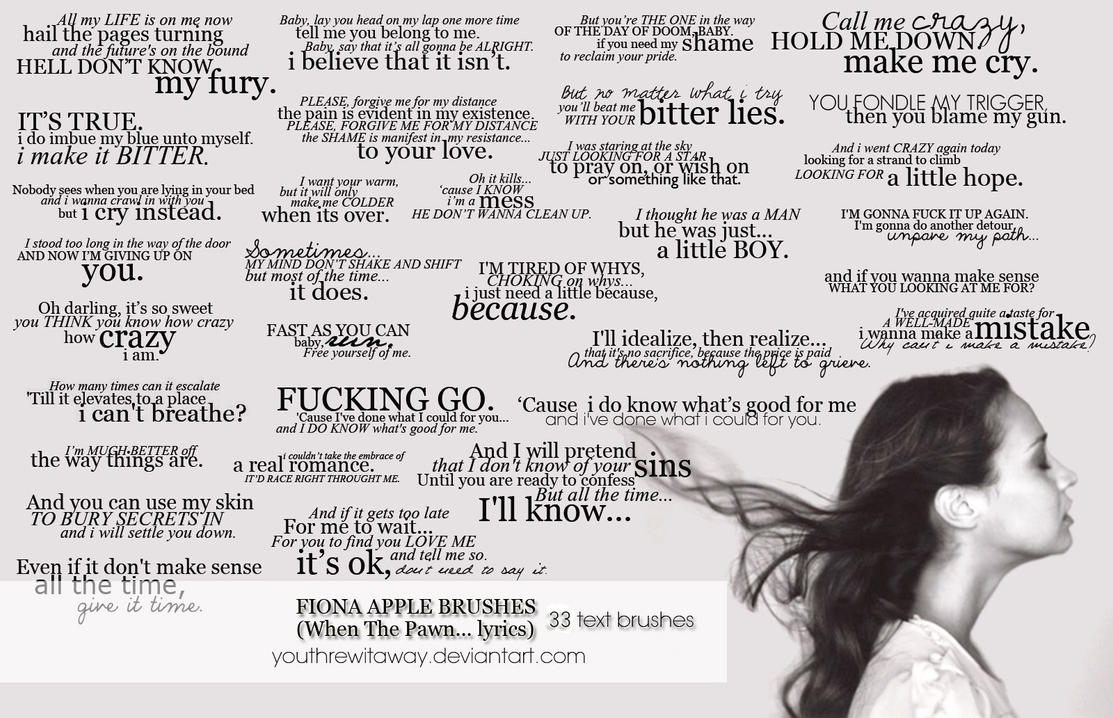
Fiona Apple challenged expectations and came into her own with the heartbreak and humor of this powerful personal perseverance. Although her debut album 'Tidal' Best New Artist award at the MTV Music Awards , she was unsatisfied with the music industry.
Apple would reveal: "When I got off the road, I took, like, six or eight months where I didn't do anything, and I didn't, like, really play piano or anything like that, and I just didn't think about it at all, 'cause I wasn't really sure what I wanted to do. I wasn't sure I wanted to come back. I wasn't sure, I wasn't sure, and I took some time, and I didn't really think about anything like re-entering it, and then, after a few months, you just kind of forget what it was like. So I just kind of naturally started writing songs again, and then once I wrote songs the decision is made, 'cause if you write songs and you're proud of them, then you kind of have to do something with them... I just feel like [there are] certain times in life where you just feel that you have an argument and you just want to make a point, but there's really no point in making that point to someone. You just kind of need to make it for yourself, to figure out exactly how you feel about something. I'd just be alone in my house and be like, "Ahh, piano," and it just started to be the way that I would deal with things. It was the way I deal with things three or four years ago, when I was writing songs for the other album, and then it kind of stopped being the way that I would deal with things. I would kind of deal with things then by just saying things to people a lot, 'cause I wasn't around the piano a lot, except for doing the shows. But after some time away from the piano, it started to become attractive to me again. I started without thinking, "I'm going to start trying to write now for a record." I just started because it was at that moment, "I want to write something down." I think people run into that problem because they pay way too much attention to it early on. I think they start going, "Okay, well, this is going really good. How am I going to top this? What is my public image? How am I going to top that?" I didn't need to worry about topping my public image, and I'm really proud of the songs that I write [and] that I've written for this [album], and I was proud of them when I was writing them, and I knew they were good when I was writing them, so there was no worry about that. If I hadn't been sure that they were great, I just wouldn't have made the album."
'When The Pawn...' was recorded at Andora Studio; Chateau Brion Studio; Nrg; Ocean Way Studio; One On One South; Preasence Studio Westport; and Woodwinds with producer Jon Brion. The sessions featured Fiona Apple on piano and vocals; John Bainbridge on orchestration; Robert Becker and Denyse Buffman, Scott Haupert, Maria Newman on viola; Charlie Bisharat, Eve Butler,Susan Chatman, Armen Garabedian, Berj Garabedianon, Peter Kent, Brian Leonard, Robert Peterson, Michele Richards, Edmund Stein, John Wittenberg on violin; Mike Breaux on woodwind; Jonathan "Butch" Norton and Matt Chamberlain on percussion and drums; Greg Cohen and Mike Elizondo on bass guitar; Larry Corbett and Suzie Katayama on cello; Wendell Kelly on horn; Jim Keltner on drums; and Patrick Warren on Chamberlin and Wurlitzer. mixing was done by Brion and engineer Rich Costey.
Apple asserts: "Because of changes in me personally, and also because of working with Jon, every element has been taken to the highest degree. It is more confident and less self-conscious. Jon has his genius and his visions, and will go and go and never stop and play everything that comes into his mind. He can do so much. It's easy to discuss, and take apart the song and its structure. But it's not only that he wants to make a good record - he wants to make a record that the songwriter intended. He knows that I will be going out to play this ... I'm just more confident as a singer. When I made the album the first time, I hadn't ever sung before, and then I went on the road, and that was when I kind of actually started learning how to sing, and so then making this album, I wasn't as shy with it. When I did the [first] album I'd never been on a stage, so I was kinda like in [the studio] with the [headphones] feeling really insecure. And then this time, you know, I didn't care."
The full title of the album was a ninety word poem that got her into the Guinness Book of World Records for longest album title: 'When the Pawn Hits the Conflicts He Thinks Like a King/What He Knows Throws the Blows When He Goes to the Fight/And He'll Win the Whole Thing 'fore He Enters the Ring/There's No Body to Batter When Your Mind Is Your Might/So When You Go Solo, You Hold Your Own Hand/And Remember That Depth Is the Greatest of Heights/And if You Know Where You Stand, Then You Know Where to Land/And if You Fall It Won't Matter, Cuz You'll Know That You're Right.' She says it was written to help her process a negative story about her in Spin magazine: "I was crying, like, 'This can't be happening. People are personally attacking me way too much, and I need to remember that I do everything for the right reasons.' I question my motives, I make myself proud, I am a good person, I've never done anything to hurt anyone, and this is not me that they're putting down. This is something that they've created. I needed to write something, the same way that I write songs, when I feel like I need to clarify something to make myself feel better. I didn't have a piano because I was on a bus, so I wrote a poem. And then I figured, I'm going to get into a lot of this stuff again where I'm probably going to get attacked a lot. To remind myself, I'll just make it the title."
'When The Pawn...' went to number sixy-six in Germany, fifty-four in Australia, forty-six in the UK, thirty-nine in Japan, thirty-two in France, thirteen in the US, and six in Canada. Apple considers: "My goal was to really enjoy myself this time. Last time I would make myself work as hard as I could, just to prove that I could work hard. I did it so much that I got a certain pride out of it, but I also wasn't having fun at times, and just became addicted to doing everything that everybody wanted me to do. I want to do this for the rest of my life, but I have to be able to enjoy it, and that's the only goal I have. I just want to make that the f--king first priority this time. I want to be more of myself, which is about having fun rather than this self-inflicted workhorse thing ... For me, the best times are always going to be the most intense, the ones with the highest highs and the lowest lows. I was so pissed off that I was misunderstood for a while that it discouraged me. Because I don't feel that way anymore, I can use those experiences and think they're wonderful. If I had the worst of times and I had the best times, that means I really kicked ass because I got past those worst times."
http://www.fiona-apple.com/ "Fast As You Can"
https://www.youtube.com/watch?v=NbxqtbqyoRk "Limp"
https://www.youtube.com/watch?v=CfTNpbraBbI "Paper Bag"
https://www.youtube.com/watch?v=BK30r_SIZ-g "Across the Universe"
https://www.youtube.com/watch?v=UXE1C--WezU 'When The Pawn...' full album:
https://www.youtube.com/playlist?list=PL49D27E65DBFF5C6E http://www.dailymotion.com/video/xtazzh_fiona-apple-when-the-pawn-hits-the-conflicts-he-thinks-like-a-king-1999-full-album_music Fiona Apple - When the Pawn Hits the Conflicts... by kritikospa All songs written by Fiona Apple
"On the Bound" – 5:23
"To Your Love" – 3:40
"Limp" – 3:31
"Love Ridden" – 3:22
"Paper Bag" – 3:40
"A Mistake" – 4:58
"Fast as You Can" – 4:40
"The Way Things Are" – 4:18
"Get Gone" – 4:10
"I Know" – 4:57
bonus tracks
"Across the Universe" (Lennon–McCartney)
"Never is a Promise" [live]
Sting turned the clock to zero and spent a year reworking the emotional explorations of this romantic renewal. After four albums recorded with producer Hugh Padgham ('...Nothing Like the Sun' 'The Soul Cages' 'Ten Summoner's Tales' and 'Mercury Falling' ), Sting began work on a new project without him.
Sting reveals: "I pretended I wasn't working on a record. I pretended I was just gonna get some musicians together and have fun in the house and jam a little, and then pick the bones out of the jams in the mornings, and then adapt them a little bit. This was in Italy, in Tuscany. I converted a granaio, a big barn, into a playing space with a little desk in it. So I just jammed around for a month or two, and picked bits out and started to loosely structure songs without any lyrics. I finished and sequenced an hour of music without any idea of what it was about lyrically! This is not the normal way I work, which is to write lyrics first or second but always in the same period of time as the music. This was different. So I would take an hour of music away with me on my walks around the woods in Tuscany, and try and allow characters or stories to emerge, rather like the way I imagine sculptors work - they find a piece of rock and see a bit of a nose here, and a bit of an arm or leg there and end up with a body. Some days nothing would emerge out of the mist, and other days whole characters would emerge. So the music was telling me the stories. I had no plan that the songs would be connected in any way, because the music was quite disparate, but I ended up with twelve songs that were really love stories in the very traditional sense - but with "lover" always as a metaphor for something larger, some larger philosophical thought or religious view of the world. They're all connected in that sense, and I think it's quite a romantic record...I feel the millenium is very much part of this record - and as my strategy in life is to be optimistic, in art I want to be the same. We need to look positively toward the future and not be sucked in by the lunacy that this is the end of the world, or that everything's going to fall apart - trouble, strife, plague, all that stuff. All that becomes self-fulfilling. So my strategy is to be optimistic, naive maybe. But maybe that's my job...I didn't set out to write lyrics just above love, yet almost all the songs have the theme of broken lives that can be mended by love. My challenge was to write a happy love song without being banal or smug. For example, 'Brand New Day', the last song, begins with a jaundiced view and then moves toward acceptance, to diving back into love. It's basically the thought that falling in love is an act of optimism - and I think if the album has that tone, for me... it's an optimistic one...I think there's an optimism in just about all the songs...That love actually transcends not only lifetimes, it also transcends break-ups. There is meaning in a relationship even if it doesn't last. It's been a profound and useful part of living."
'Brand New Day' was produced by Sting and Kipper (Mark Eldridge) with engineers Simon Osborne, Neil Dorfsman, Geoff Foster, and Chris Blair. The process took place from summer of 1998 through the summer of 1999, starting and ending at Il Palagio in Tuscany; with string sessions recorded at Air Lyndhurst studios in London; overdubs at New York's Right Track and Avatar studios; and mixing in Paris at Studio Mega. The sessions featured Sting on guitar, bass, keyboards, vg-8 guitar synth, and vocals; Kipper on drum programming, keyboards; Dominic Miller on guitars; Manu Katché and Vinnie Colaiuta on drums; Jason Rebello on piano and clavinet; and Chris Botti on trumpet; with Stevie Wonder on harmonica; James Taylor on vocals and acoustic guitar; Cheb Mami on vocals; Branford Marsalis on clarinet; Mino Cinelu on percussion; Dave Hartley on string arrangements, conduction, and Hammond organ; B.J. Cole on pedal steel guitar; Kathryn Tickell on Northumbrian pipes and fiddle; Don Blackman on Hammond organ; Sté on vocals; Ettamri Mustapha on darbouka; Joe Mendez, Janice Pendarvis, Althea Rodgers, Pamela Quinlan, Marlon Saunders, Veneese Thomas, Darryl Tookes, Ken Williams, Tawatha Agee, and Dennis Collins on background vocals; Gavyn Wright as string leader; Farhat Bouallagui on string arrangement, conductor, and leader; with string players Moulay Ahmed, Kouider Berkan, Salem Bnouni, and Sameh Catalan. Kipper says: "He's got this place called Il Palagio, which is literally a palace with three hundred acres of olive groves and vineyards. He bought that about a year and a half ago and has been getting it up to scratch. He's only lived there for the period of time we were working on this album. He wanted to be in a different environment for the summer, and it's beautiful in Tuscany...We would jam every evening for about four or five hours and experiment. We did that for about four weeks, and then each morning we'd listen to the work we'd done the night before and write down the timecode of where we thought there was something good. Then we'd work that bit out and develop it to the next level...Even three or four months in, we were just doing demos. Of course, in the back of your mind, you know you're making a record, but you free yourself from the pressure of having to make something amazing. It's a really valuable approach for Sting, because obviously there is a lot of pressure on Sting to write another hit song and do something that's better than Ten Summoner's Tales
'Brand New Day' rose to twenty-one in Australia; nineteen in Canada; sixteen in New Zealand; nine in the US; seven in Denmark, Japan, and the Netherlands; five in Spain and the UK; four in Belgium and Sweden; three in France; two in Switzerland; and number one in Austria, Finland, Germany, and Norway. The album won two Grammys for Best Pop Vocal Album and Best Male Pop Vocal Performance.
http://www.sting.com/ "Brand New Day"
https://www.youtube.com/watch?v=cA46ZNjrzeY How many of you people out there
https://www.youtube.com/watch?v=pu9R4egeg_I "Desert Rose"
https://www.youtube.com/watch?v=C3lWwBslWqg "A Thousand Years"
https://www.youtube.com/watch?v=PQGgFCCPOrY "After the Rain Has Fallen"
https://www.youtube.com/watch?v=HLvZbR0R3CA 'Brand New Day' full album:
VIDEO All songs written by Sting, except where noted.
"A Thousand Years" (Kipper, Sting) – 5:57
"Desert Rose" (featuring Cheb Mami) – 4:45
"Big Lie, Small World" (featuring David Hartley) – 5:05
"After the Rain Has Fallen" – 5:03
"Perfect Love... Gone Wrong" (featuring Sté Strausz) – 5:24
"Tomorrow We'll See" – 4:47
"Prelude to the End of the Game" – 0:20
"Fill Her Up" (featuring James Taylor) – 5:38
"Ghost Story" – 5:29
"Brand New Day" (featuring Stevie Wonder) – 6:19
bonus tracks
"The End of the Game"
https://www.youtube.com/watch?v=mqCIMKmQSu0 "Windmills of Your Mind" (Michel Legrand, Alan Bergman, Marilyn Bergman)
https://www.youtube.com/watch?v=aj7KZRMAIxQ