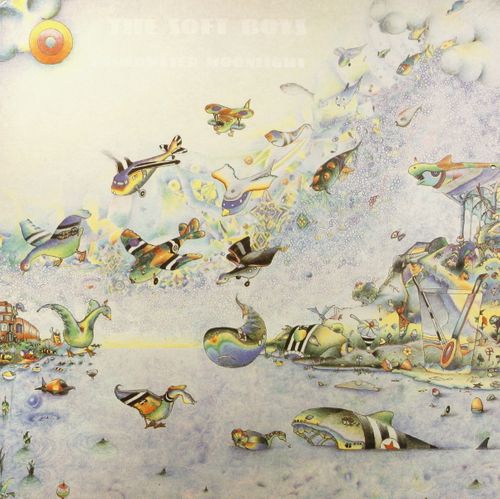
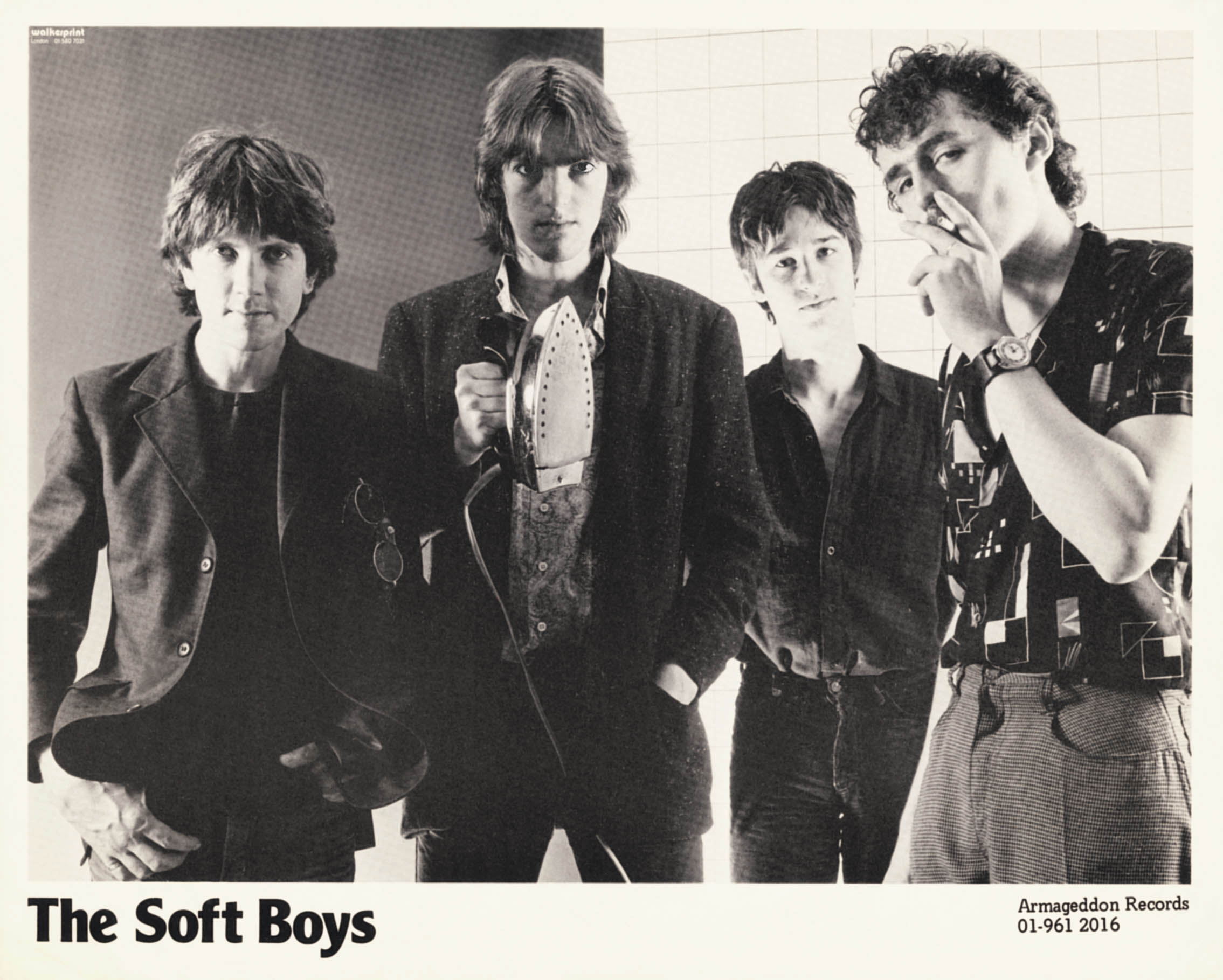
The Soft Boys were out on a limb and felt it coming on in floating currents so powerfully strong they set the body free and hatched an undersea classic. The Cambridge based group had challenged the punk ethos with their daring debut 'A Can Of Bees'
A major change came with new bassist Matthew Seligman, who forced the band to simplify their musical approach: "I couldn’t cope with all the chord changes... But you have to remember, we were just this tiny little band. That is the thing that can be most misunderstood at this remove of time. We were a tiny band with a little indie album. Everything that happened afterwards with the record is thoroughly deserved. I just wish I could go back and show you - it wasn’t in the cards for us. Our band seemed to be the most ephemeral thing, so much promise but nothing delivered at all. [ Underwater Moonlight ] is a lovely piece of history. But I don’t know how it happened... I never saw anyone ’arrange’ anything. Things would fall into place, without anybody saying anything."
'Underwater Moonlight' was produced by Pat Collier and Mike Kemp at Alaska and James Morgan studios in London and by the staff at Spaceward Studios in Cambridge, England. The sessions featured Robyn Hitchcock on guitar, vocals, and rhythm bass; Kimberley Rew on guitar, vocals, bass guitar, and synthesiser; Matthew Seligman on bass guitar; and Morris Windsor on drums and vocals; with Gerry Hale adding violin; and Andy King on sitar. Rew reveals: "I think we hit our stride with Underwater Moonlight ... Financially, the second album was done bit by bit. Every time Robyn got enough money together we could record a few songs at a time. Pat Collier was a great producer- he didn't change our sound at all. He was sympathetic and had a natural feel for it. He was low-key and confidence inspiring...The songwriting certainly changed. Robyn was always developing- his songs appealed directly to peoples' feelings. The curtain of dark imagery just got thinner and some light came through. In the early days, we'd have competitions to introduce little twists into the music. We stopped that by the second album and simply supplied the musical setting for the songs...We were always playing live in Cambridge. You had the pub-rock phenomenon there. It was the pub-circuit after pub-rock was over. We did manage to break into the London circuit but we really didn't get any further than that. When we toured nationally, punk became a problem for us. It was the current thing that the kids subscribed to. Because of that, we couldn't get an audience in Sheffield or Leeds. The strength of being individual wasn't good enough. We did get to go to New York in 1980 but that's as far as we got, geographically...We were just contemporary with punk so it tended to set the tone at the time. You were forced to justify why your band wasn't punk then...For the Soft Boys, people weren't patient enough for '60's-type, mainstream rock. That was seen as old-fashioned and because of that, the group couldn't break through commercially."
Hitchcock harkens back: "The first one was 'Can of Bees' , and there was in fact another one as well before that which we recorded for the Radar label but aborted. The first good one though was 'Underwater Moonlight' . It’s one of the albums I’m most proud of. It’s certainly the best Soft Boys album...I have made albums since then that I like as much probably... 'Underwater Moonlight' , however, is definitely up there. It’s like saying though: is it better to be 20 or 40? Neither is, it’s just different. Life isn’t a means to an end, it’s just a series of moments that you make the best of. 'Moonlight' was the work of four young guys in their mid/late twenties and I thought it was pretty good really. I'm definitely pleased with it, and I’m glad it has survived...I pictured the Soft Boys a bit like civil servants. They were powerful, but you wouldn't see them. They were invisible, but they had a huge influence. Funnily enough, that's kind of what happened...My vision of them was that they had been filleted, they had no bones so they could slide under doors and then come back up, like in the Terminator movies, so they could get anywhere, through a keyhole or under a door. They would be bloodless, like they had been drained like Halal, but they would be alive . They didn't have bones and they also had a tremendous sexual appetite in some ghastly way that was left to the imagination. I thought this is too good so I had I had to write about in a song and came up with 'Give it To the Soft Boys'...We were also in one sense all very soft. We were middle class, mother’s boys, wouldn’t hurt a fly, couldn’t confront anyone never mind each other, very nice people who avoided eye contact and really liked Monty Python and kind of laughing at things quietly in silent laughter. Anyway, there it was in a way. We did become invisible, but an influential force after our demise...I felt quite sour about it all which never helps because no one loves you when you’re sour and angry! I remember there was a bill at the Electric Ballroom in London with the Psychedleic Furs, and the Bunnymen, the Teardrop Explodes and Wah, and I thought 'Fuck it ! No one asked us.'...They were a bit younger and in some ways they were more sort of post-punk that us. They were people who had been through punk and had decided to get onto a bit of a psychedelic trip where we were pre-punk and we didn’t really adopt psychedelia. It was already there in our system. They discovered psychedelia and decided to wave it as a flag whereas we didn’t wave it as a flag. It was what we were anyway. A lot of them were from Liverpool, so they were probably a lot more outside-world friendly; Cambridge is rather sheltered."
Windsor waxes: "Robyn didn’t really understand what pop music was about. He was headed in that direction; he wanted to go there. But it is not, at his core, what he is about. [ Underwater Moonlight ] was his misinterpretation of pop music. That was the great thing about the Soft Boys: We got everything wrong - in all the right ways." http://www.fegmania.org/ http://www.underwatermoonlight.com/ http://www.matadorrecords.com/the_soft_boys http://www.robynhitchcock.com/ http://themuseumofrobynhitchcock.tumblr.com/ http://www.kimberleyrew.com/ "Queen of Eyes"
https://www.youtube.com/watch?v=9UpF6BPo0TY VIDEO https://vimeo.com/55180305 Robyn Hitchcock (The Soft Boys) - The Queen of Eyes from Child of Psi on Vimeo .from "Underwater Moonlight"
"I Got the Hots"
https://www.youtube.com/watch?v=Ohhuw7rG-ig VIDEO "Insanely Jealous"
https://www.youtube.com/watch?v=qz2CO8yre1M VIDEO "I Wanna Destroy You"
https://www.youtube.com/watch?v=XqoULJrhk3w VIDEO "Kingdom of Love"
https://www.youtube.com/watch?v=MftxRvT90zw VIDEO "You'll Have to Go Sideways"
https://www.youtube.com/watch?v=L6CIzAOPY9Y VIDEO "Innocent Boy" bonus 7"
https://www.youtube.com/watch?v=S2yhxa2kQjc VIDEO "Only the Stones Remain"https://www.youtube.com/watch?v=fJqT1eaw2nc VIDEO https://www.youtube.com/watch?v=ZD_a8lntjWI VIDEO 'Underwater Moonlight' full album:
https://www.youtube.com/playlist?list=PL7BB0615A1A8E9102 https://www.youtube.com/playlist?list=PLbJL6UNvY7tXBL5OYDRK14ltQ518OEjmJ VIDEO All songs written and composed by Robyn Hitchcock, except as noted.
Side A
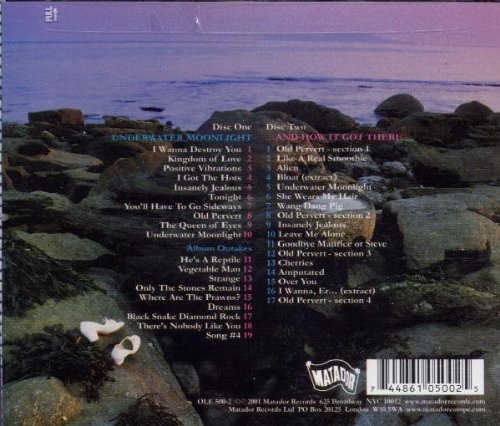
1. "I Wanna Destroy You" 2:52 2. "Kingdom of Love" 4:10 3. "Positive Vibrations" 3:10 4. "I Got the Hots" 4:42 5. "Insanely Jealous" 4:15 Side B
6. "Tonight" 3:44 7. "You'll Have to Go Sideways" Hitchcock, Kimberley Rew 2:57 8. "Old Pervert" Hitchcock, Rew, Matthew Seligman, Morris Windsor 3:52 9. "Queen of Eyes" 2:01 10. "Underwater Moonlight" 4:17 bonus tracks
11. "He's a Reptile" 4:27 12. "Vegetable Man" Syd Barrett 2:59 13. "Strange" 2:59 14. "Only the Stones Remain" 2:50 15. "Where Are the Prawns?" 6:06 16. "Dreams" 4:37 17. "Black Snake Diamond Rock" 4:24 18. "There's Nobody Like You" 3:11 19. "Song #4" 4:35 reissue bonus disc: ...And How It Got There
1. "Old Pervert – Section 1" 1:38 2. "Like a Real Smoothie" 3:43 3. "Alien" 3:13 4. "Bloat (Extract)" 1:00 5. "Underwater Moonlight" 6:24 6. "She Wears My Hair" 5:22 7. "Wang Dang Pig" 3:56 8. "Old Pervert – Section 2" 1:31 9. "Insanely Jealous" 5:03 10. "Leave Me Alone" Lou Reed 6:45 11. "Goodbye Maurice or Steve" 3:14 12. "Old Pervert – Section 3" 0:36 13. "Cherries" 2:54 14. "Amputated" 4:22 15. "Over You" Bryan Ferry, Phil Manzanera 4:00 16. "I Wanna, Er... (Extract)" 0:42 17. "Old Pervert – Section 4" 1:24 bonus 7"
1. Innocent Boy (Studio outtake)
The Soft Boys chiseled open a can of funky psychedelia and waded crabwise through the ventilator with the farcical fury of this jagged metallic folk. The group had formed in Cambridge, England as Dennis and the Experts with Robyn Hitchcock, Rob Lamb, Andy Metcalfe, and Morris Windsor. Hitchcock reveals the genesis of the band: "The Soft Boys came into my head in Cambridge, in the hot, dry summer of 1976 while punk was being conjured up by a small group of artists and villains in London. My idea was to concoct a tribe of translucent, bloodless man-things that had awesome powers but were largely invisible: stalkers of the hypothalamus, erotic guerrillas that would transform people's thoughts in a different way from the bludgeoning M.O. of UK punk. The front man would be a robot, for good measure; being the songwriter and lead guitarist I would supply the material and direct the music, while he, Golem-like, would be the cyber-darling of the crowds. I saw The Soft Boys as upmarket versions of Morlocks from HG Wells' Time Machine crossed with William Burroughs' slithery boys on bikes. At my table in the Portland Arms, where at the folk club each Saturday I tormented the local bluegrass community with my three-song floor-spot (the MC Nick Barraclough once introduced me as 'Cambridge's answer to music'), I hunched over my Guinness and sketched out my plans. When it came to the actual birth of the band, the reality was a little different. My friend James 'The Great One' Smith had pointed out to me some of the great local players who were already on the ladder to professionalism. On his advice, I met Morris Windsor in his dark eyrie, where he gave me some coffee and we leafed through copies of Creem magazine together, not saying much. Then I found Kimberley Rew, appearing through a trapdoor with shoulder-length hair and an ironic (or was it?) grin; he seemed amused that I was me and he was him. Could it have been the other way 'round? From my performance-art perspective, living for my weekly spots at folk clubs, these guys were like Ringo Starr and Eric Clapton, as yet unused. Matthew Seligman smiled charmingly at me across an empty plate in another medieval chamber, and Andy Metcalfe loomed out of the shadows to play bluegrass mandolin at the Portland Arms occasionally. I could see these people but I couldn't get at them. The true Soft Boy is almost invisible, only appearing at twilight. But courtesy of Rob Lamb (half-brother of Charlie Gillett, DJ and man of great taste, who sadly died earlier this year) I eventually recruited them all at different points into the band. The early Soft Boys featured Alan 'Wang Bo' Davies on guitar and was light in touch; we were crystalline guitars over a nimble rhythm section. Our first EP Give It to The Soft Boys (1977) shows us trying out whatever we thought would work, and on that record it did. When Kimberley Rew replaced Wang Bo, our sound mutated into a ferocious kind of folk-metal, not the easiest of wares to peddle to a UK audience in 1978, which had only the year before been brutally shaved of whiskers and bell-bottoms and converted to punk. What did we play back then? Bowie's 'Station to Station,' Lennon's 'Cold Turkey,' Cream's 'Sunshine of Your Love,' and Rob Lamb's ace, the John Cale arrangement of 'Heartbreak Hotel'. There was always a hard rock element to the SB's, but we were innocent of marketing at that point. We played what we felt like playing. Gradually my own songs developed: 'Give It To The Soft Boys,' 'The Face Of Death,' 'Where Are The Prawns?' and 'The Pigworker'. We spent a month arranging a group composition called 'Hear My Brane' which was always a favourite. Morris and Andy inclined to The Beach Boys and Steely Dan; Andy, Kimberley and I were big into Fairport, Richard Thompson, and The Albion Band; while I was magnetized by Syd Barrett and Captain Beefheart, but we all loved the Beatles, which marked us out, irrevocably, from the permitted heroes of punk. As we learned to play electric music, we festooned it with harmonies and booby-trapped it with odd time signatures. Meanwhile, Sham 69 were singing "If The Kids Are United, They Will Never Be Divided". Wang Bo gave way to Kimberley and The Soft Boys spread in a very light film across Britain. Outside of Cambridge where we had incubated, and London where we had first crawled after hatching out, we found ourselves in a bleak and alien land. Huddled at the foot of a slag heap in Grantham (birthplace of Margaret Thatcher) in the drizzle, then watching Kimberley pad through Scarborough in his striped blazer, I wondered how long we could go without being beaten up. Would we be mugged for our cucumber sandwiches and thermoses? After a gig in Sheffield one person clapped and one person told us to fuck off. We finally got an encore in Yorkshire in late 1980. As we sharpened the guitar sound we started delving back into Steeleye Span and Fairport Convention, whilst picking up the odd droppings from Pere Ubu, whom we supported in autumn 1978. This further polarized listeners; most couldn't stand it, but the occasional fellow (it was mostly fellows) would become apoplectic with joy and go into spasm. Having spent months and thousands of pounds trying to record 'Sandra's Having Her Brain Out' and other songs of mine from that era, our record company dropped us before the deal was even signed. No one rushed to take their place, so 'A Can of Bees' was released on our own label in spring 1979. Whilst it was a hit with neither the press (apolitical, impenetrable and 3-part harmonies to boot - sorry, lads) nor many of our listeners, it was the best approximation yet of what we were playing at the time, and it did make its way to a swathe of US record shops where young musicians working there behind the counter would listen to it in amazement, sometimes putting it on to clear the shop at closing time. I've worked with a few of them since. The 'Can of Bees' tour was a demoralizing experience: long silences in the van punctuated by Kimberley sighing, 'Looks like rain.'"
Rew remembers: "Robyn Hitchcock arrived in the medium-sized college town of Cambridge, England in 1975 to look for musicians for his band- not an obvious choice of location as a hotbed of talent but none of this would apply if he hadn't. I first heard him at some weekly informal musical get-togethers at the Great Northern Hotel run by a man called Sunshine Joe, with a backing band he later described as 'people who were living in my house'. Robyn wore black leather trousers and jacket, long hair and beard, and either glowered at the audience or, then as now, launched into lightningly impromptu song introductions which took the subject matter on a season ticket to Unexpectedsville. At the time I was renting a room in a terraced house whose basement contained Spaceward recording studio. Robyn arrived and recorded and we met in the kitchen where he stubbed his fag on the lino and was rebuked by recording engineer Mike Kemp. Mike subsequently invented the 'Sadie' hard disk recorder and retired to the Algarve. Morris Windsor and Rob Lamb (and original Waves singer Rob Kelly) were in local rock outfit Mad Hatter whom I heard at a cricket pavilion on one of those balmy summer night college shindigs. Rob and Morris went on to form Sheboygan (which I thought for a long time was a quote from Surfin' USA, but then found was a generic name for 'Nowheresville') and discovered pub-rock. The next year, 1976, in pursuit of a 'white soul' style, they teamed up with Robyn and Andy Metcalfe to form Dennis and the Experts and began to rehearse in Robyn's front room. Uneasy about the way things were shaping, in December Rob quit (subsequently forming the respected Ducks on the Wall, whose Adrian 'Hots' Foster gave us the phrase 'I've got the hots for you'). Except Robyn was in bed at the time so he had to shout his resignation thru the keyhole. Dennis and the Experts were booked that month for a university Christmas ball- recruiting Alan Davies on guitar, Robyn arrived at the venue, which being an educational institution had a blackboard, that night being used to list the evening's musical program. Erasing 'Dennis and the Experts', he chalked in 'The Soft Boys'. Thus were they born. Now began the group's truly formative year. All the distinctive musical ingredients were brewed- incisive lyrics, unexpected twists (at least few expected twists), the twin guitar attack. There was a vague feeling among the local musos that it wasn't 'proper' music- proper music at the time was more a swamp of 'tasteful' licks at the pinnacle of which, if swamps have pinnacles, was Steely Dan. Nobody of course ever actually could play like Steely Dan, but that distant peak was always in view. Certainly it was hard to hear the subtleties of the Soft Boys thru the group's two four-by-twelve WEM columns. That all changed with the appearance of the EP 'Give it to the Soft Boys' Robyn put up the cash to record 'A Can of Bees' independently at Spaceward on his own Two Crabs label." 'A Can of Bees' was cut with engineer Mike Kemp at Spaceward Studios in Cambridge with Gerry Hale on violin; Robyn Hitchcock on bass, guitar, and vocals; Jim Melton on harmonica, percussion, drums, and vocals; Andy Metcalfe on bass and vocals; Jim Milton on harmonica, percussion, and vocals; Kimberley Rew on guitar and vocals; and Morris Windsor on drums and vocals. Hitchcock says that the original concept for the band was "to cross Abbey Road with Trout Mask Replica, to have those harmonies and choruses but also that jumping sound. But it was quite an ugly hybrid. In 1978, we were at our most fragmented - a kind of heavy metal/barbershop doo-wop/country and western/psychedelic/folk blues band. We would play something like ’Mystery Train,’ then do these gothic pieces in 9/8 time. We were painting ourselves into a corner with cleverness. I didn’t have an identity as a songwriter either. What we tried to do was make an identity out of not ruling out any possibility. It was a beast that couldn’t survive...By the time we recorded 'A Can of Bees' , most of the songs had been recorded at Radar’s expense in three or four studios up and down the land. The songs were overworked. The technique was there, but there was no love in it." http://www.robynhitchcock.com/ the-soft-boys "Human Music" 4:30
https://www.youtube.com/watch?v=toGX1yXZ0W0 VIDEO "Sandra's Having Her Brain Out" 3:47https://www.youtube.com/watch?v=anvqXNQixik VIDEO 'A Can of Bees' full album:
VIDEO All tracks written by Robyn Hitchcock, except where noted.
1. "Give It to the Soft Boys" 1:57
2. "The Pig Worker" 4:30
3. "Human Music" 4:30
4. "Leppo and the Jooves" 5:27
5. "The Rat's Prayer" 3:19
6. "Do the Chisel" 3:03
7. "Sandra's Having Her Brain Out" 3:47
8. "The Return of the Sacred Crab" 2:54
9. "Cold Turkey" (John Lennon) 4:17 10. "School Dinner Blues" (Live) 2:26
11. "Wading Through a Ventilator" (Live) 4:08
12. "Leppo & The Jooves" 5:29
13. "Sandra's Having Her Brain Out" 3:39
14. "School Dinner Blues" 2:14
15. "Fatman's Son" 2:38
16. "(I Want to Be An) Anglepoise Lamp" (Live) 2:51
17. "Ugly Nora" (Live) 3:05