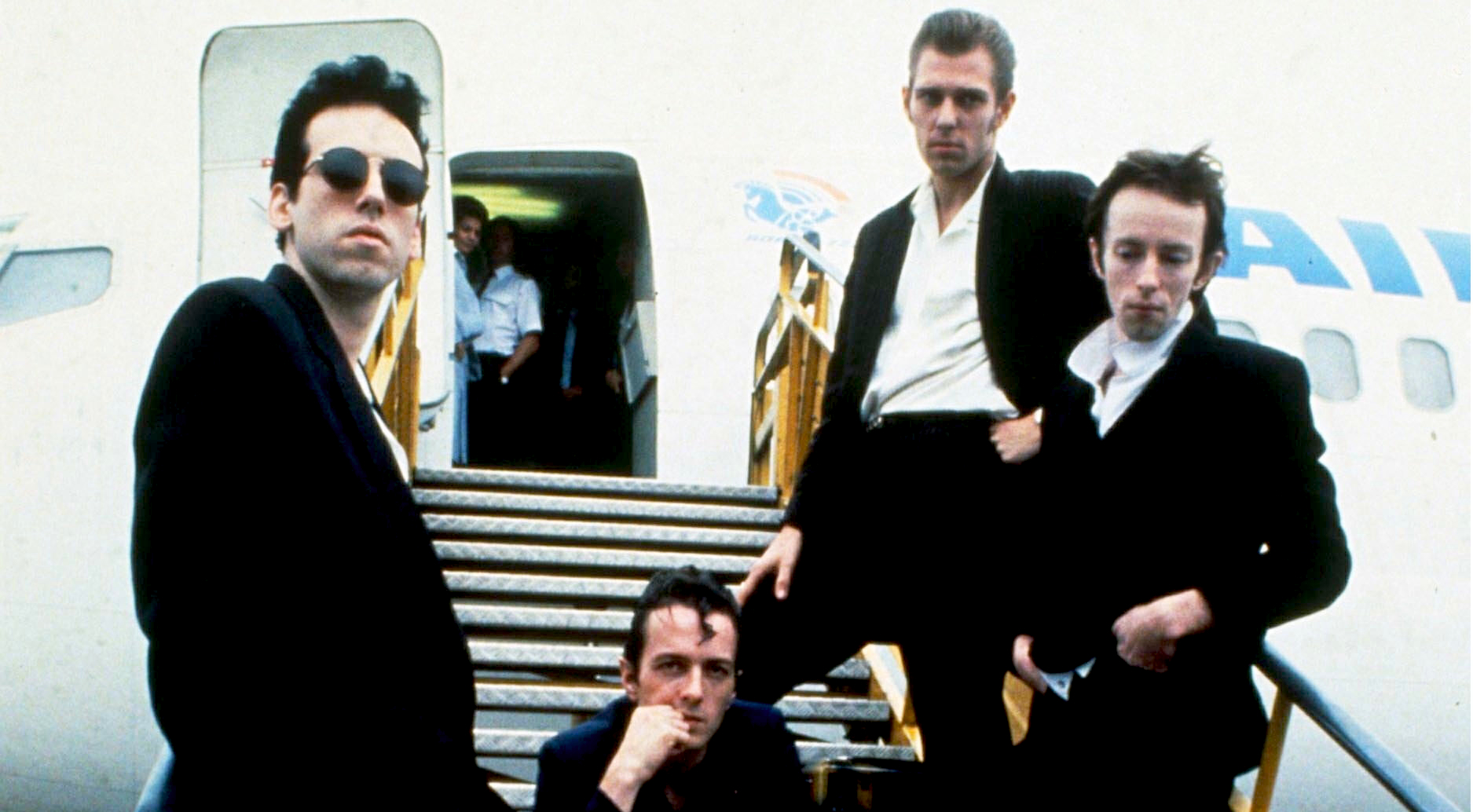
The Clash raged against the machine with a more personal and polished punch on this prophetic punk protest. Their eponymous debut had established the band at the cutting edge of the punk movement; but it created controversy when they were paired up with American producer Sandy Pearlman, known for his work with Blue Öyster Cult. The sessions took place at Basing Street Studios in London with overdubs done at the Automatt in San Francisco and final mixing at the Record Plant in New York. 'Give 'Em Enough Rope' features Joe Strummer on lead vocals and rhythm guitar, Mick Jones on lead guitar and vocals, Paul Simonon on bass guitar, and Topper Headon on drums; with Allen Lanier playing piano on "Julie's Been Working for the Drug Squad".
'Give 'Em Enough Rope' made it to number one hundred and twenty-eight in the US, thirty-six in Sweden, fifteen in New Zealand, and number two in the UK, where it has been certified gold. In the US, it was released before their first album.
'English Civil War' stormed its way to number twenty five on the UK charts.
Stay Free
'Give 'Em Enough Rope'
full album:
All tracks written by Joe Strummer and Mick Jones, except where noted. All lead vocals by Strummer, except "Stay Free" by Jones. Side one 1."Safe European Home" 3:50 2."English Civil War" (Traditional; arranged by Jones and Strummer)2:35 3."Tommy Gun" 3:17 4."Julie's Been Working for the Drug Squad" 3:03 5."Last Gang in Town" 5:14 Side two 1."Guns on the Roof" (written by Topper Headon, Jones, Paul Simonon, Strummer; contains the main riff from The Who's "I Can't Explain")3:15 2."Drug-Stabbing Time" 3:43 3."Stay Free" 3:40 4."Cheapskates" 3:25 5."All the Young Punks (New Boots and Contracts)" 4:55
The Clash were at odds over the experimental diversions and ragged pop that gave them their greatest commercial success even as the band was coming apart. 'Combat Rock' began as a double-album concept called 'Rat Patrol from Fort Bragg' with guitarist Mick Jones mixing the first version at Ear Studios in London; but after some disagreement among the rest of the band, studio veteran Glyn Johns took over as chief engineer. They recorded while on tour at Electric Lady Studios in New York City and then at Wessex Studios in London. Scaling the project down to a single disk, band still manages to dabble in straightforward punk, reggae, rap, funk, sound collage, jazz, and beat poetry.
Joe Strummer recalled: "We were making music for 'Combat Rock' to fit onto that album plus a twelve inch that went with it, or was it two twelve inches? I don’t know. You have to get that sardonic triple-album feel in the air in the studio. That’s when I really started to wake up. You have to make an artistic decision, a creative decision, you have to say 'This bit is rubbish, I’ve got this feeling, we’re doing it again, we’re becoming self indulgent, I can feel it, everything’s going a bit funny.' Eventually we had to take the album to Glen Johns back in England and he mixed it inside of a week and gave us one compact album. He did well, too. He was really brutal with it, and I liked that brutalness. 'You like what was on this track? Nope, get rid of it.' I thought that saved the album, which was what we’d been lacking when we recorded it. It was all kind of like, 'Hey, let’s overdub that dripping drain pipe on this track, the rustling of the carpet, let’s get that in stereo, double it up, quadruple it up.' And I realized, this is not the way we made the first record, what have we come to? So when Glen Johns had cut it down and saved it and put it out and it became a big success, Mick turned to me and went 'You’ve ruined my music,' and I went, 'I beg your pardon?' And he went 'You’ve ruined my music' and I went 'How so?' and he went 'You took it to that butcher who cut all the goody bits out and made it into one LP and made it all boring and raucous', he was screaming at me, and I went, 'Haven’t you had enough of that sardonic stuff with jingle bells dribbling from 48 tracks?'"
Jones says: "We were just playing the music we liked. We took on the music that was actually around us. We never wanted to do the same record twice. The groups I liked, you really looked forward to their albums and you rushed to get them the first day, because you knew it was going to be different than what they did before. The records told you what that group was into at that time. We were always reaching out, though I must say, now it sounds more conscious than it actually was. With the benefit of hindsight, I suspect you can sort of see what we took from where, but we didn't really see it while we were doing it...I remember one time, when we were doing 'Straight To Hell', Paul Simonon came in and went, 'That's a bit transcendental, isn't it?' And Tymon Dogg, who was in the studio at the time, said, 'Oh, that must be the rice.' And I remember I tried to get Paul to sing about pensions on 'Career Opportunities', and he wasn't going to. I don't know why I was trying to get him to sing about that in the first place. But we didn't really argue about it particularly. There was always a bit of tension on each record in regards to what we were all putting in. Jostling for a bit of position, or something."
Topper Headon enjoyed layering on different types of percussion: "It just happened. Some songs just called out for percussion. On the recordings I would often just hold the beat down and then do all the embellishments, and put all the colour on with percussion - and I was allowed to do that! The rest of the band thought it was great because it all added to it. I was free to add percussion and do what I wanted. Where did the beat for 'Straight To Hell' come from? It’s a Latin American beat of some sort. It was just the first thing I did on the song - snare’s off, which wasn’t rock n roll, it was the first thing that came to me - and I overdubbed a hi hat part too."
Just before the album was released drummer Topper Headon was asked to leave the band because of his worsening heroin addiction. During the tour tensions between Jones and Joe Strummer led to Headon's replacement Terry Chimes leaving. Pete Howard played with the band for a show in San Bernardino, California on May 28, 1983. The band argued with promoters over inflated ticket prices and brawled with security. It was the last show that Jones played with the Clash. He was officially asked to leave in September.
Strummer explained: "I just came right to the end of my tether. I thought, 'If I’m gonna have to put up with this behavior any longer, I’d rather just get any job — go dig a ditch, I’d rather do anything else.' What I had to deal with was emotional blackmail, he wouldn’t leave the hotel to go to the next gig, he had no enthusiasm whatsoever, he was just sarcastic about everything. Sometimes he asked for 1,000 quid just to go on stage that week. He was constantly, he wouldn’t turn up at a recording session, he’d just say he wasn’t going to go. We just wasted our energy for three or four years back there, arguing with each other. I tried to get him to snap out of it, but in the end I thought, well, I don’t see how you can make music if it’s just nothing but sarcasm and a lack of enthusiasm and gloom and doom."
Jones admits: "I made it kind of easy for it to happen, because I became uncommunicative when it wasn't really going my way. I had a big part to play in the eventual end. But I think mostly, we'd just been with each other day-in, day-out for six or seven years without a break, and we just sort of got fed up with each other. There was a lot of other stuff that made it happen too, but that was the one thing that could've been different. Yes, I would like to have done more. Even though we did a lot. I would like to have made another record. But that's the way it is, you know? That's the way it is."
Strummer adds: "I was trying to prove that I was the Clash and it wasn't Mick. I learned that that was kind of dumb. I learned that it wasn't anybody, except maybe a great chemistry between us four, and I really learned it was over the day we sacked Topper, and not the day we sacked Mick. There was quite some time between them. We played a whole tour between those times. But it was the day we sacked Tops. Because it's between humans. Bernie Rhodes and Cosmo Vinyl I think perhaps didn't understand that. You couldn't just jigsaw-puzzle it, take out a piece and put in another piece. That it was something weird between four humans that when they played it sounded OK, you know. And that's fairly rare, that's all. And when we knocked out Topper for excessive drug abuse, I don't, think honest to God, we ever played a good gig after that. Except for one night in New Jersey we played a good one, but I reckon that was just by the law of averages. Out of a thirty gig tour, one night, you've got to say it's a fluke."
Headon remembers the 'Combat Rock' period as his low point: "We just weren’t getting on! I remember we were mixing the record and my girlfriend said there was a drought on back in London, which meant there was no heroin. I said 'OK; I’ve got some, I’ll bring some back from America' – that’s how much I’d lost the plot! So I say to the band, 'I gotta pop back to London' and then - I got busted for trying to import heroin into the UK!" Still, Headon says he doesn't hold a grudge: "Joe was sacking everyone else rather than just leave himself. He had no choice. I was in a state. We were kids. Who cares? It was the best thing that could have happened. We made all that fantastic music and then imploded at the top."
'Combat Rock' went to number twelve in Canada, nine in Sweden, seven in Norway and the US, five in New Zealand, and number two in the UK. It has been certified double-platinum in the US. It included Tymon Dogg on piano, Poly Mandell on keyboards, Gary Barnacle on saxophone; and guest vocals by Allen Ginsberg, Futura 2000, Ellen Foley, and Joe Ely. At the time it came out, Jones compared the Clash to other punk bands: "We're not minimalists. Where they tend to keep themselves in one line. we tend to go out in every line possible - all sorts of sub-tracks."
Headon describes what made the Clash so special: "It was like Joe said; it was the chemistry between the four of us. But, none of us really knew what made The Clash work. We didn’t know at the time that we had this amazing chemistry or that punk bands weren’t supposed to make triple albums with Mose Allison songs and reggae songs. I must say Paul was great for me. I’d really like to big him up here because he was so important to the bands sound. He really kept us happening on stage. If it wasn’t for Paul I couldn’t have done half the things I did on stage! He would play stuff exactly the same every night and that left room for me to do whatever I wanted. I could cross Paul and he’d stay rock steady, he’d take over the drum role and I could express myself – you know, just jam! I could hand over the keeping time stuff to Paul and I could just show off - and it worked. Paul was integral to The Clash – not just the sound but the art work and the look, with his low slung bass. Paul was vital to the band live; he stopped us becoming a jazz band! At the time The Clash were political, fighting the establishment, fighting the record company, triple albums for the price of one, 'We ain't doing Top Of The Pops', you know? Brilliant! But as years have gone by, people who are into the band now, it’s the music that’s lived on, not the anti-Thatcher stuff or the miners and all that. It’s the music!"
Simonon reflects: "To inspire people, even just for one second, is worth something. To be honest, we were blokes with guitars, and it's unlikely we could change the world, but at eighteen you at least think it's possible -- and it is, but maybe not in the way you first think. The amount of people who come up and say we changed their lives and gave them a whole different concept of how to look at things, is fantastic. I'm not saying we were holier than thou, we were pretty regular blokes."
About the politics, Jones says: "Maybe it won't change anything, but I still believe in it, as something worth doing. Perhaps we're too ambitious a band. I would say rock & roll can contribute toward some minor change. But it ain't gonna tell the politicians what to do. It ain't gonna save people from wars!"
'Rock the Casbah' was a worldwide sensation, going to twenty-six in Canada, twenty-one in the Netherlands, fifteen in the UK, eight in the US, four in New Zealand, and four in Australia. Strummer calls it his proudest moment: "It's such a groove. Long live groove. Screw the rest of it...The true genius of 'Rock the Casbah' is Topper Headon. I was in Electric Ladyland and he said, 'Look, I've got this tune, can I put it down?' I said, 'OK, Tops, let's put it down . . . .' He ran out in the studio and banged down the drum track to 'Rock the Casbah'. And then he ran over to the piano and he banged down the piano track to it, and then ran over to the bass and he banged down the bass part. This is, like, I suppose, within twenty-five minutes, and 'Rock the Casbah' is there, boom. Topper Headon did that in twenty-five minutes. And now he's serving fifteen months in (prison) . . . . For partially supplying the heroin that killed some guy."
'Should I Stay or Should I Go' hit number forty-five in the US, forty in Canada, thirty-seven in Australia, sixteen in Ireland, three in the Netherlands, and number one in the UK. Jones sang the lead vocal, but Strummer says he didn't want to: "Tis part of the whole 'Playing the guitar is passe'. If he can do something well, he wouldn’t want to do it just to be awkward. I’m not exaggerating, I had to force him to sing it in the studio, onto that record, that vocal track that’s on that record. I had to beg him, force, cajole, whisper, entice, because he was doing his whole 'Oh, it’s so rock and roll.' At first he wanted me to sing it. We’d already demoed it and he sung it great. It sounded great, straight up and down, no frittering around, I could see what it was, solid, straight and short. But then we got to the studio and really put it down and I was like, 'Look, you do a fine job on it. I’m already singing these other tracks, you’re not singing on them. You wrote it, so you sing it,' and he’d go, 'Um, can’t' and at the end, what I had to do is say 'All right, I’ll translate into Spanish after you’ve sung the English, I’ll sing the Spanish in.' And then he was all gung-ho for it. But really we had to take half of the Spanish off the record, but really I had to cajole him to do it."
"This indecision's bugging me (Esta undecision me molesta) If you don't want me, set me free (Si no me quieres, librame) Exactly whom I'm supposed to be (Diga me que tengo ser) Don't you know which clothes even fit me? (Saves que robas me querda?) Come on and let me know (Me tienes que desir) Should I cool it or should I blow? (Me debo ir o quedarme?)"
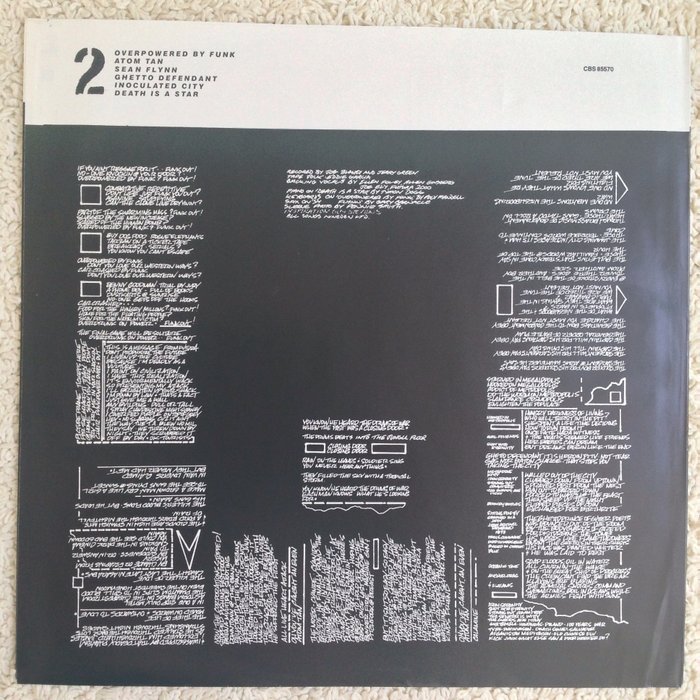
All tracks written by The Clash, except where noted. Vocalists listed. Side one 1."Know Your Rights" (Strummer/Jones)Joe Strummer3:39 2."Car Jamming"Joe Strummer3:58 3."Should I Stay or Should I Go"Mick Jones3:06 4."Rock the Casbah"Joe Strummer3:44 5."Red Angel Dragnet"Paul Simonon/Kosmo Vinyl3:48 6."Straight to Hell"Joe Strummer5:30 Side two 1."Overpowered by Funk"Joe Strummer/Futura 20004:55 2."Atom Tan"Mick Jones/Joe Strummer2:32 3."Sean Flynn"Joe Strummer4:30 4."Ghetto Defendant"Joe Strummer/Allen Ginsberg4:45 5."Inoculated City" Mick Jones/Joe Strummer2:43 6."Death is a Star"Joe Strummer/Mick Jones3:13
Jones talks about whether or not the 'The Rat Patrol from Fort Bragg' version of the album will ever be released: "You never know. I think 'Rat Patrol From Fort Bragg' was the more contemporized mix for the time, leaning toward more of a Big Audio Dynamite thing. But ultimately, I think the record we actually came out with was more definitive. No one really remembers those synthesizers and squiggle noises. A lot of times, I wasn't participating in what the record became, because I was in a bad mood about something. After so many years, all you can remember is how successful the record was, and how it helped everybody. I don't remember what I was so upset about at the time. Another reason why I think we could've done with a break...I somehow doubt it. It's not as good as the one that came out in the end. Even though it was painful at the time for me to admit that it was. But in the end it turned out fine, and no one remembers all the little finicky bits. It was a little bit more of a contemporary, what-was-going-on-at-the-time-type of thing, but the end record turned out to be a more lasting record, I think." 'Rat Patrol From Fort Bragg'
Mick Jones produced version of the album that would eventually be mixed by Glyn Johns and released as Combat Rock 1. 0:00 - The Beautiful People Are Ugly Too 2. 3:45 - Kill Time 3. 8:54 - Should I Stay Or Should I Go 4. 12:00 - Rock The Casbah 5. 15:48 - Know Your Rights 6. 20:58 - Red Angel Dragnet 7. 26:12 - Ghetto Defendant 8. 32:25 - Sean Flynn 9. 39:50 - Car Jamming 10. 43:45 - Inoculated City 11. 48:21 - Death Is A Star 12. 51:03 - Walk Evil Talk 13. 58:40 - Atom Tan 14. 01:01:26 - Overpowered By Funk 15. 01:04:39 - First Night Back In London 16. 01:07:40 - Cool Confusion 17. 01:10:04 - Straight To Hell
The 'only band that matters' were branded as sellouts when they exploded onto the musical scene with the raw and relentless revolution rock of their debut album. The Clash came together from the pub rock of the 101'ers and the punk precursors London SS. After a series of live shows, the band was offered a record deal. Many fans considered it a huge sellout; but they were riding the wave of punk popularity. Recorded over three weekend sessions at CBS Whitfield Street Studio in London,'The Clash' expanded the scope of punk with their embrace of reggae music while they focused their rage on uncomfortable social realities. Joe Strummer expressed their perspective thusly: "We're not into elections and political parties and things like that. We hate fascists, what kind of idiots wear swastikas? We are political in our struggle to survive." Lead guitarist Mick Jones considers: "I am interested in politics. I could reel off a lot of cliches about the political conditions in England, but we write about a lot of things. We're not just interested in one or two subjects. I write about anyhting that interests me. The thing that interests me most is the power and excitement of rock 'n' roll, what it can do to people. I saw Mott the Hoople years ago and I'll never forget the frenzy in the room. People were going crazy. I knew then I wanted to be a rocker. It showed me the impact the music can have on people. I thought about it for weeks afterward. It was a difficult time in my life. The music was one of the only things I had to hold onto. By the time I was old enough to be in a band, however, that frenzy and emotion was gone. People were listening to bands that my grandmother listens to. Then a bunch of bands came along and tries to revive that old energy. That's what the spirit of '76 was all about in England."
That energy expressed itself in an intense competition within the band. Bassist Paul Simonon says: "It was there from day one, there was always verbals going on, there was always competition. At one time, I used to watch the others on stage and think, look how high he's jumped. I'm going to jump higher than that. Right, I'll get on the drum riser and jump off that." Original drummer Terry Chimes remembers: "It took on a life of its own. It was like joining a cult. I wanted to enjoy playing music - and they wanted to suffer. It was serious from the moment you got up in the morning, until the moment you went to sleep." Simonon says the scene was dangerous: "The fact that you had straight-legged trousers was enough that people wanted to come up and give you some. You always knew that if you found yourself in Hammersmith, you had to be careful, because it was known teddy boy country. We had concerts where the minute we started playing, the room would immediately divide into two sort of groups of louts and they'd just go crunch, bash. We were just the soundtrack to a punch-up."
"Now I'm in the subway and I'm looking for the flat
This one leads to this block, this one leads to that
The wind howls through the empty blocks looking for a home
I run through the empty stone because I'm all alone
London's burning with boredom now
London's burning, dial 99999"
'Career Opportunities' addresses the massive unemployment going on at the time.
"Career opportunities are the ones that never knock
Every job they offer you is to keep you out the dock
Career opportunity, the ones that never knock"
The reggae rock of 'Police & Thieves' was written by Junior Murvin and Lee Perry. When Bob Marley heard this song, he was inspired to write 'Punky Reggae Party'.
"Police and thieves in the streets, oh yeah
Scaring the nation with their guns and amunition
Police and thieves in the street, oh yeah
Fighting the nation with their guns and ammunition
From genesis to revelation
The next generation will be, hear me"
'Garageland'
"There's twenty-two singers! But one microphone
Back in the garage
There's five guitar players! But one guitar
Back in the garage
Complaints! Complaints! Wot an old bag
Back in the garage
All night"
Topper Headon replaced Chimes on drums. He'd been in the London SS with Jones: "I was really on top of my game then...I loved drumming, so I just thought, 'Right, I'm going to learn reggae now.' That's the way I was – I've got an addictive personality. All I ever did was drum, drum, drum. Then I went on the road and discovered booze. All I did was drink, drink, drink. Then Mick turned me onto coke and all I did was coke."
He played on the band's second album 'Give Em Enough Rope'and appeared on five new songs that were recorded for the American release of 'The Clash' in 1979.
All tracks written by Joe Strummer and Mick Jones, except where noted.
Janie Jones
Remote Control
I'm So Bored with the U.S.A.
White Riot
Hate & War
What's My Name (Strummer, Jones, Keith Levene)
Deny
London's Burning
Career Opportunities
Cheat
Protex Blue
Police & Thieves (Junior Murvin, Lee Perry)
48 hours
Garageland
'The Clash'
full album:
US version
All tracks written by Strummer and Jones, except where noted. Side one 1."Clash City Rockers"3:56 2."I'm So Bored with the USA"2:25 3."Remote Control"3:00 4."Complete Control"3:14 5."White Riot"1:59 6."(White Man) In Hammersmith Palais"3:59 7."London's Burning"2:12 8."I Fought the Law" (Sonny Curtis)2:41 Side two 1."Janie Jones"2:03 2."Career Opportunities"1:52 3."What's My Name" (Strummer, Jones, Levene)1:40 4."Hate & War"2:05 5."Police & Thieves" (Murvin, Perry)6:01 6."Jail Guitar Doors"3:05 7."Garageland" 3:12