Showing posts with label synthpunk. Show all posts

Monday, March 23, 2015

arular


M.I.A. (Mathangi "Maya" Arulpragasam) blazed a glaze to pull up the people and started a soul revolution with this completely unique trans-global mélange of political pop and serious swag.   Born in London and raised in Sri Lanka during the civil war, during which time her father Arul Pragasam (AKA Arular) became an activist for the Tamil cause and her family went into hiding.  After her school was destroyed in a government raid, her mother brought her and her younger brother back to London.  Maya reveals:  "When you come over you start from scratch: you’re nothing, you don’t have anything, you don’t have self-worth. You could have been a doctor, but, no you’re not going to come here and start doing your doctor thing — so you have to work with that. Maybe that’s harsh and I just have to deal with it, but by the time you get to the West as a refugee, you are an immigrant broken by war...I found understanding hip-hop a universal thing. Not just understanding the rhythm, how they danced, their style or their attitude; there was something else, beyond song structure and language. It works on a few basic human principles, in terms of what stimulation buttons to push. It had everything for me that other art forms did not: content and struggle behind it. And it’s not necessarily a consciousness thing – it’s a natural thing. And because I was able to adapt to it, hip-hop gave me a home, an identity. Before, people looked at me and thought ‘Oh, she’s a Paki refugee kid who doesn’t know how to speak English.’ Now they looked and said, ‘Her trousers are so baggy, she’s got bleach in her hair, her Walkman’s on too loud.’ These kinds of [bigotries] were easier to deal with. If you’re alienated because of the type of music you listen to, it’s okay because you have a tribe of people who understand it, and I knew that in little holes all over the world, there were kids picking up on that shit, joining the secret club. That’s how you feel as a teenager. It was an outsider culture, for those who didn’t have a sense of belonging in the mainstream. I was already used to that thinking, being a Tamil, a guerilla. Hip-hop was the most guerilla thing happening in England at the time. You had Public Enemy fronting it, and that felt like home, and I could dance while I was feeling shitty. It had a whole aesthetic to it – it was being really crass with pride."

Maya graduated from Central Saint Martins College of Art and Design after studying fine art, film, and video.  She was commissioned to do the album cover for Elastica's second album 'The Menace' and document their American tour.  She began experimenting with lead singer Justine Frischmann's Roland MC-505 groovebox while they were vacationing at the Grenadine island of Bequia and adopted her stage name:   "M.I.A. came to be because of my missing cousin. I wanted to make a film about where he was since he was M.I.A. (Missing in Action) in Sri Lanka. We were the same age, went to the same schools growing up. I was also living in Acton at the time. So I was living in Acton looking for my cousin missing in action."


Back in London, she recorded a demo of  "Galang" which was released as a single on a limited pressing on independent Showbiz Records and proceeded to build an international following with her Myspace page.  The attention led to a deal with XL Records and began work on her debut album 'Arular'.   The album features features Maya Arulpragasam on vocals and artwork; engineering by Pete Hofmann; chorus vocals by Nesreen Shah;  and a crew of producers that included Paul Byrne, Cavemen, Diplo, KW Griff, Richard X, Switch, Anthony Whiting, and Wizard.  Maya says:     “I’m always really up for collaborating, but when I was making my album, I felt there was some weird misunderstanding with me and what was going on in grime. They were like, 'What is she? What’s she doing?’ But I didn’t want to put it in anyone’s face. I just quietly got on with it. And I couldn’t afford anyone to come on my album. When I was making the album, I had no money. I basically hustled and borrowed studio time, and when I got signed, it was still on a budget... I found it too hard to convince people of what I was doing. I thought I’d just get on with it. I figured that in time, when they thought [it] was good enough, they’d come to me. But at the time, I didn’t wanna convince anyone it was good. I felt it was much better to prove that I could be an individual. Right now with urban music in England, it’s so much about that posse culture. If you watch every grime video, that’s all it is. But if you teach any of those kids to stand up on their own and do something that comes from nothing, that’s kinda cool. It’s an old school way of doing shit, but it’d be nice for the young kids to get back into that. I think you can find too much comfort in a posse ... It was like, a lot of things coming together really fast. Because I didn't really try to be a musician all my life. I was just putting one foot in front of the other; just meeting people and finding out things about myself. Half of it was learning about the music and the music industry, because I had no idea about the actual industry...[I was  just starting out] like, turning demos into real songs. And then, between 2003 and 2005, I sort of met the industry, met Diplo, went to America because of the mixtape. By then I already made an art show, which then went into the music and then made all the artwork, and was making my own website. A lot of it was handmade and self-made...XL took notice and gave me a record deal, and that was like the most liberating thing on the planet — to have somebody care that your work is any good, that they would give you a check. And for the first time I was able to like, pay rent — move in to somewhere and pay rent, put a deposit down to buy a computer — because up to that point I used Justine's Roland MC 505. She took the 505 back and I had to buy my own one. That to me was like a massive life-changing thing to be able to afford your own equipment, and you don't owe anything or anything you do to anyone. And to have that independence and freedom was amazing." 

'Arular' reached one hundred and ninety on the US Billboard 200, ninety-eight in the UK, ninety-seven in Belgium, seventy-eight in Japan, seventy-one in Germany, forty-seven in Sweden, twenty-seven on the Australian Urban albums chart, twenty in Norway, sixteen on the US top independent albums chart, fourteen on the US top heatseekers chart, and number three on the US top electronic albums chart.   Her father asked her to change the name of the album; but she refused.  


http://www.miauk.com/


https://myspace.com/mia


"Galang"


"Sunshowers"


"Bucky Done Gun"


'Arular'

full album:

https://myspace.com/mia/music/album/arular-4926


https://www.youtube.com/playlist?list=PL8DF5D765B75946CC


https://www.youtube.com/watch?v=Bp_9cSj-0rs


"Banana Skit"  (Maya Arulpragasam)
"Pull Up The People" (M. Arulpragasam, A. Brucker, Paul Byrne)
"Bucky Done Gun" (M. Arulpragasam, Wesley Pentz, Bill Conti, Ayn Robbins, Carol Connors)
"Sunshowers" (M. Arulpragasam, Ross Orton, Steve Mackey, August Darnell, Stony Browder Jr.)
"Fire Fire" (M. Arulpragasam, Anthony Whiting)
"Dash The Curry Skit" (M. Arulpragasam)
"Amazon" (M. Arulpragasam, Richard X)
"Bingo" (M. Arulpragasam, Whiting)
"Hombre" (M. Arulpragasam, Dwain 'Willy' Wilson III)
"One For The Head Skit" (M. Arulpragasam)
"10 Dollar" (M. Arulpragasam, Richard X)
"U.R.A.Q.T." (M. Arulpragasam, Quincy Jones)
"Galang" (M. Arulpragasam, Justine Frischmann, Orton Mackey)
"M.I.A." (M. Arulpragasam, Frischmann, Sugu Arulpragasam)



Thursday, August 29, 2013

q: are we not men? a: we are devo!


Devo wrapped their new philosophy into the regressive robotic rapture of this new wave manifesto. The genesis of the band came from Gerald Casale and Bob Lewis while they were students at Kent State. It started as a joke about the absurdity of life and how human society had stopped moving forward and had begun to regress with herd mentality and willful ignorance. The ideas took on more serious overtones in the wake of the shootings in 1970. Mark Mothersbaugh joined the duo around that time and they began performing in various configurations over the next few years with Rod Reisman, Fred Weber at first and then Casale's brother Bob and Mothersbaugh's brother Jim and Bob joining the fun. In 1976, the band was featured in a documentary by by Chuck Statler called 'The Truth About De-Evolution' which won a prize at the Ann Arbor Film Festival and led to more exposure. Their demo tape made it to the hands of David Bowie and Iggy Pop; and Bowie declared them to be the band of the future. He was determined to produce their first album; but was unable to do so when he was involved in a film. Brian Eno stepped in and took the helm on their debut album before they even had a record deal. The sessions took place at Konrad Plank's studio located near Cologne, Germany with Bob Casale on rhythm guitar, additional keyboards, and occasional backing vocals; Gerald V. Casale on bass, additional keyboards, and lead vocals; Bob Mothersbaugh on lead guitar and backing vocals; Mark Mothersbaugh on keyboards, occasional guitar, and lead vocals; and Alan Myers on drums.

Gerald Casale recalls: "It was outside of Cologne in a place called Neunkirchen, and we were staying in this bed-and- breakfast type hotel that was a couple of steps up from a student hostel. There was no central heating, like everything in Europe. We were there in the winter under big down comforters, and we had to get up early in the morning because the schedule we were on was absurd. We'd get picked up and driven over the frozen tundra into this studio that was a converted barn in the country. The studio owner [Konrad "Conny" Plank] had a wife [Christa Fast] and kid, and we'd all eat breakfast with them in the morning. It was a selection of heavy meats - processed meats, sliced like Monsanto floor tiles. We didn't know what the hell it was, but they had a huge array, and this is how we started our day. It was insane...I do think that being isolated with no distractions probably was a good thing, because all we could do every day was work hard and concentrate. Obviously we produced an extreme-sounding record. It's so extreme-sounding that it's hard to date it. You don't hear it and go, "Oh, that's what they all did in 1978...At the time there was mostly disco and lightweight stuff, middle-of-the-road ballads and English punk...It was funny because Brian had worked through his Roxy Music phase and was into ambient stuff by then. He had done Music for Airports. He was into beauty by the time he got around to producing Devo, which was pretty strange because Devo was about this brutal, industrial aesthetic."

'Q: Are We Not Men? A: We Are Devo!' was eventually released on Warner Brothers Records in the US and Virgin Records in the UK. It charted at number seventy-eight in the US, fifty-seven in Australia, twelve in the UK, and seven in New Zealand. The album takes its title from refrain of 'Joko Homo' which was inspired by the film 'The Island of Dr. Moreau'. The album cover features a drawing of professional golfer Juan "Chi-Chi" Rodríguez that was combined with a morphed picture of the faces of United States presidents John Kennedy, Lyndon Johnson, Richard Nixon and Gerald Ford.

Their art films prefigured the age of MTV. Mark Mothersbaugh remembers how their video aesthetic developed: "Here’s what it was. Somewhere around 1974, a friend of ours, Chuck Statler, came over to where we were rehearsing. He said, “Check this out.” It was a Popular Science article all about laserdiscs. 'Everyone will have them next year!' it said. And they were described as whole albums which not only had sounds, but visuals. You could almost get a whole movie on them, the original ones, and they looked just like a vinyl record. And we thought, 'Damn! That’s the end of rock and roll, because the great artists are going to be the ones who are into both sound and vision.' We became totally convinced then that we wanted to make art for that world—the one beyond rock and roll, which we were sure was going to be populated by people who had something to say both visually and musically. Which felt good to us, since we were visual artists in college. So we were writing music that was saying good-bye to rock and roll. That’s what we thought we were doing: deconstructing music that was popular at the time—disco and concert rock, like Styx and Foreigner. The message for that music was “I’m white, I’m stupid, I’m a conspicuous consumer and I’m proud of it.” Disco, on the other hand, was music that was like a beautiful woman with no brain...Originally, our goal was to make our own films. We made short films. Actually, we predicted MTV five years before it happened—we talked about the idea of music television in interviews. But we didn’t realize it was going to be so awful. We were looking for a new art form, a new way to think about our relationship to culture, something smart, a light step forward. Instead we ended up with a Home-Shopping Network for music companies. The sad thing was that it didn’t have to be that way. In the beginning, MTV was getting bombarded by artists around the globe with short films that were not just about a Fleetwood Mac–lookalike band mugging in front of the camera, or some kind of retrofitted Tom Petty song. They were getting original, unusual things. I know this because MTV would have these contests that they asked me to help judge. MTV knew me, knew us, because by the time MTV started, we already had made all sorts of clips—we’d started filming them in maybe 1974—and so you would see one Devo song just about every hour. Anyway, that’s how I started helping to judge these contests. I remember one time, there was a band called Tone Set from Arizona. They were so cool. I was sure they were going to win. This was in the early ’80s and they were playing stuff similar to what became trance and rave music. They didn’t have guitars and they had an electronic drum kit. But I was voting with people from the music companies—managers, agents. And I think it was a band that just spoofed ZZ Top—spinning their guitars—that won. I remember our first album had a song on it which didn’t use any guitar. And a reviewer, I think he was from Rolling Stone, was totally incensed by that. [Laughing] It was different times back then. These days you pretty much have to sit on an electronic drill in a video for anyone to react."


http://www.clubdevo.com/


'Q: Are We Not Men? A: We Are Devo!'
full album:
http://www.youtube.com/watch?v=d43gKl9xIME


1. Uncontrollable Urge - 0:00
2. (I Can't Get No) Satisfaction - 3:09
3. Praying Hands - 5:49
4. Space Junk - 8:37
5. Mongoloid - 10:51
6. Jocko Homo - 14:35
7. Too Much Paranoias - 18:14
8. Gut Feeling / Slap Your Mammy - 20:10
9. Come Back Jonee - 25:07
10. Sloppy (I Saw My Baby Gettin') - 28:54
11. Shrivel-Up - 31:33

Q: Are We Not Men? A: We Are Devo! Live At The London HMV Forum:
1. Uncontrollable Urge - 34:41
2. (I Can't Get No) Satisfaction - 38:08
3. Praying Hands - 41:30
4. Space Junk - 44:50
5. Mongoloid - 47:27
6. Jocko Homo - 51:17
7. Too Much Paranoias - 57:06
8. Gut Feeling / Slap Your Mammy -59:39
9. Come Back Jonee - 1:04:06
10. Sloppy (I Saw My Baby Gettin') - 1:08:32
11. Shrivel-Up - 1:10:59

Thursday, June 14, 2012

2x45


Cabaret Voltaire made the transition from trio to duo with the deconstructionist dance grooves, tape loops, and distorted vocalizations of these two twelve inch records.  Richard H. Kirk, Stephen Mallinder, Chris Watson named the band after a nightclub in Zürich, Switzerland that was key in the development of the dada art movement.  '2X45' was recorded over two distinct sessions, the first in October of 1981 with Chris Watson and the second in February of 1982 without him.  The earlier sessions at their Western Works studio in Sheffield featured Alan Fish on percussion and drums; Kirk on synthesizer, clarinet, guitar, saxophone, and wind; Mallinder on bass, percussion, vocals, and tapes; and Watson on tapes and vox continental.   After Watson left the band to pursue a career in television sound recording, Kirk and Mallinder went into Pluto Studios in Manchester with Nort on percussion and drums; Eric Random on guitar and percussion; and Phil Bush assisting with production.  '2X45' went to number ninety-eight on the British album chart and number one on the UK indie album chart.  The polyrhythmic industrial funk was a huge influence on many bands that followed.  


"Breathe Deep" was from the sessions at Western Works .


"Yashar" was also from the earlier sessions.

"The seventy billion people of Earth; where are they hiding?"


"Wait and Shuffle" was from the sessions at Pluto Studios .


"Get Out of My Face" was also from the later sessions.


'2X45'
full album:


Side A
1. "Breathe Deep (Chris Watson, Richard H. Kirk, Stephen Mallinder)"   5:20
2. "Yashar (Watson, Kirk, Mallinder)"   5:10
Side B
1. "Protection (Watson, Kirk, Mallinder)"   7:42
Side C
1. "War of Nerves (T.E.S.) (Kirk, Mallinder)"   5:11
2. "Wait And Shuffle (Kirk, Mallinder)"   8:10
Side D
1. "Get Out Of My Face (Kirk, Mallinder)"   13:13


Monday, June 11, 2012

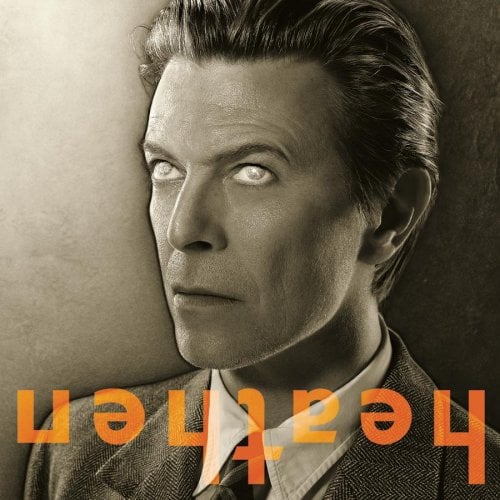
heathen


David Bowie ushered in a new millennium with a new record label and the lush electronic experimentation of this matured and assured return to form.  After parting ways with Reeves Gabrels, Bowie reconnected with Tony Visconti to co-produce 'Heathen' at Allaire Studios in Shokan, New York and Looking Glass Studios in New York City.  Visconti had produced several of Bowie's classic albums during his heyday in the seventies and the sound on 'Heathen' draws from the many styles that they had explored during that time.  'Heathen' also borrows two new songs from the 'Toy' project of reworked versions of old songs that Bowie's label refused to release. 


Bowie remembers:  "Sometime in spring of 2001, I had been told by guitarist David Torn of a new studio that was in near completion state called Allaire...It's just outside of Woodstock, remote, silent and inspirational. We couldn't believe what a find it was. The place had been originally built in the twenties as a summer home for an industrialist and his family. He had been under the spell of a certain kind of building style, all wood with nautical overtones. Being in the building felt at times like being on one of those Eisenhower era yachts or something like that. He even had that seafaring blue down. Must have ordered it especially, I imagine. The main room, which would have been the dining room in its day, was so high, oh, at least thirty, forty feet high with twenty five-foot windows. Just enormous. And the view. Well, this whole complex was situated on the top of a mountain giving fifty mile views through one hundred and eighty degrees over the Ashokan reservoir. North through the West ending at the South. Unbelievable. I just knew exactly what lyrics I was to write as I stepped into the room although I didn't yet know what the words themselves were."


The sessions included Bowie on vocals, keyboards, guitars, saxophone, stylophone, backing vocals, and drums; Visconti on bass, guitars, recorders, string arrangements, and backing vocals; Matt Chamberlain on drums, drum loop programming, and percussion; David Torn on guitars, guitar loops, and omnichord; Tony Levin on bass; Pete Townshend, Dave Grohl, and Carlos Alomar on guitar; Sterling Campbell on drums and percussion; Kristeen Young on vocals and piano; Lisa Germano on violin; Gerry Leonard on guitar;  Mark Plati on guitar and bass; Jordan Rudess on keyboards; the Borneo Horns: Lenny Pickett, Stan Harrison, and Steve Elson; and the Scorchio Quartet:  1st violin Greg Kitzis, 2nd violin Meg Okura, Martha Mooke on viola, and Mary Wooten on cello.  Mark Plati, Brian Rawling, and Gary Miller assisted with production on a couple of tracks.  'Heathen' also features three great covers:  the Pixies' 'Cactus', Neil Young's 'I've Been Waiting for You' and the Legendary Stardust Cowboy's 'I Took a Trip on a Gemini Spaceship'.  Bowie admits:  "We didn't know where we were going but it was a joy when we got there. I had a sense of the sonic weight that I was after, a sort of non-professional approach, a kind of British amateur-ness about it. And I mean amateur in that dedicated fashion you find in a man who, only on Sundays, will build a cathedral out of matchsticks, beautiful but only to please himself and his family and friends. I went in very much like that. I wanted to prove the sustaining power of music. I wanted to bring about a personal cultural restoration, using everything I knew without returning to the past. I wanted to feel the weight and depth of the years. All my experiences, all the questions, all the fear, all the spiritual isolation. Something that had little sense of time, neither past nor present. This is the way that the old men ride."


'Heathen' was the first album on his ISO subsidiary of Columbia Records and marked his fifth decade of recording.  It went to number twenty-two in New Zealand, nineteen in the Netherlands, fourteen in the US, nine in Australia, seven in Switzerland,  six in Sweden, five in the UK, four in Austria and Germany, three in France, two in Norway, and number one in Denmark.   Bowie says, "Heathenism is a state of mind. You can take it that I'm referring to one who does not see his world. He has no mental light. He destroys almost unwittingly. He cannot feel any Gods presence in his life. He is the 21st century man. However, there's no theme or concept behind 'Heathen', just a number of songs but somehow there is a thread that runs through it that is quite as strong as any of my thematic type albums." 


http://www.davidbowie.com/


'Heathen' 
full album:


All tracks written by David Bowie, and produced by Bowie and Tony Visconti, except where noted.


1. "Sunday" 4:45
2. "Cactus" (Black Francis) 2:54
3. "Slip Away" 6:05
4. "Slow Burn" 4:41
5. "Afraid"  Bowie, Mark Plati 3:28
6. "I've Been Waiting for You" (Neil Young) 3:00
7. "I Would Be Your Slave" 5:14
8. "I Took a Trip on a Gemini Spaceship" (Norman Carl Odam) 4:04
9. "5:15 The Angels Have Gone" 5:00
10. "Everyone Says 'Hi'" Brian Rawling, Gary Miller  3:59
11. "A Better Future" 4:11
12. "Heathen (The Rays)" 4:16


Monday, October 18, 2010

big audio dynamite!


when this is big audio dynamite exploded onto the music scene in october of 1985, it was "insanity bohemian style!" featuring electronic beatbox technology and extensive use of computer sampling of dialogue and music from movies like the good, bad, and the ugly and the treasure of the sierra madre; it was a groundbreaking album that set troubling political realities to a whimsical and very danceable soundtrack. jokey references to "germ war III", "robots run amok on the factory floor", "trouble in the homelands", and all of "the things that drive [us] crazy" are set to a shiny modern groove like "cheap thrills wrapped up in bubblegum." there's also a great use of joe strummer's scream from 'london calling'.

after his dismissal from the clash, mick jones played guitar briefly with general public before moving on to a new project: top risk action company, which was a short-lived forerunner to big audio dynamite. bassist leo "e-zee-kill" williams was the only member of of t.r.a.c. that continued with jones. they teamed up with director and musician don letts (who co-wrote all but one of the songs), who filmed a documentaries about punk rock and the clash and is credited with bringing reggae and punk music together; along with keyboardist dan donovan and drummer greg roberts to fill out the exciting sound.


medicine show
"it was really foul weather when we got tarred and feathered"


e=mc² was inspired by various films by director nicolas roeg. "didn't know that you could get so much from a picture show."

"ritual - ideas - relativity
only buildings - no people - prophecy
time slide - place to hide - nudge reality
foresight - minds wide - magic imagery"


the bottom line
"a dance to the tune of economic decline"


this is big audio dynamite

full album:


All songs written by Mick Jones and Don Letts; except as indicated.


Side one

1. "Medicine Show"   6:29
2. "Sony"   4:30
3. "E=MC²"   5:54
4. "The Bottom Line" (Mick Jones) 4:35
Side two
5. "A Party"   6:40
6. "Sudden Impact!"   5:03
7. "Stone Thames"   4:05
8. "BAD"   5:54