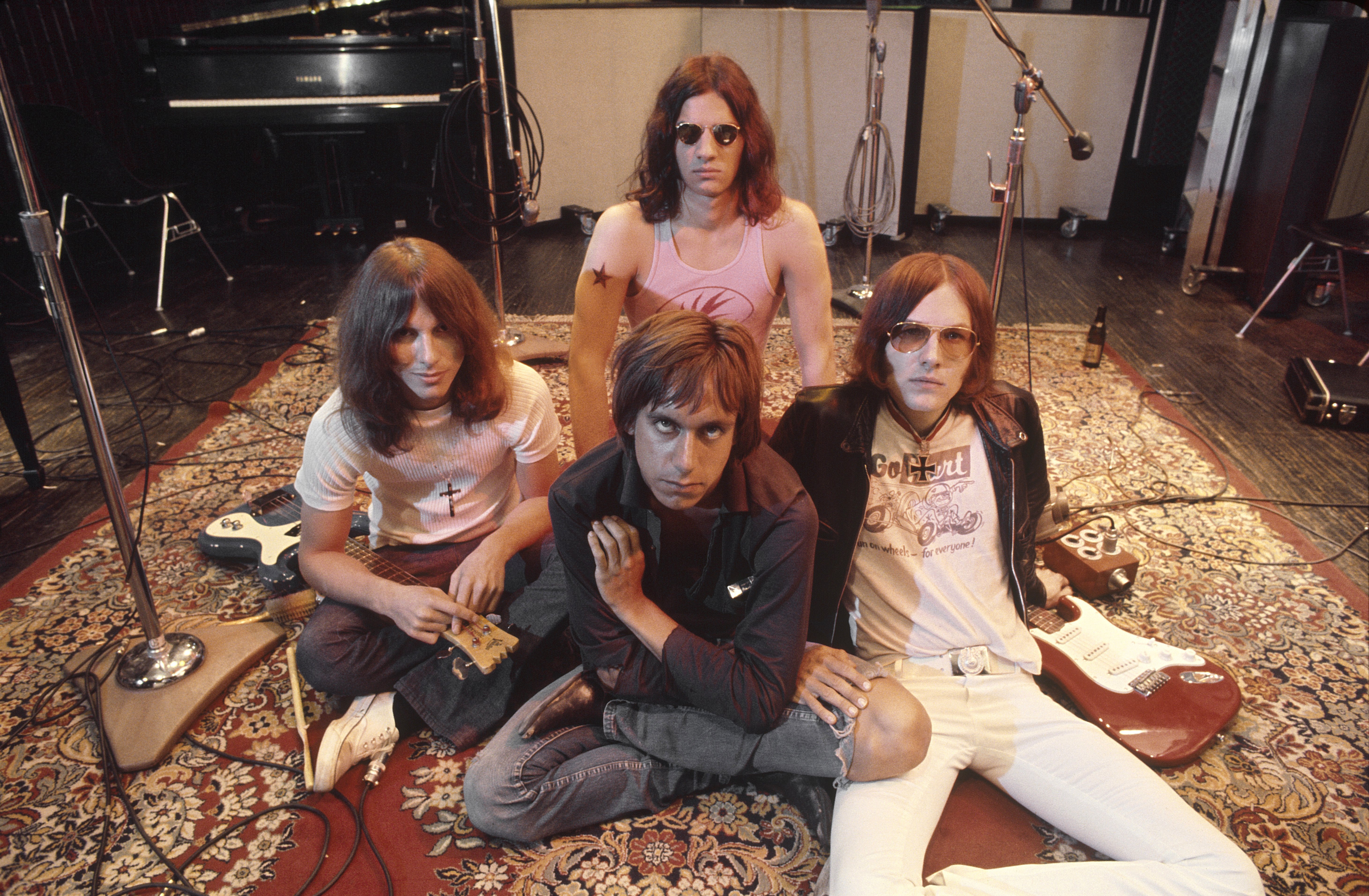
The Stooges came to play live and loose in the studio with a real low mind on this primitive punk freak out. The Detroit band had defied expectations with their audacious live shows with lead singer Iggy Stooge (James Newell Osterberg aka Iggy Pop) gyratic outrageously and diving off of the stage into the audience. Guitarist Ron Asheton says: "I empathize with [Iggy] only in the sense that he had set a precedent with his stage antics, and he had to come up with stuff all the time. I didn't know, he actually told me that he took acid for every show for a year. And I went "What?" I was so used to him, I didn't even know he was on acid. His eyes always looked like he was crazy. He just smoked a bunch of pot...He had to come up with stuff, and it did start to drain him, mentally and physically, and he found the heroin probably to be relaxing in the beginning, but then it was like oh, man...When we did ['Fun House'], we still liked each other, we were still a band, all that was smoked was hashish or marijuana, that was the only drugs. No one was taking...at least I wasn't, or Dave or Scotty; Iggy was taking acid. In other words, it was just back to the so-called soft drugs."
Although their eponymous debut had only charted at number one hundred and six on the US album chart, the band got the green light to record another album. 'Fun House' was recorded during two weeks in May of 1970 at Elektra Sound Recorders, Los Angeles. The sessions featured Iggy Pop on vocals, Ron Asheton on guitar, Dave Alexander on bass guitar, Scott Asheton on drums, and Steve Mackay on saxophone. Don Gallucci, who at the age of fourteen had played keyboards on the Kingsmen's classic "Louie Louie" , was brought in to produce and even played organ. Gallucci remembers: "Iggy was using the mic just like he did onstage, and you're going to get distortion that way. We used limiters, but there is only so much they can do! We didn't think it hurt for this record to have distorted vocals. No one wanted to wear headphones, except for Ron Asheton...We all knew it was awful. However, there was no subsequent big discussion about a different recording technique. Iggy was clearly frustrated. He wanted to have close contact with his guitarist. He wanted to be able to lean over into Ron's amp and hear the guitar jump out at him. I knew nothing could sound worse than what we had, so we got rid of the baffles, set the band up just as they would be onstage and brought in the P.A. speakers [and split the singer's mic feed between the P.A. amplifier and the recording console]...That way Iggy could be comfortable and have the live sound experience he was used to, and he didn't need headphones. We absolutely wanted everything to bleed. That gave us the much-needed natural sound quality and the familiar aural environment the band wanted. I think some of the best recordings-at least in terms of fatness, texture and warmth-were made with one microphone at the back of a bar, so I thought it was at least worth a try ... Everything in music had gotten so fey. At around the same time as Fun House , I went to this big Columbia Records dinner, and the main event was Simon & Garfunkel performing 'Bridge Over Troubled Water.' That's a beautiful song, but to The Stooges, taking rock and pop and making it so acceptable and refined was sacrilegious. Their whole thing was to go Zen, to cut the music right back to its essence ."
Ron Asheton reveals: "Gallucci had a very cool concept. He wanted to find another aural direction for The Stooges, to capture a total live feeling, one where the sounds would encompass themselves like onstage. And that's the beauty of that record, because it was as close to our live sound as could be captured in a studio ... They picked him, and we didn't even know that he was coming to a lot of shows in the beginning, and seeing us play, and then we kinda met him, and knew he was gonna be there, and "He's gonna be your producer," and we're like, "Hunh?... He was a short guy, he was always impeccably dressed in a really nice suit, and I'm going, "How is this guy, who's dressed in this really nice suit, gonna relate to the Stooges?" But he did an excellent job. He wanted to capture the show. I think he only changed the order of the set; he switched two songs, I can't even remember. What was even more amazing is when we first met him and we met the engineer, Ross Meyer -- he was pretty quiet, probably in his 50s at the time -- and I thought "Oh boy, we're in trouble." Little did we know we had very competent people in the control room. He finally started talking a little bit, and he goes, "Yeah, this stuffs all right. It's a big change from Barbara Streisand. " Hunh? He just got done doing Barbara Streisand's record. From Barbara Streisand to the Stooges... Whaat? It turned out they did a fantastic job. And we had a great time, and we'd just come off the road, so our chops were...man, we were there. I mean, it was literally off the road, a week to get our house in order so we could go to L.A. for a month. So we were ready to go, and that's why that record was as smooth and good as it was. We did minimal takes; I don't think we did more than five takes, or four takes, and a lot of times we'd take the first one or the second one. It went really well...Well, basically by then, everybody had learned to play and had a little bit more of a handle on what to do. The first record was a big pain, because all we knew was stack of Marshalls on ten. And that was the big fight. "You can't play a double stack of Marshall amps on ten in this little studio." I'm going, "Yeah, but man, that's the sound." So there'd be big fights...I think the compromise was I went down to like nine. But still, they overcompensated, taking a lot of the edge off. And I used the Flying V for half the tunes, every song but three. But by the Fun House record, I went down to a Marshall 50, which could be on nine, ten...just a smaller cabinet, what I call "the refrigerator top;" I think it had six tens in it. And Dave just used a hundred watt with one speaker. So yeah, it was a bigger studio and it was a lot more fun. And we were treated like not stupid kids, but actually "professional musicians," which was like Hunh? I mean, that was only the second time I'd ever been in a recording studio. But by then, being that we'd been on the road so long, we really progressed. We learned an awful lot in a short amount of time. You can see the progression of our playing from the first record to the second record. Gee, that was like a year. We just played so much, everyone's abilities just increased unbelievably. I never thought of it until just recently..."On the job training." That's how the Stooges learned everything..."on the job."...That whole Funhouse album was our set. Gallucci wanted to capture our set the best he could on record. He did a good job. We were playing all those tunes at the time we recorded them, but we didn't have to be in the studio and go, "Oh, we need some more songs." It was already all there."
'Fun House' didn't even chart in the US, and despite going on to become cited as a major influence on the punk movement that came years later, the album has still only sold less than a hundred thousand copies. Iggy considers: " I have a suspicion that the design of some of the songs was ahead a few years. I've always hated that phrase "it was ahead of its time", but it was. Some of the albums, like Fun House , but certain parts of each of the three... Some of the lyrics have allowed the songs to stick around, but then again some of the terms and phrases were a little out there when we were coming up with them. But right now, it fits. The music itself in all its aspects may have become...it may have found a utility for younger musicians that it didn't have when we started. In other words, I know when I was first starting John Lee Hooker was incredibly useful to me...In 1965, when great young white artists in the English-speaking world were successfully re-channeling hillbilly and black music-- you know Bob Dylan, Ray Davies, Pete Townsend, Keith Richards-- they didn't get any money at first. They were all broke. All those giant people had to stay around quite a while to cash in because the industry ripped them off more efficiently ." www.iggyandthestoogesmusic.com "TV Eye"
live in Cincinnati
June 13, 1970
https://www.youtube.com/watch?v=XR2rl_OVcl4 VIDEO "Funhouse Freak" (aka LA Blues) first take
Iggy says: "We used to call that song "Freak Out", and when we recorded Funhouse, because we were in L.A., I gave it the title "L.A. Blues". On the very end of that record, you'll hear me repeat that lyric a little different. I think I say the phrase "I am", and then the last sound on that record is the word "you" and for some reason I enjoy doing it live. The one thing it means to me, maybe, is that I'm still that person in the audience. Maybe that's what I'm trying to say there, because for some reason I'm still…I get outraged when I see some fat bottom creep…I can't explain it. It's as near to a religion as I ever got, this thing, and I really don't like getting any more than casual about it, but I do have certain deep feeling about it that do come out time to time."
https://www.youtube.com/watch?v=p1aS_3tjSog VIDEO 'Fun House' full album:
VIDEO All songs written and composed by The Stooges.
Side one
1. "Down on the Street" 3:42
2. "Loose" 3:33
3. "T.V. Eye" 4:17
4. "Dirt" 7:00
Side two
5. "1970" (aka "I Feel Alright") 5:14
6. "Fun House" 7:45
7. "L.A. Blues" 4:52
outtakes
Lost In The Future – 5:42 Slide [Slidin' The Blues] – 4:35 VIDEO
Iggy and the Stooges prefigured punk with the savage swaggering subversive sonic boredom blues of their dark and dangerous debut. James Newell Osterberg had played in various bands around Ann Arbor, Michigan, getting his nickname 'Iggy' after a stint in the Iguanas. He was inspired to create a new kind of blues music after a visit to Chicago. He hooked up with brothers Ron and Scott Asheton and their friend Dave Alexander, who gave Iggy his pseudonymous surname 'Pop'.
Osterberg reveals: "I had some basic ideas. One idea was when I woke up - like Steve Martin does in The Jerk
'The Stooges' was produced by John Cale for Elektra Records and featured Iggy Pop ("Iggy Stooge") on vocals; Dave Alexander on bass guitar; Ron Asheton on guitar and vocals; and Scott Asheton on drums; with John Cale adding piano, sleigh bell on "I Wanna Be Your Dog", and viola on "We Will Fall". The story goes that Cale tried to convince the band to use smaller amps than their Marshall stacks; but the group sat down in the middle of the studio and smoked hash until Cale finally acquiesced. Even so, the initial mix of the album was deemed unsatisfactory by the band and was ultimately remixed by Elektra founder Jac Holzman and Iggy Pop. That was after the band was told they needed to record more material than the five songs that were part of their standard live set: "We handed [it] in and they refused it. They said, 'There aren't enough songs!' So we lied and said, 'That's OK, we've got lots more songs.'"
'The Stooges' made it to number one hundred and six on the Billboard album chart. The sheets of feedback and the primative proto-punk sound were too much for critics and fans alike. Osterburg reflects: "It was just a completely different world than any of the people in Detroit or in the universe at that time. It sold enough for me. It never bothered me. Everybody is so wrong about these concepts, and I can tell you that in fact the entire capitalist system has over-emphasised money to the point where we’re now on the verge of the same sort of collapse that happened in the Soviet Union a few years ago. It led to the Balkanisation of their country, because they made themselves vulnerable too. It’s become a one-horse system. You can’t run the fuckin’ world as a goddamn business. Fuck! And honestly, as a kid, that wasn’t the dream. That wasn’t the dream. Maybe for some of the other guys - I never talked to anybody about this, including the guys in the band - but my dream was just to do something really good and really cool. I didn’t think I’d heard music that sold millions - the really good music that sold millions was by people much more accomplished than us, so I knew we weren’t gonna sell like that. And the bad stuff that sold millions, I thought, ‘I don’t care about that, because if we make an album and we’re better and we just sell a few, I would rather be the guy to do something better selling a few than be the fuckin’ schmidiot idiot selling a bunch of shit.’ And I knew that there was no future for these people either. And, by the way, when people say that the group sells or an artists sells an album, this is a misnomer. A company sells them. A company generally owns the master, the company owns the right to manipulate the accounts and will cheat and steal from the artists. The artist gets zilch. The artist also has to fend off divorce settlements, girlfriends, drug dealers, managers, lawyers, agents - a whole panoply of crooks. I always thought, when we put out our first thing, there must be about fifty thousand people in America who would be interested in this. I thought that was pretty good. And we sold thirty-five thousand. That’s what I was told. Of course, that could have been a lie too - the whole industry’s corrupt. I thought that was pretty good. And by the second album, I was so into it I didn’t even really care! (Laughs) Or pay attention. But I knew we weren’t the fuckin’ Ronnettes. They could sing better than what I could, but I thought we sounded pretty cool. (Laughs) That was all I really wanted. I listen to it now and it’s better than I realised. It took a while. It may be that kind of music."
www.iggyandthestoogesmusic.com http://www.iggypop.com/ I Wanna be your Dog
https://www.youtube.com/watch?v=vwmU343eBu0 No Fun
https://www.youtube.com/watch?v=CVyqsRfUZ60 'The Stooges'
full album:
http://www.youtube.com/watch?v=vH6iDPhUjWs 1_ 1969 [00:00]
2_ I Wanna be your Dog [04:03]
3_ We Will Fall [07:10]
4_ No Fun [17.30]
5_ Real Cool Time [22:48]
6_ Ann [25:20]
7_ Not Right [28:20]
8_ Little Doll [31:10]
bonus track:
"Asthma Attack" 06:26
https://www.youtube.com/watch?v=7cfH93B9ono
The Stooges broke up and reformed as Iggy and the Stooges for the ironically muted menace of this potent proto-punk postlude. After the triumphant failure (critically lauded but never charted) of 'Fun House' the band had dissolved in a haze of heroin. Iggy Pop met David Bowie who brokered him a deal with Colombia Records through MainMan management. Pop had brought guitarist James Williamson from the last incarnation of the Stooges to take part in the sessions; and, after having trouble finding a rhythm section there, they invited the Asheton brothers to reform the band with Ron moving from guitar to bass. 'Raw Power'
Iggy remembers: " The way that the ‘Raw Power’ ‘Fun House’ Everything from what Marc Bolan was doing then, to the ‘Exile On Main Street’ ‘Raw Power’
Tony DeFries told Pop that the mix had to be redone or the label would not release it; so Bowie was tapped to do the new mix in one day at Western Sound Recorders. Pop reveals: "On a very, very old board, I mean this board was old! An Elvis type of board, old-tech, low-tech, in a poorly lit, cheap old studio with very little time. To David's credit, he listened with his ear to each thing and talked it out with me, I gave him what I thought it should have, he put that in its perspective, added some touches. He's always liked the most recent technology, so there was something called a Time Cube you could feed a signal into -- it looked like a bong, a big plastic tube with a couple of bends in it -- and when the sound came out the other end, it sort of shot at you like an echo effect. He used that on the guitar in 'Gimme Danger', a beautiful guitar echo overload that's absolutely beautiful; and on the drums in 'Your Pretty Face Is Going To Hell'. His concept was, 'You're so primitive, your drummer should sound like he's beating a log!' It's not a bad job that he did...I'm very proud of the eccentric, odd little record that came out."
Bowie considers: "The most absurd situation I encountered when I was recording was the first time I worked with Iggy Pop. He wanted me to mix 'Raw Power' 'Raw Power' http://iggypop.com/ 'Raw Power' full album:
VIDEO
All tracks written by Iggy Pop and James Williamson.
Side one
1. "Search and Destroy" 3:29
2. "Gimme Danger" 3:33
3. "Your Pretty Face Is Going to Hell" (originally titled "Hard to Beat") 4:54 4. "Penetration" 3:41
Side two
5. "Raw Power" 4:16
6. "I Need Somebody" 4:53
7. "Shake Appeal" 3:04
8. "Death Trip" 6:07