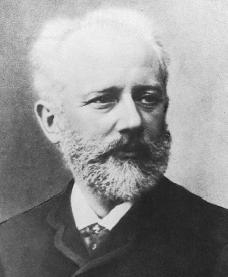
Nikolai Andreievich Rimsky-Korsakoff (March 18, 1844 - June 21, 1908) This Russian Romantic composer worked to bring elements of folksongs and folklore into classical music to create a new Nationalistic form. Born to aristocratic parents, Nikolai showed natural talent for music; but was more interested in books. At the age of twelve his father sent him to the the Sea Cadet Corps (Naval College) where his musical skills flourished as he became influenced by different teachers, most notably Mily Balakirev, the leader of a movement to create a new Russian form of music that was distinct from European traditional classical forms. Rimsky-Korsakoff became a part of a group called The Five, also known as The Mighty Handful, The Balakirev Circle, and The New Russian School; which included Balakirev, César Cui, Modest Mussorgsky, and Alexander Borodin. After his graduation in 1862, Nikolai became a navel officer and travelled the world on a three year cruise. During that time he completed his First Symphony. He continued to develop his own sound, incorporating Eastern fairytales and themes. The popularity of his works led to a position as professor of harmony and orchestration at the St. Petersburg Conservatory. During this time he began studying Western methods and incorporated them into his own art. His support of the students during revolts during the Revolution of 1905-1907 led to the end of his professorship and his works being banned by the police. The outcry from students and professors was so great that he was reinstated months later. Due to his influence on his many students, he is considered to be the primary architect of the Russian school of composition. He died from complications of his angina pectoris that had worsened during the Revolution. "Flight of the Bumblebee" is his most famous piece. It is an orchestral interlude from his opera 'The Tale of Tsar Saltan' during which the magic Swan-Bird changes the Tsar's son Prince Gvidon Saltanovich into an insect so that he can fly away to visit his father. http://www.youtube.com/watch?v=aYAJopwEYv8
Russian Easter Festival Overture: Overture on Liturgical Themes, Op. 36 was dedicated to the memories of Modest Mussorgsky and Alexander Borodin. http://www.youtube.com/watch?v=7FHFJ0lU9Us
Sergei Vasilievich Rachmaninoff (1 April 1873 – 28 March 1943)
This Russian composer, pianist, and conductor is considered one of the last romantic composers, who revived the form in the modern era. Born to a wealthy aristocratic family, his natural abilities with the piano were revealed when he was five years old. His grandfather arranged for lessons which lasted for a few years until his father was forced to sell their home because he had wasted the family fortune through drinking and gambling. The family moved to a small apartment in Saint Petersburg, where his sister died from diphtheria. He began studying at the Saint Petersburg Conservatory and then transferred to the Moscow Conservatory where he distinguished himself as a composer and pianist.
After the Russian Revolution, he escaped with his family in an open sled to Finland. He then emigrated to the United States where he signed a contract with the Victor Talking Machine Company. They set up a house where they entertained guests in the style of the old Russian aristocracy. He performed so many concerts that he had little time to compose. It wasn't until he built a new home in Switzerland that his muse returned. He fell ill during a concert in the US and died of melanoma in Beverly Hills, California, just four days before his 70th birthday.
Rachmaninoff would reveal: "I have never been able to make up my mind as to what was my true calling -- that of composer, pianist, or conductor . . . I am constantly troubled by the misgiving that, in venturing into too many fields, I may have failed to make the best use of my life." http://www.rachmaninoff.org/
The Philharmonic Society of London invited Rachmaninoff to conduct one of his pieces at Queen's Hall; but, rather than do his First Symphony, he decided to compose a new piece. His writer's block led him to psychologist Nikolai Dahl, who used hypnosis to help him overcome his block. The result was his most famous work, Piano Concerto No. 2, which he dedicated to Dahl.
Piano Concerto No. 3
Rhapsody on a theme of Paganini
Trio Elegiaque No. 1 in g minor was written in memory of the recently departed Tchaikovsky
Aleko was a one-act opera based on the poem The Gypsies byAlexander Pushkin, It was his final composition for the Conservatory of Moscow and earned him the Great Gold Medal.
The first performance of Symphony No. 1 in D minor, Op.13 was so terrible that Rachmaninoff stopped composing for three years. Conductor Alexander Glazunov is rumored to have been drunk during the performance.