Ornette Coleman found an emotional ethos in the ramblin' abandon of this impressionist ensemble improvisation. After recording two albums of unconventional jazz for Contemporary Records (Something Else !!!! Tomorrow Is the Question! The Shape of Jazz to Come 'Change of the Century' features the same cast of characters as The Shape of Jazz to Come www.biography.com/ornette-coleman 'Change of the Century' full album:
https://www.youtube.com/playlist?list=PL26E7604B1A8FC8F0 VIDEO All compositions by Ornette Coleman
Side one
1. "Ramblin'" 6:39 2. "Free" 6:24 3. "The Face of the Bass" 6:59 Side two
1. "Forerunner" 5:16 2. "Bird Food" 5:31 3. "Una Muy Bonita" 6:02 4. "Change of the Century" 4:41 outtakes:
"Music Always" "The Circle with the Hole in the Middle" liner notes:
Some musicians say, if what I’m doing is right, they should never have gone to school. I say, there is no single right way to play jazz. Some of the comments made about my music make me realize though that modern jazz, once so daring and revolutionary, has become, in many respects, a rather settled and conventional thing. The members of my group and I are now attempting a break-through to a new, freer conception of jazz, one that departs from all that is “standard” and cliché in “modern” jazz. Perhaps the most important new element in our music is our conception of free group improvisation. The idea of group improvisation, in itself, is not at all new; it played a big role in New Orleans’ early bands. The big bands of the swing period changed all that. Today, still, the individual is either swallowed up in a group situation, or else he is out front soloing, with none of the other horns doing anything but calmly awaiting their turn for their solos. Even in some of the trios and quartets, which permit quite a bit of group improvisation, the final effect is one that is imposed beforehand by the arranger. One knows pretty much what to expect. When our group plays, before we start out to play, we do not have any idea what the end result will be. Each player is free to contribute what he feels in the music at any given moment. We do not begin with a preconceived notion as to what kind of effect we will achieve. When we record, sometimes I can hardly believe that what I hear when the tape is played back to me, is the playing of my group. I am so busy and absorbed when I play that I am not aware of what I’m doing at the time I’m doing it. I don’t tell the members of my group what to do. I want them to play what they hear in the piece for themselves. I let everyone express himself just as he wants to. The musicians have complete freedom, and so, of course, our final results depend entirely on the musicianship, emotional make-up and taste of the individual member. Ours is at all times a group effort and it is only because we have the rapport we do that our music takes on the shape that it does. A strong personality with a star-complex would take away from the effectiveness of our group, no matter how brilliantly he played. With my music, as is the case with some of my friends who are painters, I often have people come to me and say, “I like it but I don’t understand it.” Many people apparently don’t trust their reactions to art or to music unless there is a verbal explanation for it. In music, the only thing that matters is whether you feel it or not. You can’t intellectualize music; to reduce it analytically often is to reduce it to nothing very important. It is only in terms of emotional response that I can judge whether what we are doing is successful or not. If you are touched in some way, then you are in with me. I love to play for people, and how they react affects my playing. A question often asked of me is why I play a plastic alto. I bought it originally because I needed a new horn badly, and I felt I could not afford a new brass instrument. The plastic horn is less expensive, and I said to myself, “Better a new horn than one that leaks.” After living with the plastic horn, I felt it begin to take on my emotion. The tone is breathier than the brass instrument, but I came to like the sound, and I found the flow of music to be more compact. I don’t intend ever to buy another brass horn. On this plastic horn I feel as if I am continually creating my own sound. Now to the music. They are all originals. Each is quite different from the other, but in a certain sense there really is no start or finish to any of my compositions. There is a continuity of expression, certain continually evolving strands of thought that link all my compositions together. Maybe it’s something like the paintings of Jackson Pollock. RAMBLIN’ is basically a blues, but it has a modern, more independent melodic line than older blues have, of course. I do not feel so confined to the blues form as do so many other jazz musicians. Blues are definite emotional statements. Some emotional statements can only be told as blues. FREE is well-explained by the title. Our free group improvising is well demonstrated here. Each member goes his own way and still adds tellingly to the group endeavor. There was no predetermined chordal or time pattern. I think we got a spontaneous, free-wheeling thing going here. FACE OF THE BASS begins as a vehicle for our bassist. Charlie Haden is from Missouri and he has a lot of heart. It is unusual to come across someone as young as he is and find that he has such a complete grasp of the “modern” bass: melodically independent and non-chordal. FORERUNNER shows the interchangeability and flexibility of the component parts of the group. I like the way the melody here often runs through the rhythm instruments, with the melody instruments – the horns – providing rhythm accents (the traditional function of drums and bass). BIRD FOOD has echoes of the style of Charlie Parker. Bird would have understood us. He would have approved our aspiring to something beyond what we inherited. Oddly enough, the idolization of Bird, people wanting to play just like him, and not make their own soul-search, has finally come to be an impediment to progress in jazz. UNA MUY BONITA, in Spanish, means “a very pretty girl.” I had no one in particular in mind. It is perhaps a little lighter in mood than some of our other pieces. It has a relaxed feeling and a more settled rhythm – and yes, I suppose, a “prettier” melody. CHANGE OF THE CENTURY expresses our feeling that we have to make breaks with a lot of jazz’s recent past, just as the boppers did with swing and traditional jazz. We want to incorporate more musical materials and theoretical ideas – from the classical world, as well as jazz and folk – into our work to create a broader base for the new music we are creating. Every member of the group made an important and distinctly personal contribution to this album, which I think is the best we have made so far. ORNETTE COLEMAN (as told to Gary Kramer)
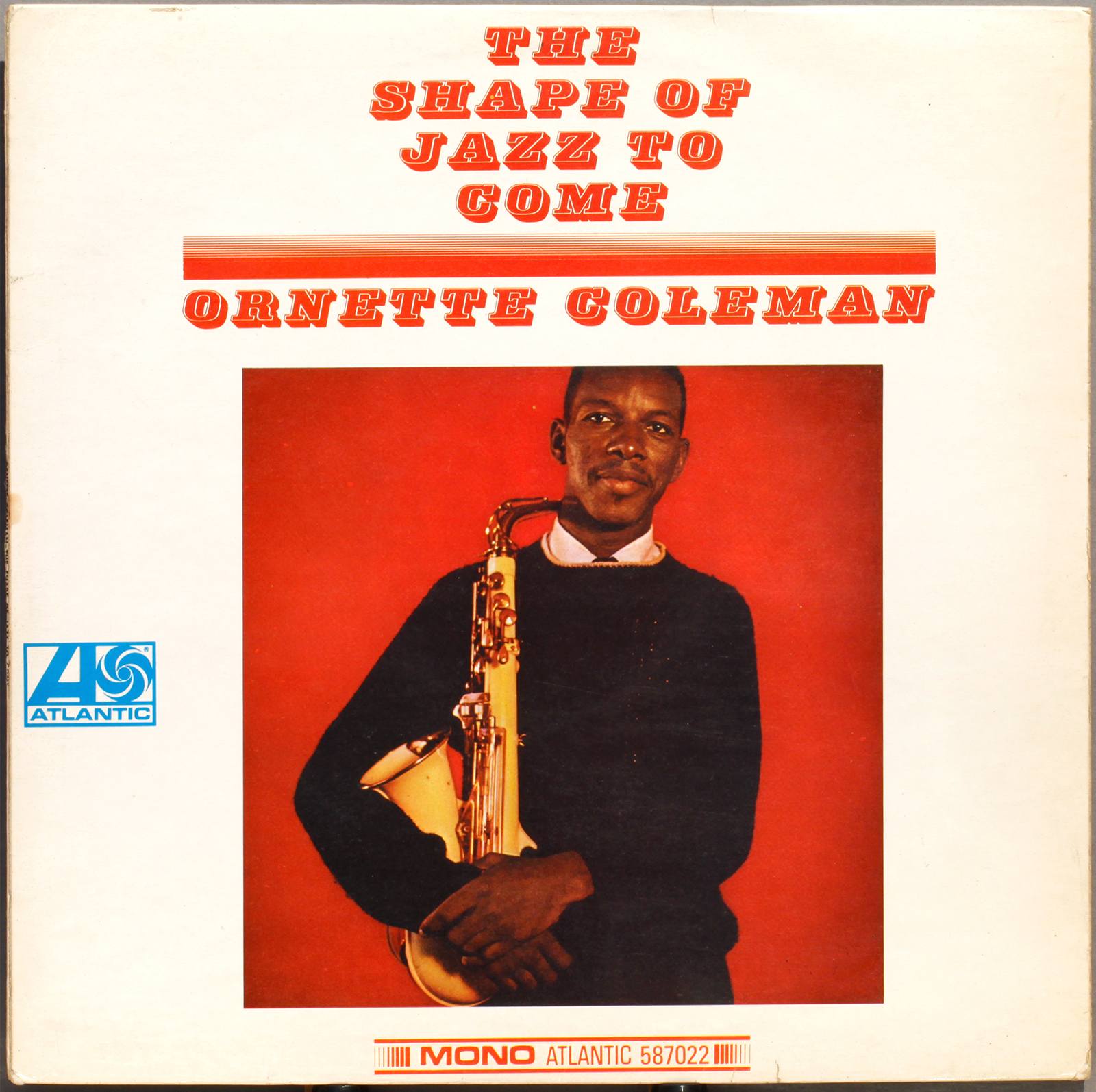
Ornette Coleman established the avante-garde in jazz with the unconventional improvisation and atonal acrobatics of this controversial free jazz milestone. Coleman had challenged listeners with his first two albums ('Something Else!!!!' 'Tomorrow Is the Question!' ) on Contemporary Records; but for his third release he took things even further. With his second album, he did away with the pianist, a standard in jazz. For 'The Shape of Jazz to Come' , he did away with chord structure, utilizing a brief theme before launching into uncharted territory. The album was his first after signing a deal with Atlantic Records, which John Lewis from the Modern Jazz Quartet helped him secure. Coleman looks back: "Before becoming known as a musician, when I worked in a big department store, one day, during my lunch break, I came across a gallery where someone had painted a very rich white woman who had absolutely everything that you could desire in life, and she had the most solitary expression in the world. I had never been confronted with such solitude, and when I got back home, I wrote a piece that I called "Lonely Woman."
'The Shape of Jazz to Come' was recorded in Los Angeles at Radio Records, Inc with producer Nesuhi Ertegun and features the quartet of Ornette Coleman on alto saxophone; Don Cherry on cornet; Charlie Haden on bass; and Billy Higgins on drums.
Coleman considers: "The idea is that two or three people can have a conversation with sounds, without trying to dominate or lead it. What I mean is that you have to be… intelligent, I suppose that’s the word. In improvised music I think the musicians are trying to reassemble an emotional or intellectual puzzle in which the instruments give the tone. It’s primarily the piano that has served at all times as the framework in music, but it’s no longer indispensable and, in fact, the commercial aspect of music is very uncertain. Commercial music is not necessarily more accessible, but it is limited...For me, being an innovator doesn't mean being more intelligent, more rich, it's not a word, it's an action. Since it hasn't been done, there's no use talking about it...It interests me more to have a human relationship with you than a musical relationship. I want to see if I can express myself in worlds, in sound that have to do with a human relationship. At the same time, I would like to be able to speak of teh relationship between two talents, between two doings. For me, the human relationship is mush more beautiful, because it allows you to gain the freedom that you desire, for youself and for the other."
http://www.ornettecoleman.com/ 'The Shape of Jazz to Come' full album:
VIDEO All compositions by Ornette Coleman.
Side one
1. "Lonely Woman" 4:59
2. "Eventually" 4:20
3. "Peace" 9:04
Side two
1. "Focus on Sanity" 6:50
2. "Congeniality" 6:41
3. "Chronology" 6:05
outtakes:
"Monk and the Nun"
https://www.youtube.com/watch?v=8VOITCYjqoE "Just for You"
https://www.youtube.com/watch?v=h2n6e0FMWUE
Ornette Coleman found expression for his unorthodox tonal style with this radical blues bebop. His improvisation rubbed people the wrong way from the start, getting him kicked out of his high school band; and later, after a show in Baton Rouge, he was physically beaten and his tenor saxophone was destroyed. He switched to alto saxophone and moved to Los Angeles where he ended up working as an elevator operator at a department store while pursuing his music. With his penchant for stretching notes as far as they would go, many of his contemporaries considered his playing to be out of tune. He brought some of his compositions to Lester Koenig of Contemporary Records; but the tunes were too much for other musicians and Coleman was invited to record them himself. 'Something Else !!!!' was produced by Koenig with Don Cherry on trumpet, Walter Norris on piano, Don Payne on double bass, Billy Higgins on drums, and Ornette Coleman on his white plastic alto saxophone.
Coleman would later reflect on the evolution his musical perspective: "The idea is that two or three people can have a conversation with sounds, without trying to dominate it or lead it. What I mean is that you have to be...intelligent, I suppose that's the word. In improvised music I think the musicians are trying to reassemble an emotional or intellectual puzzle, in any case a puzzle in which the instruments give the tone. It's primarily the piano that has served at all times as the framework in music, but it's no longer indispensable and, in fact, the commercial aspect of music is very uncertain. Commercial music is not necessarily more accessible, but it is limited...Let's suppose that we're in the process of playing and you hear something that you think could be improved; you could tell me, 'You should try this.' For me, music has no leader...I don't know if it's true for language, but in jazz you can take a very old piece and do another version of it. What's exciting is the memory that you bring to the present. What you're talking about, the form that metamorphoses into other forms, I think it's something healthy, but very rare...Repetition is as natural as the fact that the earth rotates...I was in the South when minorities were oppressed, and I identified with them through music. I was in Texas, I started to play the saxophone and make a living for my family by playing on the radio. One day, I walked into a place that was full of gambling and prostitution, people arguing, and I saw a woman get stabbed—then I thought that I had to get out of there. I told my mother that I didn't want to play this music anymore because I thought that I was only adding to all that suffering. She replied, 'What's got hold of you, you want somebody to pay you for your soul?' I hadn't thought of that, and when she told me that, it was like I had been re-baptized...She was an intelligent woman. Ever since that day I've tried to find a way to avoid feeling guilty for doing something that other people don't do...Bebop had emerged and I saw it as a way out. It's an instrumental music that isn't connected to a certain scene, that can exist in a more normal setting. Wherever I was playing the blues, there were plenty of people without jobs who did nothing but gamble their money. Then I took up bebop, which was happening above all in New York, and I told myself that I had to go there. I was just about 17 years old, I left home and headed for the South...I had long hair like the Beatles, this was at the beginning of the Fifties. So I headed for the South, and just like the police, black people beat me up on top of everything, they didn't like me, I had too bizarre a look for them. They punched me in the face and demolished my sax. That was hard. Plus, I was with a group that played what we called 'minstrel pipe-music', and I tried to do bebop, I was making progress and I got myself hired. I was in New Orleans, I was going to see a very religious family and I started to play in a 'sanctified' church—when I was little, I played in church all the time. Ever since my mother said those words to me, I was looking for a music that I could play without feeling guilty for doing something. To this day I haven't yet found it...When I arrived in New York, I was more or less treated like someone from the South who didn't know music, who couldn't read or write, but I never tried to protest that. Then I decided that I was going to try to develop my own conception, without anybody's help. I rented the Town Hall on 21 December 1962, that cost me $600, I hired a rhythm and blues group, a classical group and a trio. The evening of the concert there was a snowstorm, a newspaper strike, a doctors' strike and a subway strike, and the only people who came were those who had to leave their hotel and come to the city hall. I had asked someone to record my concert and he committed suicide, but someone else recorded it, founded his record company with it, and I never saw him again. All that made me understand once again that I had done that for the same reason that I had told my mother that I didn't want to play down there anymore. Obviously, the state of things from the technological, financial, social and criminal point of view was much worse than when I was in the South. I was knocking on doors that stayed closed...Before becoming known as a musician, when I worked in a big department store, one day, during my lunch break, I came across a gallery where someone had painted a very rich white woman who had absolutely everything that you could desire in life, and she had the most solitary expression in the world. I had never been confronted with such solitude, and when I got back home, I wrote a piece that I called 'Lonely Woman'...It interests me more to have a human relationship with you than a musical relationship. I want to see if I can express myself in words, in sounds that have to do with a human relationship. At the same time, I would like to be able to speak of the relationship between two talents, between two doings. For me, the human relationship is much more beautiful, because it allows you to gain the freedom that you desire, for yourself and for the other ... In music you have something called sound, you have speed, you have timbre, you have harmonics, and you have, more or less, the resolutions. In most music, people that play what I call mostly standard music, they only use one dimension, which means the note and the time. Whereas like say I'm having this conversation with you now. I'm talking, but I'm thinking, feeling, smelling, and moving. Yet I'm concentrating on what you're saying. So that means there's more things going on in the body than just the present thing that the person's got you doing. Like you're interviewing me, although I'm doing more than just talking to you. And the same with you. To me, human existence exists on a multiple level, not just on a two-dimensional level, not just having to be identified with what you do and what you say. Those things are the results of what people see and hear that you do. But the human beings themselves are living on a multiple level. That's how I have always wanted musicians to play with me: on a multiple level. I don't want them to follow me. I want them to follow themself, but to be with me." https://myspace.com/ornettecoleman myspace.com/ornettecolemanfreejazz 'Something Else !!!!' full album:
VIDEO All tracks composed by Ornette Coleman.
"Invisible" – 4:11
"The Blessing" – 4:45
"Jayne" – 7:17
"Chippie" – 5:37
"The Disguise" – 2:46
"Angel Voice" – 4:19
"Alpha" – 4:09
"When Will the Blues Leave?" – 4:58
"The Sphinx" – 4:13
VIDEO
Ornette Coleman recorded an album length collective jazz improvisation that gave Free Jazz its name. They embraced the aesthetic of Jackson Pollack, whose painting is featured on the album sleeve; and the loose structure allows the solos to dance and interweave like the colors on the canvas. It may not have been the first or the free-ist; this set was revolutionary at the time. The double quartets (one in each stereo channel) play simultaneously and rather harmoniously considering how crazy Free Jazz would get. This was not so much an avant-garde experiment as it was an attempt to return to the primitive experience of pure invention.
full album: https://www.youtube.com/watch?v=xbZIiom9rDA VIDEO